RESEARCH FOCUS Pause dot animation Stakeholder Capital Governance Relationships Contribution Capital Governance
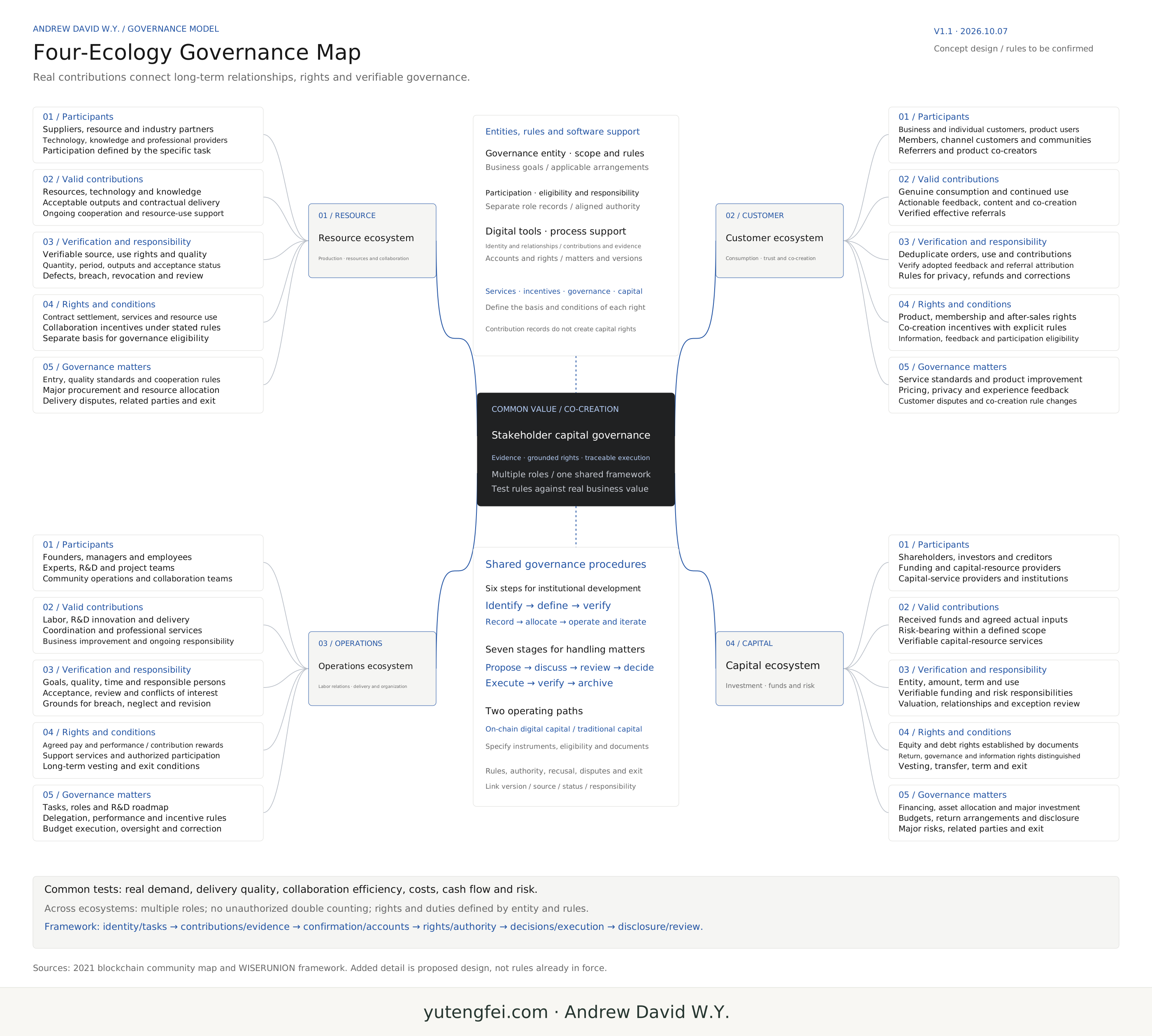
Resources & know-how People & delivery Customers & needs Funding & risk Co-creation Lasting capabilities Rules & review Who creates value together? Resources, people, customers and capital work together in business activity.
Participants Collaboration Co-creation Where do the inputs come from? Identify each party’s inputs and actual role. Use records to distinguish the source, scope and results of contributions.
Inputs Contribution records Sources of value What can keep contributing? Identify resources, capabilities and relationships that remain useful, then reinvest in the next round of creation.
Outputs Lasting capabilities Reinvestment How does cooperation become accountable? Put rules and authority into practice, record outcomes and disagreements, then review and revise the arrangements.
Rules & authority Execution & records Feedback & revision Choose a perspective to explore the relationships Contribution Identify each party’s inputs and actual role. Use records to distinguish the source, scope and results of contributions.
Capital Identify resources, capabilities and relationships that remain useful, then reinvest in the next round of creation.
Governance Put rules and authority into practice, record outcomes and disagreements, then review and revise the arrangements.
A conceptual map; arrangements depend on the business, rules and records.
Read Stakeholder Capital ↗ · Chinese text
01 Think tank ↗ 02 Papers ↗ 03 Books ↗ 04 Meditation ↗ 05 Updates ↗ 06 Services ↗ SELECTED WORK
From theory to mechanisms to practice. Start with three selected works to see how I investigate questions, map relationships and bring ideas into real work.
HOW I WORK
Connect a question to real work. Research, systems design, planning, execution and improvement. Follow one question through models, plans, work records and reusable methods.
01 How does co-creation become long-term cooperation? + 01
Research Research questions
Clarify the question first.
02
Systems design Theory & models
Connect the elements and relationships.
03
Planning Implementation plans
Turn judgments into steps and conditions.
04
Execution Work records
Return to the field and record progress.
05
Improvement Methods & Skills
Review the work and retain methods and standards.
02 How do project materials become actionable work? + 01
Research Research questions
Clarify the question first.
02
Systems design Theory & models
Connect the elements and relationships.
03
Planning Implementation plans
Turn judgments into steps and conditions.
04
Execution Work records
Return to the field and record progress.
05
Improvement Methods & Skills
Review the work and retain methods and standards.
03 How does strategy become consistent brand expression? + 01
Research Research questions
Clarify the question first.
02
Systems design Theory & models
Connect the elements and relationships.
03
Planning Implementation plans
Turn judgments into steps and conditions.
04
Execution Work records
Return to the field and record progress.
05
Improvement Methods & Skills
Review the work and retain methods and standards.
These readings address the same question. Work records retain their actual progress; Skills describe reusable methods and standards.
MY SKILLS · EXPERIENCE & METHODS
Share the judgement and standards behind the work. Explore my Skills ↗ Three selected Skills connect theory review, project clarity and website delivery—reusable methods for colleagues and training.
01 Private repository
The problem it addresses Do a theory’s claims, original contribution and evidence form a coherent argument?
What to prepare An outline, chapters or research framework; intended readers and sources.
What it delivers Assessment of the argument and contribution, editorial decisions and a validation plan. 02 Public repository
The problem it addresses How can a team align scattered materials and conflicting project versions?
What to prepare The designated project files, the brief’s purpose and disputed data.
What it delivers A project brief, fact and terminology tables, sources and open questions. 03 Public repository
The problem it addresses How can positioning, content and design become a maintainable website?
What to prepare Site goals and audiences, available materials, languages and publishing requirements.
What it delivers Pages and visitor paths, a working preview, acceptance and handover records. LATEST / UPDATES
Latest writing Work in progress, field notes, and everyday reflections.
View all posts ↗
↗ Notes 2026.11.14
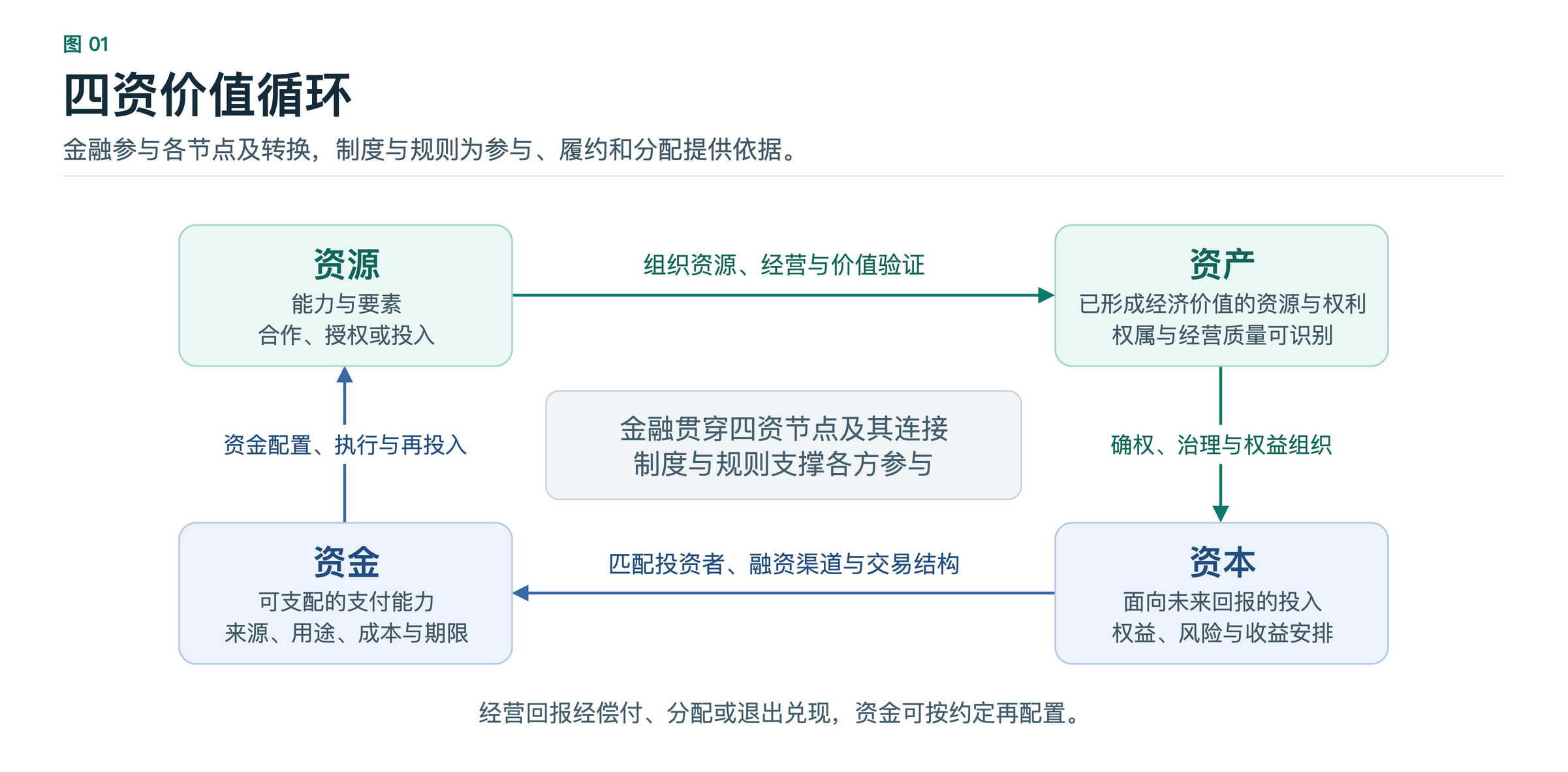
The Capital Logic and Pathways of Stakeholder Capital Theory Trace the cycle of resources, assets, capital and funds to see how operating results give rise to verifiable rights, funding and returns. The two cycles, four layers and four ecosystems explain the research framework for WISERUNION Company Zero.
↗ Work 2026.11.11
After Bringing In AI, What Capability Does the Company Keep? While drafting V2.0, I looked at handover decisions, how three work documents can agree and how one actual workflow could test today's result and the capability left for next time.
↗ Work 2026.11.07
Gold Capital’s mine-to-store model: from operations back to capital I have redrawn Gold Capital’s mine-to-store model, starting with how mines, plants, the supply chain, stores and customers work together, then connecting receipts, entitlement to returns, DFSL’s capital role and reinvestment.
↗ Work 2026.11.05
AI-Native Business Models: Looking at Society's Next Needs and Opportunities Starting from AI-native business models, I consider human value, AI's operating needs and transition services for human–AI collaboration. I connect needs, knowledge, work outputs and stakeholder collaboration, then return to client payment, costs, acceptance and responsibility to find starting points that can be tested in practice.
↗ Work 2026.11.05
From Four-Way SOP to AI Skills: What I Want the Think Tank to Become I connect actions, functional tasks, business processes and business performance with role responsibilities, roles, departments and the company. Skills and handbooks help link outputs at each level, while real work tests the business logic and builds knowledge that people and AI can use and improve together.
↗ Work 2026.11.03
The core logic of putting Stakeholder Capitalism into practice I bring the four ecosystems, business results, contributing roles, four SOP directions, rules and AI Skills together in one framework. The next step is to take one real piece of work through the full process, then refine the arrangements against the results.
ONGOING INQUIRY
01 How does co-creation build lasting capabilities? + Start with current inputs and results, then ask which resources, capabilities and working relationships can keep contributing in the future.
02 How should participants’ contributions be recognised? + Explain how contributions are assessed, how returns are allocated, and what rights are based on. That makes commitments easier to understand and check.
03 How does good governance enter everyday operations? + Put rules into practice through records, confirmation, fulfilment and review, so people know how to handle disagreements.
Here are my papers and working drafts, along with questions I am still studying.
01 Public manuscript 2026-09-18 Corporate Governance
Shareholder primacy treats the firm as a nexus of contracts and puts shareholder wealth first. This paper proposes a stakeholder governance framework for an economy reshaped by AI, financialization, and the reorganization of globalization.
↗ 02 Working paper 2026-09 Stakeholder Governance
Joint improvement often asks a supplier to advance tooling, trials, and on-site costs and to share cost-reduction or volume gains only later. Delay raises waiting and exposure and can weaken willingness to continue. Buyers therefore offer compensation promises against present input. Williamson showed that specific investment needs credible commitment;[1] reciprocity and network studies show that long cooperation can organize knowledge sharing.[2][3] What remains is whether, when stated returns and risk notes are held comparable, the verifiability and enforceability of a promise can ease the damage of delay—and whether the supplier’s liquidity constraint swamps that easing.
↗ 03 Working paper 2026-09 Stakeholder Governance
Sustained firm growth depends on employees and teams continuing to contribute knowledge, collaboration, innovation, and relationship maintenance beyond formal duties. Prior research shows that organizational justice predicts organizational citizenship behavior, yet most studies still treat employees primarily as internal subordinates. Fewer studies explain, from the standpoint of participants in a cooperative scheme, why people keep making hard-to-price voluntary contributions after current compensation has already been paid. This paper links Phillips’s principle of stakeholder fairness with the literatures on organizational justice, social exchange, and organizational trust, and proposes a mechanism of stakeholder fairness perception → trust → voluntary contribution behavior.
↗ WISERUNION / RESEARCH Blockchain — The Underlying Technology of Stakeholder Capital Theory
Codex;Andrew David W.Y. Public reading edition · V1.0
Blockchain — The Underlying Technology of Stakeholder Capital Theory This book treats blockchain as institutional technology and examines digital assets, contribution recognition, capital formation, entitlement design, collaborative governance and evolvable institutions through two linked lines: information copying versus asset transfer, and social consensus versus technical execution.
Explore this book ↗ · Chinese text WISERUNION / RESEARCH Stakeholder Capital Theory
ChatGPT、Andrew David W.Y. Public working manuscript · V1.0 · H03
Stakeholder Capital Theory Examines the conditions under which shared contributions form resources, capabilities and cooperative relationships that remain usable over time, and how corresponding rights and governance arrangements support long-term cooperation.
Explore this book ↗ · Chinese text 04 / MEDITATION
Meditation Find insight in experience.
Practice it in everyday life.
Explore Meditation ↗ Begin with purpose. · Return to kindness. · Put integrity into practice.
These short pieces record my experiences, choices and judgments. Start here if you want to understand how I think and work.
WEB & APP READING Read on your phone, tablet or computer. No installation needed.
Web reading is available W.Y. App · In beta Official release expected May 2027
View apps and beta details ↗