A business can produce a great deal of material: introductions, plans, processes and strengths, each with plenty to say. Yet someone encountering it for the first time may still be unable to explain whom you help and what you do.
Adding more material may not solve that problem.
I would step back and ask four questions: whom do we serve, what problem do we solve, how does it work, and what evidence supports it?
Once those are clear, try a positioning sentence, an explanatory paragraph and a one-page diagram. Then ask someone unfamiliar with the business to explain it back in their own words.
Does their account describe the same thing we intended?
That is the focus of this exercise.
1. Fix the audience first
A clear explanation needs a specific reader.
Customers want to know whether it addresses their problem. Partners want to know how to participate and what they undertake. Internal staff need the next actions and confirmation responsibilities.
These versions may have different emphases without changing the core facts. A capability still being designed must not become a mature service in the customer version. An internal target must not become an achieved result on a promotional page.
The wholly fictional business for this exercise is a store campaign-material coordination service.
It proposes to serve small retail teams with several stores and limited design-coordination staff. The reader is a team leader encountering the proposal for the first time, deciding whether it is relevant.
Requirements scattered across chats, different prices and dates by store, and difficulty identifying the final version are problems the team has proposed for validation. At this stage there is only a plan and desktop samples, with no real-store trial.
Put those limits on the table. None of the three forms of expression should quietly remove them.
2. Lay out the material before seeking an impressive phrase
Starting with a grand positioning phrase can quickly lead to “empowerment,” “ecosystem” or “growth platform.” Readers may still have no idea how the business relates to them.
I suggest placing the materials under four questions.
Whom do we serve? Break down “all enterprises” into specific people, organizations and situations. A diffuse audience makes a sentence vague.
What do we solve? Describe the reader's actual difficulty: unclear information, disconnected handovers or no one confirming the final version? What we like doing is not automatically a confirmed customer need.
How does it work? Follow the process from what the other party supplies to what we deliver. Explain who handles it, who confirms it and where a problem returns.
What evidence supports it? Examine the materials individually. A plan shows intended work; a sample allows format checks; a real trial provides use records. They support different judgments.
One material may answer several questions, but every judgment needs a corresponding source. Record what must be obtained when it is missing.
Do not invent a customer, an effect or a capability to fill four boxes.
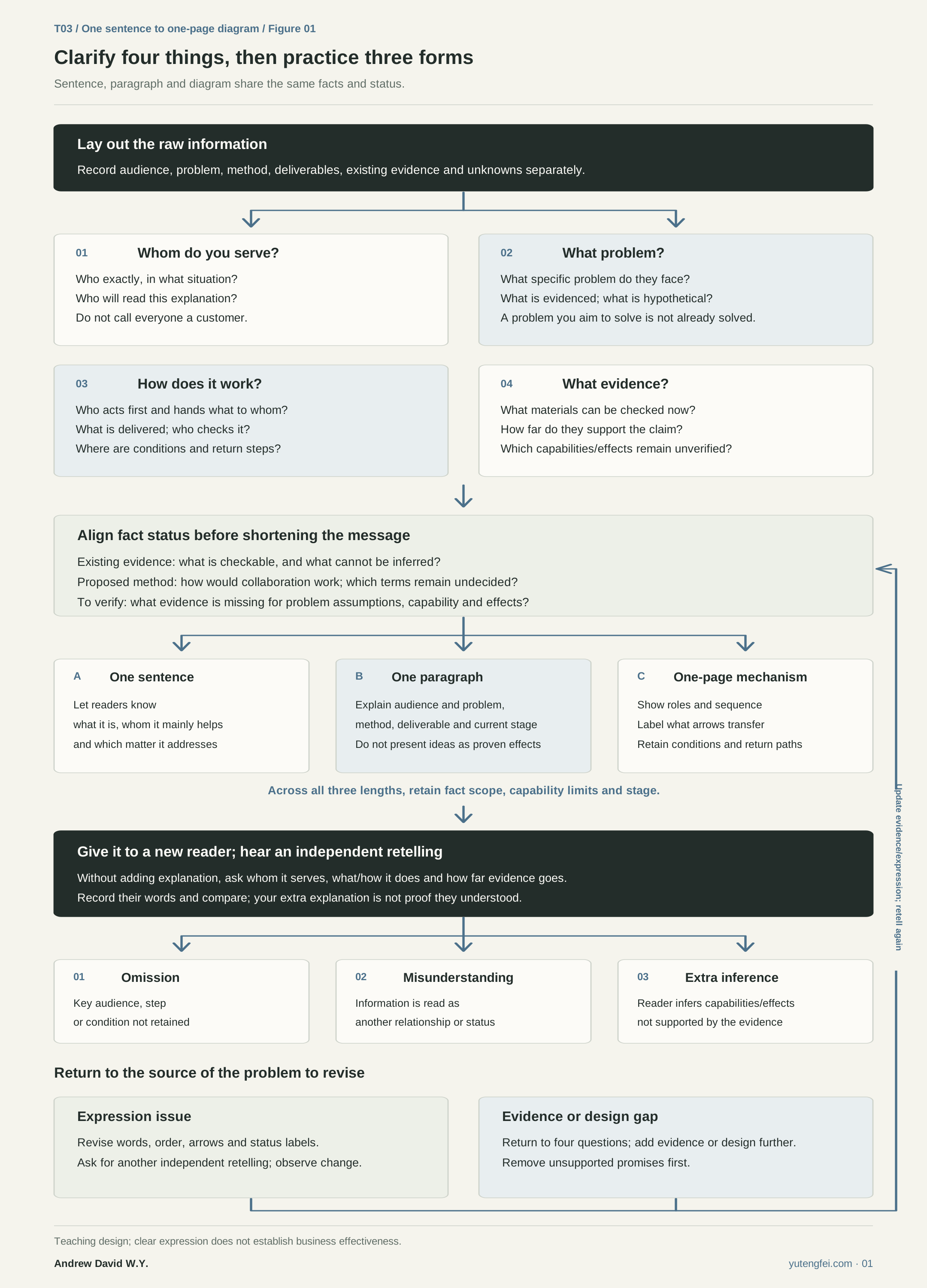
Figure 1: Organize the facts through four questions, then express them in three forms. Route reader feedback separately to communication problems and evidence gaps.
3. Give each form one clear job
The sentence, paragraph and diagram may differ in length while describing the same business.
A sentence: show the reader why it matters to them
Identify the audience and problem, adding the key approach and current stage where necessary.
The sentence need not contain every detail. Evidence, process and limits can follow immediately. But if removing “being trialled” makes a proposal sound like an established service, retain that qualification.
Positioning and a slogan are also different. A slogan may express an attitude; positioning should tell people what the business does. A universally agreeable phrase still leaves the explanation to be done.
A paragraph: explain operation and evidential limits
For an interested reader, explain where a service starts, what happens, what they receive and who confirms it.
State what can currently be examined. If there are only desktop samples, show those. If there is no real-use record, retain that fact rather than replacing it with “widely recognized.”
“We hope to automate synchronization” and “we synchronize automatically” can lead to very different judgments.
A page: draw the relationships
Show who delivers what to whom, where confirmation occurs and how a problem returns.
The campaign owner supplies confirmed requirements, the service team returns drafts for checking, and the final handover is a version directory with IDs and statuses. Information, actions and confirmation responsibilities give arrows a meaning.
A network of large circles labelled “resources,” “platform,” “customers” and “growth” may still fail to explain a single service interaction.
For every arrow, ask what is actually passing along it.
Open the expression and reader-retelling worksheet
4. Clarify relationships before choosing colours and style
Visual quality matters to me too. Start by placing participants, deliverables and confirmation points correctly.
Then distinguish roles with colour, use solid lines for the proposed handovers in this diagram, and use dashed lines or separate notes for unvalidated or undeveloped items. Include a legend and words rather than relying on colour alone.
The feeling conveyed by a colour is an expressive choice. A technological appearance does not establish a working system; a professional appearance does not show that the business chain has run successfully.
Automatic synchronization remains an idea here and must not appear as an operating core capability. “Confirmed usable” in a desktop record means only that simulated fields passed a check. It is not real customer acceptance or formal publication.
The diagram explains the design. Reliable delivery, willingness to pay and business outcomes need separate validation.
5. Let an unfamiliar reader respond before helping them
“Unfamiliar” means unfamiliar with the activity, not necessarily a stranger.
Give the reader the three forms and let them read independently. Do not explain terms or point to the intended emphasis yet.
Ask them to explain four things in their own words:
- Who uses this business, and what problem do they face?
- How does cooperation start, who confirms along the way and what is received?
- What exists now, and what remains a proposal or idea?
- What is unclear, and which effects lack evidence?
Record their actual words before correcting them.
An omission may mean the information was buried. Reversed roles may signal an unclear responsibility diagram. An invented system or guarantee calls for checking whether a word or line implied more than intended.
To examine the sentence, paragraph and diagram independently, use different readers. With one reader, present them in that order and record the added understanding each time. Later responses are influenced by earlier material and are not independent tests.
Accurate retelling is more informative than “What do you think?” followed by “Looks good.”
6. Revise along two different paths
Some problems are in the explanation.
An overbroad audience, a late mention of the deliverable or an arrow without a confirmer can be corrected in text and diagrams. Ask someone to read again and see whether misunderstanding decreases.
Other problems concern missing business evidence.
Whether customers have the problem, how much labour a trial requires and what they will pay for cannot be solved by changing words. Conduct interviews, trials or further recording, then update the explanation.
A problem can involve both. If a reader thinks synchronization already works, correct the misleading expression and retain the fact that the capability has not been developed.
Clear retelling tests whether an explanation is understood. It does not establish demand, service effectiveness or profitability.
Open the simulated samples and evidence boundaries
7. Leave a version that can be maintained
I hope the exercise produces more than three attractive finished pieces.
Keep a source table: which statement corresponds to which material, its current status, who checks it and what future changes trigger an update.
When a sentence changes, check the paragraph and diagram too. An unchanged target audience should not become “all industries” in one figure. An undeveloped system should not become an automated platform in another promotional context.
A reference set appears after the exercise. It illustrates one way to organize the material rather than prescribing identical wording. Complete your version first, then compare facts, responsibilities and evidence.
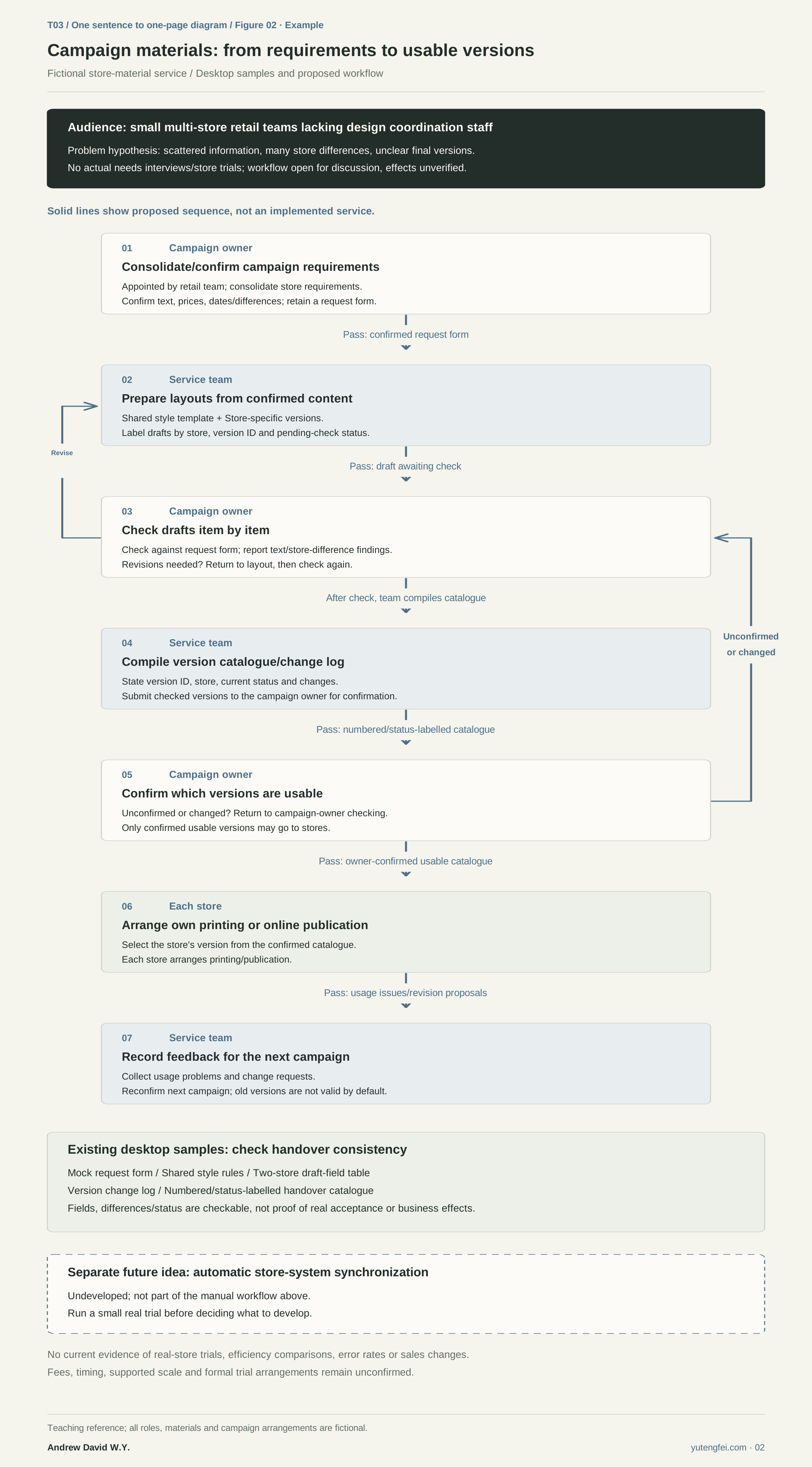
Figure 2: A reference for the same exercise, showing proposed handovers, checks and returns. The entire service remains at the proposal and desktop-sample stage.
After drafting and independent retelling, consult the reference expressions and review
Exercise materials
Lay out the materials, identify the four questions, turn them into concrete expression, and test it through diagrams and retelling. Organizing complexity, simplifying, making action easier and drawing the relationships become a practical piece of work.
- Exercise plan and instructions
- Source cards E01–E08
- Simulated samples and evidence boundaries
- Expression and retelling worksheet
- Reference expressions and review
- Download the blank four-question and retelling exercise diagram as SVG
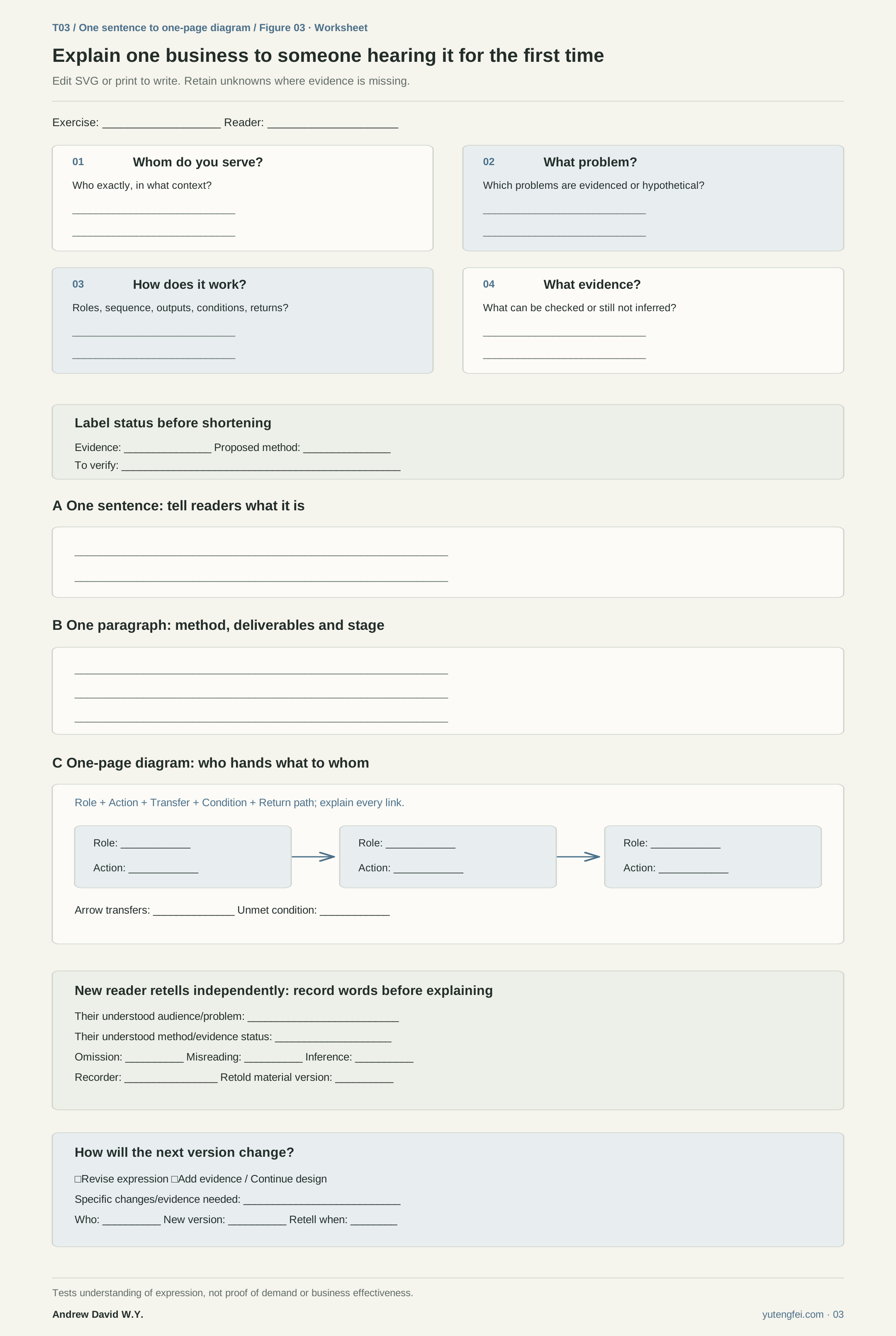
The business, materials, samples and records are independently written fictional teaching materials. The four questions, exercise process and diagrams were designed for this edition. Their effectiveness still needs testing in actual use.