Attracting investment, working with external partners and discussing financing all come down to dealing with specific people.
What matters to the other person? Why are they willing to talk, and why might things still not move forward? These questions need to be understood. Describing what we have to offer may not yet address the problem they are trying to solve.
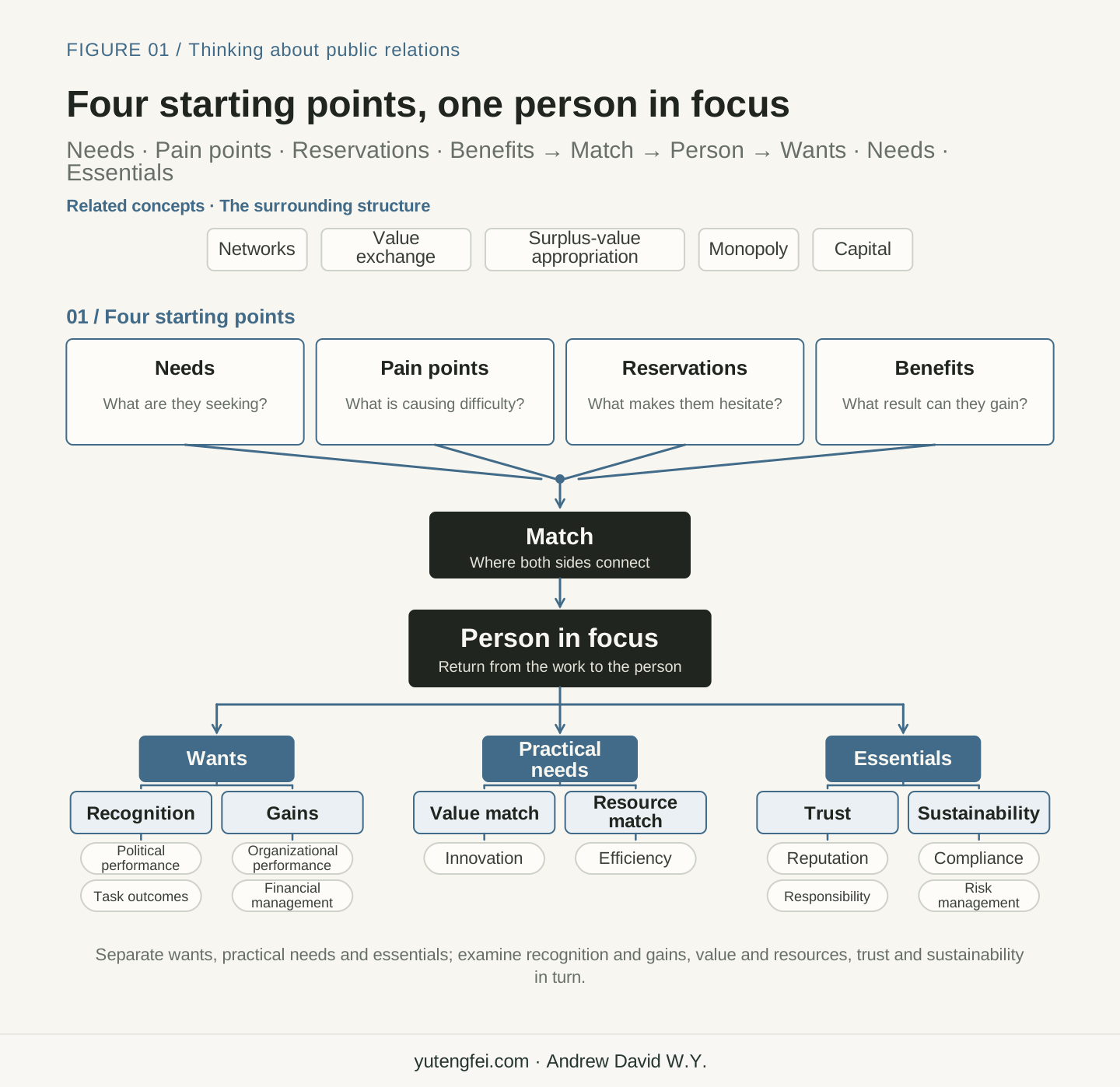
I want to use this diagram to organize several questions about public relations. First, look at needs, pain points, reservations and benefits, and consider where the two sides can match. Then return to the person involved and distinguish what they want, what they need to act, and what is essential.
The “person in focus” in the diagram is the specific person we need to understand and communicate with in this situation. Alongside their personal goals, we need to consider their role, their responsibilities and what matters to the organization they represent.
First, understand what matters to the other person
Needs, pain points, reservations and benefits can be explored separately.
- Needs: What are they looking for, and what problem do they need to solve? Is it funding, projects, people or some other form of support?
- Pain points: What keeps going wrong? Where are costs high, efficiency low, or a workable approach still missing?
- Reservations: What makes them hesitate or feel uncertain? Is information missing, are responsibilities and risks unclear, or do they have a different view of the matter itself?
- Benefits: Once the work is done, what practical results can the person and the organization they represent each gain?
Separating these questions helps us ask more precisely. A condition raised by the other person may express a need, or it may be a response to risk. Understanding the reason behind it makes the next discussion easier to connect.
We also need to distinguish what the other person has explicitly said from judgments we have made using the information available. Where evidence is missing, we can note the point and return to it in conversation.
Matching has to lead to work both sides can actually do
Once these questions are clearer, we can look at what we can offer.
Can the product meet the need? Can the solution address the pain point? Are there facts and arrangements that explain the concerns? Can the expected result be achieved through specific cooperation? Each point needs checking.
Reservations deserve a careful hearing too. Some questions can be discussed further once information is supplied. Other disagreements may mean that the two sides are not ready to proceed together. Be clear about what can be fulfilled, and take time before making commitments that lack a sound basis.
For me, the key to matching is that both sides can explain why they are taking part, what each will do, what each can gain and what each must take on. Once resources are brought together, there also needs to be a practical way to move the work forward.
Distinguish wants, practical needs and essentials
Returning to the person involved, I divide these questions into three levels.
Wants are the goals and preferences the person actively expresses. A particular result, a form of recognition or a condition they hope to secure can be considered here.
Practical needs are the conditions that enable them to get the work done. A desired result also requires the relevant capabilities, methods and resources.
Essentials are the foundations that allow the work to continue. In the diagram, I place trust and sustainability at this level, then look further at reputation, responsibility, compliance and risk management.
These three levels need to be understood together. Once someone has said what they want, we still need to consider the conditions needed to achieve it and the arrangements without which progress would be difficult. As new information appears, the judgment can change.
Break recognition and gains into four areas of observation
Within “wants,” I make a further distinction between recognition and gains. Under recognition, I look at political performance and task outcomes. Under gains, I look at organizational performance and financial management.
This is the way this diagram organizes the questions. Applied to specific people and situations, the four areas may affect one another. We need to understand the task the person is carrying out and how their work is being assessed.
| Area | Group in the diagram | Main focus | What else to check |
|---|---|---|---|
| Political performance | Recognition | Performance within the political environment, including policymaking, decisions and dealings with other political entities | Moral and ethical standards, responses to conflict and crises, and judgment and guidance on the organization's direction |
| Task outcomes | Recognition | Performance on a particular task or project, including project management, execution of plans and the ability to handle challenges and problems | Organizational and communication skills, task goals, deadlines and actual results |
| Organizational performance | Gains | Performance in achieving organizational goals, including team management, leadership, and the setting and realization of strategic goals | Leadership approach, decisions, innovation and problem-solving abilities, and their actual effect on organizational results |
| Financial management | Gains | Performance in resource allocation, budgeting and financial management | Financial knowledge, assessment of returns and risks, financial health and organizational stability |
For example, in a discussion about the same project, one person may be more concerned about achieving visible task outcomes, while another focuses on its effect on organizational performance and financial results. If the subject and criteria of evaluation are unclear, the two sides may mean different things by “doing it well.”
These four terms therefore need to be understood through specific responsibilities and assessment criteria. Returns also need to be considered alongside risks; a return cannot be treated as an outcome already secured.
Getting work done requires value and resources to connect
At the level of “practical needs,” I place value matching and resource matching.
Value matching asks whether the capabilities and offerings of both sides can address the actual problem. I connect it to “innovation” in the diagram to ask a further question: could this combination produce a new approach and make something possible that neither side could achieve alone?
Resource matching looks at what each side lacks, what each has and how those resources can be organized. Its connection to “efficiency” asks whether bringing resources together can reduce duplication, waiting and waste.
Both relationships need to be tested through specific work. In discussion, we can clarify what each side provides, how they will cooperate, who is responsible and how results will be assessed, then see whether the match is effective.
Long-term cooperation needs trust and sustainability
At the level of “essentials,” start with trust.
Reputation offers a reference from the past; responsibility concerns the current agreement. How earlier work was completed, how problems were handled, who is responsible this time and how far that responsibility extends all affect whether both sides feel comfortable continuing together.
Then consider sustainability. In the diagram, this connects to compliance and risk management: which rules apply, what problems may arise, who will handle them and whether existing capabilities can bear the demands. These questions need to be discussed alongside the expected results.
Some conditions look attractive at first, but responsibilities remain unclear and later arrangements do not connect. Clarifying these foundations early makes it easier for both sides to judge whether the relationship should continue.
Look at the structure surrounding the relationship too
Five other terms appear at the top of the diagram: networks, value exchange, surplus-value appropriation, monopoly and capital.
For now, I retain them as related lines of analysis. The original diagram does not arrange them into a fixed causal chain. Each needs its own evidence when applied to a specific discussion.
It is worth examining how networks help establish contact, what value the two sides exchange, how resources and decision-making power are distributed, and how the resulting outcomes are shared.
“Surplus-value appropriation” and “monopoly” involve judgments about the structure of a relationship. To use these terms in a specific case, we need to explain who created what, who controls what, who receives what and the evidence for those judgments. A single outcome is not enough to characterize the relationship. How capital organizes and influences these relationships is also open to further study.
Including these questions is a way to see the organizations and relationships around a person while trying to understand that person.
Use it at work for an initial review
For a specific collaboration, we can begin by writing down the following questions:
- What are the other person's needs, pain points, reservations and benefits? Which have been confirmed, and which remain judgments?
- Where can the two sides match? What will each provide and take on, and how will the work move forward?
- What does the other person want, what is needed to achieve it, and which foundations need to be clarified first?
- What do political performance, task outcomes, organizational performance and financial management mean in this situation, and who assesses them?
- How is value created and exchanged, how are resources and decision-making power distributed, and how are results shared?
Record what can be answered and leave the unclear points for checking. After the conversation, add the new information.
The purpose I want this diagram to serve is to help us see the people and the work more specifically. Understand what matters to the other person, explain what we can do, and then consider how to work together.
Source and version
This article is an edited version of Wei Tengfei's personal notes, “Thoughts on Public Relations.” It retains the main conceptual relationships in the original diagram and the core meanings of political performance, organizational performance, task outcomes and financial management.
Version: V1.0. Edited on: 2026-10-27.