The Capital Logic and Pathways of Stakeholder Capital Theory
Trace the cycle of resources, assets, capital and funds to see how operating results give rise to verifiable rights, funding and returns. The two cycles, four layers and four ecosystems explain the research framework for WISERUNION Company Zero.
Reading & sharing
The value cycle of resources, assets, capital and funds: a research framework for WISERUNION Company Zero
Interim research synthesis V1.0 | November 14, 2026
Introduction: From organizing resources to forming lasting capital relationships
My earlier research asked how to organize stakeholders’ resources so that several parties can participate and create value together. The next question is how to fund the results already achieved and the value still taking shape. First, establish ownership and other rights. Then see how a capital structure and financial arrangements can support them. Finally, check whether operating results can flow back to the different participants on the agreed terms.
Who contributes what? How is value created? Who confirms each party’s rights, and who bears the risk? Once money comes in, how is it used in the business, and how are the results shared? Financing belongs in this sequence. Putting these questions under the same set of rules makes it easier to see how the company’s operations, investor returns and continued cooperation fit together.
Establish ownership, arrange rights and choose suitable financial mechanisms so that genuine value can receive sustained funding. Give stakeholders rules for participation so that lasting capital relationships can develop as contributions are verified and rights are fulfilled.
1. The four-part cycle: Finance runs through each stage and the links between them
The reading notes on Operating the Four Forms of Value offer a starting point for seeing how resources, assets, capital and funds connect. Follow that sequence and put finance, institutions and rules into each stage. It becomes easier to see how each party participates, what responsibility it takes on and on what basis it shares in the outcome.
In this framework, resources are capabilities and inputs that can be brought together and put to use. Assets are resources and rights that already have some economic value and whose control or use can be identified. Capital consists of contributions organized around future returns and the associated rights, risks and rewards. Funds are the means of payment that a particular party can actually control and allocate. These categories can overlap: cash, for example, can be an asset or be contributed as capital.
The full path can be described as follows:
Organize resources → create value → form assets → confirm ownership and operating quality → structure capital, governance and rights → structure financing and transactions → obtain and allocate funds → manage operating returns and risk → repay, distribute, exit and reinvest.
In a real project, operations, governance, financing and risk management often proceed in parallel. Keep checking which stages are already connected and which still need work as new evidence and operating results become available.
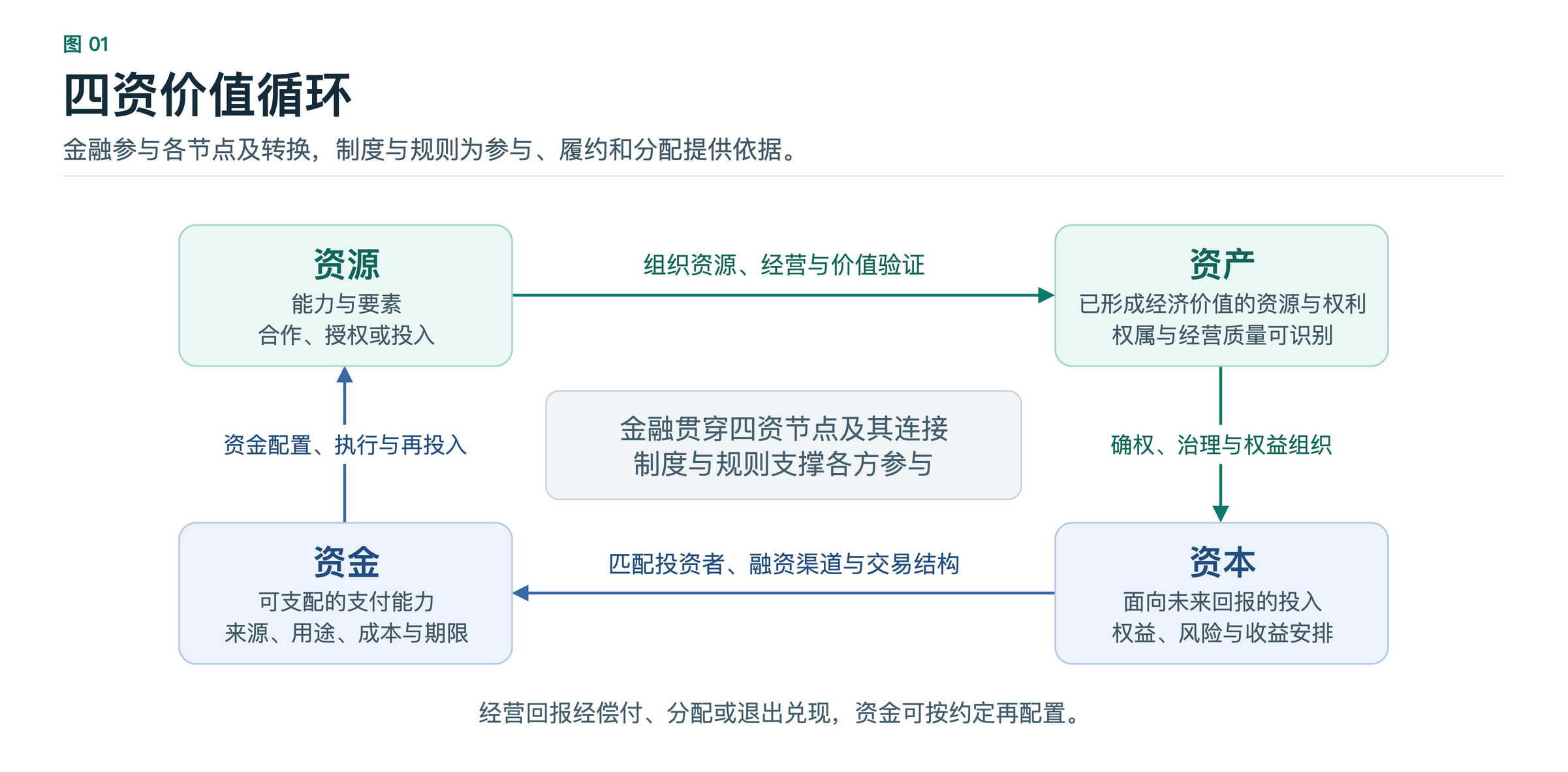
1. Finance has a role at each stage
At the resource stage, decide how a resource enters the collaboration: through a service purchase, project partnership, license, contribution in kind or another agreed arrangement.
At the asset stage, establish the boundaries of the asset and associated rights, the quality of its operations, the basis for its value and any existing encumbrances. That gives later investment or financing an intelligible basis that others can check.
At the capital stage, set out who contributes, who has control, who gets paid first, how returns are shared and how participants may exit. Each party should know what rights and obligations to expect.
At the funds stage, address the source, use, term, currency, cost and repayment of the funds so that they serve the operating objective.
2. Finance also helps turn one form of value into another
Turning resources into assets takes organization, operations and evidence of value. Bringing assets into a capital arrangement takes confirmation of ownership, governance design and allocation of rights. Connecting capital to funds takes suitable investors, financing channels and transaction structures. Putting funds back into resources and assets takes allocation decisions, execution and review of the results.
Finance therefore acts at each stage and in the transitions between them. Institutions and rules run through the cycle, giving the resource, operations and management, customer, and capital ecosystems ways to participate that fit their contributions, responsibilities and interests.
The cycle ultimately depends on whether value can keep being created, rights can be enforced clearly, funds can be put to effective use and returns can be delivered as agreed.
2. Capital thinking: Consider value, rights, funds, risks and returns together
When I look at a financing proposal, I first ask what business activity the money will support, then how the risks and returns will fall to each party.
Capital thinking means identifying and organizing resources and assets around long-term value creation and future returns. It means designing the rights, responsibilities, risks and rewards, then choosing the entities, funding sources, channels and instruments that help create value, allocate funds and realize returns. The aim is to keep directing funds to activities that can create value.
Turning assets and associated rights into usable funds is a matter of financing and liquidity. Whether the funds then produce operating results and value that can be realized determines whether the capital cycle can continue.
1. How efficiently can we raise funds and realize value?
Financing efficiency concerns whether the funds fit the project. It takes into account the net amount raised, when it will arrive, the full cost, dilution and any conditions attached.
Realization efficiency concerns whether assets and investment rights can be turned into funds their holder can use, through customer payments, sales, redemptions, distributions or other agreed arrangements. Timing, achievable prices, transaction costs and exit conditions all matter.
Money can arrive quickly and still reduce capital efficiency if it costs too much, dilutes rights too far or falls due before a long-term project recovers its investment. To decide if the arrangement is worthwhile, consider both forms of efficiency in relation to long-term value.
2. Six questions to answer
| Core question | What needs to be clear |
|---|---|
| Where does value come from? | How operating cash flow, use value, asset appreciation or other sources arise, and which have been verified. |
| Who holds the rights? | What the founders, resource providers, investors, operators and other participants hold, and how their rights are confirmed and enforced. |
| Where do the funds come from? | The roles of internal funds, equity, debt, operating revenue, partner contributions and any other sources. |
| What will the funds be used for? | The operating objective, the activity to be financed, who uses the funds and when there will be results to check. |
| Who bears the risks? | How the parties share asset impairment, operating shortfalls, price changes, cash gaps, compliance risks and liquidity risks. |
| How can investors exit and how are returns distributed? | How dividends, principal and interest payments, equity or asset transfers, buybacks and other lawful arrangements will work. |
Another financing round can provide funds, but it does not explain where value comes from. A project still needs to say what the new money will finance, how that will create additional value and what will ultimately enable repayment, distribution or exit.
3. Separate four kinds of information when assessing assets and capital
Operating and management decisions should distinguish present value, the basis for future growth, verifiable evidence and untested assumptions.
Present value describes the assets, business, cash flows and rights already in place. The basis for future growth identifies what customers need, what can drive growth and under what conditions. Verifiable evidence includes contracts, output, revenues, costs, customer records, audits and independent assessments. Untested assumptions include projected returns, the ability to turn resources into assets, and future market size.
Keeping these categories separate preserves room for future potential while grounding the capital assessment in present evidence. Audits, valuations and legal documents support judgments within their respective scope. Operating capability and future returns still have to be tested over time.
3. How stakeholders form lasting capital relationships
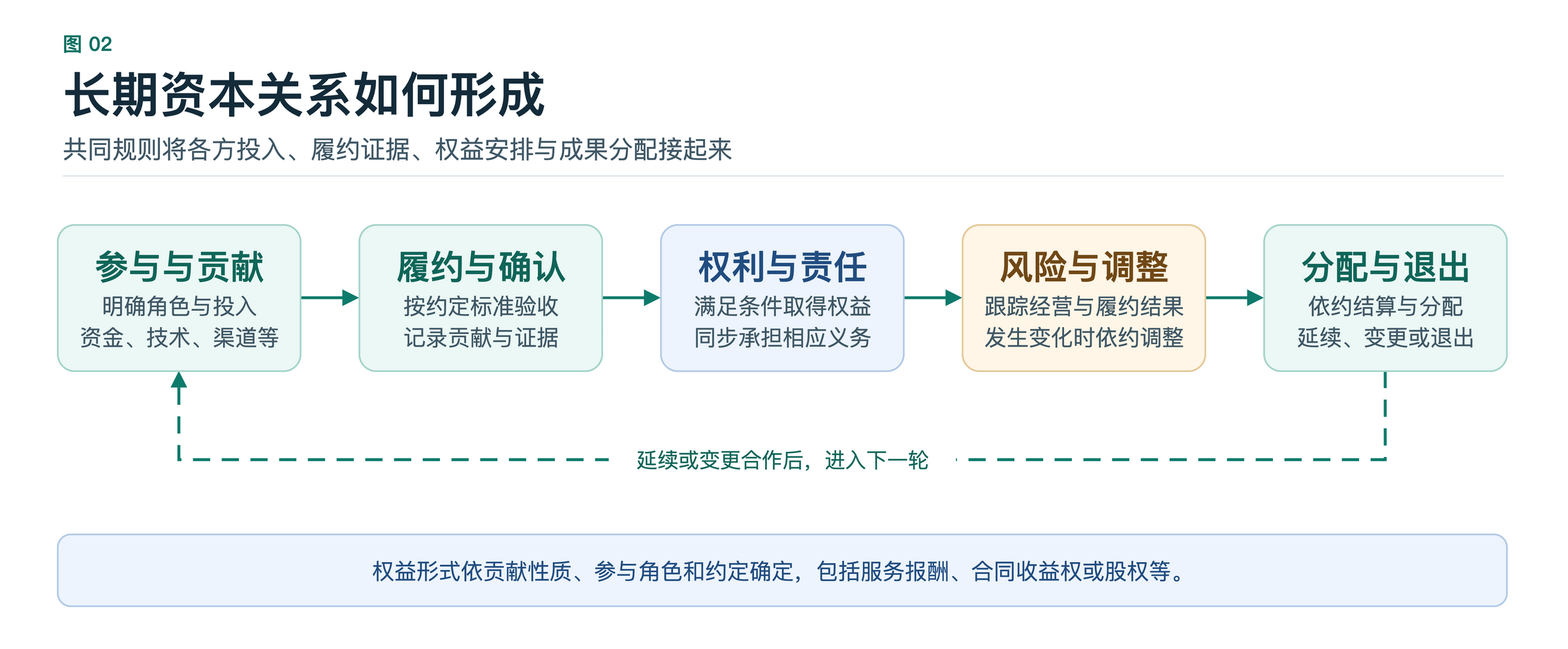
At this stage, stakeholder capital theory focuses on how contributions from several parties are verified, how rights are arranged, who bears risk and how the outcomes of joint work are shared.
Contributions can include money, technology, intellectual property, talent, distribution channels, access to customers, the work of running the business or other capabilities. Clear rules and evidence of performance connect different contributions to appropriate pay, rights or participation in governance.
Equity, debt claims, contractual rights to income, intellectual property, payment for services and governance rights should therefore be designed separately. They apply to different relationships. Calling something a contribution does not make all these rights equivalent.
1. Connect contributions and rights through rules
Rules that can sustain long-term collaboration need to answer the following questions:
| Stage | What needs to be clear |
|---|---|
| Participation and contribution | Who can participate, in what role and with what input or deliverable. |
| Performance and verification | Who verifies the result, against which criteria and with what evidence retained. |
| Rights and responsibilities | What rights arise when the agreed conditions are met, and what obligations accompany them. |
| Risk and adjustment | Who absorbs losses or shortfalls, and how the parties respond to changing conditions. |
| Distribution and exit | How outcomes are settled and shared, and how participation continues, changes or ends. |
Continued participation, actual performance, contribution verification and fulfillment of rights all sustain a lasting capital relationship. That relationship may involve equity, long-term contracts, a share of proceeds or cooperation in governance. Its form depends on the parties’ contributions and what they have agreed.
2. Give different participants a common set of rules
The roles, inputs and expectations of return differ across the four ecosystems. The rules should provide common principles for verification, procedures for carrying out decisions and a way to resolve disputes, while allowing each role to participate on suitable terms.
Once the rules are written down, a few questions help test them. Can participants find out how their contributions were recorded? Do operators know how results will be assessed? Do funding providers know who bears the risk? When it is time to distribute proceeds, each party should know what entitles it to a share.
That is how separate resource partnerships can gradually give rise to enduring rights and capital relationships.
4. The operating and capital cycles: Connect value creation with funding
Two connected mechanisms put the four-part cycle to work. The operating cycle explains how value is created. The capital cycle explains how funds enter the business, risks are allocated and returns are realized.
1. The operating cycle
Invest funds → organize resources → produce goods, services or productive assets → receive customer payments or realize asset value → generate cash → reinvest.
The operating cycle focuses on demand, delivery, costs, collections and how effectively assets are used. Once funds arrive, put them into specific business activities and use operating results to see how well they worked.
2. The capital cycle
Assess asset value → design rights and responsibilities → match funding providers to the project → receive funding → manage the arrangement while it is in force → repay, distribute or exit by transfer.
The capital cycle asks who contributes, what rights they acquire, what risks they bear and how they can earn a return or exit. After the money arrives, governance, disclosure, oversight of the use of funds and continued performance remain part of the relationship.
3. How the two cycles connect
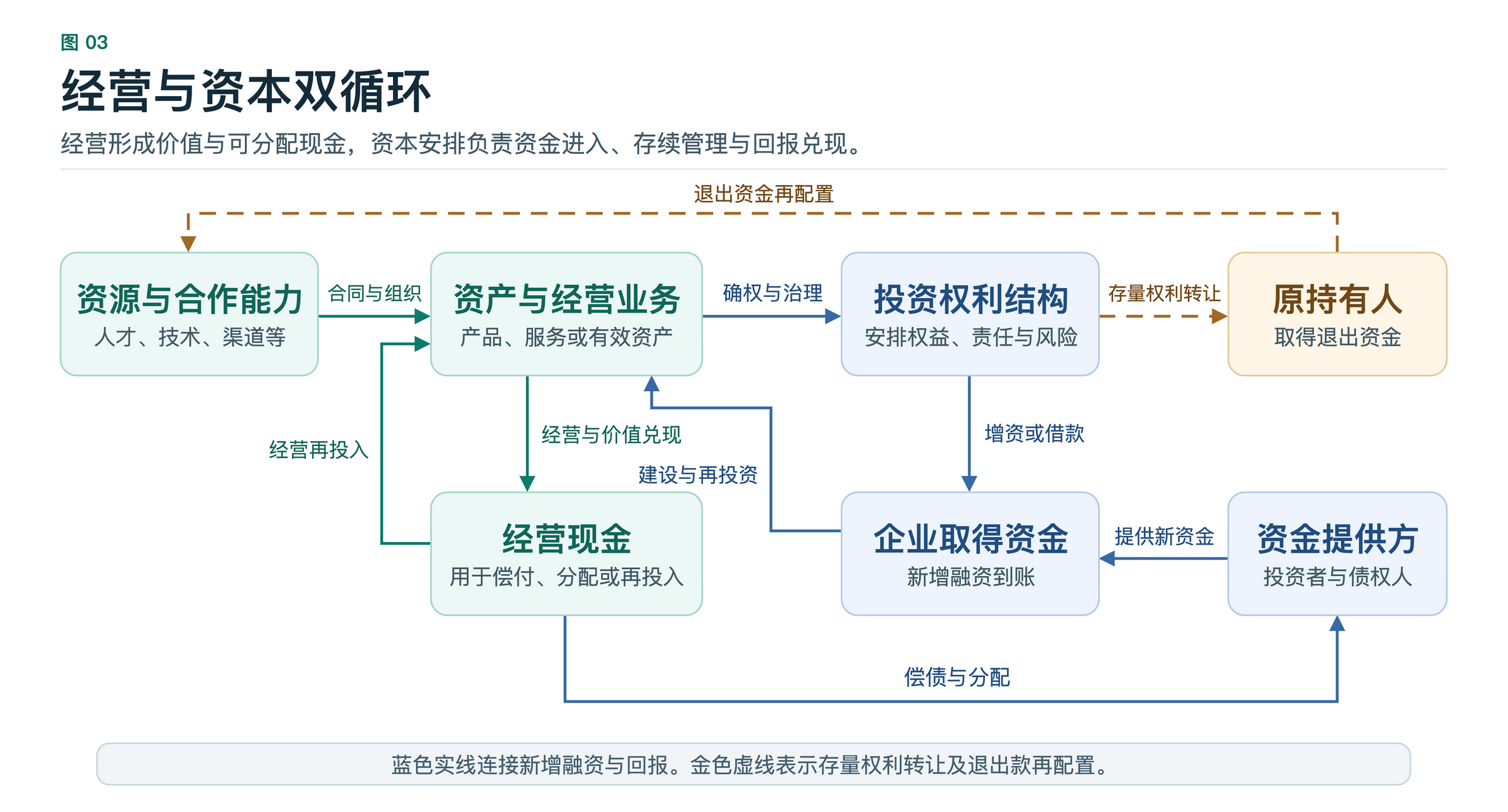
If I put this diagram next to a real project, my first question is: whose account actually received the money? Operations and capital arrangements may both center on an asset, yet the recipients can differ. Proceeds from issuing new rights go to the company; proceeds from transferring existing rights go to the previous holder. Trading outstanding securities between investors generally adds no cash directly to the issuer. [1]
Two distinctions follow:
The operating cycle determines what value the asset can create. The capital cycle determines who provides funds, bears risk and receives returns.
Record and assess funds received by the company separately from exit proceeds received by existing holders.
Show original Mermaid source (Chinese)
flowchart TD
    R["资源与合作能力"] -->|"合同与组织"| A["资产与经营业务"]
    A -->|"确权与治理设计"| C["可投资的权利结构"]
    C -->|"增资或借款"| F["企业取得资金"]
    F -->|"建设与再投资"| A
    A -->|"经营与价值兑现"| O["可用于偿付和分配的现金"]
    O -->|"偿债与分配"| I["投资者与债权人"]
    I -->|"提供新资金"| F
    C -->|"存量权利转让"| S["原持有人取得退出资金"]
    S -->|"再配置"| R
5. A common set of dimensions for traditional and digital capital
To compare traditional and digital capital, start with the underlying assets and rights. Then look at how financing and issuance bring in funds, how markets and transactions allow rights to change hands, and how financial instruments allocate risk and returns. Identify the infrastructure actually used for registration, custody, settlement and delivery.
Describe the funding round, participants’ roles, offering method, investment rights, product form and registration technology separately. A project often has all of these at once; they do not represent successive stages.
| Dimension | What does it answer? | Typical examples |
|---|---|---|
| Development stage and financing round | How far has the project progressed, and what will this round address? | Seed, pre-Series A, Series A/B/C/D, pre-IPO. |
| Capital providers and roles | Who provides capital, and in what capacity? | Angel investors, VC, PE, strategic investors, cornerstone investors. |
| Investment rights | What does the investor actually acquire? | Equity, a debt claim, fund units, contractual distribution rights, use rights, exposure to price movements. |
| Issuance and offering | To whom is the offer made, and how is the issue arranged? | Private offering, public offering, IPO, follow-on issuance and the particular offering structure of a security token. |
| New issuance and transfers of existing rights | Are new rights created or existing rights transferred? | Primary issuance, secondary trading and sales of existing shares. For a “primary-and-a-half” transaction, specify the issuance or transfer that the term refers to. |
| Product structure | Is this a single investment, a pooled investment or an arrangement with different tranches? | Stocks, bonds, convertible bonds, funds, ETFs, asset-backed products. |
| Trading and risk management | How does trading work, and how are leverage and price exposure managed? | Spot trading, margin financing and securities lending, futures, options, swaps, perpetual contracts. |
| Returns and distribution | Where do returns come from, and how are they distributed or realized? | Dividends, bond interest, rent, a share of operating proceeds, buybacks, staking rewards, lending income and transaction fees. |
| Registration and delivery technology | How are rights recorded, held in custody, transferred and settled? | Conventional registration and settlement systems, blockchains, wallets, custody systems, tokenization, smart contracts and records such as NFTs. |
A single project can combine several of these characteristics. For example:
Growth-stage company + strategic investor + debt with a conversion right + private offering + new issuance + convertible bond + agreed transfer restrictions + interest and conversion terms + conventional or tokenized registration.
This keeps the stage, participants, rights, issuance, product, returns and technology in their proper places and makes alternatives easier to compare.
Assess any digital form by looking at the actual rights it represents. Securities can be tokenized in different ways. Token holders and holders of the underlying securities may have different economic and voting rights. The term “mapping” alone does not establish the legal or economic relationship. [1]
Describe the source and risks of each return separately. Operating distributions, lending income, protocol rewards and other returns each need an identifiable source of payment, conditions for realization and a party responsible for performance.
6. Match capital platforms and instruments to funding needs
A capital proposal often involves an investment vehicle, financing channels, transaction infrastructure and financial instruments at the same time. To understand what a platform does, identify the parties involved and match each one to its responsibilities.
1. Three roles a capital platform can play
| Role | Main function |
|---|---|
| Asset and investment vehicle | A company, project company or fund holds assets, receives investment and takes on the related responsibilities. |
| Financing and distribution channel | Banks, investment institutions, brokers and other suitable channels connect providers of funds with the opportunity. |
| Transaction and service infrastructure | Trading venues, registries, custodians, clearing and settlement systems, and technology services help rights move between holders. |
For each proposal, confirm who holds the assets, raises the funds, runs the business and fulfills obligations to investors. Also confirm who provides registration, custody and trading services. Several parties can work together, with clear lines of responsibility.
2. Group financial instruments by what they do
| Function | Typical instruments or arrangements | Main question |
|---|---|---|
| Bring in equity | Capital increases, new shares, rights issues, targeted issuance. | Who provides long-term capital and shares in growth and losses? |
| Raise debt | Loans, bonds, financing secured by collateral. | How much is borrowed, for how long, and how will principal and interest be paid? |
| Combine debt and equity | Convertible bonds and other hybrid instruments. | How will the parties combine a current debt claim with the opportunity to convert into equity later? |
| Raise funds from existing assets | Asset sales, transfers of receivables, qualifying asset-backed financing. | How can existing assets or cash flow rights be turned into funds? |
| Pool investments | Funds, ETFs and other suitable products. | How can investors pool funds, manage a portfolio and access investments or trading? |
| Provide leverage and manage risk | Margin financing, securities lending, futures, options, swaps. | How can participants extend their buying power or adjust exposure to price movements? |
| Distribute returns and adjust the capital structure | Dividends, share buybacks, debt repayments or buybacks. | How will funds be returned to holders and outstanding rights adjusted? |
Start with the business problem and work back to the instrument. One instrument can serve several purposes, and several combinations can serve the same purpose. Choosing between them requires checking the entities, the assets, investor requirements and the applicable rules.
3. Choose instruments by considering how funds will be used and repaid
The basic matching principle is:
Use the asset’s sources of value, cash flow characteristics and development stage to match investors, rights, financing channels, instruments, terms and currencies.
| Project or funding need | Funding and instruments to examine first | What needs to fit |
|---|---|---|
| Early exploration with unverified cash flow. | Angel, venture or strategic equity and suitable hybrid financing. | Who bears the cost of experimentation, and how much more investment might be needed? |
| A proven business needs to expand. | A mix of growth equity, long-term loans, bonds or other instruments. | How do the expected expansion returns and cash recovery period compare with the financing term? |
| Orders and receivables are well documented. | Trade finance, factoring and other suitable arrangements. | What is the debtor’s credit quality, how reliable are collections, and who bears recourse liability? |
| A mature asset needs a broader pool of funds. | Public or private issuance, funds, and qualifying asset-backed products. | What ongoing disclosure, cash flow coverage and investor requirements apply? |
| An existing holder needs to exit. | Sales of existing shares, strategic sales, mergers and acquisitions, or suitable secondary transactions. | Who pays the exiting party, and what effect does the transfer have on the business? |
| Existing rights need better registration and delivery. | Suitable tokenized registration, distribution and settlement arrangements. | Does the technology improve costs, delivery efficiency or the investor experience? |
These are options to analyze. Whether they suit a project depends on its actual circumstances.
4. Assess transferability and actual liquidity separately
Permission to transfer, a listing or tokenization can make trading possible. Actual liquidity also depends on buyer demand, market depth, execution prices and price impact. The SEC likewise describes liquidity in terms of how easily and quickly a security can be bought or sold without substantially affecting its price. [1]
To understand the kind of exit a platform can support, ask specific questions. Can the right be transferred? How does the transaction settle? Are there enough buyers, and what does it cost to exit?
Trading arrangements and real market demand both affect whether value can be realized. A connection to a platform alone does not establish sufficient liquidity.
7. The four layers of WISERUNION Company Zero’s capital logic
At this stage, the Company Zero research first clarifies the relationships between four layers: value, rights, capital and financial connections. It then compares specific paths such as a listing or digital securities.
These layers give a capital proposal its structure. Explain the business and its value first, then verify contributions and rights, match the funding and finally design the financial connections the proposal needs.
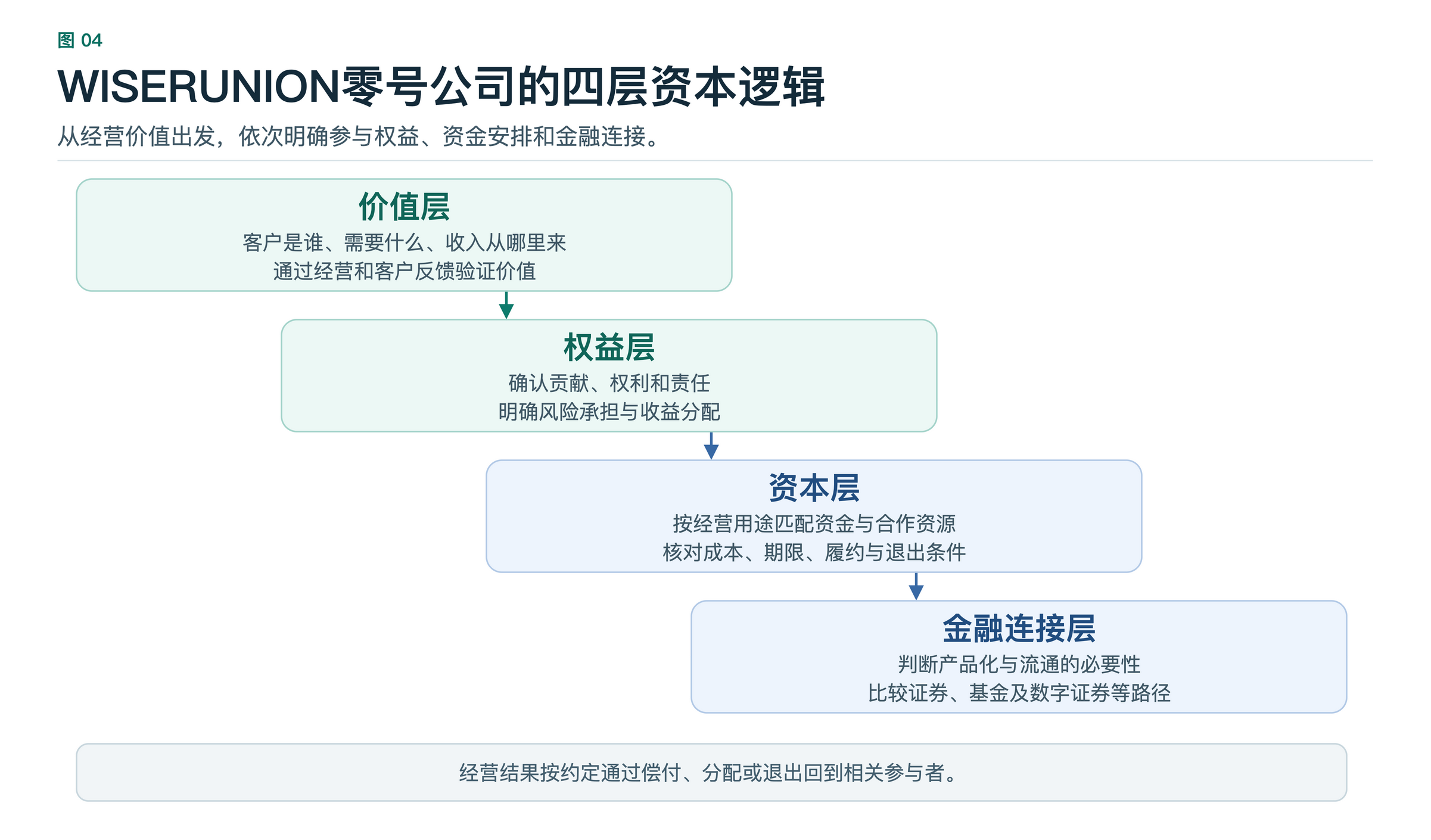
Layer 1: Value — What business are we in, and for whom do we create value?
For research, education, products, services and solutions, identify the customers, the problem being solved, the source of revenue, the providers of key resources and the capabilities Company Zero needs to retain.
This layer should produce a business logic that people can understand and operating goals that can be tested. Bringing resources together is a start. They become productive assets and results over time through operating activity and customer validation.
Layer 2: Rights — Who contributes, who holds rights and who bears responsibility?
Resources, funds and work in the business need to be matched clearly to different forms of rights.
Design equity, debt claims, contractual income rights, intellectual property, payment for services and governance participation separately. Set out the conditions for obtaining them, the limits of responsibility, who bears risk and how outcomes are shared. A resource contribution can earn payment or an agreed right; the right form depends on the nature of the contribution, the participant’s role and the rules in place.
This layer puts the questions at the center of stakeholder capital theory into practice: how to verify each party’s contribution, allocate risks and share results.
Layer 3: Capital — Organize funds and resources around what the business needs
Start with what is missing. Is it working capital, project funding or a longer-term investment? A partner may be able to meet some needs directly with resources and capabilities.
Then compare internal funds, equity, debt, advance payments, project partnerships and other suitable arrangements. Identify the cost, term, obligations, effects on rights and exit conditions of each option.
The capital layer directs funds and resources to the intended uses, with a term that fits the operating goal.
Layer 4: Financial connections — Decide whether to package the investment or enable trading
Compare conventional securities, funds, digital securities and other paths once the underlying business, ownership, disclosures, eligible investors, custody, exits and applicable local rules can be clearly explained.
One digital securities path considered here is a targeted issuance of shares by a listed company, followed by custody with a securities broker and mapping to tokens. The original research called this an “STO path.” I use the term in that specific sense, as a line of research that still needs a defined structure. It is not a general definition of all security token offerings.
Check the rights involved one by one. Who holds the underlying shares? What rights does the token represent? How does custody work, and how do holders receive distributions? What transfer conditions apply to the shares and to the tokens? The actual structure and governing documents are the basis for confirming the rights after mapping. [1]
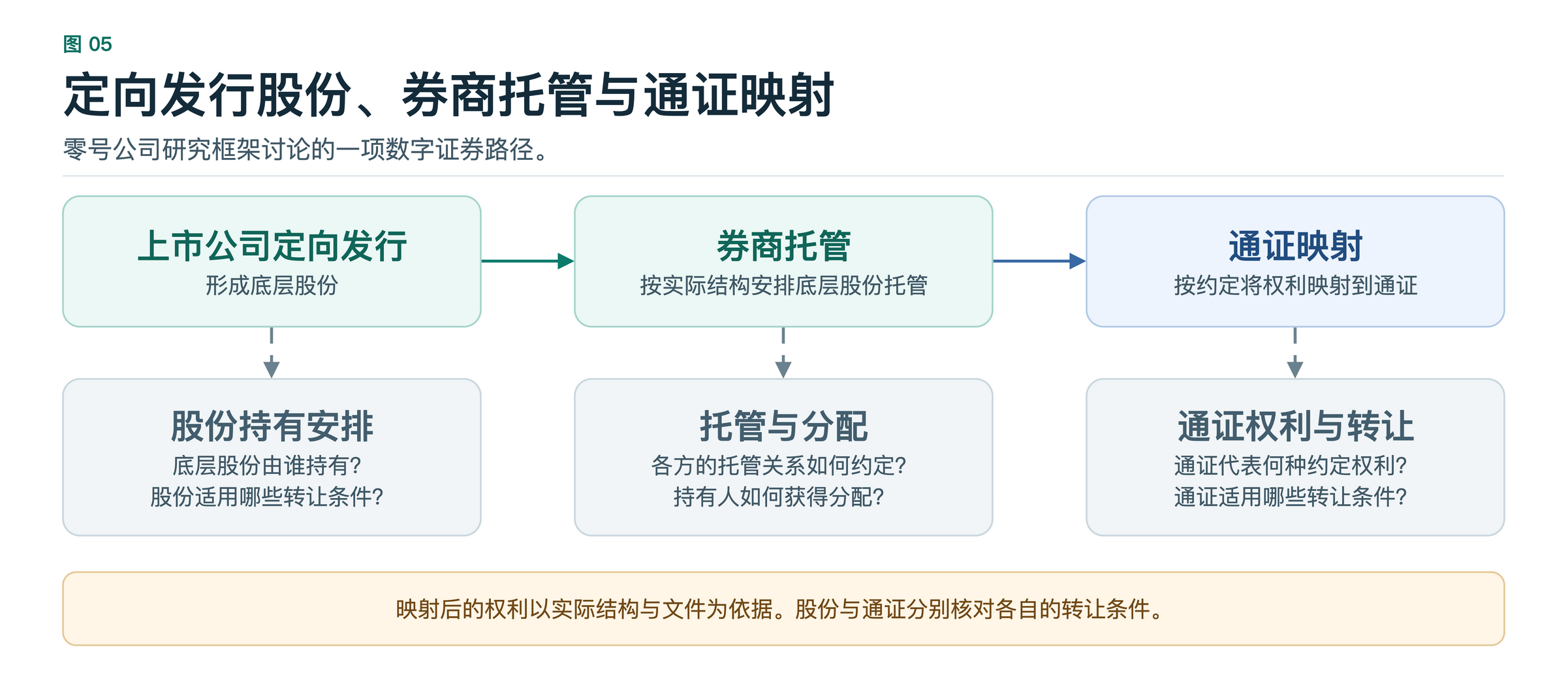
The financial layer serves the underlying value and rights. For a concrete issuance, fundraising, trading or cross-border arrangement, check the actual jurisdictions, parties and product structure one by one.
The four layers of Company Zero can be summarized as follows:
How value is created → how rights are confirmed → how risks and returns are shared → how funds enter → how instruments connect them → how operating results return to participants.
8. How the four ecosystems share the work and what the capital platform needs to do
The four layers explain how the proposal is put together; the four ecosystems identify who does each part. Use the same rules for both so that each responsibility can be traced to a person or an institution.
| Ecosystem | Responsibilities in the value cycle |
|---|---|
| Resource | Supply talent, technology, asset opportunities, channels and capacity to collaborate. |
| Operations and management | Organize resources, govern assets, run the business, and manage cost and delivery. |
| Customer | Validate value through demand, purchases and continued use, generating operating revenue. |
| Capital | Provide suitable funding and take part in pricing, governance, risk bearing, distribution and exit. |
The capital ecosystem connects with the resource ecosystem for assets and capabilities, with operations and management for operating and governance capabilities, and with customers to verify demand, revenue and whether value can be realized. Clear rights and responsibilities also give the other ecosystems a way to build a lasting relationship with capital providers.
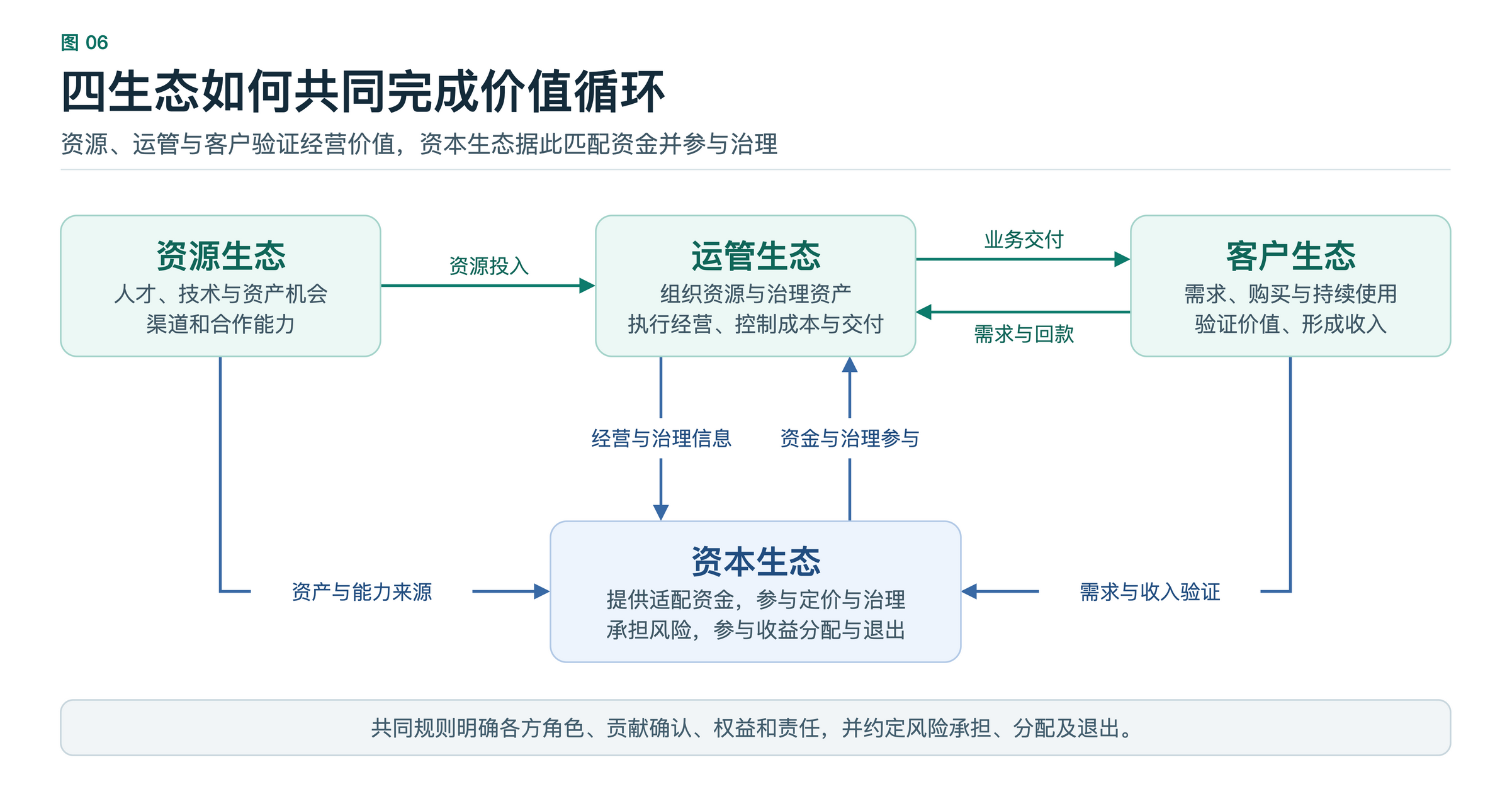
With this division of work, the Company Zero capital platform can build five capabilities:
- Identify and organize assets: Find sources of value within the ecosystems and organize the assets and capabilities that can produce operating results.
- Define investment rights: Explain contributions, ownership, governance responsibilities and return arrangements clearly.
- Match funding: Choose the sources, channels, instruments and terms that fit the assets and operating needs.
- Manage the arrangements while they are in force: Track operating results, use of funds, changes in risk and performance of obligations.
- Carry out distributions and exits: Return the proceeds of operations and transactions to the relevant parties on the agreed terms.
This framework can also connect with the existing six value systems and the four-way SOP, linking judgments about value to roles, tasks, coordination and operating results. The existing systems provide the definitions; real projects can help refine how they map to one another.
Conclusion: Keep value creation and capital relationships connected
When I go back to a particular project, I trace a few things in order. How did we organize the resources, what value resulted, how did we arrange the rights, how did the money enter the business, and what will ultimately fund payment and distribution? A capital arrangement has a basis for continuing when the evidence connects each step to the next.
Assess financing and realization efficiency alongside asset quality, operating capability, risk bearing and long-term value. Finance runs through the stages of the cycle and the connections between them. Institutions and rules let different people take part with clear roles, contributions and responsibilities.
Company Zero can test the four layers, four ecosystems and two cycles on real projects. Use the operating records to check the progress of the business, how rights were put into effect, where the money actually went and whether agreements were carried out. It is through this work that long-term capital relationships take shape.
Organize resources into assets, use governance to establish rights, use finance to connect funding, realize value through operations and transactions, and complete the capital cycle through distribution and exit.
Sources and editorial notes
- Main source: The confirmed seven-page working paper, 整理.pdf. This version combines repeated definitions and dimensions, standardizes terms such as “Company Zero,” reorganizes the discussion and restores the original diagram relationships in Mermaid.
- Related research cited in the source: Reading notes on the four forms of value: how resources, assets, capital and funds connect (in Chinese). The link is retained as a research lead from the original.
- [1] Terminology: U.S. Securities and Exchange Commission — Glossary. The entries “Secondary Market,” “Liquidity” and “Digital Security” provide background on transfers of existing rights, market liquidity and differences in rights across tokenization structures. The rules that apply to a particular project depend on its location and participants.
Download the WISERUNION capital logic diagrams (Draw.io, six pages, Chinese original)
Further reading in the Think Tank
- How Stakeholders Form Long-Term Capital Relationships
- Analyzing a Project through Resources, Assets, Capital, Funds, and the Two Cycles
- Contribution and Rights Fulfillment Worksheet
- Nine-Dimension Comparison Worksheet for Capital Pathways
- From Verified Contributions to Fulfilled Rights: How Stakeholders Form Long-Term Capital Relationships