Use this resourceTools
- Purpose
- Compare a loan, a new equity subscription, and a combination of new equity and an existing-share transfer. Record your assessment, its evidence, and open questions, and check who receives funds, what rights investors obtain, and where returns come from.
- Conditions for use
- Check that the subject, objective and constraints fit the task. Confirm any conditions that the article does not specify.
- Tools
- Fields, records and interpretation rules
- Evidence and validation limits
- Editable Excel tool V0.1. The workbook is in Chinese. The three proposed structures and amounts are fictional. Figures are in units of RMB 10,000. No separate external-validation result is recorded for this article. Publication does not establish effectiveness; check the evidence, assumptions and limits in the text.
- Version
- V0.1 · Revised 2026-11-14
- Original diagrams and files
- Download the editable Excel comparison sheet (Chinese) ↓
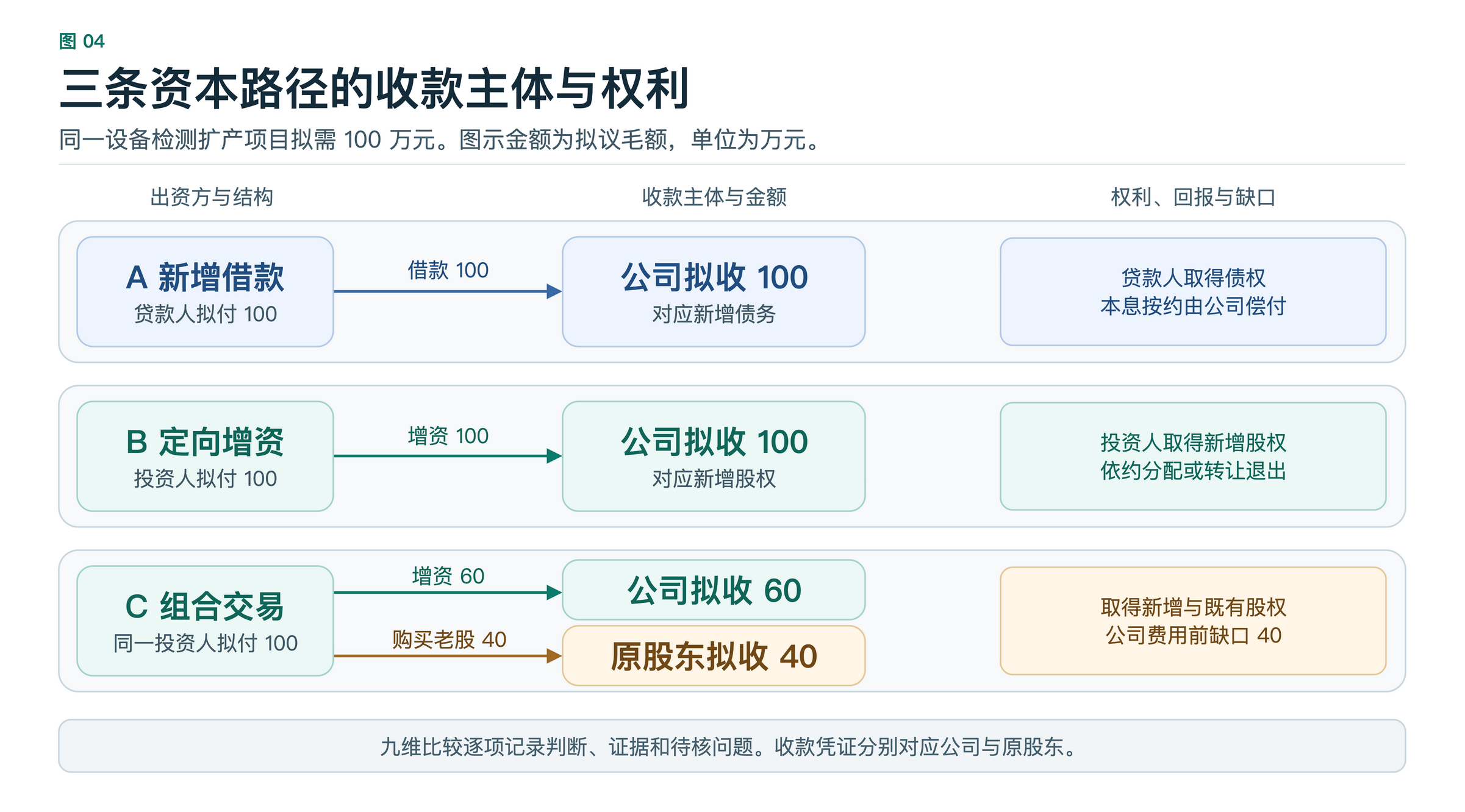
- Figure 4. A loan or a new equity subscription would each bring RMB 1 million to the company. Under the combined transaction, the company would receive RMB 600,000 and the original shareholder RMB 400,000, leaving the company RMB 400,000 short before fees.
- Download the Draw.io source (five pages, Chinese) ↓
This is a readable, citable knowledge resource, not an installed Skill. When using it with AI, retain its sources and limits and review the output.
CC BY-NC-ND 4.0 · Applies to original text unless otherwise stated; excludes third-party materials. Downloading or machine reading does not extend the existing license or separately authorize derivatives, commercial use or model training.
WISERUNION Think Tank · Tool V0.1 · November 14, 2026
Download the editable Excel comparison sheet (Chinese) ↓
Two proposals can call for the same total investment yet leave the company with quite different amounts of cash. I start by following each payment from payer to recipient. Then I check exactly what rights the investor receives, who will pay future returns, and where the money will come from.
To compare proposals on one sheet, start with the same project, funding need, and review date. In the Nine-Dimension Comparison tab, enter the project entity, review period, and proposal names. Then record your current assessment, the evidence, and the questions still open for each dimension. Evidence should point to a specific document, version, date, and clause. Where questions remain, identify what needs checking and who can confirm it.
How to fill out the nine dimensions
| Dimension | What to check |
|---|---|
| Development stage and financing round | How far has the project progressed, and which operating problem will this round address? |
| Capital participants and their roles | Who invests, who holds the rights, and who operates and fulfills the obligations? What risk does each party take? |
| Investment rights | What rights does the investor obtain, against whom, and when do they arise and become exercisable? |
| Issuance and fundraising arrangements | Who is approached through which channels, and under what conditions is payment made? |
| New issuance and transfers of existing rights | Which rights are newly created, which are transferred by an existing holder, and who receives each payment? |
| Product structure | Is the arrangement organized as a loan, direct equity, a fund, or another vehicle? What terms apply? |
| Trading and risk management | How can the rights be traded or exited, what restrictions apply, and who bears the risks? |
| Returns and distributions | Where do returns come from, who pays them, and in what order and under what conditions are they realized? |
| Registration and delivery technology | Which records establish the rights, and who handles registration, custody, settlement, and delivery? |
Check where funds go and where returns come from
In Funds and Returns, use one row for each payment. Record who pays, who receives it, how much, and when. Then record the use of proceeds, the rights obtained, and the source of returns. If an investor both subscribes for new equity and buys existing shares, enter the two payments separately. Record operating receipts separately too, marking whether a figure is an estimate for debt service or distributions, or a verified receipt.
Take proposed amounts from the proposal, approved commitments from approval documents, and actual receipts from account statements. Contracts establish rights and performance conditions. Payment records establish whether the transfer took place.
The top of the Nine-Dimension Comparison tab automatically totals proposed company financing, proposed proceeds from existing-share sales, the company's proposed funding gap, and verified financing received for each of the three routes. For a receipt to count, set the status to Partially Received or Received and enter a positive amount, a receipt date no later than the review date, and supporting evidence. Leave the amount blank if it is unknown and enter 0 if there is definitively no payment. Record installments by tranche and allocate proposed gross amounts to the respective tranches. The workbook provides three routes and 60 payment rows. Replace the examples with data from the actual project.
The fictional equipment inspection expansion in the method article illustrates the comparison. All three alternatives are proposals. The amounts in the table are in units of RMB 10,000, before fees. Analyzing a Project through Resources, Assets, Capital, Funds, and the Two Cycles
| Proposal | Proposed recipients | Rights and source of returns |
|---|---|---|
| A · Loan | The lender pays 100 to the company. | The lender obtains a contractual debt claim and receives interest and principal as agreed. Check repayment capacity against available company cash and the repayment schedule. |
| B · New equity | The new investor pays 100 to the company. | The investor receives newly issued equity. Returns come from eligible distributions or proceeds from a later sale to a buyer. |
| C · New equity and existing-share transfer | The investor pays 60 to the company and 40 to the original shareholder. | The investor receives both newly issued and existing shares. The original shareholder receives the sale proceeds. The investor's future returns depend on the rights acquired and the terms for distribution or exit. |

View full-size figure ↗Download the Draw.io source (five pages, Chinese) ↓
In proposal C, the investor proposes to pay RMB 1 million in total, of which the company would receive RMB 600,000. Against the RMB 1 million needed for expansion, the company still faces a RMB 400,000 gap before fees. For each proposal, check the actual receipt date, costs, and permitted uses. When evidence is missing for a right, a payment destination, or a source of repayment, record the open question in the relevant dimension and preserve the version of the materials used. Understanding a Project through Four Chains: Entities, Assets, Funds, and Rights