A project presentation can describe an ambitious industry, a platform, partners and a development path. Yet when the team tries to move forward, a few questions may still be unclear: who signs, who owns the assets, who receives the money, and who is responsible if something goes wrong?
I think these questions offer a useful starting point.
Lay out four chains: entities, assets, funds and rights. Then examine whether they correspond. What does each name refer to? What does each connection mean? Which document supports it, and what stage has the arrangement reached?
Once these matters are clear, there is a basis for discussing the details.
A diagram can show a complete set of relationships. Evidence determines how much we can say about those relationships.
1. Examine the four chains separately first
Each chain answers a different question.
| Chain | First question | Follow-up questions |
|---|---|---|
| Entities | Who participates, signs and takes responsibility? | How are the parties related, and where does their authority come from? |
| Assets | What assets or rights does the project involve? | Who controls them, how were they obtained, and what conditions or restrictions apply? |
| Funds | Where does money come from, through whom does it pass, and where is it used? | What remains planned, what has been secured, and what supports each payment? |
| Rights | What does each participant obtain, and who must fulfil the corresponding obligation? | When and under what conditions are rights obtained, and how are they recorded, fulfilled or exited? |
Separating the chains helps explain matters of different kinds. We then need to bring them back together around the same transaction or activity.
One company may perform several roles, and several companies may divide the work of one business activity. What needs explaining is the basis for those arrangements and the part for which each party is responsible.
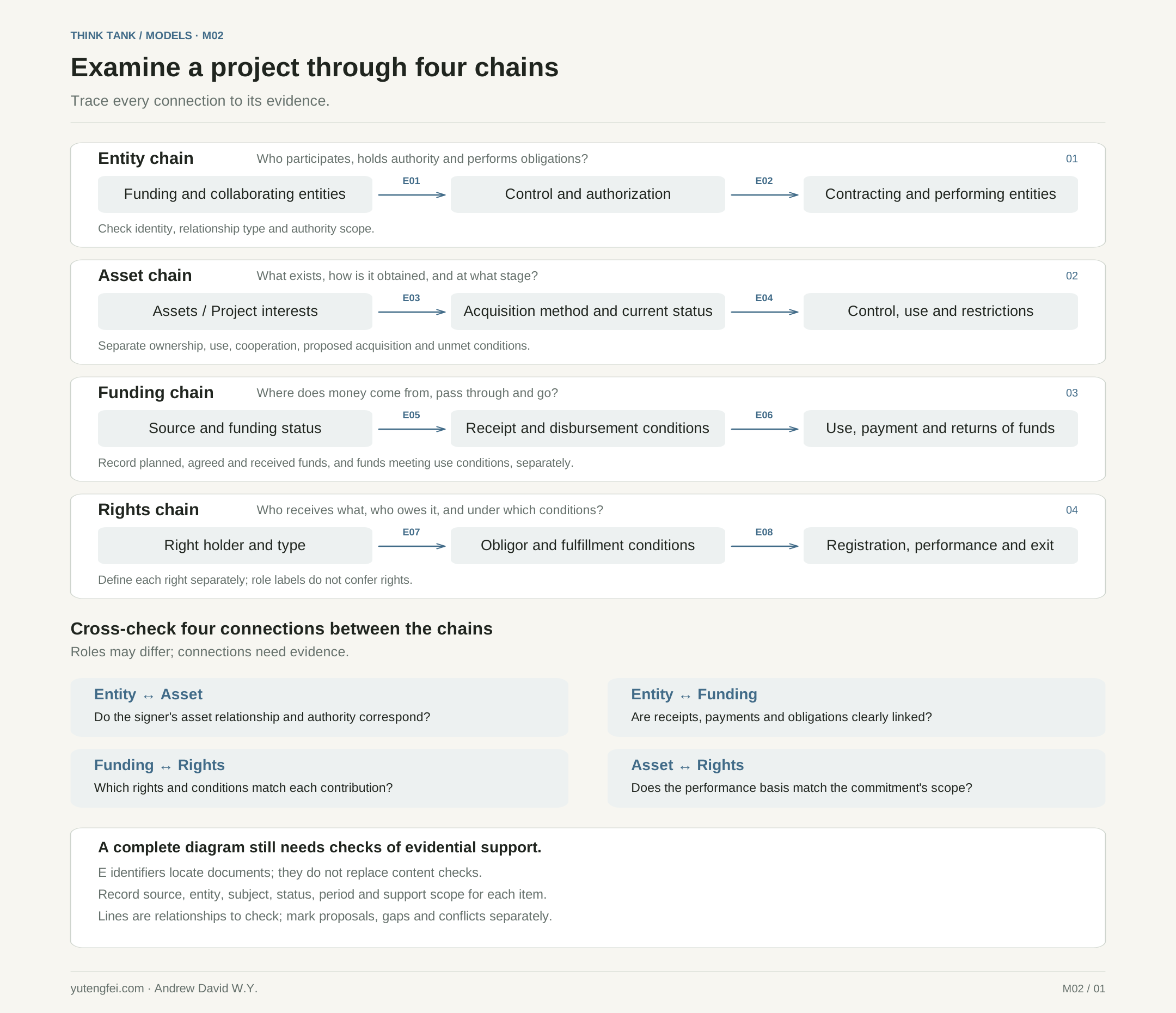
Figure 1: The four chains are four perspectives for review. A connecting line identifies a relationship to establish; it does not imply a transaction sequence or that the relationship already exists. E01–E08 are illustrative evidence IDs.
Download the editable SVG framework
2. Entities: who is actually doing the work behind each name?
Project materials may mention a group, a business brand, an operating platform, a project company, partner organizations and a preparatory team. Distinguish what each name represents before discussing the relationships between them.
For every name, I suggest adding three pieces of information: what it is, what work it undertakes, and who can make the relevant arrangements on its behalf.
If it is a company, verify the specific legal entity. If it is a brand, business division or working name, label it accordingly. Do not automatically treat it as the contracting party or recipient of funds. A partner's name in a presentation also requires confirmation of the scope and current status of the cooperation.
Then follow the relationships: who provides capital, who manages, who operates, who signs and who performs the obligations? Which relationships involve control, cooperation or delegation? What authorizes the person signing on an entity's behalf?
A shareholding chart may answer some of these questions. The business activity itself also needs corresponding agreements, authorization and records of actual performance.
Pay particular attention when the project is introduced under one name, the contract uses another entity and a third party receives payment. Different roles do not by themselves establish a problem, but the connections between them must be explained.
3. Assets: what is their current status?
When reviewing assets, I would separate “what is involved” from “how it may be used.”
A machine, premises, technology, an order and an arrangement for project income are different things. Ownership, a right of use, eligibility to cooperate and a proposed acquisition also create different operating conditions.
At a minimum, an asset record should identify the object, the relevant entity, how it was or will be obtained, and its current status. Add the scope, term, conditions of use and known restrictions where needed.
If an acquisition is proposed, say so. If an agreement is signed but its conditions remain unmet, retain that status. If delivery and use have begun, check the corresponding records. Clear status descriptions are more useful than placing everything inside a box labelled “group assets.”
Check the scope of the evidence too. A photograph of equipment may help identify the object; the photograph alone does not establish ownership. An expression of intent may show the direction of discussions, but it does not replace evidence of a completed acquisition.
If a document is absent from the materials supplied, record “not included in this set of materials; further information required.” State the gap before drawing a conclusion about whether the enterprise has the asset or the relevant right.
4. Funds: examine each step after establishing the total
Funding figures are easily mixed. Record the total project budget, proposed funding for the current round, expressions of interest, committed amounts, funds actually received and funds eligible for use separately.
The same money appearing at several steps must not be counted as several sources of funding. If the group receives money and transfers it to a project company, that is a movement between entities. Define the reporting scope and avoid double counting.
For each amount, I would continue checking: who provides it, who receives it, what authorizes receipt, which conditions allow payment, what it will ultimately fund and who checks its use?
Where money is expected to flow back later, specify the source, payment obligation, calculation basis and conditions. Planned sales or operating income remain plans. A return arrow in a diagram does not demonstrate that distributable funds already exist.
The main task is to distinguish plans, agreements and events that have actually occurred. Only then can people discuss a funding gap, disbursement progress and implementation on the same basis.
5. Rights: what does participation actually provide?
Participation may provide equity, a contractual income-sharing arrangement, goods, services, business benefits or other rights. Explain each separately.
Terms such as “partner,” “business partner” or “long-term co-builder” may help describe a relationship. The specific rights still depend on the corresponding arrangements.
I think at least five questions need answers:
- Who holds the right, and what exactly is it?
- Who carries the corresponding obligation?
- Under what conditions is the right obtained, and when does performance begin?
- Which records confirm it, and how are discrepancies reviewed?
- If the original plan cannot proceed, how are adjustments, termination or exit handled?
Record different forms of participation separately. Calling them all “investment” or “cooperation” does not make the rights identical.
In particular, reconcile funds with rights. Who receives the money and who owes the relevant obligation are two questions to check. If they are different parties, establish the basis connecting them. A sentence of assurance in a presentation cannot replace that connection.
6. Bring the four chains together to find the gaps
Here is a wholly fictional equipment project. Its entities and arrangements are created for teaching and do not refer to a real enterprise.
Suppose Project Company A plans to build a production line. Operating Company B will run production, Supplier C will supply equipment, and Partner D proposes to provide funding.
The presentation says D is acquiring equity in A. An existing draft contract names B as the payment recipient. A signs the equipment procurement draft, while a separate note proposes that B may use the equipment.
These materials allow us to ask questions. They do not yet establish all the relationships as effective.
- Entities and funds: Why would D pay B? If B collects on A's behalf, the authority and accounting arrangements need to be clarified.
- Funds and rights: How does D's payment correspond to equity in A? Explain the obligated party, acquisition conditions and confirmation procedure separately.
- Entities and assets: Who purchases, receives, controls and uses the equipment? Check the scope of the contracts and the subsequent delivery records.
- Assets and rights: Does B's proposed use of the equipment support the production responsibilities it undertakes? What are the scope, term and outstanding conditions?
Update the assessment if later materials reconcile these matters. Retain an unresolved status for remaining conflicts.
This review tells the team what to ask next and whom to approach for further information. A complex structure can be explained, provided its connections have an adequate basis.
7. Give each important connection an evidence ID
When drawing the diagram, I suggest numbering important connections. A discussion of a particular relationship can then go straight to the relevant materials, without searching the entire file set again.
The IDs in Figure 1 can be used as follows.
| ID | Connection to explain | Materials to examine |
|---|---|---|
| E01 | Participating entities and their control or cooperation relationships | Entity information, shareholding or cooperation arrangements and their current status |
| E02 | Authority, contracting parties and parties responsible for performance | Authorization, signing capacity and corresponding responsibilities |
| E03 | Asset objects, acquisition method and status | Ownership or acquisition evidence, agreements and explanations of conditions |
| E04 | Current status and the scope of control or use | Delivery records, use arrangements, terms and restrictions |
| E05 | Funding sources, receipt and disbursement conditions | Funding agreements, secured status and the basis for receipt and disbursement |
| E06 | Disbursement, actual use and arrangements for funds to flow back | Payment records, evidence of use, budgets and repayment or return arrangements |
| E07 | Rights holders, obligated parties and acquisition conditions | Rights provisions, corresponding obligations and conditions |
| E08 | Conditions, registration, performance and exit | Applicable confirmation records, evidence of performance and subsequent handling arrangements |
An ID is a locator. Whether the material is valid, which entity and period it concerns, and how much it supports still depend on its content.
One document may support several connections; one connection may require several documents. After receiving an attachment, keep “received” separate from “reviewed.”
8. What happens after a gap is found?
First make the intended conclusion specific. For example: “A has obtained the right to use this equipment,” or “this payment has reached the agreed recipient.” A specific conclusion makes the necessary evidence easier to define.
Then check whether four things correspond: the entity, object, status and period.
If they do not yet correspond, add the issue to a gap register. Distinguish missing information, conflicting materials and an event that has not yet occurred. They require different next steps and should not all be labelled simply “to be improved.”
For missing information, state what is needed. For a conflict, ask the relevant parties to reconcile the descriptions and supporting evidence. For an event that has not occurred, retain a planned or pending status.
Give each gap an owner, a list of required materials and a review point. Recheck when the information returns, and limit the conclusion to what the evidence supports.
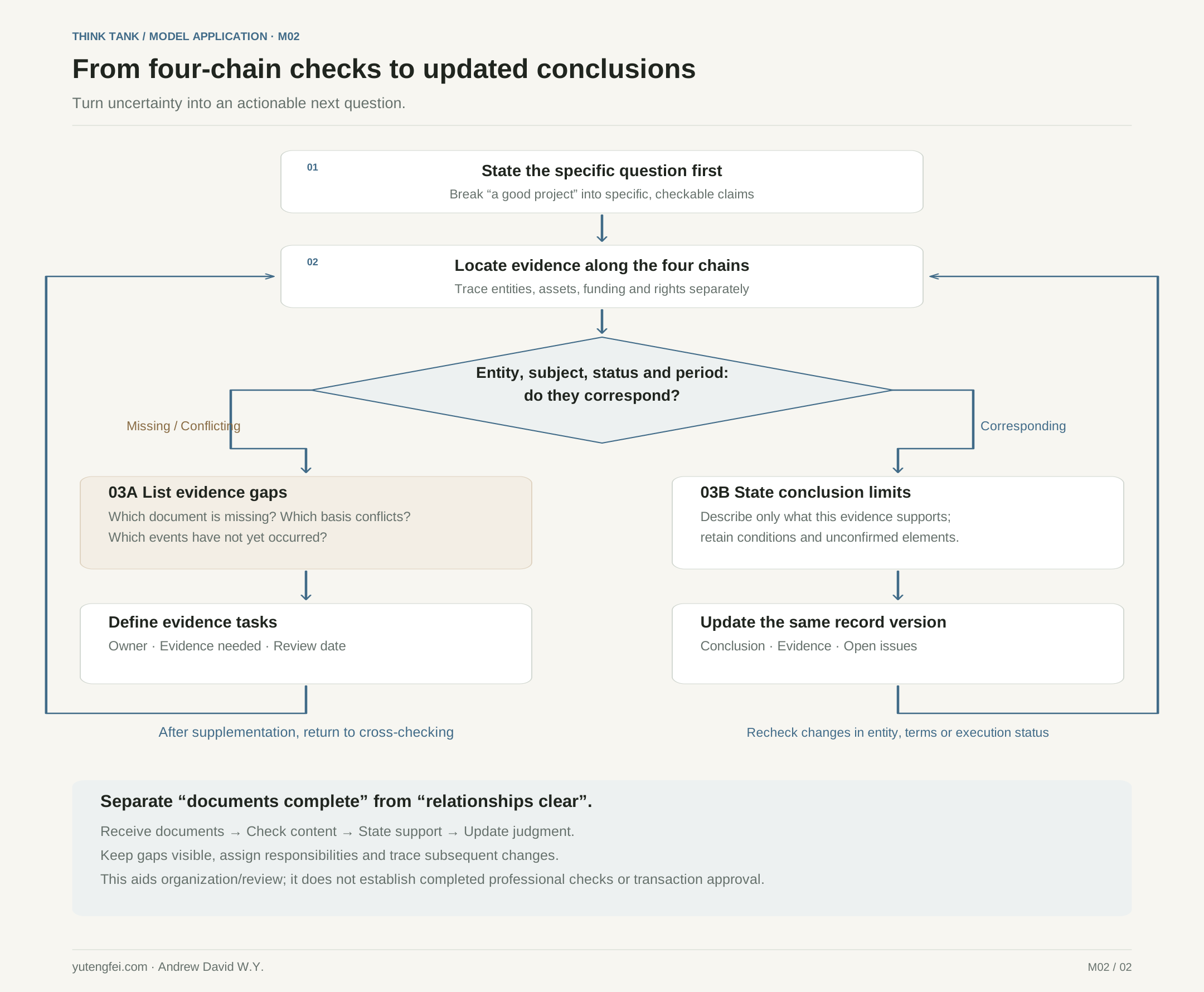
Figure 2: Return to review after obtaining further evidence. Where the materials correspond, form a working assessment with a defined scope. Changes in entities, terms or performance status require a further update.
Download the editable SVG mechanism diagram
Keep the conclusion, evidence and unresolved matters in the same version of the record. When something changes later, the team can identify which connection needs rechecking and which external statement needs updating.
9. A project becomes easier to advance when it can be explained
Understanding a project means turning scattered materials into relationships that people can question, trace and update.
The entity chain identifies responsibility. The asset chain shows the operating basis and conditions of use. The funding chain explains how resources are secured and used. The rights chain explains what each party receives and undertakes.
Cross-checking these chains moves the discussion from “this is a good project” to specific conditions and actions.
The framework helps organize facts, identify gaps and coordinate the next step. Specific questions of ownership, transaction validity, finance or other professional matters still require the appropriate people to assess the actual materials.
What matters most to me is whether, after drawing the diagram, the team can say accurately: what do we know, what do we still not know, and who will establish which fact next?
That is when the diagram starts doing useful work.