As a project moves forward, its materials usually multiply: plans, contracts, spreadsheets and chat records, stored on computers and shared in groups. Yet when someone asks where a number came from, how far a task has progressed, or which document supports a claim, the search often starts again.
Finding a file does not always mean finding an answer. A target in a plan may become reported progress. An internal record of goods leaving the warehouse may become “delivery completed” in external materials. The documents are still there, but the meaning has been stretched along the way.
I think this calls for a ledger linking statements to their supporting materials.
Before a statement is used, establish what it says, where its evidence is, how far that evidence supports it, and what remains unverified. When the materials change, follow those links to update both the conclusion and its citations.
1. Write down the statement to be checked
Organizing files into folders is useful, but take one further step: what exactly do we intend to say on the basis of these files?
Copy the original sentence proposed for a plan, webpage, report or introduction, and assign it a claim identifier. Here, a “claim” is a statement awaiting verification; the identifier does not establish that it is true.
Specify its subject, time, scope and basis. For “completed”, which batch, which stage, as of what date, and confirmed by whom? Without those details, even many documents may fail to match.
Check each action in a sentence separately. Warehouse dispatch, receipt and acceptance each require their own evidence. Verifying dispatch alone does not allow you to tick off receipt and acceptance. Keep the original sentence to show what was initially said, but split it into separately assessable items. Formal wording must stay within what is actually supported.
The same applies to figures. Amounts need units, percentages need a base, cumulative figures need a period, and plans must remain separate from actual results. Accurate wording gives the search a clear direction.
2. Give claims and evidence separate identifiers
I suggest recording claims, evidence and the verification links between them separately.
Use C identifiers for claims, E for evidence and L for links. C01 r1 is the first revision of a claim; E01 v1 is the first version of a document; L01 records how that claim revision uses that evidence version. Adapt the numbering to the team’s practice, but keep it stable. Changing a sentence must not overwrite its earlier record.
Why record links separately? One conclusion may require several documents, and one document may be cited by several conclusions. A whole file cannot simply be labelled “verified”. Its support must be assessed for each specific claim.
For example, a dispatch record may help establish quantity without establishing receipt. The same document in three folders still has one source; it is not three independent confirmations.
Record exact locations too. For a PDF, state the version, physical file-page sequence and relevant passage; add the printed page number if it differs. For a spreadsheet, give the sheet, row or record ID. “See attachment” leaves the next person searching again.
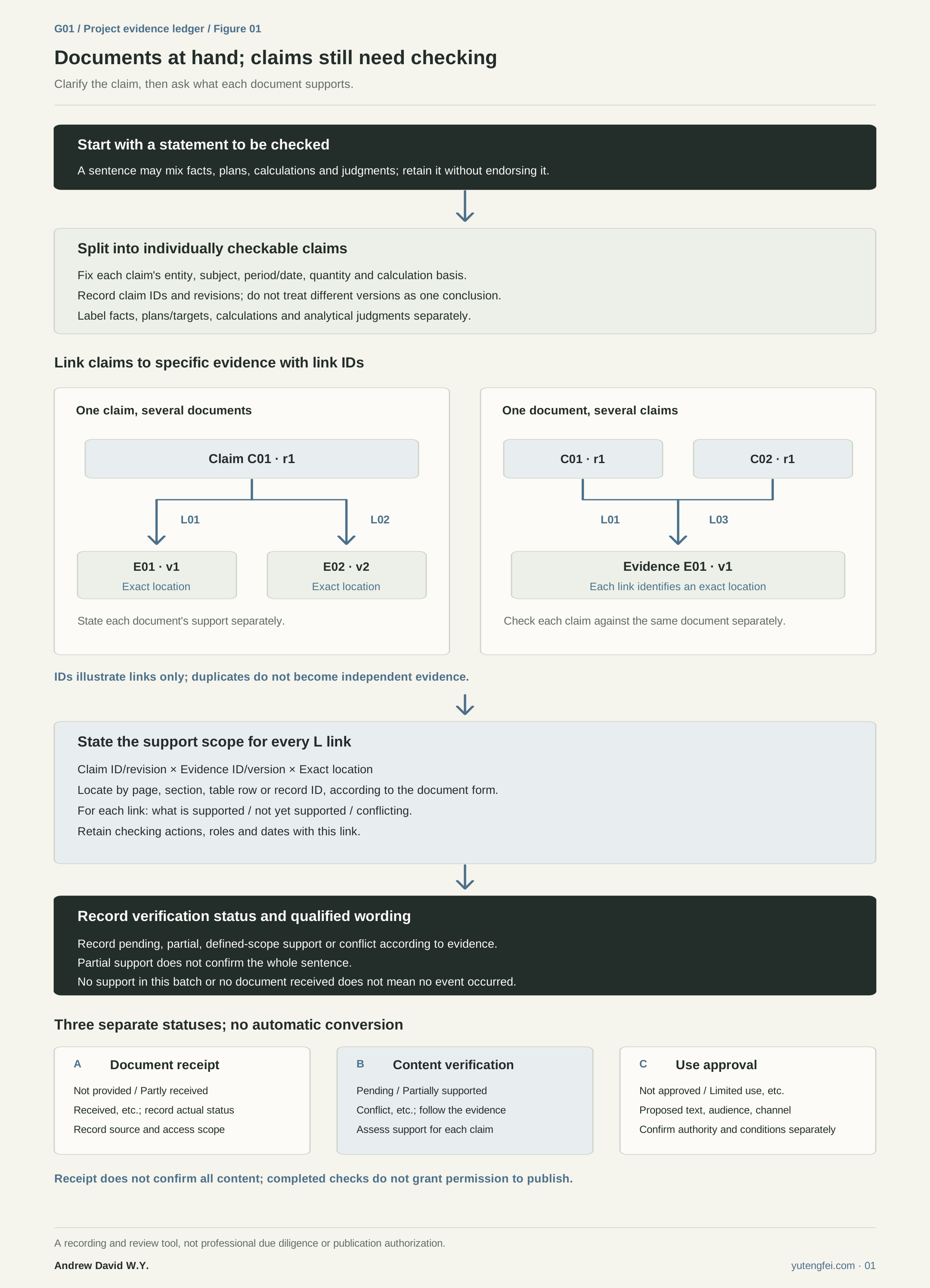
Download SVG: Claims and limits of evidential support
3. Separate three easily confused statuses
Receiving a document establishes that it has been obtained. Checking its contents establishes that certain checks were performed. Whether a statement may be used externally still depends on its wording, audience, channel and approval authority.
Record these three matters separately.
| Question | What to record | What does not follow |
|---|---|---|
| Have the materials arrived? | Not provided, partly received, received, and other acquisition statuses | Receipt does not establish authenticity, completeness or continuing validity |
| How far has this statement been checked? | Pending verification, partially supported, supported within a defined scope, conflicting, and other verification statuses | Checking part does not establish the whole statement |
| Where may this text version be used? | Not approved, approved for limited use, review required, and other use statuses | An internal judgment is not permission for public disclosure |
Also record the nature of the claim and form of evidence. Is the claim a fact, target, calculation or analysis? Is the document an original, copy, screenshot or draft plan? These affect the checks needed, but do not determine truth automatically.
The ledger needs no “pass” button that automatically turns green. A defined scope is more useful than an unqualified “confirmed”.
4. Keep conclusions within the support available
For each statement, I look at two fields together: what is supported, and what is not yet supported.
The first preserves the value of existing evidence; the second prevents overstatement. Record conflicts specifically: different subjects, periods or bases, or two accounts of the same event? Identify the difference before deciding what to obtain next.
Both examples below were newly written for teaching and are fictional. Their materials, roles, values and 2030 scenario dates represent no real project. They demonstrate verification methods, not actual business records.
Example 1: Can 12 display stands be described as “delivered and accepted”?
The original claim is: “The 12 display stands in this batch have been delivered and accepted.”
Open E01 and find record ID OUT-07. The first row records 12 stands as dispatched from the warehouse. Neither receipt confirmation nor acceptance records have been provided.
The evidence currently supports only that the simulated internal record states that 12 items were dispatched. It does not yet establish receipt or completed acceptance. Mark C01 “partially supported”. Next obtain receipt confirmation and acceptance records, and check the entity, batch, scope and dates.
For internal review, narrow the wording to: “The simulated internal records for this batch state that 12 display stands were dispatched from the warehouse; receipt and acceptance remain to be verified.” This wording is still not approved for external use.
Missing acceptance records in this batch do not establish that acceptance never happened. The current conclusion is “not yet verified”. Do not turn missing documents into a negative claim about reality.
Open E01: Simulated dispatch record
Example 2: Why does an unchanged 15% produce two results?
The original claim is: “The materials-organizing subsidy has been set at 1200 exercise units.”
Draft A, E02, uses a base of 8000 exercise units: 8000 × 15% = 1200. Draft B, E03, uses a base of 2000: 2000 × 15% = 300.
Both calculations can be arithmetically correct, while the choice of base remains unresolved. Both documents are drafts, with no evidence of approval or effectiveness and no formal statement that one supersedes the other. B is dated one day later; that alone does not make it effective.
Mark C02 “conflicting”. Keep the two inputs, recalculations and limits of support separately in L02 and L03. Retain this internal wording: “Recalculation using the different bases in two simulated drafts produces 1200 and 300 exercise units respectively; the adopted base, approval and eligibility conditions remain unconfirmed.”
Arithmetic shows how a result follows from given inputs. Whether the inputs were approved, to whom they apply, and whether eligibility conditions are met need separate checks. A calculator result cannot replace confirmation by an authorized person.
Open draft A · Open draft B · View both completed fictional examples
5. Link gaps to people and next actions
“More information needed” often leaves the work where it was. State exactly what is needed, which role is proposed to provide it, who will follow up and review it, and when it is planned to be checked again.
If nobody has been assigned, write “proposed follow-up by [role], pending assignment”. If the date is unconfirmed, leave it to be determined. Do not make commitments for others merely to fill the table. Record planned dates and actual action dates separately; reaching a planned date does not complete the work.
Specify the review action too: locating an original passage, checking applicability, recalculating, or comparing documents. Record the action and result so that others can understand how “partially supported” was reached.
Some questions require financial, legal, technical or other professional work. The ledger routes them appropriately and retains the response. Its working statuses do not replace professional due-diligence conclusions.
6. When materials change, find where they were used
The ledger must cover more than the first check. A new document may change an earlier statement and affect materials already distributed.
Retain the old file and register the new version. Check what changed, the applicable scope, who confirms effectiveness, whether supersession is explicit, and how existing rights and conditions are handled. A later date or “final” in the filename answers none of these automatically.
If a claim changes, retain the old revision and add a new one with its basis and verification date. Mark the current wording to which an old revision no longer applies, so that it is not reused directly as a current source.
Return to use records and locate webpages, plans, presentations and downloads that cited it. Decide individually whether renewed review, suspension, text changes, attachment replacement or other action is needed, and record the actual result.
Use approval must identify the exact text version, audience, channel and conditions. Permission for a sentence in one internal meeting does not permit publication on a public webpage. Completed verification also does not establish permission to display source materials publicly.
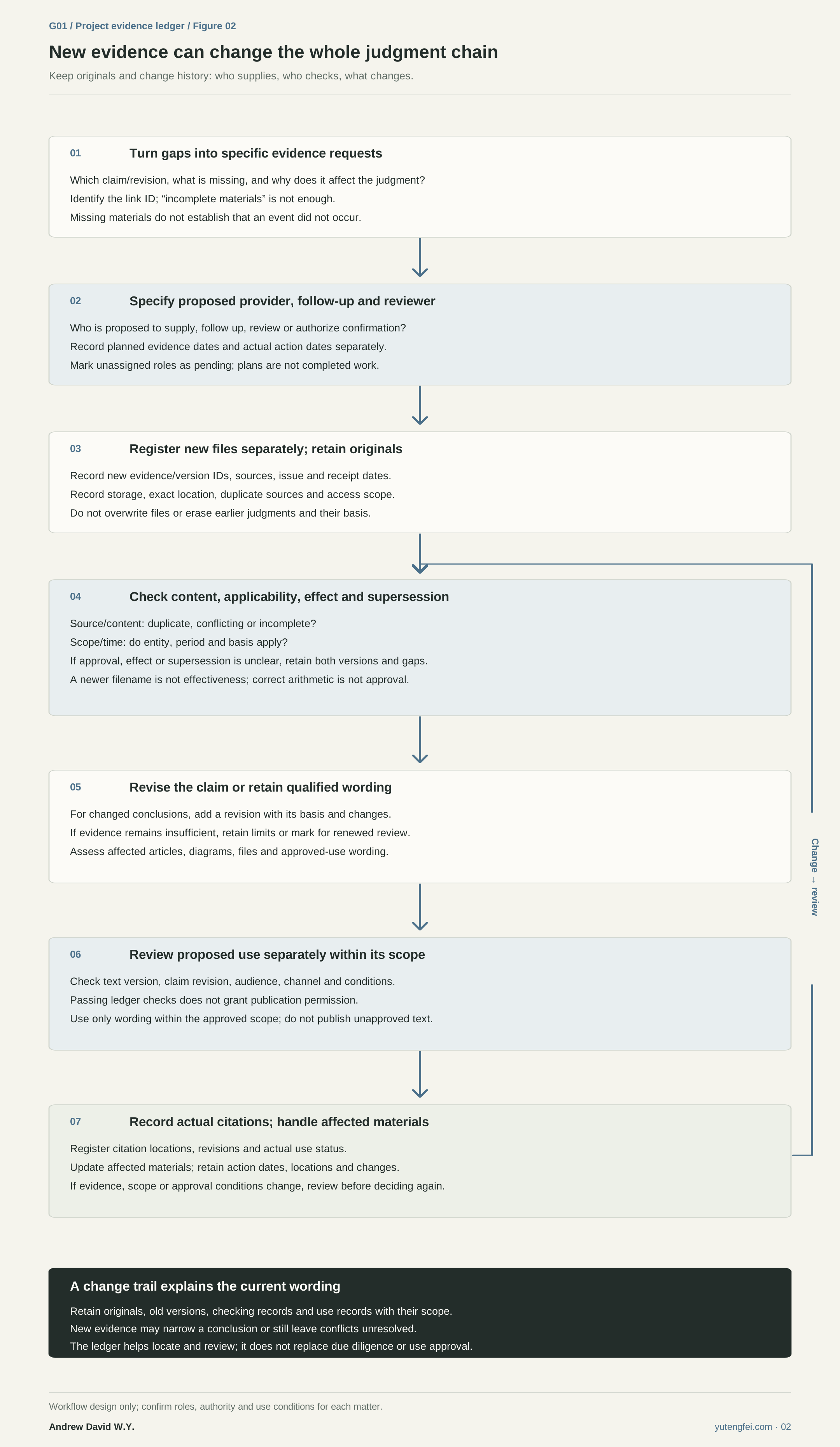
Download SVG: Evidence, review and statement updates
7. Start with one important conclusion
There is no need to renumber every file at once. Choose one important, frequently cited statement and work through these steps.
- Copy the original statement; specify subject, period, units and applicable conditions; assign a claim identifier and revision.
- Register the materials, exact versions and locations, sources, duplication relationships and access scope.
- Link each claim to each relevant document, recording support, gaps, conflicts and actual checking actions separately.
- Form limited wording for internal review. List proposed additional materials, follow-up and review roles, and planned dates.
- When use beyond the immediate review is genuinely needed, record the proposed text, audience, channel and approval basis. Recheck all citations after materials change.
The tool has five tables: claims, evidence index, verification links, actions and changes, and use approvals and records. Start at the claim row and follow identifiers to documents and checking records. The relationships remain traceable as they multiply.
The Excel workbook contains five blank tables and two fictional examples. Blank tables contain no prefilled names, statuses or approval dates. Examples are on separate sheets to prevent confusion with real records. CSV and Markdown versions are also provided for maintenance in other tools.
Download the editable Excel ledger · Blank ledger and instructions · Field and status definitions · Update review and citation checklist
Download SVG: Blank check for a single conclusion
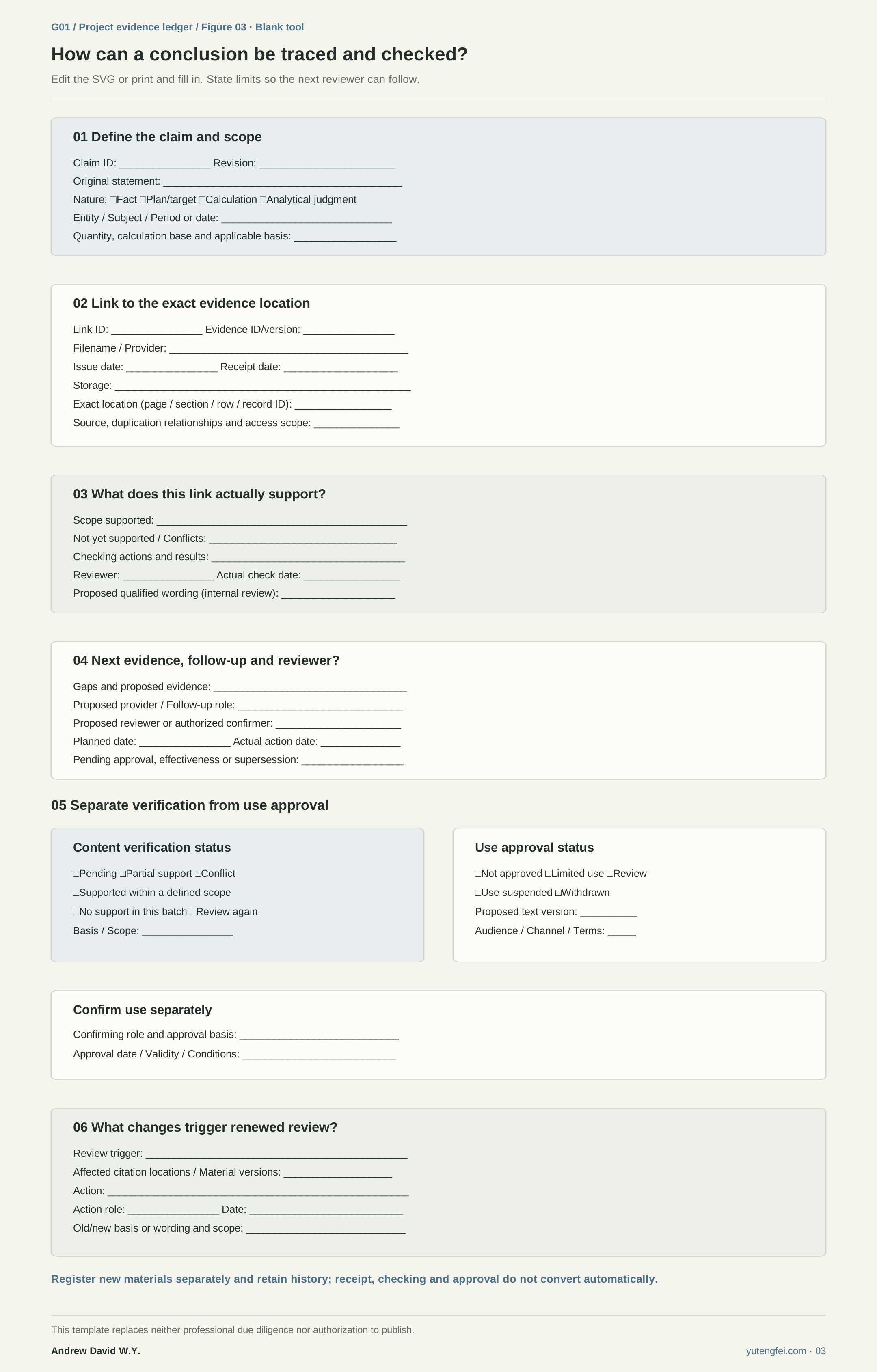
8. Turn complex materials into checkable relationships
This is a practical expression of what I call “complexity, simplicity, ease and diagrams”.
First organize scattered materials, original statements, conditions and conflicts: address complexity. Then isolate the evidence and gaps relevant to one claim: simplify. Make numbering, locating, status recording, follow-up and review into actions another person can take over: make it usable. Finally, connect conclusions, evidence, supplementation, confirmation and citation updates in a diagram.
The diagram must still let someone open the evidence, find the passage and explain the judgment. Keep unresolved questions, narrow overstated wording, and continue obtaining missing materials.
The next person should be able to follow the ledger and see what supports a statement, how far it has been checked, and which role must confirm the next step.