Use this resourceMethods
- Purpose
- Use an equipment inspection expansion to trace value, check three cash flows through the operating and capital cycles, review the proposal in four layers, and assign verification responsibilities across four ecosystems.
- Conditions for use
- Check that the subject, objective and constraints fit the task. Confirm any conditions that the article does not specify.
- Methods
- Steps, inputs and completion criteria
- Evidence and validation limits
- Project analysis method V0.1. The inspection case and figures are fictional. The figures in the tables are in units of RMB 10,000. No separate external-validation result is recorded for this article. Publication does not establish effectiveness; check the evidence, assumptions and limits in the text.
- Version
- V0.1 · Revised 2026-11-14
- Original diagrams and files
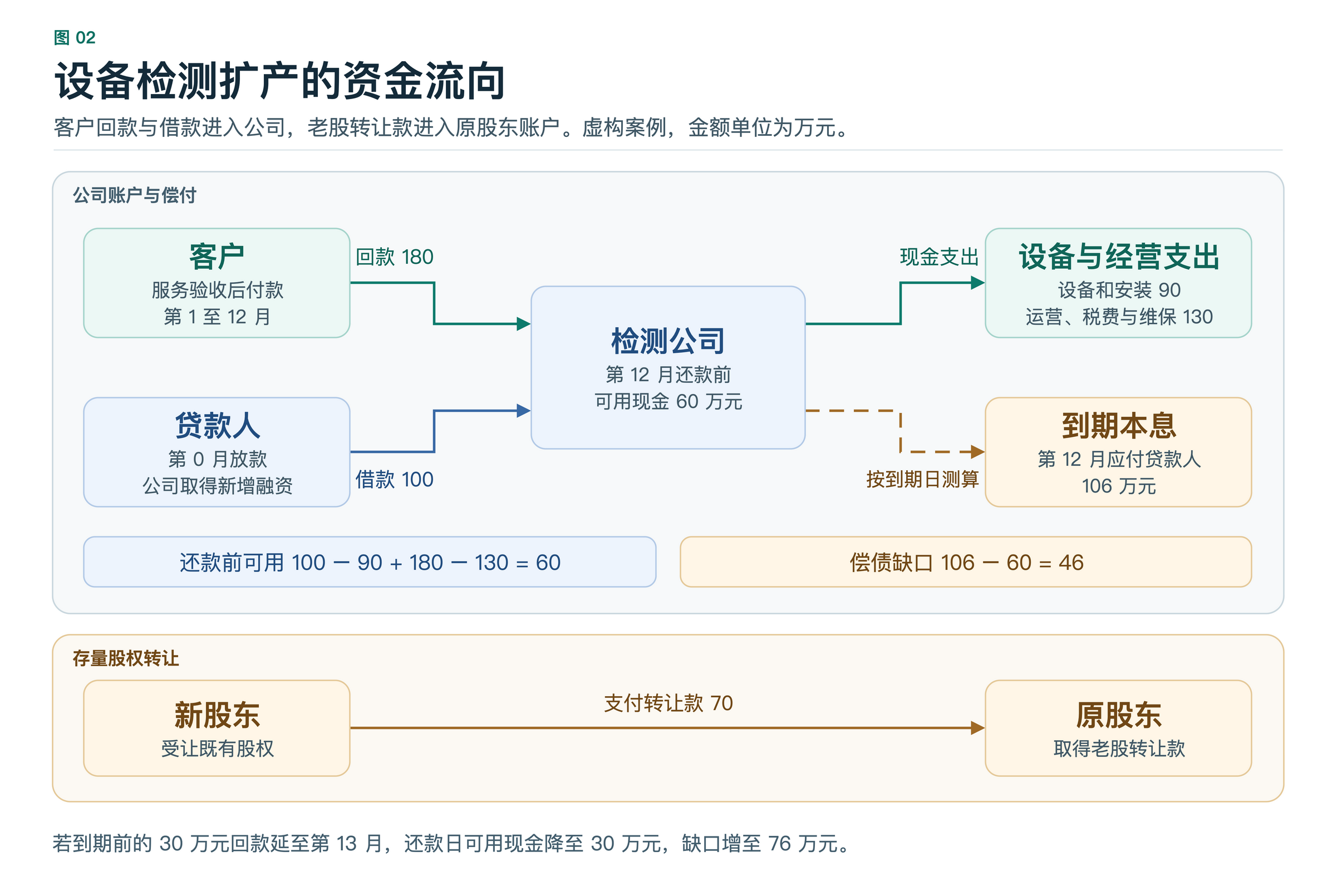
- Figure 2. The inspection company receives RMB 1.8 million in customer receipts and RMB 1 million in loan proceeds. After spending RMB 2.2 million, it has RMB 600,000 before repayment. Principal and interest due total RMB 1.06 million, leaving a shortfall of RMB 460,000. A separate RMB 700,000 share purchase goes to the original shareholder.
- Download the Draw.io source (five pages, Chinese) ↓
This is a readable, citable knowledge resource, not an installed Skill. When using it with AI, retain its sources and limits and review the output.
CC BY-NC-ND 4.0 · Applies to original text unless otherwise stated; excludes third-party materials. Downloading or machine reading does not extend the existing license or separately authorize derivatives, commercial use or model training.
WISERUNION Think Tank · Method V0.1 · November 14, 2026
An equipment inspection company plans to expand. The company receives a loan of RMB 1 million. On the same day, a new shareholder pays RMB 700,000 for existing shares. The inspection business then collects RMB 1.8 million from customers. Put the figures together and it is tempting to start with the total. I first ask whose account each payment reached, how much the company can use on repayment day, and where the lender's and shareholders' returns come from.
To reconcile the figures, first agree which company to examine, on what date, and from what starting point. Here, examine the inspection company from the initial outlay in month 0 through month 12. Use the agreed repayment date in month 12 as the cutoff. The case and amounts are fictional. Amounts are in units of RMB 10,000 unless written out.
| Framework | What it helps answer | What to record |
|---|---|---|
| Resources, assets, capital, and funds | How do resources become assets, how do assets support capital arrangements, and how do funds go back into operations? | The outcome of each transition, the limits of control or use, its evidence, and bottlenecks. |
| Operating and capital cycles | How does funding support delivery, and how do delivery and receipts affect funding size, tenor, and repayment? | Two connected processes and where they meet at investment and collection. |
| Four layers of capital design | Which operating conditions should be verified before deciding on rights, funding, and financial arrangements? | Findings and open questions for the value, rights, capital, and financial connection layers. |
| Four ecosystems | Who provides resources, runs operations, validates value, and provides capital and bears risk? | Participants, responsibilities, evidence, and return arrangements. |
Step 1. Trace value through resources, assets, capital, and funds
Follow the business and ask at every stage what happened, who controls or can use it, and what evidence supports it. Cash received can count as an asset in financial records. For the project, check who can draw on it, what it can fund, and whether conditions apply.
| Transition | What happens in the inspection project | Evidence to check |
|---|---|---|
| Resources → assets | Organize inspection staff, technology, and equipment supply into installed and accepted inspection equipment and repeatable service processes. Customer trial orders and acceptance records test whether those capabilities have operating value. | Purchase and installation acceptance records, equipment inventories, software or technology use terms, trial orders, and service acceptance records. |
| Assets → capital | Use equipment readiness, verified orders, and payment terms to explain the expansion. Then clarify the rights, obligations, and risks of the creditor, shareholders, and project company. | Equipment ownership and use restrictions, order and collection history, the loan agreement, and share transfer documents. |
| Capital → funds | The lender pays RMB 1 million to the company under the loan agreement. The buyer pays RMB 700,000 to the original shareholder. The two payments correspond to a debt claim and existing shares, respectively. | Disbursement conditions, actual receipts, the share transfer agreement, and the seller's receipt records. |
| Funds → operations and reinvestment | The company pays RMB 900,000 for equipment and installation and keeps RMB 100,000 for working capital. It then uses customer receipts for service costs and checks what remains for agreed repayment, distributions, or reinvestment. | Use-of-funds ledger, equipment payment evidence, operating cash records, and debt-service schedule. |
If equipment has arrived but installation has yet to be accepted, revisit the expansion schedule. When can it enter service? Who deals with a delay? The answers determine when the first inspections can be delivered and whether cash collection dates should change.
Step 2. Put the three cash flows into the two cycles
Start with the use of funds. After equipment and staff are in place, how many inspections can the company deliver, when will customers accept them, and when will they pay? Receipts first have to cover operations, taxes, and maintenance. The remainder may support the next round of investment. That is the operating cycle. Then work back from results and funding needs. Who is willing to provide funds, what rights do they receive, how does the company use the funds, and how does it repay or distribute them? Existing shares can also be transferred under the relevant terms, allowing holders to exit. That is the capital cycle. Funds in place support capacity and delivery. Actual delivery and receipts then inform a fresh look at the amount, tenor, and return agreed for the financing.
| Cash flow | Payer and recipient | Amount and timing | Evidence and use |
|---|---|---|---|
| Customer operating receipts | Customers pay the inspection company. | 180 actually collected in months 1–12. | Reconcile orders, acceptance, receivables records, and company account statements. Used for operating costs and agreed repayment or reinvestment. |
| New company financing | The lender pays the inspection company. | 100 received in month 0. A single payment of principal and interest totaling 106 falls due in month 12. | Reconcile the loan agreement, disbursement records, and use-of-funds ledger. The loan funds equipment, installation, and working capital. The lender receives interest as agreed. |
| Proceeds to the prior holder | The new shareholder pays the original shareholder. | 70 paid in month 0. | Check the transfer agreement, seller's proof of receipt, and change of shareholding. The seller receives the proceeds. The buyer obtains existing shares, with future returns depending on the rights acquired, distributable results, or the terms of a future sale. |

View full-size figure ↗Download the Draw.io source (five pages, Chinese) ↓
One buyer can subscribe for new equity and buy existing shares in the same deal. For each payment, check who receives it, what the payer acquires, when it arrives, and what it can fund. If the seller later reinvests the proceeds in the company, check the terms and receipt for that new transaction. In funding records, keep distinct evidence for budgets, commitments, receipts, and amounts spent. Once money arrives, check restrictions on its use.
Check available cash on the repayment date
Assume the project starts with zero cash. From the loan, the company pays 90 for equipment and installation and retains 10 for working capital. Operating cash expenses total 130, comprising 120 in operating costs and 10 in taxes and maintenance. Assume that all flows occur within the stated periods, that month 12 receipts and operating payments occur before the due date, and that the full remaining balance is initially available for debt service.
| Review period | Cash received by the company | Cash paid by the company | Period-end or pre-repayment balance |
|---|---|---|---|
| Month 0 | 100 | 90 | 10 |
| Months 1–6 | 70 | 55 | 25 |
| Months 7–11 | 80 | 60 | 45 |
| Month 12, before repayment | 30 | 15 | 60 |
On repayment day the company owes 106 in principal and interest and has 60 available, a gap of 46. The original shareholder holds the separate RMB 700,000. Debt service depends on money the company can use. What happens if the month 12 customer receipt of 30 moves to month 13 while expenses and the loan due date stay put? Available cash falls to 30 and the gap rises to 76. If the company needs to retain working capital for ongoing operations, deduct that amount before calculating the gap.
Monthly totals offer a first look. To check whether payments can be made on time, put receipts, expenses, and debt payments on a daily schedule and check balances on major payment dates and due dates. For early payments, customer delays, or restrictions on funds, return to the specific dates, accounts, and evidence.
Step 3. Review the proposal through four layers
| Layer | What to establish | Evidence needed here |
|---|---|---|
| Value | Establish why customers pay, how many inspections the company can deliver, and when receipts are expected. | Signed orders, inspection capacity and utilization, acceptance records, payment history, and receivables outstanding. |
| Rights and obligations | Identify who owns and uses the equipment, who signs the contracts, who repays the debt, and whose rights the share sale affects. | Purchase and use terms, the loan agreement, share transfer documents, and related approvals or authorizations. |
| Capital | Estimate the gap for equipment, working capital, and the minimum cash reserve. Compare funding size and cost with the operating payback period. | Scheduled outlays and projected receipts, repayment plan, use of proceeds, and stress scenarios. Here, check how the repayment plan holds up if receipts are delayed. |
| Financial connection | Check the channel, disbursement terms, accounts, and settlement process against the use of funds, term, and obligations. | Proof of disbursement and use, account restrictions, repayment conditions, and items requiring fresh agreement. |
If customers pay more slowly, update the evidence on delivery and receipts at the value layer, then check the fit with the financing, disbursement, and repayment terms. If considering a longer term, installment repayment, or additional funds, verify costs, responsibilities, whether the funds are secured, and the impact on future operations.
Step 4. Assign verification responsibilities across four ecosystems
| Ecosystem | Participants here | Evidence responsibilities |
|---|---|---|
| Resource ecosystem | Equipment suppliers, technicians, and service partners. | Suppliers provide equipment and technology delivery records. Operations confirms acceptance and use conditions. |
| Operations ecosystem | The inspection company's operating, delivery, and finance leads. | Operations verifies capacity, cost, and delivery. Finance verifies receipts, uses, due dates, and balances. |
| Customer ecosystem | Customers buying inspections. | Customers confirm orders and acceptance. Operations and finance reconcile actual receipts against contracts and bank statements. |
| Capital ecosystem | Lender, new shareholder, and original shareholder. | The lender checks disbursement and amounts due. Share buyer and seller retain payment and change-of-rights records. Project finance checks which payments entered the company's account. |
If the same participant plays several roles, record its role, responsibilities, and returns transaction by transaction. Track each party's inputs, performance, and fulfillment of rights through the stages in the companion model. How Stakeholders Form Long-Term Capital Relationships
State a conclusion that can be verified
On the case records, the company needs to address a RMB 460,000 funding gap before the repayment date. Operations generated net cash, yet receipts on the existing schedule cannot cover principal and interest due in one payment. The company needs to verify what funding can be secured before maturity or obtain the lender's agreement to a revised schedule, then update the calculation.
For an actual project, state the conclusion alongside the evidence. Specify the company, review date, and available money. Identify the first shortfall date, who must be paid, and where payment will come from. Record the missing evidence and who will obtain it. Here, start with acceptance and payment dates for month 12 receipts, the available account balance, and the latest repayment terms in force. Once the records are available, repeat the calculation on the same basis.
Related reading
- How Operations and Capital Arrangements Support Each Other
- Putting Sources and Uses of Funds in One Table
- Understanding a Project through Four Chains: Entities, Assets, Funds, and Rights
- The Capital Logic and Pathways of Stakeholder Capital Theory
- From Verified Contributions to Fulfilled Rights: How Stakeholders Form Long-Term Capital Relationships