Use this resourceModels
- Purpose
- Start with a customer referral and follow five stages, from contribution and verification through rights and obligations, fulfillment, and renewal or exit. Decide when one-off compensation, ongoing revenue sharing, or governance participation fits.
- Conditions for use
- Check that the subject, objective and constraints fit the task. Confirm any conditions that the article does not specify.
- Models
- Elements, relationships and assumptions
- Evidence and validation limits
- Mechanism model V0.1. The channel partnership and amounts are fictional and illustrate how to verify each stage. No separate external-validation result is recorded for this article. Publication does not establish effectiveness; check the evidence, assumptions and limits in the text.
- Version
- V0.1 · Revised 2026-11-14
- Original diagrams and files
This is a readable, citable knowledge resource, not an installed Skill. When using it with AI, retain its sources and limits and review the output.
CC BY-NC-ND 4.0 · Applies to original text unless otherwise stated; excludes third-party materials. Downloading or machine reading does not extend the existing license or separately authorize derivatives, commercial use or model training.
WISERUNION Think Tank · Model V0.1 · November 14, 2026
A channel partner introduces a customer. At what point is the contribution complete? Sometimes the parties settle once the referral is accepted. In other cases, the partner continues to support the customer, shares in receipts once payments arrive, or takes part in channel governance. To see how far the relationship can extend, start with the referral. What did it leave the business with, who obtained what rights, and how did the parties follow through?
For any given collaboration, I look at both sides. Which assets, capabilities, or working relationships can the business use in the future? Which rights and responsibilities carry into later operating periods, and how well are they fulfilled? A single delivery can leave the business with lasting capabilities even when the parties close out the relationship after settlement. Looking at both sets of records shows how what the business has built can sustain a long-term capital relationship.
Five stages and what moves a contribution forward
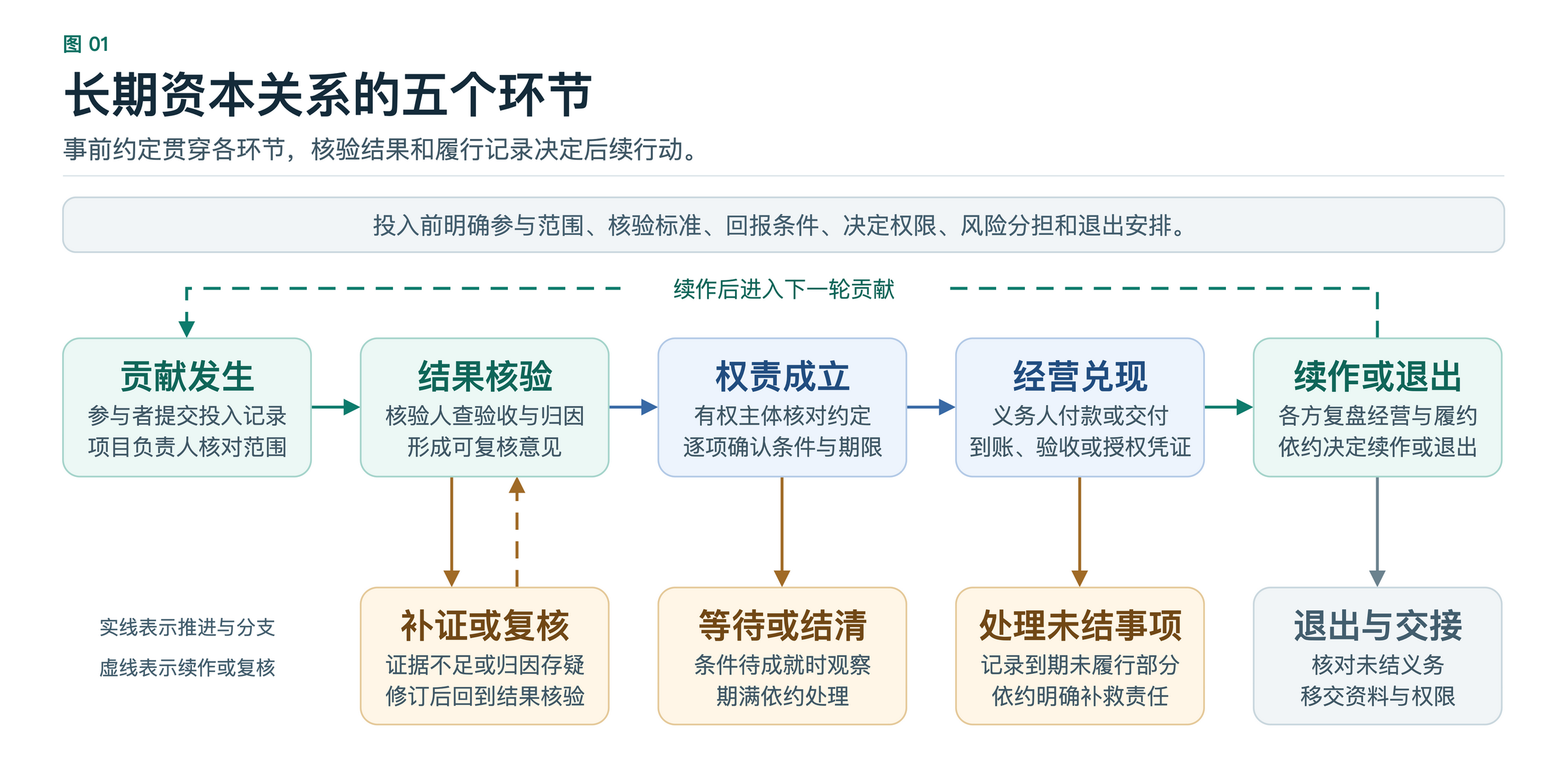
Contribution → Verification → Rights and obligations established → Fulfillment → Renewal or exit
Before anyone makes a contribution, agree on who can participate, what counts as acceptance, what triggers a return, who decides, who bears risk, and how work is handed over at exit. An agreement can take effect before any contribution is made. Check the relevant conditions when a payment is claimed or an authorization is exercised. The project lead, verifier, decision-maker, and obligor can be different parties. One contribution record can also support several rights. A one-off payment, ongoing revenue sharing, and governance participation each follow their own terms.

View full-size figure ↗Download the Draw.io source (five pages, Chinese) ↓
| Stage | Who verifies it and on what basis | When to move forward | Risks and responses |
|---|---|---|---|
| Contribution | The participant submits deliverables or input records. The project lead checks the task, dates, scope, and people involved. | Submit the deliverables and input records for verification once they can be checked against the task. | The party named in the agreement bears the relevant input or rework costs. Check whether any change of scope was authorized. |
| Verification | The designated verifier checks the result against acceptance criteria, operating data, and original records, then verifies each party's contribution. | Once the outcome and attribution meet the agreed criteria, issue a verification finding for the authorized decision-maker. | For overlapping claims or incomplete evidence, gather supporting material or start a review. Keep supported findings separate from points still disputed. |
| Rights and obligations established | The authorized party checks the agreement in force, the scope of authority, and the facts triggering each right. They identify the right holder and obligor. | Confirm each trigger and deadline. Once a condition is met, track payment, delivery, or authorization under the agreement. | If the basis or calculation is disputed, retain the verification findings and resolve the outstanding issues as agreed. Check who bears operating fluctuations and waiting costs and what resources the obligor can use. |
| Fulfillment | The obligor pays, delivers, or grants access as agreed. The parties check fulfillment against receipts, delivery acknowledgments, or authorization records. | Confirm how much was fulfilled and what remains open before reviewing the period. | For missed deadlines, record the outstanding portion, responsible party, and agreed remedy. Verify separately whether access was granted and whether the participant used it. |
| Renewal or exit | The parties or authorized decision-maker use operating results, fulfillment records, and exit terms to decide whether to continue, revise, or end the arrangement. | At renewal, begin the next cycle under the new task and applicable terms. At exit, use the original terms to settle and hand over outstanding items. | Check outstanding settlements, work in progress, and handover of records and access. Follow any obligations that survive exit until their individual deadlines. |
Review, waiting, and overdue obligations
If verification is disputed, go back to the original records to see what they establish about attribution. If the contribution is clear and the basis for the right still needs checking, retain the finding and refer the matter to the authorized party. Once a valid agreement is in place, distinguish whether the trigger has occurred, when performance is due, and what has actually been done. If revenue sharing is triggered by cash receipts, the condition remains pending until eligible funds arrive. If the period ends first, close it out as agreed. When the receipt meets the condition but the payment date is still ahead, record the amount as not yet due. If a balance remains after the deadline, record the unpaid amount and its overdue status.
The parties decide anew whether to cooperate in the next cycle. Even if every obligation in the current period was fulfilled, they can exit once the project is complete. At renewal they can draw on earlier outcomes and fulfillment records, then verify the scope, rules, and responsibilities of the new cycle. If a review changes an earlier finding, preserve the original and the basis for revision, then recheck affected settlements or authorizations.
Choosing how to recognize the same kind of contribution
| Arrangement | When it fits | Terms to specify |
|---|---|---|
| One-off compensation | The work can be accepted independently, settlement terms are clear, and the contributor's main responsibility ends with delivery. | Acceptance criteria, compensation, payment date, payer, and any continuing responsibilities. |
| Time-limited ongoing revenue sharing | The contribution continues to produce measurable operating results. Attribution and settlement calculations are verifiable, and the parties can bear delays and fluctuating returns. | Calculation basis and deductions, applicable period, verifier, source of payment, and treatment of shortfalls. |
| Governance participation with a defined scope | The contributor retains an ongoing responsibility and needs to participate in specific matters to carry it out. | Scope and authority, access to information, objections and recusals, termination of access, and handover. |
One-off compensation and ongoing revenue sharing can be combined, with governance participation agreed alongside either. Check governance rights against the applicable terms or authorization. Work through the actual task. Can delivery be accepted? Can later returns be calculated? Does the contributor have an ongoing responsibility that calls for taking part in decisions? Where an answer is missing, obtain the relevant acceptance, calculation, or authorization evidence.
Channel partnership example
Consider a fictional equipment services company and a channel partner. They agree before work starts to settle each qualified referral separately. If the partner continues supporting the customer, it can receive a share of eligible net receipts over an agreed six-month period. If the partner is also responsible for channel quality, the company can separately authorize it to review attribution rules and require recusal in disputes involving the partner.
The partner submits referral and customer support records. The business lead checks who made first contact, which channel gets credit, and what follow-up services were performed. If another channel already registered the customer, the lead reviews attribution as agreed. After verification, the authorized person checks whether the compensation conditions have been met. At monthly settlement, finance checks receipts, refunds, and covered transactions, and retains calculation and payment records.
Suppose the month has RMB 100,000 in eligible receipts and RMB 10,000 in deductible refunds. A 5% share of net receipts gives RMB 4,500 payable. If RMB 3,000 is paid by the deadline, that amount is fulfilled and RMB 1,500 is overdue. Another order has been signed but its cash is still outstanding, so it awaits receipt under the example terms. For governance participation, check whether the rules were provided as agreed, whether the partner joined the review, and whether the resulting decisions were recorded.
At six months, the parties look at whether customer relationships can still support operations, whether revenue sharing was fulfilled as agreed, and whether the partner is willing to continue supporting customers. If they exit, they reconcile eligible receipts under the original terms, hand over customer support and records, and address permissions according to the authorization period.