Many people may help complete a piece of work. Some bring opportunities, some solve problems, and others see it through to the end. If evaluation comes down to “who contributed most”, the discussion can quickly become a set of competing accounts.
I would first record what happened. People may disagree about the evaluation, but their views should be checkable against the same event.
1. Record the event before assigning scores
Start with an identifiable event. Record the task, period, each participant’s role, what they delivered, and which work was completed jointly with others.
Retain sources and document locations when recording facts. Meeting minutes, delivery records, service feedback and system logs may help, but each covers only part of the picture. Not finding a record for someone does not establish that they made no contribution.
Give the event and each person’s participation separate identifiers. Many people may participate in one event, and one person may participate in many events. Reference the overall result once and record individual actions separately, so that everyone does not claim the entire team result as their own.
2. Give facts, evaluation and review their own fields
The facts field records checkable actions and results. The evaluation field states the rules and perspective behind the judgment. The review field records what was checked, which views were accepted and where disagreement remains.
Do not collapse these fields into “excellent performance”. Excellence is a judgment requiring a comparison scope, defined indicators and supporting materials. Evaluators should also state their role, relationship to the matter, and any interests that may require recusal.
Receiving materials means only that the files are available. Verified facts still do not guarantee a complete evaluation. An evaluation does not automatically confer a bonus, equity or any other entitlement; the relevant authority and applicable arrangements require separate confirmation.
3. Use six dimensions to ask questions, without assuming a universal score
Consider role, contribution, time, responsibility, risk and strategic value. This does not require six numerical scores for every record.
Role concerns agreed duties; contribution concerns actual actions and results; time concerns effort and continuity; responsibility concerns what was undertaken and fulfilled; risk concerns what was actually borne; strategic value concerns the relationship to explicitly stated organizational goals.
Pre-sales coordination and subsequent maintenance for the same event may need different observation periods. Do not assign zero to the latter simply because the former is easier to count. Leave insufficient evidence pending supplementation, and explain when an evaluation criterion does not apply.
If weights are introduced, state their purpose, applicable roles and period, basis and decision authority in advance. Without an agreed basis, retain views by dimension rather than inventing a precise algorithm.
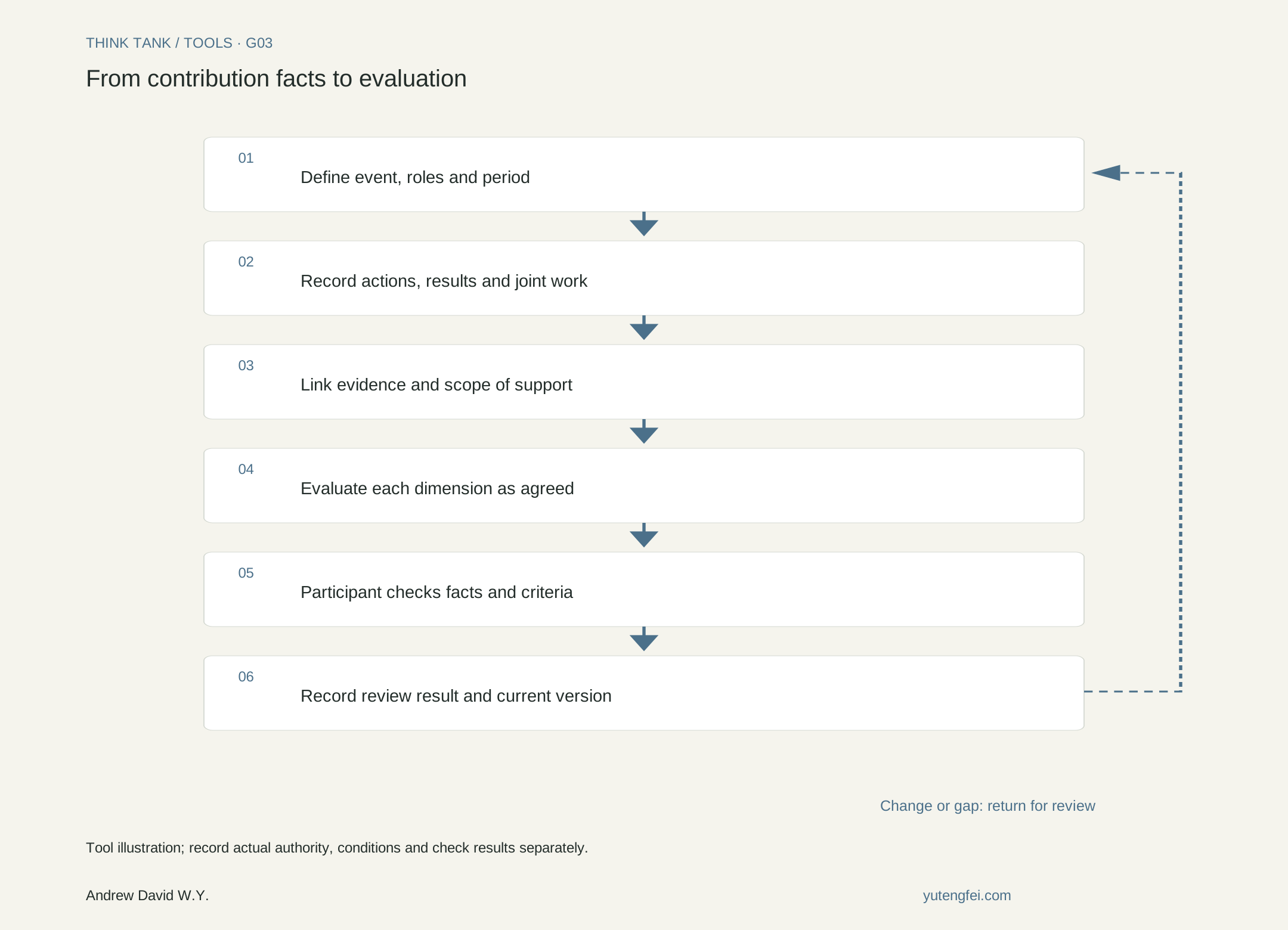
Download SVG: From contribution facts to evaluation records
4. Let participants see judgments concerning them
Once records are completed, provide relevant participants with their own facts, evaluation basis and review channel within the permitted access scope. Use suitable excerpts or controlled access for other people’s personal information, trade secrets and restricted materials; do not publish all original files.
A participant’s confirmation of facts does not mean agreement with every evaluation. Retain separate descriptions such as “factual error”, “additional evidence”, “objection to the criteria” and “objection to the outcome as applied”.
Silence is not automatic consent. Handle late responses, inability to contact someone and extension requests under the procedure agreed in advance, retaining actual notification and handling records.
5. A fictional record
The following event and roles are entirely fictional and illustrate only the recording method.
Event EV01 concerns organizing materials for a simulated training session. Role A submits a first draft; role B checks references and identifies two source mismatches; role C provides feedback on use at the session. The final materials are a joint result of all three. Do not count that complete result three times.
Record R01 covers only role B’s checkable participation: submitting a checklist within the agreed period, identifying two reference issues and proposing actions. Evidence E01 is the checklist; E02 consists of the corresponding passages in the revised draft. Together they support that the issues were raised and the related changes made. They do not independently establish that B caused all improvements in quality.
An evaluation might state: this check helped improve the accuracy of the materials; records of time spent and long-term impact are currently insufficient. On reviewing the facts, the participant notes that A also helped identify one issue, so joint participation should be added.
The reviewer checks the records and revises the description, retaining the original opinion, additional materials and reasons for revision. Mark unresolved elements as pending evidence rather than requiring one score to settle every disagreement at once.
This record predetermines no bonus, weight or entitlement. The exercise produces clearer facts and evaluation and allows joint participation to be added.
6. Provide a separate path for objections
An objection should identify the record, disputed content, reasons and available supporting materials. First determine whether it concerns factual correction, missing evidence, rule interpretation or an authorized decision, then refer it to the appropriate role.
The original evaluator may explain their view, but should not conduct the final review alone where their own interests or a clear conflict are involved. The applicable organizational arrangements should define recusal, review authority and further handling procedures in advance.
A review may uphold or revise the evaluation, seek more evidence before reconsideration, or refer the matter to an authorized role. State the reasons and scope, and notify the relevant people. “Handled” is insufficient if nobody can see what actually changed.
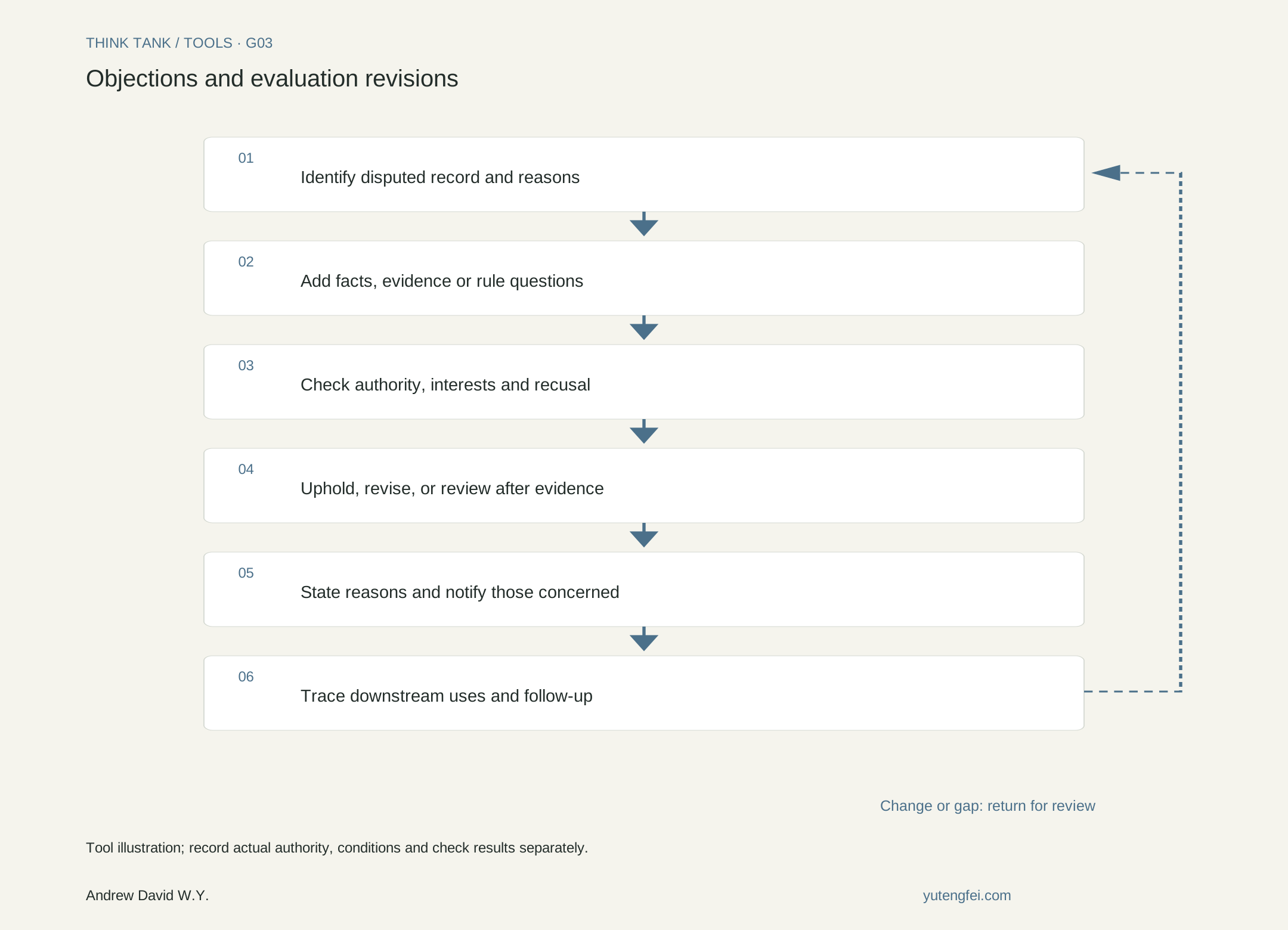
Download SVG: Raising objections and revising evaluations
7. Trace references after a revision
If the original evaluation informed performance discussions, incentive reviews or other decisions, send the review result to those stages. Updating a record does not automatically change downstream decisions; the relevant authority and procedures still apply.
Keep historical opinions traceable and identify the current version when it is used. Periodically examine which contributions remain difficult to record, which indicators cause double counting, and which roles cannot readily access their own evaluation basis. Adjust the recording method accordingly.
A useful contribution table lets others understand what happened, how the evaluation was formed and how to raise a different view. It helps an organization make evaluations checkable; it does not claim to measure every contribution objectively.