A company's continuing development depends on contributions from many people in different positions. Shareholders provide capital, teams organize operations, employees contribute labor and capabilities, consumers generate genuine demand, merchants and suppliers provide goods and services, channels connect markets, and strategic partners create opportunities for collaboration. Companies also operate within communities, public services, and a wider social environment.
Together, these contributions form the foundations of a business. They raise three questions that deserve careful answers: who creates the company's value, how can each party's contribution be identified, and how should the results of the company's growth respond to those contributions?
This approach to stakeholder value co-creation and sharing develops around these questions. It seeks to connect transactions, operations, organization, rights and benefits, governance, and capital, so that an initial involvement may develop into continuing cooperation. Continuing cooperation may then accumulate long-term value, while arrangements grounded in evidence allow that value to support the joint development of participants and the company.
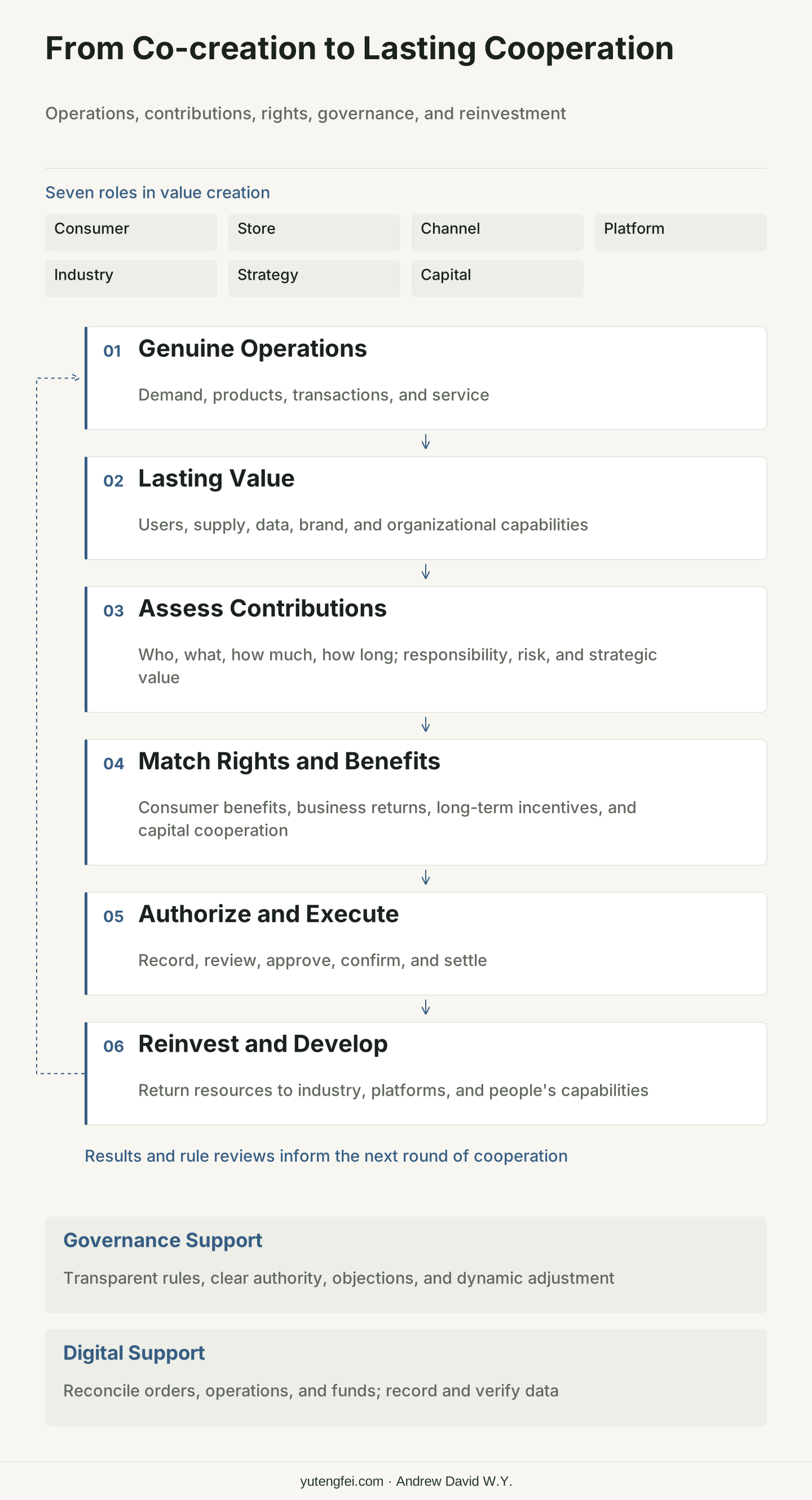
The central idea can be expressed as follows: create value through genuine business activity; understand its sources through roles and contributions; respond to different inputs through differentiated rights and benefits; support implementation with digital systems and governance procedures; and reinvest the resources gained through development in the next round of value creation.
Understanding this idea requires considering value creation, contribution identification, the allocation of rights and benefits, and business continuity together. Rewards without an operating foundation are difficult to sustain. Growth without clear rules for cooperation also makes lasting relationships difficult to maintain.
1. Company Value Emerges from Continuing Cooperation Among Multiple Parties
Understanding value creation requires seeing the full network of cooperation
We can begin to understand a company through its products, revenue, and profit, and then ask how those results come about.
Products require research and development, procurement, production, and supply. Sales require demand, trust, customer settings, and channels. Delivery is followed by service, feedback, repeat purchases, and improvement. Management teams organize these activities, while capital provides resources and supports risk-bearing for some of them.
When we broaden our view from an individual position to the supply chain, value chain, and organizational ecosystem, it becomes apparent that many business results cannot be achieved by a single participant alone. A salesperson's completed sale depends on product quality, supply capacity, brand trust, and after-sales service. Repeat purchases at a store are also influenced by product selection, pricing, service, and customer relationships.
The stakeholder perspective therefore broadens how we examine a company. It asks business leaders to understand how different parties contribute to value creation, and how the company's arrangements for cooperation and distribution will affect their participation in the next round.
The ownership of a company and the joint creation of its value need separate explanations. Recognizing that multiple parties create value does not automatically give every participant the same ownership, economic rights, or decision-making rights. Each right still requires a clear source, specific conditions, and appropriate procedures.
Long-term cooperation requires participants to see a reason to remain involved
After a transaction is completed, a company can simply record the revenue, or it can continue to develop the relationships left by that transaction.
Consumers who receive satisfactory products and services may return. Merchants with reliable supply and effective tools may expand their cooperation. Employees whose capabilities and responsibilities are recognized may continue contributing. Channels whose actual contributions receive an appropriate response are also better placed to develop markets over the long term.
This raises a practical business question: when participants accumulate value for the company's future, should their only return be a single payment in the current period? If cooperation requires sustained commitment, return arrangements should also consider time, responsibility, risk, and the process through which future results are created.
Long-term cooperation therefore needs understandable relationships. Participants should know what they are responsible for, the company should know what contributions it needs, and both sides should be able to assess inputs and returns under clear rules. Only then do a shared endeavor, shared interests, and a shared future have a chance to become part of actual operations.
Shared value and long-term shareholder value can support each other
More reliable supply, stronger teams, more repeat purchases, and more effective collaboration are important conditions for continuing operations. Investing in these relationships may also support the long-term business value that shareholders care about.
That connection must be tested through operating results. A company cannot assume that every investment will generate a return simply because it aspires to mutual benefit. Nor should it repeatedly damage relationships that support its future operations in pursuit of short-term indicators.
The plan's basic principle is that value creation comes first, contribution is an important basis for distribution, and long-term development determines the scope for continued sharing. Fairness needs to account for actual roles and responsibilities, while efficiency needs to be understood within the conditions that make continuing cooperation possible.
2. Current Operations Should Build Lasting Capabilities and Assets
From possessing resources to organizing them
The plan understands capital as the ability to integrate resources, create value, amplify value, and allocate resources for the future. This understanding shifts business leaders' attention beyond money in an account toward the resources and capabilities that support long-term creation.
Money can purchase equipment, build systems, and support business activity. Whether resources become effective also depends on how they are organized. Whether users stay, suppliers reliably fulfill commitments, data improves operations, and talent develops the ability to collaborate all influence the actual value of those resources.
This broader scope of capital remains conditional on resources being scarce and capable of creating long-term company value. The original plan's ten categories of capital offer the following ways to examine what a business is building over time. The explanations help clarify operating relationships; they are not financial recognition or valuation conclusions.
| Dimension of capital | What to look for in long-term accumulation |
|---|---|
| Human capital | Labor, professional skills, management experience, and organizational collaboration |
| User capital | Genuine user relationships, continued use, trust, and repeat purchases |
| Customer-setting capital | Stores, service networks, and transaction settings that meet genuine demand |
| Market capital | Market reach, channel coverage, and the ability to enter markets |
| Digital capital | Usable data, digital systems, and the ability to analyze operating problems |
| Brand capital | Recognition, trust, reputation, and continuing identification with the brand's value |
| Supply-chain capital | Product supply, fulfillment efficiency, cost control, and conditions for collaboration |
| Industrial capital | Real-economy businesses, production and operating capabilities, and a foundation for continuing supply |
| Social capital | Social relationships, conditions for cooperation, and a basis of trust in company activity |
| Financial capital | Financial support and the ability to connect with long-term capital resources |
These dimensions remind us that long-term value depends on the continuing contribution of resources. Resource counts, contact lists, and the scale of data reveal only some of the conditions. We must also examine whether those resources are used effectively and whether they actually improve operations.
A transaction can produce several kinds of business outcomes
Beyond revenue, a sale may leave information about user preferences, product feedback, fulfillment experience, directions for service improvement, and opportunities for further cooperation. Through continued operations, this information and these relationships may develop into better product selection, more reliable supply, lower collaboration costs, and stronger brand trust.
Business management therefore has two time horizons. In the current period, it must address revenue, costs, profit, and cash flow. Over the longer term, it must develop user relationships, platform networks, supply-chain capabilities, brand assets, innovative capacity, and defensible industry advantages.
The two horizons need to support each other. Current business provides resources for long-term development, while accumulated capabilities improve the conditions for subsequent operations. Expansion without capabilities that endure may raise costs as the business grows. Long-term investments that fail to connect with genuine demand are also unlikely to receive sustained support.
Operating returns and capital value need separate explanations
Business activity generates revenue and profit, while cash flow reflects the actual movement of money in and out. Profit differs from cash flow, and growth on paper does not directly represent money available for distribution.
Equity and capital markets involve expectations about a company's future operating capabilities. Value created by real-economy businesses and capabilities accumulated by platforms may find further expression through equity and capital markets, creating conditions for financing, mergers and acquisitions, and subsequent development.
Those expectations still need an operating foundation. A short-term price increase cannot substitute for products, users, profitability, cash flow, or improvements in governance. Connections to capital can expand available resources, but they also bring corresponding responsibilities and risks.
Likewise, investors buying shares on a public market and operating participants receiving long-term incentives under formal mechanisms follow different paths. They cannot be reduced to an automatic route from participating in business activity to receiving shares.
3. Understanding Co-creation Through Different Roles
Clarify each role before discussing partnership arrangements
Stakeholders encompass a broad range of parties, while actual operations require workable divisions of responsibility. Consumers, employees, suppliers, channels, capital providers, and other social parties participate in different ways. The same tasks and indicators cannot be applied to everyone.
The original plan discusses value-creation roles, business participants, and recipients of long-term sharing from different perspectives. Its seven partner categories offer a useful way to explain seven functions in the operating network.
| Role | Primary function | Operating contributions to be developed |
|---|---|---|
| Consumer partners | Generate genuine demand and user relationships | Consumption, repeat purchases, activity, and word of mouth |
| Store partners | Develop customer settings and provide service | Local operations, service experience, and lasting user relationships |
| Channel partners | Connect the business with additional markets | New users, new merchants, and effective market coverage |
| Platform partners | Organize collaboration and the operating ecosystem | Operating efficiency, digital support, and ecosystem development |
| Industry partners | Provide products and an operating foundation | Product quality, supply collaboration, and industrial performance |
| Strategic partners | Connect key resources and collaboration opportunities | Resource cooperation, industry collaboration, and sustained support |
| Capital partners | Support resource allocation and development | Capital investment, resource integration, and capital-market connections |
These seven functions form an operating relationship: consumption brings users together; stores provide customer settings; channels expand markets; platforms organize the ecosystem; industry provides the foundation; strategy connects resources; and capital supports further development.
This table does not replace the identification of all stakeholders. Employees and core teams perform continuing work in operations, management, and execution. Suppliers, creditors, communities, and public bodies also occupy their own positions in the network of relationships. Companies need to define their participation in relation to actual business, rather than overlooking their contributions because a particular partnership diagram does not list them separately.
Collaboration between roles determines whether value can be created
Consumers express demand, stores and channels bring that demand to the platform, the platform coordinates supply and service, industry partners provide products and fulfillment capabilities, and strategic and capital partners help secure the conditions needed for further development. The value of each part needs to be considered within these relationships of mutual dependence.
To illustrate this collaboration, imagine a store completing an order: a channel brings in the customer, the store provides the service, a supplier provides the goods, the platform supplies systems and settlement, and employees carry out the work. This is an illustrative example of how the relationships work, not a statement of verified project performance.
If every part counts the entire sale as its own independent contribution, the result is double counting. Conversely, attributing the whole outcome only to the person who closes the sale overlooks the preceding supply, service, and organizational work. Dividing responsibilities therefore needs to be followed by decisions about how contributions are recorded and attributed.
Relationships can deepen, while rights require separate confirmation
The original plan envisages consumers progressing from a single purchase to long-term active users, ecosystem participants, brand advocates, and long-term value contributors. Strategic cooperation may similarly deepen from resource cooperation into strategic collaboration, joint ecosystem development, and longer-term capital cooperation.
These paths describe possible directions in which relationships may develop. Moving to a further stage still depends on actual contributions, the intentions of both parties, formal rules, and the necessary conditions. A change of title cannot by itself establish that rights have changed.
Early trust and the timing of involvement can also provide context for understanding cooperation. Trust, length of involvement, or access to resources, however, cannot by themselves replace specific contribution assessment and the confirmation of rights and benefits.
4. Contribution Assessment Must Consider Both Results and Responsibilities
Begin with four questions
The original plan poses four basic questions: who contributes, what do they contribute, how much do they contribute, and for how long?
“Who contributes” identifies the participant and role. “What do they contribute” distinguishes money, labor, products, users, technology, channels, and collaboration. “How much” seeks an observable measure of the contribution. “For how long” incorporates time and continuing responsibility into the assessment.
These questions need to be considered together. The same sales amount may involve different costs and service responsibilities. The introduction of similar resources may entail either a one-off introduction or continuing coordination. Assessment must explain these differences to provide a basis for arranging returns.
Use different indicators for different roles
For consumers, relevant indicators can include spending, repeat-purchase frequency, activity, referral contributions, and user lifetime value: the value a user relationship produces over a period of time. Stores can be assessed through transactions, user numbers, service quality, and repeat purchases. Channels can be assessed through new users, new merchants, effective coverage, and operating efficiency.
Platforms need to consider operating efficiency, user and merchant growth, the usefulness of data, and ecosystem collaboration. Industry partners need to consider sales, gross profit, supply efficiency, product quality, and collaborative value. Strategic and capital roles require further judgment based on the effects of resources, sustained support, and contributions to long-term value.
These indicators should not all be reduced to transaction volume. Quality, efficiency, risk-bearing, and improvements in collaboration also influence the company's future operating conditions.
Measurable outcomes require verification of their authenticity and actual effect. Contributions that are more difficult to quantify require a clear basis for evaluation. Data records can assist judgment, but they cannot automatically assign an accurate price to every form of value.
Six factors jointly inform the assessment of rights and benefits
The original plan identifies role, contribution, time, responsibility, risk, and strategic value as parallel considerations. Together, they support a multifactor judgment: what work a person undertakes, what they actually contribute, how long they remain involved, what responsibilities they carry, what risks they bear, and how important their role is at a particular stage.
Strategic value changes with the stage of development. The capabilities needed for market entry may differ from those needed for operating at scale or reorganizing the business. A dynamic assessment should explain changes in circumstances and the grounds for judgment, so that participants understand why adjustments are made.
The source material provides neither uniform weights for these six factors nor a general algorithm that converts them directly into cash or shares. Institutional arrangements still need to be developed around actual business, defining the specific connections between indicators, assessment methods, and rights.
Genuine business is the shared foundation of assessment and incentives
Contribution assessment needs to be traceable to real products, procurement, transactions, services, and operations. Repeatedly manufacturing transactions with subsidies or recording circular movements of funds as performance undermines the purpose of assessment.
The sustainability of an incentive also requires checking where it comes from. Consumer rewards may draw on reasonable product margins, merchant concessions, and platform operating income. Long-term incentives require clarity about the source of the underlying rights, the conditions of granting them, and the responsible party.
Specific arrangements must also address the attribution of collaborative outcomes, the treatment of overlapping contributions, and the distinction between existing wages, payments for goods, commissions, and additional long-term incentives. These questions directly affect whether distribution is fair and whether the rules can operate over time.
5. Responding to Different Contributions Through Differentiated Rights and Benefits
Forms of return should fit the cooperative relationship
Consumers buying goods first need appropriate products, prices, and service. Merchants joining a platform need effective supply, tools, customer traffic, and operating conditions. Employees undertaking continuing work need clear compensation and development arrangements. When long-term partners assume longer-term responsibilities, corresponding long-term incentives and capital cooperation become additional considerations.
Sharing can therefore take place at several levels.
| Level of rights and benefits | Main content | Questions to clarify in the design |
|---|---|---|
| Consumer benefits | Discounts, points, membership services, repeat-purchase rewards, and product redemption | Source, eligibility, duration, and rules of use |
| Business and operating rights and benefits | Returns connected with specific services, operations, and collaboration | Business basis, contribution boundaries, calculation, and settlement |
| Long-term incentives | Explore employee share ownership, restricted shares, strategic equity, and similar arrangements for eligible parties | Source of rights, acquisition conditions, continuing responsibilities, and formal procedures |
| Capital cooperation | Strategic investment, industry cooperation, and capital collaboration | Parties, inputs, risks, rights and obligations, and exit arrangements |
| Governance participation | Participation in relevant matters according to responsibilities and authorization | Decision-making scope, accountability, oversight, and adjustment procedures |
These arrangements can complement each other, but each needs a separate definition. Consumer points, business remuneration, equity, and governance authority perform different functions. A general reference to “sharing” cannot replace specific explanations.
Consumer benefits should primarily support the consumption relationship
Consumer incentives aim to improve the benefits customers experience, encourage repeat purchases, build lasting membership relationships, and strengthen the willingness to remain involved. They should rest on ordinary demand for products and services.
The original plan states explicitly: “Consumption is consumption; incentives are benefits. Consumption must not be presented as an investment of any kind.” This establishes an important boundary for consumer relationships. Rewards following a purchase require an explanation of their basis and conditions. Prospective capital returns must not be used to induce consumers to misunderstand the nature of the purchase.
The original also includes four illustrative membership tiers: RMB 100, RMB 500, RMB 2,000, and RMB 5,000 or above, each corresponding to different membership benefits. These are tier designs in that version of the business plan. The material does not clarify whether the amounts are per transaction or cumulative, so they cannot be used to infer an equity purchase price, a fixed rebate, or a share allocation.
Long-term incentives should connect continuing creation with continuing responsibility
For those who continue to build the business, a company may explore longer-term arrangements under appropriate conditions, giving their contributions an opportunity to connect with its future. The purpose is to extend the horizon of cooperation and provide incentives that support capability building, sustained commitment, and responsibility.
Such arrangements still need to answer specific questions: who provides the reward, on what basis it is granted, what conditions apply, what continuing responsibilities are required, and what happens when circumstances change. A label without these details is unlikely to give participants stable expectations.
The shareholder framework for long-term value contributors proposed in the original plan is a strategic design. It does not establish that participants have already acquired shares. Nor must all stakeholders receive the same form of return, or all become shareholders.
Better conditions for cooperation are also a form of sharing
For merchants, procurement costs, inventory turnover, customer acquisition, repeat purchases, cash flow, and online operating capabilities often have a direct effect on business continuity.
By improving these conditions through supply chains, digital tools, user operations, marketing, and data support, a platform creates value for its partners. Physical stores, online marketplaces, group buying, privately managed customer channels, livestreaming, and corporate procurement can improve operations only when they work together with products, replenishment, fulfillment, and accounting.
Assessment of a sharing mechanism should therefore also examine whether participants have become more capable of running their businesses, whether unnecessary collaboration costs have fallen, and whether they have gained the tools and conditions needed to keep creating value.
6. Long-term Sharing Requires Clear Governance and Authorization
Broaden the consideration of interests while clarifying decision-making responsibility
Considering more stakeholders brings specific governance questions: who can confirm contributions, who can decide on distribution, who is accountable for those decisions, and how should conflicting interests be handled?
The discussions in the source material also retain questions about the authority to distribute value: on whose behalf do managers act, are they authorized to adjust interests between different parties, and how do they fulfill the responsibilities they have already undertaken? These issues belong alongside discussions of co-creation and long-term sharing.
Good intentions can encourage cooperation, but stable rights and benefits still require authorization and procedures. Particularly where equity, securities rights, or major resource arrangements are involved, formal agreements, corporate governance procedures, and applicable rules must establish the source of rights and the basis for approval.
Different levels of participation should correspond to different responsibilities
Participants differ in the information they hold, the responsibilities they bear, and the effects they experience. Different forms of participation may therefore be appropriate. Business collaboration, operating feedback, major decisions, and capital cooperation also require different scopes of authority.
The original plan proposes differentiated participation, rights and benefits, governance, and dynamic adjustment. Turning these principles into workable rules requires specifying the scope of matters at each level, the method of authorization, oversight responsibilities, and the way adjustments are made when circumstances change.
Broader participation does not require everyone to have equal authority over every matter. Concentrated power also requires corresponding accountability and constraints.
Transparent rules should extend from recording to confirmation
Transparent rules, authentic data, standardized review, and clear authorization are implementation conditions emphasized in the original plan.
Participants need to know which actions are recorded, which results enter the assessment, and what conditions allow them to apply for benefits or rights. Reviewers need clear responsibilities and a clear basis for their work. Decisions affecting important rights should be traceable to records, reviews, and authorization.
For eligible platform partners, the original sets out this process: identity registration, review of documentation, confirmation of rights and benefits, and registration of confirmed rights. This points to the need to connect identity, evidence, and rights in a continuous process before arrangements can be put into effect.
The process does not mean that every participant has already acquired rights. The original's proposal to begin relevant procedures, in principle, within seven working days after public trading in the listed company's shares begins is also only a conditional proposed starting point. It cannot be interpreted as a promise that all entitlements will be fulfilled within seven days.
Protecting participants should be part of everyday operations
Consumer rights, product quality, after-sales complaints, business registration, intellectual property, tax, and transaction compliance all affect cooperative relationships. How a platform makes rules, handles disputes, and affects participants when rules change also falls within governance.
A framework intended for long-term cooperation must further specify arrangements for objections, exits, losses, difficulties in fulfillment, and changes to rules. These are matters that need to be completed when moving from principles to implementation. A shared vision cannot replace them.
The stability of a community is reflected both in how it shares the benefits of growth and in how it assumes responsibility and protects confirmed rights when cooperation encounters difficulties.
7. Digital Systems Support Recording, Collaboration, and Settlement
Start by creating records that can be checked
The original plan describes the relationship between technology and institutions through four propositions: digitization makes contributions visible; data makes value measurable; mechanisms allow rights and benefits to be matched; and capital connections allow long-term value to be linked to participation.
Understanding this relationship requires retaining the judgments and procedures between those stages. A transaction record initially demonstrates only that a corresponding business activity occurred. Rules are still needed to decide how the contribution is assessed, who confirms it, and which rights or benefits it corresponds to.
Digital systems improve the conditions for factual recording and collaboration, giving relevant judgments an evidentiary basis. Data can support the application of rules, while those rules also need to define how data is used.
Connect operating activities through business systems
The six digital systems planned in the original each support specific work.
| System | Main work supported |
|---|---|
| SaaS system | Connect applications, marketplaces, merchants, and platform administration; support multiple business formats |
| Payment allocation and settlement system | Order reconciliation, merchant payments, platform service income, and partner settlement |
| ERP and warehouse system | Procurement, inventory, goods receipts and dispatches, stocktaking, loss reporting, and cost management |
| Point-of-sale system | Connect online and offline orders, products, and members |
| Weighing system | Identification, barcodes, pricing, and settlement for fresh and bulk goods |
| Ordering system | Coordinate ordering, payments, kitchen operations, membership, and orders |
These are planned functions. Whether the systems are deployed and interconnected requires separate confirmation. Their methodological value lies in returning cooperative arrangements to actual operations: how purchases occur, how goods move, how orders are fulfilled, and how funds are settled.
The correspondence between “order flows, business activity flows, and fund flows” is particularly important. Orders should be traceable to actual goods or services, business activity should have fulfillment records, and settlement should explain the destination and basis of payments. Only then can the returns partners receive be linked to specific business activities.
Data should also help improve operations
Beyond supporting calculations, data can help identify user needs, adjust products, improve supply, support merchant decisions, and raise operating efficiency. It is through continued use that companies have an opportunity to develop better judgment and organizational capabilities.
AI should also be understood within this operating relationship. The value of technology depends on whether it solves actual problems: are demand assessments more accurate, is supply more effective, are decisions more timely, and have collaboration costs improved?
Between possessing more data or adopting a tool and developing lasting digital competitiveness lie further tasks: data quality, governance, organizational use, and the verification of results.
8. Operating Growth and Connections to Capital Should Support Each Other
Growth comes from coordination across several activities
The original plan uses six flywheels to describe the positive relationships it hopes to develop between operations and capital.
| Growth cycle | Relationship envisaged in the plan |
|---|---|
| User cycle | User growth supports repeat purchases, which help establish lasting user relationships |
| Merchant cycle | More merchants provide more customer settings, which support genuine transactions |
| Supply-chain cycle | Business scale supports centralized procurement, while procurement and collaboration improve cost conditions |
| Data cycle | Business activity accumulates data, data assists operations, and operations improve efficiency |
| Transaction-scale cycle | Genuine transactions support platform development, which further connects with industry |
| Capital-value cycle | Operating performance supports the expression of long-term value, while capital resources support further development |
These cycles are proposed mechanisms, and each requires testing. User growth may not lead to repeat purchases. More merchants may create service problems. Greater scale may increase inventory and management costs. Capital-market pricing is also influenced by many conditions, so performance growth cannot be described as a guarantee of higher market capitalization.
Business leaders need to examine whether value is genuinely passed between activities. Where growth occurs, where costs rise, and where resources are reinvested all require specific observation.
The connection from operations to capital involves different stages
The original presents a relatively comprehensive proposed chain:
Consumption → Users → Transactions → Data → Supply chain → Revenue → Profit → Industry → Equity → U.S. equity capital markets → Financing → Mergers and acquisitions → Securities digitization → Industrial expansion → Growth in company value.
This chain can be understood at three levels.
First, consumption, transactions, supply, and service form the operating foundation; revenue, costs, and profit must be tested against actual business. Second, user relationships, data, supply chains, and industrial organization form lasting capabilities and assets. Third, equity, financing, mergers and acquisitions, and capital-market connections create possibilities for further resource allocation.
Each level requires relevant capabilities and conditions. These fifteen activities are not a standard sequence every company must complete, and no one activity automatically ensures the next will occur.
The original also proposes stages involving domestic platform scale, value creation from data, global cross-border e-commerce, access to U.S. equity capital markets, and securities digitization. Securities digitization, STOs, and global digital capital networks are exploratory paths to be studied subject to applicable regulatory requirements. They cannot be treated in advance as established capabilities.
Capital investment should ultimately return to continuing creation
Internationalization concerns the reach of markets and cooperation. Capital development concerns where resources come from and how they are allocated. Digital finance concerns possible ways of connecting assets with capital. For stakeholder cooperation, these activities face a common test: do additional resources improve the conditions for continuing value creation?
After financing or an acquisition, are there better products, supply, talent, and organizational capabilities? After industrial expansion, do merchants and consumers receive more reliable service? Is the company's long-term value supported by operating evidence?
When capital resources return to industry, platforms, and human capability building, one round of development has a chance to support the next round of cooperation. A financing event, a transaction, or a price movement cannot replace this continuing work.
9. Turning Value Principles into Workable Mechanisms for Cooperation
SCV addresses value; SCVP addresses implementation
The original uses SCV to mean Stakeholder Capital Value. It asks who creates value, who continues to build the business, who assumes long-term responsibility, and how long-term contributions can be connected with long-term value.
SCVP handles participation and implementation, including participation mechanisms, contribution assessment, differentiated incentives, and long-term value sharing. This allows a distinction between principles and implementation: value principles explain why people cooperate and what is recognized; implementation mechanisms explain how they participate, how contributions and rights are confirmed, and how arrangements are carried out.
The source material expands SCVP in two ways, using Plan and Partnership. Its formal name remains to be standardized. To understand the method, we can first focus on the connections between participation, contribution, rights and benefits, and long-term cooperation, rather than treating the naming difference as evidence of two mature institutional frameworks.
Connect three sets of relationships
The first is co-creation within operations: participate together, create value, share it reasonably, and use that sharing to support continued participation.
The second connects contributions with rights and benefits: identify contributions, match appropriate rights and benefits, establish long-term incentives, connect with capital when conditions permit, and put the corresponding sharing into practice.
The third provides implementation support: business activity produces records, rules guide judgments, governance provides authorization, and systems support calculations and execution.
These three relationships need to work together. Without genuine business, returns lack a source. Without contribution assessment, rights and benefits lack a basis. Without authorization and procedures, even discussed arrangements are difficult to implement reliably.
Develop the mechanisms around specific business activity
Drawing on the original plan's thinking, implementation can be organized into the following seven steps. These steps are an operational synthesis of the material; the project still needs to confirm specific arrangements in light of actual conditions.
- Clarify needs and shared objectives. Begin with genuine needs, identify the operating problem to be solved, the project through which it will be addressed, and the capabilities required. Link the list of needs with the list of projects and the list of capabilities.
- Identify participants and responsibilities. Set out each party's work, inputs, and dependencies. Clarify collaboration interfaces and establish a shared direction, stage-specific objectives, and an execution plan.
- Establish the basis for observing contributions. Set indicators by role, specify recording periods, business evidence, and verification methods, and address collaborative attribution and double counting.
- Design differentiated returns and identify their sources. Arrange consumer benefits, business returns, long-term incentives, and capital cooperation separately. Define conditions, responsibilities, periods, and the boundary between existing remuneration and additional incentives.
- Establish review and authorization procedures. Specify who records, reviews, approves, and oversees, and how objections, changes, and exits will be handled.
- Connect business systems and settlement. Make orders, fulfillment, funds, and relevant contribution records reconcilable so that assessment outcomes can enter formal implementation procedures.
- Keep improving through actual operation. Observe operating improvements, participants' experience of benefits, and the cost of applying the rules. When conditions change, make adjustments through pre-agreed procedures and handle confirmed rights and benefits appropriately.
The original plan's calls for alignment in thinking, strategy, objectives, mechanisms, and execution can serve as requirements for organizational cooperation. Applying them to work requires further clarity about responsibility, schedules, and how completion of each stage will be assessed.
A complete framework still needs to resolve specific questions: how different contributions are compared, how assessments correspond to benefit amounts, where capital-related rights come from and in what quantities, and what each party bears in the event of losses, exits, or difficulties in fulfillment. Explaining these matters one by one is necessary for value principles to enter actual cooperation.
10. Joint Development Requires Investment in Both Industry and People
The operating perspective of stakeholder co-creation and sharing considers the development of the company and its participants within the same set of relationships. Companies need industry, tools, technology, and money. They also need people's skills, judgment, sense of responsibility, and ability to cooperate.
Investment in industry improves supply conditions, while investment in people improves capabilities and the conditions for participation. Education, training, income expectations, and service support need to work together with products, equipment, and digital systems to create a more durable operating foundation.
Entrepreneurs have a responsibility to organize this cooperation: understand the needs of different parties, establish meaningful shared objectives, design workable mechanisms, and take responsibility for operating results and their effects. Mission, responsibility, and social value need to be expressed through product quality, normal settlement, fair rules, continuing service, and the fulfillment of formal commitments.
A community can also be understood from different perspectives. A shared endeavor explains why people work together. Shared interests explain how they benefit. Industry collaboration explains how they keep creating value. Capital cooperation explains how they connect with the future. These perspectives are related; they need not be arranged as a ladder of identities that everyone must climb.
Within such cooperation, participants should have an opportunity to understand their role. Companies should be able to identify genuine contributions. Arrangements for rights and benefits should have a basis, a source, and accountable parties. Additional resources should return to further creation.
The value of a stakeholder mechanism must ultimately show up in these specific relationships: whether cooperation becomes more stable, operations become more capable, long-term commitment receives a reasonable response, and rules remain credible when difficulties arise. The joint growth of companies and participants takes place through successive rounds of real business activity.