Thinking through how Company 0 should operate
Building these websites has led me to revisit how Company 0 should operate: connecting research, delivery, acceptance, contribution review and long-term relationships, then using practical feedback to improve products and rules. The next step is to take one small project through the full process.
Over this period, several websites have been under construction and revision. Ideas that used to exist in my head or in documents are gradually becoming something people can see and discuss.
I think this process is useful. Once a page exists, many problems become easier to spot. What is unclear, which parts do not connect, and whether other people can understand it can all be improved through actual feedback. AI has also greatly reduced the cost of trying things out.
The main thread is now there. Next, I want to work through how Company 0 should operate.
How do people join? How is the work organized? What value is created, who confirms each contribution, and how do long-term relationships develop? These things need to connect.
Start by using it within Company 0
My idea for WISER UNION Company 0 is for it to become the first enterprise to put the NST theoretical framework into sustained practice.
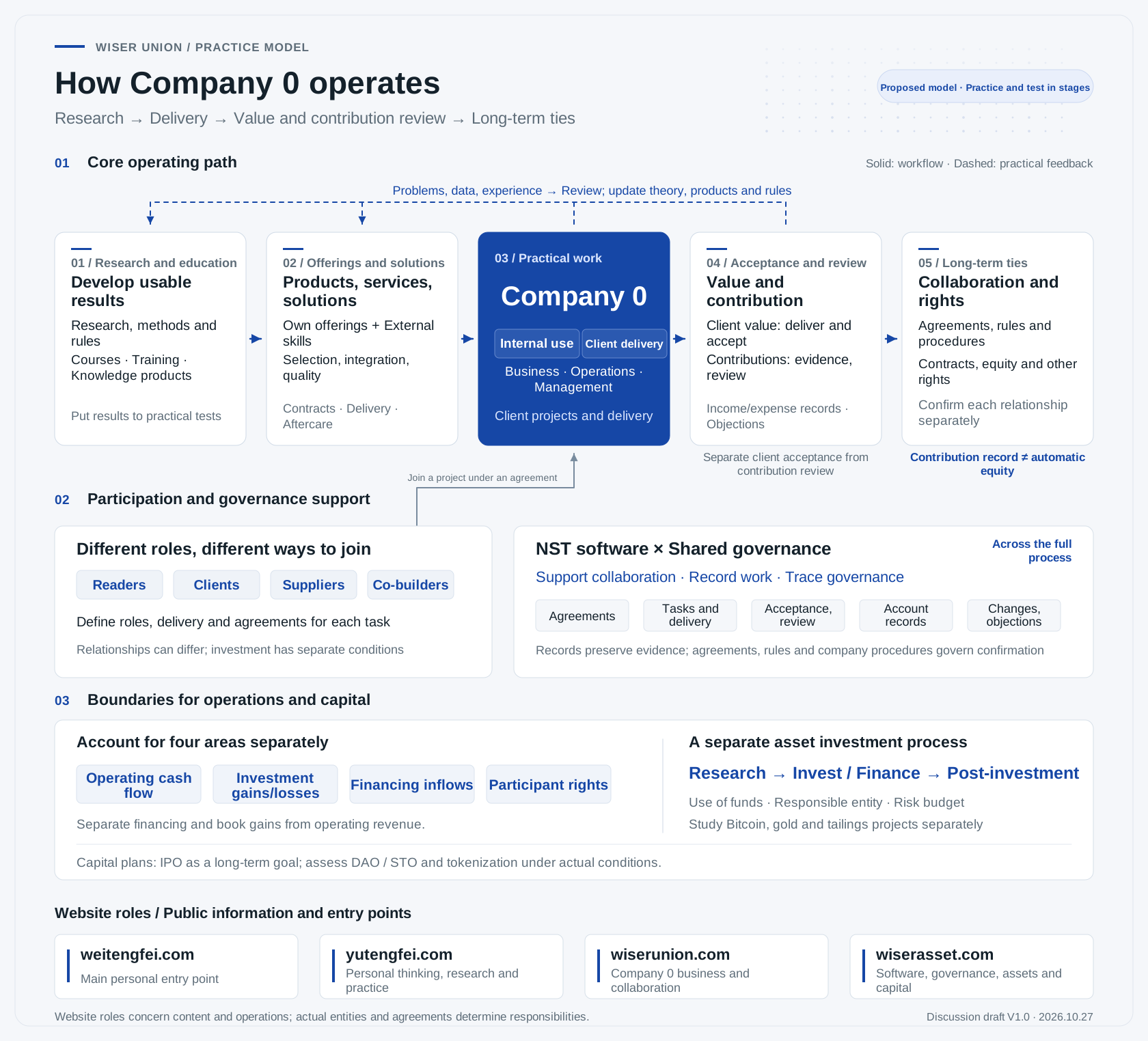
Research raises questions and develops theories, methods and rules. These results can then become knowledge products, software products and service offerings. Company 0 would first use them in its own business, operations and management, while also bringing together internal and external capabilities to deliver work for clients.
Specific problems will arise during use and delivery. Those problems, data and experiences can then feed back into revisions to the products, rules and theory.
So Company 0 needs to work toward answering three questions:
- Can its products and services create practical value for clients?
- Can different people work together to get things done, with their contributions reasonably recognized?
- As the enterprise develops, can participants share in its long-term results under clear rules?
The theory also needs to remain open to revision. If the company makes money, we need to examine how it was earned and which mechanisms contributed. If problems arise, we need to distinguish the effects of the market, execution and the institutional arrangements.
I want to keep a record of these processes, so that both the practical work and later adjustments have a basis.
Connect the different groups of work
I think the twelve areas of work listed earlier can first be organized into five groups. There is no need to rush into making each one a department.
Research and education. Research develops theories, methods and rules. Education turns these results into material that other people can understand, learn and use. We need a clear route from what has been researched to what can be taught, which tools can be developed and which problems they ultimately solve. Internal working standards, proposed standards and formally recognized standards also need to be described separately.
Products, services and solutions. Products and services are specific offerings. A solution brings suitable offerings together around a client's needs. Before adding an external supplier's offering to the catalog, we need to clarify who provides it, who signs the contract, who delivers it, who accepts the work, who handles after-sales support and what WISER UNION actually does in the arrangement. The catalog needs to prove its value through reliable delivery.
The resource hub and joint development. The resource hub organizes the capabilities of people and institutions. Participation in joint development connects those capabilities to specific work. Being listed, making contact, expressing willingness to participate, completing delivery and making a contribution that can be confirmed are different states. They need separate records.
NST software and shared governance. Governance sets the rules; software supports execution and recordkeeping. NST should first help Company 0 organize collaboration and preserve the process. Actual use can then test whether it can become a software product offered to others.
Investment research, investment and financing, and post-investment work. First research, then decide whether to invest and who will invest, followed by ongoing tracking, disclosure and review. We also need to distinguish Company 0 raising funds for its own operations, financing for a particular project and related services provided to external clients. Different responsible entities and uses of funds call for different arrangements.
Projects need to connect these groups of work. Each group should know what it receives, what it delivers, whom it delivers to and how completion is confirmed.
Start participation with specific work
I would like there to be several ways to participate.
Some people want to read and exchange ideas. Some are clients. Some provide products or services, some join a particular project, and others go on to establish a long-term capital relationship. People can choose a suitable role according to their capabilities, willingness and circumstances.
For each participant, first clarify the work to be done, the role, how delivery will work, who will accept it, how the contribution will be confirmed and which agreement applies. There should also be a way to raise differing views and have them reviewed.
The long-term capital account needs to make these supporting records traceable, including participation agreements, tasks, delivery, acceptance, contribution confirmation and subsequent changes.
Account records, contribution confirmation and specific rights need separate treatment. Recording a contribution cannot be taken to mean that equity is acquired automatically. Nor should we assume that every contribution carries the same rights to returns or voting rights.
Long-term relationships need to start with the agreements we make and fulfill now. Making each collaboration clear and carrying it through gives the relationship a foundation for later.
Keep the accounts for operations and investment separate
There is one connection in the profit logic that I think needs to be expressed more accurately.
Products, services and solutions need to build operating revenue over time. Alongside that, we can explore asset investment and long-term accumulation within clear funding boundaries, risk budgets and decision rules.
These two capabilities need to be tested separately.
Bitcoin and gold can be subjects for research and allocation, but we cannot take “high and stable returns” as a premise. Both have price fluctuations. We also cannot expect investment returns to make up the shortfall precisely when operations run into difficulty.
Operating cash flow, investment gains and losses, financing inflows and participants' rights need to be viewed separately. Raising funds is not the same as making a profit. An increase in an asset's book value does not mean there is enough cash to cover daily expenses.
Gold-related work also needs further distinctions. Physical gold, gold-related financial products and gold tailings development projects each require different research. Tailings projects involve the source material, technology, construction, production, costs and sales. The gold price alone is not enough.
Websites and products can be adjusted quickly. For arrangements involving investment, funds and rights, the supporting basis needs to be checked before we make external statements or specific agreements.
Connect long-term goals with current arrangements
An IPO remains a long-term goal I hope to pursue. But the long-term relationship between participants and the enterprise needs a clear basis starting now.
First establish the rights and obligations attached to each type of participation, then consider the structure that can support them.
Which relationships are suited to contracts, which involve equity, which matters are suited to collaboration and governance through DAO mechanisms, whether tokenization is needed, which rights a token represents and who bears the obligations all require specific discussion.
An IPO, DAO mechanisms, DAO Tokens and STO Tokens need to be considered as part of capital and governance arrangements. The choice depends on the actual entities, applicable jurisdictions and participation conditions. It cannot be based only on how familiar participants are with traditional capital or digital assets.
Learning, exchange and some collaboration can be as open as possible. Investment, the issuance of rights and governance voting each need their own conditions explained.
What each of the four websites is for
The relationship between the websites also needs to be easy for a first-time visitor to understand.
weitengfei.com serves as my main personal entry point. It should first help visitors understand the overall relationship, then take them to the relevant website.
yutengfei.com holds my personal thinking, research, methods and practical experience. Personal views and company business need to be clearly expressed, with a clear route to the entity that takes on, contracts for and delivers the specific work.
wiserunion.com serves as the business and collaboration entry point for Company 0. Clients can see which problems it can address, suppliers can see how to work with it, and people interested in joint development can find specific work to join.
wiserasset.com covers professional content relating to NST software, governance, asset research, investment and financing, and post-investment work. It also needs to distinguish Company 0's governance matters, services provided by Asset and the entities and rules belonging to individual projects.
These are divisions of website content and operation. Rights and responsibilities for specific business activities still need to rest with the actual entities and agreements.
Next, take one small project through the full process
This round of website development can first be organized into a complete work example.
We can preserve records and evidence of why it was proposed, how requirements changed, what was confirmed, what work was done, how it was accepted, what has been released and what remains planned.
As technical work progresses, the governance record needs to keep pace. Execution should be followed by acceptance, disclosure, review and rule revisions. Business offerings, participation rules and rights arrangements that are not yet in place should remain on the task list.
Then choose a project small enough in scope to deliver, and take it through client needs, participant roles, delivery and acceptance, receipts and expenses, contribution confirmation and the applicable rights.
What I want now is to make this process solid. People meeting me for the first time, and people willing to work with me, should be able to see specifically how work moves forward, how value is created, how contributions are confirmed and how long-term relationships are built.
First produce a practical example that can be checked. Then keep adjusting and expanding it according to the actual results.