When discussing collaboration among several parties, people can usually describe a shared direction: serve customers together, organize supply, improve operations and share the results as agreed.
Doing the work brings more specific questions. Who takes responsibility for the first task? Who commits resources first? What information needs to be shared? Who handles a discrepancy? What must be achieved before it makes sense to continue?
I think we can begin with one representative activity whose scope is manageable and whose results can be observed, and run the collaboration from beginning to end.
The pilot should answer whether the work can be done, whether each party's inputs can be explained, whether disagreements can be handled and whether continuing is worthwhile.
A smaller scope lets us examine the problems more closely. Once there is evidence, we can discuss expansion. The following is a reference arrangement to adapt to the business concerned.
1. Define what this pilot is testing
A pilot should start with a specific operating problem.
Perhaps order confirmations repeatedly go wrong, stores struggle to coordinate replenishment, supply information arrives late or after-sales issues keep being passed from person to person. Each can be examined further: where does it happen, whom does it affect, which steps are involved and what do existing records show?
Bringing every activity, partner and rights arrangement into the pilot at the outset entangles the problems. Even if results change, it may be difficult to identify which practice made a difference.
Define the boundaries: which business activity, which roles, the starting action, the ending result and what will not be addressed this time.
Also consider whether the setting is representative. A pilot involving only the easiest partners and orders, or one sustained by unusually intensive attention from the person in charge, may not transfer elsewhere even if it runs smoothly.
I would prefer a real, recurring activity that can be observed within acceptable limits. Include ordinary handovers, records, exceptions and reconciliation rather than selecting only the most attractive step.
Keep the scope small while preserving a complete view of the activity's beginning, middle and end.
2. Put scope, responsibility and authority on the same page
Prepare a brief pilot charter before starting.
It need not be lengthy. First explain the problem, participation boundaries, resource limits, review method and stopping conditions.
| Item | Questions to answer |
|---|---|
| Problem and objective | What needs improvement, what evidence exists, and which changes will be observed? |
| Business boundaries | Which activities and parties are included or excluded, and where does the pilot start and end? |
| Roles and authority | Who coordinates, executes, collaborates and checks? Who approves launch and significant changes? |
| Resources and commitments | What are the limits on staff time, expenses, system changes and service commitments? |
| Observation and next steps | When is the review, what information is needed, and what would justify expansion, adjustment, suspension or closure? |
In particular, distinguish responsibility for advancing the work from authority to approve it.
A coordinator may collect issues, arrange discussions and follow progress without having authority to increase a budget, change cooperation terms or make commitments for others. Those decisions require confirmation by someone with the relevant authority.
Four working roles can be identified: coordination, frontline execution, collaborating parties and review.
Coordination connects the work. Frontline participants complete actions and record problems. Collaborating parties explain their conditions and responsibilities. Reviewers check records, hear different views and submit their assessment to the appropriate decision-maker.
People in a small team may hold several roles, depending on the matter. If an assessment is challenged, disclose the interests involved and arrange review by someone without a direct conflict. Where the conditions are not met, defer the relevant decision.
Clear authority and responsibility tell people whom to approach when conditions change and which matters require a pause for renewed confirmation.
3. Explain the rules before recording contributions
People may contribute different things to a collaboration.
Some supply goods, handle customer needs, arrange deliveries or maintain systems. Others coordinate and resolve errors. Looking only at final sales can miss much of this work.
Start by recording basic facts: who did what, which business event it concerned, what can be checked, what additional work was undertaken and which exceptions arose.
Then discuss how those inputs should be assessed.
Fact records, contribution assessments and allocation decisions each need their own basis. A contribution record is not automatically a claim to a reward, equity or greater decision-making authority.
If the pilot includes rewards, define eligible participants, the funding source, approved limits, calculation basis, confirmation and settlement conditions. Future financing or unrealized value cannot replace a present payment arrangement. A pilot without rewards can still test collaboration and recordkeeping.
Agree new rewards separately. Existing payments for goods, wages and promised services continue under their original arrangements.
Provide a route for different views: who corrects a record, who reviews a disputed assessment and who approves a rule change?
Retain the version and scope after a change, including its effective date and treatment of past events. Do not quietly change the basis and apply it retrospectively to people's inputs.
Limit data collection as well. Collect only information the team is authorized to obtain and needs for this collaboration. Define who may see it, what they may do and how long it is retained. Start with necessary information before deciding whether more is needed.
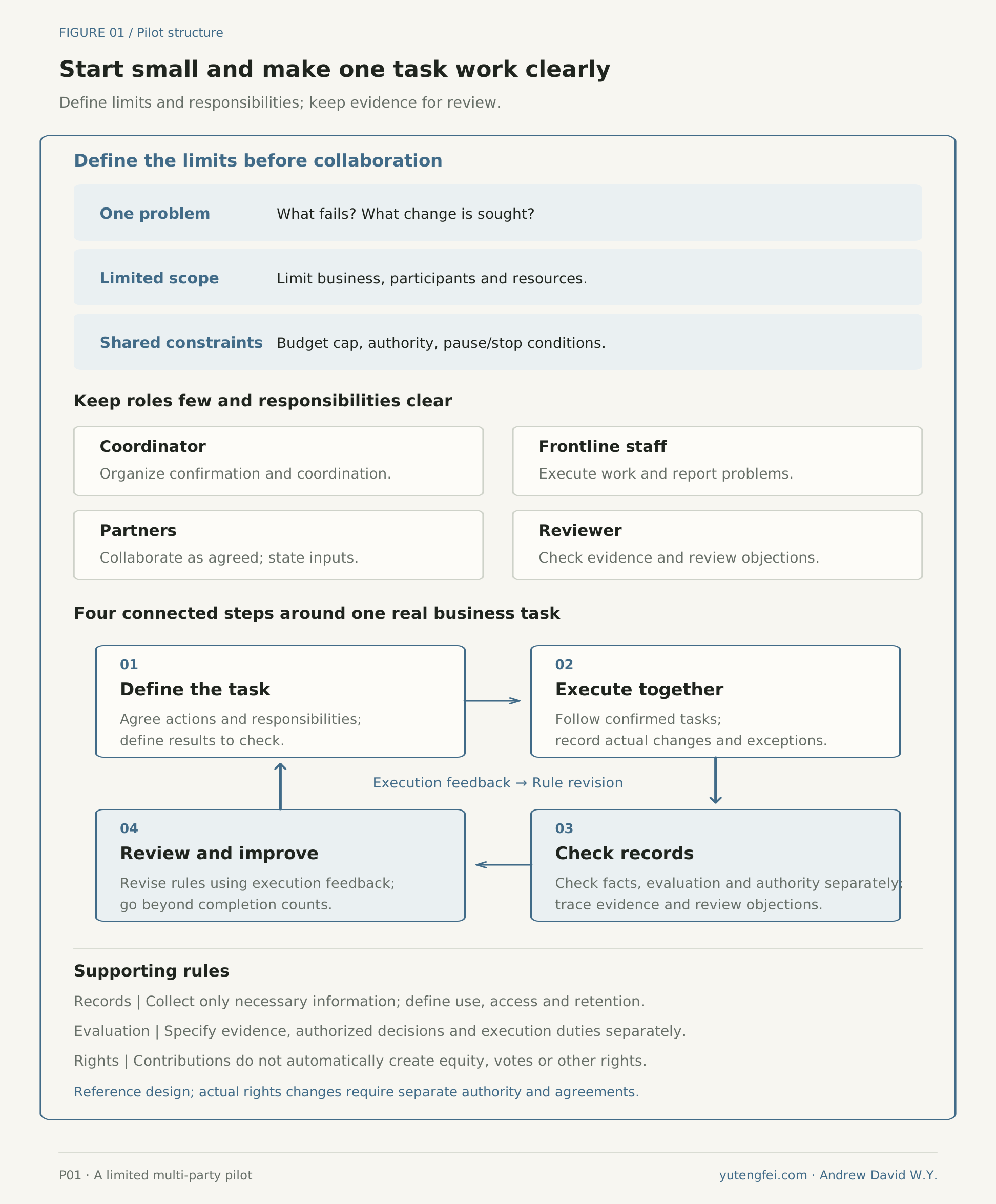
Figure 1 is a reference operating structure connecting tasks, execution, records and review. New commitments and rights arrangements still need the relevant confirmation.
4. Put the pilot into a fictional replenishment activity
The following situation was created to explain the reference arrangement. It does not describe a real enterprise.
Several stores find that the same product is sometimes out of stock and sometimes overstocked. The stores, supplier and delivery provider want to test whether replenishment can be coordinated better.
Limit the pilot to one product category, a defined group of stores and one supply-and-delivery chain. Observe the process from a store's request through supply confirmation, delivery receipt and discrepancy handling to reconciliation for that batch.
The questions are whether demand can be confirmed promptly, handover errors reduced, and urgent replenishment and inventory burdens improved. Existing purchasing relationships and payment responsibilities remain governed by their agreements.
| Step | What participants should clarify | Evidence to retain |
|---|---|---|
| Store request | What is needed, what stock and inbound quantities exist, and when is replenishment required? | Necessary demand, inventory and in-transit records |
| Supply confirmation | How much can be supplied, when, and how will unmet needs be reported? | Confirmed quantities, timing and exceptions |
| Delivery and receipt | Who hands over, how are differences confirmed, and who handles exceptions? | Dispatch, receipt, discrepancy and resolution records |
| Review and reconciliation | What is complete, what remains pending, and what extra inputs did each party make? | Business reconciliation, exception handling and input records |
Set resource limits together: transaction volume, coordination hours, additional delivery costs and acceptable system changes. They cannot keep increasing indefinitely. Obtain renewed approval before exceeding the agreed scope.
The observation period should cover a meaningful business cycle and reflect how often the main problems occur. One successful delivery does not justify immediate rollout, and a pilot should not continue indefinitely without an ending condition.
At a stage review, list unfinished deliveries, reconciliation and after-sales matters separately. Distinguish results that can already be assessed from those needing more observation.
This pilot first tests whether collaboration improves. It does not promise higher sales or lower costs in advance, or require a single pilot to settle the entire long-term sharing mechanism.
5. Assess operating results and participation burdens together
After a pilot has run for a while, people may first count orders completed, records entered and meetings held.
These show whether some activities took place. We still need to examine what happened in the business itself.
In the replenishment example, check changes in shortages and excess stock, urgent coordination, customer waiting and previously uncounted costs borne by suppliers and delivery providers.
I suggest reviewing four aspects.
| Aspect | Questions |
|---|---|
| Business and experience | Has the original problem improved, and have new problems appeared? |
| Collaboration and burdens | Are responsibilities clearer, do parties want to continue, and who bears additional work? |
| Records and judgments | Can key records be checked, have exceptions been handled, and what remains uncertain? |
| Cost and capacity | Are inputs within limits, can more business be supported, and what resources would continuation need? |
Agree the observation definitions before starting, in terms everyone can understand. Keep periods, included activities and input calculations as consistent as possible.
Record significant changes in volume, prices, season or supply conditions. A comparison may provide useful clues without establishing that every change resulted from this mechanism.
Discuss improvements and deterioration together. Stores may have fewer shortages but much more stock; orders may move faster only because staff work sustained overtime. These situations require further judgment.
Completed forms show that recording work was done. Whether collaboration deserves to continue depends on actual results and the burdens carried by the parties.
Where evidence is insufficient, state what cannot be confirmed. If more observation is worthwhile, specify the missing information and the permitted next stage, and obtain confirmation from the appropriate decision-maker. Defer expansion in the meantime.
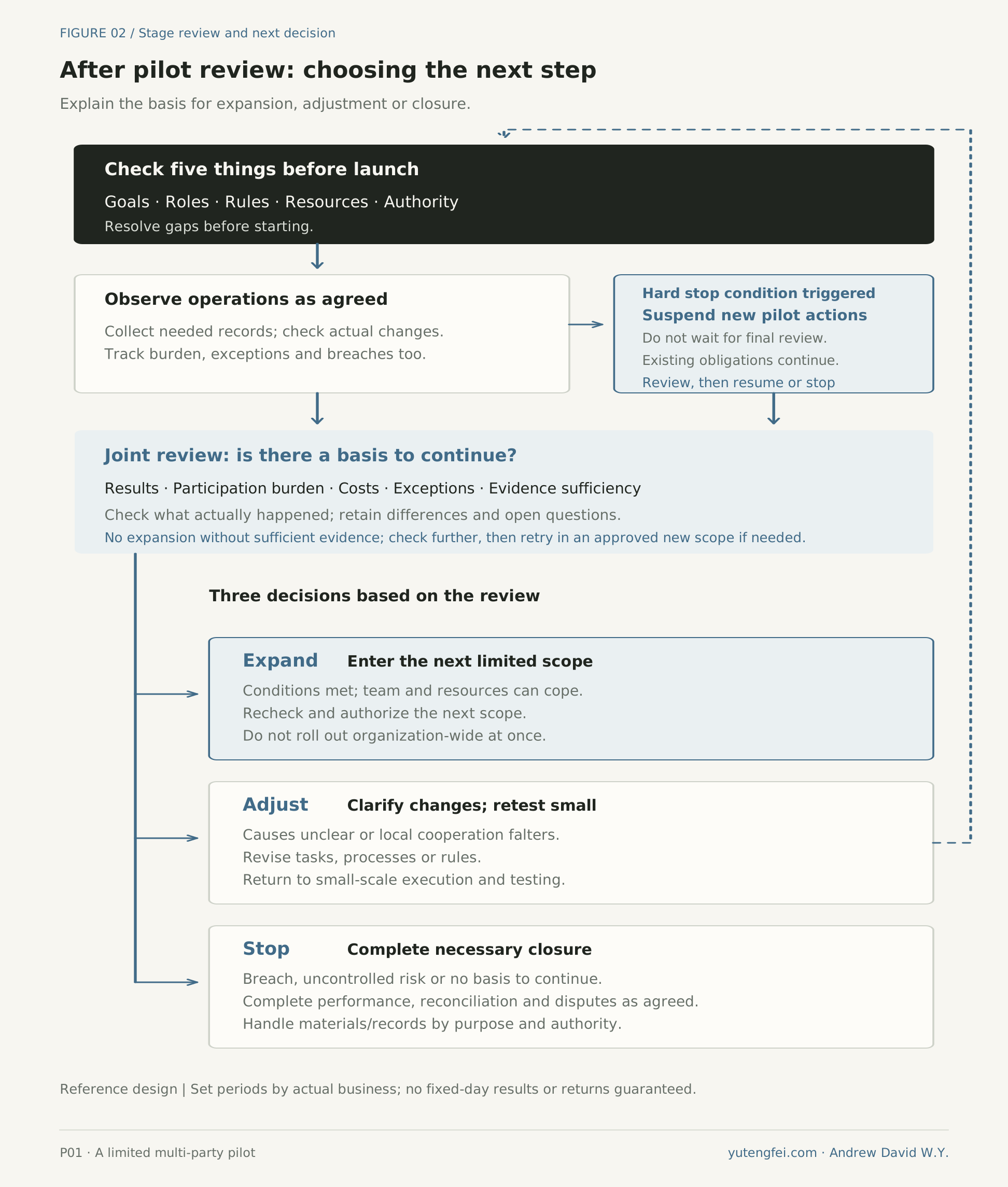
Figure 2 connects stage review to subsequent decisions. If an agreed mandatory stopping condition is triggered during execution, suspend the relevant new pilot actions without waiting for the final review.
6. The next step may be expansion, adjustment or closure
Expand: establish that the next scope can be supported
There is a basis for discussing expansion when the original problem has demonstrably improved, major exceptions have been handled, participants want to continue and costs and resources remain manageable.
Before expanding, examine how the next scope differs. A new product category, different partners or greater volume may require different recording, coordination and review arrangements.
Increase one defined scope, provide the resources, responsibilities and authority it needs, and continue checking. Pilot results do not replace a judgment about organization-wide rollout.
Adjust: specify the problem and test again
Some steps may work while others remain unclear. Revise the particular areas concerned.
Perhaps demand confirmation improved but change notices still arrive too late, or recordkeeping itself created considerable work. State the problem, proposed change, responsible person and new observation conditions before deciding whether to retry.
Retain the previous version's records. People should be able to check what changed, why and which results remain unexplained.
Stop: settle responsibilities already undertaken
Discuss closure if the pilot exceeds its scope, costs or risks become unmanageable, cooperation conditions cannot be met, or there is no basis to proceed.
Agreed conditions such as unauthorized new commitments, serious reconciliation differences or an inability to safeguard ordinary performance should also trigger suspension of the relevant new pilot actions and a defined response. Before resumption, establish the cause, corrective measures and new execution conditions, then obtain authorized confirmation.
Suspending or closing a pilot does not automatically end existing responsibilities. Someone must take responsibility for outstanding orders, incurred expenses, unresolved disputes, and information handling under agreed access and retention requirements.
Resolving these matters establishes where the pilot ended and which lessons can be retained.
7. Make one activity explainable and checkable first
To me, the most useful result of a small collaboration pilot is that previously vague problems become specific.
People can explain who did what, which coordination worked, what needs changing and which conditions further investment requires.
Before formal launch, ask again:
- Can we state the problem in one sentence?
- Do participants understand the scope, input limits and stopping conditions?
- Can we identify the people responsible for execution, review and approval?
- Is there a clear way to handle disagreement and rule changes?
- What evidence will determine whether to expand, adjust or stop?
With workable answers, begin within the confirmed scope. Fill remaining gaps first rather than expecting one pilot to solve everything at once.
A clear account of this activity, including its conditions and limits, gives later cooperation a foundation it can use.
Download the accompanying Pilot Charter, Responsibility Allocation and Stage Review Checklist