A talk in Hong Kong: giving co-creators a place in a company’s long-term future
At a talk in Hong Kong on October 22, 2026, I discussed four ecosystems, contribution records, long-term accounts and distinct rights, and how co-creators can participate in a company’s long-term development.
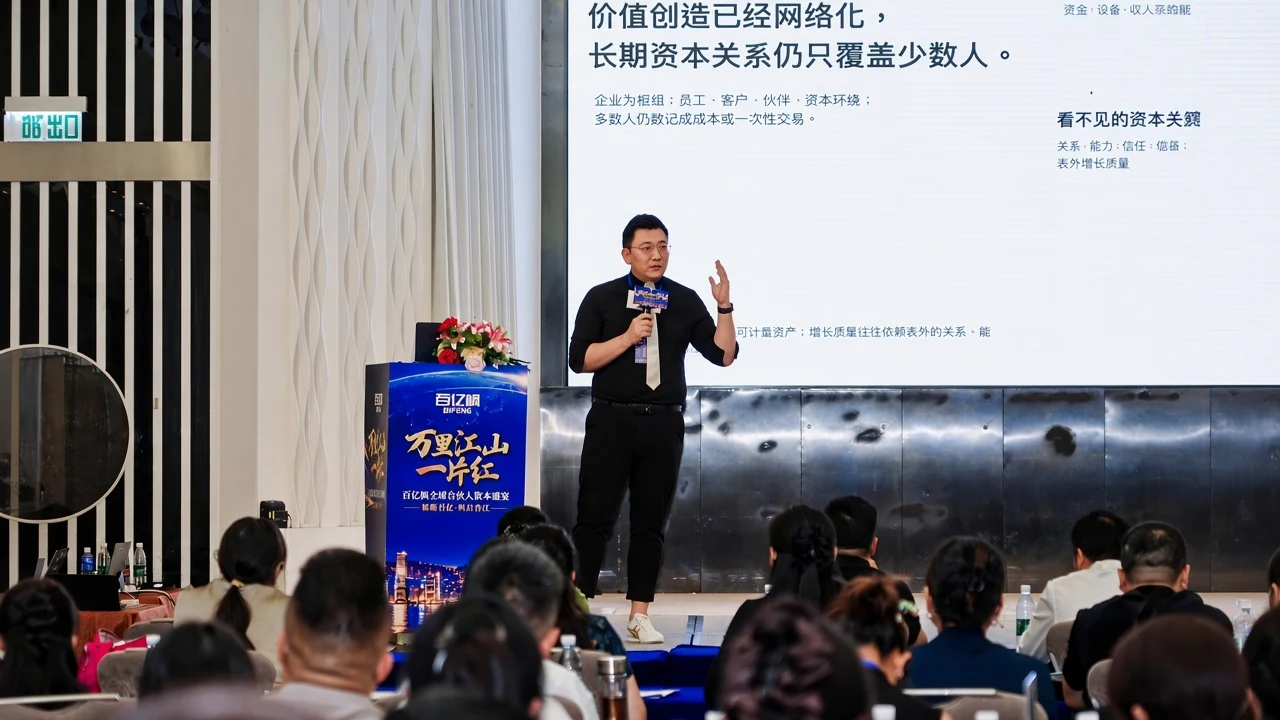
On October 22, 2026, I attended BiFENG's Global Partners Capital Banquet in Hong Kong. I spoke about a question I continue to study: how stakeholders can move from contributing to a company's operations to having a place in its long-term development.
The title of my talk was “Stakeholder Capitalism: From Goodwill to Governable Capital.”
It may sound academic. Inside a company, the question is quite concrete.
Who has helped build the business into what it is today?
There are investors who provide funding, teams that deliver products and services, partners who contribute technology, supplies and distribution channels, and customers who keep buying, giving feedback and recommending the business. They create the company's value together, in different ways.
Salaries, payments to suppliers and commissions settle what is due for the current period. How contributions accumulate, how cooperation continues and how people participate in future development require further arrangements.
One slide in this talk captures a point I consider important:
Value creation has become a networked effort, while long-term capital relationships still include only a small number of people.
Companies increasingly depend on cooperation among different parties. Relationships, capabilities and trust also have a growing influence on operating results. How to make these visible, record them and build long-term cooperation governed by clear rules is something I want to keep exploring in research and practice.
Understand the people working together
I organize the relationships around a company into four ecosystems: resources, operations and management, customers, and capital.
The resource ecosystem concerns what a company needs to produce value. It includes suppliers, technology providers and industry partners.
The operations and management ecosystem concerns who moves the work forward and how it is delivered. Founders, managers, employees, specialists and external service teams have different roles and responsibilities.
The customer ecosystem concerns whether people need and buy what the company offers, and whether using it leads to feedback and continued cooperation.
The capital ecosystem concerns how funding enters, how risk is borne, and what capital and governance support long-term development requires.
Looking at these four ecosystems together gives a fuller picture of operations: resources come in, teams work together, products and services reach customers, revenue is generated, and resources are committed to the next operating cycle.
The diagram is meant to explain how each party participates and how they support one another.
A partner supplies a critical resource, a team solves a delivery problem, and a customer provides useful feedback. These are different contributions. A vague statement that someone “supported us” does not describe them adequately. Making the relationships and roles clear provides a basis for later evaluation, allocation and responsibility.
Record contributions and give cooperation clear rules
When businesses discuss cooperation, the conversation easily starts with a vision and how much everyone might achieve together.
I think some concrete questions need to come first.
Who participated? What did they do? What evidence supports the contribution? Who verifies it? Which rules apply? If people disagree, how is the matter reviewed and handled?
Clear answers give long-term cooperation a foundation people can rely on.
In this talk, I arranged these relationships into a sequence:
Identity → Contribution → Verification → Rules → Long-term accounts → Governance → Capital interfaces.
A long-term account here begins as a record of relationships that can be checked over time.
It connects a participant's identity, actual contributions, confirmation results, applicable rules and corresponding rights and entitlements. When there are new contributions, new responsibilities or changes to an existing arrangement, the record remains available to follow.
This gives cooperation continuity. There is a place to check what happened before, the current status and the conditions for future participation, with someone responsible for explaining the record.
I hope digital systems can support this work, gradually turning information scattered across contracts, spreadsheets, conversations and people's memories into records that can be checked and maintained.
Define different rights clearly
How people share in what they create together needs careful design.
In this model, I discuss different rights and entitlements separately. Participating in governance, receiving service benefits, participating in a particular income-sharing arrangement and holding equity each involve different conditions, responsibilities and rules.
Recording a contribution does not automatically turn it into equity or an investment return.
Points, tokens and shares also need separate definitions and separate records. The choice of instrument needs to be considered against the actual business and applicable rules. The technical ability to record something is no reason to mix rights of different kinds.
I think clear boundaries are a way of respecting participants.
People can form more stable expectations when they understand what they are participating in, the responsibilities they take on, how to check their records and the conditions under which particular rights or benefits become available.
Trust builds through these concrete details.
Test the model in actual operations
Presenting a model is part of the work. Whether it helps a company improve cooperation still has to be tested in its operations.
Has cooperation become more stable? Can contributions be checked? Are the rules easy to understand? Is there a way to resolve disagreements? Do these arrangements support the next round of value creation?
Actual use has to answer these questions.
At the end of the talk, I therefore proposed starting with a specific setting and a small pilot. Record identities, contributions and data properly, connect the rules to the accounts, and then consider further technical instruments and capital connections according to actual needs and the conditions in place.
Working step by step helps establish which parts of the model are useful and which need adjustment.
My central point in Hong Kong was that the people who create value together should be able to see their place in a company's long-term development.
Companies need continuing support in resources, capabilities, customers and funding. Participants also need to understand how their inputs are recognized, how their contributions are confirmed and how cooperation can continue.
With these relationships properly arranged, what I call “stakeholder capital” can gradually take a concrete form.
Keep a record of co-creation, give long-term cooperation clear rules, and connect the company's development with the growth of its participants.
That is the work I want to keep pursuing after this talk.