Use this resourceThinking
- Purpose
- Use a quality inspection collaboration to trace the operating capabilities a business retains and the rights and responsibilities contributors carry into later periods. The article proposes questions that Company Zero can test in actual collaborations.
- Conditions for use
- Check that the subject, objective and constraints fit the task. Confirm any conditions that the article does not specify.
- Thinking
- Premises and reasoning
- Evidence and validation limits
- Model research draft V0.1. The quality inspection collaboration is fictional. The article sets out an observation plan and questions for Company Zero to test. No separate external-validation result is recorded for this article. Publication does not establish effectiveness; check the evidence, assumptions and limits in the text.
- Version
- V0.1 · Revised 2026-11-14
- Original diagrams and files
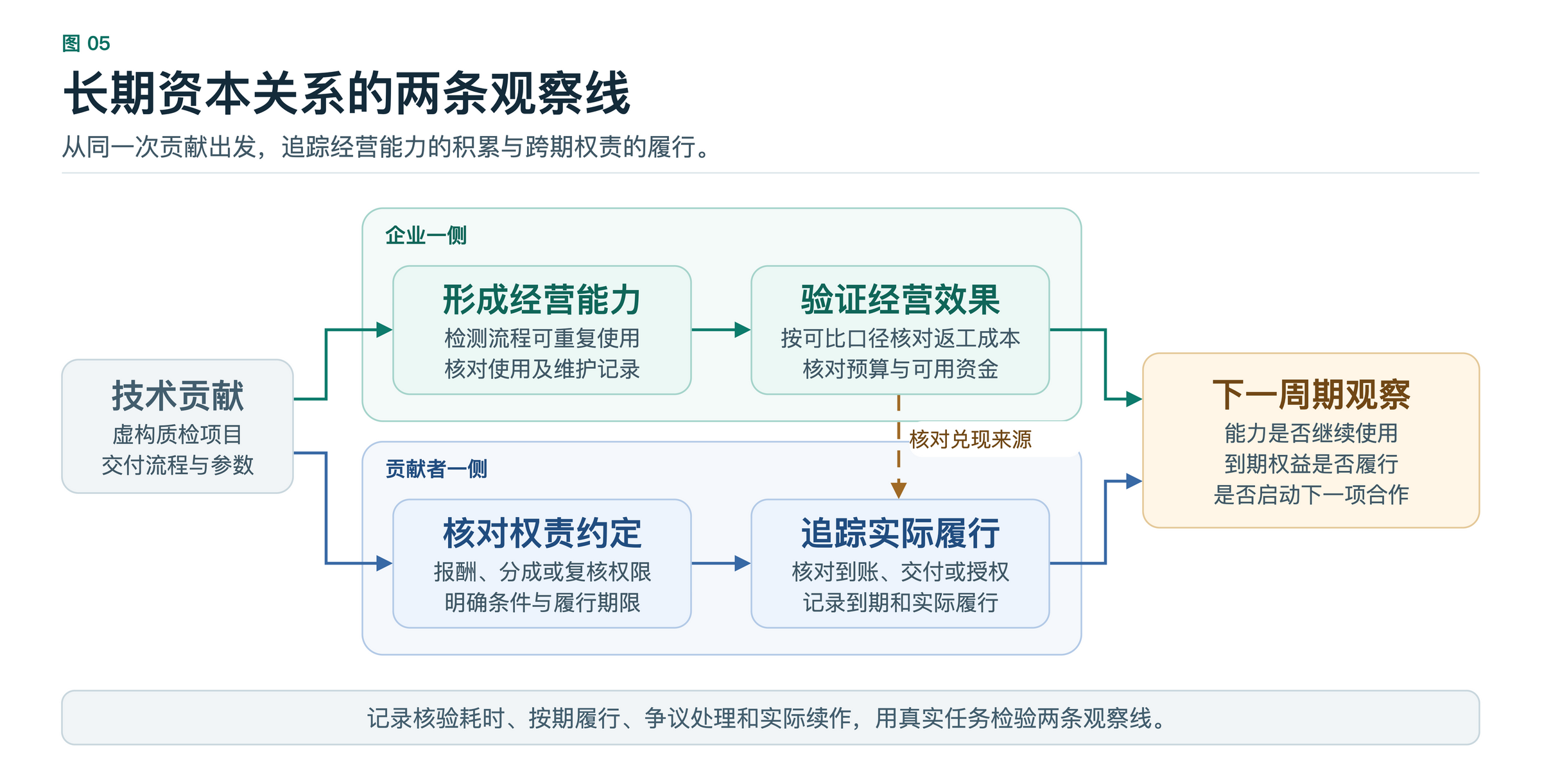
- Figure 5. From the same technical contribution to quality inspection, trace the operating capability the company retains and the rights and obligations the contributor carries forward. Operating results and fulfillment records inform the next cycle.
- Download the Draw.io source (five pages, Chinese) ↓
This is a readable, citable knowledge resource, not an installed Skill. When using it with AI, retain its sources and limits and review the output.
CC BY-NC-ND 4.0 · Applies to original text unless otherwise stated; excludes third-party materials. Downloading or machine reading does not extend the existing license or separately authorize derivatives, commercial use or model training.
WISERUNION Think Tank · Model research draft V0.1 · November 14, 2026
Suppose a manufacturer asks an outside technical team to improve its quality inspection process. How might the parties work together after accepting the project? The company could pay the service fee in full, or agree to share the actual savings on rework over the following year. If the team also maintains the inspection rules, the parties could agree that it will join quality reviews. The same technical contribution can lead to three different arrangements.
I start with two questions. What remains with the company? Can it reuse the inspection methods, data, and maintenance capabilities in the next production cycle? Then look at the contributor's side. What did the contributor obtain, who will fulfill it, and with what resources? A one-off purchase can leave the company with a lasting capability even if the contributor exits after settlement. An ongoing sharing arrangement still depends on actual operating results, the resources available for fulfillment, and how much delay and volatility each party can bear.
I use long-term capital relationships to observe how parties carry rights, responsibilities, risk-bearing, or governance participation into later operating cycles through outcomes that remain useful. To examine a collaboration, record its agreed term and then trace what the parties did. An agreement to share savings can take effect before any amount is payable. Check what happened when the condition and the deadline arrived, then follow whether the parties kept working together.

View full-size figure ↗Download the Draw.io source (five pages, Chinese) ↓
Five stages from contribution to renewal
Before making the investment, settle what you can. Agree who may participate, how acceptance will be assessed, and when returns are payable. Once work begins, follow the stages below. For a right that depends on a condition, use the verification record to establish whether the condition is met. The authorized party can then deal with the rights and responsibilities under the agreement in force.
| Stage | Who is responsible | Evidence and risks |
|---|---|---|
| Contribution | Participants provide the inputs, and the project lead records them against the relevant tasks. | Check the prior agreement, deliverables, versions, and allocation of work. For joint work, record the shared result and each person's part. Handle costs and responsibility for failed or out-of-scope inputs under the agreed terms. |
| Verification | The designated acceptance party verifies results and handles objections through the agreed procedure. | Confirm delivery and results through acceptance records, operating data, or third-party material. Retain the original evidence and review findings when a joint result's attribution is disputed. |
| Rights and obligations established | The authorized decision-maker confirms rights, obligations, and effective conditions under the contract or applicable rules. | State the basis, scope, and term for service compensation, ongoing revenue sharing, or governance participation. After confirming the contribution, check which agreement applies and what triggers each right. |
| Fulfillment | The obligor makes the payment, delivers, or grants the agreed governance access. The parties retain supporting records. | Check the source of payment, due date, actual amounts paid, or records of exercised rights. Handle underperformance, insufficient funds, and missed deadlines as agreed, recording their distinct causes and responsible parties. |
| Renewal or exit | The parties or the authorized entity use fulfillment records to decide whether to renew, adjust, or exit. | Check outstanding rights, ongoing maintenance, and handover. Record the causes and consequences of expiration, voluntary withdrawal, or interruption due to a dispute. |
Acceptance, the establishment of rights, the due date, and actual fulfillment each need their own evidence. Acceptance of the inspection process can trigger an agreed service fee. For ongoing sharing, check whether savings were verified and whether settlement is due. If savings fall short of the agreed threshold, record the condition as unmet. If the payment deadline passes without payment, record it as overdue and verify why. Governance participation can be checked in the same way. Were the review materials provided as agreed? Did the participant attend, and was their input handled through the agreed process?
Contribution records support assessment and review. Distribution rules identify the amount or operating result used to calculate what is owed. Both should link to the same item. Contribution Records and Review Worksheet · Agreeing on a Calculation Basis Before Distributing Proceeds
Structuring returns for the same technical contribution
The following quality inspection project is fictional. The technical team delivers an inspection procedure, operating parameters, and instructions. The manufacturer runs the process on site and organizes production. The appropriate arrangement depends on whether delivery can be accepted on its own, whether results can be measured over time, and which responsibilities the team retains.
| Arrangement | When it fits | Terms for the quality inspection project |
|---|---|---|
| One-off service fee | Delivery scope is clear, the work can be accepted and handed over, and the company has a defined source of payment. | Set the scope, acceptance criteria, fee, and payment date. The company takes over daily operation. The technical team remains responsible for warranty or defect corrections under the contract. |
| Time-limited sharing of ongoing savings | Later results can be measured, the parties can agree on a calculation basis, and the contributor can bear delays and volatility. | Calculate agreed-period rework savings using comparable output and quality levels and deduct additional maintenance costs. Specify the verifier, share, settlement frequency, payment source, and treatment of lower-than-expected savings. |
| Governance participation with a defined scope | The contributor retains maintenance, quality assessment, or other ongoing responsibilities, and involvement in relevant decisions helps it carry them out. | Specify which parameter changes and reviews the team can join, what it can inspect, comment on, or vote on, and how recusals, expiration of authority, and handover work. |
These arrangements can be combined. A service fee can cover initial delivery, a share can reflect later verified operating results, and review authority can support ongoing quality responsibilities. Each rests on its own agreement. Sharing requires a baseline and deductions, as well as a payer and source of funds. Lower rework costs can demonstrate better operations. The company still has to check whether available funds cover amounts when due.
Changes in operations can also raise attribution questions. Rework costs may fall while output shrinks, the product mix changes, or equipment is replaced. Review those changes using the agreed basis for comparison and refer disputed items for review. Document the operating result, the basis for sharing, and the actual payment separately.
Connecting payment conditions to operating cash flow
At fulfillment, I check two things. Why is it payable? Look at the agreement in force, verification results, and due conditions. How will it be paid? Look at budgets, available funds, and cash flow. The timing can differ. Customer payments may still be pending after contributors have advanced labor and equipment costs and the company's obligation has fallen due.
For a project with external financing, trace where each of three payments goes. Customer receipts go to the operating entity, which uses them for working capital and payments under its agreements. New financing goes to the financed entity and is allocated to its permitted uses. Proceeds from transferring existing rights go to the prior holders and are listed separately in project funding records. The three flows show how much cash operations bring in, how much new money the company raises, and how prior holders exit. Whether a particular obligation can be fulfilled depends on the recipient, restrictions on use, and the amount actually available. How Operations and Capital Arrangements Support Each Other
Testing the mechanism through real work at Company Zero
Start with a technical or channel collaboration with a defined scope that can run through acceptance and settlement. Before work begins, record what will be contributed, what reusable outcomes are expected, how they will be verified, and how rights are arranged. After settlement, check what is still in use, which obligations have fallen due, and which were fulfilled. Observe whether the parties actually start another collaboration. Record zero returns, overdue obligations, disputes, and early exits so the team can trace issues to operating conditions, verification rules, or available resources.
The first cycle can capture four measures.
- Verification time measures the period from submission of complete material to confirmation.
- On-time fulfillment rate is the share of obligations due in the observation period that were completed on time. Mark partial fulfillment separately.
- Disputes and resolution records objections to facts, attribution, calculation, or fulfillment and how they were handled.
- Actual renewal records whether the parties started a new joint task or committed new resources during the agreed observation period.
The working paper How Intertemporal Conflicts of Interest Affect Stakeholders’ Willingness to Continue Cooperating considers whether commitments are verifiable and enforceable and whether suppliers can bear a delay. Company Zero can pursue a related question. For collaborations with comparable contributions, operating stages, and cash constraints, are upfront verification criteria and identified sources of payment associated with a higher rate of on-time fulfillment, fewer disputes, or more renewals? The first case can reveal where the process breaks down and help refine the records. Later, compare similar cases and capture payer creditworthiness, budgets, and operating volatility. Faster verification without better payment performance can point to the source of funds. If rights are fulfilled on time and the parties still do not renew, check for changes in demand, fit, or the cost of cooperation. Working paper on intertemporal conflicts and continued cooperation
Conclusion
After acceptance, check whether the company can reuse the capability in its next operating cycle and whether the participants received what was due when it was due. Operating and fulfillment records give the parties a basis for deciding whether the collaboration can continue.