A total is often the most misleading part of a funding table. Budgeted expenditure, planned fundraising, an expression of willingness to invest, and cash received can make a project appear funded if they are all placed in one column.
I would hold off on adding them up. First establish where the money is now, who may use it, what it may be used for, and under what conditions.
1. Define the scope before examining the figures
State the project, receiving entity, period and currency at the top of the table. Cash held by different entities cannot simply be combined because they participate in the same arrangement. Different currencies cannot be added directly. For conversions, retain the original amount and currency, the exchange-rate source and date, and the conversion basis.
Opening cash, actual inflows and outflows during the period, and closing cash must reconcile. Do not register opening cash again as new financing for the period. Record both sides of transfers between projects. When consolidating, identify internal transfers so that the same money is not counted repeatedly as new funding.
A budget shows planned expenditure. Funding records show how much has actually been obtained. The two must correspond, but neither replaces the other.
2. Distinguish at least three stages for each source
For a planned source, record the expected amount and its basis. Once an agreement is signed, check payment conditions, deadlines and cancellation terms. When funds actually arrive, verify the receiving entity, amount, date and corresponding records.
Receipt raises a further question: may this money be used for the current purpose? Earmarked use, temporary custody, pledges, refund obligations and other restrictions may limit its use. Record actual receipt separately from freedom to use the money.
I suggest retaining descriptions such as “proposed”, “agreed, not yet received”, “received, conditions pending verification”, “confirmed available for specified purposes”, and “use suspended”. Enter status based on the checks performed; do not change it automatically when a date arrives.
Give each source a stable identifier and retain a history of status changes. If one source progresses from an expression of intent to actual receipt, update that source’s progress. Do not add together its amounts at different stages.
3. Link uses to specific payments
“For operations” is not specific enough. Record what is being purchased, who receives payment, why payment is due now, the relevant contract or approval, the due date, and the delivery and acceptance conditions.
Keep payment requests, approval, actual payment and acceptance separate. A budget allocation does not authorize immediate payment. Approval does not mean payment has occurred. Payment does not mean the other party has completed delivery.
One source may cover several uses, and one use may draw on several sources. Keep matching records showing amounts, periods and restrictions. A connecting line without an amount cannot reveal whether the same money has been allocated twice.
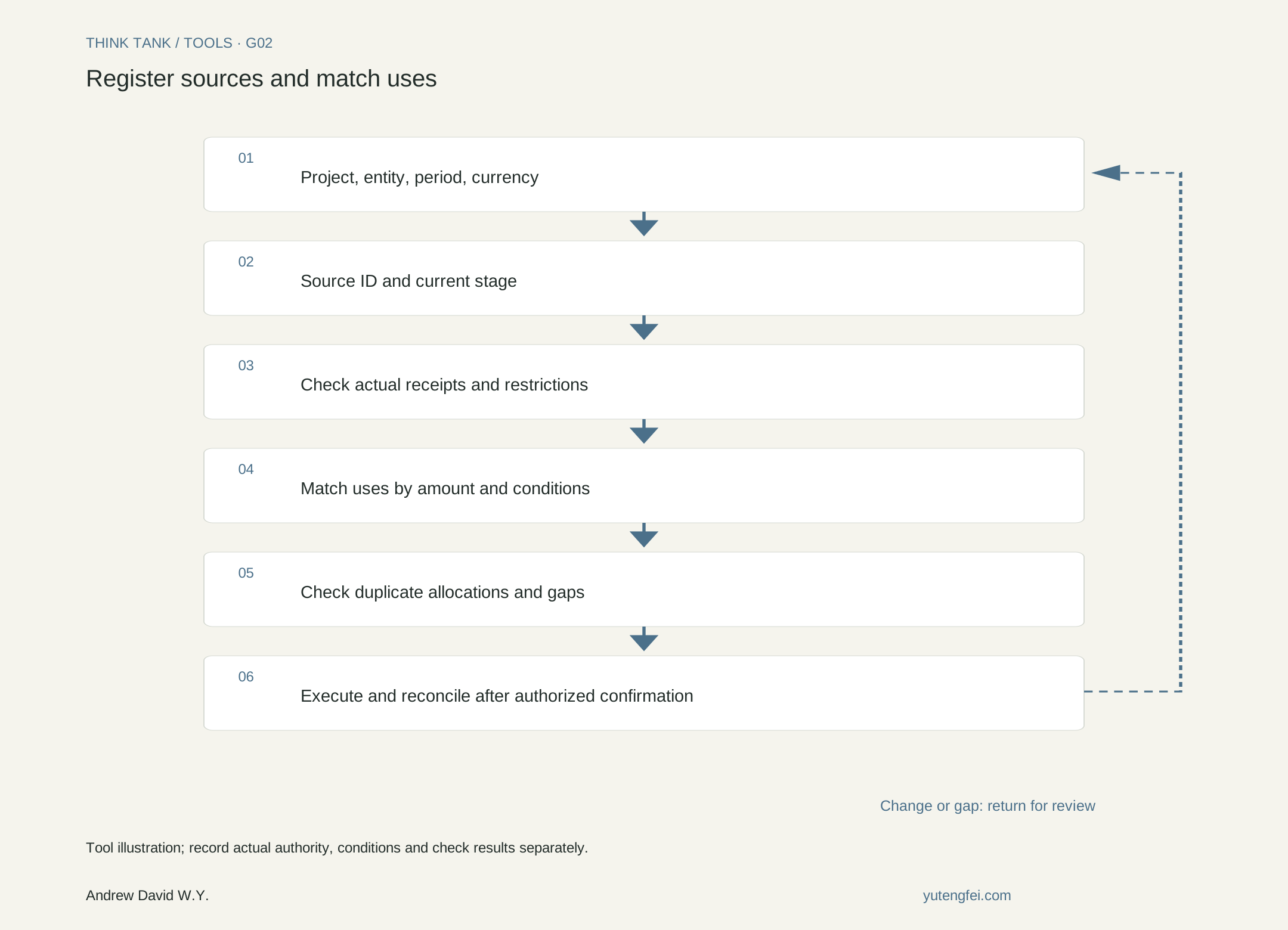
Download SVG: Registering sources and matching uses
4. Examine the gap through a fictional example
Everything below is a teaching assumption. Amounts are in exercise units and do not represent real clients, accounts or financing arrangements.
Assume opening cash is 0. Source S01 has a planned contribution of 1000, but only 600 has arrived. Of that amount, 200 is subject to earmarked-use and disbursement conditions and must not fund ordinary purchases. Even expenditure for the earmarked purpose must wait until its applicable conditions are met. Source S02 is an expression of intent for 300; nothing has arrived.
As of the verification date, cash is 600 and the amount currently available for ordinary purchases is 400. Do not add 1000, 600 and 300 together, or count the intended 300 toward a payment due now.
Ordinary purchases require 450, and specified-purpose expenditure requires 150. Under the current conditions, ordinary purchases have a shortfall of 50. Although 150 is less than the restricted 200, the specified-purpose conditions still need checking. Sufficient funds alone do not authorize payment.
Total requirements of 600 exactly match cash of 600. The totals balance, but the conditions do not. The work cannot proceed on the strength of that total. This is why the matching table must retain restrictions.
Now assume 300 is actually paid for ordinary purchases. With no other cash changes, closing cash is 300. The restricted 200 is unchanged, leaving an ordinary available balance of 100. Of the original ordinary requirement of 450, 150 remains unpaid, so the ordinary funding shortfall is still 50. Do not leave the paid 300 in future unpaid requirements, as that would overstate the gap.
5. Reconcile cash and allocations separately
Cash reconciliation checks whether opening cash plus actual inflows minus actual outflows equals closing cash. Allocation reconciliation checks whether proposed matching amounts exceed what each source permits, whether a use is allocated funding twice, and whether unpaid requirements exclude amounts already paid.
Perform both checks. Reconciled cash does not mean a use is approved; a balanced budget does not mean cash has arrived.
For refunds, reversals or changed conditions, record the original identifier, the basis of the change, and the affected matching rows. Do not simply delete the original entry. Other participants need to know whether the difference reflects a business change, a changed accounting or calculation basis, or a previous recording error.
6. Connect gaps to the next action
When a gap appears, identify its cause: insufficient funds, a timing mismatch, restricted use, or outstanding approval or payment conditions. Each calls for a different response.
Proposed additional sources may be recorded as plans, but cannot be treated as funds already available. Deferral, a smaller scope, phased execution or an alternative source require confirmation by the appropriate authority and checks of contractual and performance implications.
If a responsible person is unconfirmed, mark the assignment as pending. Record planned dates separately from actual completion dates. Do not turn uncertain financing into a commitment or a payment awaiting approval into a completed payment just to make the table look complete.
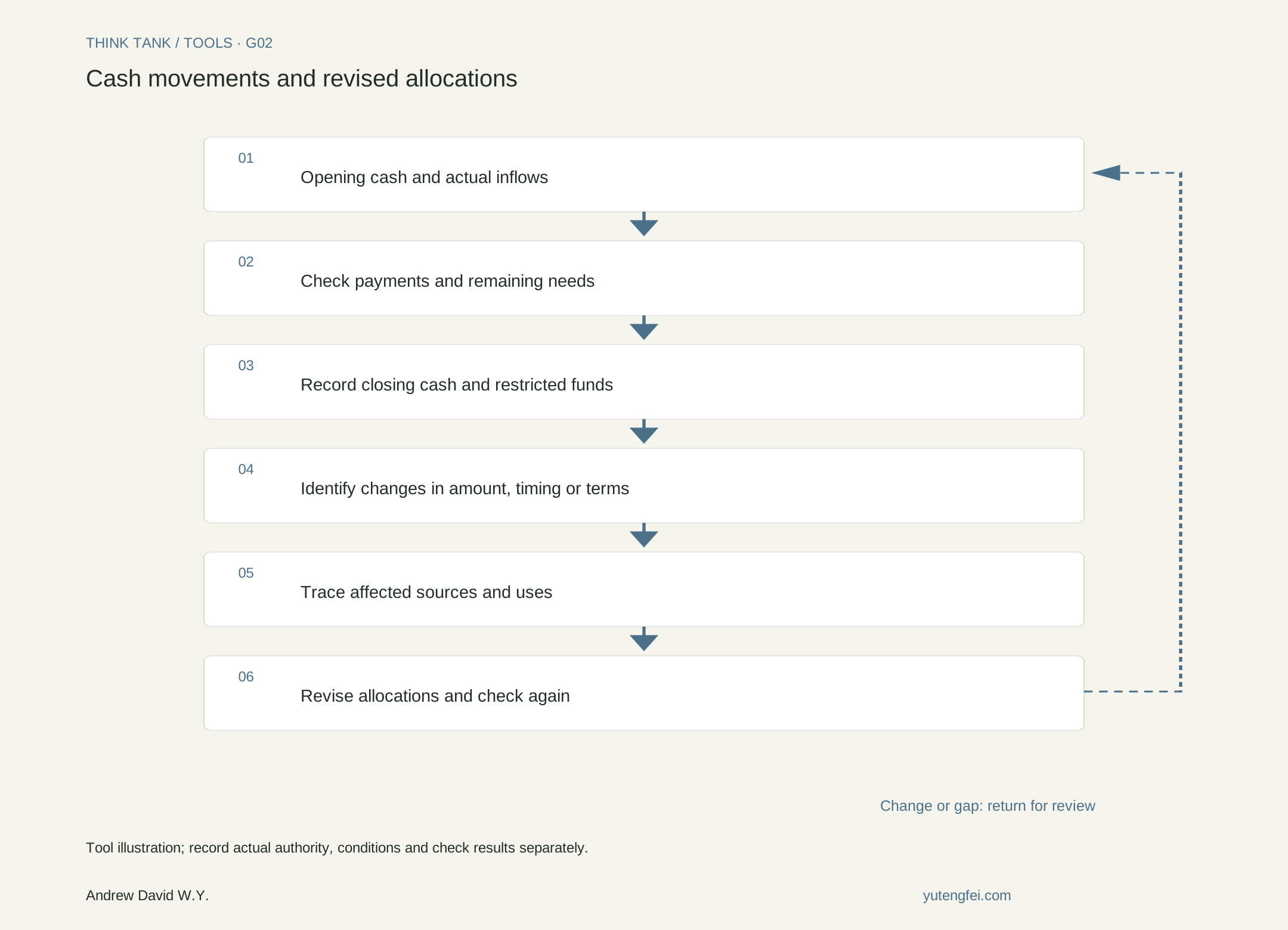
Download SVG: Cash movements and revised allocations
7. Trace one amount through the whole relationship
Start with the basis for a funding source. Find the receipt record, use restrictions, approval for the use, payment and closing balance. Record identifiers, versions, dates and reviewers for each link.
Putting sources and uses together connects actual cash and its conditions to operating tasks. Readers should be able to see what can be done now, what conditions remain unmet, and what to check next. This working framework does not replace actual financial books, professional review or payment authority.