AI-Native Business Models: Looking at Society's Next Needs and Opportunities
Starting from AI-native business models, I consider human value, AI's operating needs and transition services for human–AI collaboration. I connect needs, knowledge, work outputs and stakeholder collaboration, then return to client payment, costs, acceptance and responsibility to find starting points that can be tested in practice.
Reading & sharing

Recently, while organizing the relationship between the think tank, Four-Way SOP and AI Skills, I took the thought one step further: if AI can take part in more and more of a company's work, how might its business model change?
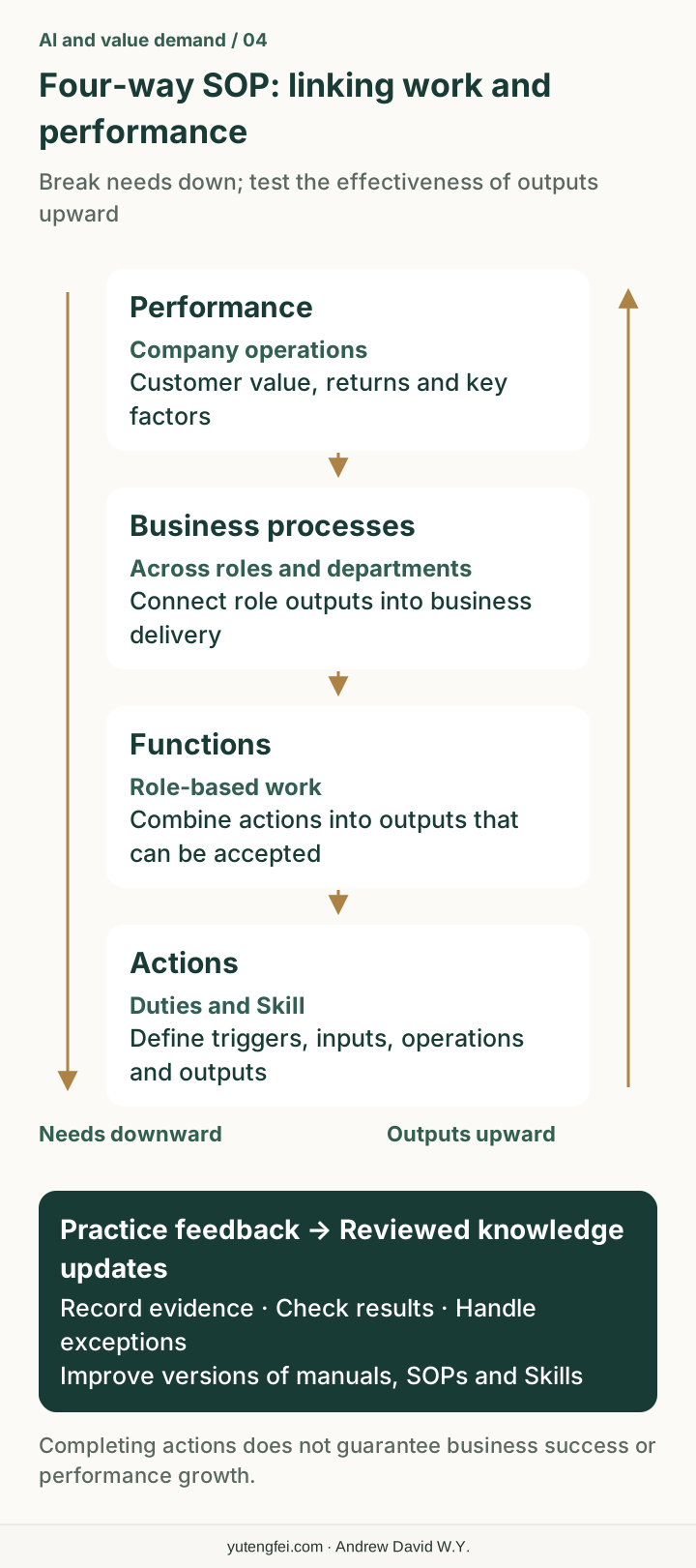
An action can be organized into a Skill. Several actions combine to produce the outputs of a role. Through business collaboration, the outputs of several roles can meet the key conditions needed to generate business performance. Those conditions are then organized to produce the company's business results.
Seen through this process, the opportunities brought by AI extend from using a tool to how a company organizes work, delivers value and earns returns.
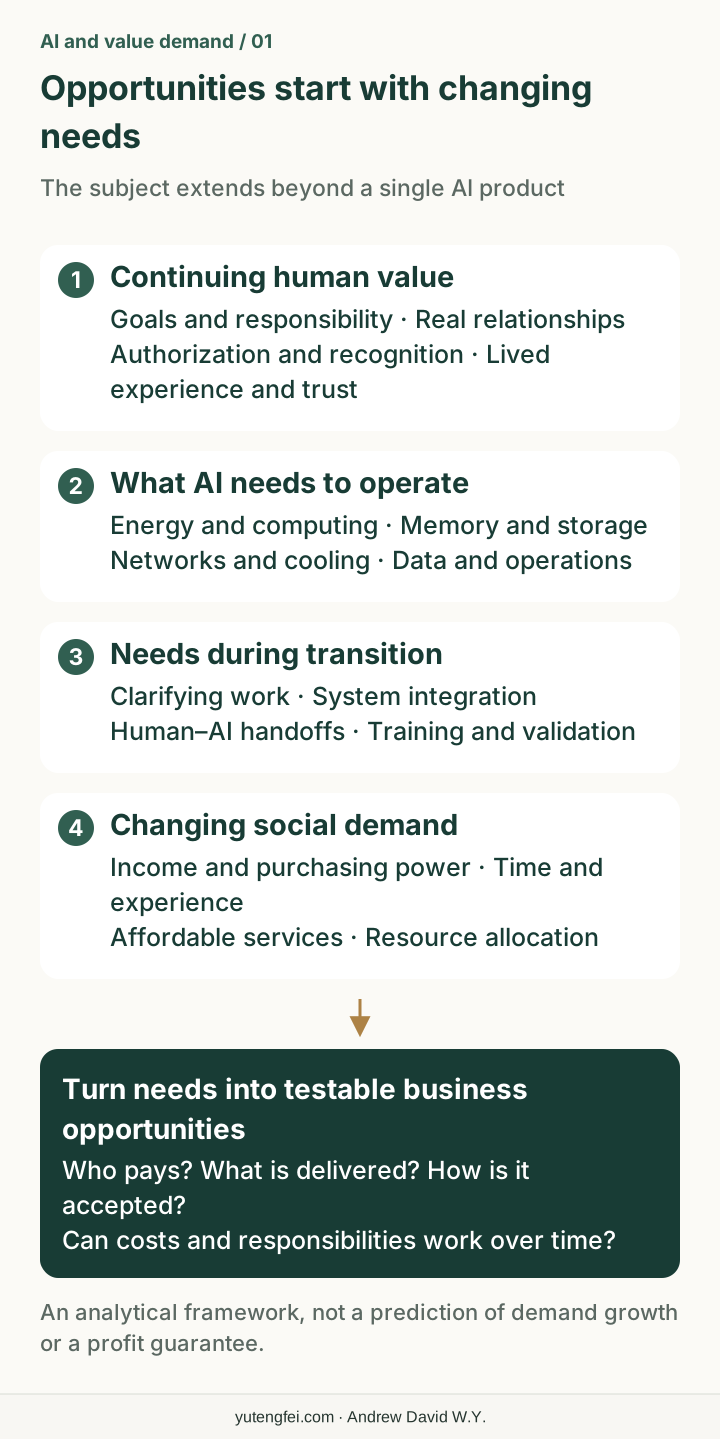
Looking more broadly, if AI capabilities continue to grow and combine with robotics, where will human value lie? What resources does AI itself need? What new needs might arise during the transition toward people and AI working together?
These questions point toward what I most want to study: how the demand for value across the economy and society may change next, and where we can participate. Below, I organize my current thinking, looking at what can be tested today while leaving room to discuss future scenarios.
Some of these are AI-native products and services, some are infrastructure supporting AI, and others are transformation services arising from the use of technology. They occupy different positions in the same value chain and cannot all be treated as one business model.
1. First, clarify what AI-native changes
As I understand it, being AI-native means considering the work AI can undertake from the outset when designing products, services and ways of operating, then rearranging people, processes, resources and responsibilities accordingly.
Take research services. One approach is to use AI to help write reports. Another is to organize a continuing service around the questions a client cares about: continually gather material, identify changes, check evidence and flag matters that need attention, with professionals reviewing the work and exercising judgment.
Both approaches may have value. The latter changes how the service is organized more substantially, creating an opportunity to deliver work at different costs and frequencies that previously required more people to sustain.
For me, four questions can help determine whether a model is worth studying:
- What problem does the client need to solve, and why would they pay?
- How does AI's involvement change the way work is done, delivery speed and the cost structure?
- How are results accepted, and who is responsible when something goes wrong?
- Does each delivery leave knowledge that can be reused and improved?
Without clear answers, combining many AI tools still makes it difficult to judge whether the business model works.
2. Eight kinds of opportunities I see
These eight categories are an initial way of organizing opportunities by how value is delivered. They overlap, and a company may use several approaches at once.
1. AI products that work continuously
Some needs do not end after a single task. Companies need to keep track of competitive changes, managers need to follow projects continuously, and clients keep raising new questions.
If AI can keep handling this work within a defined scope, the product delivers an ongoing capability. For example, it might regularly organize industry developments, identify information that needs attention, retain sources and alert the relevant person.
Such products can charge by subscription, usage or number of tasks. Whether a client renews ultimately depends on whether the product reliably helps them do their work, rather than whether the first demonstration was impressive.
2. AI services that deliver specific outputs
Many professional services can be reorganized.
Consider reviewing how a company operates. After obtaining the client's authorization, we can use its materials to analyze how it creates value and earns returns, then organize its business processes, role responsibilities and work-related problems. AI handles suitable standardized organization and analysis; professionals verify, exercise judgment and handle exceptions. The final outputs should be usable by the client.
Revenue might come from project fees, or a base service fee plus fees for tasks accepted against agreed criteria. The prerequisite is to clarify the delivery scope: are we providing a diagnosis and recommendations that meet a standard, or supporting the client through implementation? The responsibilities and costs differ.
If fees are tied to the client's profit growth from the outset, baselines, attribution, observation periods and the effects of the client's own execution need further consideration. Outcome-based pricing is attractive, but results that are difficult to control cannot simply be written into a promise.
3. Digital functions that continually deliver work outputs
If several Skills can work together reliably, a service may develop from individual actions toward the functional responsibilities of a role.
A research assistant could combine material collection, source checking, organizing views and update alerts. Project coordination could combine task breakdown, milestone tracking, issue summaries and meeting preparation. Customer service could combine identifying needs, searching knowledge, preparing replies and handing matters over to people.
These capabilities could be provided monthly, with pricing based on task volume, service scope and the amount of human support.
The responsibility for a role's results needs attention here. Completing many actions does not mean the role's function has been fulfilled. Even when AI carries out the work, authority, acceptance criteria and situations requiring human decisions still need to be defined.
4. Professional knowledge and expert capabilities that can be called on
Much valuable experience is scattered across experts' minds, documents and projects. With authorization and organization, it can gradually take the form of ideas, models, methods, cases, tools and Skills.
Clients could then consult experts directly or call on a particular capability that has already been organized clearly. For example, they could use a method to check which evidence is missing from a business plan, then ask an expert to review the key issues.
Revenue could come from knowledge licensing, access to capabilities, professional review or combined delivery. How contributors are credited and compensated can also be clarified in the process.
The rights governing knowledge need consideration as well. Being able to read something does not mean being allowed to publish it. Being allowed to use it for the current task does not mean it can be used for training across clients or licensed again. These relationships need to be clear before knowledge can be accumulated and circulated over time.
5. Collaboration networks organized around needs
A client's need often requires several kinds of professional capability working together.
For example, a company expanding overseas may need market research, branding, products, payments, legal work and operations. AI can help clarify needs, break down tasks, match resources and track delivery, while the relevant participants remain responsible for professional judgment and actual fulfillment.
A platform could earn revenue from organizing projects, matching participants or managing delivery.
What really needs to be established is a mechanism for collaboration: whether the need is real, whether resources have the required capabilities, how outputs are handed over, who accepts them and how disputes are handled. Working through these relationships in specific projects first, then codifying the repeated parts as platform capabilities, would provide a firmer basis.
6. Education and training built around actual work
AI may also change how educational products are delivered.
For example, when learning Four-Way SOP, learners could go beyond reading models and cases. They could bring a problem from their own company and gradually organize business performance, business processes, functional tasks and actions into a work output that can be discussed, checked and revised.
AI can take part in explanation, practice and feedback, while mentors help with difficult points and questions requiring judgment. Courses, training programs, organizational learning services and mentor support could all provide revenue.
The effectiveness of this approach needs to be tested through what learners actually understand and apply. Generating an assignment does not directly demonstrate understanding, still less an improvement in company operations.
7. Evaluation, governance and ongoing validation of AI capabilities
As companies begin to rely on AI for work, new questions arise: are the materials reliable, under what conditions does a Skill apply, which version has been tested, which operations require approval, and how can errors be traced?
These questions can support services for assessment criteria, test cases, permission design, review and ongoing monitoring.
They could charge by project, annual service or tool subscription. Their value lies in helping companies understand capabilities and risks more clearly and keep checking them, rather than guaranteeing that nothing will ever go wrong.
8. More continuous research, investment research and post-investment services
AI can help organize public materials, compare projects, track operating data and flag anomalies, making research more continuous and allowing professionals to concentrate on key questions.
These capabilities could support research subscriptions, enterprise services or post-investment support.
Where investment advice, financing or transactions are involved, qualifications and regulatory requirements still need to be checked for the relevant jurisdiction and business. Greater information-processing capacity does not replace professional responsibility, and analytical results cannot be treated as a guarantee of returns.
3. Pricing units are changing, but work outputs need to be clear
Some new pricing approaches are already visible in the market. Intercom Fin, for example, charges for customer-service “outcomes” as it defines them. Salesforce Agentforce offers pricing based on conversations, action consumption or user licenses, among other options. These are observable product mechanisms; they do not mean the companies as a whole are AI-native enterprises. Intercom's official explanation | Agentforce's official explanation
These changes draw my attention to a question: the unit a client buys may extend beyond the right to use software to work that has been completed.
But “an action,” “a conversation” and “a platform-defined outcome” are not the same level of result as the company's eventual business performance. Fin's outcomes, for example, include the completion of certain workflows; the details still depend on the product's billing definitions.
The connection with Four-Way SOP is direct. When actions are completed, we need to see whether they produce role outputs. For role outputs, we need to see whether they meet business delivery needs. After business delivery, we still need to test whether it supports business performance.
So when designing an AI business model, I think the first step is to clarify what is being sold. Is it the right to use a tool, an ongoing function, a specific deliverable, or a work result accepted against agreed criteria? Different units of delivery require different cost calculations and responsibility arrangements.
4. Even with stronger AI, which needs may still call for people?
Thinking further naturally leads to a question: if stronger artificial intelligence emerges and combines with robotics, which roles could never be replaced?
The question is worth studying, but we cannot yet provide a list of occupations that will be safe forever. What future technology can do, what society will permit and what people will accept all remain uncertain. A role also consists of several tasks: some may be automated while others may still need people.
I would rather analyze the need itself: what human value does the client actually need, and why would they pay for it?
1. Goals, choices and responsibility
AI can propose many plans. But what a company ultimately pursues, which risks it will accept and how it balances stakeholders' interests need to be decided by an authorized party that bears responsibility.
Owners, directors and entrusted managers can make extensive use of AI for information analysis, but authority, responsibility and representation of interests need explicit arrangements. In most current organizations and institutional systems, natural persons or organizations still bear these responsibilities. Institutions may change later; today's rules cannot be treated as permanent laws.
Opportunities here include decision support, risk alerts, evidence management and governance services. Their value is to help the responsible party make better-grounded decisions. Giving AI a job title does not transfer responsibility away.
2. Relationships between people
Part of some needs is the wish for a real person to take part.
Examples include a family member's personal companionship, trust between people, understanding built through shared experiences, and interest in another real creator. Even if machines can provide somewhat similar experiences, not everyone will make the same choice.
Elder care, education, psychological support, cultural services and experience-based services may all develop divisions of work between people and machines. AI can help prepare, record and handle repetitive matters, leaving people more time for the parts that truly need relationships and presence. This does not establish that every role in these sectors will remain, nor should human companionship simply be treated as a commodity requiring no professional standards.
3. Legitimacy, representation and social acceptance
Some decisions need acceptance by the people concerned. A representative chosen by an organization, a mediator trusted by both sides of a dispute, or an authorized reviewer provides value that includes the question, “Why are you the person making this decision?”
This involves computation and reasoning, but also rules, authority, identity and trust. AI can assist, while whether it is accepted as directly undertaking a role depends on the specific institutions and participants.
There may therefore be continuing demand for identity verification, authorization records, negotiation mechanisms, independent review and dispute resolution. Any barriers to entry here need to rest on real responsibility and trustworthy rules.
4. Authentic origins and scarce experiences
As content becomes easier to generate, authentic origins may receive more attention. A person's firsthand experience, the process of creating a work and the verification record for a result may all affect whether people are willing to trust and pay.
Art, live events, crafts and local experiences may also involve preferences for who made something and where it happened. Whether these preferences create a sufficiently large market depends on the audience. We cannot assume everyone will pay more for a “real person.”
5. The ability to handle complex real-world situations
People may retain an advantage for a time in settings with changing conditions, significant cost constraints and a need for flexible coordination. Examples include equipment maintenance, services in nonstandard settings and exception handling. As robotics improves in reliability and economics, the boundary will shift again.
These opportunities therefore need to be assessed by setting. “Machines cannot do it yet” is insufficient grounds for a long-term judgment. What is more worth accumulating is field knowledge, problem-solving capability and service networks, so that we can also take part in later human–machine collaboration.
This analysis shifts my attention from role titles to the needs behind them. Human preferences, responsibility arrangements, trust and practical constraints may make some human functions valuable over the long term. The number of people involved, their compensation and how the work is organized will still change. We need continued observation; calling something “irreplaceable” cannot substitute for analysis.
5. AI itself also creates a chain of demand for value
It is easy to focus on what AI produces and overlook what it needs to keep working.
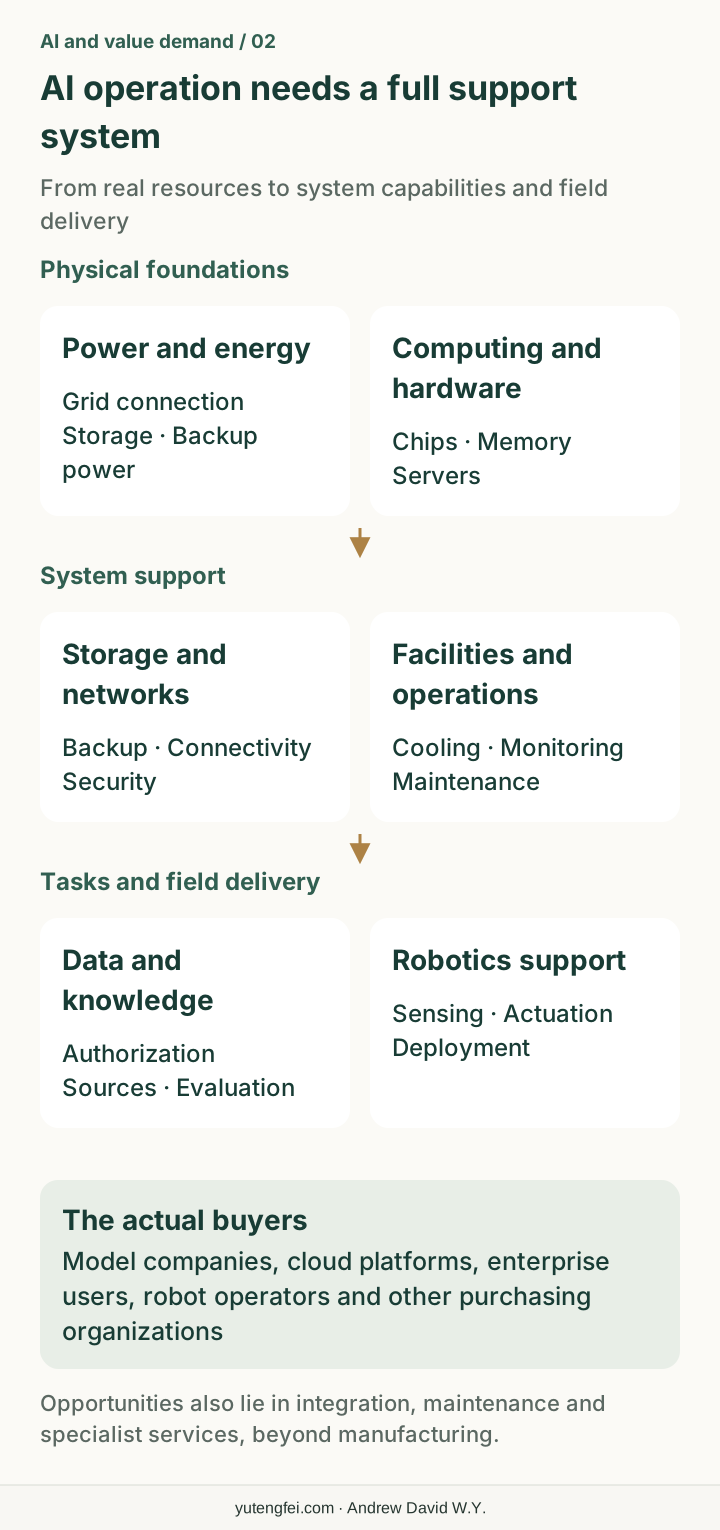
Using AI requires a person or organization to pay for energy, hardware, data and operations and maintenance. Here, “AI's needs” are actually purchasing and payment decisions made by model companies, cloud platforms, enterprise users, robotics operators and others. Finding the actual buyer matters more than simply listing related industries.
1. Electricity and reliable energy supply
Training and running AI systems requires electricity. The need extends beyond how much power is generated to whether it can be connected, when it is supplied, how stable and affordable it is, and how backup power and energy storage are configured.
The International Energy Agency's Energy and AI addresses data-center electricity consumption and related energy supply as a dedicated topic, showing that energy is a practical condition for AI deployment. We do not need to assume when stronger artificial intelligence might emerge to see real problems that already need solutions. International Energy Agency report
Possible ways to participate include energy-efficiency services, power distribution and supply facilities, energy storage and backup power, energy-use planning, and energy projects where the necessary conditions are met. Capital, technical and permitting requirements vary greatly. Rising demand does not mean every energy project will earn good returns.
2. Computing capacity, memory and hardware supply
AI work needs chips, servers, memory, packaging, boards and supporting facilities. Computing and memory requirements differ by task. Training a large model, deploying a specialized model and performing an ordinary inference should not be understood as requiring the same configuration.
Beyond hardware production, there may be opportunities in equipment integration, performance optimization, scheduling, repair and lifecycle management. Entry depends on supply capability, customer channels, technical experience and capital.
We especially need to avoid seeing equipment demand without considering utilization and the pace of replacement. Buying computing capacity does not mean being able to sell it. Idle equipment, lost customers and technological depreciation can all change returns.
3. Storage, data and networks
Systems need to retain models, business materials, operating records and backups, and transmit information between computing equipment, data centers and users.
Memory supports access to data during operation, while long-term storage retains and manages it. They are different needs rather than substitutes. High-speed cluster interconnects, data-center networks and user access networks also have different requirements.
Related opportunities include storage management, backup and recovery, data organization, low-latency connections, secure transmission and edge deployment. Before choosing a product, we need to determine whether the customer's real problem concerns capacity, speed, reliability, cost or permissions.
4. Cooling, space and ongoing operations and maintenance
Computing-intensive equipment needs cooling and depends on equipment rooms, power distribution, monitoring, operations and maintenance. Cooling designs are also affected by location, water resources, climate and facility conditions.
Cooling equipment, facility upgrades, equipment monitoring, repair and energy-saving services are all worth studying. Some companies can provide value in a specialized part of the process without investing in an entire data center.
However, facility needs depend on deployment locations, equipment density and technical approaches. No particular cooling method or type of land can be treated as an asset that will inevitably benefit.
5. Usable data, knowledge and validation
Computing capacity enables a system to run; data and knowledge affect whether it can complete specific work.
Companies need more than additional documents. They need materials that can lawfully be used, accurate sources, clear structures, ongoing updates, and examples and standards for checking results. Data organization, knowledge licensing, professional evaluation, and maintaining SOPs and Skills may all become services.
This connects directly with the think tank's direction. Organizing experience into understandable, usable and verifiable knowledge is continuing work. It does not end with handing all the old files to a model.
6. When AI enters robotics, demand extends further into the physical world
Robots also need sensors, drive components, control systems, batteries or power-supply equipment, mechanical structures, and charging, repair, spare-parts and recycling services.
Deployment at a customer's site also involves task design, site adaptation, system integration, safety checks and continuing operation. Whether a robot can perform a task, and whether it can perform it reliably and economically over time in a real location, are two questions that need separate validation.
Opportunities therefore may extend beyond manufacturing complete robots to deployment, maintenance and operation for particular settings. For example, we can first define tasks, acceptance criteria and human collaboration in a specific location, then assess whether pricing by equipment, leasing or completed task is suitable.
Viewed through this demand chain, greater use of AI at work may create greater need for reliable real-world resources and professional services. But demand growth does not automatically become profit for every participant. We also need to assess who controls key resources, who bears capital expenditure, who can secure orders and whether competition will drive prices down.
6. From people to AI, stronger intelligence and robots: what value lies in the transition itself?
I consider people, AI, stronger artificial intelligence and robots together to observe changes in capabilities and ways of collaborating.
They will not necessarily appear one after another on the same timeline. Specialized robots can already work in some settings without necessarily waiting for artificial general intelligence. Stronger software intelligence does not mean every real-world task will be automated at the same time. Regions and industries may remain at different stages for a long time.
The value needed during this transition is therefore worth studying in its own right.
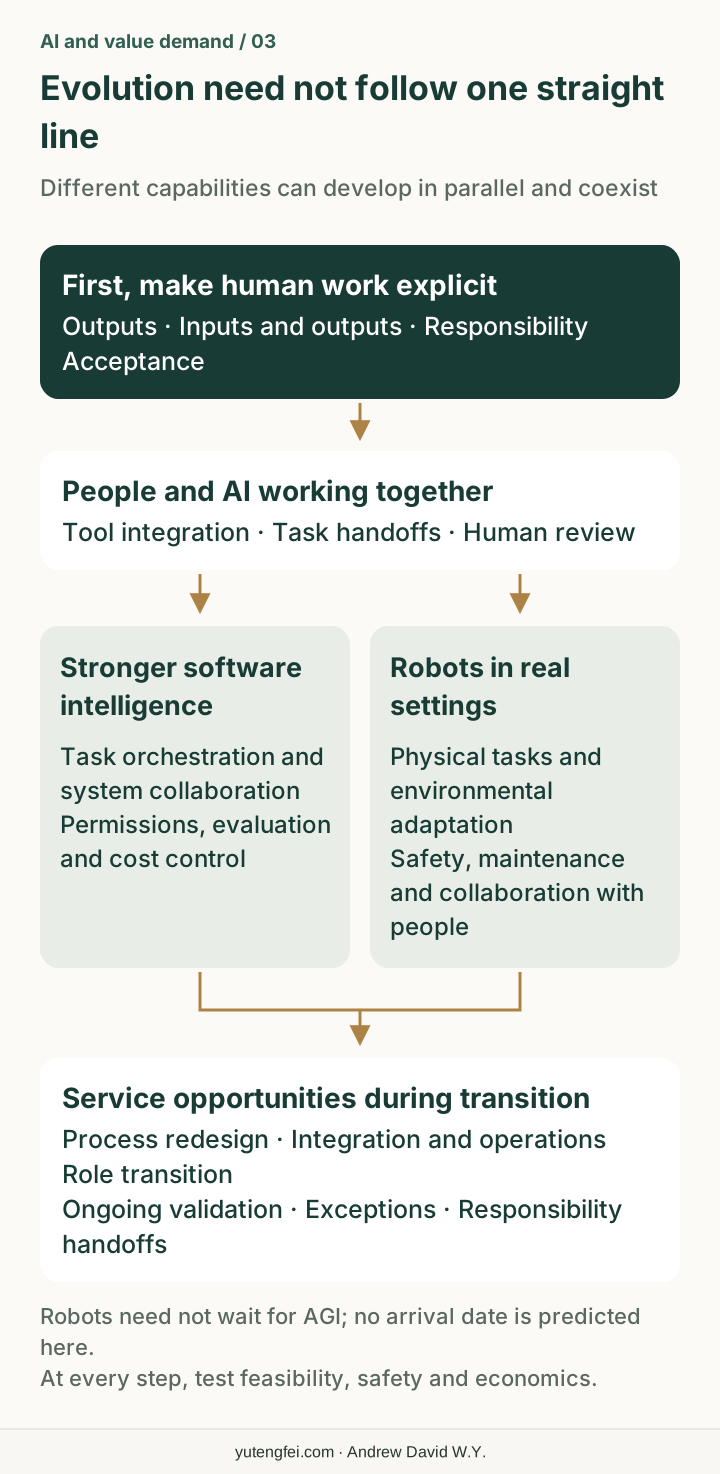
1. First, make human work clear
Many companies still cannot clearly explain how an output is produced, who is responsible, what the inputs are and what counts as acceptable.
Under these conditions, introducing AI often carries existing ambiguities into the system. Clarifying work, organizing knowledge, standardizing processes and designing acceptance criteria have value in themselves and can be delivered as research, consulting and training services.
At this stage, Four-Way SOP can help companies look downward from business-performance requirements and validate upward from specific actions, avoiding the automation of isolated actions without an improvement in business results.
2. Manage the handoff when people and AI work together
Specific arrangements are needed for which tasks go to AI, which require human approval, when work must stop and how to recover after failure.
Companies may also need to connect existing software, organize permissions, train staff, monitor quality and control costs. System integration, human–AI workflows, ongoing operations and maintenance, and support for workforce transition may all generate demand at this stage.
If a service helps a company reduce rework and waiting time, while making costs and responsibilities clear, its value becomes easier for the client to understand.
3. Organization and governance become important when several AIs work together
When several AI capabilities handle research, execution and checking separately, someone still needs to design objectives, task allocation, data boundaries, budgets, acceptance criteria and escalation of exceptions.
This creates demand for capability catalogs, task scheduling, identity and authorization, testing and auditing. The more autonomous an AI system becomes, the more clearly it needs to be defined whom it may represent, what it may do, and who can pause and correct it.
These capabilities can become software or services. But a process running automatically does not by itself establish authority to publish, make payments or make major decisions for a client. Trustworthiness and risk management throughout design and evaluation are also continuing concerns of existing frameworks. NIST AI Risk Management Framework
4. When robots enter a site, connect digital processes with physical work
Tasks in digital systems acquire equipment, environmental, personnel and safety constraints when they move into the real world.
Site assessment, facility adaptation, deployment, remote support, repair, spare parts and operations management may all become services clients need to buy. The full operating cost needs to be calculated; comparing only the robot's price with one person's salary is insufficient.
If frequent human takeover is needed, or downtime affects production, maintenance and recovery may be highly valuable. Conversely, as robots mature, some one-time integration work may diminish. Services therefore need to keep developing from helping with installation toward helping sustain operations and taking responsibility for results.
5. As capabilities grow further, watch for new constraints
If future systems can perform a broader range of cognitive and physical tasks, services that currently depend on a particular scarce skill may be repriced.
In that scenario, it may be more useful to observe where real needs come from, who holds lawful resource-use rights, which experiences people still value, how responsibility is borne and how society arranges employment, income and the distribution of returns.
This is a future scenario requiring continued research. It cannot be written as a definite timetable or used to conclude that a particular project today is certain to succeed.
7. How might demand for value across society change?
Bringing these lines of thought together, I think several changes need to be observed at the same time.
First, the cost of some production and services may fall. Needs previously unmet because of high costs may become addressable, such as more specialized research, more personalized learning support and more continuous operating services.
Second, some work that previously commanded high fees may face price pressure. As content generation, basic analysis and routine operations become easier, commercial value may shift toward understanding needs, verifying quality, complex delivery and bearing responsibility. The actual direction depends on supply and demand.
Third, new capabilities will create supporting needs. Energy, computing capacity, networks, facilities, operations and maintenance, and governance are needs arising alongside AI's expansion. These areas will also be affected by efficiency gains, added capacity and technological change.
Fourth, supply capacity and purchasing power need to be considered separately. Even if society can produce more products and services, needs may not immediately turn into orders if some people lose income or struggle with the transition. Changes in employment, learning skills and the distribution of benefits will affect whether opportunities ultimately form markets.
Fifth, people may place more value on time, autonomy, relationships, health, authentic experiences and trustworthy sources. These involve commercial opportunities as well as public services and institutional arrangements. They cannot all be addressed through the same charging model.
So, in observing the next stage of economic and social development, I want to keep asking: what is becoming easier, what remains scarce, what new problems follow, and who is willing and able to pay to solve them?
8. How can these opportunities be understood within WISERUNION?
The WISERUNION think tank, Four-Way SOP, Skills and stakeholder ecosystems I have been considering can connect here.
The think tank organizes questions and knowledge into ideas, models, methods, plans, tools and training. Four-Way SOP goes further by connecting this knowledge with enterprise work: which key conditions business performance needs, which business processes provide those results, which roles undertake the relevant functions and which specific actions complete them.
The parts suitable for reuse and execution can gradually be codified as Skills. The four ecosystems—resources, capital, operations and governance, and customers—can then help organize real needs, professional capabilities and collaborative relationships.
Value creation and value distribution need to be considered together here.
Some people contribute ideas, others organize methods, provide tools, take part in review, organize delivery or provide funding or real application settings. How these contributions are recorded and assessed, and how agreed benefits and rights arise from them, is important to whether the system can develop sustainably.
The opportunity I see is therefore to use AI to connect knowledge, work and collaborative relationships more clearly, allowing more professional capabilities to enter actual business and giving participants' contributions a chance to be recognized and treated fairly.
This still needs validation in practice. Having think tank content does not mean every item is already executable. Having a Skill does not mean it applies across companies. Each step needs records of its conditions of use, actual effects and areas needing revision.
9. If choosing a starting point, I would prioritize three directions
First, mapping a company's Four-Way SOP. Begin with a real company, clarify the possibilities and key conditions for generating business performance, then organize business processes, functional tasks and actions into work outputs that can be discussed and improved further.
Second, enterprise research and action support. Around a specific industry or operating question, continually organize sourced information into issue lists, bases for judgment and action recommendations, and test whether clients are willing to keep using the service.
Third, co-creation tasks for Company Zero. Choose a real task with a clear scope and manageable risks. Let different roles and AI participate together, recording inputs, actions, outputs, acceptance and contributions, and observe whether the collaboration rules are useful in practice.
These three directions can help me understand, respectively, why clients pay, how knowledge can be delivered reliably and how collaboration among several parties produces results.
For now, choosing suitable settings for validation is more likely to reveal real problems than building a complete platform at the outset. The materials produced through validation can return to the think tank as a basis for improving cases, methods and tools.
Energy, computing capacity and robotics can also be included in continuing research and resource connections. But the way we participate needs to match our capabilities. Being able to research, connect resources or offer professional services does not mean being ready to build capital-intensive facilities or manufacture complete machines immediately. Demand, technical approaches, funding, permits and risks to returns need separate checks for these projects.
10. Ultimately, return to needs and the business model itself
There is still a distance between AI being able to do something and that work forming a sustainable business model.
I will keep looking at whether the client has a real need, who controls the budget, whether they will pay repeatedly, whether outputs can be accepted against criteria and whether delivery still makes economic sense after model, tool, data, human-review and rework costs are deducted.
We can ask one more question: if the next generation of models becomes substantially more capable, will this service become more valuable or disappear with that change? The answer can help distinguish opportunities of a particular stage from capabilities more worth accumulating over time.
We also need to see whether knowledge and experience can be accumulated lawfully, whether it becomes easier to do well next time and whether the same capability can be reused in similar settings.
Seen this way, research into AI-native business models can follow a relatively clear path: start with the result the client needs, organize people, AI and resources to complete the work, then use acceptance and feedback to revise methods, processes and collaboration rules.
For WISERUNION, this also gives me a clearer understanding of the think tank's value. Organized knowledge can help people understand problems. When incorporated into SOPs and Skills, it can further support work. Repeated use and validation in real business can, in turn, advance that knowledge.
I want to keep studying these questions within one map of needs: what people still need, what AI needs to operate, what the transition to human–AI collaboration requires, and how new productive capabilities may change income, consumption and resource allocation.
From there, we can return to specific companies, business processes and tasks to judge which needs are worth meeting, who provides value, how revenue is generated and how participants can grow together under clear rules. This is my current direction for understanding AI-native business opportunities.
Notes
The company examples in this article illustrate publicly stated pricing mechanisms only. They are neither product recommendations nor evidence of operating results. The official pages were checked on November 5, 2026 and may change later.
The discussion of stronger artificial intelligence and robotics concerns scenarios. It is not a definite prediction about when they will emerge, which roles will remain or what commercial returns will follow.