From Four-Way SOP to AI Skills: What I Want the Think Tank to Become
I connect actions, functional tasks, business processes and business performance with role responsibilities, roles, departments and the company. Skills and handbooks help link outputs at each level, while real work tests the business logic and builds knowledge that people and AI can use and improve together.
Reading & sharing

As I have been organizing the think tank over the past few days, my thinking has moved a step further.
Ten topics answer what we study. The four ecosystems—resources, capital, operations and governance, and customers—identify the relationships through which we look at a problem. Thinking, methods, models, plans, tools and training are different ways of expressing and using knowledge.
With these dimensions in place, my next concern is: how does this knowledge enter our work, and how can it help people and AI get things done together?
I want to connect Four-Way SOP more closely with responsibilities within an organization. Business performance, business processes, functional tasks and actions broadly correspond to the company, departments, roles and role responsibilities. Looking in the other direction, practices within role responsibilities can be codified as Skills; a role's functional tasks can be organized in a role handbook; business collaboration can be organized in departmental and cross-departmental collaboration handbooks. At company level, the business model, overall planning and a handbook for achieving business results bring these results together.
I think this also says something about the mission and value of the WISERUNION think tank I am building.
Start with the results the company needs, and keep asking how the work will be done
First, look from the top down.
We need to make clear what business results the company hopes to achieve. What value will customers receive? Through which products, services or integrated solutions will the company earn revenue? What inputs are required, and how will costs and collection of payments be arranged? We need to be able to explain these relationships.
Then we can ask which key conditions must be in place to achieve those results, and what each business process needs to deliver to establish them. Organizing these elements also means considering their sequence, their dependencies and how to adjust when conditions change.
As we break business processes down, we come to roles and responsibilities. Who receives requirements, verifies resource conditions, develops the plan, completes delivery and checks the results? We need to be specific about the outputs each role must provide consistently and how the work connects from one stage to the next.
Further down are the actions within a role's responsibilities. What information triggers the work? What basis should it use, how should it be processed, what should be delivered, what counts as completion, and whom should we contact when conditions are missing or an exception occurs?
Seen this way, Four-Way SOP connects overall results with specific work. The company, departments, roles and role responsibilities provide an organizational entry point for understanding it. Actual business processes may cross departments and companies, and a role may undertake several functional tasks. At the functional level, each task needs a clear path from input through processing to an accepted output; the role handbook then organizes those tasks. The main question remains what result each level needs and how the next level supports it.
Looking up from actions: how Skills become part of roles and business processes
Looking in the other direction connects this structure with AI.
A relatively clear, reusable practice within a role's responsibilities can be organized into a Skill. A Skill may contain one action or a group of related actions. What matters is making its conditions of use, inputs, steps, outputs and checks clear. It should also record which materials, tools and authorizations are needed, and who makes a judgment when an exception occurs.
Several Skills organized around the outputs a role must deliver can become part of its handbook. The handbook also needs to explain why the role exists, its responsibilities and authority, and which other roles it works with. With AI involved, the appropriate Skills can be called for each task, while people assess the actual situation, make decisions and verify delivery.
Outputs from several roles can then be connected to form a business result. A business collaboration handbook should explain whether the next stage can use the output directly, what omissions require it to be returned, and who confirms that work may proceed. Departments provide a structure for organizing this work; the collaboration arrangements still need to follow the actual business process.
At company level, several key conditions and business results need to be organized to support overall performance. The business model explains how value and returns may be created. Overall planning sets direction, resources and development paths. A handbook for achieving business results connects the relevant processes, responsibilities, conditions and checks.
By “handoff,” I mean gradually establishing shared guidance for work that previously depended on people explaining, teaching and coordinating it in person. What AI does, what people remain responsible for and how results are checked can then continue to evolve through actual work.
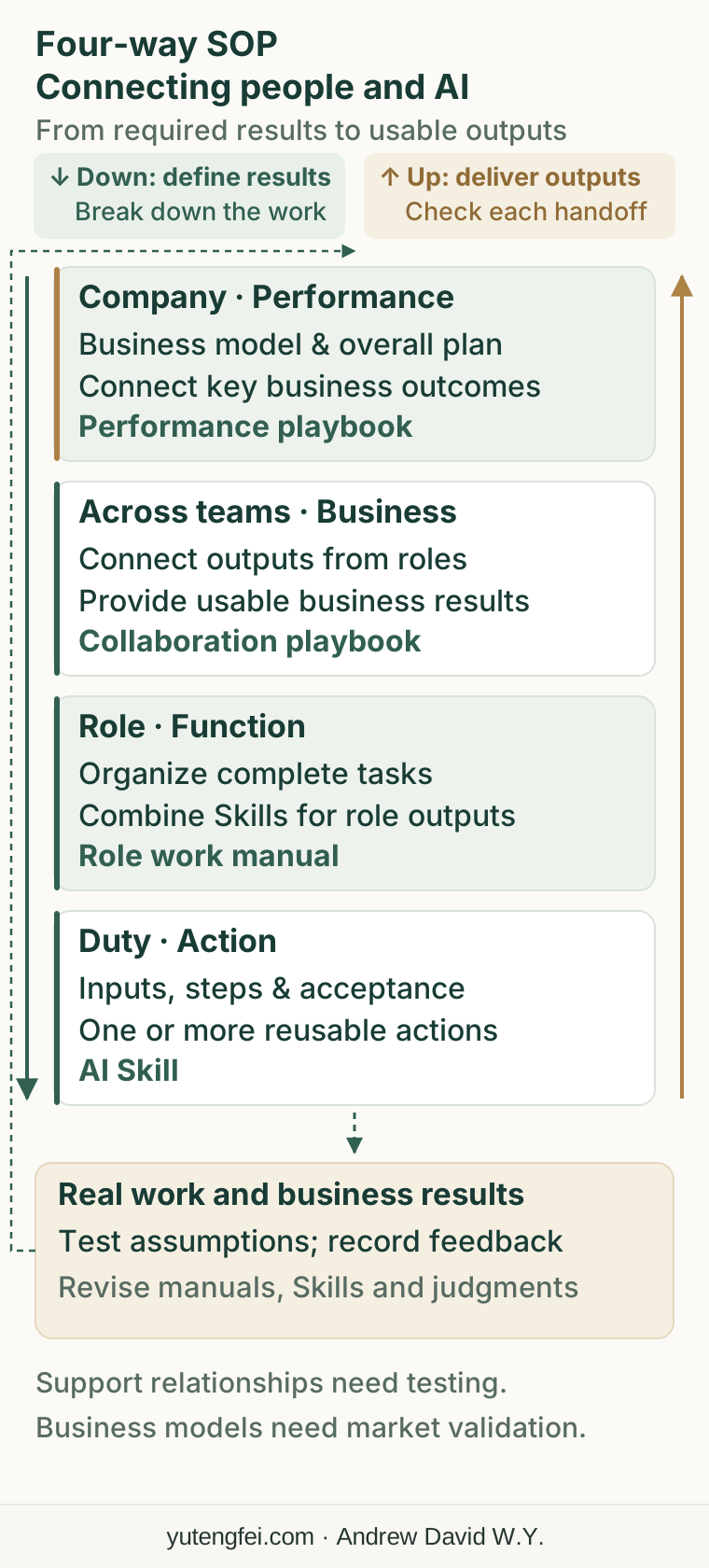
The test is whether an output meets the needs of the level above
What concerns me most here is still the relationship between results.
Take a simplified quotation example. AI checks quantities and pricing units and produces a calculation record: this is work at the action level. The quotation role brings together requirements, supply conditions and pricing information to deliver a costing sheet: this is the output of a role's task. Sales, procurement and the relevant reviewers connect these outputs to produce a quotation that can be offered to the customer and can be fulfilled under the stated conditions: this is a business result.
What happens next still needs to be observed. Will the customer accept it? Can delivery, acceptance and payment collection be completed? Will the revenue cover the relevant costs? Each level has its own completion criteria. Completing a costing sheet does not in itself show that the company has achieved its business results.
This is also why I think a business model still needs to be tested in the market. Our judgments about customer needs, prices, costs and ways of working together begin as a set of business assumptions. SOPs can organize the path for implementing and testing them. Actual results then help us determine whether an action went wrong, collaboration failed to connect, or the original business assumptions need to change.
Making this clear gives AI use a concrete direction. We can check whether it completed the task as required, then keep asking whether that output helped the business move forward.
Fei-Fei Li and her team's work on ImageNet gave me an idea
I thought about Fei-Fei Li and her team's work on ImageNet. They organized large numbers of images into categories and used crowdsourced annotation and quality checks to provide data resources for training and evaluating computer vision research.[1][2]
What this suggested to me is that human understanding and judgment need to be organized before they can become resources that machines can use effectively. How categories are defined, labels confirmed and quality checked all affect whether those resources are usable.
Experience in business operations presents a similar problem. Much of the knowledge is held by different people. Some know how to assess requirements, others know how to organize delivery, and others know where mistakes tend to occur. If only a conclusion is recorded, people who come later—and AI—will struggle to judge the conditions in which the approach was used, why it worked and whether it can be used in another setting.
The think tank I want to build would gradually organize these foundations, relationships, methods and feedback. The common logic is to organize human knowledge into usable resources. The specific technical paths and results achieved are different.
At this stage, AI can read handbooks, retrieve knowledge and call Skills while working. With further preparation, these materials may also become training or evaluation data. Reading an SOP does not in itself mean that the model has undergone new training.
For me, first organizing knowledge so it can be used, then checking and improving it through use, is itself worth pursuing over time.
The think tank's value needs to develop through working together
Following this line of thought has made my understanding of the think tank more concrete.
Thinking helps us understand problems, methods help us move forward, models explain relationships, plans organize objectives and actions, tools support operations, and training helps more people learn and use them. Putting them into real tasks reveals new problems and gives us an opportunity to improve them.
Four-Way SOP connects this knowledge with the results an organization needs to deliver. Actions leave usable practices, roles leave handbooks, business processes leave a basis for collaboration, and the company develops business logic that can be tested continually. Effective practices can keep accumulating, while failures, exceptions and changes in conditions also need to be recorded.
I hope the WISERUNION think tank will gradually develop this capability: turning experience in creating business value and results into knowledge that people and AI can understand, use, test and improve.
This is part of the foundation needed as human roles gradually move into collaboration with AI. Every completed piece of work can leave something useful for the next one. When the next task encounters a problem, it can lead us back to revise our understanding. I want to keep working on this.
Sources and further reading
This article records my working thoughts on the relationship between Four-Way SOP, human–AI collaboration and think tank development. The diagram is an original framework drawn for this article. The quotation is a simplified example, and the proposed relationships still need to be tested in specific business settings.
- [1] About ImageNet: categories, human annotation and quality checks, and uses for training and testing.
- [2] Deng et al., ImageNet: A large-scale hierarchical image database (2009), Princeton University publication record: the abstract describes building the dataset using Amazon Mechanical Turk.
- Four-Way SOP: Connecting Specific Work with Business Results
- From SOP to AI Skill
- Building a Knowledge Foundation for Humans and AI to Work Together