Use this resourceModels
- Purpose
- Start with customer outcomes and economic results, then connect the key business processes, closed-loop tasks, and specific actions that support them. Four-Way SOP provides a supporting structure that can be developed downward and checked upward. It helps people understand why a task is needed and helps an organization see what still needs to be verified after a process is complete.
- Conditions for use
- Check that the subject, objective and constraints fit the task. Confirm any conditions that the article does not specify.
- Models
- Elements, relationships and assumptions
- Evidence and validation limits
- The example shows how to map a four-way SOP. To assess its use, check whether downstream teams can use the deliverable and whether customer and economic outcomes change. No separate external-validation result is recorded for this article. Publication does not establish effectiveness; check the evidence, assumptions and limits in the text.
- Version
- R1 · Revised 2026-11-04
- Original diagrams and files
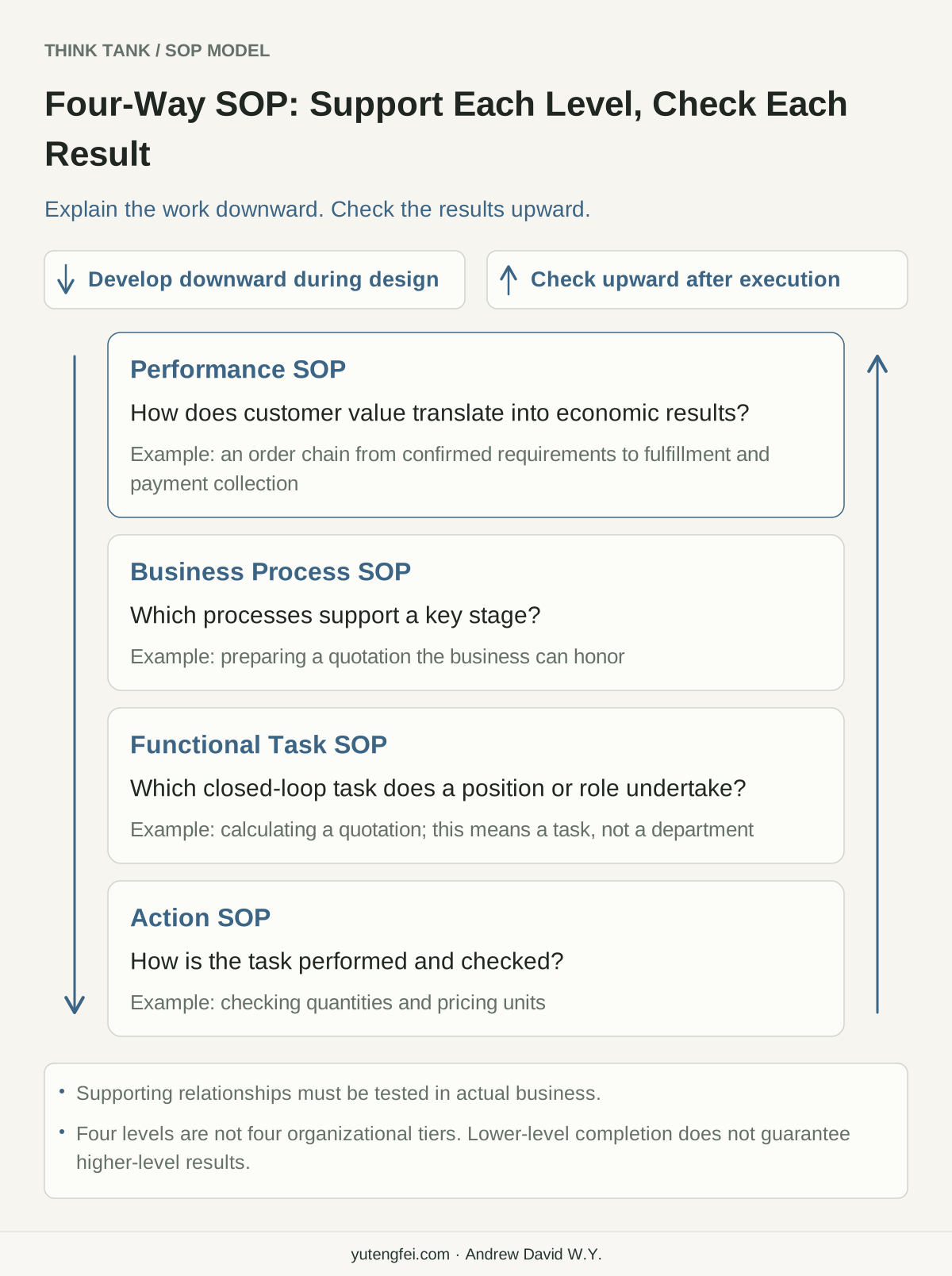
- The supporting relationships across the four SOP levels: work downward to specify the necessary work, and check upward to verify the basis for the results.
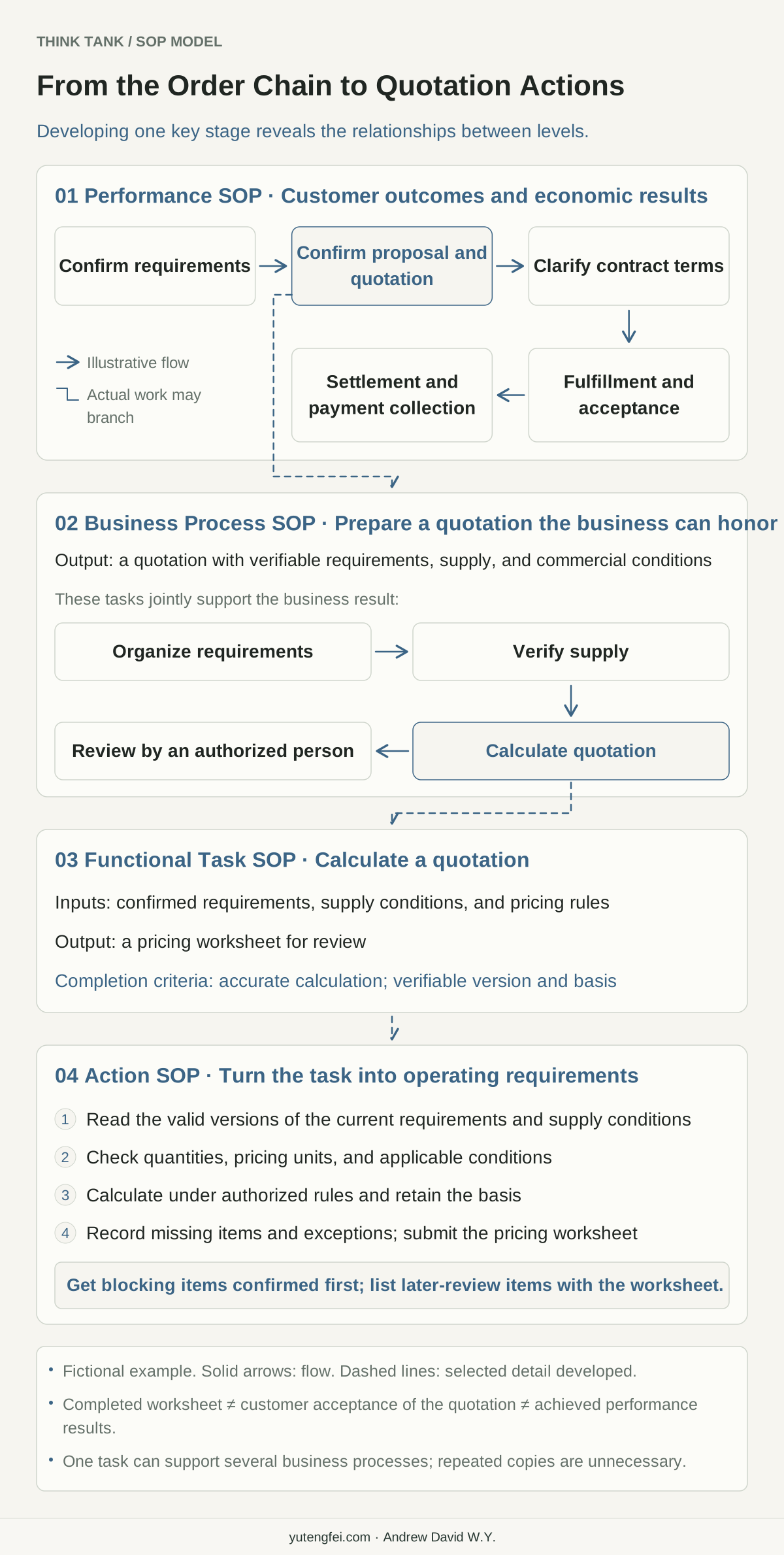
- How a quotation connects four SOP levels: a key stage in the order chain is developed into a business process, closed-loop tasks, and operating requirements.
- Official technical guidance
This is a readable, citable knowledge resource, not an installed Skill. When using it with AI, retain its sources and limits and review the output.
CC BY-NC-ND 4.0 · Applies to original text unless otherwise stated; excludes third-party materials. Downloading or machine reading does not extend the existing license or separately authorize derivatives, commercial use or model training.
A quotation has been sent, but the customer has still not confirmed it. Sales says the quotation is complete. Purchasing says it has provided the supply conditions. The person preparing the quotation has also worked through the figures in the worksheet. Everyone has a completion record, yet the business has not moved forward.
At this point, I would not rush to ask who has failed to finish. First, look at the problem the customer needs to solve. Does the quotation meet that need? Can the business deliver what it promises? Which result do all these completed tasks actually support?
Four-Way SOP seeks to clarify the relationship between specific work and operating results. It divides SOPs into four levels: performance, business processes, functional tasks, and actions. During design, we can work downward from the result. After the work has been carried out, we can check upward from the actions. Following these relationships helps us keep asking why a task is needed, what standard it must meet, and how it connects with other people's work.
1. Four levels, four questions
SOP stands for Standard Operating Procedure. The Four-Way model discussed here classifies work procedures by their scope and level of detail. It does not require four separate documents for every piece of work, and the four levels are not four tiers of an organization.
| Level | Main question | What it focuses on | Simplified example |
|---|---|---|---|
| Performance SOP | How does customer value translate into the business's economic results? | Key stages and results closely connected with customers | An order chain from confirming requirements to fulfilling the order and collecting payment |
| Business Process SOP | What processes need to be organized to move a key stage forward? | A business result produced through several coordinated tasks | Preparing a quotation the business can honor |
| Functional Task SOP | What single closed-loop task must a position or role complete? | A task with inputs, processing, outputs, and completion criteria | Calculating a quotation |
| Action SOP | How is this task carried out in practice? | Preparation, operations, checks, exceptions, and handover requirements | Checking quantities and pricing units |
A Performance SOP starts with customer outcomes and economic results. For an order-based business, we can map key stages such as confirming requirements, confirming the proposal and quotation, clarifying contract terms, fulfilling the order and completing acceptance, and settling and collecting payment. Different businesses have different sequences, branches, and parallel activities. One illustrative chain cannot be treated as a fixed route for every company.
Performance also cannot be judged only by the number of deals closed. Whether the customer accepts the delivery, whether the business collects payment, and whether the work covers the necessary costs may all affect the assessment. A business should first define the scope of this performance chain, the observation period, and how its results will be measured, then choose the relevant records.
A Business Process SOP organizes work around a business result. Getting a customer to confirm a quotation may require organizing requirements, verifying supply conditions, calculating the quotation, and having it reviewed by an authorized person. The Business Process SOP connects this work so that it produces a result the next stage can use. One department may be responsible for it, or it may involve collaboration across departments and organizations.
A Functional Task SOP covers one closed-loop task. Here, “functional task” means a single task undertaken by a position or role, such as calculating a quotation, issuing an invoice, or verifying a supply lead time. It does not mean a functional department such as Finance or Purchasing, nor does it cover all the responsibilities of a position. To judge whether a task forms a complete loop, look at the conditions under which it starts, what it processes, what it delivers, and how completion is confirmed.
An Action SOP turns a task into instructions people can follow. When calculating a quotation, for example, first read the confirmed version of the requirements, then check quantities and pricing units, calculate according to the authorized pricing rules, record the basis and unresolved matters, and finally submit the pricing worksheet. Where errors are likely, handovers are needed, or specific risks exist, the operating standards and handling of exceptions should be clear. There is no need to turn every familiar action into a lengthy tutorial.
Scroll sideways to explore, or open the full diagram.

2. Working downward means finding the processes that are actually needed
Start with a real business activity. Look at where the customer makes a choice, where the business makes a commitment, and how delivery and payment are carried through. Then select one key stage and ask what results it needs and which tasks must jointly produce them.
Take “confirming the proposal and quotation.” The fact that a customer can receive a quotation does not, by itself, establish that this stage has achieved its purpose. The quotation should address confirmed requirements. The supply, delivery, and commercial conditions on which it relies should be verifiable. Terms beyond the existing authorization need a decision from the appropriate decision-maker. The internal work to organize depends on what is needed to support these conditions.
Working further downward, the business process of “preparing a quotation the business can honor” may include organizing requirements, verifying supply, calculating the quotation, and review by an authorized person. Each task has its own output and its own interfaces with other work. Organizing requirements cannot be marked complete just because “we have spoken.” It should produce a statement of requirements that can be checked. Verifying supply cannot stop at “it should be in stock.” It should state the conditions that have been confirmed and the limits within which they are valid.
Now select the functional task of “calculating a quotation.” Its inputs might be confirmed requirements, valid supply conditions, and the currently applicable pricing rules. Its output might be an accurately calculated pricing worksheet that identifies its version and calculation basis for subsequent review. Missing information that blocks calculation should first be returned for confirmation. Items that do not block calculation but require later review can be listed with the worksheet. Any unresolved conditions affecting a commitment to the customer must be resolved before that commitment is made. At this level, the specific operating actions need to be explained in more detail.
Each time we develop the next level down, we need to answer one question: How does the additional work help produce the result needed at the level above? If that cannot be explained, the task may be unnecessary, the higher-level objective may be unclear, or a process may be missing between the two. Document numbers alone cannot connect them.
Scroll sideways to explore, or open the full diagram.

3. Checking upward: completed actions do not establish performance results
Clear downward analysis must be matched by upward checking.
Completing a check of pricing units shows only that one operating requirement has been met. Completing the quotation calculation means a worksheet meeting the task requirements has been produced. Only after requirements, supply, and authorization have been reviewed together may there be a quotation ready to offer the customer. Whether the customer accepts it, and whether the business can later fulfill the order and collect payment, still need to be observed.
The four levels therefore cannot be expressed as simple equations between results. Several correctly completed actions can provide conditions for a closed-loop task. Several tasks can jointly support a business result. Several business processes can move a performance chain forward. But market changes, customer choices, product fit, resource constraints, and business judgment still affect the final result.
If a customer has not accepted a quotation, first examine the customer's feedback and the relevant records in this performance chain. The problem may involve response time, the understanding of requirements, or an error in the quotation. It may also involve an unsuitable product, an unacceptable lead time, an uncompetitive price, or even a change in the customer's purchasing plan. After locating the problem, decide whether to adjust business coordination, a particular task, or operating requirements, or to reconsider the product and market. Develop the level that needs attention; there is no need to work through all four levels every time.
Four-Way SOP helps us follow these relationships, ask further questions, and trace the supporting evidence. A layered diagram alone cannot prove a cause. Nor can below-target performance be attributed directly to one person's poor execution.
4. Related to the organization, but not confined by its chart
In practice, the four levels do not usually map one-to-one onto a company, its departments, its positions, and individuals. One person may undertake several functional tasks. One business process may require several roles. The same task of “verifying the supply lead time” may support both a new quotation and an order change.
When mapping SOPs, retain two sets of relationships: which result a task supports, and who holds the relevant responsibility, authority, and resources. The first explains the logic of the work. The second explains who organizes and completes it. They are connected, but neither can replace the other.
Shared tasks also need version and scope management. If supply conditions change, for example, which quotations remain valid, and which need to be reconfirmed? Copying the same task into several documents without maintaining its source can easily lead to work being carried out according to the process while relying on inconsistent information.
We can observe a business through four kinds of participation relationships: Resource, Operations and Governance, Customer, and Capital—the four ecosystems. Participants can offer contributions proactively or respond to needs. A lean operations and governance team is responsible for decisions, rules, and the coordination of value production, sales channels, and customer relationships. Roles that contribute value enter business collaboration through the relevant tasks, while role handbooks explain how to use these processes. Customers acting only as consumers and investors acting only as investors follow their respective processes. Neither status alone requires a handbook for a co-creation role.
The focus here is on how work connects. How contributions are assessed and rights and benefits are agreed still requires separate rules based on the actual business. These cannot be derived automatically from task completion records.
5. Test one chain before deciding where to expand
Using this model does not require starting with a company-wide document exercise. Select a real, recurring business chain whose results can be observed, and begin with three things.
First, state which customer outcomes and economic results the chain should produce and which conditions cannot be omitted. Second, choose one key stage, develop the necessary business processes and closed-loop tasks, and connect inputs, outputs, responsibilities, and the basis for acceptance. Third, follow the work as it actually happens. Record missing items, waiting, rework, and customer feedback, then decide which operations need further standardization.
A concise guide may be enough where people are already proficient, the work is stable, and handovers are simple. For new business, frequently changing requirements, or work that depends heavily on judgment, first clarify the objectives, decision conditions, and feedback arrangements, then develop procedures over time. Adding forms and approvals merely to fill all four levels can obstruct the business.
Supporting work such as training and equipment maintenance may not relate directly to an individual sale. It may support several performance chains or affect capabilities and risks over a longer period. Explaining that support requires relevant records and judgment. We cannot force an allocation of revenue onto every action.
The process approach already has an established body of work. ISO's technical guidance on the process approach in ISO 9001:2015 likewise emphasizes inputs, outputs, interfaces, responsibilities, and checks between processes. It also recommends determining the documentation needed in light of the organization's context and risks.[1] The purpose of the Four-Way model in this article is to use four levels of observation to work from customer outcomes and economic results down to specific tasks and actions. Its applicability still needs to be tested in actual business.
To assess whether a trial is useful, look at whether participants can explain which result their delivery supports, whether the next stage can use that result, and whether relevant records can be found when a problem occurs. It is also worth observing whether handover omissions, rework, and waiting decrease, while recording changes in business volume and the complexity of requirements. Even if results improve, a single trial is not enough to establish that the model caused the improvement.
The value of Four-Way SOP ultimately lies in whether work and results can explain each other. Working downward should show what needs to be organized. Checking upward should show what has been delivered and what has not yet been established. Repeatedly testing these relationships in the business gives procedures a chance to become a lasting way of working.
Sources and further reading
The model draws on the early research document supplied by the author, Methodology for Mapping and Designing SOPs (《SOP梳理设计方法论》), particularly sections 2, 4, and 5. Its version record lists a training-related revision on March 9, 2023, and the development of the basic theory and model with the participation of Yang Jing (杨婧) on May 11, 2023. This article explains the four-level relationships afresh. Its diagrams are original reconstructions for this article and do not carry over the appraisal or allocation mechanisms in the historical diagrams. The quotation business described here is fictional.
[1] ISO/TC 176/SC 2, The Process Approach in ISO 9001:2015, N1289, pp. 1 and 4–5. Official technical guidance. The reference here concerns the process approach. It does not present the Four-Way classification as an ISO requirement or imply that this model has been certified.
Further reading: Complexity, Simplicity, Clarity, and Diagrams: A Way to Think About Business Logic Design (Chinese); Ten Steps in Enterprise Planning: Connecting Direction, Resources, and Execution (Chinese).