Use this resourceMethods
- Purpose
- A practical update of an early ten-step planning framework, with customer evidence, cash-flow checks, agreed dependencies and rolling reviews. Two diagrams connect long-term direction to near-term work with owners, resources and acceptance criteria.
- Conditions for use
- Check that the subject, objective and constraints fit the task. Confirm any conditions that the article does not specify.
- Methods
- Steps, inputs and completion criteria
- Evidence and validation limits
- This article builds on the earlier ten-step method. Testing customer assumptions, scenario-based cash planning, rolling 90-day actions, and suggestions for using AI are additions in this edition. No separate external-validation result is recorded for this article. Publication does not establish effectiveness; check the evidence, assumptions and limits in the text.
- Version
- V1.0 · Revised 2026-10-30
- Original diagrams and files
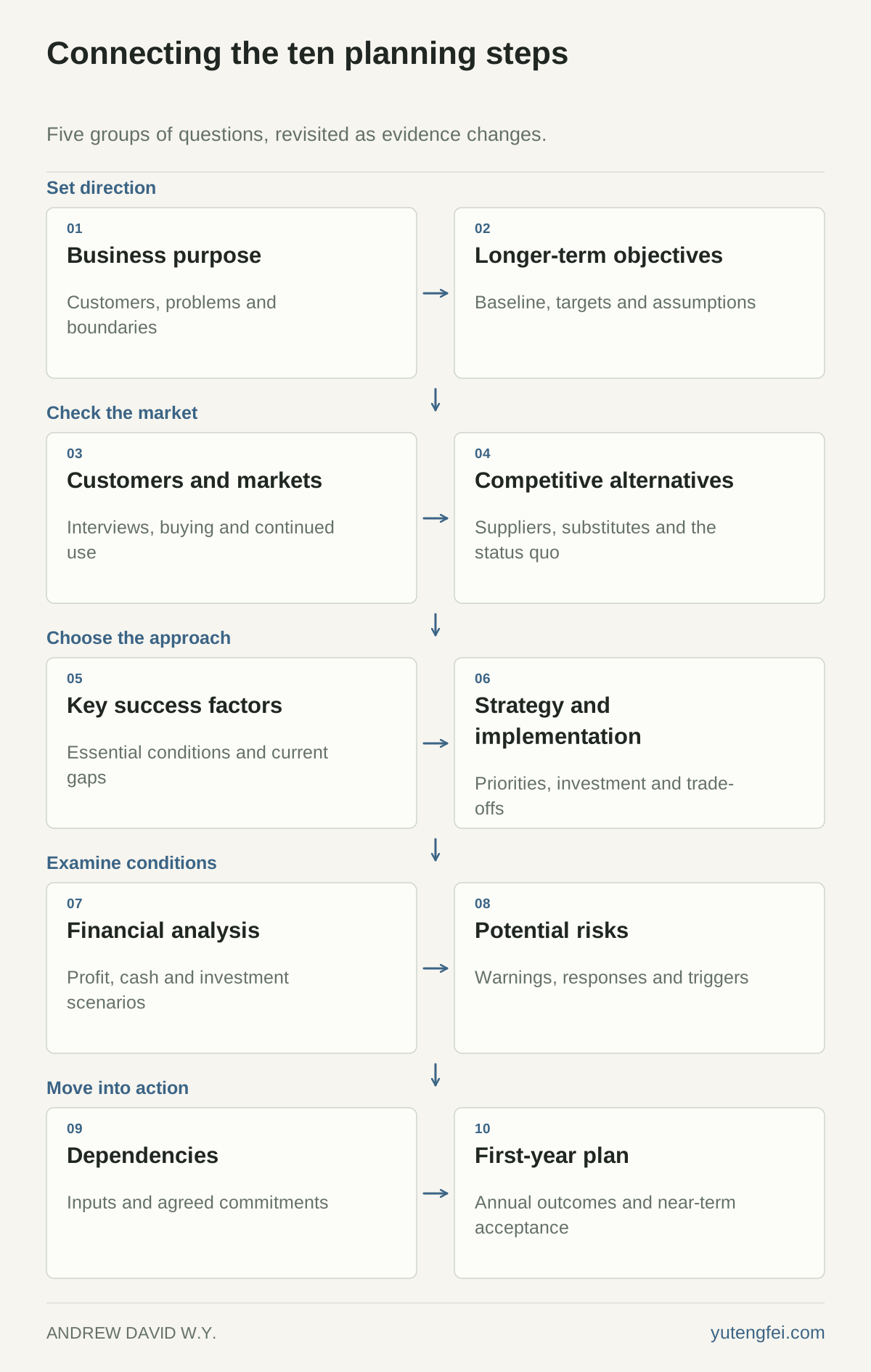
- Figure 1. Read the numbered steps within five groups. Review can return to any step that needs checking, rather than following a one-way sequence.
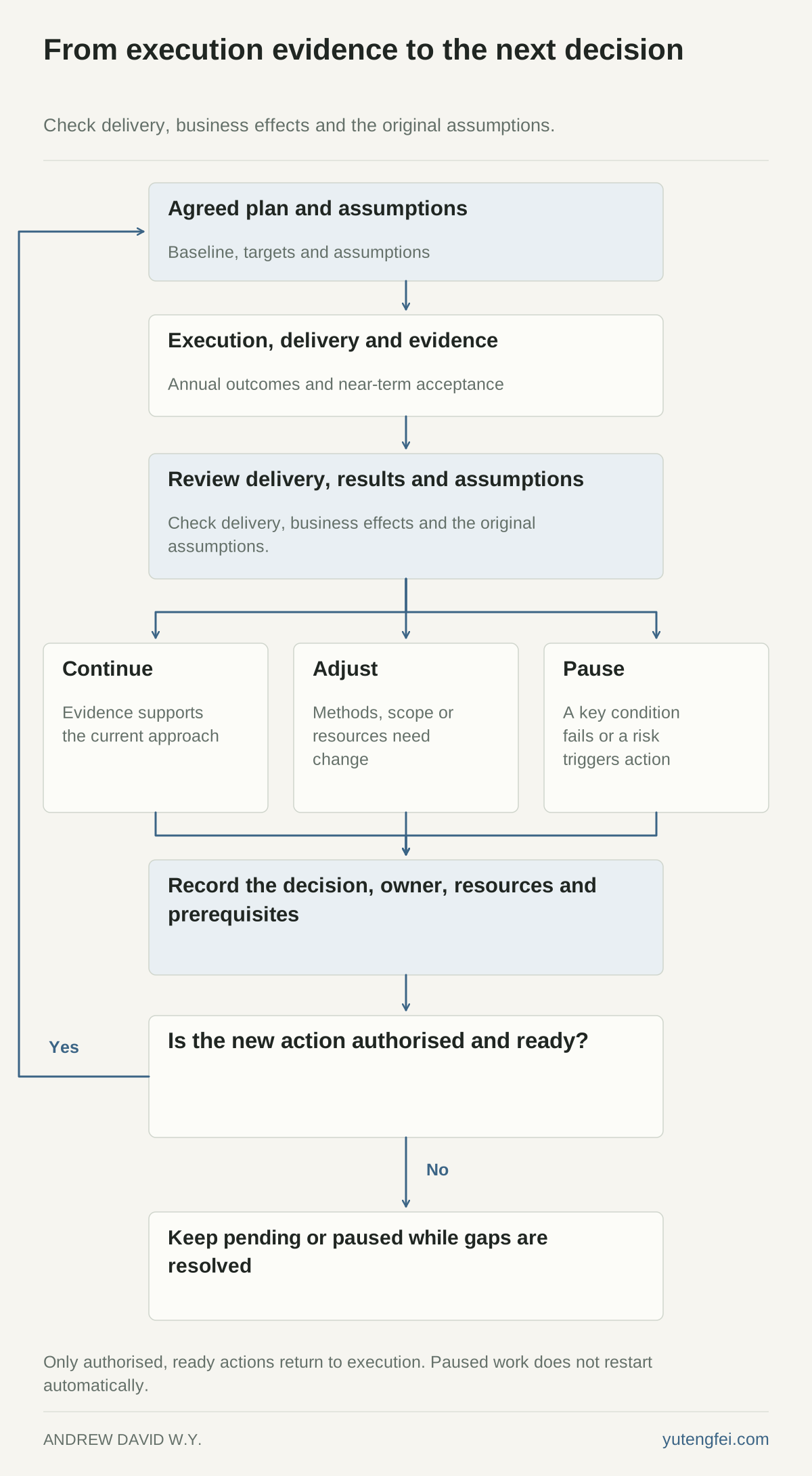
- Figure 2. Review delivery, results and assumptions before deciding to continue, adjust or pause. New action needs authority and prerequisites. Paused work does not restart automatically.
- External links in the article
This is a readable, citable knowledge resource, not an installed Skill. When using it with AI, retain its sources and limits and review the output.
CC BY-NC-ND 4.0 · Applies to original text unless otherwise stated; excludes third-party materials. Downloading or machine reading does not extend the existing license or separately authorize derivatives, commercial use or model training.
Business planning often runs into a familiar problem. Everyone seems clear in the meeting, then returns to their department and carries on as before.
Direction, targets, budgets and performance measures all exist, yet they do not connect. Sales promises delivery that operations cannot support. A new project has no funding allocation. At year end, the team discovers that several important assumptions were never checked.
I recently revisited an early training deck called Enterprise Planning in Ten Steps. Its company figures and examples belong to another period. Its way of considering direction, markets, strategy, finance, risk and cooperation together is still useful. This article follows its practical ten-step sequence and updates the working methods.
What matters to me is whether the team can identify its priorities, decide what to leave aside, and say who will deliver what next.
The whole picture: how the ten steps connect
The steps form five groups: establish direction, check the market, choose an approach, examine conditions and move into action.
Their numbers organize discussion. Real planning moves back and forth. A change in customer demand may require new targets. Funding constraints may change scope. A finding in step seven can send the team back to steps two and six.
The ten steps are ten sets of planning questions. Review continues throughout execution. It does not need to become an invented eleventh step.

Putting the ten steps to work
01 Purpose: whose problem will the business solve?
Start with ordinary language: which customers, which problem, how value is created and how the business can sustain itself.
Add clear boundaries. Which orders and markets will it decline? Which practices would damage the long-term interests of customers, employees or partners?
Test the statement against a real opportunity under discussion. Does it help the team decide whether to accept it, and why? If almost any business fits, narrow the statement.
The output is a direction card covering customers, the core problem, value proposition and operating boundaries.
02 Longer-term objectives: make the conditions visible
Retain a direction for three to five years, then define annual results and near-term validation points. Record the baseline, desired result, timing, measurement definition and owner.
Alongside revenue, consider continued customer use, delivery reliability, essential capabilities and cash capacity. Select measures that fit the business rather than filling every category.
State the assumptions. Entering a new region may depend on distribution, service capacity and customer acceptance. Approval of the target does not establish those conditions.
The output is an objectives table and assumptions register. Arrange validation for major unknowns before treating future capability as already available.
03 Customers and markets: check behaviour
Choose a specific customer group, use case and buying process. Who uses, decides, pays and bears the cost of switching? These can be different people.
Interviews help explain the problem. Trials, purchases, repeat orders and renewals provide further evidence of behaviour. A few positive responses do not establish market-wide willingness to pay, and free use does not prove paid demand.
Make each important assumption testable. Define the group, test, observation period and behaviour to observe. Agree criteria in advance and record the sample and its limits.
The output is a customer evidence table: what was observed, which judgment it supports and what remains unresolved. This is consistent with Strategyzer's approach of starting experiments from critical hypotheses. Reference
04 Competition: include every alternative available to customers
Customers can choose another supplier, keep their current process, do the work themselves, postpone purchasing or leave the problem unresolved.
Compare what matters to them: effectiveness, total cost, delivery time, ease of use, reliability and support. A claim such as professional expertise needs a concrete explanation and evidence.
SWOT remains useful when each finding leads to a choice. Does an opportunity match available capabilities? Could a weakness prevent delivery? Filling four boxes alone changes little.
The output is an alternatives comparison and a set of actions to pursue, improve, monitor or avoid.
05 Key success factors: identify essential conditions
A key success factor is a condition the business needs to work. A critical business issue is a current gap that requires attention. Keep the two distinct.
For a service needing continuous on-site support, reliable response may be essential. Having nobody on duty is a specific gap. More advertising may do nothing to close it.
Start by discussing three or four conditions. For each, state why it is necessary, the present gap and how closure will be checked. This number helps focus discussion. It is not a universal limit.
The output is a conditions-and-gaps table. Calling every initiative a top priority makes meaningful choices difficult.
06 Strategy and implementation: choose where resources go
Connect objectives, customer evidence and critical gaps. Then select a few priority initiatives. Explain which condition each will change, why that should affect results, what resources it needs and what will wait.
For an uncertain new business, define a limited pilot, spending ceiling, review point and conditions for the next decision. Expand after reviewing evidence. An established business can justify a different investment pace.
Keep a decision record of choices, rejected alternatives and reasons. When conditions change, the team can revisit a specific judgment.
The output is a priority portfolio with resource allocations, rather than general phrases such as improve marketing or strengthen management.
07 Financial analysis: distinguish profit, cash and investment
Explain how revenue arises, what remains after delivery and when cash enters and leaves.
Orders, revenue, profit and receipts are different measures. A profitable project can still run short of cash because of slow collections, inventory or initial spending. Review payment terms, delivery timing, receivables and required investment together.
Use base, favourable and stressed scenarios, with their assumptions stated. Mark estimates as estimates and identify their basis and next check. Multiplying subjective scores does not create an exact financial forecast.
The output is a financial model, cash schedule and resource gap. Appropriate specialists should check accounting, tax or financing details against the actual circumstances.
08 Risks: define when the plan must change
Record warning signals, responses, owners and decision authority as well as likelihood and impact. Address controllable factors and prepare alternatives for those outside the team's control.
The source deck uses impact and likelihood for prioritisation. This remains a discussion aid when scoring definitions are clear. Low-probability, high-loss events need separate attention and should not disappear beneath a multiplied score.
Agree the conditions for continuing, adjusting, reducing scope or pausing. Assign responsibility for winding down commitments and protecting customers and partners if work pauses.
The output is a risk register with triggers, rather than a broad statement that risk is controlled.
09 Dependencies: turn requests for support into commitments
Naming a task owner is only part of the arrangement. Specify required inputs, providers, timing and acceptance criteria.
A service launch may need product scope, operating capacity and payment terms confirmed by different teams. A date cannot be treated as secured while these prerequisites remain unresolved.
Put dependencies in one table and obtain confirmation from the people involved. Refer resource conflicts to the authorised decision-maker and record effects on objectives, scope and timing. External cooperation also needs a basis, costs, responsibilities and a change process.
The output is an agreed dependency table. Strategy deployment offers a useful model of dialogue between management and teams to reconcile targets, resources and practical conditions. Reference
10 The first-year plan: define work that can be accepted
Keep annual outcomes and resource limits visible, then detail the work nearest at hand. I suggest starting with the next ninety days and updating as conditions develop.
Each action needs an owner, deliverable, deadline, resources, prerequisites and reviewer. Distinguish activity from its purpose. Completing interviews is an activity. Establishing purchasing conditions is the judgment it should support.
Ninety days is this article's suggested working window, not a fixed requirement of the original method. Long sales cycles, research programmes and seasonal operations need their own review points.
The output is an annual plan with a near-term action table. After accepting a deliverable, check whether it produces the expected effect.
Keeping planning active: responsibility and revision
The business leader owns strategic choices and resources. Business owners provide evidence and execute. Finance checks assumptions and cash. Partners confirm dependencies. Someone also needs to facilitate the process, maintain records and follow unresolved items. A small team can combine roles without omitting the work.
Review three questions: was the agreed work delivered, did business outcomes improve, and do the original assumptions still hold?
For execution gaps, check resources, dependencies and methods. When activities are complete but results do not follow, revisit the causal judgment. If outside conditions have changed, reconsider objectives, scope and spending.
Weekly blockage reviews, monthly operating reviews and quarterly or milestone resource decisions are a starting rhythm. Adjust it to the business. Keep records of evidence, decisions and assigned actions.

A planning table to start with
Use this table to connect the first discussion. A complex organisation may use several documents, but they should point to the same objectives and decisions.
| Step | What to check | Output |
|---|---|---|
| 01 Business purpose | Whose problem, and what stays outside scope? | Direction card |
| 02 Longer-term objectives | From which baseline to which target, on what assumptions? | Objectives and assumptions |
| 03 Customers and markets | What purchasing and usage behaviour was observed? | Customer evidence table |
| 04 Competitive alternatives | What alternatives can the customer choose? | Alternatives comparison |
| 05 Key success factors | Which conditions are essential, and what is missing? | Conditions-and-gaps table |
| 06 Strategy and implementation | What comes first, and what will wait? | Priorities and resources |
| 07 Financial analysis | Does the model work, and can cash support it? | Financial model and cash schedule |
| 08 Potential risks | Which signals trigger adjustment or a pause? | Risk register with triggers |
| 09 Dependencies | Who provides what, when, and under what acceptance criteria? | Agreed dependency table |
| 10 First-year plan | Who delivers what next, and who accepts it? | Annual and near-term actions |
Choose one real business activity and complete the ten rows with the people involved. Mark unsupported assumptions for validation and unconfirmed support as pending. The next meeting can then address specific gaps.
Where digital tools and AI fit
Dashboards help observe change. AI can help organise interviews, summarise materials, list assumptions and compare scenarios. Essential data must remain traceable, important conclusions need human review and access rules apply to sensitive information.
Tools do not take responsibility for business choices. Authority for spending, customer commitments and pausing work still needs to be explicit. NIST's AI Risk Management Framework similarly addresses governance, context, measurement and ongoing management. It is a supporting reference for AI use here. Reference
Bring planning back to the business
Start with one activity that needs progress. Consider its direction, customers, conditions, resources, cooperation and actions together.
If the discussion clarifies current priorities, missing conditions and the circumstances requiring a new decision, planning has begun to help.
The ten-step method organises judgment and action. Market and operating results still need testing. Preserve the reasons for today's decisions and the route to tomorrow's adjustments.
Method source and further reading
This article follows the practical sequence on slides 28 and 75 of an early Enterprise Planning in Ten Steps training deck, drawing on its customer, success-factor, finance, risk and dependency material. Hypothesis testing, cash scenarios, ninety-day rolling actions and AI guidance are additions in this article, not quotations from the deck or claims of proven results.