Use this resourcePlaybooks
- Purpose
- Choose a real business chain connected to customer and economic results. Reconstruct how it works, locate the gaps, and organize the changes needed in ecosystem relationships, roles, SOPs and rules. A proposed WISER planning service illustrates the approach, with business results and the ability to continue the collaboration reviewed together.
- Conditions for use
- Check that the subject, objective and constraints fit the task. Confirm any conditions that the article does not specify.
- Playbooks
- Objectives, combinations and implementation conditions
- Evidence and validation limits
- The candidate planning service illustrates how to organize a change. Before proceeding, verify the outcome chain, the available evidence, and whether the roles involved can take on the work. No separate external-validation result is recorded for this article. Publication does not establish effectiveness; check the evidence, assumptions and limits in the text.
- Version
- R1 · Revised 2026-11-04
- Original diagrams and files
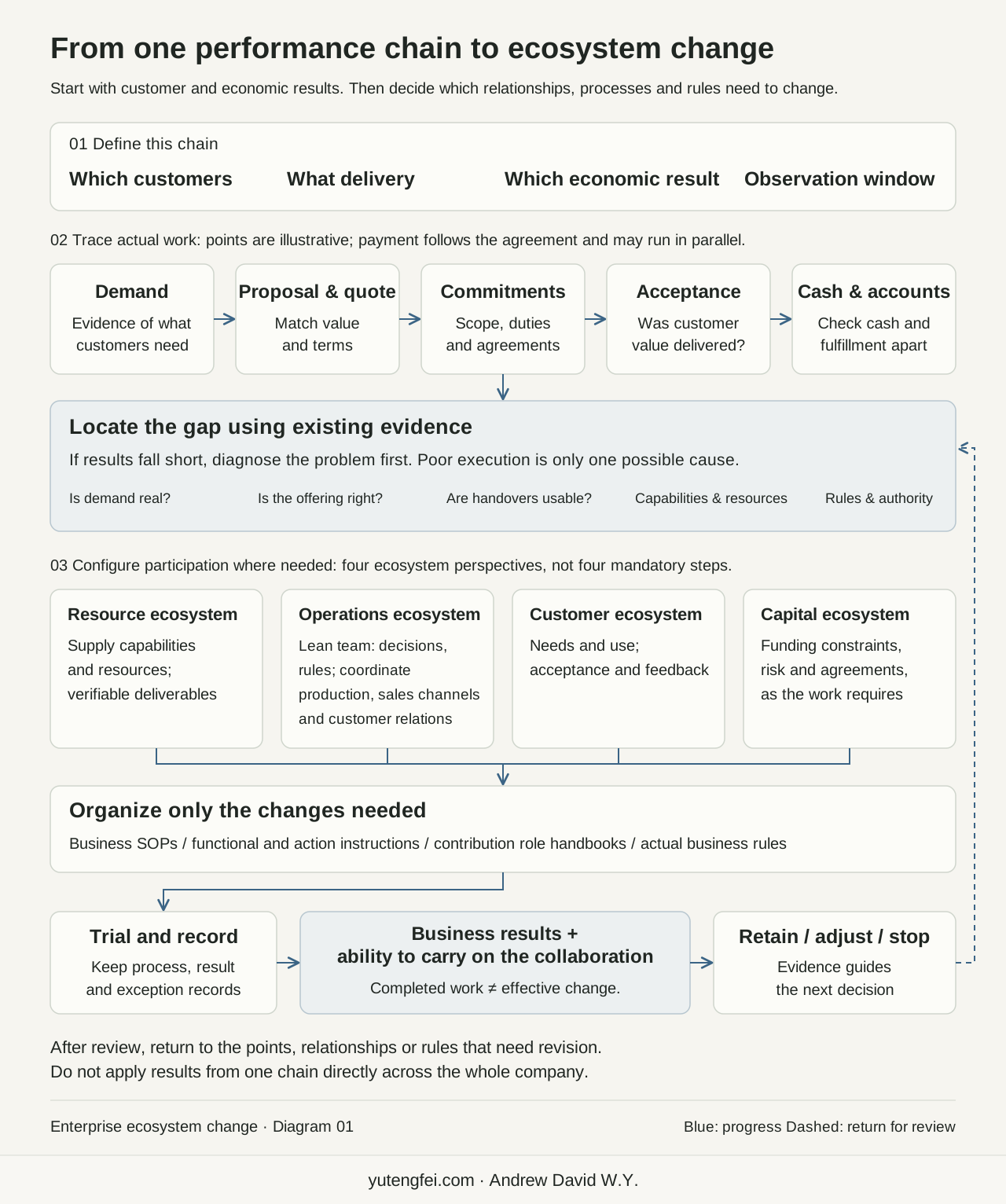
- Figure 1: Locate problems along the performance chain, then organize changes to ecosystem relationships, roles and processes around the points that need them.
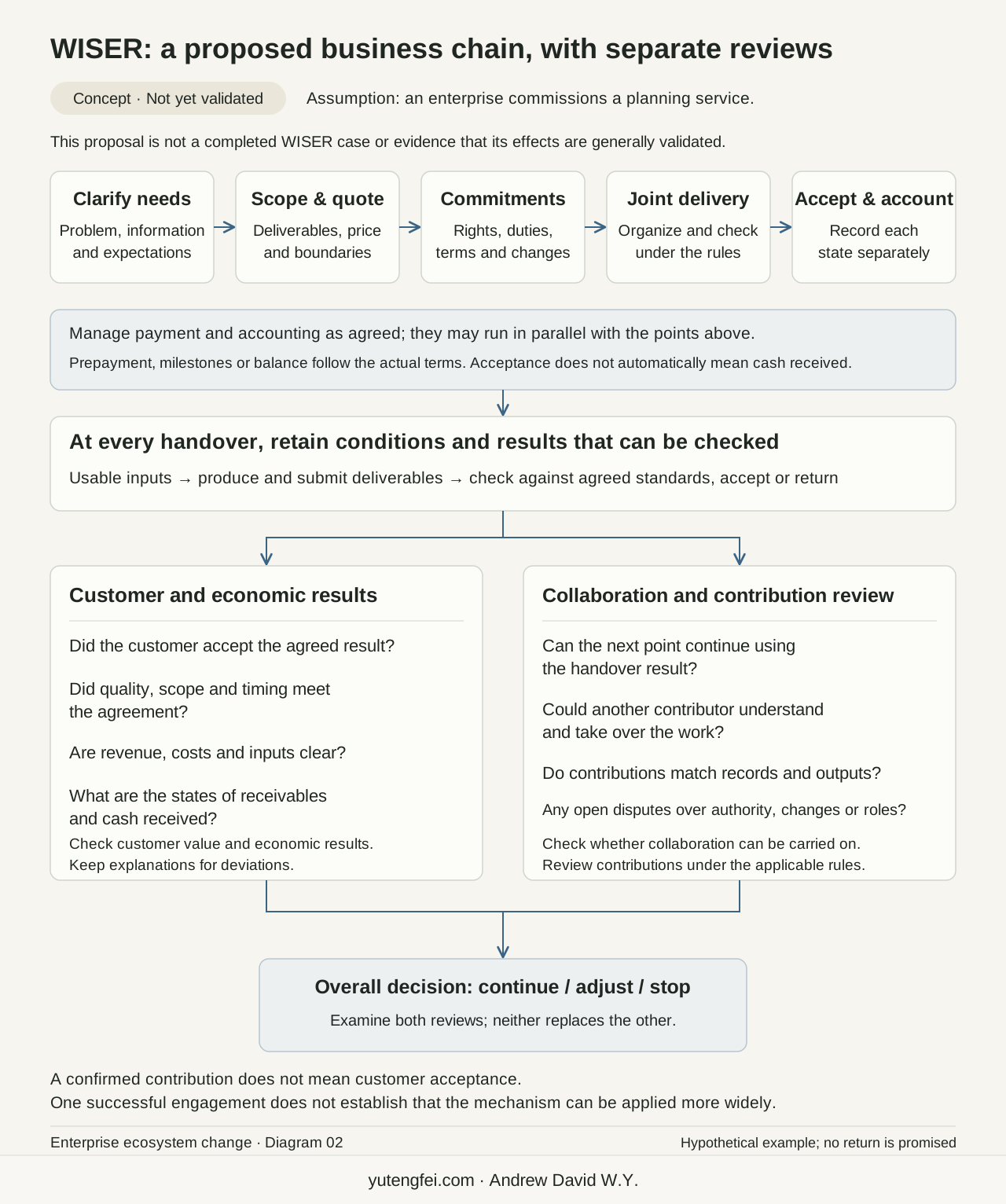
- Figure 2: In a proposed WISER planning service chain, review customer and economic results separately from collaboration and contribution evidence, then decide on the next round.
This is a readable, citable knowledge resource, not an installed Skill. When using it with AI, retain its sources and limits and review the output.
CC BY-NC-ND 4.0 · Applies to original text unless otherwise stated; excludes third-party materials. Downloading or machine reading does not extend the existing license or separately authorize derivatives, commercial use or model training.
When a company wants to bring people and capabilities together, inside and outside the organization, the conversation often moves quickly to roles, platforms, rules, incentives and AI. Each has a purpose. Once we apply them to real work, though, there is a concrete question to answer: which piece of business should we start with?
My suggestion is to choose one performance chain: a business chain connected to customer and economic results. Follow it to see what customers need, how the company makes commitments, who works together to deliver, how results are confirmed, and how receipts and expenditure are checked. Then locate the points affecting the outcome and organize the changes needed.
That gives a role list, a role handbook and a set of rules a clear place in the work. They should help this business run more reliably. Their practical effect can then be checked through the work itself.
This article proposes an implementation approach for teams with a real customer problem, a business scope they can define, and a willingness to keep records. The WISER scenario illustrates how the pieces can be combined. Its specific arrangements and effects still need to be tested in actual projects.
Choose a performance chain whose results you can observe
A performance chain connects how customers accept an offering with the economic results that follow. The chain differs by business. It may branch, return to an earlier point, or repeat a step.
A planning service, for example, may begin with a customer need, move through scope and quotation confirmation, fulfillment and acceptance of deliverables, and then review the related receipts, expenditure and subsequent feedback. Payment may occur before the work starts, during a stage, or after acceptance. Draw it in according to the actual agreement. Customer acceptance, contract signing, revenue recognition and cash received should also be recorded separately.
When choosing the first chain, consider four things together:
- A specific customer problem. There is evidence of demand, use or a transaction, and you know whose situation you want to improve and in what way.
- Observable results. You can observe delivery, customer feedback and the relevant economic results within a time and cost you can afford.
- Representative collaboration. The chain includes routine handovers and exceptions, so the necessary participants actually have to work together.
- Access to records. Key points have clear owners and sources of information, allowing the states before and after to be checked.
The first chain may not be the one with the highest revenue. It should be worth improving, while allowing you to see how the improvement happens. If the business cycle is long, define one stage first. At the same time, state what can be observed at that stage, and when final collection or continued customer use can be observed.
Before starting, explain in a few sentences what kind of business is included, where the chain starts and ends, which customer and economic results will be examined, how much can be committed, who will move the work forward, and who has authority to make major decisions. For a new business with no evidence of real demand yet, the first round should test the demand and the conditions for supplying it.
Reconstruct the current chain from actual business
Once the scope is set, look at a group of recent business records. Include work completed smoothly, as well as delays, rework, lost business and cases that ended partway through. Record separately how the work would normally be expected to proceed and what actually happened this time.
At each key point, ask four questions: what was received, what was handed over, who confirmed that the work could continue, and what evidence was retained?
For example, a requirement may already have been passed to the planner. It still needs to be checked for whether it supports the work that follows. Is the customer’s problem clear enough? Who can confirm the scope? What information has been supplied, and which conditions remain unverified? If the next participant has to start asking questions from the beginning, find the gap in that handover.
Also attach time, cost and waiting to the points where they occur. A slow quotation may result from slow costing, an unclear customer problem, uncertain supply conditions, or the need to coordinate again after every change. Understand what happened before deciding which part to change.
The output of this round is a map of the current chain backed by evidence: which points have been completed, where work repeatedly returns, and which results cannot yet be confirmed. Where information is missing, mark what needs to be added. There is no need to fill the map with guesses.
Locate the gap, then decide what work to organize
This article uses four levels of SOP, or standard operating procedure: performance, business, functional and action. A performance SOP describes the key chain connected to customer and economic results. A business SOP organizes the collaboration needed within it. A functional SOP sets out specific responsibilities and tasks. An action SOP details the method and standards. These levels connect through the work; they do not correspond to fixed departmental ranks.
When performance falls short, first trace the gaps along customer and economic results. Whether an SOP was followed is only one part of the check.
| Gap currently observed | Evidence to check first | Work that may be needed |
|---|---|---|
| Many inquiries arrive, but few customers confirm a proposal | Customer needs, reasons for refusal, alternatives, price and supply conditions | Revalidate demand or adjust the offering, then decide whether to change the sales process |
| Proposals are revised repeatedly and commitments keep changing | Reasons for each change, decision makers, scope and versions | Add requirement confirmation, scope change handling and the relevant decision arrangements |
| The customer has confirmed, but delivery still requires repeated rework | Prerequisite information, handover conditions, capabilities and resource arrangements | Revise the relevant business SOP; add the necessary role handbooks, functional responsibilities and action instructions |
| The customer accepts the result, but the economic outcome remains poor | Actual inputs, rework cost, pricing, payment agreements and cash received | Adjust quotations, cost control or collection arrangements, and check whether the business can be sustained |
| The work gets done, but participants do not want to continue | Coordination burden, responsibilities, evidence of contributions and dispute records | Change collaboration interfaces or rules, and address gaps between what participants carry and what was agreed |
This table offers directions for investigation. A result can have several causes. Customer budgets, market changes and chance events may also affect the assessment.
Once the problem is confirmed, organize the lower levels of SOP as needed. If a point in the performance chain requires collaboration across roles, clarify the corresponding business process. If responsibilities within it are unclear, work is inconsistent, or no one handles exceptions, add what is needed at the functional and action levels. Problems with demand or pricing may also require a new business decision.
In each round, try to state the main changes and the reasons for them. If several changes must be introduced together, retain a record of the combination. At review, explain which effects cannot yet be assessed separately.
Scroll sideways to explore, or open the full diagram.

Connect the four ecosystems to specific points in the work
Resources, operations and management, customers, and capital provide four views of participation relationships. The same person or institution can take different roles in different matters. When arranging them, return to what this performance chain needs.
The Resource ecosystem concerns the capabilities, products or services that can be provided, the conditions under which they can be taken on, and who is responsible for delivery. A capability profile is not enough. Available time, quality standards and specific commitments still need to be confirmed.
In the Operations and management ecosystem, a lean team handles the relevant decisions, rules and coordination. It connects value production, sales channels and customer relationships, and makes trade-offs among scope, resources and exceptions. Be clear about what delivery roles can handle themselves and what needs to be escalated for a decision.
The Customer ecosystem gives needs, choices, use, acceptance and feedback clear points of entry. Customers can make requests. They can also proactively contribute feedback, knowledge or channels. Whether they take on an additional role in joint work depends on their actual participation and the agreement.
The Capital ecosystem checks funding sources, uses, payment constraints and risk bearing as the business requires. If the work can be completed within existing resources and agreements, proceed on those terms. Where there is a real funding gap or a new capital arrangement, examine the entity involved, responsibilities and conditions separately.
Roles in every ecosystem can proactively offer contributions or respond to specific needs. A role handbook is for a role that actually contributes value. It explains objectives, methods, handovers and exception handling. Customers acting as buyers and people participating solely as investors enter the relevant service, transaction or investment processes. If the same person also takes on joint work, define the handbook and responsibilities for that additional role.
Specific rights and entitlements are determined by the actual business and applicable agreements. Keep separate evidence for participation, delivery, contribution confirmation, expense settlement and long-term rights. Do not treat them as a sequence that happens automatically.
Apply the combination to one proposed WISER engagement
In “Thinking Through How Company Zero Will Operate Next” (Chinese), I proposed completing one small project first, handling acceptance of customer value separately from review of participants’ contributions. This offers a possible starting point for practice. The public work record sets out the thinking and next steps at that time. It does not establish that this approach has already proved effective.
Suppose WISER is preparing to take on a clearly scoped enterprise planning service, organizing research, a proposal and related deliverables around one customer business problem. The roles and processes below are proposed arrangements. Before the work formally starts, the contracting entity, customer needs, participation conditions and specific agreements still need to be verified.
| Point in the business chain | Result that needs to be produced | Proposed contribution roles and supporting evidence |
|---|---|---|
| Clarify needs | The customer problem, current information, unverified conditions and person authorized to confirm are clear | The customer relationship role organizes communication; the customer confirms the requirement record |
| Define scope and quote | Deliverables, boundaries, acceptance method, schedule and price align | The planning coordinator brings together research and delivery resources; an authorized person approves the quotation |
| Confirm commitments | Contracting, delivery, receipt and payment responsibilities, and change handling have a clear basis | The actual contracting entity and relevant authorized people confirm; each participant confirms what they will undertake |
| Deliver collaboratively | Each stage’s output meets the input conditions for the work that follows | Set up research, proposal, design or other roles as needed; retain sources, versions and handover records |
| Accept and account | Customer acceptance or objections, fees, costs and cash received can be checked | The customer accepts according to the agreement; the relevant roles separately handle corrections, accounting, receipts and payments |
Start by connecting a few necessary materials: a performance chain card stating customer and economic objectives, a process map marking key handover conditions, handbooks for the relevant contribution roles, and records of applicable agreements, exceptions and results. What matters is being able to find the corresponding evidence from one part to the next. More documents are not automatically better.
If the first round of records shows that repeated quotation changes mainly arise from an unconfirmed requirement scope, add requirement confirmation and scope change handling first. Observe quotation time, reasons for changes and coordination inputs. If the main obstacle is the customer’s budget or a mismatch in the offering, return to the business decision and recheck the service and price.
For example, when research material is passed to the proposal role, it should state its sources, which judgments it supports, and what still needs verification. When the proposal is passed to the design role, the structure, data definitions and presentation requirements should have been confirmed. If the customer makes a new request, the original scope, impact assessment and relevant decision should be traceable.
AI can help with retrieval, organization, drafting and checks. Before delivery, the relevant roles still need to verify sources, judgments, responsibilities and customer commitments. Once a practice has been used and its inputs, steps and acceptance conditions have become reasonably stable, assess which parts can become a Skill: an action guide that AI can reuse.
Scroll sideways to explore, or open the full diagram.

Review both whether the business improved and whether collaboration can continue
At the end of the first round, set out business results and collaboration separately before making an overall assessment.
For the business, examine how far the customer problem has been resolved, the quality of the result, rework, cycle time, actual inputs, and the status of the relevant payments. If a payment is not yet due or subsequent use has not yet occurred, mark the next observation date.
For collaboration, check whether key handovers allow work to continue, whether someone else can take over a role, whether participants can bear the added burden, and whether contribution records and rule disputes have supporting evidence. Even when a project is completed, check whether it depended mainly on the person in charge repeatedly stepping in or on sustained overtime.
Agree on specific measures before starting. Choose only a few that help assess the issue in this round. If repeated quotations are the main problem, for example, check the number and reasons for changes after requirements were confirmed, along with actual time spent. If rework is the main issue, examine whether the first handover met the conditions for the work that followed. When comparing results before and after, also record changes in customers, price, scope and business difficulty.
A review should leave at least three kinds of information: which results are supported by evidence, which explanations remain hypotheses, and how the next round can obtain more useful evidence. Once these are clear, an authorized person can decide which changes to retain, adjust or stop. If the original problem improves while costs or the collaboration burden rise, the trade-off still needs assessment. If evidence is insufficient, define what needs to be added. If conditions no longer support the work, deal with obligations already undertaken and stop the relevant new commitments of resources.
What this round can produce is practical knowledge with stated conditions. To assess whether it transfers to more business, continue testing with different participants, levels of difficulty and resource conditions.
Reshaping an enterprise ecosystem can begin with a concrete record: how this business runs, where problems occurred, what we changed, how the results shifted, and what remains unconfirmed. The next participant can use that evidence to continue the work. The next round of changes also has a clear place to begin.
Research basis and optional further reading
This approach continues ideas in the earlier Methodology for Mapping and Designing SOPs: performance processes connected to customers, prerequisites and handovers, trials and iteration. The ecosystem combination and WISER arrangements in this article are part of the proposed design. A complete set of implementation validation results has not yet been recorded.
- Four-Ecosystem Governance Model: A Closed Loop of Contributions, Rights and Collaboration (Chinese): for the governance structure connecting participation relationships, contributions and rights.
- Ten Steps for Enterprise Planning: Connecting Direction, Resources and Execution (Chinese): for a closer check of objectives, resources and business assumptions.
- How Can a Multi-Party Collaboration Mechanism Start with a Small Pilot? (Chinese): for optional use alongside the arrangements for pilot scope, authority, inputs and exit.
- Thinking Through How Company Zero Will Operate Next (Chinese): for WISER’s publicly stated plans for practice and its progress at that time.