Building a Knowledge Foundation for Humans and AI to Work Together
I am rethinking how my website connects thinking, methods, models, plans, tools and training, organizing research into resources that people and AI can use. Through brainpower, computing power and Skills, I want to link knowledge, execution and feedback while exploring how blockchain-based financial instruments may support future forms of organization.
Reading & sharing

Recently, I have been rethinking my website, yutengfei.com.
As my research, writing and practical work have grown, the site has come to include a think tank, papers, books, updates, services, integrated solutions and Skills. I want clearer connections between these materials, so that one line of thought can feed into the next piece of work, and one result can become a starting point for further research and creation.
This reflection has gradually brought one direction into focus: my think tank should be understandable and usable by people, while also allowing AI to read and cite it accurately and, under appropriate conditions, use it to carry out work.
That gives my personal website a new development goal: to gradually organize my accumulated research into a knowledge foundation for humans and AI to work together.
1. The think tank now has two kinds of users
When preparing an article in the past, I mainly considered whether readers could understand it, find inspiration in it and apply its methods to their own work. Now I need to consider another user as well: AI.
When someone gives AI a specific task, AI needs to know the background, the definitions of the concepts involved, the methods it can use, the conditions it must observe and the standard a result must meet to count as complete. When the think tank makes these relationships clear, its content can serve as a basis for work.
People can follow an author's thinking through an article. AI also needs to find knowledge it can draw on. It needs to distinguish facts from judgments, verified methods from ideas still under investigation.
I therefore want to make each piece of content progressively more usable: what problem it addresses, what supports it, when it applies, how it connects to other material and what needs to be checked when using it.
The same knowledge can explain why something matters to a person and help AI understand how to proceed. Human understanding and AI use should be able to return to the same clear basis.
2. Starting with thinking, organize knowledge so it can solve problems
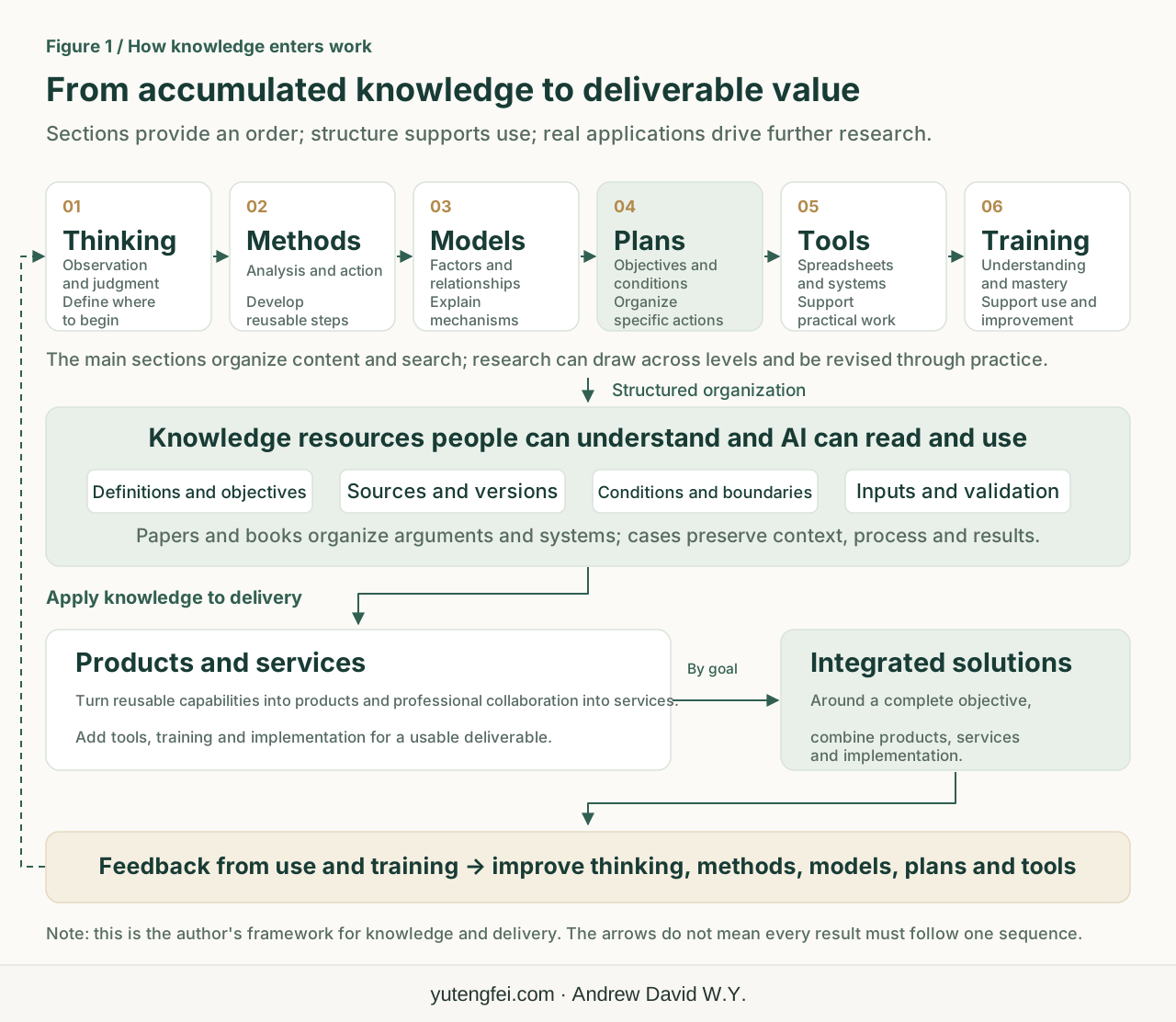
I plan to arrange the think tank's main sections in this order:
Thinking → Methods → Models → Plans → Tools → Training.
This sequence expresses my understanding of how knowledge enters our work.
- Thinking helps us observe problems, assess relationships and identify assumptions, so that we can decide where to begin.
- Methods organize thought into reusable steps for analysis or action, showing us how to move forward.
- Models abstract important factors, relationships and mechanisms, helping us explain problems, form judgments and discuss what may happen when conditions change.
- Plans place methods and models within specific objectives and constraints, making clear what to do, how to do it, who will do it and how to check it.
- Tools turn parts of that work into usable spreadsheets, software, scripts, templates or systems.
- Training helps users understand and master these materials, enabling more people to use the knowledge while feeding experience from its use back into improvement.
In the way I organize research, several ways of thinking can support a single method. As methods are repeatedly used and compared, their important factors, relationships and mechanisms can be further distilled into models. For a specific problem, relevant methods and models can then be selected and combined into a plan.
What matters here is distillation, validation and combination. Putting several concepts together still requires us to explain why they can work together, whether their conditions of use are consistent and whether the combination produces better results.
These six sections form a main line that makes the material easier to understand and find. Actual research can move back and forth between levels: a tool may reveal a gap in a model, a training session may help us rediscover a problem, and practical work may lead to a new way of thinking.
I place particular value on plans because this is where knowledge begins to connect with real problems. In the think tank, a “plan” focuses on action design for a class of problems. In actual delivery, reusable capabilities within it can become products, while work requiring professional collaboration can become services. Bringing the relevant products, services, tools, training and implementation arrangements together around a client's complete objective creates an integrated solution.
Papers and books can present the arguments, evidence and systems developed through this research more fully, giving future users a traceable foundation.
3. How I understand AI work: brainpower + computing power + Skill
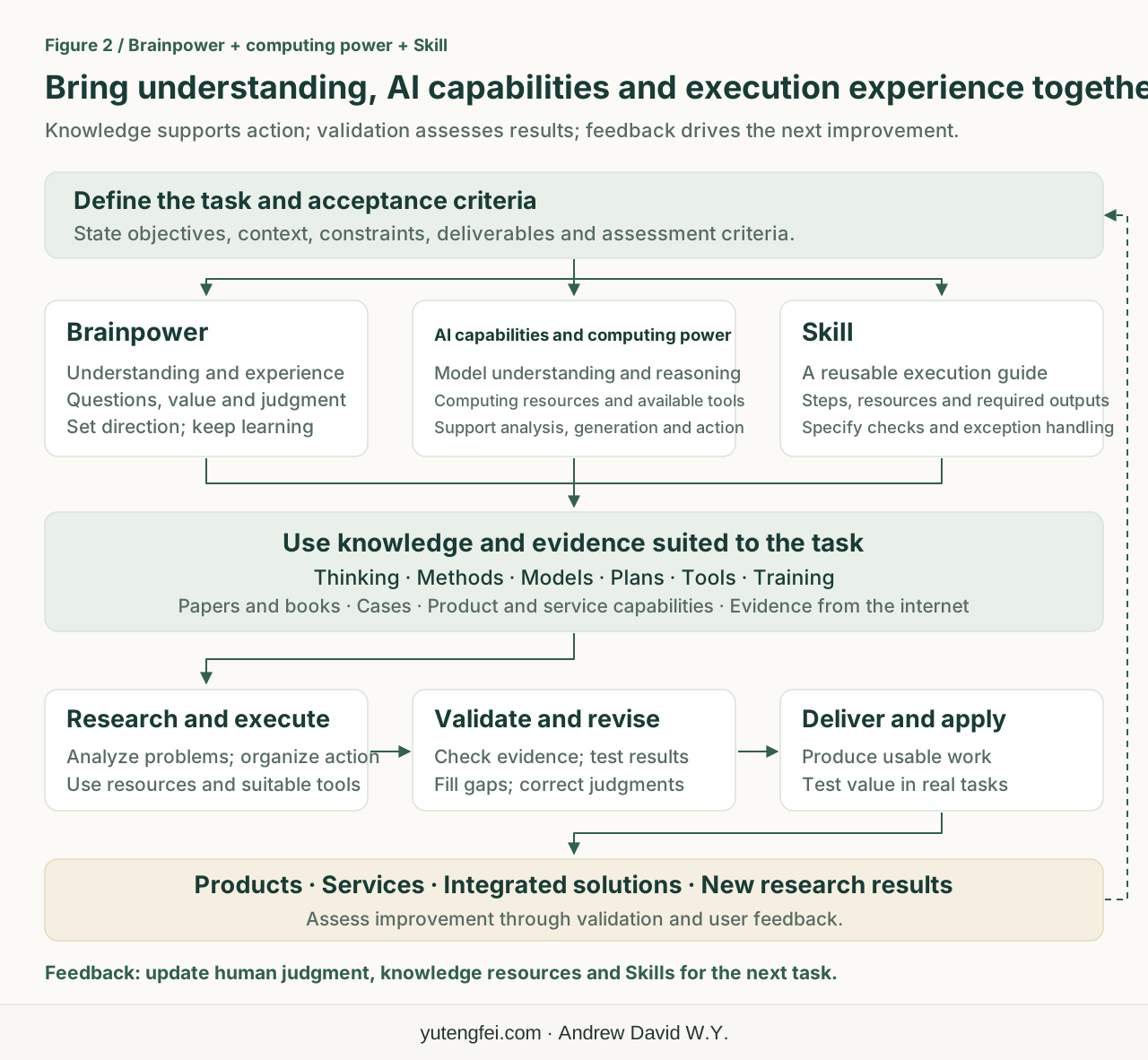
I describe this emerging way of working as brainpower + computing power + Skill.
Brainpower means a person's accumulated understanding, experience and judgment, along with the ability to keep learning and asking questions. It helps us decide what is worth doing, what results have value and which assumptions need to be reconsidered.
In this expression, computing power is shorthand for the computational support provided by AI. When organizing actual work, I consider model capabilities and computing resources separately: the model influences the ability to reason, understand and generate, while computing resources, context and available tools influence how those capabilities can be put to work. More spending on computation does not directly translate into better judgment.
A Skill organizes existing professional experience and effective practices into an execution guide that AI can follow.
As I understand it, a Skill should explain when to use it, what inputs it needs, what steps to follow, which materials and tools it can draw on, what it should deliver and how to check the result. Where necessary, it should also explain how to handle exceptions and which actions require a human decision.
This relates directly to the way knowledge, instructions and supporting resources are packaged in the Agent Skills open specification. For my work, the key is to turn reusable professional experience into explicit action arrangements.
Existing plans can be an important source for Skills. Making a plan's conditions, steps, resources and acceptance criteria explicit is what allows it to support AI execution more effectively.
Human judgment, AI capabilities and organized execution experience can then work together on a task.
4. Bring clean resources into execution, then bring results back to update those resources
Alongside brainpower, computing power and Skills, we need materials we can rely on.
Thinking, methods, models, plans, tools and training materials, as well as papers, books, product descriptions, service processes and integrated solutions, can all provide AI with a basis for work at different levels. Cases help us understand the conditions in which a practice was used, the results it achieved and the factors that cannot simply be copied elsewhere.
By “clean,” I mean that the material has a clear meaning, traceable sources and versions, consistent concepts and explicit conditions of use, and that facts, inferences and ideas can be distinguished. Material that is outdated or has yet to be validated should also state its status.
Some resources are for AI to read and cite. Others participate directly in execution through tool interfaces, product capabilities or service processes.
These resources play different roles in a task. Models support analysis, methods support progress, plans organize action, tools support operations, cases enable comparison, and papers and books help trace the basis for a claim. Skills connect the relevant resources to execution steps.
Resources should be selected around the problem at hand. My own library can provide understanding accumulated over time, while the wider internet can add new facts, contrary evidence and external research. New problems still require an open search for answers, and the knowledge base needs continual updating.
I hope this combination can produce results beyond our original expectations. Moving toward that goal requires carrying the task through: checking results after execution, filling gaps with evidence, correcting methods when errors appear and bringing new understanding back into the resource library.
Agents acting through tools and continuing to adjust in response to their environment are principles already discussed systematically in the design of agent workflows. I want to put these principles into practice in my daily research and project work.
A completed result should leave something that can be used next time: a more accurate judgment, a more effective method, a clearer Skill or a new set of questions worth researching.
5. Research means continually expanding the problems we can understand and solve
Following this line of thought has also clarified my understanding of research.
I want my research to keep discovering new problems, proposing explanations that can be discussed, developing methods that can be used and testing them in practice, continually extending the boundaries of knowledge and technology.
Working with AI creates new conditions for this work. An idea can be explored more fully, different views can be compared, a model can be questioned about its assumptions, and a tool can move more quickly into development and testing.
For me, the worthwhile investment is to organize these capabilities into a continuing research process: pose questions, form hypotheses, seek evidence, design mechanisms, conduct validation and improve in light of the results.
Research results can also take different forms and serve different purposes. An argument can develop into a paper, a connected body of research can become a book, a method can be codified as a Skill, and some established capabilities can become tools, products or services. New problems encountered in real applications can then return to research.
I want the website to gradually make these connections visible. Each piece of content should explain what it investigates, what it can help accomplish and how it supports other results.
6. How blockchain-based financial instruments may influence future forms of organization
As the way we create together changes, the ways we organize contributions, rights and returns also need to develop.
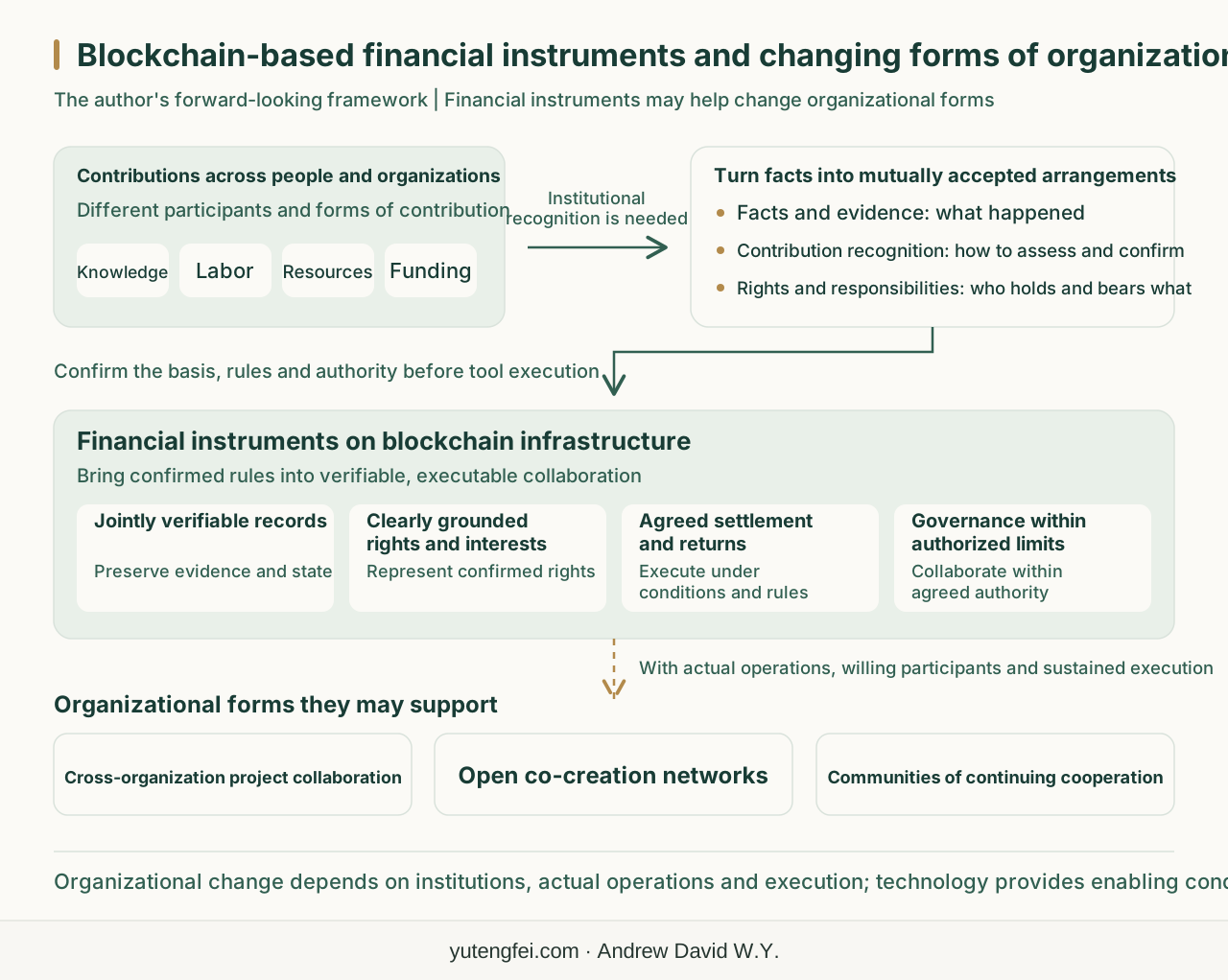
The knowledge, technology, labor, resources and funding in a project can come from participants in different regions, institutions and roles. AI also enables individuals and small teams to do more work, opening new possibilities for collaboration across organizations.
This raises a set of important questions: How can participants keep contributing? Who recognizes those contributions? What establishes their rights and interests? How are returns realized? Who is entitled to participate in which decisions? And how should existing relationships be handled when collaboration ends?
One of my important judgments is therefore that financial instruments built on blockchain infrastructure will be important tools for changing future forms of human organization.
Financial instruments can influence how funding enters a project, how rights and interests are held, how returns are distributed, how risks are borne and how participants maintain long-term connections. These arrangements in turn influence whom an organization can include, the relationships through which people collaborate and whether that collaboration can endure.
Blockchain provides new technical conditions for some of these processes: participants can jointly verify records, rights and interests with a clear basis can be expressed digitally, some agreements can be encoded as execution rules, and settlement and governance processes can leave inspectable changes of state. Smart contracts are one way to implement some of these mechanisms.
If these capabilities are combined with clear institutional arrangements, actual operations and effective allocation of responsibility, they may support more forms of organization: projects across organizations formed around specific objectives, continuously open co-creation networks, and communities that can record contributions, provide an institutional basis for rights and interests, and sustain long-term cooperation.
Participants can establish different relationships through labor, knowledge, resources or funding, and then receive justified returns and corresponding participation arrangements based on their actual contributions, responsibilities and risks. Organizational design therefore needs to consider from the outset how these relationships fit together.
My interest in stakeholder capital governance concerns precisely these questions: How can contributions from multiple parties form a shared accumulation that remains usable over time? How can institutions connect contributions, rights and responsibilities? Why would participants continue creating value for a shared future?
For these tools to change organizations in practice, contribution recognition, the basis of rights and interests, responsibility and dispute resolution must be designed together. How on-chain records correspond to off-chain facts, and how specific rights are supported by institutional arrangements, are questions this research needs to answer.
What I want to explore is a connection between new capabilities for productive collaboration and financial and governance arrangements that can accommodate shared contributions and long-term rights and interests. A knowledge system helps humans and AI create together more effectively; financial instruments and governance institutions help participants organize contributions, share results and maintain cooperation.
7. Facing more capable AI, first build the foundations we can build today
I will also continue thinking about the more distant future.
If AI can consistently pose valuable new questions across more fields, develop new explanations, design ways to validate them and improve autonomously in response to results, the ways humans conduct research and collaborate through organizations may change more deeply still.
I hope that artificial general intelligence (AGI) will be able to participate in more profound original research, accelerate breakthroughs in knowledge and technology and perhaps help bring about what people call the “technological singularity.” This is a forward-looking judgment; there is still considerable uncertainty about how future capabilities will develop, and it needs to be examined further as research and practice progress.
I want to keep developing the website along this path: organize knowledge into resources, codify experience as Skills, enable humans and AI to research, execute and create together, and explore forms of organization that can accommodate shared contributions and long-term rights and interests.
Starting from one line of thought, keep building the ability to solve problems. That is what I want to do next.
Notes on the figures and references
All three figures were created specifically from the ideas in this article. They present the author's mechanism frameworks for organizing knowledge, arranging work and researching future forms of organization. The arrows concerning organizational change and future capabilities express connections and conditions to be explored; they cannot by themselves establish that a causal relationship has been demonstrated.
- Agent Skills format specification: explains the structure of Skill instructions and supporting resources.
- Anthropic: Building effective agents: explains working principles for tool execution, feedback and iteration.
- Ethereum: Smart contracts and Oracles: explain rule execution, the input of off-chain information and the relevant conditions.
- International AI Safety Report 2026: supports keeping an open judgment about the development of future capabilities.