Stakeholder Capital Theory: connecting co-creation to lasting capital relationships
I bring eight groups of classic business models into one diagram to examine how co-creation, contribution recognition, rights arrangements and governance can connect into lasting capital relationships.
Reading & sharing

This time, I brought together several classic models of the firm that directly relate to Stakeholder Capital Theory. I studied their connections and organized them into this mechanism diagram.
The question I want to keep working on is this: when different people take part in a business and create value together, how can their inputs become visible, their actual contributions be established, and their cooperation develop into lasting relationships whose commitments can be fulfilled?
Customers pay, employees work, suppliers deliver, and investors bear financial risk. Each of these relationships already has its own basis. As a business develops, new inputs, new forms of cooperation and new results also emerge that were not clearly covered by the original agreements. How to connect these things is a question I want Stakeholder Capital Theory to address further.
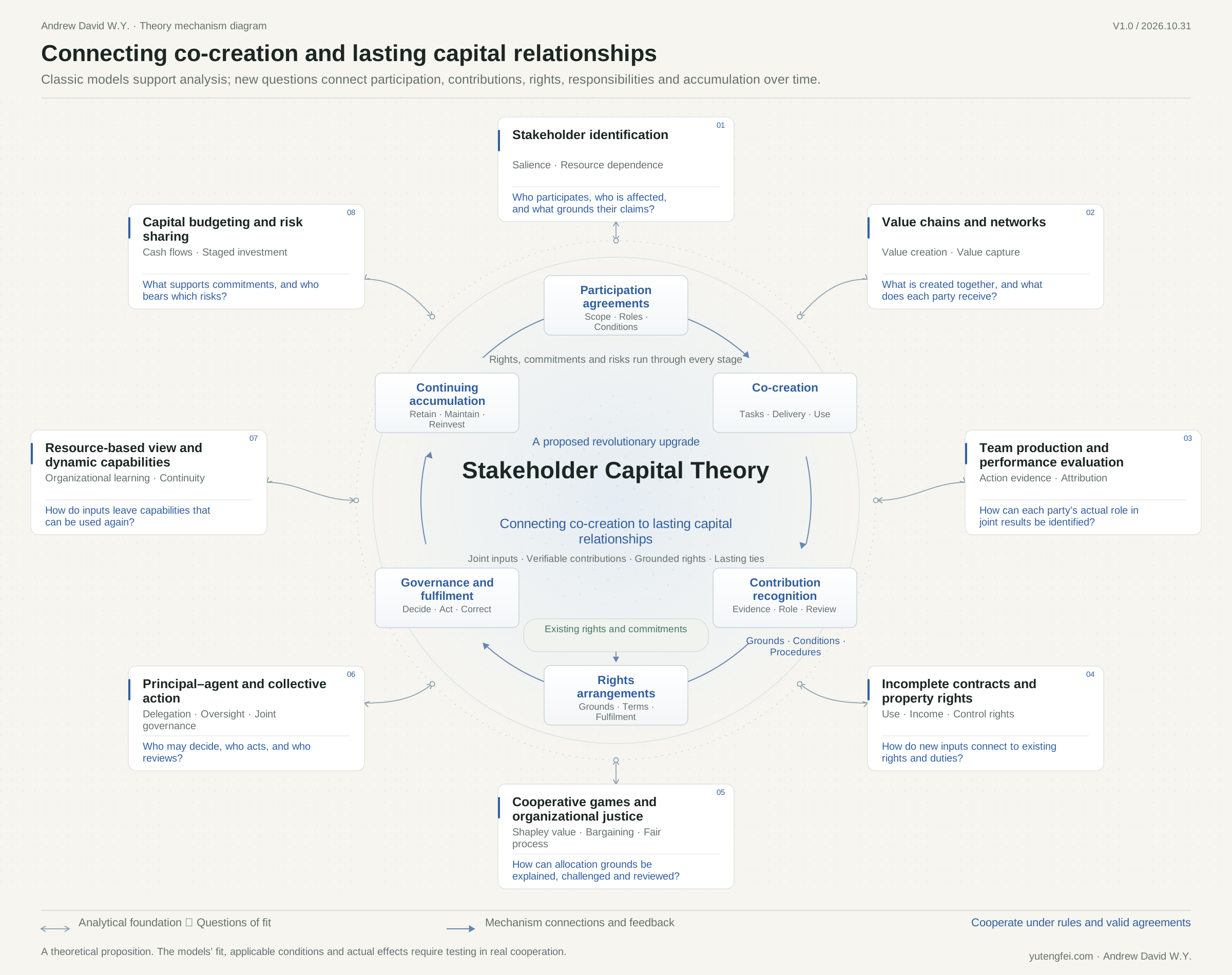
Looking at eight groups of classic models within the same process
Classic models already offer many useful ways to analyze a business. I have chosen eight groups and placed them within one operating process, to see what each can explain and what still needs further study.
Start with stakeholder identification, together with the value chain and value networks. Who participates, who is affected, and what grounds their claims? Which activities does the business choose to carry out, how are those activities connected, what value do they create for customers, and what does each party actually receive? Taken together, these two groups connect participants to concrete business activities. People who are affected need a response; the roles of those who help create value need analysis. A list of names cannot replace either task.
Next come team production and performance evaluation, alongside incomplete contracts and property rights. A joint result often reflects the efforts of several people, as well as market conditions and other external factors. Assessment should be based on tasks, deliverables and actual use. An increase in revenue is not a reason to allocate credit simply by job title or by who speaks the loudest. Even after a person's role has been established, deciding which rights apply still requires checking existing agreements, permitted uses, responsibilities and the necessary procedures.
Cooperative game theory and organizational justice help examine how the basis of allocation can be explained. Principal–agent theory and collective action help examine who decides, who carries out decisions, and who reviews them. Calculations can support discussion, but we also need to explain who was included, which value was counted, and what assumptions were made before calculating. Participants should have channels to raise objections and request a review. Joint participation needs arrangements that can actually make decisions and assign responsibility.
Finally, consider the resource-based view and dynamic capabilities, together with capital budgeting and risk sharing. Do the inputs leave behind knowledge, tools and a capacity to cooperate that the business can draw on again? Who needs to maintain those capabilities? What cash flows and resources will support the business's long-term commitments, and who bears which risks when conditions change? These questions affect how long cooperation can continue and whether promises have practical support.
The connections among these eight groups are what I most want to develop. Value creation, contribution assessment, allocation and governance can be studied separately, but participants experience them as one process. If the rules do not connect, a business may welcome participation at the start yet be unable to explain contributions and rewards later. Lasting relationships are then difficult to build.
Connecting participation, contributions, rights and lasting relationships
That is why the diagram has six stages at its center: participation agreements, co-creation, contribution recognition, arrangements for resulting rights, governance and fulfilment, and continuing accumulation.
At the start of cooperation, clarify the scope, roles and conditions. During the work, keep records of tasks, deliverables and use. Once results emerge, use evidence to assess the actual role each party played. Then, under valid agreements and applicable rules, determine how any additional rights will be arranged and who must fulfil them. Keep review and correction available throughout fulfilment. Finally, examine which results can be retained, how to maintain them, and how they can be used in the next round of business activity.
The relationship between contributions and rights needs particular care. Agreed wages, payments for goods and other existing rights have their own independent basis and should be honoured as agreed. Their recognition cannot be postponed until a new contribution assessment is complete. Nor does an additional contribution automatically confer equity, voting rights or any fixed return. The arrangement depends on the relationship participants wish to establish, what the business can undertake, and the conditions and procedures applicable to both sides.
Testing these connections in a concrete project
Consider a hypothetical example. A business invites a customer and a team to improve a management tool together. The customer provides real workflows and takes part in testing. The team organizes requirements, develops the tool and maintains it. Managers coordinate resources. The deliverables owed to the customer for purchasing the service must first be completed under the original agreement. Additional time invested, suggestions adopted and actual use of the improvements can be recorded and reviewed separately.
If the business later plans to reuse the customer's materials, or participants wish to establish an ongoing income arrangement, they need to discuss the scope of use, forms of compensation and future responsibilities. Even after the tool has been created, someone must maintain it, and the customer should be able to keep using it as new problems arise. Only after working through these steps can we assess what the cooperation has left behind and which relationships are worth continuing.
The “revolutionary upgrade” I hope to advance lies in connecting these mechanisms: giving co-creation a path toward capital relationships that have a sound basis, can be fulfilled and can endure. Classic models help analyze specific problems. Stakeholder Capital Theory goes further into how those analyses can enter the same cooperative process, so participation, contributions, rights, responsibilities and long-term accumulation can connect over time.
For now, this diagram expresses a theoretical proposition and a research direction. The next step is to choose a small project that can realistically be completed and run through all six stages. We should examine both what is created and the added costs of recording, review and coordination; both what participants receive and whether anyone bears burdens that were not made clear.
Keep the mechanisms that help, and revise those that do not fit. If contributions remain unclear, return to tasks and evidence. If rights cannot be fulfilled, re-examine conditions and resources. If extensive records do not help cooperation, change the approach. Real projects can gradually show under which conditions these connections are useful and what still needs improvement.
Related manuscript: Stakeholder Capital Theory — public working draft · Chinese text.