Second thoughts on the gold-tailings model: four diagrams, one connected view
Continuing my review of Chairman King's recording, I separate industry, capital, finance and support for other businesses into four matching diagrams, explain each below, then bring them together.
Reading & sharing

In the previous post, I put Chairman King's recording about a gold-tailings project into chronological order, drew the model from the corrected transcript, and worked through unclear points one by one. This is my second round of thinking, continuing that work log.
Continuing from the first version
This time I have separated industry, capital, finance and support for other businesses into four diagrams of the same size, trimming repeated explanations. Below each diagram I explain what that layer addresses, where money and rights go, and how it connects to the next. The combined view comes last.
I think understanding this model starts with a few relationships: how the operations earn money, what rights an investor receives, what a financial instrument changes, and how the result can help a company develop its existing business.
Industry: start with the gold and the profit
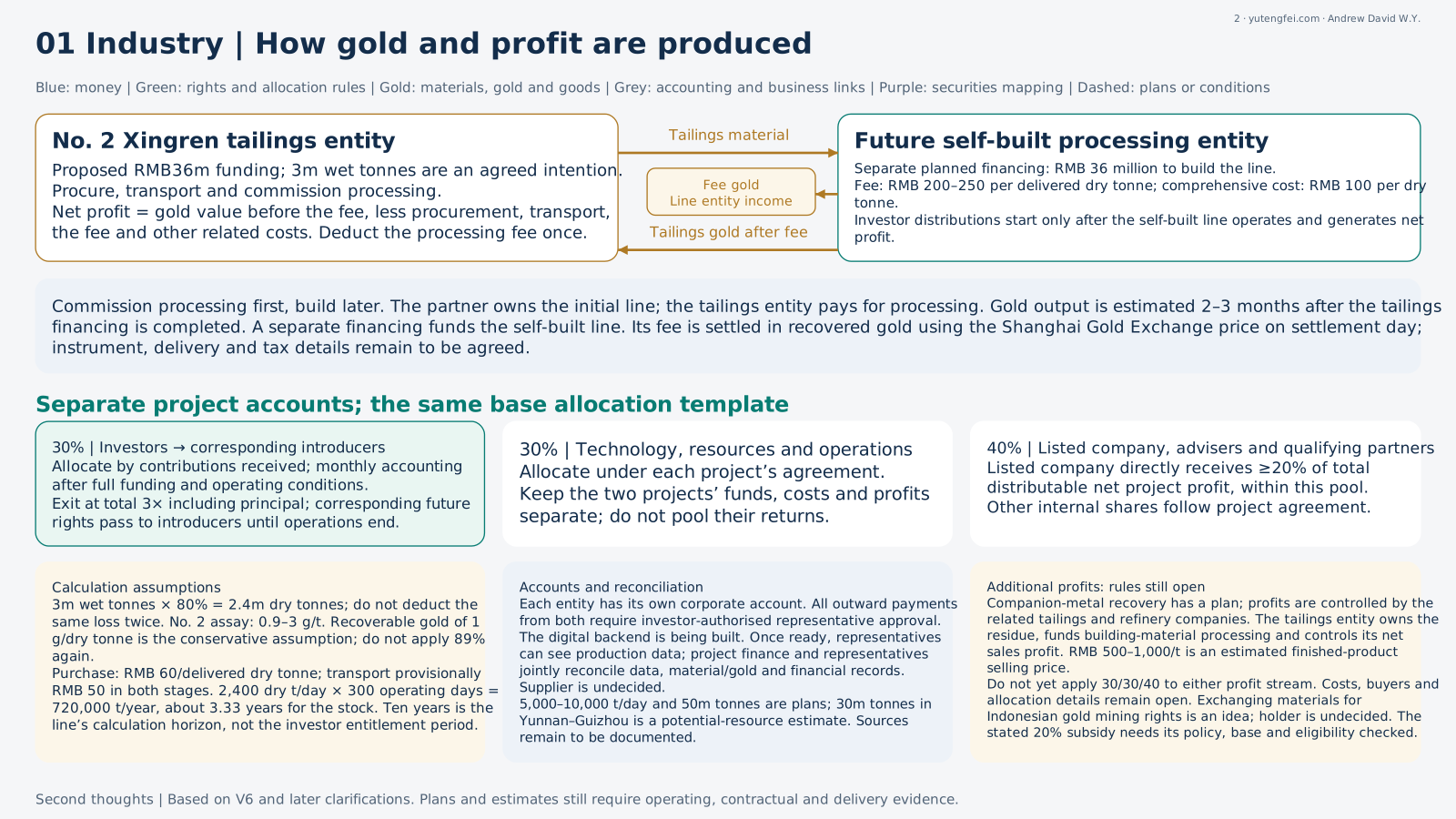
Start with the two entities. The tailings project procures, transports and commissions refining, with proposed funding of RMB36 million. The later self-built line is another project, also seeking RMB36 million. The partner owns the initial line and receives a processing fee. Distribution-right investors in the self-built line begin receiving distributions only after that line operates and earns net profit. These are two funding uses and two stages.
The three lines in the middle describe business after the self-built line starts: tailings arrive at the plant, the line entity sets aside and retains fee-equivalent gold from the same recovered batch at the plant, and returns the remainder to the tailings entity. The fee uses the Shanghai Gold Exchange price on the settlement day. Tailings profit starts with gold value before the fee and subtracts procurement, transport, the fee and other related costs. Line profit starts with fee-equivalent gold income and subtracts its own costs. Deduct the fee once; keep the line's RMB100 per dry-tonne comprehensive cost on the line side.
The figures below are calculation assumptions. An intended 3 million wet tonnes converts at 80% to 2.4 million dry tonnes. Recovery of 1 gram per dry tonne is the conservative estimate; do not multiply by 89% again. Procurement at RMB60 and provisional freight at RMB50 are per delivered dry tonne. At 2,400 dry tonnes a day and 300 working days a year, the batch takes about 3.33 years. The line has a ten-year calculation horizon; investor exits follow their own rules.
Each entity has its own corporate account. All outgoing payments need approval by the investor-authorised representative, who reconciles records with project finance. Associated-metal and building-material profits follow the confirmed entity ownership, but detailed allocation is unsettled. They do not yet use the basic 30/30/40 template.
Capital: who contributes, what they receive, when they exit
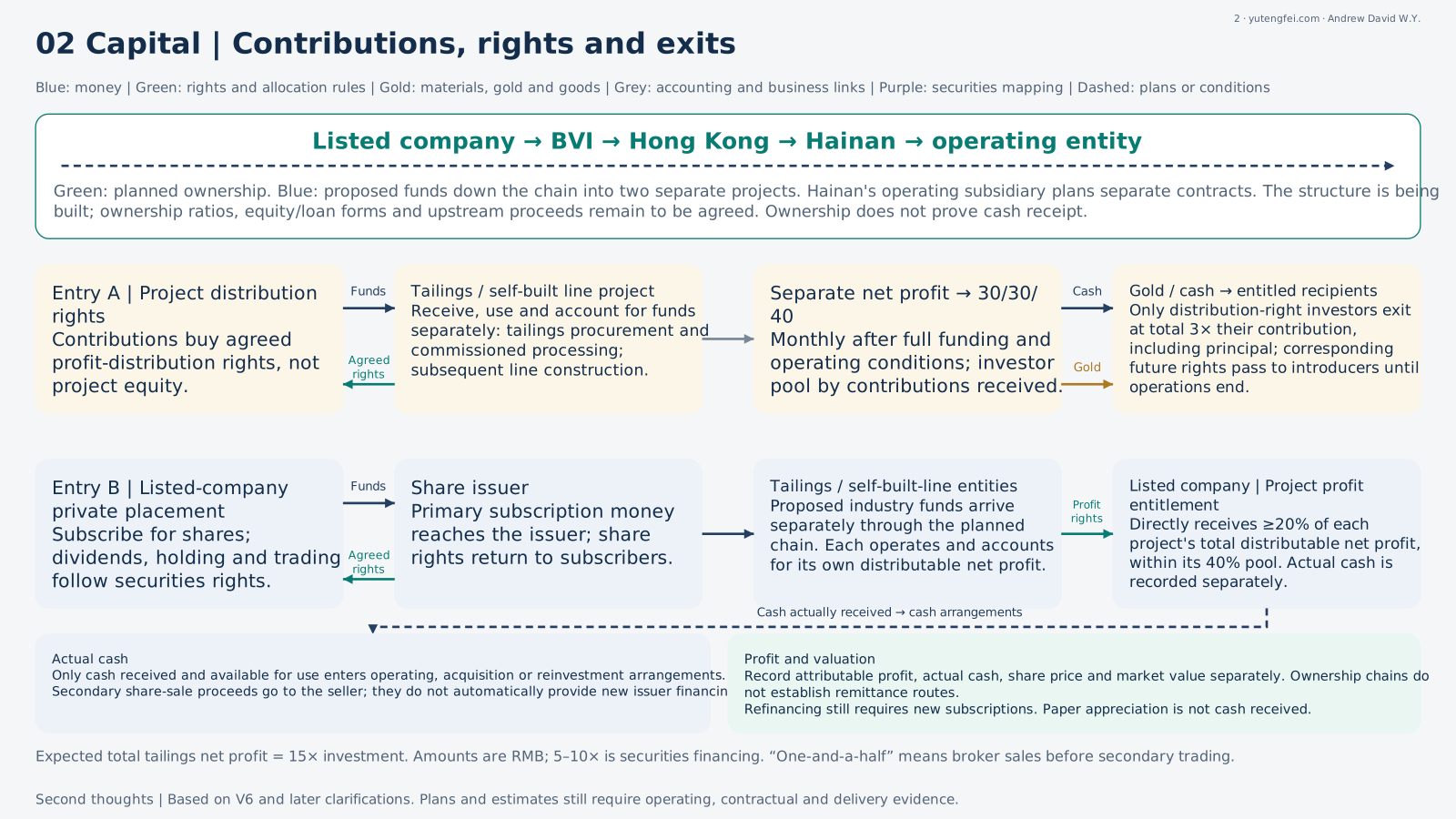
There are two entry routes. One contribution buys agreed project distribution rights without project equity. The other subscribes for listed-company shares through a private placement. The tailings and self-built-line projects apply the same 30%, 30%, 40% allocation to their own distributable net profit. The investor pool follows contributions actually received. Monthly accounting follows the company's operating rhythm once funding is full and operating conditions are met.
Project distribution-right investors exit at cumulative recovery of three times their contribution, including principal. A RMB1 million contribution exits at RMB3 million. Only that contribution's subsequent distribution rights pass to its introducer until the project ends. Listed shares follow securities terms. The listed company receives directly at least 20% of total project distributable net profit, included within the 40% pool.
Cumulative recovery and net cash received are different measures. Gold counts at the Shanghai Gold Exchange price on delivery day. Cash counts before gold-sale expenses and taxes; the cash recipient bears those costs. The later marketing budget therefore depends on what is actually received and available to spend.
The listed-company–BVI–Hong Kong–Hainan–operating-entity chain is a planned structure. Downstream funding and upstream proceeds each need their own arrangements. Book profit and a higher share price do not prove cash receipt. The fifteen-times figure means expected cumulative net profit over the whole tailings project equals fifteen times investment. It is neither an annual return nor a promised return for each investor. The green line from the project entities to the listed company represents profit entitlements. The blue proceeds line applies only to cash actually received and available for use.
Finance: connect the instruments and keep the rights aligned
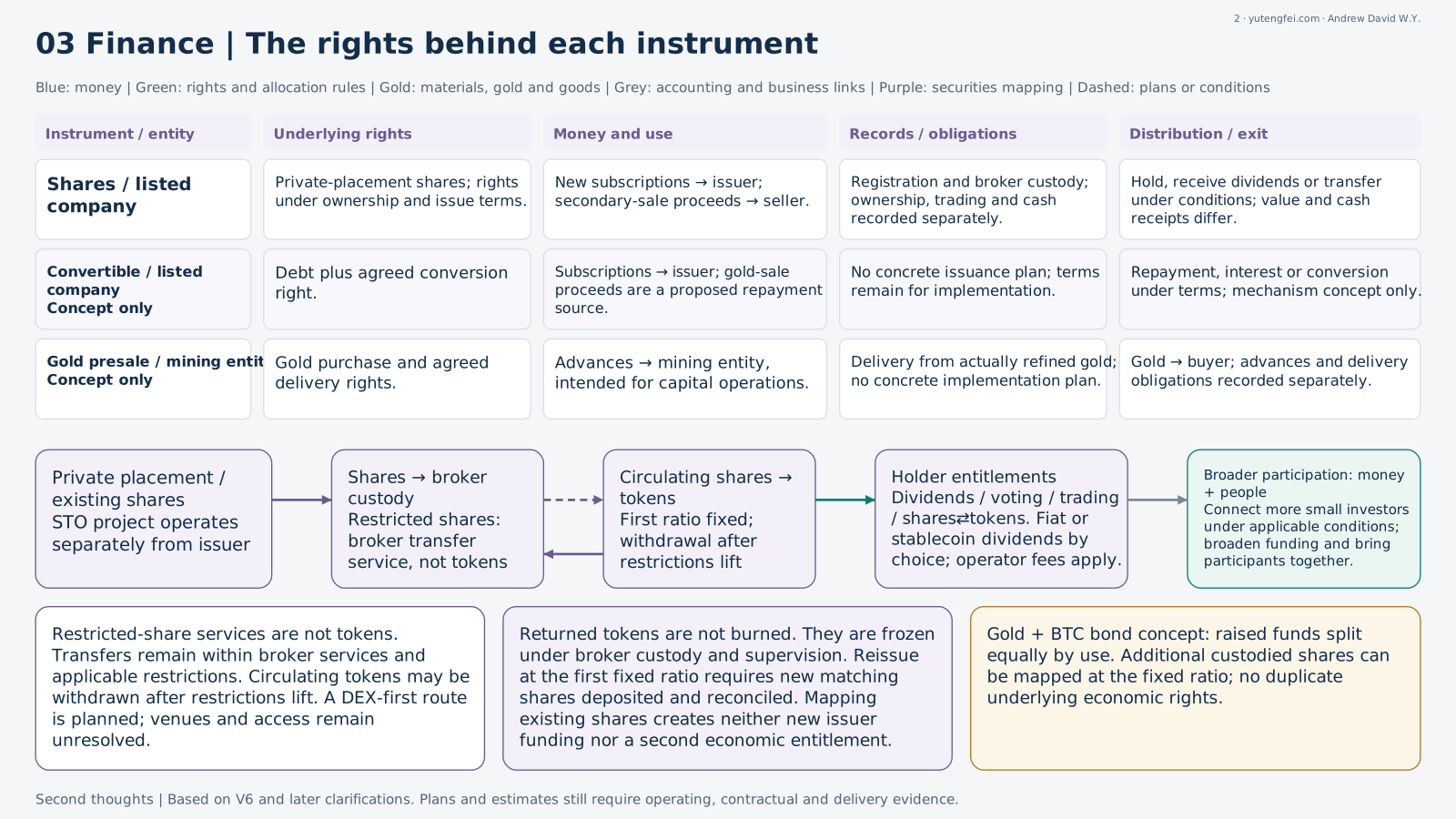
Read across the top first. A share subscription gives shareholder rights: new subscription money goes to the issuer, transfer proceeds to the seller. A convertible bond gives a debt claim and agreed conversion rights, with the listed company as proposed issuer. Repayment from gold-sale proceeds is still an idea. A gold presale sends an advance to the mining entity, intended for capital operations, followed by delivery of actually refined gold. Neither of the latter two has a concrete implementation plan.
Then follow the STO route. An independent project acquires listed shares, deposits them with a broker, and maps them under the applicable conditions. One listed company can underlie several independent STO projects. The first mapping ratio becomes fixed; it is not automatically one-to-one. The restricted-share stage is a broker transfer service, not a token. Once restrictions lift, the route can lead to withdrawable circulating tokens under the agreed terms.
Dividends pass through the STO project proportionally to holders, who choose fiat or stablecoin, participate in voting as agreed, and convert shares and tokens in both directions. The operator charges a fee. Tokens returned in exchange for shares are not burned; they are frozen. Reuse requires new matching shares deposited and reconciled. Mapping existing shares does not itself provide new subscription money to the issuer, and the underlying entitlement cannot be counted twice.
I have kept the goal of bringing in people as well as money. Wider participation by smaller investors is the intended benefit. Services, venues, access and policy applicability still need to be established. In the proposed gold-and-BTC structure, fifty-fifty describes the use of raised funds, not equal collateral or repayment sources.
Supporting other businesses: bring the return back to the original business
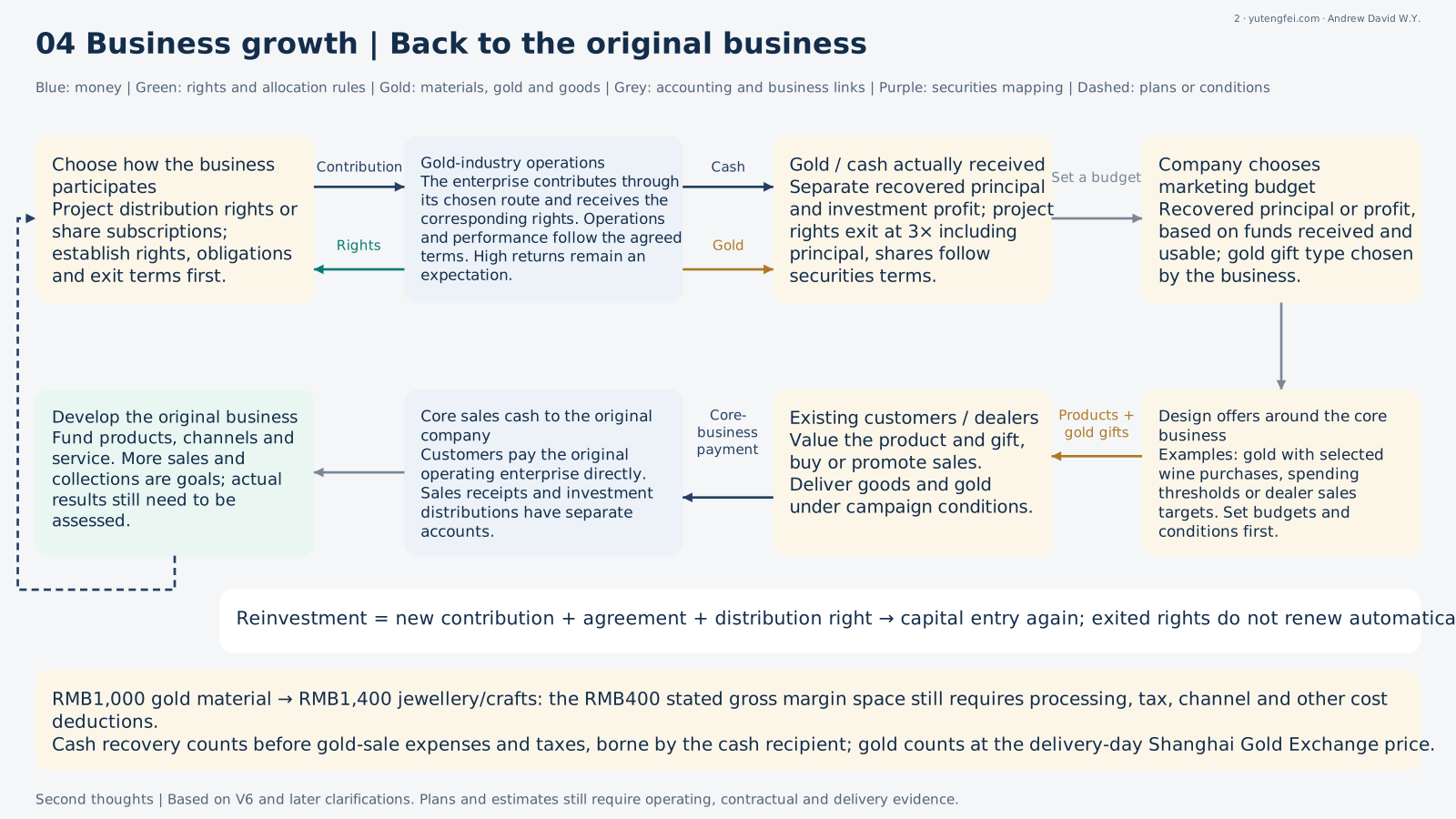
For me, this is where the whole model needs to lead. A company already selling wine, retail goods, cars or something else participates in gold to gain another resource for its core business. High gold-industry returns begin as an expectation. A marketing budget can use only gold or cash actually received under its rights and available to spend.
The company may choose recovered principal or investment profit. It chooses the campaign and whether the gift is raw gold material, jewellery or a craft item. In the example of RMB1,000 of gold material becoming RMB1,400 of jewellery, the RMB400 difference is the stated gross margin space. Processing, taxes, channel costs and other expenses still have to be deducted before net profit.
Follow the loop: investing, running the campaign and receiving core sales proceeds are different stages of the same enterprise. It delivers products and gold gifts to customers. Customers buy products and pay the original operating company directly, supporting products, channels and service. With that direction clear, the campaign can be assessed through actual sales and collections.
Another investment needs a new contribution, agreement and entitlement. Once the previous investment reaches its exit condition, its old distribution rights do not renew automatically. Investment returns, core sales and the next investment each need their own records.
Bring the four diagrams together
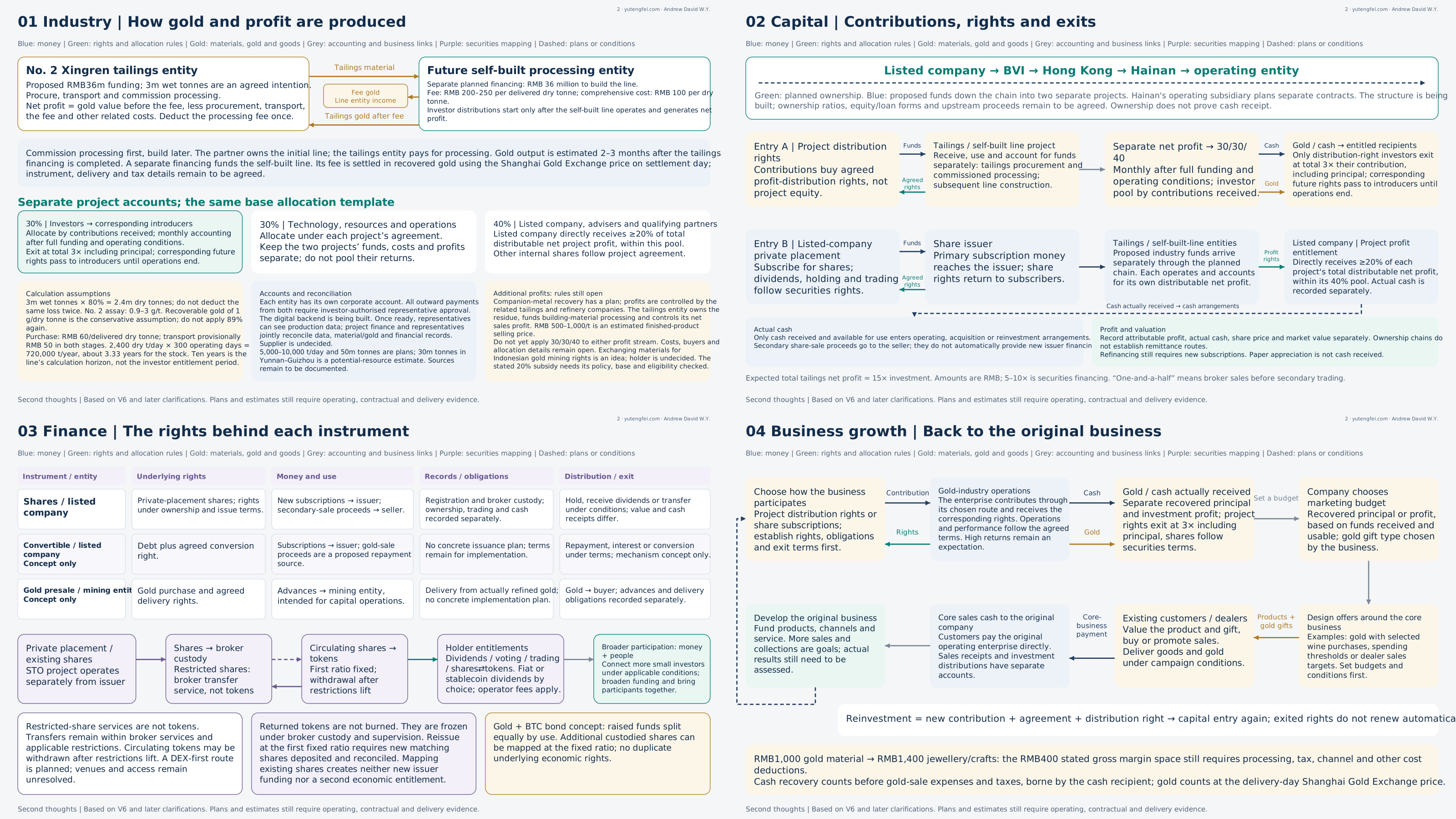
Industry supplies the operating basis for gold and profit. Capital establishes contributions, allocations and exits. Finance carries the relevant rights through appropriate instruments. Business support brings resources actually received back into the original business. Connected this way, the model is easier to explain as a whole.
After drawing it, I care more about whether each line can be explained: who gives what to whom, whether it is money, gold or a right, when it happens, and how it is reconciled. The next step is to compare those lines with contracts, accounts, production data, deliveries and receipts.
This is where I will leave the second version for now. Confirmed points go into the diagrams and explanations; open points remain in the checklist. This records the current proposal and my work on it. Plans, estimates and actual results still need to be checked against each other.