Taking the gold-tailings model apart, then connecting it again
V6 reconnects industry, capital, finance and business growth with clarified distributions, exits, STO and marketing budgets. Diagrams keep the main relationships; operational details stay in the checklist.
Reading & sharing

Today, I have been working through a recording of Chairman King discussing a gold-tailings project. First I put it in chronological order, then drew the model from the corrected transcript, and worked through questions one at a time.
A recording can sound broadly understandable. Drawing it exposes the gaps. Where do the two RMB 36 million financings go? Who receives the processing fee, in cash or gold? Does recovery of three times the investment include principal? What profit base does the 20% refer to?
Without those answers, a diagram can look complete while different readers understand different models. That is why I find drawing useful: each entity, line and number becomes something we can check.
For V6, I made a choice: keep entities, money, rights and returns in the diagrams, and leave operational details in the checklist. More detailed questions do not always make the main model clearer.
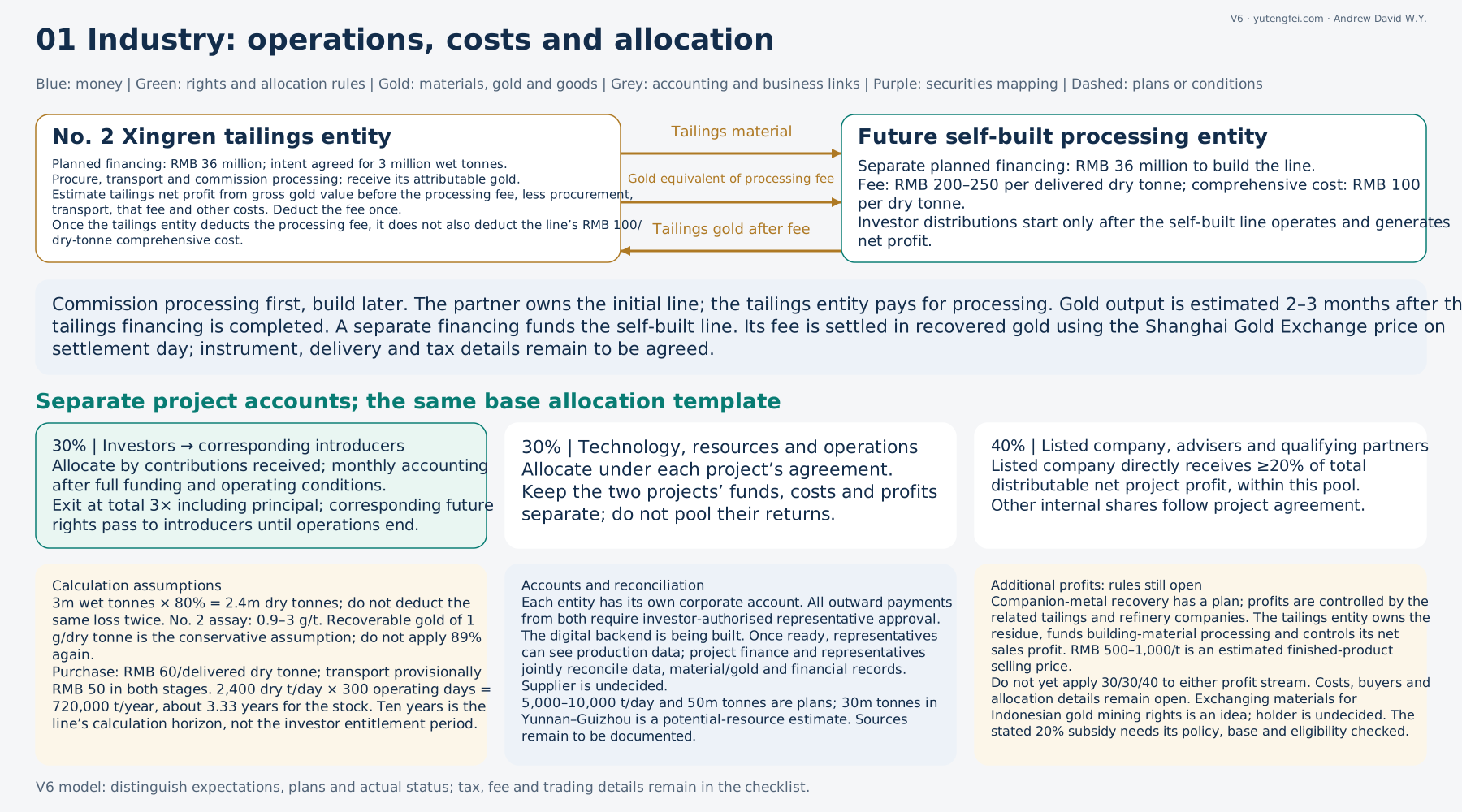
Industry: explain how the gold is produced
This round mainly concerns the No. 2 Xingren tailings. The 3 million wet tonnes are resources for which intent has been agreed, converted at 80% to 2.4 million dry tonnes. Recovering 1 gram per dry tonne is the conservative calculation assumption. The separately stated 89% recovery rate is not applied again. Intent, calculations and actual production each need their own status.
The two stages then need separating. Initially, a partner factory processes the material for a fee and owns that line. A separate RMB 36 million would later fund our own line. The estimate of gold output within two to three months starts when the tailings financing is completed. Investors in the self-built line start receiving distributions only after that line operates and generates net profit.
The self-built line’s fee is settled in equivalent recovered gold at the Shanghai Gold Exchange price on settlement day. The diagram returns gold to the tailings entity after that fee. Its net-profit calculation instead starts from gold value before the fee, then deducts procurement, transport, processing and other relevant costs. Deduct the fee once, without also deducting the line’s RMB 100/dry-tonne comprehensive cost. Record remaining gold, fee-equivalent gold and distributable net profit separately. The line’s ten-year calculation horizon is not every investor’s distribution period.
Account governance belongs in the diagram too. Each entity has its own corporate account, and all outward payments require approval by an investor-authorised representative. The digital backend is being built; once ready, project finance and representatives will jointly reconcile production data and financial records. Ownership of companion-metal and building-material profits has been described, but their allocation details remain open, so the base template is not applied to them yet.
Capital: define the base behind each number
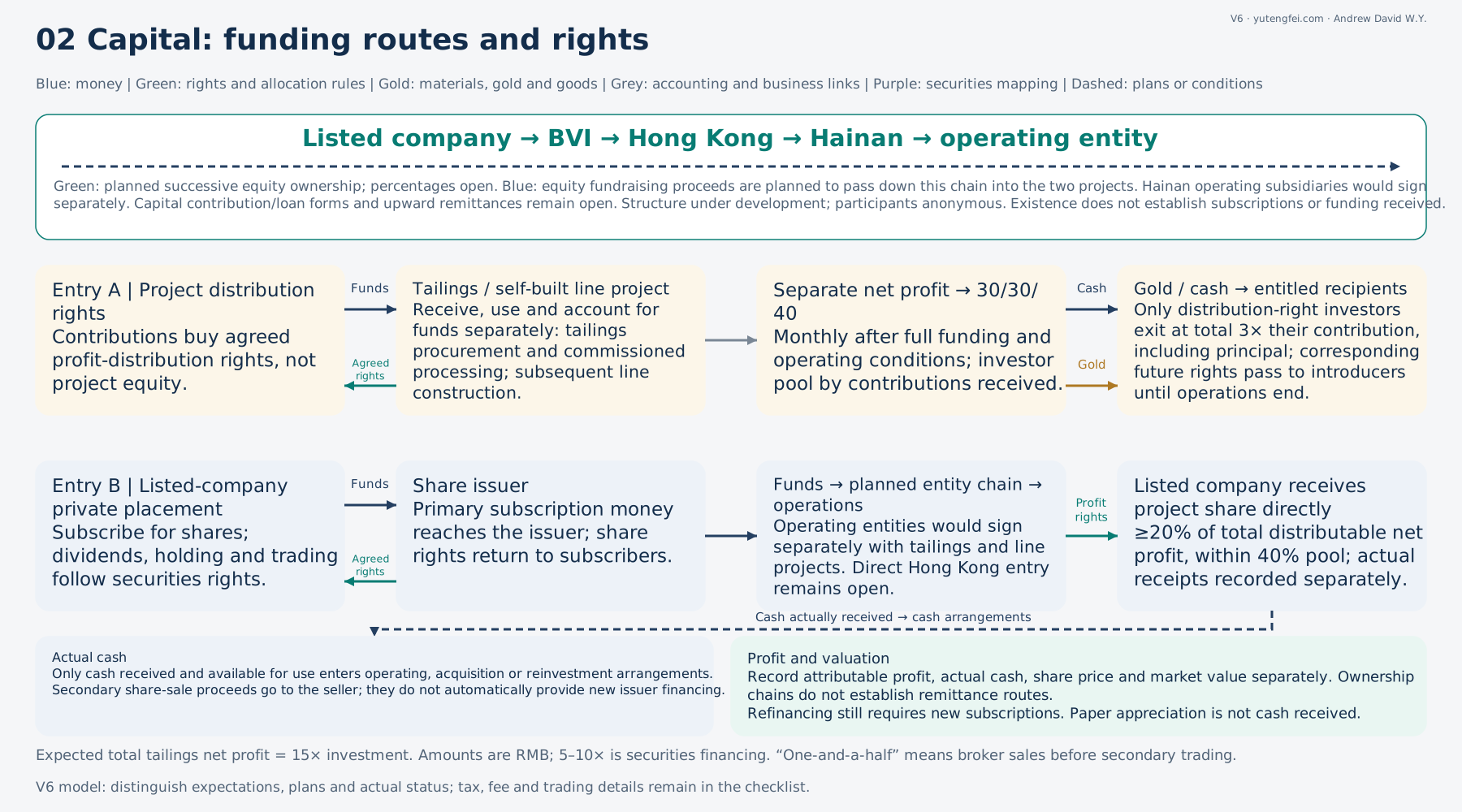
The tailings and self-built line use the same base split with independent accounts: 30% for investors and their subsequent corresponding introducers, 30% for technology, resources and operations, and 40% for the listed company, advisers and qualifying business partners under agreement. The investor pool is allocated in proportion to contributions actually received. Monthly accounting follows the company’s operating rhythm once financing is full and operating conditions are met. Project contributions receive profit-distribution rights, not project equity. Private-placement subscriptions receive listed-company shares.
Total recovery of 3× includes principal: RMB 1 million invested exits after RMB 3 million received in total. Only that investment’s subsequent distribution rights pass to its introducer, until project operations end. The listed company directly receives at least 20% of total distributable net project profit, within the 40% pool.
The 15× figure means expected cumulative net profit of the entire tailings project equals 15 times the investment. It is neither an annual return nor a further valuation multiple applied to expected profit. Financing amounts in the recording are in renminbi; 5–10× refers to a securities-financing concept.
The equity route uses a private placement. Planned ownership runs from the listed company through BVI, Hong Kong and Hainan to the operating entity; funds would then enter the two projects along the planned chain. The recording’s “one-and-a-half market” refers to a broker selling before secondary-market trading. Ownership, downward funding, attributable profit and actual receipts remain separate. The structure is still being developed.
Finance: connect instruments without confusing rights
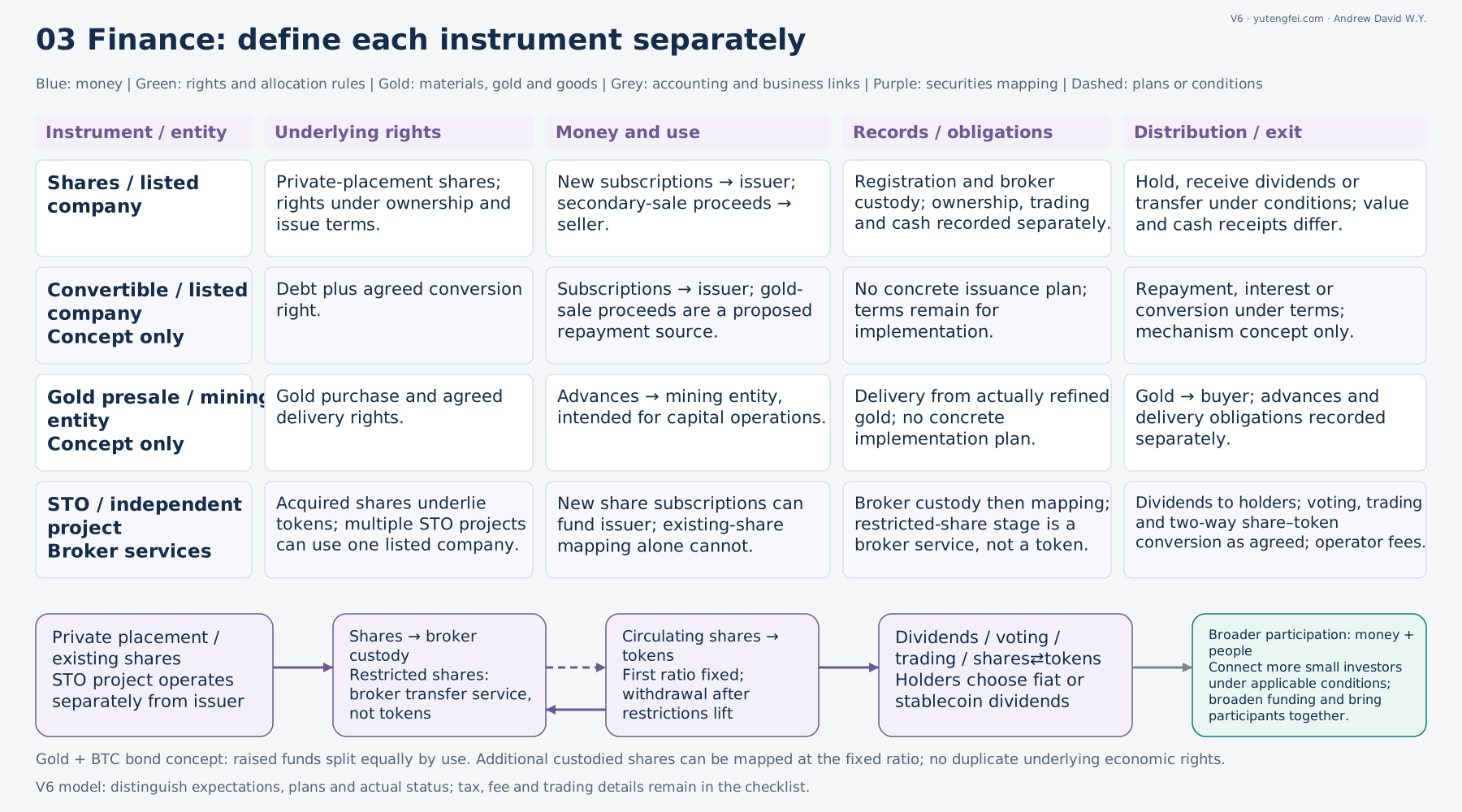
Shares, convertibles, gold presales and STO involve different rights and obligations. The convertible concept uses the listed company as proposed issuer and proceeds from gold sales as a repayment source. In the presale concept, the mining entity receives advances for capital operations and delivers actually refined gold. Both remain mechanism concepts without concrete implementation plans. “Half gold, half BTC” refers to the use of raised funds.
An STO project operates separately from the listed company. It acquires listed shares as underlying assets, places them in broker custody, then maps tokens. One listed company can underlie several independent STO projects. The ratio is fixed after the first mapping; additional shares can be mapped after custody. Detailed issuance quantities and procedures stay outside this diagram.
One point needed correcting: the restricted-share stage is not a token. It is a broker-provided service for transfers and trading of restricted shares. After restrictions lift, circulating tokens can be withdrawn. Underlying dividends pass to holders, who choose fiat or stablecoin payment and participate in voting, trading and share–token conversion as agreed. The operator charges fees; the fee schedule stays in the checklist. Shares and tokens convert in both directions as agreed.
The aim to bring in people as well as money remains. STO is intended to broaden small-investor participation and connect participants with funding. Mapping existing shares alone does not create new listed-company financing or a second economic entitlement.
Business growth: return to the original business
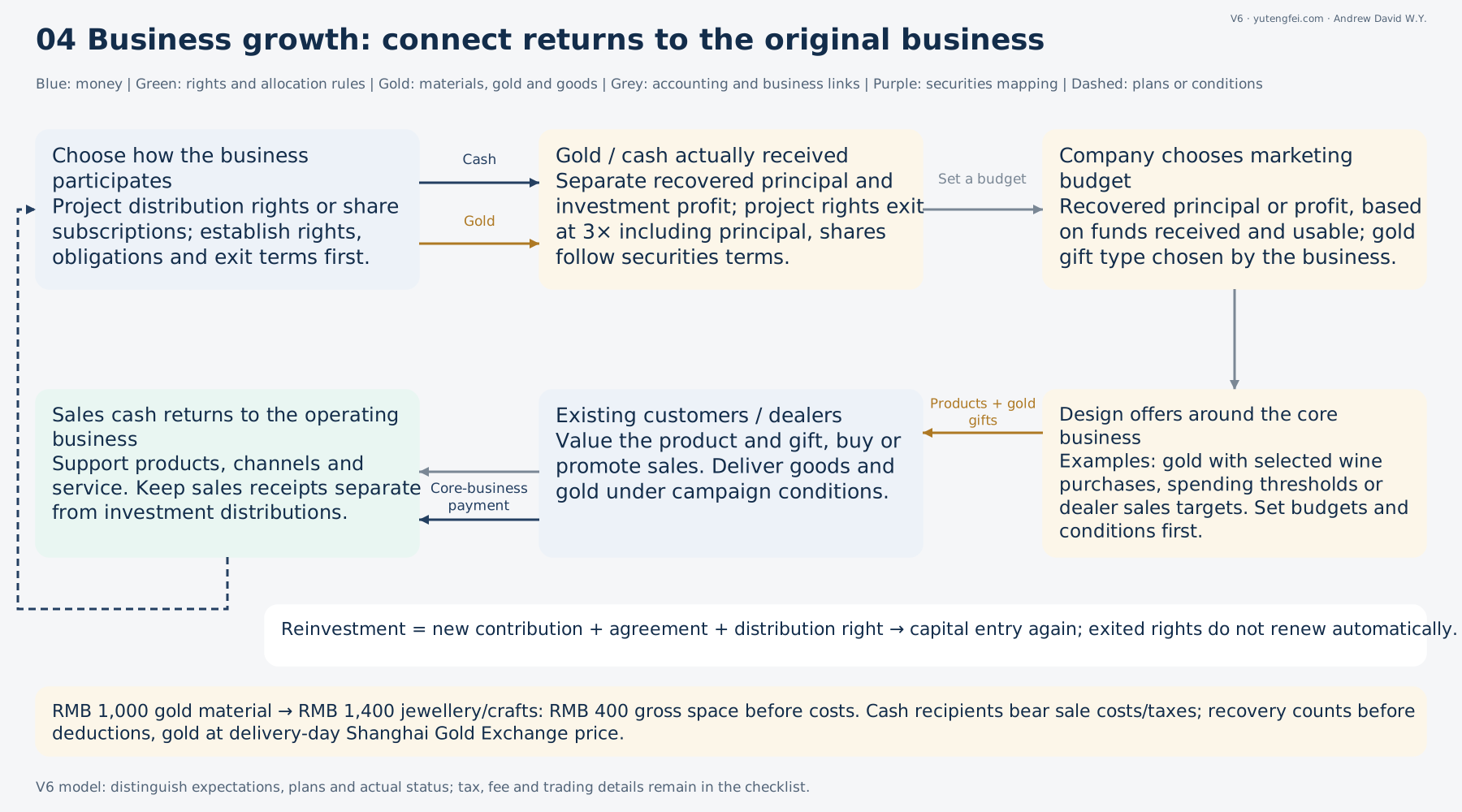
The connection back to other industries needs to support their existing business. A company can decide whether to use recovered principal or investment profit for marketing, based on funds it has actually received and can control. Each industry chooses its campaigns and whether to offer gold material, jewellery or crafts. High gold-project returns remain an expectation; budgets need actual funds.
For example, RMB 1,000 of gold material becoming RMB 1,400 of jewellery or crafts leaves RMB 400 of gross profit space before processing, taxes, channel and other costs. Investors choosing cash bear gold-sale costs and taxes. Their recovery threshold is counted before those deductions; gold distributions are valued at the Shanghai Gold Exchange price on delivery day.
Products and gold gifts go to customers. Core-business payments return directly to the original operating company for products, channels and services. Reinvestment means a new contribution, agreement and distribution right; an exited investment does not renew automatically.
Reconnect the four layers
Connected again, industry explains how gold and profit arise; capital explains contributions, rights and exits; finance explains instruments and their entitlements; business growth explains how the funds and resources support the original business.
This is V6. Confirmed points are now in the diagrams. Taxes, fee rates, specific trading conditions and additional-profit rules stay in the checklist. The diagram explains the relationships first; contracts, accounts, production data, deliveries and receipts will need to match in execution.
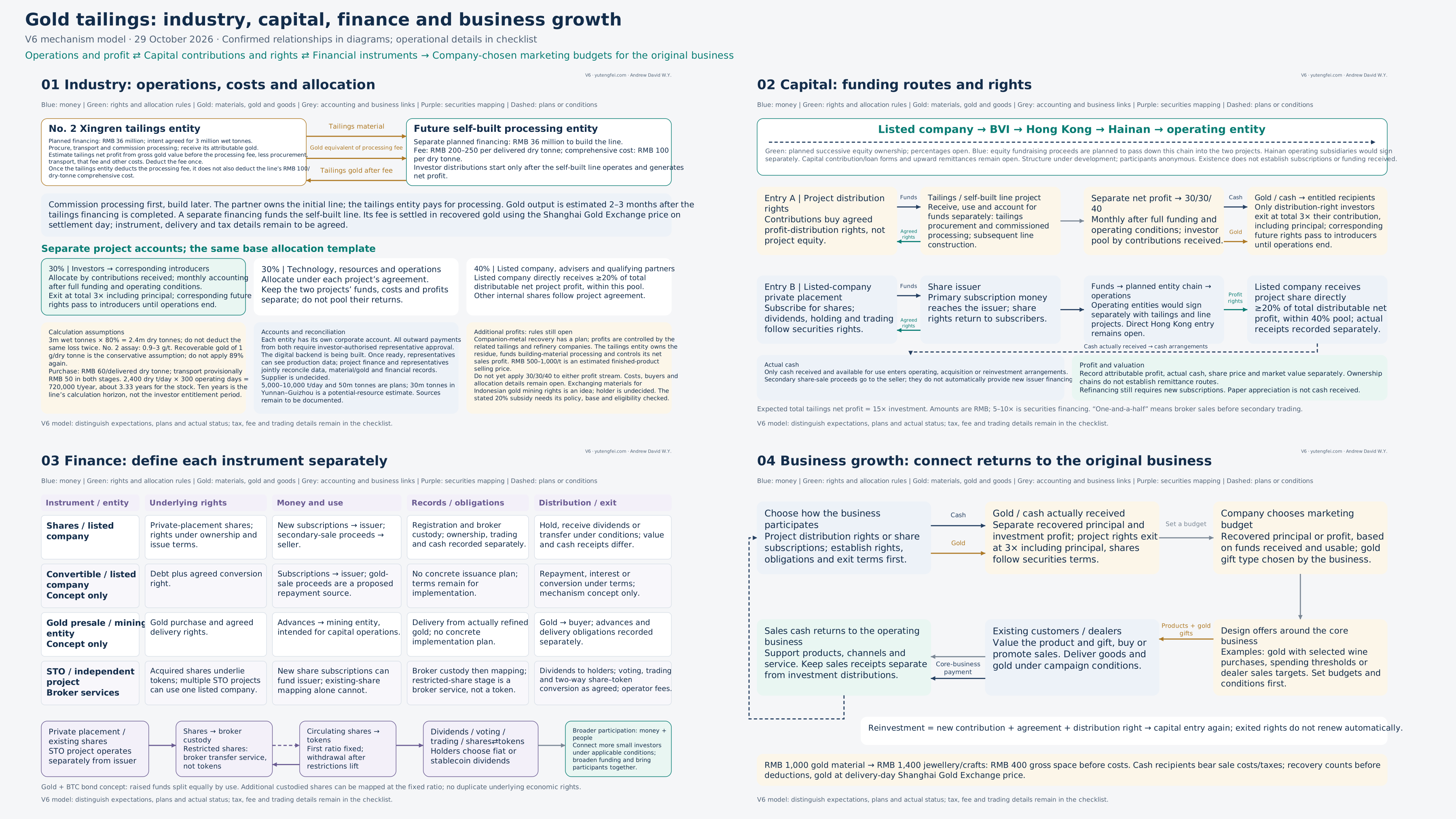
I am pausing the operational questions here. Update what is clear, retain what is undecided, and first make the whole model understandable.
Several rounds of transcript correction, drawing, questions and revisions have turned a spoken explanation into a model people can discuss and check. As work proceeds, contracts, accounts, production data, deliveries and receipts will also need to match.
This records the process and current proposal. It does not establish completed financing, realised calculated returns, verified subsidy eligibility or operational financial channels. Make the logic clear first, then keep testing it through actual work.