Gold Capital’s mine-to-store model: from operations back to capital
I have redrawn Gold Capital’s mine-to-store model, starting with how mines, plants, the supply chain, stores and customers work together, then connecting receipts, entitlement to returns, DFSL’s capital role and reinvestment.
Reading & sharing

This time, I took another look at Gold Capital’s mine-to-store model. What I wanted to do was straightforward: put mines, plants, the supply chain, stores and customers on one diagram, then make clear how money comes back, who is entitled to the returns, what DFSL takes on, and how funds go back into the business.
I divided the main relationships into operations, returns and reinvestment. First follow the gold, then work back through the money and the rights. That makes the model a little easier to understand.
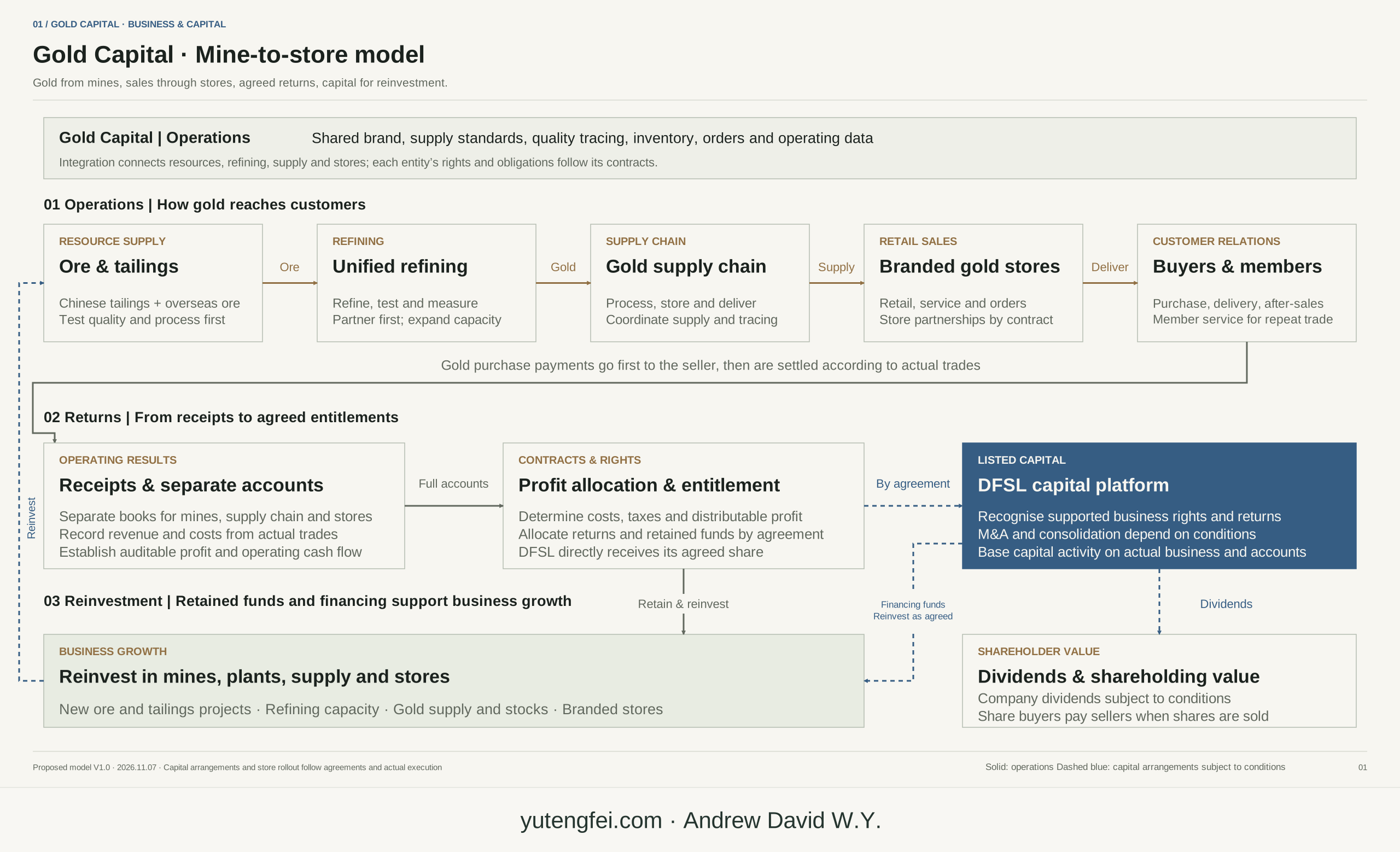
Connect the operations, from mine to store
My understanding of mine-to-store integration is to connect resources, refining, gold supply and stores within the same operating relationships. Ore resources and tailings first go through testing and process validation, then into refining to produce gold that can be processed and delivered. The supply chain connects that output to gold stores and, ultimately, customers.
The things that need connecting are quite specific. Where does the gold come from? How is quality verified? Who manages inventory? How do stores take orders, and who handles delivery and after-sales service? Common supply standards, branding and traceability help these parts keep working together. Stores can participate according to their circumstances; each store does not have to be tied to a particular mine.
Once payment arrives, who is entitled to the returns?
A customer’s gold purchase payment first goes to the entity making the sale. That entity then settles with suppliers, processors and others according to actual transactions. Mines, the supply chain and stores each account for their own revenue and costs. Taxes and the parties’ agreements also need to be clear before we can see the profit and usable cash each has generated.
That is why I gave profit allocation and entitlement their own place in the diagram. Who contributed what and took which responsibilities? Which contract establishes their right to returns? What stays with the operating entity, and what is DFSL entitled to receive under the agreement? Those relationships need to match. They provide the basis for connecting the business to capital.
What does DFSL take on, and where do funds go next?
For DFSL’s role as a listed capital platform, I am more interested in which business rights and returns it takes on, and how those are reflected in actual operations and financial records. Equity, acquisitions, settlement of returns and consolidation of earnings each have their own conditions. A line on the diagram needs to lead to work that can be carried out.
Retained funds from operations, together with funds actually available from lawful financing, can then go into new resources, refining capacity, gold supply and inventory, and branded stores. Seen this way, capital and operations form a cycle we can keep testing. Shareholder returns also have their place: the company distributes dividends subject to the relevant conditions, while the buyer pays the proceeds when shares are sold.
Keep the three kinds of money clear
There is another point I think matters in this review: customers’ gold purchase payments, investors’ contributions to projects, and subscriptions for listed shares need to be shown separately. A purchase corresponds to products and services; a project contribution corresponds to the project rights agreed in the contract; a share subscription corresponds to the shares and shareholder rights set out in the offering documents.
All three forms of participation can exist in the same ecosystem. But each time someone participates, they need to know who receives the money, what it is used for, what they obtain, and who must fulfil the obligation. Membership services, project distributions and listed-company equity then each have a clear place.
This version sets out the main relationships and records my current understanding of the model. Specific projects, store partnerships and capital arrangements will still need to be checked against contracts, operating data and actual execution, so that every line in the diagram corresponds to something that can be put into practice.