- Author: Andrew David W.Y.
- Version: V1.6 · Final version of the research outline
- Revision ID: V1.6-F20261126-Finalized research outline
- Version date: November 26, 2026
- Final draft: V1.6 Strategic Management Research Revised Edition · November 26, 2026
- Purpose: General outline of personal research, taking into account team review and use
- Main academic positioning: A cross-disciplinary research program with AOM Strategic Management (STR) as its main academic base
- Practice objectives: Company Zero; external case for comparison and boundary identification
- Promotion principle: Advance according to conditions, evidence and phased results, with no fixed deadline
reading path
Read first Research overview and research positioning, look again Shared explanatory model with Five directions and fifteen main lines. If you need to go deeper, continue reading original contribution、Comparison and Research Methods, three flagship topics and the practical connection of company zero; when studying the long-term capital relationship path, enter conceptual boundaries。
- Three flagship topics: Evidence collection order · Technology, organization and capabilities · Capital and Capacity Investment · Contribution, equity and follow-up investment
- Team Study Card: Flagship 1·First round projects and procurement destinations · C2 · Receipts, payments and net profits
- Practice entrance:Current starting point confirmed by the author · Reinvestment of operating assets and returns · Practical advancement conditions
- Positioning and Appendix:academic positioning · AOM/SMS support · Existing model · Products · service · supplier · solution · Research records and examples
- Pictures and sources:Picture catalog · Equivalent text with pictures · Sources of author research and methods · business source · academic sources · Contributing to the comparative literature
To find business and platform information, you can go directly to the appendix. If you want to see which type of job Company Zero starts collecting evidence from, you can read first The order of evidence collection for the three flagship topics。
Research overview
Public expression:Technology drives business. Science and technology guide change. Upper level proposition:Firm adaptation and differentiation in technological change.
How do firms adapt their business models, organizational arrangements, and capital structures in response to technological change to build and renew capabilities and create and capture value? Why do firms adopting similar technologies end up with different long-term operating outcomes and development paths?
The question that best represents the general outline
After peers can all obtain similar technologies, how can companies develop their own capabilities, retain profits in the competition, and create conditions for the next round of investment? Let’s first look at how companies facing similar technology supplies choose, including adopting, postponing or continuing their original practices. Then compare businesses with similar actual usage conditions to see how organizational methods and capital arrangements affect subsequent operating results.
Taking customer delivery as an example, what was saved the first time? Next time a similar task comes, can you still do it well? Who did the customer choose when purchasing again? By connecting these things, we can see clearly who gets the benefits and what the company will use to support the next round of investment.
The research path I have accumulated the most
How do stakeholders voluntarily acquire and continue to hold interests related to the long-term value of the enterprise? Under what conditions will such an arrangement change knowledge sharing, dedicated investment and continued cooperation? For example, if a partner ends the service, the rights and interests obtained in the past will continue to be honored as agreed. When the next cooperation opportunity arises, will he be more willing to invest, or will he retain his rights and invest his energy elsewhere? Both options deserve explanation.The formation and persistence mechanism of long-term capital relationships
Five research directions answer the overall question from different perspectives. A looks at smart technology adoption and organizational restructuring, B looks at capability accumulation and renewal, C looks at customer value, competition and revenue acquisition, D looks at investment, financing and capital allocation, and E looks at rights, incentives and cooperative governance. AI is a cognitive and work technology, and blockchain is an institutional technology. Their respective roles must be compared in specific tasks and rules. The theories, methods and proposed institutional arrangements each have applicable conditions.Five directions and fifteen main lines · Shared explanatory model
Company Zero is the target of practice. I prioritize recurring customer deliveries, and knowledge content construction can also provide handover and reuse materials. Document alternatives as budget decisions arise. During the preparation of the co-construction system, first study the judgment and willingness, wait for the rules to take effect, and then look at the actual implementation and subsequent investment. External corporate and peer data are used to compare differences. Long-term capital relations and long-term capital accounts are my two proposed main contributions, and the other four candidate contributions are tested separately. In the long term, I am concerned about how the organizational form of enterprises and stakeholders may evolve under changes in smart technology and institutional arrangements.
Who you know is the starting point of connection; what you can do together depends on how the collaboration is organized.
Research positioning and core issues
public expression
Technology drives business. Science and technology guide change.
“Technology” here focuses on the specific applications entering the enterprise, while “technology” focuses on the broader impact of scientific knowledge and technological development. Technology brings possibilities, and business needs, competition, organization, and capital arrangements affect technology adoption and its results; research allows for no change, failure, and different development paths, and does not predict that technology will inevitably improve operations.
upper level proposition
Firm adaptation and differentiation in technological change.
General topic
Firm Capabilities and Capital Governance in an Era of Intelligent Technology
Core research question
How do firms adapt their business models, organizational arrangements, and capital structures in response to technological change to build and renew capabilities and create and capture value? Why do firms adopting similar technologies end up with different long-term operating outcomes and development paths?
This study takes enterprises as the core analysis object, compares how enterprises adjust their business models, organizational methods, and capital arrangements in the face of technological changes, and explains why capability formation and renewal, value creation and acquisition, and long-term operating results and development paths are different. Five directions and fifteen main threads work together to organize the question, and specific research can support, qualify, or deny candidate explanations.
| Expansion of core issues | research tasks |
|---|---|
| How do companies adjust their business models, organizational methods and capital arrangements? | Compare requirements, competition, tasks, technology and resource constraints, and observe options such as adoption, combination, traditional substitution, and no adjustment. |
| How are capabilities formed and updated, and how are values created and obtained? | Track work and organizational changes, learning and capability retention, customer usage and actual payments, and value capture under competition, rights, and capital allocation respectively. |
| Why do similar technologies correspond to different long-term results and paths? | Compare organizational and capital conditions, processes and inter-temporal results, include situations such as loss of capabilities, interruption of cooperation, business failure and no significant changes, and identify the applicable scope of the explanation. |
Specific development of core issues: similar technologies and different results
Why do companies using similar smart technologies produce different long-term operating results? How do organizational and capital arrangements affect capacity accumulation, who ultimately captures the new value, and how does this distribution affect the next round of investment and cooperation?
This existing question further expands the questioning of "similar technologies and different results" in the general question, connecting organizational adjustment, capability accumulation, value acquisition and the next round of investment. "Added value" continues to be used as an analytical and measurement concept, and it cannot be used to narrow the income covered by specific systems to only new income.
Important supporting issues: organizational capabilities and operating asset formation
Under what organizational and governance conditions can dispersed knowledge, professional capabilities, social relationships and funds be transformed into capabilities and operating assets that enterprises can sustainably use? How can the corresponding returns support participants' continued investment?
This question studies how dispersed elements enter real operations and are continuously used in tasks, roles, division of labor, usage relationships, and organizational arrangements. Capability performance, operating asset boundaries, input costs and participant returns are checked separately to provide support for explaining corporate adaptation and differentiation.
Important research path: the relationship between stakeholders and long-term capital
How can stakeholders acquire and continue to hold interests related to the long-term value of the enterprise based on voluntary choices and institutional rules, forming long-term capital relationships? How does this relationship affect organizational form, capacity accumulation, income distribution and continuous cooperation, and how is it inherited, realized and continued through capital operations?
This accumulation continues to be placed in the relationship path between stakeholders and long-term capital, mainly connecting E's rights, incentives and cooperative governance and D's capital operation, while comparing its consequences for B's ability accumulation, C's value creation and acquisition, and A's work and organizational methods. Stakeholder capital theory, long-term capital relations, long-term capital accounts, NST, ecological governance and the four capitals, etc., are studied as theoretical explanations, methods, governance arrangements and practical paths according to their actual nature; the five directions also accommodate other well-founded explanations and arrangements.
Long-term capital relationships are still limited to participants independently accepting and continuing to hold equity related to the company's long-term value and capital strategy in accordance with effective arrangements. Acquisition of equity, continued holding, business collaboration, actual performance, transfer and repurchase are observed separately; regular wages, supplies, paid memberships and continuing services themselves do not become capital relationships accordingly, nor are they regarded as one-time transactions. For specific definitions and boundaries, see Conceptual Boundaries of Long-term Capital Relationships and Operating Assets。
Interpretative framework, technical conditions and research levels
AI as a cognitive and work technology, and blockchain as an institutional technology. Comparative adoption, non-adoption, combined adoption or traditional substitution in specific topics, as well as the differences in conditions for these choices. Technology use by itself does not prove capability formation, value realization, or the establishment of long-term capital relationships.
Shared explanatory model It is used to explain the mechanism in the general research problem, connect technology, organization, capabilities and capital, and continue to use the existing mechanism content. For an overview of the research, see Research overview。
Upper-level proposition → general title → core issue → five first-level directions → fifteen continuous main lines → specific research topics → theories, plans, methods and evidence.
The existing research accumulation is organized according to the general problem, and the original names and hierarchies of the general topic, five directions and fifteen main lines are maintained. Theories, models, programs, methods and tools propose candidate explanations or practical arrangements based on actual properties, continue to absorb the results of other researchers, and accumulate through comparison, demonstration, testing and revision. The two proposed main contributions and the four supporting candidates are my proposed contribution combinations. The priority, argumentation and evidence status are retained and do not represent all the research on the general outline.
The five directions answer what is researched, and the five dimensions of academia, community, resources, business, and capital answer how actual operations are organized. The two do not correspond one to one. The four ecologies continue to organize participants and relationships, and the four assets are used to explain the principle logic of long-term asset management and operation strategies. The long-term concern is: how the organizational form of enterprises and stakeholders may evolve under changes in smart technology and institutional arrangements. This questioning does not presuppose that a certain form will inevitably emerge, nor can it generalize corporate-level explanations to have explained the whole society.
Research scope and practice goals
Company Zero is the overall practical carrier of scientific research results and a real organization that continues to operate, generate external income and carry out capital operations. Scientific research results run through its operation, organization, execution, capacity building, capital allocation and cooperative governance; the use, results, deviations and new problems in practice feed back scientific research. Academic, community, resources, business, and capital form an interconnected five-dimensional operating structure: organizational direction and theory, basic participation identity, social and organizational resources, profit-making business, capital operation, and four capital cycles. Five-dimensional operations are undertaken by five established research directions and fifteen main lines, both of which are at different levels.
Other enterprises, customers and cooperation projects are used for practical collaboration, cases, comparisons and boundary identification, and the input, rights and results of each subject are recorded separately.
How to advance the research depends on the research conditions, evidence accumulation and stage results. There is no fixed time limit. Model proposal, plan formation, actual implementation, use of results and evidence of effects are registered separately.
Academic positioning and classification basis
Main academic base
This study is based on Strategic Management (STR) As the main academic base, it intersects digital technology and organization, technological innovation, organizational theory, organizational change, cognition and learning, stakeholder governance, organizational behavior and operational collaboration. The fields of corporate finance, capital market and financial law are necessary adjacent disciplines to the study of capital operations.
This positioning is mainly based on the AOM's field statement: STR focuses on why companies develop different inter-temporal performance under different conditions, and covers issues such as resources and capabilities, organizational boundaries, strategy implementation, governance, alliances, and mergers and acquisitions. See AOM STR official domain description。
The role and scope of application of classification
AOM and SMS are important academic communities for management and strategy research. Their grouping helps to find literature, peers, and conferences, and also provides references for research conversations. The definition of the field adopts the public statement of the society; the correspondence between this outline and each field is a positioning judgment based on core issues and levels of analysis, and does not constitute certification by the society.
This research focuses on its own general topic and uses "five directions and fifteen main lines" to organize the issues. It interfaces with multiple international research fields and does not serve as a unified classification that all scholars must adopt.
| level | Tasks undertaken | Update method |
|---|---|---|
| General title and core issues | Determine the boundaries of common inquiry and research | Maintain continuity and review major issues as they change |
| Five directions and fifteen main lines | Organizational literature, topics, practices and results | As a stable index, continue to deepen |
| Theory and Model | Provide mechanistic explanations and testable propositions | Compare with other explanations and revise based on evidence |
| Solutions, methods and tools | Translate issues into arrangements for implementation, documentation and analysis | Test, compare, improve and explain applicable conditions |
| Practice and Evidence | Verify inputs, actions and results that actually occurred | support, limit or deny an existing judgment |
overall research statement
The upper-level proposition of this study is:Firm adaptation and differentiation in technological change.
The core question is: In the face of technological changes, how do companies adjust their business models, organizational methods and capital arrangements to form and update capabilities, create and obtain value? Why do companies using similar technologies have different long-term operating results and development paths?
This question aims to explain why the inter-temporal operating results and development paths of enterprises are different. To this end, it links technology adoption, business models, organizational restructuring, capability accumulation, value acquisition and capital arrangements. The main academic base is still STR, and specific papers are divided into areas such as technology and organization, learning, stakeholder governance and necessary finance according to central issues and levels of analysis. What is adjusted here is the connection of questions in this outline, and the existing society field descriptions, classification sources and scope of application are maintained.
How dispersed elements can become sustainably deployed capabilities and operating assets remains a supporting question. Stakeholder capital, long-term capital relations, long-term capital accounts, NST, ecological governance and the four capitals, etc., are used for specific theoretical explanations, methods, governance arrangements and practical paths according to their actual nature. The long-term capital relationship problem mainly connects E and D, while comparing its consequences for B, C, and A. The original conceptual boundaries and research accumulation are retained, and other directions can also have their own theoretical issues, explanations and results.
The specific topic compares the cognitive and work role of AI, the institutional and technical role of blockchain, and also compares adoption, combination, traditional substitution and condition differences. The two proposed main contributions and the four supporting candidates are my proposed contribution combinations, and the arguments, priorities and evidence status are retained; these accumulations do not represent all the research on the general outline, nor can the originality be determined based on this.
The existing ecological governance, four-way SOP, AI operating capabilities, capital mechanism and blockchain system technology are the model, method and practical starting point of this research. The task and cognitive role of AI, the institutional and collaborative role of blockchain, connecting CTO, OMT, STR, SIM and adjacent fields according to specific issues, technical names cannot replace academic contributions. Specific contributions are established through propositions, comparative designs, mechanism evidence, methods or institutional designs; the proposed increment and current status are shown in Positioning and Inspection of Original Contributions。
Academic classification and specific papers
Each topic should clearly record a main research question, clarify the main academic attribution, and a few well-founded cross-fields. Specific papers select dialogue areas based on theoretical contribution and level of analysis. Technical names, industry names, or tool names cannot be used to directly replace academic issues.
Long-term focus: How organizational forms evolve
The long-term concern of this study is an open inquiry: how the organizational forms of enterprises and stakeholders may evolve under changes in smart technology and institutional arrangements. The research starts from the business model, organizational style and capital arrangement of enterprises when facing technological changes, and compares the formation and renewal of capabilities, value creation and acquisition, as well as long-term operating results and development paths, to see under what conditions the organizational form continues, adjusts or changes.
Within specific organizations and their partnerships, examine how technology enters tasks, processes, cognition and collaboration, which changes are retained and transferred, and which ones remain dependent on specific people, technologies or relationships. Technology brings possibilities, and demand, competition, organizational and capital conditions also influence choices and outcomes. Adoption, combination, traditional substitution, no obvious change or failure must all be observed. It cannot be assumed that more advanced technologies will inevitably bring better results or new organizational forms.
Dispersed factors are transformed into capabilities and operating assets to provide support. The relationship between stakeholders and long-term capital is a comparable and specific path: how participants voluntarily accept and continue to hold interests related to the company's long-term value and capital strategy, how organization, capabilities, returns, and cooperation change, and how capital operations undertake, honor, and continue these relationships. Holdings, collaborations, interests and performance continue to be reconciled separately, and this path does not replace comparisons with other organizational and capital arrangements.
The cognition and work role of AI and the institutional technology role of blockchain are compared based on specific topics, such as adoption, combination, traditional substitution and condition differences; the use of technology itself does not prove the formation of capital relationships, nor does it prove that a certain organizational form is superior.
At this stage, enterprises, real tasks and verifiable cooperative relationships are still the main objects of analysis, and the five directions and fifteen main lines are followed. Whether specific findings can explain broader changes in organizational forms requires demonstration of the scope of application; it cannot be inferred that human organizational forms will inevitably change based on the practice of one organization, nor can it be claimed that this research has explained the entire society.
Shared explanatory model
How do these choices change the way companies accumulate capabilities as they adopt technologies, adjust the way they work, and allocate capital and control? What do customers recognize, what returns do companies and other participants achieve, what risks do they take, and how do they decide on the next round of investment, cooperation, or exit?
On the research path of long-term capital relations among stakeholders, I further examine how long-term capital accounts support the confirmation, performance and review of rights and interests. When multi-party verification is required, compare blockchain with other recording methods to see which arrangement works under specific conditions.
Figure R01 · Common explanation model

How do technology and organizational arrangements change corporate capabilities, how do all parties obtain benefits, bear risks, and how do they decide on the next round of investment, cooperation, or exit? The figure uses long-term capital accounts to illustrate an arrangement of rights and responsibilities on the stakeholder path.
Editable Draw.io · SVG Preview · PNG preview
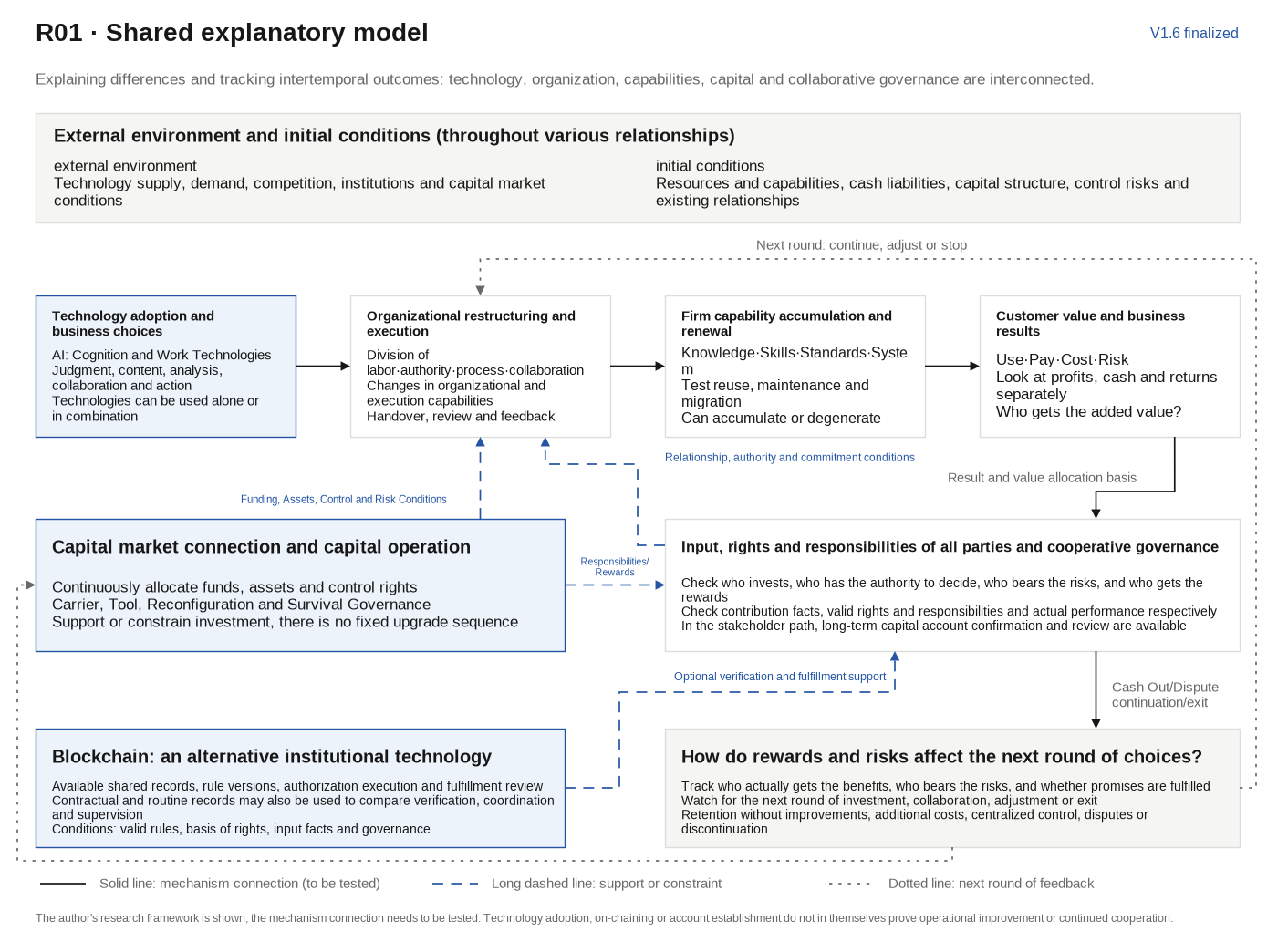
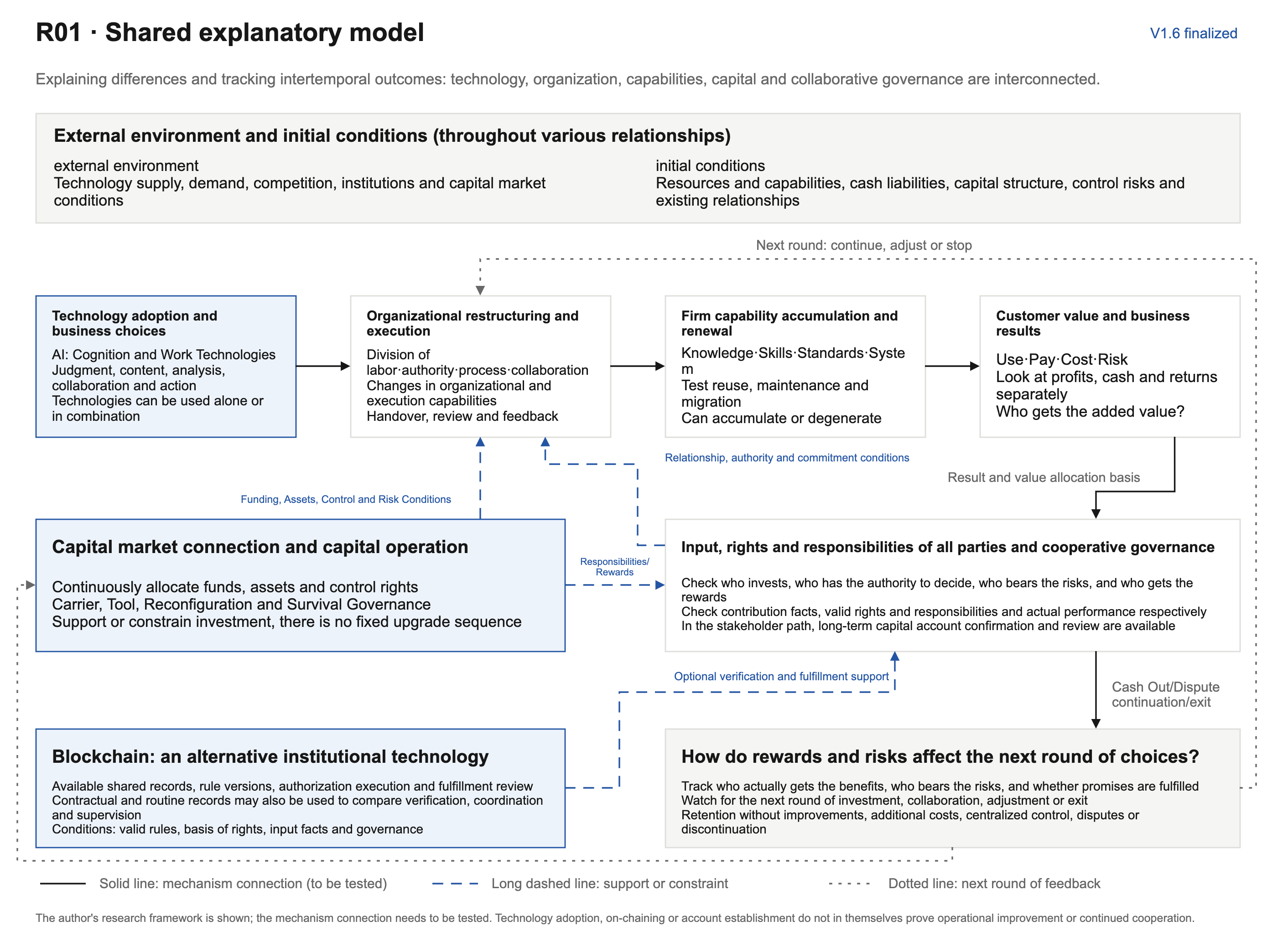
Equivalent text: The external environment and initial conditions run through each relationship. It must be examined how technology adoption and operating choices affect the accumulation or degradation of capabilities through division of labor, authority, handover, and feedback, and then affect customer usage, payment, and operating results. AI can engage in judgment, content, analysis, collaboration and action. Capital market connections and capital operations support or constrain investment through the allocation of funds, assets and control rights. Observe what each party has invested, who has the right to make decisions, who bears the risks, and who actually gets the rewards, and check the contribution facts, effective rights and responsibilities, and actual performance respectively. On the path of long-term capital relations among stakeholders, long-term capital accounts can be used to confirm and review relevant rights and performance. Comparisons of institutional technologies include blockchain shared records, rule versions, authorization enforcement and performance review, and contract and routine records. Validation, coordination, supervision and enforcement all check valid rules, basis of rights, input facts and governance conditions. AI and blockchain can be used independently, alone, or in combination. Operating results, returns and risks are fed back to the next round of capital and organizational arrangements, tracking the parties’ investment, cooperation, adjustment or exit decisions, and retaining results such as no improvement, additional costs, centralized control, disputes or suspensions.
External environment and initial conditions
External environment: Technology supply, customer demand, product and factor market competition, institutional environment, as well as financing availability, capital prices, capital market pricing and liquidity, investor requirements and exit conditions.
Initial conditions: Existing resources, organizational capabilities and asset base, cash flow and liabilities, capital structure and financing capabilities, ownership, control, risk-taking and existing stakeholder relationships.
Research Positioning of AI and Blockchain
This study focuses on both work technology and institutional technology.AI is mainly used as cognitive and work technology research; blockchain is clearly used as institutional technology research. This division refers to the research focus. The actual uses of the two types of technologies can overlap, and they can be used independently or in combination.
| Technical positioning | Tasks in this study | Key mechanisms and conditions |
|---|---|---|
| AI: Cognition and Work Technologies | Support analysis, judgment, content generation, task execution, collaboration and learning, and study how it fits with processes, roles and reviews | Judgment and learning, division of tasks, organization and coordination, mistakes and takeover; observation based on data, tasks, permissions and people's abilities |
| Blockchain: Institutional Technology | Participate in organizational contribution confirmation, rights and responsibilities, collaboration and fulfillment by sharing records, rule versions, authorized execution and traceability status across entities | Verification, coordination, supervision, commitment and performance; combined with off-chain facts, effective rules, rights basis, resources and governance observation |
| A combination of two types of technologies | Study how AI participates in decision-making or actions, institutional technical support authorization and responsibility records, how they jointly affect operations and cooperation | Make it clear who decides, who implements, who reviews, and who is responsible, and examine the role of technical, organizational, and institutional arrangements respectively. |
“Institutional technology” studies how technology participates in economic coordination and the organization and operation of governance rules. In this study, blockchain not only links long-term capital accounts, but also involves task handover, knowledge and data rights, supplier collaboration, contribution review and capital rights connection. Whether and which implementation method is adopted depends on the specific relationship and comparison results.
The positioning of blockchain as an institutional technology has an academic foundation, see Davidson, De Filippi and Potts (2018). For the substitution or complementarity of its governance role with contract and relationship governance and its applicable boundaries, see Lumineau, Wang, & Schilke (2021). This study raises specific mechanism and design issues on this basis. [63, 66]
Mechanism 1: Technology promotes changes in management, organization and execution methods
| ability level | Research caliber | Main observations |
|---|---|---|
| Operating power | Determine what value is created for whom, select business and investment level | Opportunity judgment, business trade-offs, customer value, resource and investment decisions |
| Organizational power | Implement outcome requirements into processes, responsibilities, authorizations, and resource allocations to coordinate interdependencies | Human-machine division of labor, decision-making rights, organizational boundaries, resource availability and cross-role collaboration |
| Execution ability | Translate decisions into reliable delivery, handle deviations and complete feedback | Action delays, handovers, quality, rework, acceptance, exception and problem closure |
The research chain is:Technology selection and adoption → Changes in division of labor, authority, process, review and collaboration → Changes in organizational and execution capabilities → Accumulation of corporate capabilities → Customer value and operating results.
AI mainly enters this chain from tasks, judgments and actions; blockchain, as an institutional technology, enters from sharing facts, confirming authority, rule execution and performance review. It is necessary to distinguish the respective roles of technology and organizational system selection, and then study how the two complement each other.
When studying enterprise capabilities, we also need to see whether these improvements can be repeated, maintained, migrated, and updated across people, tasks, tools, and time periods. Technology may improve execution, or it may increase coordination burden or dependency, and outcomes will need to be judged based on specific conditions and comparative evidence.
Mechanism 2: Capital market connection and capital operation
Capital operation refers to an enterprise connecting to the capital market through appropriate entities, financial rights, tools and transaction structures based on its operating foundation and development needs, organizing funds and resources, adjusting assets and control rights, and continuously handling returns, risks, governance and exit.
| abstract function | specific path or means | Jointly explain problems in the model |
|---|---|---|
| Capital carriers and market entry | IPO, listing route, acquisition of listing entity, etc. | What subjects and institutional conditions do enterprises use to connect to the capital market? |
| Financial Instruments and Transaction Structure Organization | Applicable equity, debt, convertible rights and STO related arrangements | How to configure duration, returns, controls, responsibilities and risks |
| Capital acquisition and resource reallocation | Issuance financing, mergers and acquisitions, asset transactions, etc. | What funds, assets or control rights the enterprise actually obtains and how it is put into operation |
| continuing capital operations | Disclosure, Investor Relations, Liquidity Conditions, Reimbursement, Distribution and Exit Management | How to maintain capital relationships, fulfill obligations and support subsequent investment |
IPO, post-listing securities instruments and STO are paths, structures and implementation arrangements that can be combined and do not constitute a fixed upgrade sequence. Whether it is applicable should be studied based on the subject, market, underlying rights and corresponding institutional conditions; listing, issuance, transaction access and actual financing should be observed separately.
For continuing post-listing obligations and securities issuance requirements, see SEC Public Company Description. Securities tokenization involves two levels: underlying security rights and technical implementation, see Hong Kong Securities and Futures Commission Circular on Securities Tokenization Related Activities. These materials are used to clarify concepts and classifications and do not promote a certain market rule as a uniform arrangement for all regions.
The logic of four capitals in long-term operation strategy
Company Zero follows the logic of mutual transformation and circulation of resources, assets, capital, and funds to organize asset management and long-term development. Support the continuous entry of high-quality resources through capital operations and financial instruments, create value and return capital through asset management, and then support the next round of resource acquisition, cultivation and operation.
This logic is used to explain long-term operating strategies, looking at how resource base, asset management, capital organization and capital circulation are connected. see A common analytical language for capital and finance and Figure R24。[67]
Mechanism 3: Blockchain as an institutional technology supports long-term capital relationships
The task of "Stakeholder Capital" in this model is to study how the continuous investment of different participants can form a sustainable long-term capital relationship through contribution confirmation, rights arrangement and actual performance.
Long-term capital accounts It is the system and technology carrier to be studied and piloted, and is used to continuously connect the following contents:
| Account level | Related content | Basis for verification |
|---|---|---|
| identity and relationships | Participating subjects, belonging ecology, multiple roles and collaborative relationships | Identity, actual tasks or transaction relationships, scope of application |
| Investment and Contribution | Labor, knowledge, technology, customer feedback, channels, resources and capital investment and results | Source, evidence, confirmation authority, review and objection |
| Rights and Responsibilities | Established or conditional remuneration, income, use rights, participation qualifications, responsibilities and risks | Valid Agreements, Applicable Rules, Types of Rights and Subjects of Performance |
| Fulfillment and Governance | Fulfillment, Oversight, Disputes, Revisions, Continuations and Withdrawals | Actual performance status, authorization, decision and change records |
The research objectives cover various stakeholders in resources, customers, operations management and capital ecology. The same entity can have multiple roles, and remuneration, contracts, services, incentives, investments and governance arrangements are recognized separately according to their respective relationships.
As an institutional technology, blockchain is used to support the traceability and authorized execution of necessary records, rule versions and performance status, and study how it changes the verification, coordination, supervision and performance methods across entities. The account runs through investment, collaboration, contribution, distribution, governance and exit; the contribution facts, effective rights, actual performance and cooperation results are verified separately. Account records do not automatically equate to securities accounts, payable funds or equity.
This research is related to WISERUNION long-term capital account design Connect with each other. Public design and actual establishment, activation, execution and effects are registered separately.
The interface between long-term capital account and capital operation
Long-term capital accounts record participation relationships, contribution basis, rights, responsibilities, and performance status; capital operations study which arrangements can be connected to financial instruments or transaction structures under appropriate entities, effective rights, and market conditions.
After an issuance, reorganization or change of control, return to the corresponding accounts and rules to check the applicable benefits, responsibilities and governance relationships. Account records, securities arrangements, and fund receipts and payments are confirmed separately and connected through specific rights and actual events, and all participating relationships are not uniformly securitized.
Illustrated textual expression
- Technological and environmental changes affect business choices, human-machine division of labor, organizational boundaries, authorization and execution methods.
- Organizational and execution changes affect the accumulation or degradation of knowledge, skills, standards, systems, and collaborative capabilities.
- Ability to accept the test of customer needs, competition, all costs and risks, resulting in different operating results.
- Capital market connections and capital operations continue to support or constrain resource allocation, control and risk taking before investment, during implementation and after results.
- Combining market competition with effective agreements, check the inputs, decision-making rights, risks and actual returns of all parties, and track how commitments are fulfilled and disputes are reviewed. On the long-term capital relationship path of stakeholders, long-term capital accounts can be used to record contributions, rights, responsibilities, and performance.
- Fulfillment, trust, cooperation and exit are fed back to the next round of investment, organizational adjustment, capability update and capital operation.
Observe and test boundaries together
- The enterprise side tracks capabilities, assets, operating cash, capital structure and control changes; the contributor side tracks investments, applicable equity, responsibilities, risks and actual returns.
- Capacity accumulation, asset formation, capital relationship establishment, financing arrival and profit realization are recognized separately; accounting profit, operating cash, market valuation and investment return are reported separately.
- Enterprise financing income, investor transfer income, repurchase and other expenditures are recorded respectively as the payment entity and destination.
- Compare different tools, technologies, and institutional arrangements; while retaining results of no improvements, additional costs, centralized control, disputes, and discontinuations.
The connections in the figure are all relationships to be tested. On-chain, system launch, completion of issuance, account establishment or document acceptance do not alone constitute proof of organizational capabilities, operating results or continued cooperation.
Five directions and fifteen main lines
| First level direction | Continuous Research Main Line | Division of labor for the overall research problem |
|---|---|---|
| A. Intelligent technology adoption and organizational restructuring | A1 task and technology adaptation; A2 process and human-machine collaboration; A3 technology dependence and organizational boundaries | Compare the conditions and results of technology adoption, traditional substitution and organizational restructuring, and study business choices, organizational capabilities, execution capabilities and collaboration boundaries |
| B. Accumulation and updating of corporate capabilities | B1 knowledge precipitation and feedback transformation; B2 human-machine learning and skill changes; B3 ability retention and transferability | The conditions for the formation, maintenance, renewal or loss of research capabilities, as well as inter-temporal use and migration |
| C. Customer value, market competition and revenue acquisition | C1 demand satisfaction and business realization; C2 competition and value acquisition; C3 measurement of business value | Examine the conditions for value acquisition in customer recognition, business realization and competition, and distinguish between creating value and obtaining benefits |
| D. Investment, Financing and Capital Allocation | D1 dynamic investment and project selection; D2 financing matching and capital constraints; D3 capital control, risk and exit | Explain how capital market connections, instrumental organization and active capital operations influence development |
| E. Rights allocation, incentives and cooperative governance | E1 knowledge, data and decision-making rights; E2 contribution recognition and benefit arrangement; E3 cross-organizational commitment and system adjustment | Study the general allocation of rights, incentives and cooperative governance, and compare their impact on behavior, performance and the continuation or discontinuation of cooperation |
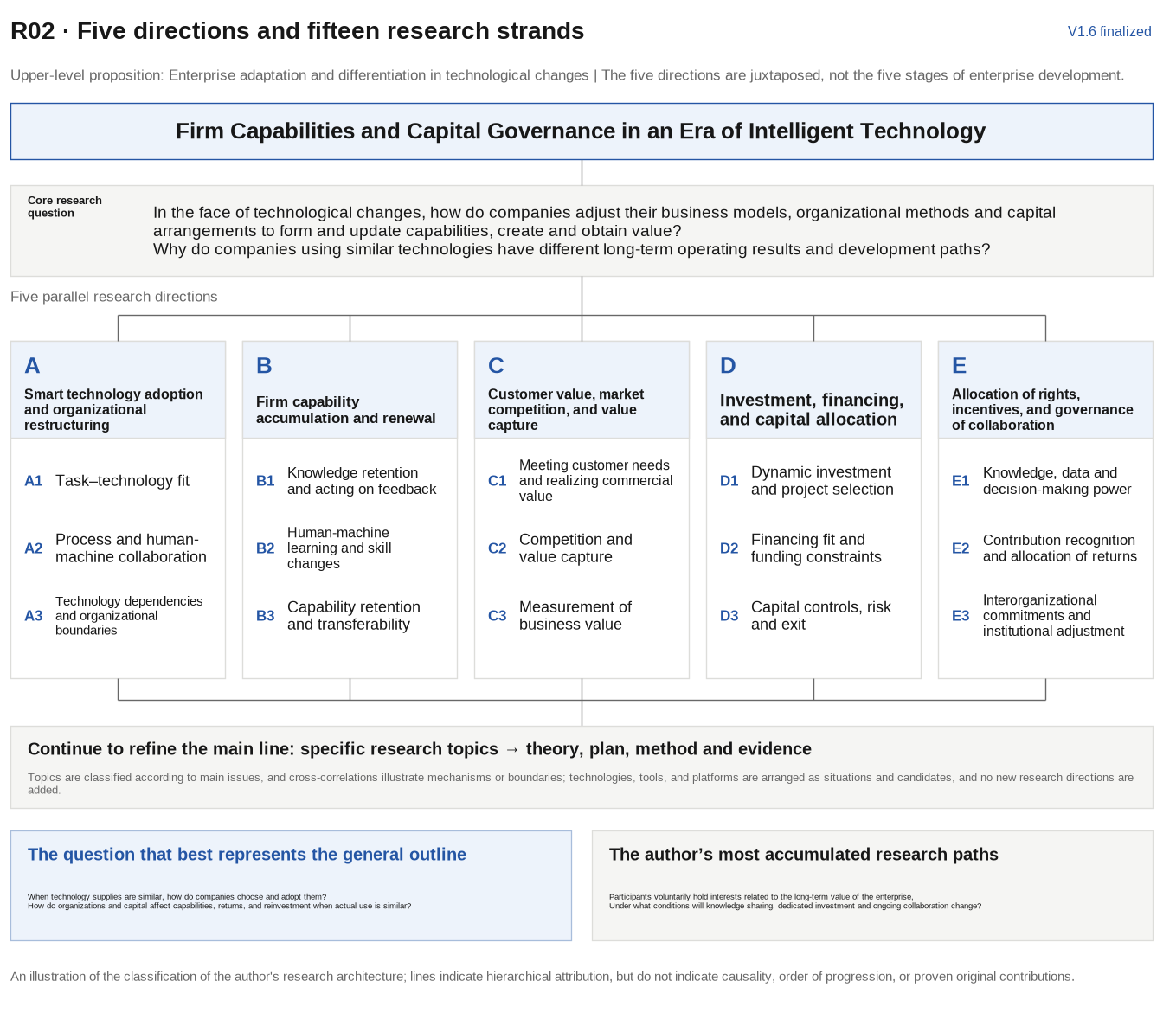
Figure R02 · Five directions and fifteen main lines architecture

There are three main lines in each of the five directions. The left column below the figure reduces the overall problem to two levels of comparison, and the right column gives the personal research path of long-term capital relations.
Editable Draw.io · SVG Preview · PNG preview · full equivalent text
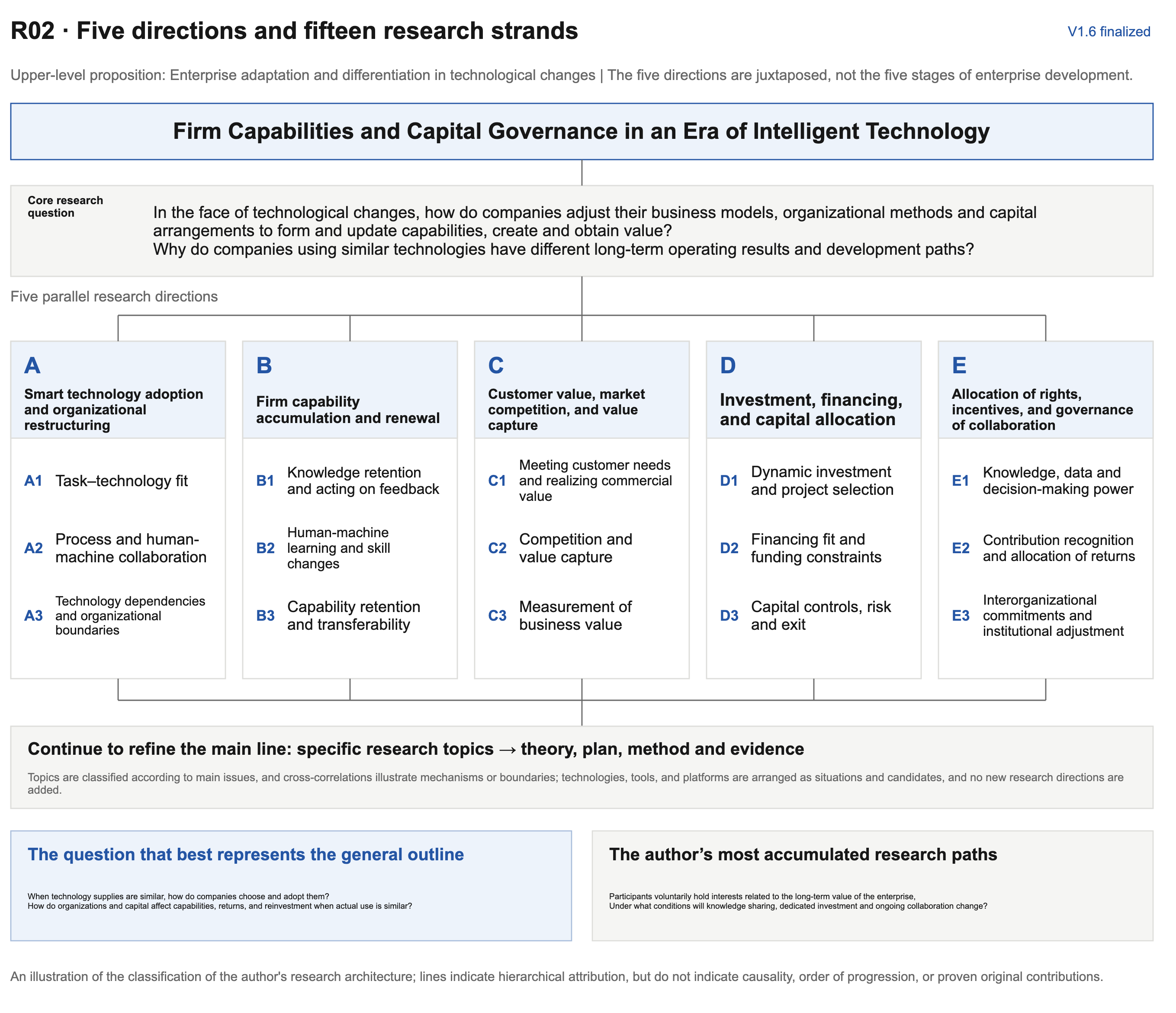
organizational relationships between directions
A studies work and organizational changes, B studies intertemporal capability accumulation, C studies market testing and value acquisition, D studies investment and capital operation, E studies rights, incentives and cooperation. The five directions are interconnected and do not require enterprises to develop in a fixed order.
The reconstruction of operating capabilities, organizational capabilities and execution capabilities mainly connects A and B, and examines the operating results through C. Capital market operations mainly enter D and connect E's rights and responsibilities. The stakeholder and long-term capital relationship path mainly connects E and D, while comparing its consequences on B capability accumulation, C value creation and acquisition, and A work and organizational methods; the long-term capital account is the arrangement in this path, studied according to its actual nature. Each direction also accommodates other theoretical explanations, methods and practical paths.
research attribution rules
Each topic should clarify the main issues and main directions, and secondary associations should be used to explain the mechanism or boundaries. C mainly studies the realization and acquisition of value by enterprises facing customers and product markets, E mainly studies the rights and responsibilities, incentives and cooperation among participants; the liquidity of the securities market mainly serves as the capital condition of D.
The cognitive and work role of AI and the institutional technology role of blockchain can be connected in five directions according to specific issues: A studies its adaptation to tasks, authorities and organizational boundaries; B studies the retention of knowledge, rules and abilities; C examines customer and operating value; D studies capital connection and allocation; E studies contributions, rights, fulfillment and cooperation. The subject compares adoption, combination, traditional substitution and condition differences, and does not assume that each entity uses the same technology or accepts the same capital arrangement as a common premise.
The names of technologies, industries, products and services are used to describe situations and carriers. Theories and methods are used to explain and test, and the five directions and fifteen main lines are used to organize problems and accumulate.
A. Intelligent technology adoption and organizational restructuring
This direction studies the cognitive and work role of AI and the institutional technology role of blockchain to see how they change operational, organizational, and execution capabilities through task selection, human-machine division of labor, shared verification, processes, positions, permissions, and collaboration boundaries. At the same time, compare the mechanism and operating consequences of organizational change.
Figure R03 · A. Intelligent technology adoption and organizational restructuring

Based on three interrelated issues: task and technology adaptation, process and human-machine collaboration, technology dependence and organizational boundaries, we compare technology and organizational arrangements, and observe the organizational strength, execution power and the connection leading to B capabilities, C value and E governance; it is not a fixed three stages.
Editable Draw.io · SVG Preview · PNG preview
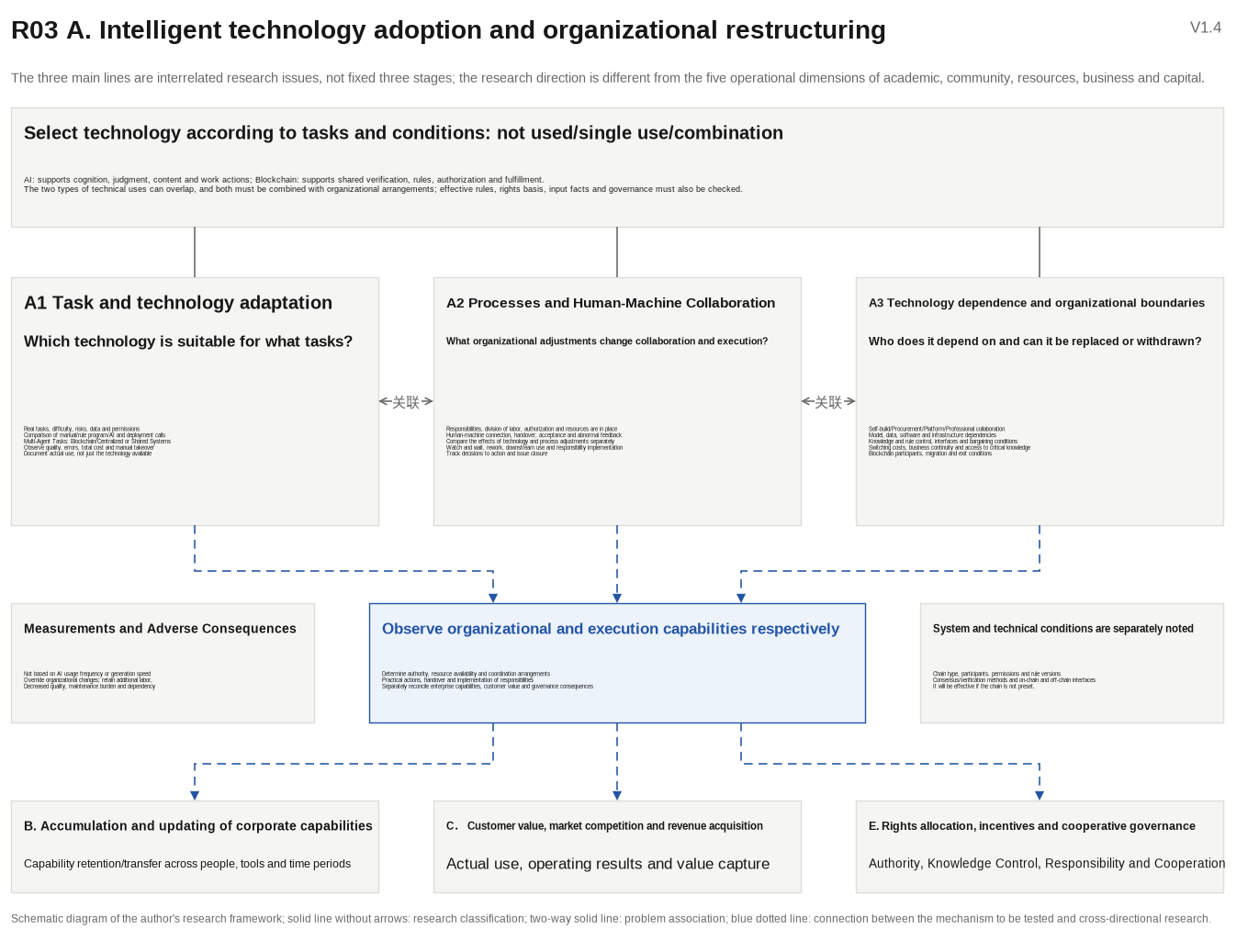
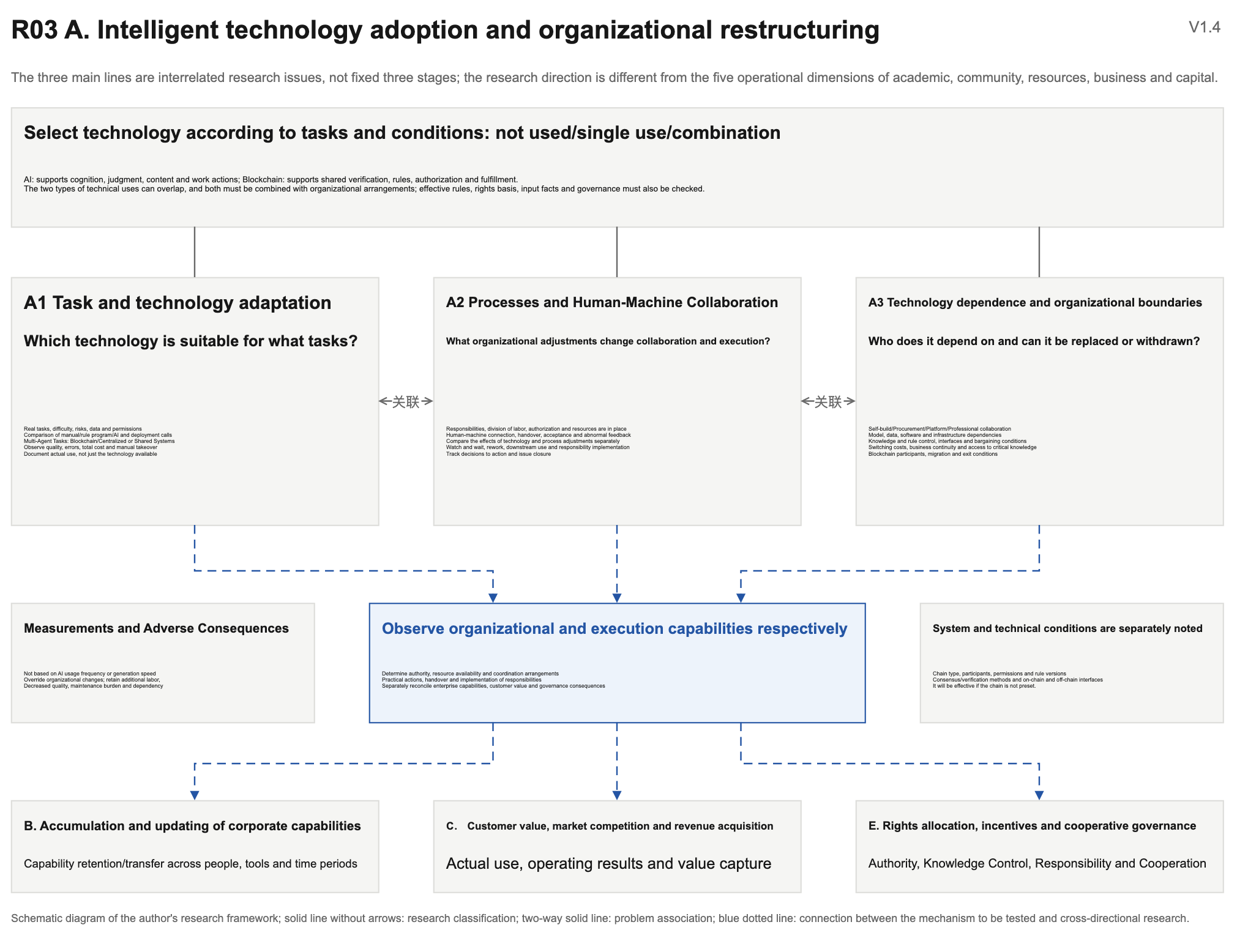
Equivalent text: Direction A studies the cognition and work role of AI and the institutional technology role of blockchain. It can be used independently, alone or in combination according to tasks and conditions. The two uses can overlap, and both must be combined with organizational arrangements and effective rules, rights basis, input facts and governance. A1 task and technology adaptation studies real tasks, difficulty, risks, and data permissions, and compares manual, rule-based procedures, AI, and deployment call methods; multi-agent tasks compare blockchain and centralized or other shared systems, and observe quality, errors, total costs, manual takeover, and actual use. A2 process and human-machine collaboration research on division of responsibilities, authorization, resource availability, human-machine connection, handover acceptance and abnormal feedback, respectively compare the role of technology and process adjustment, observation and waiting, rework, downstream use, responsibility implementation and decision-making to action and problem closure. A3 Compare technology dependencies and organizational boundaries to self-build, purchase, platform access and professional collaboration, track model, data, software and infrastructure dependencies, observe knowledge and rule control, interfaces, bargaining, switching costs, continuity, key knowledge access, as well as blockchain participants, migration and exit conditions. The three main lines are interrelated and not in a fixed order. Organizational strength and execution ability are observed separately. Organizational changes cannot be represented solely by AI usage frequency or generation speed; unfavorable results such as additional labor, reduced quality, maintenance burden, and dependence will be retained. Institutional technology also records the chain type, participants, permissions, consensus or verification methods, rule versions, and on-chain and off-chain interfaces. It does not presuppose that the on-chain is necessarily valid. Continue to examine the connections with B enterprise capability accumulation and updating, C customer value market competition and revenue acquisition, and E rights allocation incentives and cooperative governance. Lines without arrows represent research classifications, bidirectional lines represent problem associations, and blue dotted lines represent mechanisms to be tested and cross-direction research connections. The research direction is different from the five operational dimensions.
A1 Task and technology adaptation
Research scope: Starting from the real task, check whether the technical capabilities, data and permission conditions are suitable, and record the model, deployment, calling and usage methods respectively.
Candidate topics: Under different task complexity and risks, what kind of quality and total cost will be generated by AI, rules and procedures, and labor respectively?
Research unfolds: How do open source models, external API services, and hybrid arrangements change reliability, review requirements, and overall costs for similar tasks? For tasks involving multi-agent confirmation, shared rules and performance, what are the applicable conditions and complete costs of blockchain and centralized and other shared systems?
Already undertaken: Enterprise AI business capability reconstruction system, four-way SOP, SOP to Skill; business, operation, management, governance, marketing and service scenarios.
Key observations: Task difficulty, quality, total cost, errors, risk and takeover; task exposure, actual usage intensity and manual review.
AOM positioning: It mainly connects with the CTO; when digital technology enters the organizational work, the CTO mainly connects; innovative adoption connects with TIM, and operation quality and cost connect with OSCM. See Main vesting and conditions table。
A2 Processes and Human-Machine Collaboration
Research scope: Put organizational changes into the specific work of human-machine division of labor, responsibilities, authorization, resource availability, handover, acceptance and feedback.
Candidate topics: What are the respective effects of AI and process adjustment? Is there any additional improvement when combining the two?
Research unfolds: What changes in responsibilities and authorities changed coordination and execution as technology was introduced? How do AI judgments and actions, and blockchain-supported confirmation and authorization, connect with human responsibilities? How do these changes affect next-stage usage and experience retention?
Already undertaken: Job responsibilities, work manuals, skills, and dual judgment handover; technical consultation and customization implementation, platform operation and maintenance, and actual content delivery. Long-term capital account-related authorization and collaboration processes as observable organizational arrangements.
Key observations: Waiting, rework, handover, downstream use and implementation of responsibilities; the time lag from decision-making to action, resource availability, authority changes and problem closure.
AOM positioning: Mainly connects with CTO; digital work and collaboration mainly connects with CTO; organizational change connects with ODC, work design and team connects with OB, and delivery process connects with OSCM. See Main vesting and conditions table。
A3 Technology dependence and organizational boundaries
Research scope: Study how self-build, procurement, platform access and professional collaboration change corporate boundaries, knowledge control and external dependence.
Candidate topics: How does model service substitutability affect knowledge control, switching costs, and business continuity?
Research unfolds: How does reliance on external models, data, software and professional services affect bargaining, continuity and capability retention? How does the choice of blockchain infrastructure, verification, and governance participants change organizational boundaries, rule controls, and migration and exit conditions?
Already undertaken: Resource ecology, external capability collaboration, customized systems and multi-system interfaces.
Key observations: Substitutability, data and knowledge control, switching costs and continuity; interface dependencies, exit constraints, bargaining and accessibility of key knowledge.
AOM positioning: Mainly connect to STR; self-construction, external collaboration and the impact of boundaries on strategy connect to STR; organizational dependence connects to OMT, and digital infrastructure connects to CTO. See Main vesting and conditions table。
research boundaries
The degree of model openness, deployment, invocation, actual use and task conditions must be recorded separately; the institutional technology must also record the chain type, participants, permissions, consensus or verification methods, rule versions, on-chain and off-chain interfaces and actual uses. When looking at organizational change, you need to look at decision-making authority, coordination, and execution at the same time, not just at the frequency of AI use or the speed of its creation.
B. Accumulation and updating of corporate capabilities
In the face of technological changes, this direction studies how enterprises form, maintain and update capabilities during work, learning and organizational adjustments, and explains why capability accumulation and development paths are different under similar technical conditions. How dispersed knowledge, professional capabilities and cooperation resources can be deployed through organizations and become sustainable capabilities remains a supporting issue. Human learning, organizational knowledge and institutional precipitation are observed separately, and continuous operation, maintenance sustainability, cross-person recurrence, technology transfer and relationship dependence are evaluated separately; capabilities may also stably exist in specific human-machine complementarity or cooperative relationships.
Just because it was done this time doesn’t mean it can be done next time.
Figure R04 · B. Accumulation and updating of corporate capabilities

B1 examines the transformation of feedback into rules and actions, B2 distinguishes between human learning and organizational knowledge distribution, and B3 evaluates continuous operation, maintenance, cross-person recurrence, technology migration, and relationship dependence respectively. The three main lines are interrelated rather than fixed stages; stable complementarity and relationship-specific capabilities are evaluated based on conditions.
Editable Draw.io · SVG Preview · PNG preview · full equivalent text
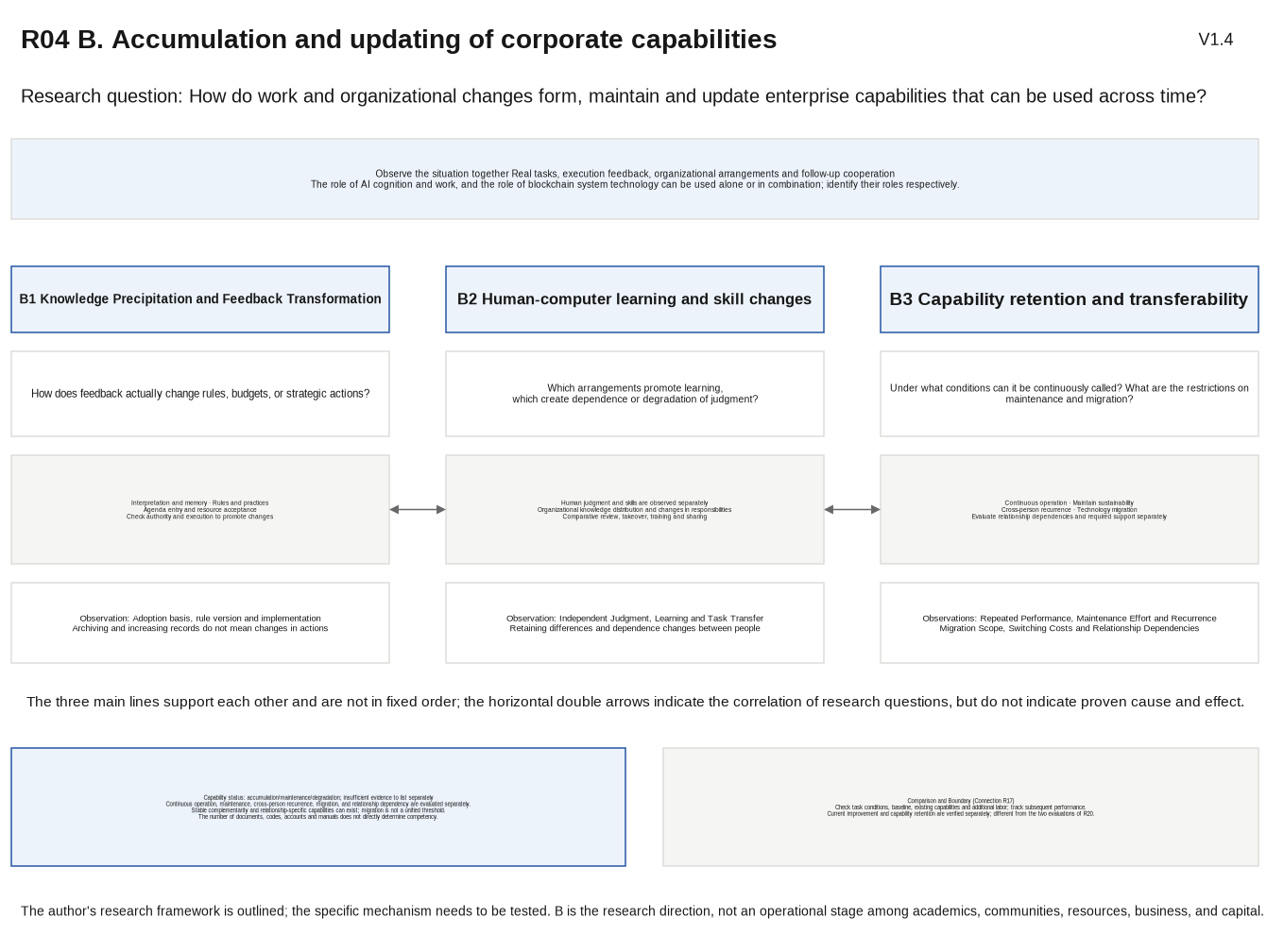
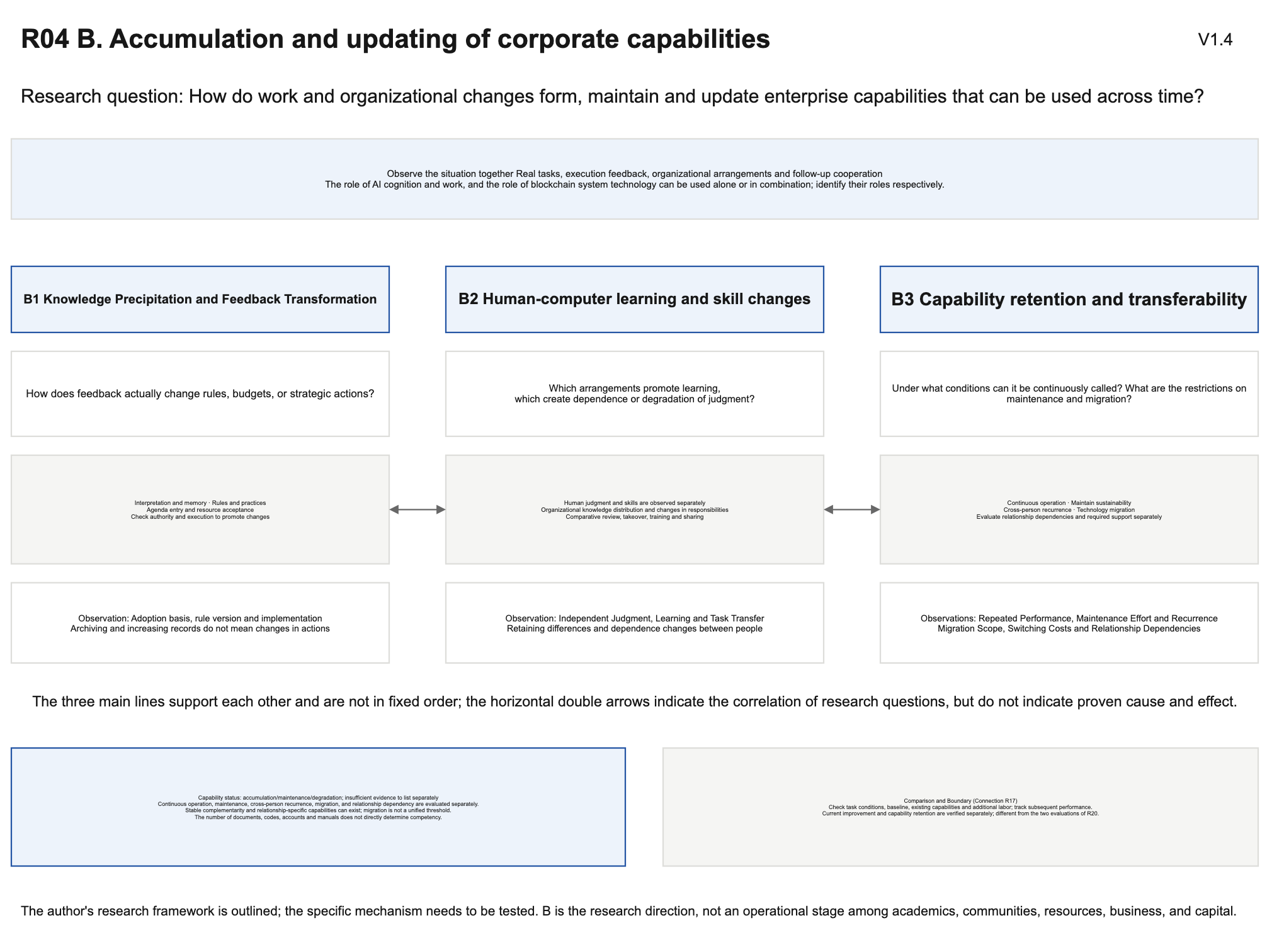
B1 Knowledge Precipitation and Feedback Transformation
Research scope: Three processes need to be distinguished here: interpretation and memory of knowledge, inheritance of rules and routines, and feedback entering strategic agenda and resource allocation.
Candidate topics: What is the process for implementing feedback to actually change SOPs, skills, budgets, or work standards?
Research unfolds: How to proceed with explanation, review, rule revision and actual action in task execution, customer use, acceptance and abnormal feedback? The long-term account can be used as a source of feedback on some topics, and its role should be compared with other records and collaborative arrangements. Does blockchain-enabled provenance and versioning make knowledge easier to review, transfer, and turn into action? Who has the authority and resources to drive change?
Already undertaken: Action-result-precipitation, Paper III, knowledge base, feedback and version update methods. Long-term accounts, contribution review and fulfillment records serve as feedback input and versioning basis.
Key observations: Feedback reception, agenda entry, resource acceptance, change implementation and actual use; feedback conversion rate, adoption basis, decision authority, rule version and implementation results.
AOM positioning: Mainly connect to MOC/STR (by question); learning, attention, interpretation and memory connect to MOC; feedback into strategic agenda, budget and resource allocation connect to STR; institutions and routines connect to OMT. See Main vesting and conditions table。
B2 Human-computer learning and skill changes
Research scope: On the one hand, observe human skills, judgment and learning, on the other hand, observe how the knowledge distribution and responsibilities in the organization change after the participation of AI.
Candidate topics: Which task arrangements promote employee learning, and which arrangements cause degradation or dependence on judgment?
Research unfolds: How do differences in independent judgment and capabilities among personnel change if arrangements for review, takeover, training, and knowledge sharing are different?
Already undertaken: Knowledge base, training, manual review and takeover design for humans and AI to work together.
Key observations: Independent judgment, transfer task performance, learning speed and dependence changes; independent completion performance, judgment accuracy, skill distribution and knowledge sharing.
AOM positioning: It mainly connects to OB; human behavior, team and learning connect to OB; skill development and staffing connect to HR, and cognitive judgment mechanism connects to MOC. See Main vesting and conditions table。
B3 Capability retention and transferability
Research scope: Under clear conditions of personnel, technology, relationships and resources, observe the continuous operation and maintenance of capabilities, and examine cross-person recurrence, technology migration and relationship dependence respectively. Disengagement from tools or relationships is not a uniform necessary condition for the establishment or retention of all abilities.
Candidate topics: What arrangements can enable continuous operation of capabilities and affordable maintenance investment; when it is necessary to change people, models or service providers, which performance can be retained, and which ones rely on original complementarity or cooperation conditions?
Research unfolds: Which of Company Zero's knowledge, processes, capital analysis and collaboration experience can be used repeatedly under the original conditions, and what investment is required for maintenance? Compare repeat performance and switching costs in applicable transition or technology migration scenarios. When partnerships change, look at how dependencies affect the scope and sustainability of capabilities. Whether shared records, rules, and accounts can continue to be interpreted, reviewed, and supported for implementation must also be observed based on actual use and migration conditions.
Already undertaken: Dual acceptance of business improvement and capability accumulation; Zhixing personal knowledge station, manual, skill, maintenance and handover.
Key observations: Form judgments based on the following five dimensions, and do not replace any one item with the others.
| Evaluation dimension | Observation content |
|---|---|
| Continuously running | Able to achieve reliable performance repeatedly across time under specified tasks and support conditions. |
| Maintain sustainability | Whether updates, error correction, personnel support and financial investment can be sustained. |
| Reappearance across people | After the handover, learning and support conditions are clarified, whether other appropriate personnel can be reused; retain the personnel-specific portion. |
| technology migration | When there is a real need for migration or corresponding inspection conditions, the performance and cost after replacing the model, tool, service provider or system. |
| relational dependency | Which capabilities require specific collaboration, authorization, knowledge or complementary resources; what are the consequences of relationship maintenance and change. |
Stable human-machine complementarity and relationship-specific capabilities can be evaluated according to their conditions, and continuous operation but limited migration can be established at the same time. Whether knowledge or processes form enterprise-callable capabilities depends on evidence of actual reuse and maintenance.
AOM positioning: Mainly connected to STR; capability continuity and performance are connected to STR; organizational memory, technology update and personnel flow are intersected according to issues. See Main vesting and conditions table。
research boundaries
Knowledge documents, codes, accounts and manuals are possible carriers, and capabilities cannot be directly determined based on quantity. The applicable conditions and results of different evaluation dimensions are recorded separately; feedback from Paper III and strategic action questions are prioritized in STR.
C. Customer value, market competition and revenue acquisition
This direction studies how companies adjust their business models, customer services and competition methods in the face of technological changes, how their capabilities and related organizational and institutional arrangements are recognized by customers and the market, and how the value created is realized and captured among companies, customers, suppliers, platforms and other participants.
Customers' willingness to pay, companies' profits, and participants' rewards are related but different outcomes.
Figure R05 · C. Customer value, market competition and revenue acquisition

Check customer usage, prices and actual receipts and payments along the same batch of projects, and then determine the net benefit based on comparable transactions, usage effects and costs of all parties.
Editable Draw.io · SVG Preview · PNG preview
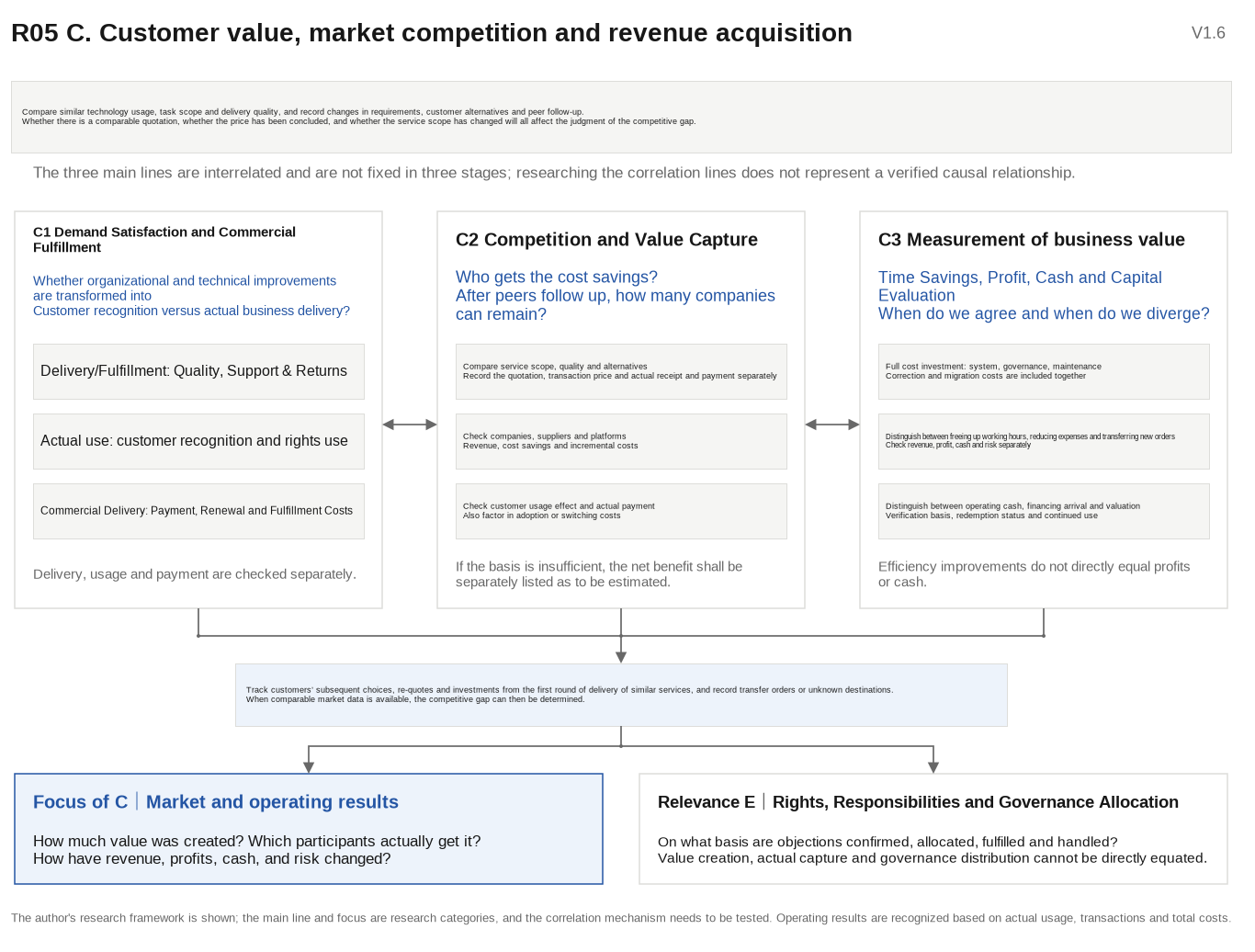
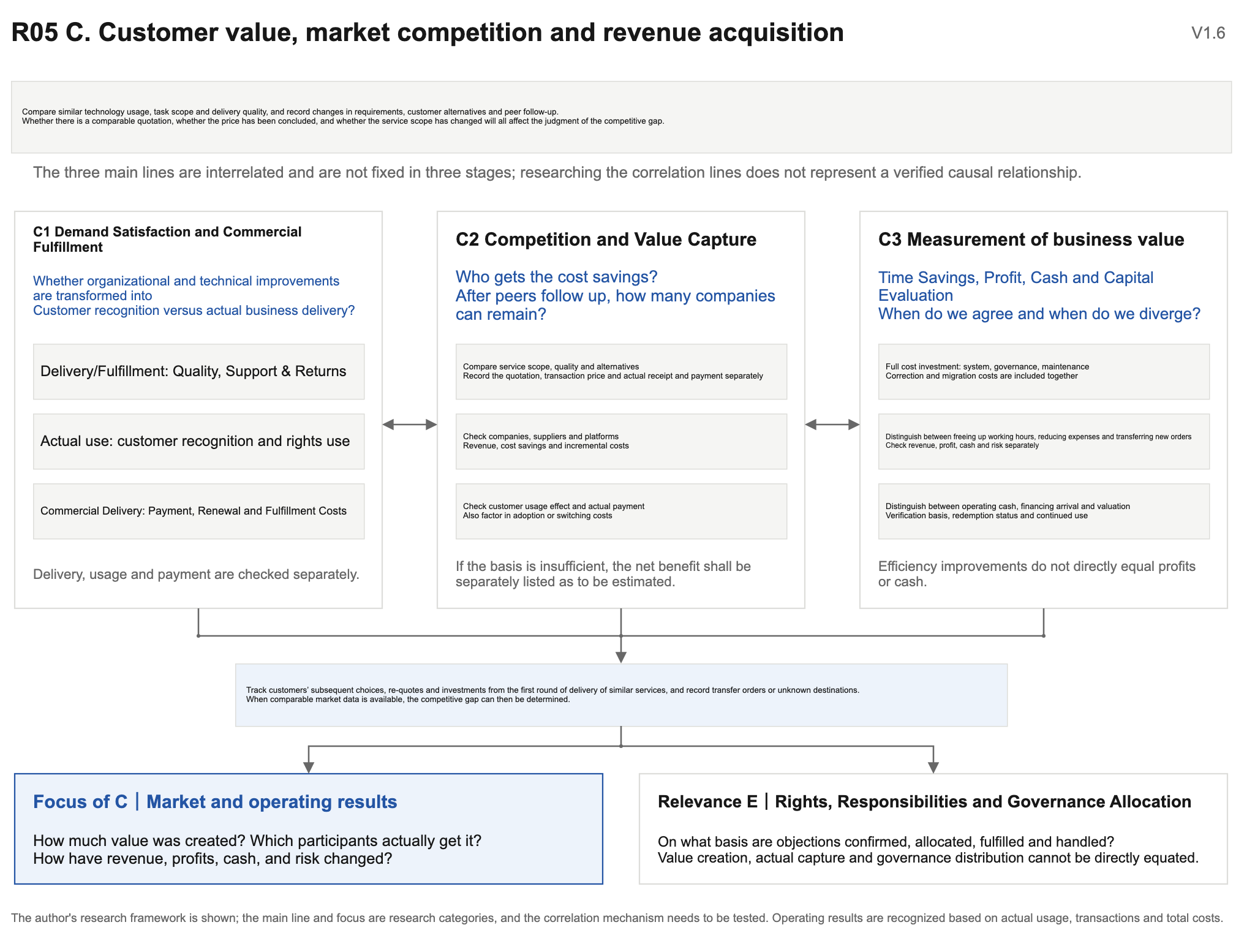
Equivalent text: First compare technology usage, task scope and delivery quality, verify changes in requirements, alternative services available to customers and peer follow-up. C1 tracks delivery, usage, payments and renewals. C2 Compare the service scope, quality and alternatives, and record the quotation, transaction price and actual receipt and payment respectively. For enterprises, suppliers and platforms, check their revenue changes, cost savings and new costs. For customers, check usage results, actual payments, and adoption or switching costs. For entities with insufficient basis, the net benefit will be listed separately to be estimated. C3 distinguishes between freeing up of working hours, reducing expenses and new orders for personnel transfer, including system, governance, maintenance, error correction and migration costs, and checks revenue, profit, cash, risk and valuation respectively. The three main lines are interrelated. Track subsequent purchase selections, re-quotes and investments from the first round of delivery of similar services, and record transfer orders and unknown destinations respectively. Competitive gaps are judged based on comparable market data. C studies the results of operations and competition, and E studies the allocation of rights, responsibilities and governance.
C1 Demand Satisfaction and Commercial Fulfillment
Research scope: Connect organizational and technological changes to customer usage, payments, fulfillment and ongoing relationships, and distinguish corporate strategy from purely consumer issues.
Candidate topics: Do improvements in responsiveness, personalization or quality lead to changes in purchases, renewals and actual payments?
Research unfolds: Select a type of service and connect the dots between delivery method, actual customer usage and payment. Will customers choose this company next time? If the contract is renewed, check any changes in requirements, service scope and closing conditions. Service entitlements and cooperative arrangements in long-term accounts are also comparable.
Already undertaken: Customer ecology, product and brand planning, marketing services, AI native business models, digital commerce and cross-border operations.
Key observations: Use, conversion, payment, renewal, return, customer support and contract performance; customer actual use, value recognition, use of rights and contract performance costs.
AOM positioning: Mainly connected to STR (strategic issues); business model and competitive results connected to STR; delivery quality connected to OSCM, technology commercialization connected to TIM; pure consumer issues connected to marketing. See Main vesting and conditions table。
C2 Competition and Value Capture
Research scope: Study the relationship between value creation, price and bargaining, platform fees and multi-party value capture.
Candidate topics: Why do similar cost reductions sometimes form corporate profits, and sometimes are mainly reflected in customer price reduction benefits or platform charges?
Research unfolds: When peers can adopt similar technologies, can customers switch to another supplier? How much handover, re-validation and running-in is required to switch to the past? Track your next purchase along the same customer relationship. When a re-quote or contract renewal occurs, compare the company's actual receipts, payments and costs for the current round with the available peer quotes, actual transaction conditions and platform charges, and compare how the project income has changed. The actual returns obtained by partners and investors will be separately verified according to their respective agreements and performance.
Already undertaken: Value sales and revenue, platform and industry collaboration, channel and brand relationships; Paper II provides a relevant perspective on distribution issues.
Key observations: Quotations, discounts, transactions and repayments for this and the next round, actual alternatives available to customers, peer follow-up, platform and supplier charges. Document scope of delivery, quality and service terms, indicating which prices are directly comparable and which can only be used as clues.
AOM positioning: Mainly connected to STR; competition, bargaining and value acquisition are mainly connected to STR; market system and power are connected to OMT, and stakeholder responsibility and fairness are connected to SIM. See Main vesting and conditions table。
C2 Study Card · How much each party actually gained
| What to check | How to record and judge |
|---|---|
| baseline | Actual transactions in the two rounds before and after selecting the same service, or the alternatives that the customer actually had available at the time. State the scope, quantity, quality, deadline and switching costs. The substitute quotation is listed, and the actual transaction is recorded separately. |
| Price and payment | Verify discounts, closing prices, platform fees, supplier revenue and actual receipts and payments from quotes, contracts, bills and payment receipts. The payer and payee are listed by transaction, and the same payment is only registered once. |
| net benefit to all parties | Enterprises, suppliers and platforms compare revenue changes, actual cost savings and new delivery, maintenance and other costs respectively. The customer side makes a judgment based on usage effects, actual payment and cost of adoption or switching. When scope, quality and results of use are comparable, the net savings to customers from price reductions can be estimated. |
| When there is insufficient data | State the amount that has been verified and the basis that is still missing. For example, two rounds of billing can verify how much platform charges have increased. In the absence of corresponding cost basis, the platform's net benefit will be recorded as "temporarily unable to estimate"; when there is only one bill, only the amount will be reported. |
C3 Measurement of business value
Research scope: Establish verifiable links between tasks, processes, operations and capital results, observing efficiency, value capture and cash results separately.
Candidate topics: When do time savings, delivery improvements, profit and cash results align or diverge?
Research unfolds: Where did the freed up hours go? The company may pay less outsourcing fees, or it may pay the original salary, or transfer the person to another charging item. Calculate based on actual expenditures and whereabouts of personnel, and record the income and costs of new projects separately. Let’s look at how operating cash changes, and under what conditions it deviates from financing receipts and capital market evaluations.
Already undertaken: Four-way SOP performance connection, AI double acceptance, business cycle and cost recovery analysis.
Key observations: All costs, income, profits, cash, risks and ongoing use; full cost of investment, operating and financing cash classification, valuation basis and cashing out status.
AOM positioning: Mainly connected to STR; operation and competitive performance are mainly connected to STR; operational quality and efficiency are connected to OSCM; when the method itself constitutes a contribution, it will be connected to the method field. See Main vesting and conditions table。
research boundaries
Delivery, usage, payment and operating results should be viewed separately, while observing demand, competition and other changes over the same period. Customer relationship records in an account do not automatically indicate that customer value or revenue has improved.
The connection between institutional technology and business value
As an institutional technology, whether blockchain reduces the verification, coordination, supervision and fulfillment costs of customers or partners, and whether it improves actual use, payment or cooperation value, must be put into corresponding operational comparisons. System, governance, maintenance, error correction and migration costs are all included, and customer value and revenue are obtained based on actual use and transaction confirmation.
D. Investment, Financing and Capital Allocation
Study how companies develop through dynamic investments, capital market connections, financial instruments and transaction structures, capital allocation and survival governance organizations. IPO, post-listing securities issuance, STO, mergers and acquisitions, restructuring and exit are compared as conditional paths.
After raising money, you still need to create a reason worth continuing to invest.
Figure R06·D. Investment, Financing and Capital Allocation

Investment sequencing and continued adjustment and cessation, financing conditions and capital constraints, capital control risks and exit constitute interrelated research issues. Update judgment with actual funds, control and performance evidence; tools are only conditional examples, and the retention of the four capitals is a long-term strategic principle.
Editable Draw.io · SVG Preview · PNG preview
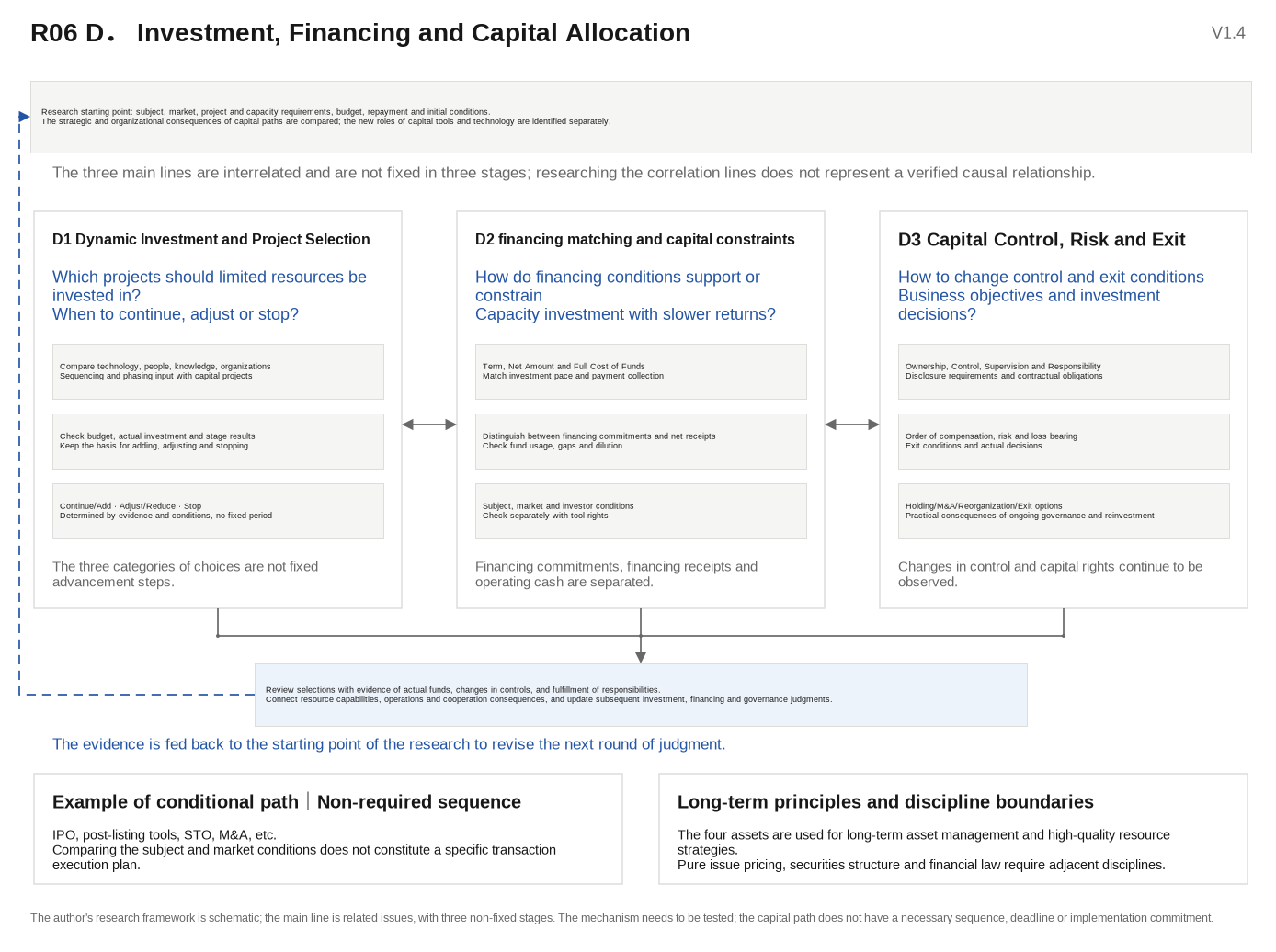
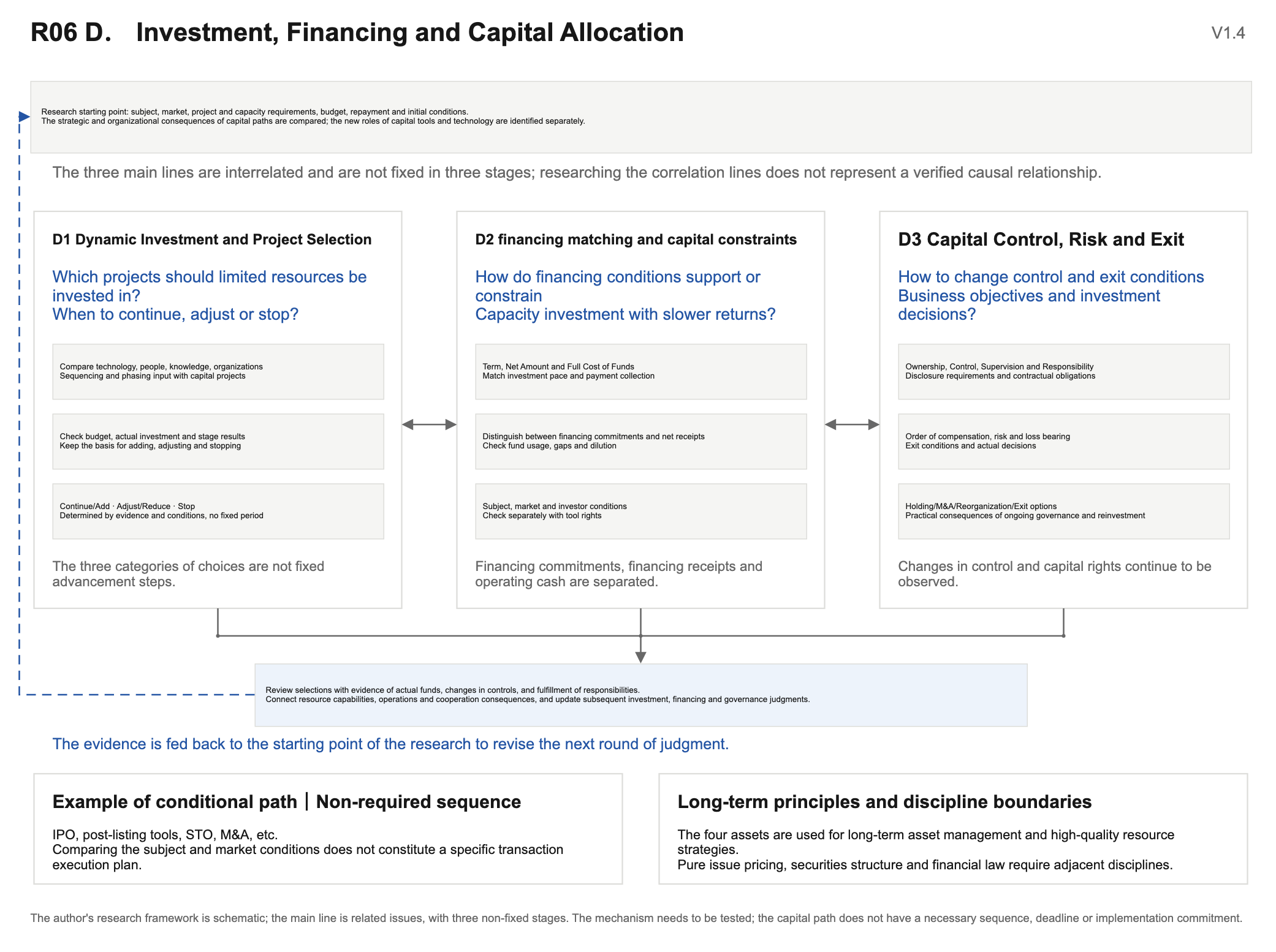
Equivalent text: Start from the subject, market, project and capacity needs, budget, payment collection and initial conditions. D1 Dynamic investment and project selection compare technology, personnel, knowledge, organization and capital project sequencing, stage investment, addition, adjustment and stop, check budget, actual investment and stage results; continuation, adjustment and stop are choices based on conditional judgment and are not fixed steps. D2 Financing matching and capital constraints examine the matching of capital term, net amount, all capital costs with investment pace and repayment, distinguish financing commitments and net receipts, and check usage, gaps, dilution, main market and investor conditions and tool rights. D3 Capital Control, Risk and Exit examines ownership, control, supervision, responsibility, disclosure of contractual obligations, order of payment, loss assumption, exit conditions and actual decision-making, connecting the consequences of holding, mergers and acquisitions, exit and subsequent continuous governance and reinvestment. The three main lines are interconnected rather than fixed three stages. Actual funds, control changes and the performance of rights and responsibilities evidence feedback research starting point, revise the next round of judgments, and connect resource capabilities, operations and cooperation consequences. IPO, post-listing applicable instruments, STO, mergers and acquisitions, etc. are only conditional comparative examples. There is no necessary sequence, deadline or implementation commitment, and they do not constitute a transaction execution plan. The four capitals are strategic principles for long-term asset management and acquisition of high-quality resources. Pure issuance pricing, securities structure and financial law require adjacent disciplines; the capital path and the new role of technology are compared separately, and the effect of the mechanism needs to be tested.
D1 Dynamic Investment and Project Selection
Research scope: Research the sequencing, phase investment, addition, adjustment and discontinuation of technology, personnel, knowledge, organization and capital projects.
Candidate topics: How to sequence investments in training, data, processes, and models? When is phased investment better than one-time investment?
Research unfolds: When adopting different capital operation paths, how can the company's capacity building, industry integration and project portfolio be adjusted based on the evidence?
Already undertaken: Four capitals and dual circulation, industrial operation and capital synergy, business and economic models, capital mechanism analysis, and the long-term strategic logic of continuously obtaining high-quality resources through capital operations to support asset operations; it also includes capital strategy and listing path planning, business portfolio and industry integration plans.
Key observations: Budget, actual investment, stage results, adjustment and stopping nodes; candidate plans, capital allocation basis, investment portfolio and decision-making events.
AOM positioning: Mainly connected to STR; dynamic resource allocation, selection and adjustment are mainly based on STR; technology and innovation investment are connected to TIM. See Main vesting and conditions table。
D2 financing matching and capital constraints
Research scope: Incorporate into the study capital carriers and market entry, financing instrument and structure selection, funding sources and term cost matching.
Candidate topics: Do cash constraints and financing maturities change investment in intangible capabilities with slower returns?
Research unfolds: How do IPO, post-listing applicable securities instruments, STO or other paths change the funding term, net amount, cost, investor conditions and capacity investment?
Already undertaken: Nine-dimensional comparison of capital paths, international financing, capital advisory; Liquidity conditions of Paper IV provide related issues. Comparison of paths and structures connecting IPOs, post-listing financing tools, and STOs to investors.
Key observations: Net arrival, total capital cost, term, repayment and funding gap; entities and market conditions, tool rights, financing commitments and actual arrival, dilution and fund usage.
AOM positioning: Mainly connected to STR (partial correspondence); connected to STR when financing conditions affect strategy and capability investment; pure issuance pricing, securities structure and supervision cannot be completely classified into AOM. See Main vesting and conditions table。
D3 Capital Control, Risk and Exit
Research scope: Study ownership, control, supervision, responsibilities and risks before and after capital operations, as well as mergers and acquisitions, reorganizations, holdings and exit options.
Candidate topics: How do control terms, risk exposure, and exit requirements change project continuation, curtailment, or termination?
Research unfolds: How do listings, securities offerings, STOs or restructuring arrangements change control and ongoing governance requirements and impact operating objectives and investment decisions?
Already undertaken: Listing mergers and acquisitions, entity acquisition, securities and market connection, IR, capitalization and exit plans. Continuous governance of the capital market, investor relations, mergers and acquisitions, and the connection of rights and responsibilities in long-term accounts.
Key observations: Control terms, payment order, losses, exit conditions and actual decisions; control changes, disclosure and contractual obligations, loss assumption, exit and reinvestment.
AOM positioning: Mainly connect to STR; Governance, control and strategic consequences of exit to STR; Institutions and control structures to OMT, Responsibility and normative issues to SIM. See Main vesting and conditions table。
research boundaries
Capital operations include market connections, instruments and transaction structures, resource allocation and ongoing governance. AOM mainly studies the strategic and organizational consequences; pure issue pricing, securities structure and financial law require adjacent disciplines. There is no necessary sequence for capital paths, nor is a certain path listed as a commitment for research advancement.
The connection between institutional technology and capital arrangements
When blockchain supports securities or asset records, rule versions, authorizations and rights fulfillment, it is necessary to observe the underlying rights, technical implementation, actual funds and market conditions respectively. Institutional technology can not only serve capital operations, but also be used in business and cooperative relationships without securities issuance; the capital path itself and the new role of technology are compared separately.
Four Capital Logic and Long-term Operation Strategy
Company Zero uses the logic of four capitals to explain how resource base, asset management, capital organization and capital return support each other. Capital operations and financial instruments serve to continuously obtain high-quality resources and long-term operations. As an overall operating principle, they are connected with the specific investment, financing and capital allocation issues studied in this direction. [67]
E. Rights allocation, incentives and cooperative governance
This direction studies how knowledge, data and decision-making rights, contribution recognition and revenue incentives, cross-organizational commitments and cooperation arrangements change when enterprises respond to technological changes, and how these arrangements affect organizational adjustment, capability accumulation, value acquisition and cooperation consequences. Contracts, relationship arrangements, organizational procedures and digital systems must be compared according to specific issues; long-term capital relationships and accounts are the specific theoretical explanations, governance arrangements and practical paths that can be studied.
Important issues in the path of long-term capital relations remain:How can stakeholders acquire and continue to hold interests related to the long-term value of the enterprise based on voluntary choices and institutional rules, forming long-term capital relationships? How does this relationship affect organizational form, capacity accumulation, income distribution and continuous cooperation, and how is it inherited, realized and continued through capital operations? This path mainly connects E and D, and compares its consequences on B, C, and A. It does not lead or exhaust this direction and general outline. How dispersed knowledge, professional capabilities, social relationships and funds form corporate capabilities and operating assets will continue to be studied as supporting issues. AI and blockchain are situations, organizational conditions and means of implementation, and are not necessary prerequisites for the establishment of general capital relationships.
Regular wages, long-term supplies, paid memberships, and ongoing service relationships do not themselves constitute what this study calls long-term capital relationships, and are not therefore considered one-time transactions. The system arranges corresponding capital rights for various roles; participants can choose independently whether to accept and continue to hold the capital rights relationship. The capital rights relationship can be superimposed on the original role, and its content, carrier, registration and actual performance are confirmed separately.
The record is clear, and whether the rights are established and whether the promises are fulfilled need to be answered separately.
Figure R07 · E. Rights allocation, incentives and cooperative governance

E1 knowledge data and decision-making power, E2 contribution recognition and benefit arrangement, and E3 cross-organizational commitment and system adjustment are juxtaposed to study general rights, incentives and cooperation issues, and test their connection with enterprise adaptation. Long-term capital relationships are one of the specific paths, and their equity holdings, business collaboration and implementation are still observed separately.
Editable Draw.io · SVG Preview · PNG preview · full equivalent text
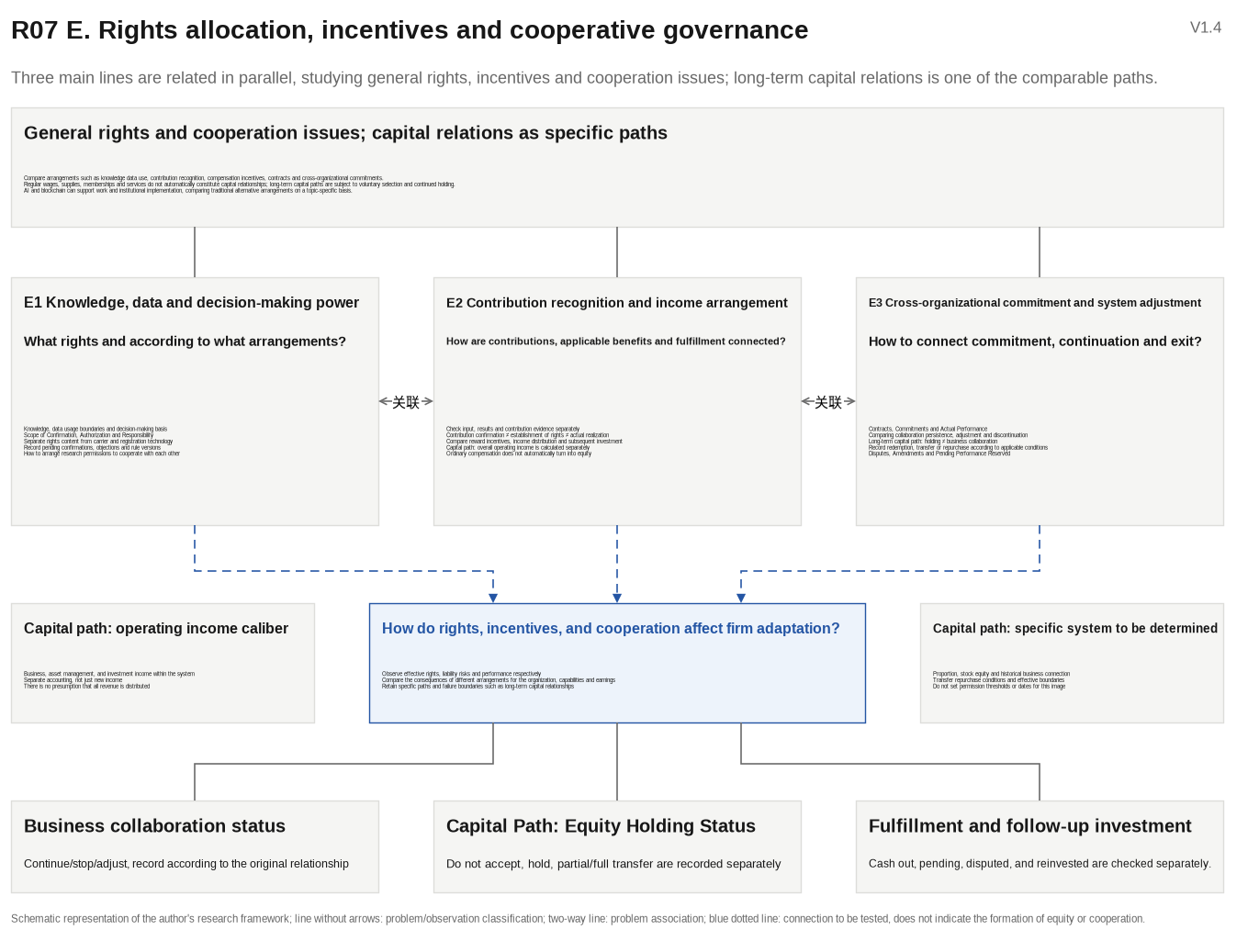
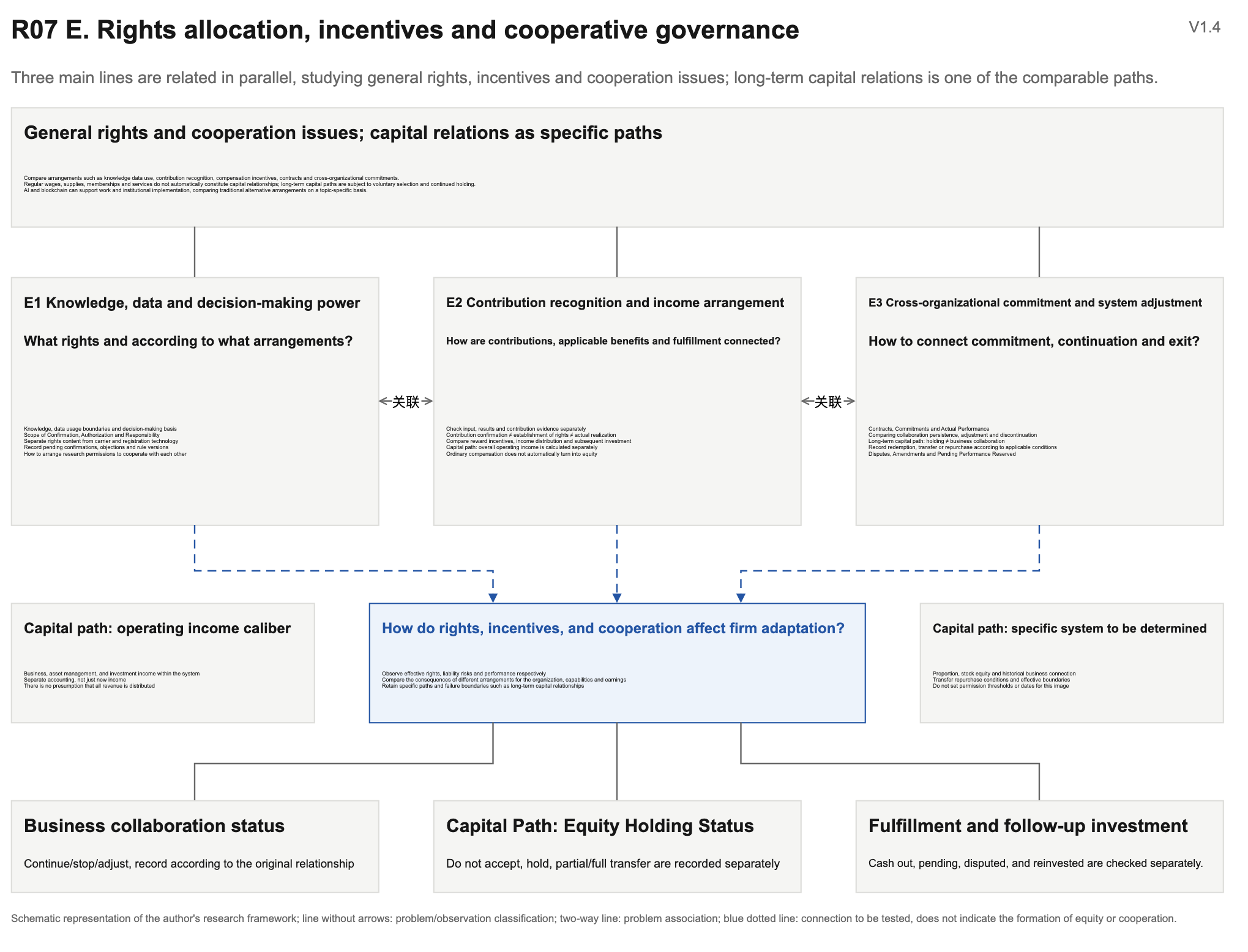
Figure R08 · Blockchain as institutional technology: joint evaluation of rules and implementation

System design and blockchain achieve joint configuration and collaboration, and influence credible commitments and long-term cooperation through verification, coordination, supervision and fulfillment mechanisms to be tested; off-chain facts, rights basis, fund authorization and governance are checked one by one, and systems and technologies are evaluated separately using two comparisons.
Editable Draw.io · SVG Preview · PNG preview
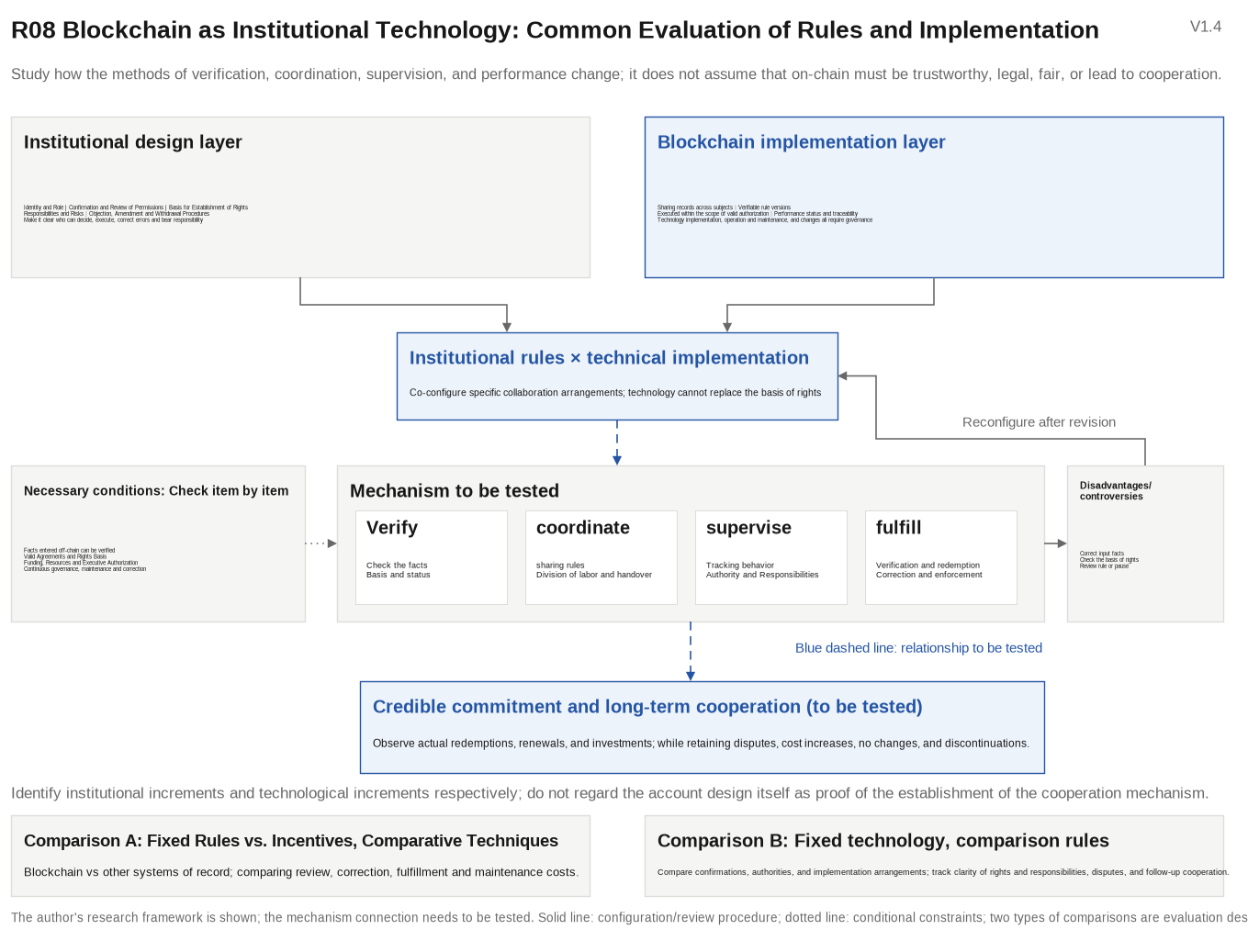
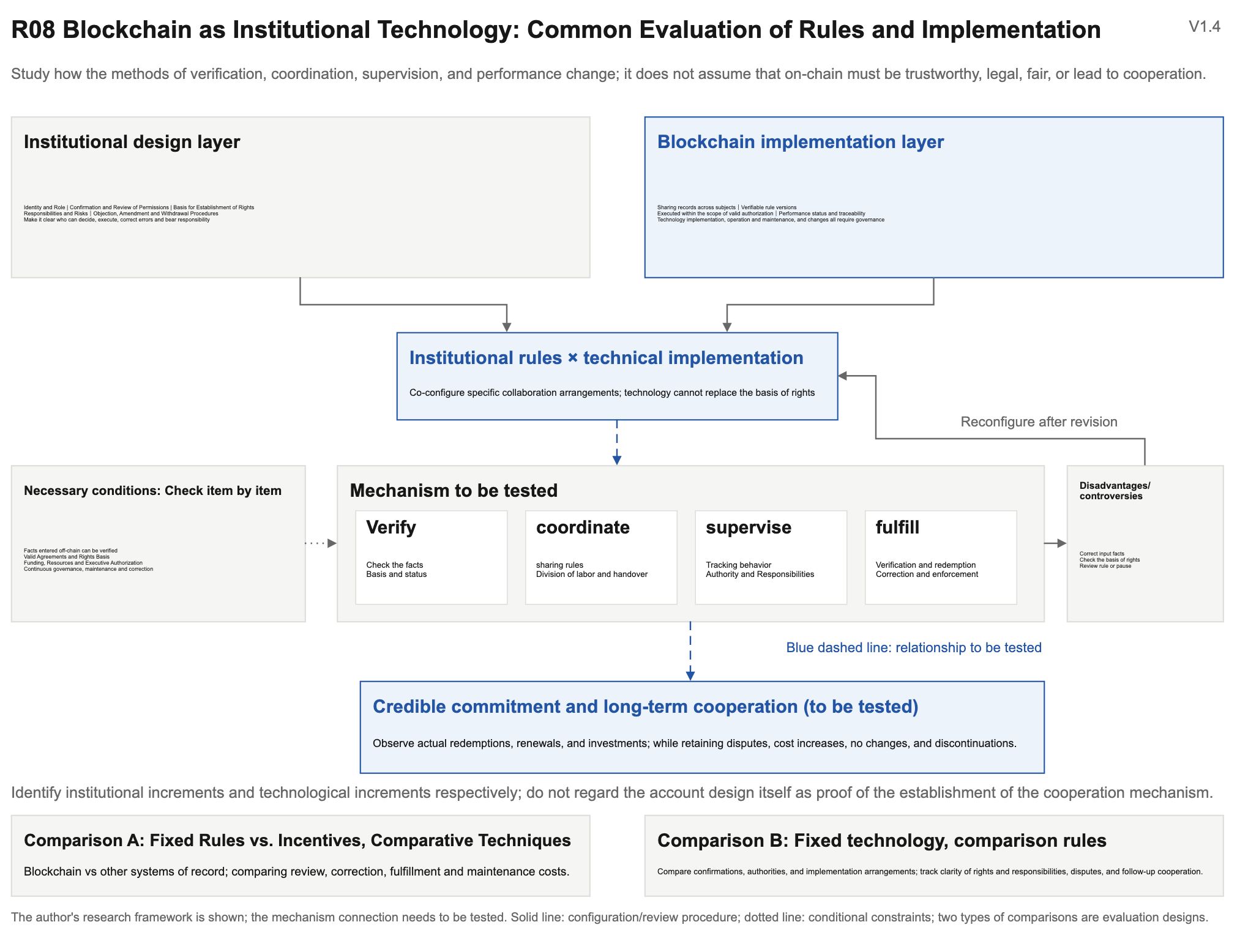
Equivalent text: The system design layer clarifies identity roles, confirmation and review authority, basis for establishing rights, liability risks and objections, revision and withdrawal procedures; the blockchain implementation layer provides cross-subject sharing records, rule versions, execution and performance traceability within the scope of effective authorization, and technical operation and maintenance and changes also need to be governed. The two layers jointly configure specific collaboration arrangements, and technology does not replace effective rights basis. Under the conditions of verifiable off-chain facts, effective agreements and rights basis, financial resources and execution authorization, continuous governance maintenance and error correction, study whether and how the verification, coordination, supervision and performance methods should be changed. The four mechanisms are juxtaposed and do not constitute a sequence of technology upgrades. Observe credible commitments, actual fulfillment, continuations and investments, and also retain disputes, cost increases, no changes and suspensions; when there are deficiencies or disputes, correct the input facts, check the basis of rights, review the rules or suspension, and reconfigure after revision. The mechanism arrows all need to be tested, and it does not assume that the chain will be trustworthy, legal, fair or produce cooperation. Comparison A compares blockchain with other record systems under fixed rules and incentives, and observes review, error correction, performance, and maintenance costs; Comparison B compares different confirmations, permissions, and performance arrangements under fixed technology, and observes the clarity of rights and responsibilities, disputes, and subsequent cooperation. The account design itself does not prove the establishment of the cooperation mechanism.
The relationship between institutional design and technical implementation
The system design clearly identifies identity, confirms authority, rights and responsibilities, fulfillment, objection and exit; the blockchain implementation layer supports shared records, rule versions, authorized execution and traceability. The study connects the two layers to the verification, coordination, monitoring and fulfillment processes, observing changes in credible commitments and subsequent cooperation.
Actual results also depend on valid agreements, off-chain facts, funds and resources, human discretion, and how disputes are managed. The role of blockchain and the role of institutional rules should be evaluated separately and compared with contracts, relational governance and other information systems. [63, 66]
E1 Knowledge, data and decision-making power
Research scope: Study identity roles, data and knowledge use, decision-making and confirmation authority, authorization and responsibility in enterprise collaboration; long-term capital account is one of the arrangements that can be studied.
Candidate topics: How should knowledge usage rights, decision-making rights and responsibilities be allocated to facilitate collaboration and eliminate gaps in responsibilities?
Research unfolds: How do different contracts, organizational procedures and digital collaboration arrangements connect facts, effective authority and enforceable rules? When using blockchain or long-term accounts, compare the specific effects of on-chain and off-chain connections, rule changes, and review objections.
Already undertaken: Four ecological governance, job responsibility authorization, enterprise wallet, customized DApp, and blockchain system technology. Roles, rules, authorization and status design of long-term capital accounts.
Key observations: Usage permissions, decision records, responsibilities, objections and corrections; account roles, data boundaries, authorization chains, confirmation responsibilities and revision records.
AOM positioning: Mainly connected to OMT; organizational systems, authority and responsibilities are mainly based on OMT; digital governance, intellectual property and strategic resource control intersect according to issues. See Main vesting and conditions table。
E2 Contribution recognition and income arrangement
Research scope: Track participants’ input and contribution basis, remuneration and income incentives, applicable rights and interests, risk responsibilities, actual distribution and performance, and compare the organizational and operational consequences of different arrangements.
Candidate topics: After independent review of contribution evidence, has the distribution changed, and will it affect subsequent knowledge investment?
Research unfolds: How do different contribution recognition, reward incentives and income arrangements affect fairness, trust, actual performance and subsequent investment? Long-term capital account is one of the specific paths. The role of its confirmation and equity arrangement is studied. Contribution confirmation, rights establishment and actual performance are observed separately. After the official operation of this path, the system covers the overall operating income and related rights and responsibilities within the scope of the system, including business, asset management, investment and other income, and is accounted separately, and is not narrowed to only new income; revenue, cost, profit, distribution, retention and reinvestment are checked separately, and all revenue is not presumed to be used for distribution. Added value can still be used as an analysis and measurement concept.
Already undertaken: Paper I, II; contribution recording and review, equity realization and long-term capital relationship model. Recognition and implementation design of long-term capital accounts of stakeholders and various rights and interests.
Key observations: Contribution facts, review, distribution, sense of fairness and subsequent actual investment; rights and interests to be confirmed and established, performance status, risk bearing and subsequent actual investment.
AOM positioning: Mainly connected to SIM; multi-party contribution, fairness and responsibility are mainly connected to SIM; sense of fairness, trust, and voluntary contribution are connected to OB, and employee compensation system is connected to HR. See Main vesting and conditions table。
E3 Cross-organizational commitment and system adjustment
Research scope: Study cross-organizational contracts, relationship arrangements, shared records, commitments, disputes, system adjustments and exits; long-term capital relationships and accounts are one of the specific paths.
Candidate topics: How do payment commitments, shared records, and dispute procedures affect supplier commitment, performance, and continuation of engagement?
Research unfolds: Compare how different contracts, relationships and institutional arrangements support or constrain commitments, performance and continuation of cooperation, while preserving situations of dispute and suspension. When using long-term accounts, or when using blockchain-supported records, rules and supervision, examine their specific effects. Equity holdings and business collaborations in the long-term capital path are tracked separately, and statuses such as those that are still held when business is discontinued, those that continue to operate but have transferred interests, partial transfers, and pending implementation are then studied, and then their relationship with subsequent investment and cooperation is studied. Holding is not used to automatically presume that collaboration continues.
Already undertaken: Paper IV, long-term capital relationships, supplier and channel cooperation, and community industry ecological operations. Long-term capital account commitments, controversies, rule changes, and sequel exit design.
Key observations: Fund or order arrangements, verifiable commitments, contract performance, contract renewal and exit; rule adjustments, dispute resolution, cooperation continuation, renewal, investment changes and exit.
AOM positioning: Mainly connect to STR; strategic consequences of cross-organizational commitment and cooperation connect to STR; supplier performance connects to OSCM, and rule formation and adjustment connect to OMT. See Main vesting and conditions table。
research boundaries
The research objectives cover all types of stakeholder relationships, and interests are recognized separately based on inputs and effective arrangements. Blockchain records, confirmed permissions, valid rights and actual performance are verified separately; continued cooperation must be verified with subsequent actions.
Dividends, equity, stocks and STO related arrangements are expressed separately according to rights content, carrier, registration technology and exit. The specific proportions, existing equity, historical business connections, effective boundaries, and transfer and repurchase conditions are left to be determined by the formal operating system; this research outline does not include automatic conversion, free transfer, or repurchase arrangements at any time, nor does it formulate its own transaction or issuance plans.
Positioning and Inspection of Original Contributions
Contribution positioning
This chapter explains the author's proposed contribution under the upper-level proposition of "Enterprise Adaptation and Differentiation in Technological Changes" and focuses on the following general core issues:
How do firms adapt their business models, organizational arrangements, and capital structures in response to technological change to build and renew capabilities and create and capture value? Why do firms adopting similar technologies end up with different long-term operating outcomes and development paths?
Research positioning and problem hierarchy Explain the connection between the general problem and each direction.
My pseudo-contribution portfolio still has two interrelated pseudo-main contributions:The formation and persistence mechanism of long-term capital relationships, and Institutional design and governance mechanism of long-term capital accounts for stakeholders. Organization and execution change, active capital operation, double acceptance and longitudinal comparison continue to be candidates for the four supports. They can not only connect with the two main contributions, but also answer the questions of technology adoption, capability updating, value realization and capital arrangement respectively. These six contributions do not cover all the research in the general outline, nor do all directions take long-term capital relations as the only explanatory mechanism or common premise.
Theoretical contributions answer why phenomena occur, what processes they go through, and under what conditions they are established; institutional design contributions answer how to organize roles, rules, rights, and performance. The two argue separately that the account design itself does not serve as proof of the establishment of the theory, and theoretical claims do not replace the evaluation of design effects.
Stakeholder capital theory and long-term capital relations undertake theoretical explanations on specific paths. Long-term capital accounts, NST, ecological governance and the four capitals enter the level of methods, governance arrangements and practical paths according to their actual nature. They are not all regarded as tools, nor do they lead all directions. Important research questions for this path remain as:
How can stakeholders acquire and continue to hold interests related to the long-term value of the enterprise based on voluntary choices and institutional rules, forming long-term capital relationships? How does this relationship affect organizational form, capacity accumulation, income distribution and continuous cooperation, and how is it inherited, realized and continued through capital operations?
This question mainly connects E and D and compares its consequences on B, C and A. How dispersed knowledge, professional capabilities, social relationships and capital form corporate capabilities and operational assets are retained as supporting questions. AI is a cognitive and work technology, and blockchain is an institutional technology; specific topics compare their adoption, combination, traditional substitution, and condition differences. It does not presuppose that technology adoption or long-term capital relationships will inevitably lead to operational improvements.
The long-term concerns of this study are:How the organizational forms of enterprises and stakeholders may evolve under changes in smart technology and institutional arrangements. This inquiry still takes enterprises and specific cooperative relationships as the current observation objects, and does not make predictions about inevitable evolution or general results.
This chapter clarifies the research increment and establishment conditions to be advocated. At present, the preliminary positioning of the author's materials and the first batch of relevant studies has been completed. Based on this, a systematic novelty review of the entire field has not yet been completed, nor has the proposed contribution been listed as a conclusion that has been empirically supported.
Figure R09 · Original contribution and evidence

Starting from the comparison of specific issues and existing research, we clarify candidate increments and counterexamples, select theoretical argumentation, design evaluation, and empirical comparison paths according to contribution types, update the originality check and evidence support status respectively, and then support, qualify, or deny the claim and revise it.
Editable Draw.io · SVG Preview · PNG preview
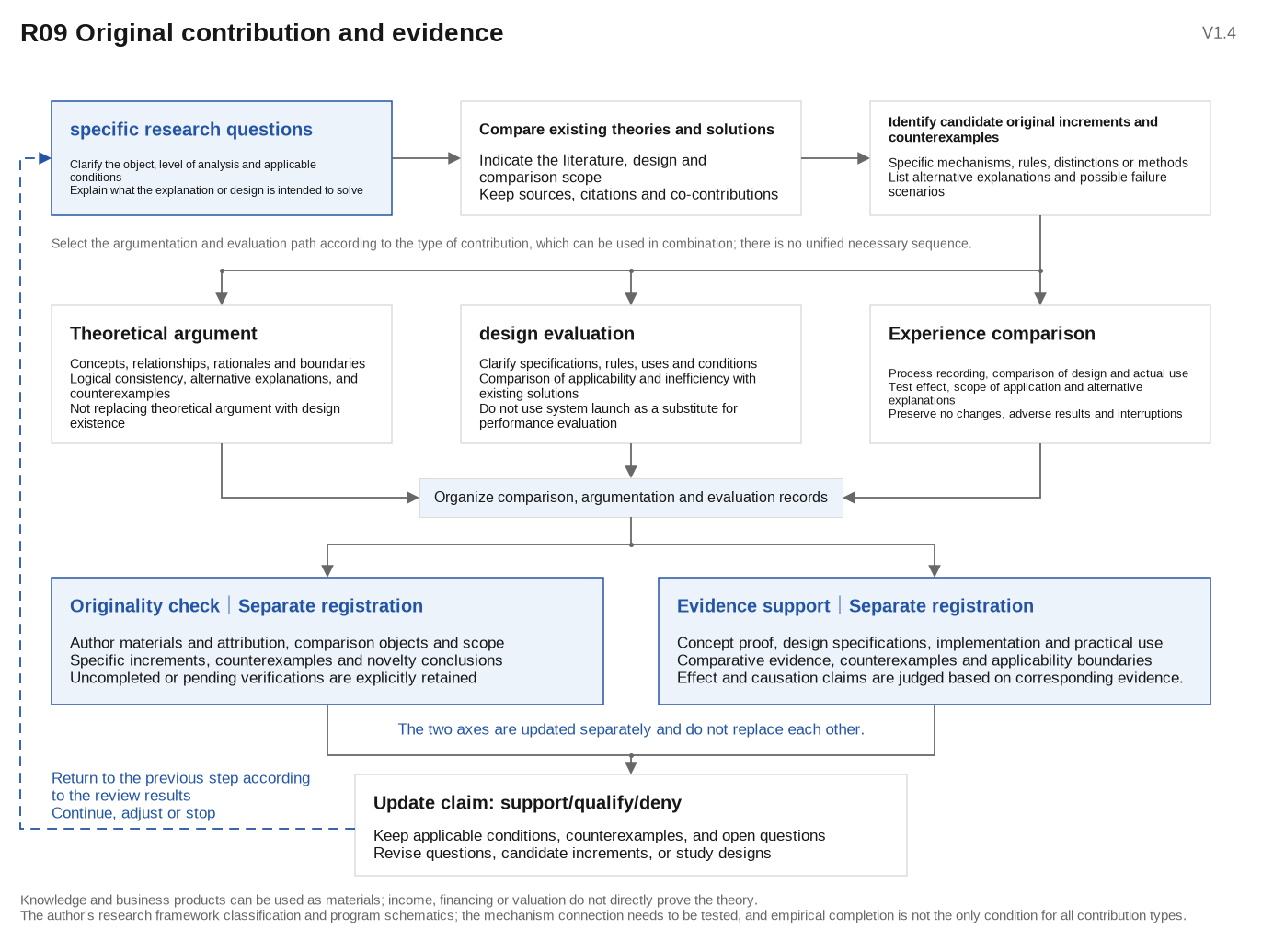
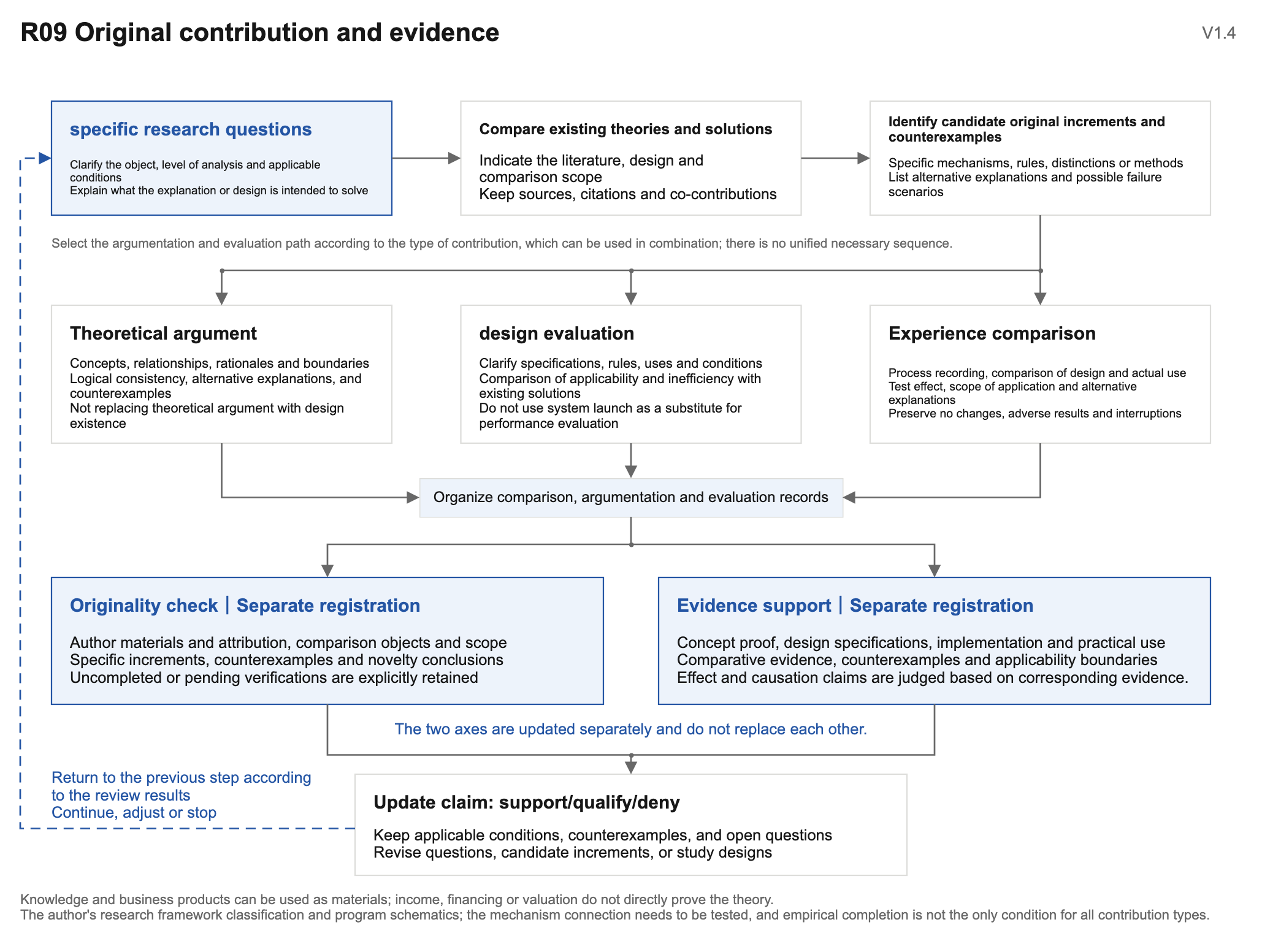
Equivalent text: First, clarify the object, level, and conditions of the specific research problem, then compare existing theories and solutions, and indicate the literature, scope, sources, and common contributions; candidate original increments must fall within specific mechanisms, rules, distinctions, or methods, and list counterexamples, alternative explanations, and failure scenarios. Depending on the type of contribution, theoretical argumentation, design evaluation, and empirical comparison paths can be used individually or in combination, and there is no uniform order. Theoretical demonstration checks concepts, relationships, reasons for action, logic and boundaries; design evaluation clarifies specifications, rules and uses and compares them with existing solutions; empirical comparison uses process records, compares designs and actual use, and retains no changes, adverse results and interruptions. After sorting out the comparison, argumentation and evaluation records, the two axes of originality verification and evidence support are updated respectively: the former registers author materials and attribution, comparison objects and scope, incremental and novelty conclusions, and is clearly reserved in unfinished or pending status; the latter registers conceptual demonstration, design, implementation, actual use, comparative evidence, counterexamples and boundaries, and effects and causal claims are judged according to the corresponding evidence. The two axes do not replace each other. Accordingly, the proposition can be supported, qualified or denied, and the question, candidate increment or research design can be revised. Return to the previous link to continue, adjust or stop according to conditions. Knowledge and business products can be used as materials, and income, financing or valuation do not directly prove the theory; not all types of contributions require empirical completion as the only condition.
Criteria for judging original contribution
To propose a contribution, explain what is added compared to existing knowledge or design, and why these added contents have explanatory, research or practical value. Theoretical contributions can be established by clarifying concepts, mechanisms, logic and boundaries; causal effects and scope of application require corresponding evidence testing. The two types of judgments are recorded separately.
Three references are used here:
- The theory needs to clearly explain the objects, factor relationships, reasons for action and boundaries, see Whetten(1989)。
- Contributions involve both originality and academic or practical use; both incremental contributions and larger new interpretations need to be positioned, see Corley and Gioia (2011)。
- Systems, systems and methods can contribute to design knowledge, but they need to explain the increment, evaluation and applicable conditions relative to existing problems and solutions. See Gregor and Hevner (2013)。
Five directions and fifteen main lines are used to organize research issues; AI, IPO, STO, blockchain, etc. illustrate research situations, paths or implementation technologies. Originality must fall on specific explanations, institutional rules, methods or discoveries. It cannot just depend on whether the catalog is complete, whether there are new names, or whether a certain technology is used.
The authors have accumulated and can continue to put forward claims
| Have accumulated | What can currently be stated | What needs to be said to further form a scholarly contribution? |
|---|---|---|
| Stakeholder ecology and four-ecology governance model | A named framework representation of organizational actors, relationships, value activities, and governance issues | Compared with the existing stakeholder, ecological and organizational framework, what new distinctions, mechanisms, expectations or boundaries are added? |
| Four-way SOP, job responsibilities, manual and handover method | There are methods to express the performance, business, functions, actions and work responsibilities. | How to increase design knowledge that is actionable, measurable, or reusable relative to processes, routines, and performance management methods |
| Enterprise AI business capability reconstruction system and double acceptance | Existing frameworks and methods for technology, organization, execution, delivery and capability accumulation | Which intermediate mechanisms and holding conditions are beyond the explanation of established technological complementarity and organizational learning, and which indicators have reliable uses |
| Stakeholder Capital Theory and Long-term Capital Relationship Model | There are manuscripts and mechanisms expressing co-creation, contribution, rights and cooperation. | How to define capital relations and what is added to relational contracts, stakeholder governance and incentive explanations |
| Long-term capital account and blockchain system technology design | Proposed design linking roles, contributions, responsibilities, performance and governance | Which rules and interfaces make observable differences, and what do technologies and institutions each add? |
| Capital Logic, Pathways and Comparison Tools | Solutions, tools and examples for capital organization and project analysis are available | How to go beyond general financing, capital structure and investment analysis to explain changes in operating capabilities and partnerships |
| Original papers, websites and knowledge collaboration practices | Standard demonstration, research design and some actual process materials are available | Establish theoretical arguments, reviewable designs or new evidence respectively, retaining authors, citations and collaboration divisions |
The formation and expression of the author's materials, novelty relative to existing literature, practical applications and effects must be identified separately. Co-authors, third-party theories, techniques and references retain their respective sources, and individual compilations cannot be used to replace the verification of contribution attribution.
Contribution 1: The formation and sustainability mechanism of long-term capital relationships
Type and status: The main theoretical contribution to be established; mainly connecting E2 and E3, and correlating B, C, and D. AOM mainly connects SIM, OMT and STR, and the behavioral mechanism of fairness, trust and subsequent contribution connects OB.
Proposed increment: Observe the facts of investment and contribution, confirmation authority, acquisition of applicable equity related to the company's long-term value and capital strategy, participants' choice of whether to accept and continue to hold, actual performance, equity withdrawal and subsequent investment, and explain how long-term capital relationships are formed, sustained or changed. Distinguish between the enterprise's sustainable capabilities and operating assets, inter-temporal responsibilities held by participants and able to be realized as agreed, and whether business collaboration continues, and study the consequences of synchronization or out-of-synchrony among the three. The equity arrangement is superimposed on the original role, and the acquisition of equity is not automatically presumed based on the role's identity, nor is holding equity the same as continuing to provide business.
Figure R10 · Contribution 1: The formation and persistence mechanism of long-term capital relationships
The diagram shows the proposed contribution points: Distinguish between the realization of existing equity and the return on the next investment. When participants can retain their rights and interests and end the current round of services, compare the two explanations that fulfillment enhances the credibility of promises and that unknown returns on new investments reduce willingness to invest, and track actual behavior when given the opportunity.

After the end of the business, the existing interests may continue to be cashed out according to the contract. The figure records the capabilities left by the enterprise and the holding, collaboration and fulfillment status of the participants respectively, and then uses two predictions to explain the dedicated investment in the next real opportunity. This path mainly connects E and D, and observes the related results of B, C and A.
Comparison reference: Stakeholder joint value creation, collective action and governance; relational contracts and organizational capabilities
Editable Draw.io · SVG Preview · PNG preview · full equivalent text
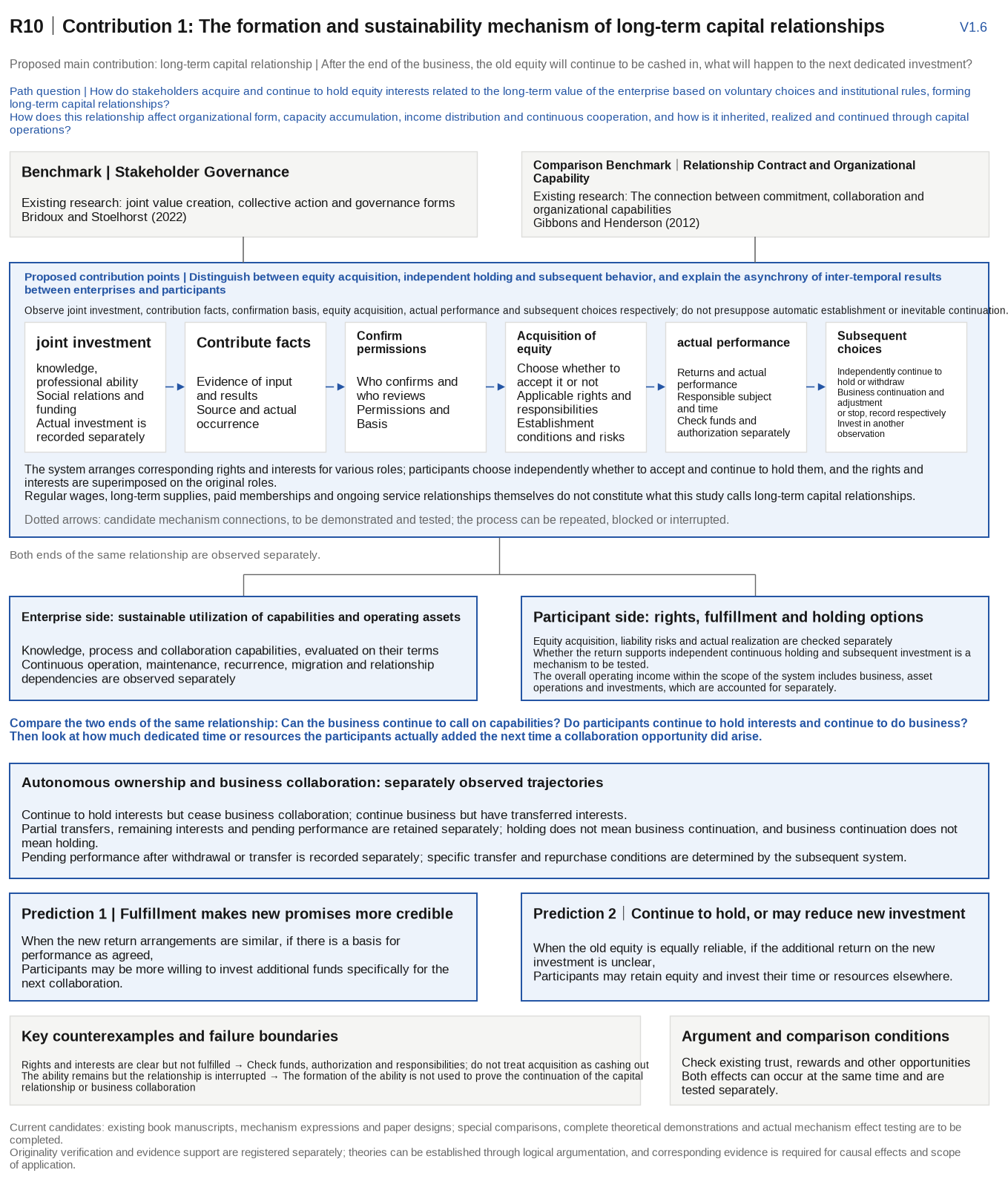
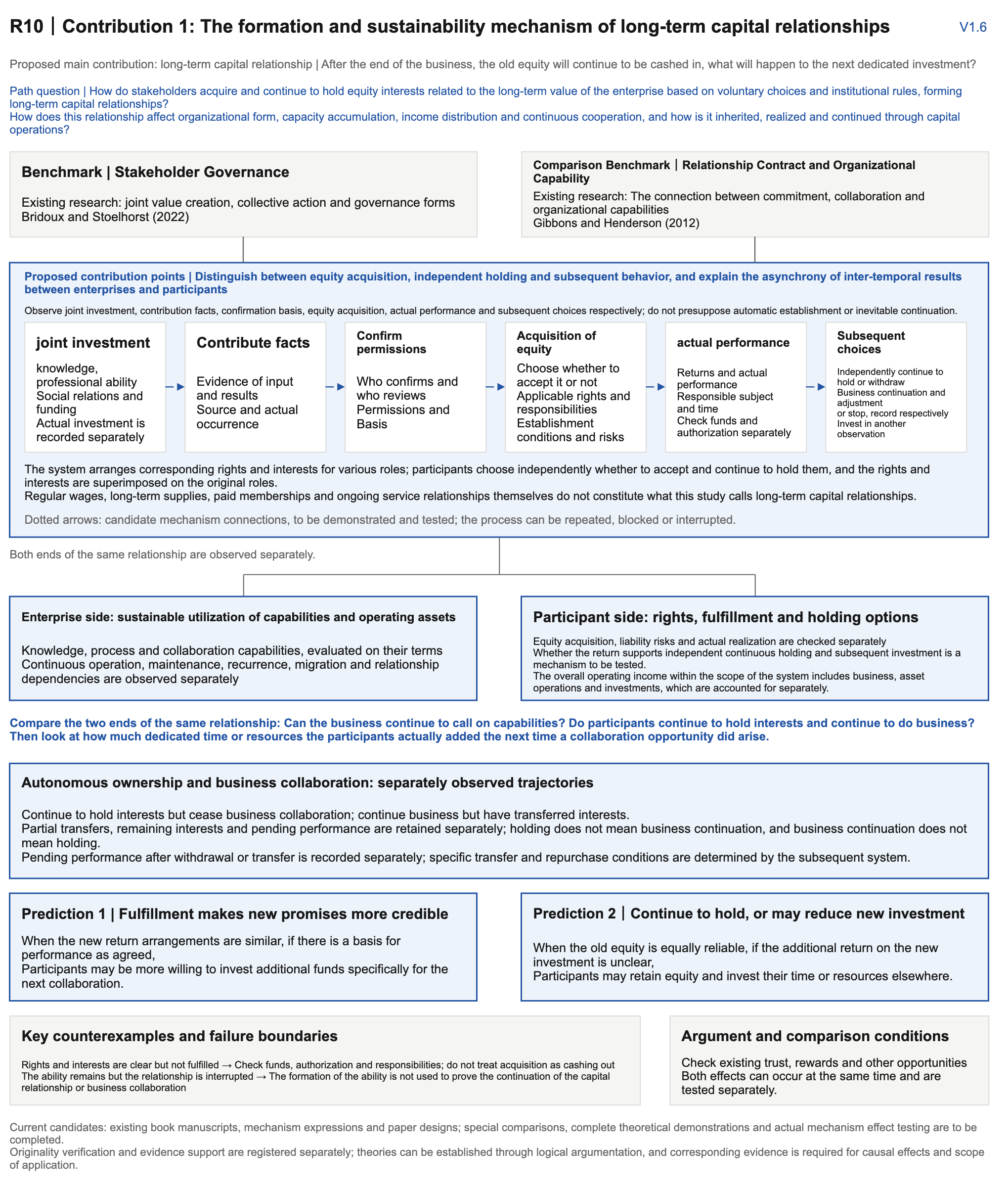
Job definition and role boundaries: The long-term capital relationship discussed in this study revolves around the investment and future returns that can support subsequent co-creation, and arranges the corresponding rights and responsibilities related to the company's long-term value and capital strategy on top of the original participation role. Participants can choose whether to accept and continue to hold it, and handle fulfillment and exit according to effective arrangements. Regular wages, long-term supplies, paid memberships, and ongoing service relationships do not themselves constitute the long-term capital relationships discussed here; they each have continuity and governance value and cannot therefore be collectively regarded as one-time transactions. The existence of a relationship, the existence of an account, or the recording of a contribution are not sufficient to independently identify a capital interest or capital relationship.
The equity discussed here is related to the long-term value of the enterprise and capital strategy; only deferred payment, long-term salary or continuing service compensation are not automatically included because of the existence of future returns. The following comparisons of holdings, exits and business selections all use this equity range.
Equity holding, business collaboration and corporate capabilities are separated:
| Status that needs to be observed separately | Conclusions that cannot be directly inferred |
|---|---|
| Obtain and continue to hold corresponding rights and interests, and continue business collaboration | The confirmation of equity arrangements cannot lead to continued investment simply because the two exist at the same time. |
| Still holds equity, but terminates original business cooperation | Business interruption cannot be automatically written as the disappearance of equity or the end of all capital relationships. |
| Business collaboration continues, but rights have been transferred or withdrawn in accordance with the agreement | Business continuity cannot be automatically written as still holding the original equity. |
| Partial transfer, partial retention of rights, or pending performance | Cannot cover all rights and responsibilities with a single "Exited/Not Exited" status |
Enterprises may maintain capabilities but business cooperation is interrupted, or they may continue to form capabilities under conditions of stable human-machine complementarity or relationship-specific conditions. Equity holdings, performance of rights and responsibilities, cooperative behaviors and changes in capabilities are recorded separately, and judging their correlation requires time, comparison and alternative explanations.
Scope of income system and rights carrier: The proposed system is oriented to the overall income and related rights and responsibilities within the scope of the system after formal operation, covering business, asset management, investment and other income and accounting for them separately, not only for new income. Revenue, costs, profits, distribution, retention and reinvestment are checked separately, and all revenue cannot be regarded as distributable or presumed to be fully paid; the added value can still be used for analysis and measurement. The specific proportion, existing equity, historical business connection and effective boundary will be determined by the subsequent system. This chapter is not certain of these terms or dates of operation.
Equity can be connected with dividends, equity, stocks and STO-related arrangements, but the rights content, carrier, registration technology and exit method must be distinguished. The transfer, repurchase and related conditions are to be determined by the subsequent system, and there is no preset automatic conversion, free transfer or unconditional repurchase at any time. Working concepts do not replace accounting, legal or itemized identification of security rights, nor do they formulate a transaction or offering proposal in this chapter.
Existing research and comparison benchmarks: Stakeholder governance has studied collective action and governance forms in joint value creation; relational contract research has connected commitment, collaboration and organizational capabilities. This study needs to locate incrementally on these explanations without reformulating “stakeholder collaboration” or “long-term commitment plays a role” as new findings. Initial dialogue partners include Bridoux and Stoelhorst (2022)and Gibbons and Henderson (2012)。
The business has stopped, but the rights and interests already obtained are still honored as promised. Will participants invest in this enterprise again when the opportunity arises next time?
Let's say a partner fulfills the original order. The next order requires him to spend time training the company's delivery team, and this experience is mainly used in the cooperation between the two parties. There are two explanations worth comparing for this new investment.
- Delivering makes a promise more credible. Even if the previous order has ended, the company will still honor its existing rights and interests as agreed. If the remuneration arrangement for the next investment is the same, compared to the situation where there is no basis for performance, seeing the fulfillment may make the partners believe in the new commitment more and be willing to invest more training time.
- New investments still need to be accounted for. If the original rights and interests have been reliably realized and continued holding is not required to continue accepting orders, then how much time training will take and how this additional contribution will be rewarded will affect his choice. Compared with the situation where the new returns are clear and expected, if the new returns are unclear and other projects are available, he may retain the original equity and reduce or abandon the new investment in the company.
Both explanations look at the actual dedicated investment in the next opportunity. A combination that already has a performance record but whose new returns are still unclear is particularly worthy of observation. You can change the performance basis and new return arrangements in the scenario respectively, or find comparable situations in real cooperation to check the original role remuneration, original equity value, project conditions and other opportunities. The two effects may occur at the same time. Just looking at someone continuing to take orders, it is not clear who played the role.
Other conditions that need to be checked
- Contributions are recognized only when the corresponding rights and interests related to the long-term value and capital strategy of the enterprise can be expected and the actual performance is based on it. It is possible to influence the acceptance, holding and reinvestment through future return expectations; if it only increases records without changing these expectations or behaviors, the explanation of this mechanism should be limited.
- Whether the equity arrangement can support business continuation depends on the specific connection between holding the equity and continuing the business and other cooperation conditions. The situation where equity income can continue to exist after the business ceases and the situation where the business continues after exiting the equity should be compared respectively, and "long-term" should not be directly understood as fixed cooperation or mandatory holding.
- Distribution, retention, and reinvestment in the current period may have different impacts on participants' returns and the company's subsequent capabilities; the role of the overall income system needs to be explained in conjunction with operations, asset management, investment results, and performance conditions. It does not presuppose that more allocations or longer holdings are necessarily better.
To be demonstrated and tested: Under conditions such as dedicated investment, interdependence, or delayed encashment, whether equity acquisition, holding options, expected returns, and actual performance affect knowledge sharing, reinvestment, and business continuation respectively; how transfer, partial withdrawal, and changes in control change remaining rights, responsibilities, and performance conditions. Comparisons such as "not accepting interests but continuing business", "holding interests but stopping collaboration" and the system's unchanged behavior were retained to check whether participation choices, original relationships, business prospects and other rewards can explain the results.
Counterexamples and boundaries: When the records are more complete but the allocation and subsequent actions have not changed, the explanation for limiting the visibility of information; when the rights are clear but not fulfilled, identify the funds, authorization and responsibility links; when the rights and interests are still held but the business collaboration is interrupted, the continuation of rights cannot be equated with the continuation of cooperation. The retention of corporate capabilities does not prove that participants still hold interests. Parts of general contracting, existing property rights, or relational governance theory that are sufficiently explanatory to narrow contribution claims accordingly.
Current status: There are already book manuscripts, mechanism expressions and paper designs; preliminary comparison objects have been listed, special literature comparisons and complete theoretical demonstrations need to be completed, and relevant actual mechanisms and effects need to be tested.
Contribution 2: Institutional design of long-term capital accounts for stakeholders
Type and status: The main institutional design contribution to be established; mainly connecting E1-E3, and linking A2, A3 and D. AOM mainly interfaces with OMT, SIM, CTO and STR.
Proposed increment: On the premise that the account can record two levels of regular performance and capital equity, multiple identities, heterogeneous inputs, contribution evidence, confirmation authority, rule version, corresponding equity acquisition, acceptance and holding options, partial changes and withdrawals, and pending performance are organized into a sustainably linked institutional interface. Regular remuneration is separated from capital equity, business collaboration, equity holdings and changes in corporate capabilities are observed separately, and all account records are not uniformly interpreted as capital relationships.
Figure R11 · Contribution 2: Institutional design of long-term capital account
The diagram shows the proposed contribution points: Continuously associate multiple roles with heterogeneous investments, equity acquisition, independent holding/exit, overall operating income items, rule versions and pending implementation; differentiate between equity and business trajectories, and retain historical business and specific conditions to be determined.

The incremental positioning of the proposed system is in the continuously related roles, equity acquisition, independent holding and withdrawal, implementation and rule version; equity holding and business collaboration are observed separately. After formal operation, the overall income and related rights and responsibilities within the scope of the system are covered. Commercial, asset operation, investment and other income are separately accounted, and revenue, cost, profit, distribution, retention and reinvestment are distinguished.
Comparison reference: Customer relationship and membership records; contribution ledgers; contracts and remuneration sharing; holder records; DAO governance; shared databases; based on actual rules, permissions, uses and cost comparisons, it is not assumed that certain types of solutions only have simple functions. ; Lumineau, Wang, and Schilke (2021); Comparing technical implementation under the same rules and incentives; Comparing confirmation, authority, and performance arrangements under the same technology
Editable Draw.io · SVG Preview · PNG preview · full equivalent text
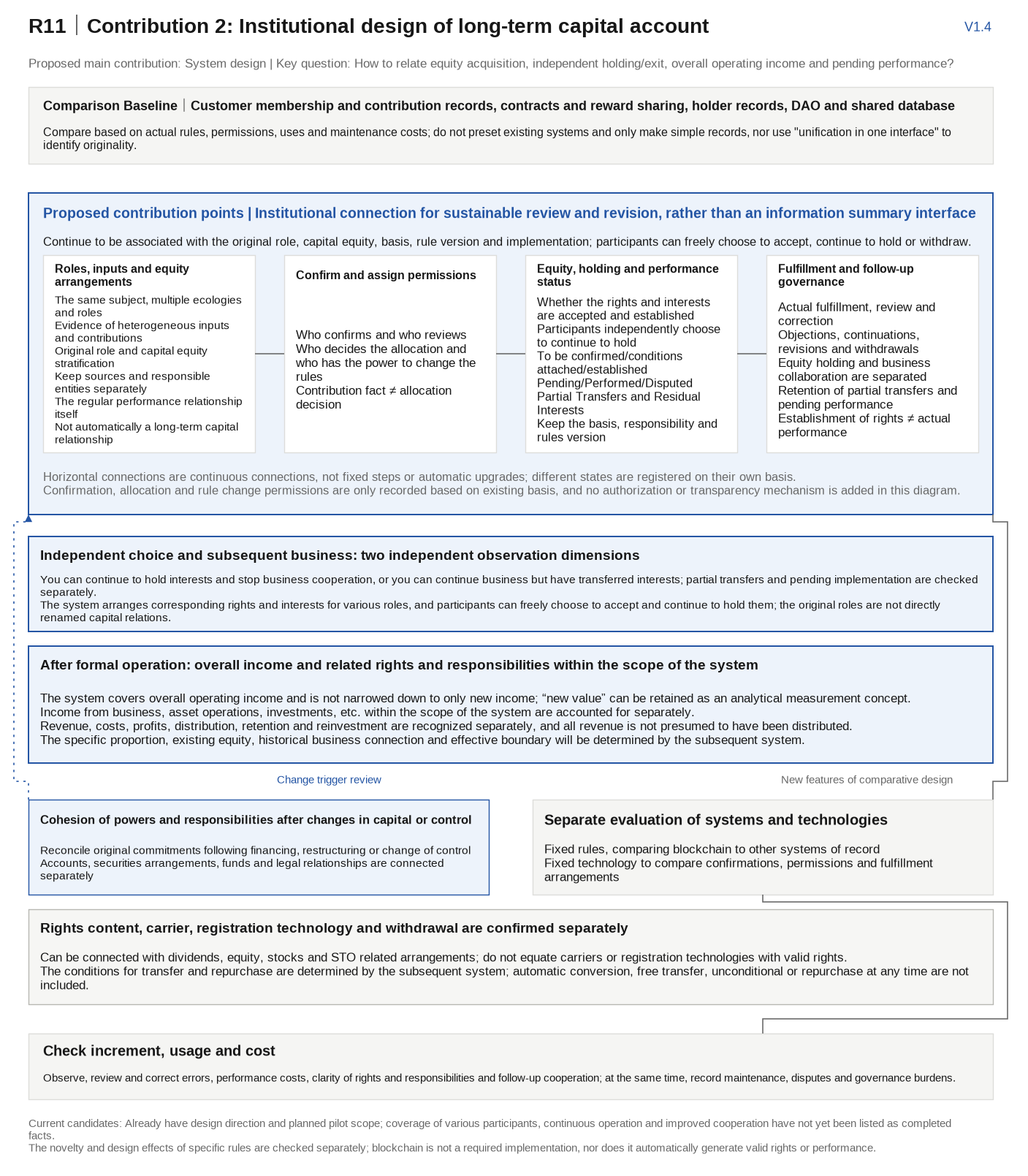
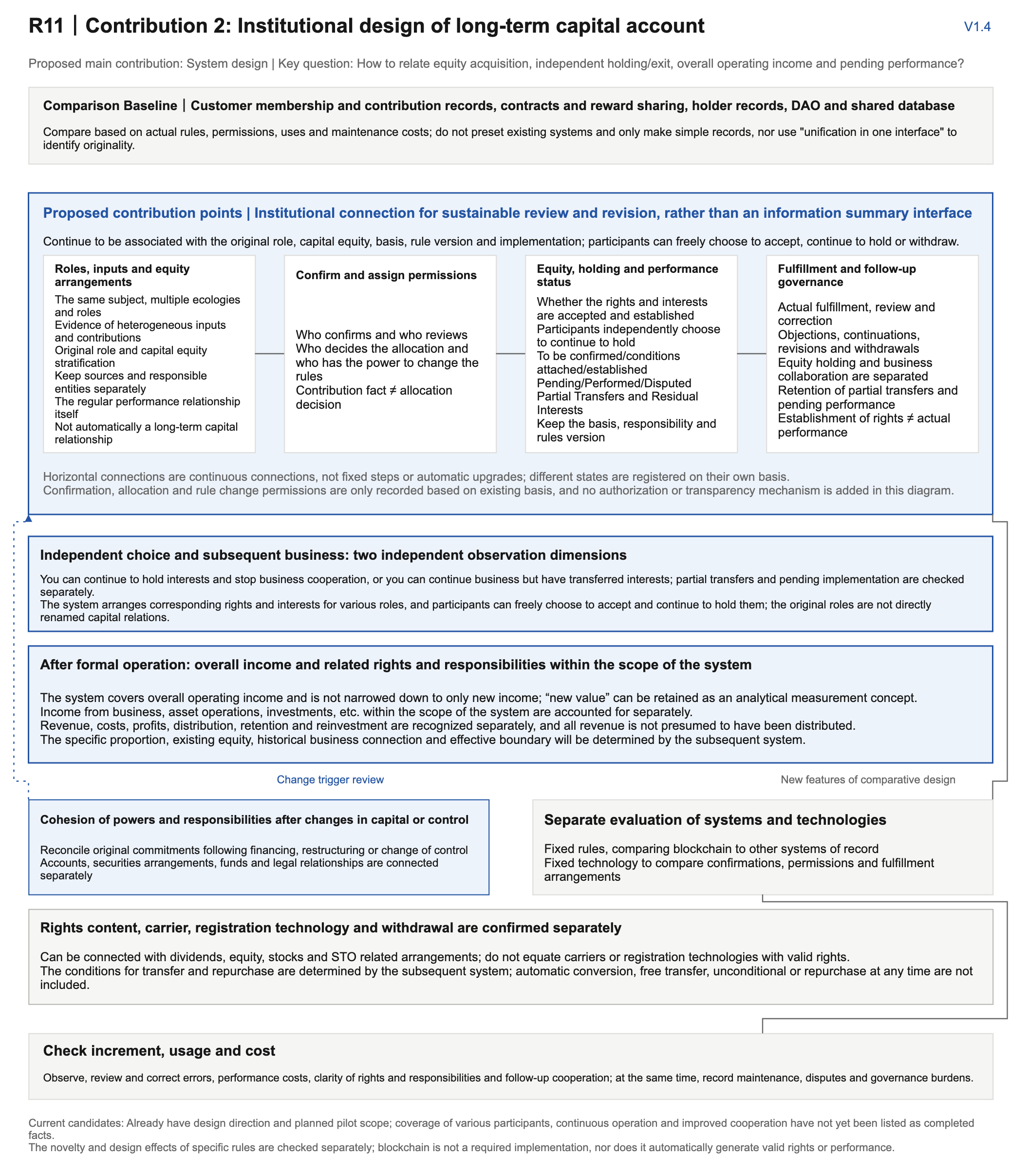
Designs that must be compared: Customer relationship and membership records, contribution ledger, compensation or sharing arrangements, holder records, contract and relationship governance, DAO governance and shared database. It is more focused on actual rules and uses. It does not assume that a certain type of existing system only has simple functions, nor does it solely identify originality based on "unification in one interface".
The specific location of the system increment:
- Related to different ecologies and roles of the same subject, while retaining different types of rights and responsibilities and execution subjects.
- Separate contribution facts from allocation decisions and explain who confirms, who reviews, and who has the authority to change the rules.
- Record arrangements to be confirmed, conditional, established, to be performed, performed or disputed respectively, and retain the basis and version.
- According to effective arrangements, the acquisition, acceptance and continued holding of interests, business continuation, partial transfer or withdrawal and pending performance are respectively related, and different types of rights and responsibilities are not pressed into an automatic status ladder.
- Feedback objections, performance, authorization, business continuation and rights withdrawal to the corresponding relationships to test whether the system changes behavior.
- Record the business, asset operation and investment income within the scope of the system, as well as the basis for revenue, cost, profit, distribution, retention and reinvestment. The specific proportion, existing equity and historical business connection will be determined later.
- After changes in capital structure, financing, reorganization or control, check applicable commitments and rights and responsibilities; accounts are linked to securities, funds and legal relationships respectively.
System and technology are evaluated separately: Under the same rules and incentives, compare what blockchain adds to other record systems; under the same technical conditions, compare the effects of different confirmations, permissions, and fulfillment arrangements. Observe reviews, corrections, fulfillment costs, clarity of responsibilities, and follow-up engagement, while documenting maintenance, disputes, and governance burdens. There have been studies comparing blockchain with contract and relationship governance. This study needs to locate the specific new rules and their consequences. See Lumineau, Wang, & Schilke (2021)。
Current status: The design direction and proposed pilot scope of accounts and related rules are already in place; coverage of various participants, continued operation, or improved cooperation have not yet been listed as completed facts. The novelty and effect of the specific design are checked separately.
Contribution 3: The mechanism by which technology, organization and execution influence ability retention
Type: Mechanism explanation and boundary contribution candidates; mainly connect A1, A2, B1-B3, customer delivery research is related to C1, C2, C3; connect CTO, ODC, MOC, OB and STR.
Proposed increment: Identify the intermediate processes such as decision-making authority, resource availability, cross-role handover, abnormal feedback and experience update, respectively study the cognitive and work role of AI, and the institutional technology role of blockchain, and explain when to improve the ability to switch to sustainable use under the conditions of clear personnel, tools and relationships. Organizational strength, execution power and enterprise capabilities are observed separately, and the continuous operation and retention of capabilities, maintenance sustainability, cross-person recurrence, technology migration and relationship dependence are evaluated separately, and they are not unified thresholds for each other.
Figure R12 · Contribution 3: How organization and execution mechanisms affect capability retention
The diagram shows the proposed contribution points: Intermediate processes such as positioning authority, resource arrival, cross-role handover, abnormal feedback and experience updating explain the specific conditions for the persistence and retention of capabilities; organizational strength, execution power and corporate capabilities are observed separately. The five capability evaluations do not replace each other. Stable human-machine complementarity and relationship-specific capabilities are judged according to conditions.

Candidates for supporting contributions: Based on existing research on technology complementarity, organizational learning, etc., it is planned to locate intermediate processes such as authority, resources, handover, abnormal feedback, and experience updating; evaluate the continuous operation of capabilities, maintenance sustainability, cross-person recurrence, technology migration, and relationship dependence respectively, and do not use changing tools or breaking away from relationships as a unified threshold.
Comparison reference: Research on technology and organizational complementarity, organizational learning, job design, and resource capabilities; existing explanations of technology complementarity and learning are not denied or simplified as having no relevant functions.
Editable Draw.io · SVG Preview · PNG preview · full equivalent text
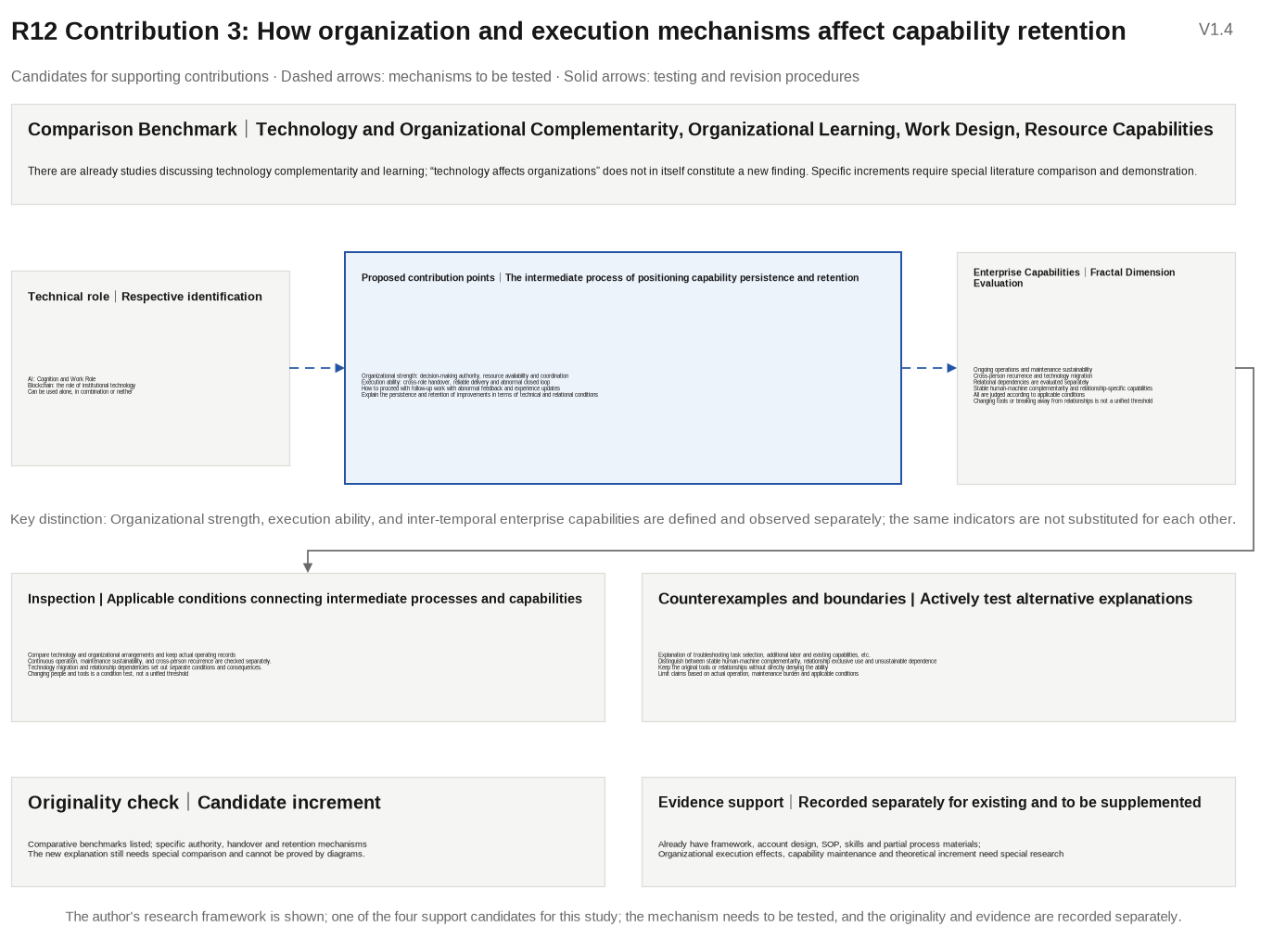
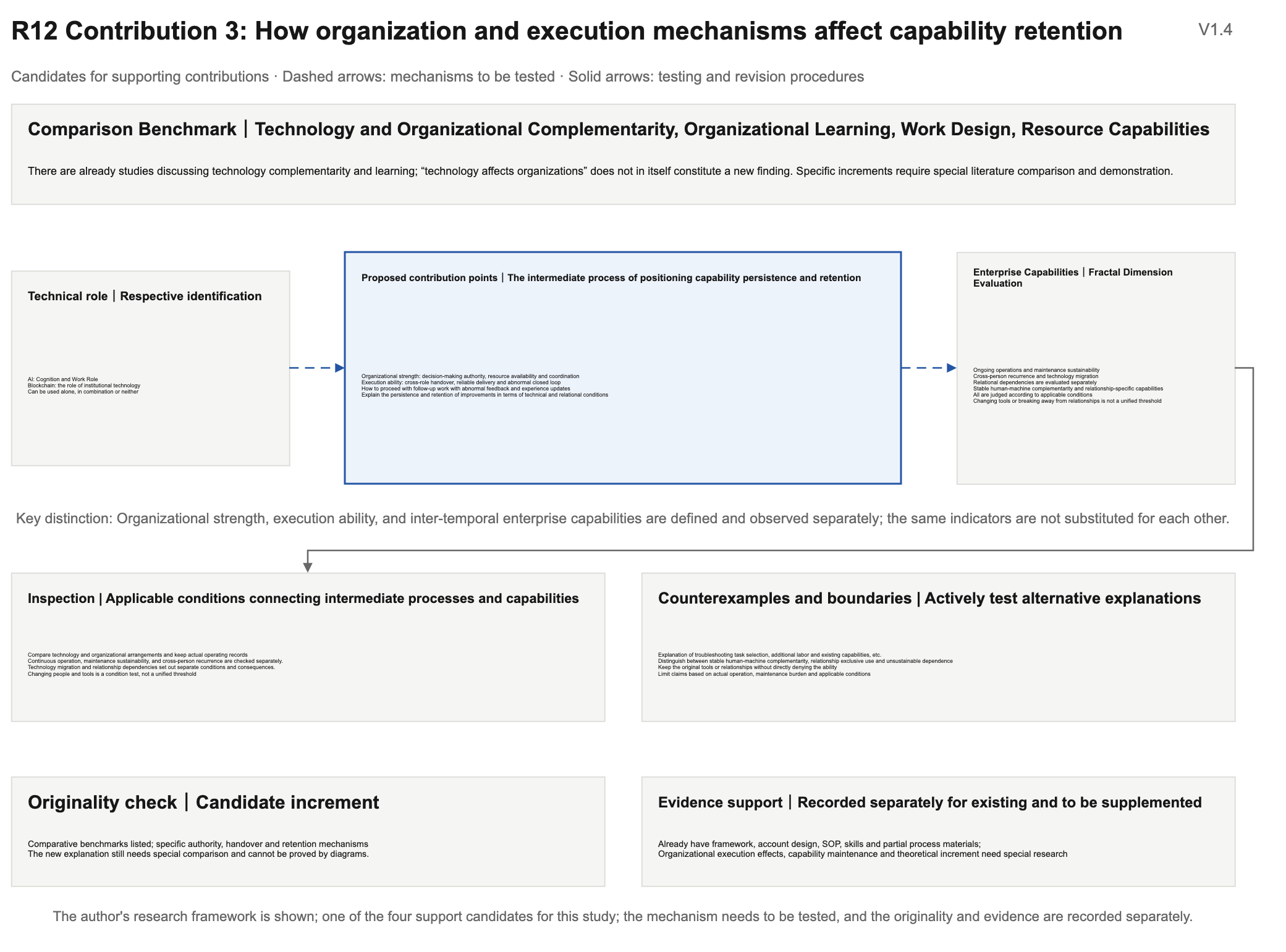
Benchmark: Research on technological and organizational complementarity, organizational learning, job design and resource capabilities. There is clear research on the need for intangible complementary investments in AI, e.g. Brynjolfsson, Rock & Syverson (2021); This study must address increments in specific handovers, permissions, or retention mechanisms, and cannot treat the broad “technology impact organization” as a new finding.
Evidence and counterexamples: Comparison of technology and organizational arrangements, process recording and follow-up operation observation are used to conduct cross-person recurrence, technology transfer or relationship condition changes tests based on research questions. Improvements that can be explained by task selection, additional labor, or preexisting capabilities are not attributed to the proposed mechanism. When it is only valid under the original tool or relationship, the dependence and scope of application shall be explained; when the maintenance cost is unsustainable or the continuous operation fails, the retention claim shall be limited. Stable human-machine complementarity or relationship-specific capabilities can exist. However, if the migration fails or the relationship is separated, it becomes invalid. This does not negate the capabilities under the original conditions alone.
Observation distinction between retention and migration:
| Evaluation dimension | Correspondence problem |
|---|---|
| Continuous operation and capability retention | Under the specified resource and relationship conditions, can it be continuously called in subsequent tasks and periods? |
| Maintain sustainability | Is the cost of updating, reviewing, correcting, and maintaining it affordable, or does it rely on undocumented additional labor? |
| Reappearance across people | What performance can be retained after a change of executors or handover, and what training and support can be relied on? |
| technology migration | What can be migrated when changing models, tools, or vendors, and what are the cost and performance boundaries? |
| relational dependency | Which capabilities rely on specific collaborations, complementary resources, or shared routines, and how do they change when relationships change? |
The above dimensions answer different questions and do not require each capability to exist independently of existing tools or relationships.
Current status: There are already AI frameworks, blockchain system technology and account design, SOPs, skills and local work process materials; comparable organizational and execution effects, capacity maintenance and theoretical increments still need to be studied specifically.
Contribution 4: The two-way effect of active capital operation and capacity building
Type: Candidates for theoretical mechanisms and boundary contributions; mainly connect D1-D3, related to B, C, and E; with STR as the main AOM docking, pure financial structure and system connect adjacent disciplines.
Proposed increment: Compare capital market entry, instrument terms, control and disclosure governance requirements, how to change capacity investment, organizational adjustment and continuous cooperation through resource and responsibility arrangements; and then study how operating evidence and performance status feed back to subsequent capital selection.
Figure R13 · Contribution 4: The two-way effect of capital operation and capacity building
The diagram shows the proposed contribution points: Identify the impact of capital entry, terms, and control disclosure requirements on capacity investment and organizational cooperation through resource and responsibility arrangements, and identify the reverse mechanism of operating evidence and performance on subsequent capital selection.

Support contribution candidates: Compare how capital arrangements affect capacity investment, organizational alignment, and collaboration through resources and responsibilities, and examine how operating evidence and performance feed back into subsequent capital selections.
Comparison reference: Research on financing constraints, capital structure, control rights, investment and strategic resource allocation; the existing financing-investment connection is used as a benchmark, and it is not claimed that other theories have no two-way connection.
Editable Draw.io · SVG Preview · PNG preview
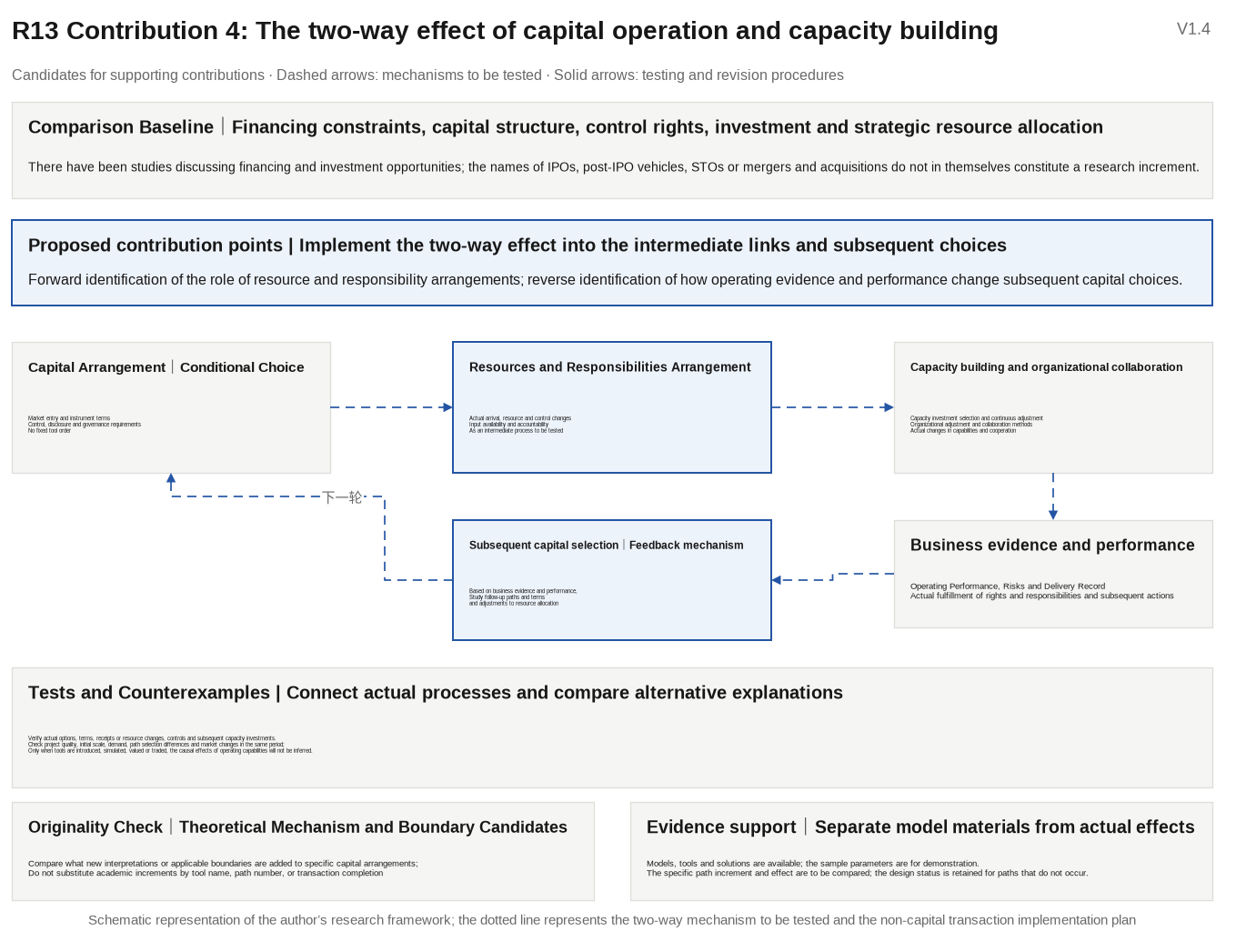
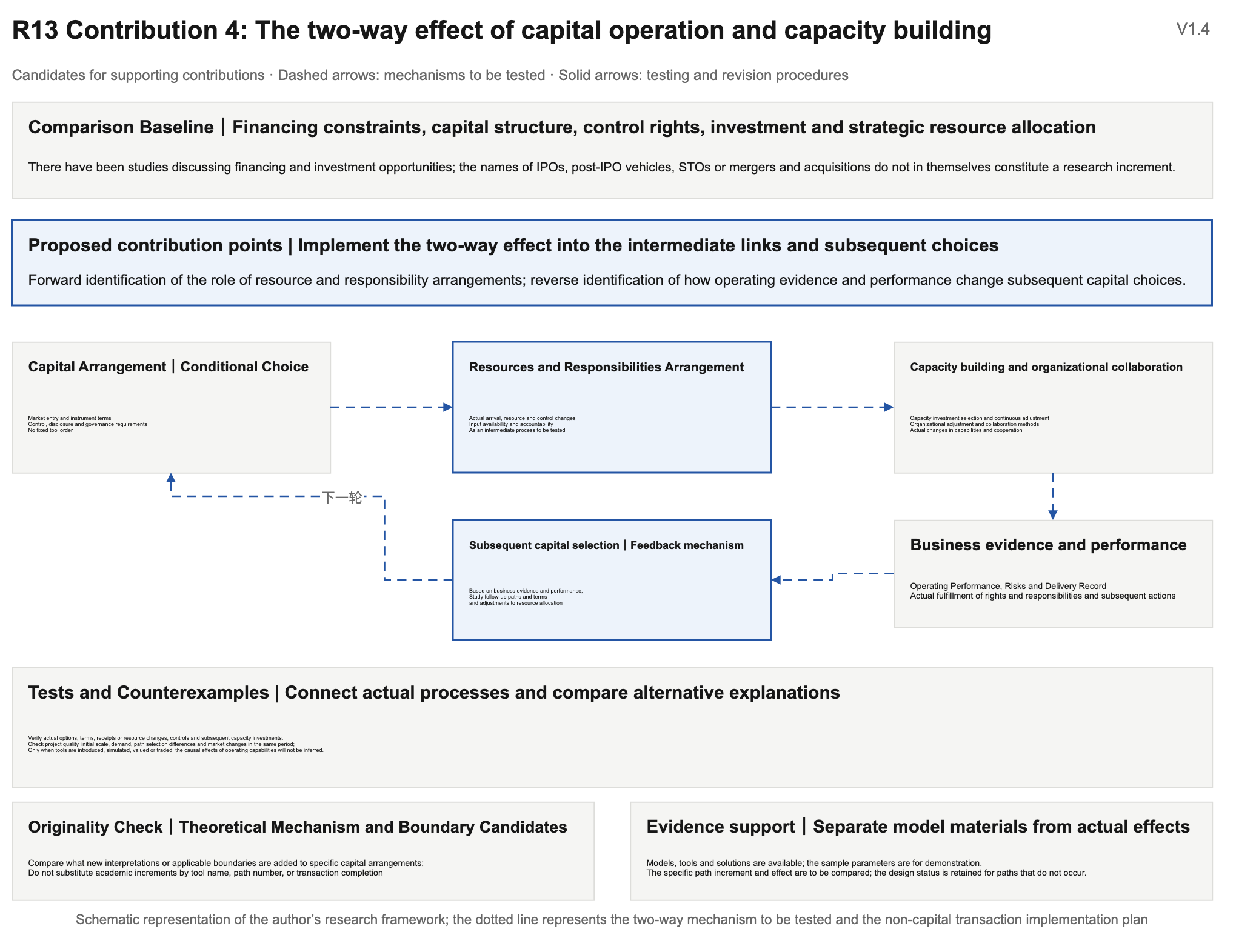
Equivalent text: Taking financing constraints, capital structure, control rights, investment and strategic resource allocation as the comparison benchmark, the name of the capital instrument itself does not constitute an increment. It is planned to identify forward the market entry, tool terms, control and disclosure governance requirements, how to affect capacity investment, organizational adjustment and continuous cooperation through actual resource and responsibility arrangements; and then reversely identify how business evidence and actual implementation affect subsequent paths, terms and resource allocation, and return to the next round of capital arrangements. Input the connection process with actual selection, terms, arrival or resource changes, control and follow-up capabilities, and check the project quality, initial scale, market demand, path selection and market changes in the same period. Only tool introductions, simulation plans, valuations or transaction changes do not infer the causal effects of operating capabilities. There are already models, tools and solutions, the example parameters are still for demonstration, and the design or scenario of the non-occurring path is retained; the specific mechanism increment and actual effect need to be compared, and the originality check and evidence support are separated.
Benchmark: Research on financing constraints, capital structure, control rights, investment and strategic resource allocation. The relationship between financing arrangements and investment opportunities has been studied in corporate finance, e.g. Myers(1977). The designation of an IPO, post-IPO securities vehicle, STO or M&A does not by itself constitute a research increment.
Evidence and counterexamples: Invest in the connection process with real options, terms, arrival or resource changes, control and follow-up capabilities. Check the project quality, original scale, market demand and participation options; when there are only tool introductions, simulation plans, valuations or transaction changes, the causal effects of operating capabilities will not be claimed accordingly.
Current status: Capital models, tools, and solution materials are already available; the example parameters remain demonstrative. The academic incremental and practical effects of specific capital pathways remain to be compared, and non-occurring pathways remain as designs or scenarios.
Contribution 5: Dual acceptance method for business improvement and capability retention
Type: Candidates for method and design knowledge contribution; mainly connected to A2, B1, B3, C3, customer projects related to C1, C2, governance issues related to E; docking with CTO, OMT, STR, operational issues connected with OSCM.
Proposed increment: Through the four-way SOP, job responsibilities and manuals, results handover and subsequent reuse records, the current delivery or operation improvement and the continuous operation and retention of capabilities under clear conditions are separately accepted; maintenance, cross-person recurrence, technology migration and relationship dependence are then reported separately. Connect the execution completion, acceptance, downstream use and operating results to form a reviewable observation caliber, and do not set tool change or break away from the relationship as a unified passing condition.
Figure R14 · Contribution Five: Dual Acceptance Method for Operation Improvement and Capability Retention
The diagram shows the proposed contribution points: Connect execution, handover, actual use, operating results and subsequent reuse and maintenance records, and separate acceptance of current delivery or operating improvement from the ability to continue to be available according to conditions; separately evaluate continued operation, maintenance sustainability, cross-person recurrence, technology migration and relationship dependence, and plan to form an observation caliber that can be reviewed and has reliable use.

It is planned to use four-way SOP, job responsibilities and manuals, handover and reuse maintenance records to connect execution, actual use and operating results; current delivery or operational improvement and follow-up capabilities that are continuously available according to conditions will be accepted respectively, and the five capability dimensions will be evaluated separately to test the increment and reliable use of the existing methods.
Comparison reference: Existing process management, organizational routines, performance evaluation, knowledge management, process tracking and capability measurement; based on actual distinction and purpose comparison, four groups/2×2 comparison and general measurement are existing methods.
Editable Draw.io · SVG Preview · PNG preview · full equivalent text
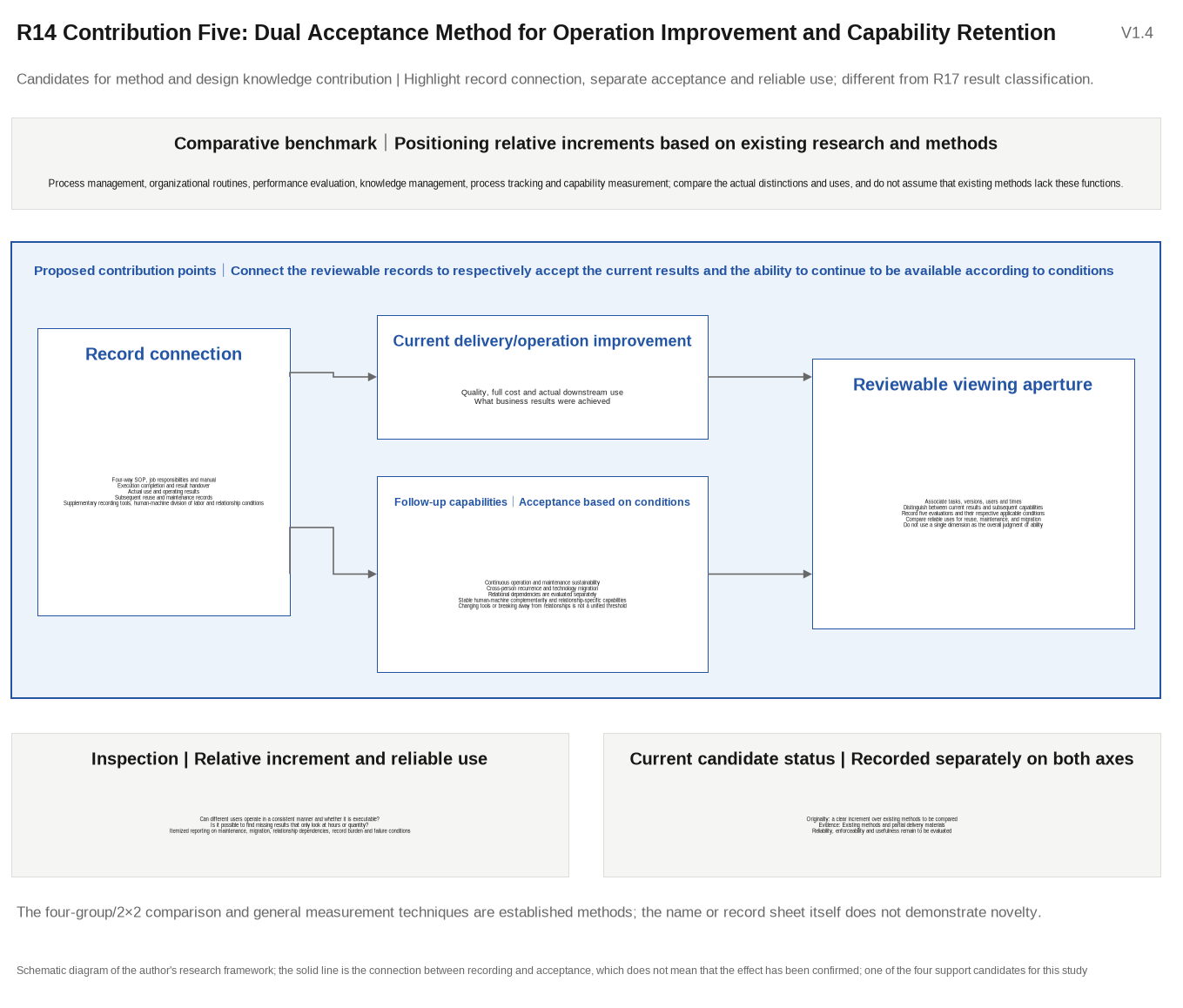
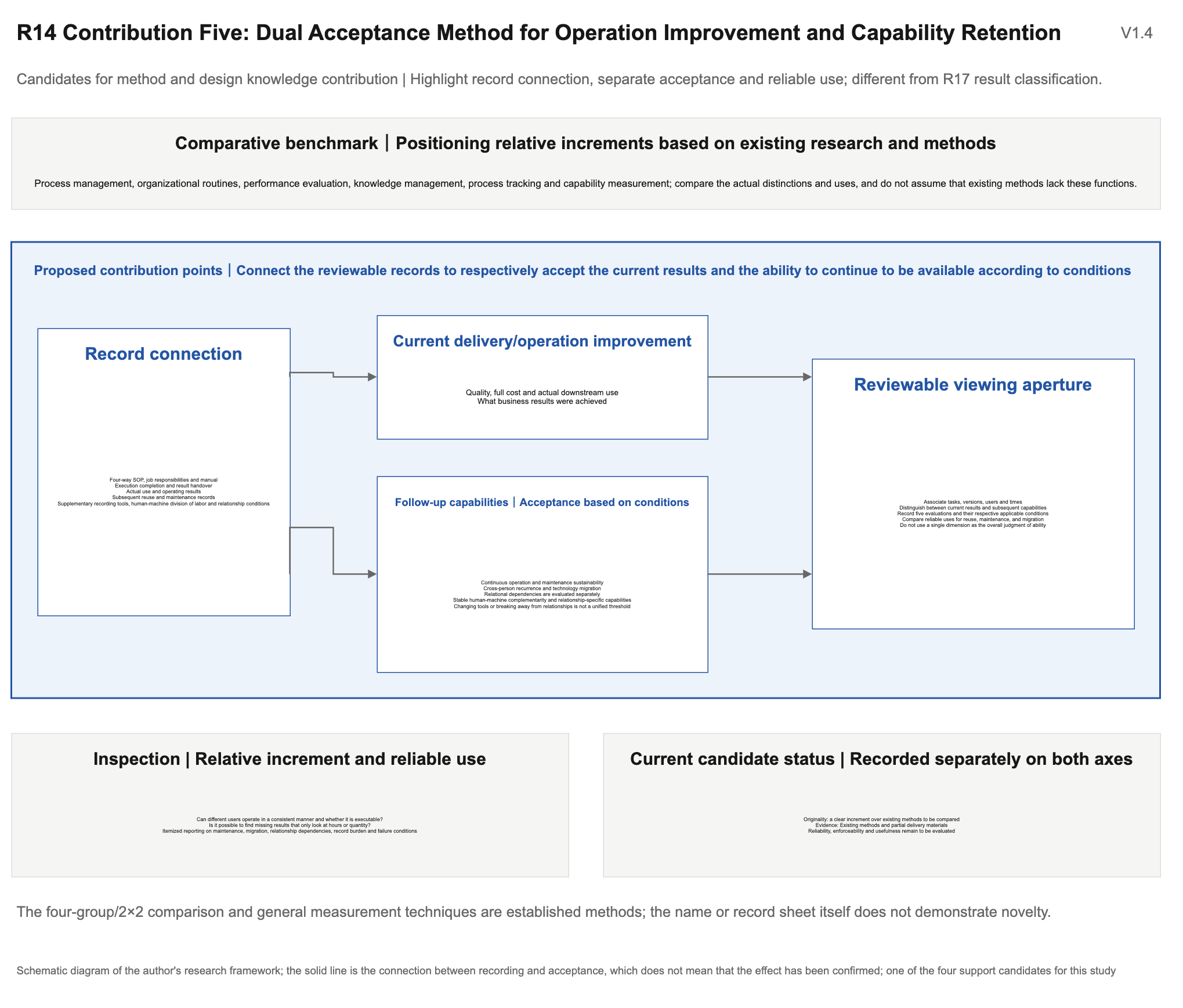
Benchmark: There are process management, organizational routines, performance evaluation, knowledge management, process tracking and capability measurement. The name of a double acceptance or a set of records does not alone prove novelty; it does indicate what distinction, reliable measurement, or applicable design principle it adds.
Evidence and counterexamples: Check whether different users can operate in a consistent manner, whether the results of missing work hours or quantities are found, and whether continuous operation, maintenance costs, cross-person recurrence, technology migration and relationship dependencies can be identified respectively. Report record burden, measurement failures, and dimensions for which there is no evidence, and do not replace all capability judgments with a single migration test. The four-group comparisons and general measurement techniques were used as established research methods and no original research design is advocated on this basis.
Current status: Existing methods and partial deliverables; clear increments, executability, reliability and utility relative to existing methods need to be evaluated.
Contribution 6: Longitudinal evidence and failure boundaries
Type: Candidates for empirical and boundary contributions; running through five directions, mainly connecting STR, OMT, CTO or SIM according to specific mechanisms.
Proposed increment: Use the real tasks, capital decisions and cooperative relationships of Company Zero to connect technical and organizational changes, capability retention, fulfillment of rights and responsibilities and subsequent actions, retain no improvements, maintenance costs, disputes and interruptions, and form reviewable process evidence and applicable boundaries.
Figure R15 · Contribution Six: Longitudinal Evidence and Failure Boundary
The diagram shows the proposed contribution points: Connect real tasks, capital decisions and inter-temporal changes in cooperative relationships, capability retention, fulfillment of rights and responsibilities and subsequent behaviors with adverse trajectories to form reviewable process evidence and locate specific increments in the judgment and application boundaries of existing mechanisms.

It is planned to connect the inter-temporal events in Company Zero's real tasks, capital decisions and cooperative relationships into reviewable process evidence, retain the lack of improvement, maintenance costs, disputes and interruptions, and test the relative increment of existing judgments, mechanism understanding and applicable boundaries.
Comparison reference: There are already cases, surveys, experiments, and longitudinal studies in the field; new locations, new cases, and more records are not automatically new theories.
Editable Draw.io · SVG Preview · PNG preview
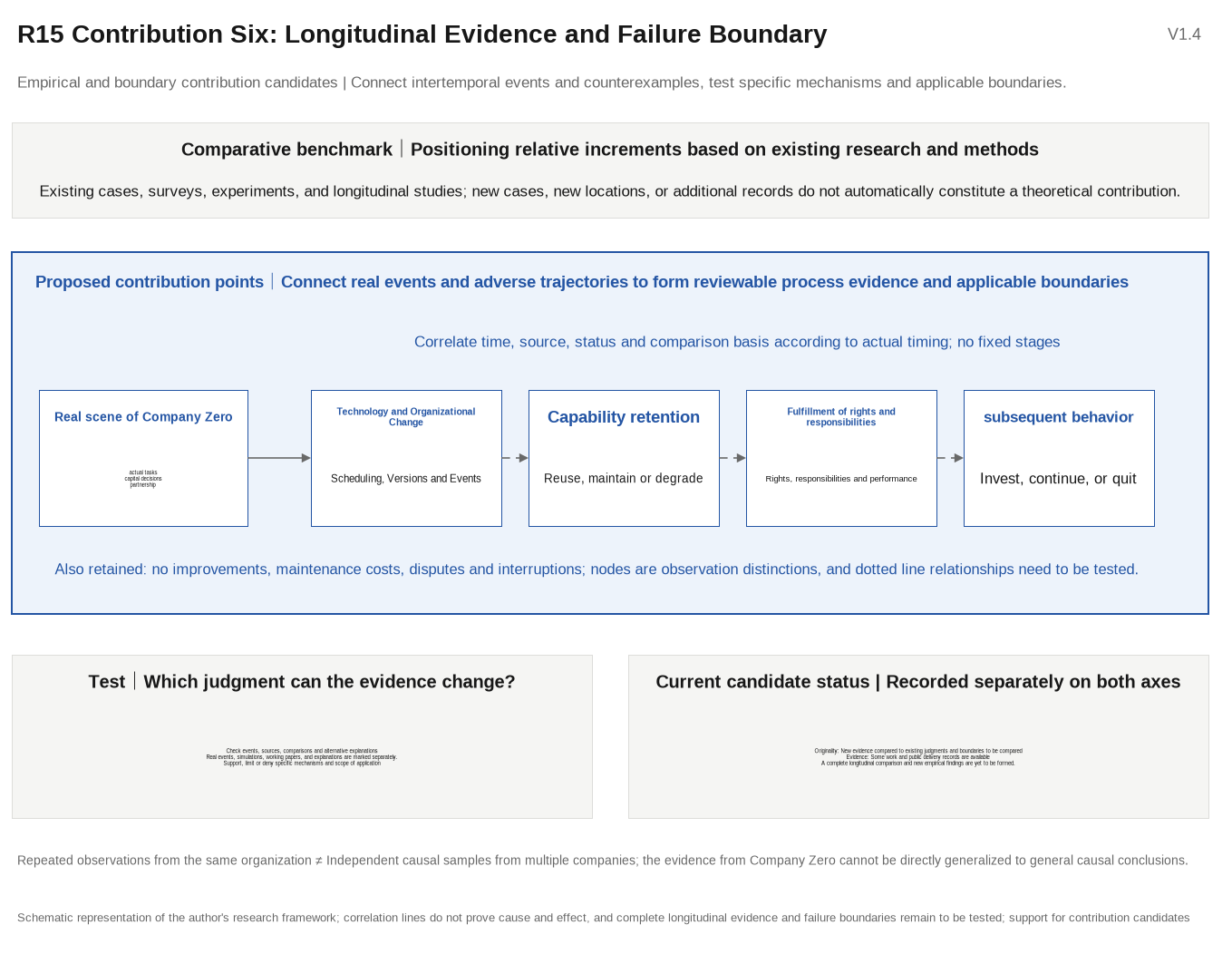
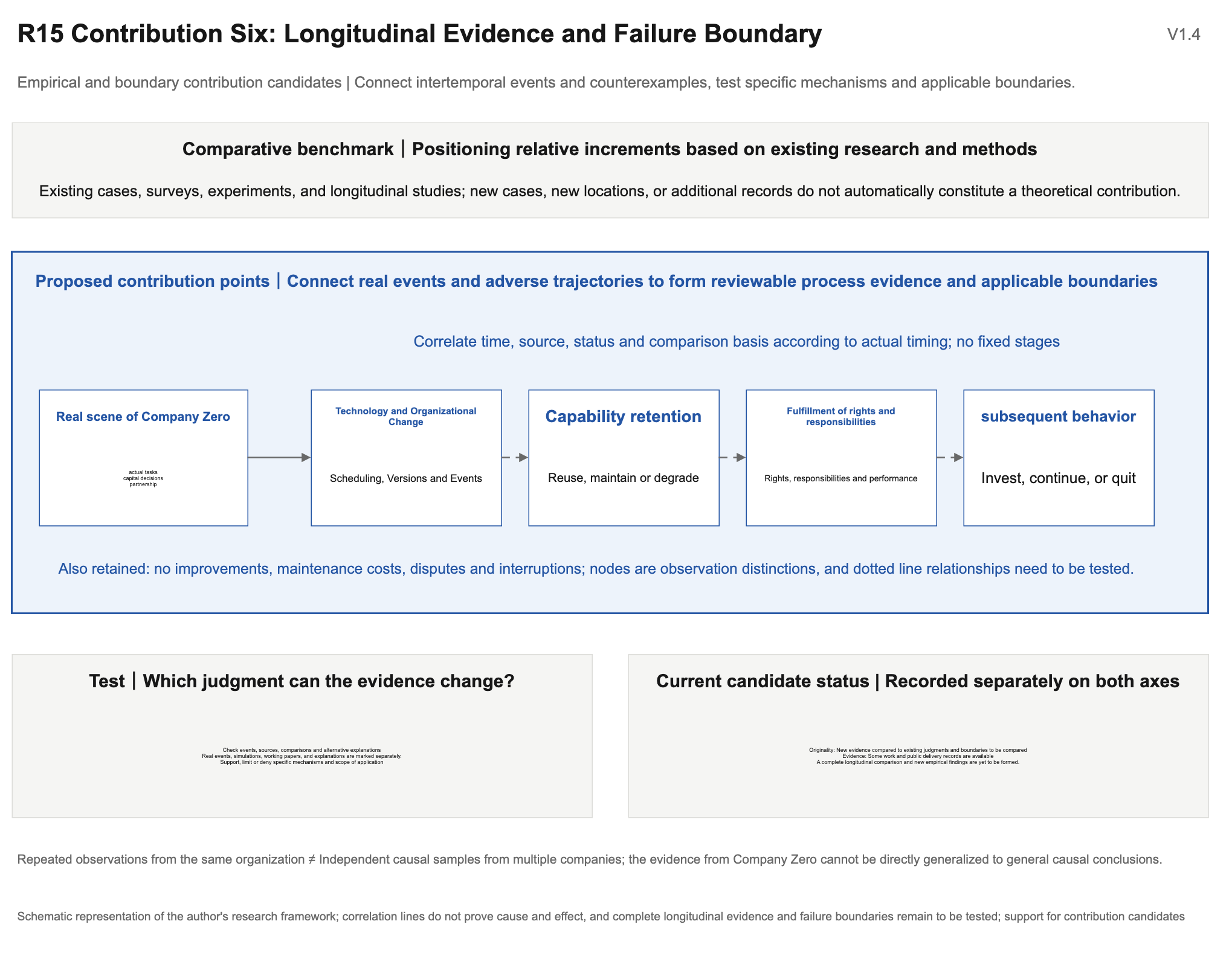
Equivalent text: Use existing cases, surveys, experiments and longitudinal studies as neutral comparison benchmarks. The proposed contribution point of the blue box is to associate the time, source, status and comparison basis in the real tasks and capital decisions of Company Zero with the cooperative relationship, connect the technical organization changes, capability retention, fulfillment of rights and responsibilities and subsequent actions, and retain unfavorable trajectories such as no improvement, maintenance costs, disputes and interruptions to form reviewable process evidence and applicable boundaries. The nodes are distinguished by observation, and are related based on the actual event sequence rather than fixed stages; the dotted line relationship needs to be tested, and the process is not drawn as an established causal chain. When evaluating, check sources, events, comparisons, and alternative explanations, differentiate between real events, simulations, working papers, and explanations, and examine which mechanism and scope of application the evidence supports, limits, or denies. The number of new cases or records does not automatically constitute a theoretical contribution. The originality axis needs to compare which existing judgments or boundaries have been changed by new evidence; the evidence axis already has some work and public delivery records, and a complete longitudinal comparison and new empirical findings have yet to be formed. Repeated observations within the same organization do not constitute independent causal samples for multiple companies, and the evidence from Company Zero cannot be directly generalized to general causal conclusions.
Benchmark: There have been cases, surveys, experiments and longitudinal studies in related fields. New cases, new locations, or additional records do not automatically constitute a theoretical contribution and require an explanation of which of the existing judgments, mechanistic understandings, or applicable boundaries they change.
Evidence and counterexamples: Identify events, states, sources, comparisons, and alternative explanations. Distinguish between real events, simulations, working papers, and interpretations; repeated observations in the same organization are interpreted at the corresponding level. The different roles of the author, human team, and AI tool are recorded separately, and multi-group collaboration in AI is not regarded as multiple independent human research samples. Counterexamples, no change, or adverse results can form borderline evidence.
Current status: Some work and public delivery records are already available, and complete longitudinal comparisons and new empirical findings are yet to be formed. The evidence from Company Zero does not directly generalize to general causal conclusions for all firms.
Correspondence between contributions and research directions and flagship topics
| candidate contribution | Main directions and main lines | Mainly undertake |
|---|---|---|
| Contribution 1: Formation and Sustainability Mechanism of Long-term Capital Relationships | E2, E3, associated B, C, D | Flagship Three; Stakeholder Capital and related mechanisms of four papers |
| Contribution 2: Design of long-term capital account system | E1—E3, associated with A2, A3, D | Flagship Three; Account, Permissions, Rules, Fulfillment and Review Design |
| Contribution Three: Organizational and Execution Changes, Capability Retention Mechanism | A1, A2, B1-B3, related to C1, C2, C3 | Flagship one. Use the next similar delivery to test the ability to retain, and use the verified purchase destination, transaction and cost to observe how much revenue the company can retain. |
| Contribution 4: Dual-way effects of capital operation and capacity building | D1—D3, associated with B, C, E | Flagship 2; Capital paths, terms and real decisions |
| Contribution Five: Double Acceptance and Observation Method | A2, B1, B3, C3, related to C1, C2, E | Flagship One and other applicable topics. Check and accept operational improvement and capability retention respectively, and then connect customer projects to market comparison. |
| Contribution Six: Longitudinal Evidence and Failure Boundary | Attribution according to specific mechanism | Three Flagships and Company Zero Practice Records |
The two proposed contributions still focus on explanation and system design. The four support candidates respectively study organizational execution, capital feedback, methods and longitudinal evidence. They also directly answer the questions of enterprise adaptation and differentiation in the general outline, and are not just for long-term capital relationships. Each item can share materials, but it is necessary to clearly explain what is being demonstrated, and the same material cannot be counted repeatedly as multiple independent discoveries.
C1 and C2 enter flagship one customer project comparison. Original contributions three and five respectively answer how to retain and how to measure ability. After peers can make similar deliveries, who can still get orders and rewards depends on the actual choice of the customer. Researchers can link two types of materials to the same project and then track whether the proceeds actually flow into the next investment.
The first batch of comparative literature and the increment to be tested
The table below is intended first to conduct a well-scoped comparison and is not yet a complete literature review, nor does it represent an identification of research gaps. The bibliographic information and public abstracts have been checked; specifically what has been added, you still need to read the relevant full text, track the follow-up literature, and then demonstrate it item by item.
| comparative literature | Already have research benchmarks | What needs further explanation in this study |
|---|---|---|
| Bridoux and Stoelhorst (2022), Stakeholder Governance | Collective action and governance arrangements in shared value creation | The distinction between the processes of confirmation, establishment of rights, actual performance and reinvestment, as well as the boundaries of long-term capital relationships |
| Gibbons and Henderson (2012), Relational Contracts and Organizational Capabilities | The connection between relational contracts and organizational capabilities | How enterprise capability formation and participants’ inter-temporal responsibilities are synchronized or not synchronized, and what is added to the account design? |
| Lumineau, Wang and Schilke (2021), Blockchain Governance | Blockchain and other cooperative governance mechanisms | Specific institutional rules for multiple roles, confirmation of authority, heterogeneous rights, performance, objection and exit |
| Brynjolfsson, Rock & Syverson (2021), The Productivity J-Curve | General technology and intangible complementary inputs | Specific intermediate mechanisms for organization and execution, retention and maintenance of capabilities, and connection with long-term rights and responsibilities |
| Myers(1977),Determinants of Corporate Borrowing | The relationship between financing, capital structure and investment opportunities | New mechanisms or boundaries for capacity input, collaboration and performance under specific capital operation arrangements |
Teece (1986) analyzed how imitation conditions and complementary assets affect the attribution of innovation benefits. Coff (1999) further explains that the bargaining power of participants affects how much benefit a company can see on its books. Following these two studies, I want to track delivery capabilities, actual revenue after requoting, and next investment selection in the same batch of customer projects, and compare the conditions under which the three are connected. This connection is the question to be examined.Teece original text · Coff original text
Supplementary closest comparison: rights, resource callability, and relationship specificity
The following four comparisons focus on equity, resource callability, and relationship specificity. The bibliographic information and abstracts of the primary sources have been checked, but this does not mean that a full-text systematic comparison or global novelty review has been completed.
| Primary source comparison object | Acknowledgment due to existing explanations | Candidate increments required for further comparison in this study |
|---|---|---|
| Rajan and Zingales (1998), Power in a Theory of the Firm [71] | Arrangements, dedicated investments and incentives for access rights to key resources have been discussed. The availability of resources or the role of rights cannot be regarded as new discoveries in themselves. | How do multi-role equity acquisition, holding and business selection relate to actual resource calls and subsequent returns? |
| Blair and Stout (1999), A Team Production Theory of Corporate Law [72] | Dedicated inputs, indivisible outputs and remuneration distribution have been discussed, and common inputs and income arrangements have been explained. | The specific mechanism and boundaries of the ongoing out-of-synchronization between equity holding, actual performance and business in the overall income system |
| Hart and Moore (1990), Property Rights and the Nature of the Firm [73] | The effect of asset control and ownership changes on investment incentives has been studied, and all income arrangements are not equated with asset ownership. | After the rights content, carrier, record and partial withdrawal are dealt with separately, what explanation or design purpose will be added to the account system? |
| Dyer and Singh (1998), The Relational View [74] | Relationship-specific assets, knowledge sharing routines, complementary resources, and governance have been discussed, and capabilities may be embedded in relationships | What are the specific methods or boundary increments when evaluating separately the retention of capabilities within relationship conditions and cross-relationship or technology transfer? |
This literature provides established explanations that require fair comparison and does not prove that this study goes beyond them. In the follow-up, we need to focus on specific propositions and design interfaces, explain the overlaps and differences one by one, and check counterexamples. The parts that can be covered by existing explanations will be reduced accordingly.
Originality depends on what is added, and evidence depends on how supportive it is.
The two types of status are recorded separately
| Judgment axis | Record content | Status of this version |
|---|---|---|
| Originality check | Author materials and sources, comparison objects, clear increments, scope of special literature comparison and conclusions | The author's accumulation has been sorted out and ranked among the first batch of comparison objects; the confirmation of the novelty of the system covering related fields has not yet been completed. |
| evidence support | Concept proof, design specifications, implementation, practical use, comparative evidence, counterexamples, and applicability boundaries | Each item is mainly based on models, designs and some process materials; the relevant causal effects and complete empirical contributions need to be tested. |
Once the manuscript is written and published, or when the system is launched and implemented, it does not itself prove novelty; the completion of document positioning does not replace the effectiveness test. Concepts and designs can form corresponding contributions after being clearly demonstrated and compared, and completion of demonstration is not the only condition for all types of contributions.
Original contribution record card
| Field | Make content clear |
|---|---|
| Contribution claim | One sentence describing the proposed explanation, design, method, or discovery |
| Contribution type | Theoretical mechanism, institutional design, methodological measurement, empirical evidence or boundary |
| baseline | Specific literature, existing explanations or actual designs, indicating the scope of comparison |
| specific increment | What relationships, rules, distinctions, indicators or applicable boundaries are changed? |
| Applicable conditions | Objects, analysis levels, necessary conditions and possible failure scenarios |
| Tests and Counterexamples | What arguments and evidence are needed, and what results will limit or deny the claim? |
| The author accumulates evidence | Manuscripts, figures, tools, versions, production records, citations and joint contributions |
| Two types of status | Record originality verification and evidence support separately, do not replace one axis with another |
Contribution statement that can be used in a research introduction
This study focuses on enterprise adaptation and differentiation in technological changes, examining how business models, organizational methods and capital arrangements are related to the formation and renewal of capabilities, value creation and acquisition, as well as the differences in long-term operating results and development paths. Under this general issue, the author continues to propose two proposed main contributions: the formation of long-term capital relations and the design of sustained and long-term capital account systems. As a specific theoretical explanation and research path, the relationship between stakeholders and long-term capital mainly connects E and D, and compares their organization, capabilities and operating consequences. Organization and execution mechanisms, capital operation feedback, double acceptance of operational improvement and capability retention, and longitudinal evidence continue to be candidates for the four supports, and also directly answer questions in each direction of the general outline. The acquisition, acceptance and continued holding, performance, withdrawal and business collaboration of equity interests are observed separately; overall income from business, asset operations and investments within the scope of the system are accounted for separately, and the specific terms are still to be determined. Capability retention, maintenance, cross-person recurrence, technology transfer and relationship dependence are also evaluated separately.
This introduction describes the proposed research contribution. Specific claims will continue to be updated with literature comparisons, theoretical arguments, design evaluations, and practical evidence.
Conceptual Boundaries of Long-term Capital Relationships and Operating Assets
This section explains the analytical definition and boundaries of the relationship path between stakeholders and long-term capital, mainly connecting E and D, and also used to compare its consequences on B, C, and A. These path definitions are not common premises for all research directions. This section takes over existing Four capital concepts, does not replace specific contracts, accounting confirmations, legal or security rights determinations.
Definition and identification of objects
| concept | Implications of this study | Not launching anything directly |
|---|---|---|
| Dispersed elements | The knowledge, professional abilities, social relationships and funds distributed among different people and organizations participate in operations according to actual wishes, tasks and effective arrangements. | Being included, established in contact, or willing to participate does not mean that you have been authorized, available, or completed your investment; people and institutions maintain their independent identities. |
| Sustainable deployment of corporate capabilities | The enterprise's ability to continue to organize and use under clear conditions and bear corresponding maintenance investment. Continuous operation, maintenance sustainability, cross-person recurrence, technology migration and relationship dependence are evaluated separately. | Each capability is not required to be established without specific tools or relationships; stable human-machine complementarity and relationship-specific capabilities can exist, and dependencies and restrictions must be clear. |
| operating assets | Resources and rights that have identifiable control or use boundaries, form a certain economic value, and are used for operations. Research traces its formation, actual use and maintenance. | Professional reputations, character lists, or social connections do not belong to the enterprise just because they are recorded; asset statements in operating analysis do not automatically form accounting assets or issuable securities. |
| Long-term capital relationships | This study refers to participants' independent acceptance and continued holding of equity related to the company's long-term value and capital strategy based on effective arrangements to support subsequent co-creation investments, and to organize the relationship between inter-temporal returns, responsibilities, risks and cooperation choices accordingly. This equity arrangement can be superimposed on the original role. | Duration, fixed remuneration, one-time contribution record, account existence or technical realization are not enough to be recognized separately; deferred settlement of wages or payment does not become such equity because of inter-temporal collection. Ordinary business relationships and capital equity relationships should be observed separately. |
Positive and negative boundary examples
The following is a hypothetical example of concept analysis to illustrate what needs to be checked. It does not mean that the existing co-construction system or specific rights and interests have taken effect.
| situation | Conceptual judgment and the boundaries that need to be observed |
|---|---|
| Employees receive wages for a long time, suppliers continue to supply goods, or members pay and use services as scheduled; there is no other basis for accepting and holding rights and interests related to the company's long-term value and capital strategy. | These can be ongoing labor, transactions, membership or service relationships. They cannot be identified solely as “long-term” in what this study calls capital relationships, nor can they all be called one-time transactions. |
| The same employee, customer or supplier independently accepts and continues to hold interests related to the company's long-term value and capital strategy according to effective arrangements, while assuming agreed responsibilities or risks. | This is a positive situation that can be included in the analysis of long-term capital relations; continue to check the content, basis, actual holding and performance of rights separately. The original wage, consumption or supply arrangements will not be automatically converted as a result. |
| The participants have stopped business collaboration, but the above interests are still held under valid arrangements. | The cessation of the business relationship does not directly equal the termination of the equity relationship; the holding, applicable rights and responsibilities and performance are recorded separately, and whether to continue to provide services is not a substitute for judgment. |
| If subsequent rules allow and the above-mentioned equity transfer is actually completed, the participants will continue the original business; or only transfer part of the equity, and there are still matters to be performed. | The continuation of the business does not directly mean the continuation of the original holding relationship; distinguish between the transferred and still held parts, original business obligations and pending performance. There is no presumption of free transfer, repurchase at any time, or simultaneous termination of all liability. |
| Enterprises rely on stable human-machine collaboration or specific partnerships for continuous delivery, and performance declines when they change tools or break away from the relationship. | The ability under the original conditions cannot be denied simply based on the decline after replacement; at the same time, the maintenance cost, cross-person recurrence, migration and relationship dependence should be evaluated to clarify its applicable boundaries. Capability retention does not directly prove that participants’ rights and responsibilities have been fulfilled. |
When the business is stopped, whether the rights and interests are retained and the responsibilities are settled depends on the agreement.
Operating income, rights and exits are checked separately
After formal operation, the proposed system will be oriented to the overall operating income and related rights and responsibilities, including commercial, asset operation, investment and other income within the scope of the system, and will be accounted separately according to the source and corresponding rights and responsibilities, and will not be narrowed down to sharing only new income. Operating income must be distinguished from costs, profits, actual distribution, corporate retention and reinvestment; covering the entire operation does not mean that all revenue is divided, nor does the proportion be determined accordingly. The specific proportions, existing equity, historical business connection and effective boundaries are still to be determined by subsequent systems.
Rights content, undertaking carrier, registration technology and exit conditions are separated: dividends involve income and its implementation, equity, stock and STO related arrangements must check the specific underlying rights and applicable basis; records or technical expressions do not make them automatically interchangeable. Participants can choose whether to accept and continue to hold. The actual transfer, partial transfer, repurchase and pending performance will be observed separately according to effective arrangements. There is no predetermined automatic conversion, unconditional transfer or repurchase at any time. No issuance, trading, distribution or governance threshold schemes are established here.
Unify comparison dimensions and mechanisms of action
| Compare dimensions | Record content together |
|---|---|
| level of analysis | Task, person, team or process, project, enterprise, inter-organizational relationship. Indicate the personnel, processes, projects and subjects to which the incident belongs, and clarify the comparison units and conclusion levels. |
| technology exposure | AI’s model capabilities, versions, usage intensity, task coverage, data access, system integration and manual review; blockchain’s chain type, participants, permissions, verification, rule versions, on-chain and off-chain interfaces and actual coverage. |
| Organization and Capital Conditions | Management and skills, process maturity, cash and liquidity, funding sources and investment horizons. |
| Market, rights and time environment | Demand, competition, bargaining, intellectual property, system; adoption, learning, stable operation, update and exit stages. |
Priority inspection mechanism
Prioritize testing of mechanisms such as learning, coordination, control, information verification, supervision and performance, bargaining and incentives, and risk sharing. Each topic first focuses on one or two mechanisms and explains how to observe the intermediate processes.
Theories and alternative explanations
Organizational learning, resources and capabilities, transaction costs, relational contracts, corporate finance and stakeholder theory are used to explain the different mechanisms. Alternative explanations such as selection differences, management quality, market changes, prior capabilities and contemporaneous inputs are also examined.
When studying the differences among peers, first explain which companies or businesses are fighting for the same type of customers, what options the customers have, and in which bidding or contract renewal they can really change their choices. A company's own back-and-forth records can illustrate how operations have changed. Comparable quotations from similar customers, delivery conditions from alternative suppliers, or transaction results after follow-up by peers can help determine whether the gap continues. When comparing, check service scope, quality, requirements and contract length.
time and boundaries
Record pre-adoption, run-in, and stabilization periods, and then track necessary updates, condition changes, and exit events. Capabilities, customer relationships and financing arrangements may change at different times; see the five-dimensional evaluation of capabilities B3。
Nested Observations and Conclusions Hierarchy
A piece of content, a task execution, a delivery or revision event may all be nested within the same person, team or process, project and enterprise. When cross-organizational cooperation is involved, record the subjects and relationships of both parties separately. The research card should clearly state the observation unit, comparison unit and level of inference at the same time, and retain the source, time, version and attribution to facilitate review of changes in the same relationship.
Multiple tasks, multiple versions or multiple months in the same organization are repeated or nested observations and cannot be directly treated as multiple independent enterprises. To improve the quality of a single task, task-level conclusions must first be formed; to judge the process or enterprise capabilities, evidence of continuous operation, maintenance, and organizational calls within the corresponding scope is also required. To make operational or causal claims, appropriate comparisons are also required. The roles of authors, human teams, and AI tools are recorded separately; AI multi-group collaboration is a work arrangement and is not equivalent to multiple independent human research samples.
“Using similar technology” is judged based on observable exposure conditions. The same technology brand, account opening or system launch are not enough to independently indicate that the actual use is similar.
Comparison requirements for new mechanisms
- Organizational change clearly documents changes in division of labor, delegation of authority, resources, handovers, reviews, and feedback, comparing their effects to those of the technology itself.
- Capital operations also record the choice of entry path, initial operating conditions, tools and terms, actual resource changes and subsequent strategies; check the differences in choices and market changes in the same period.
- Long-term capital accounts compare confirmation, review, authorization, performance and dispute arrangements, record participation choices and original relationships, and avoid directly interpreting the existence of the account as a cooperative effect.
Observations are defined by business events, status changes and necessary follow-up processes, and no fixed implementation period is preset.
Comparison of two types of institutional technology
Make rules, incentives and participation conditions as comparable as possible, and then compare the differences between blockchain and centralized or other shared record implementations; make technical conditions as comparable as possible, and then compare the differences in confirmation, permissions, rights, performance and dispute rules. There may also be interactions between technology and institutions, which should be tested based on the actual design and explain which factors cannot be separated yet.
Also look at verification and coordination costs, errors and corrections, disputes, fulfillment, follow-up investment and maintenance burden. These judgments must be made based on actual processes and comparisons, and cannot be directly inferred based on chaining, automatic execution, or system launch.
Research cards, indicators and evidence
| study card fields | Make content clear |
|---|---|
| 01 object | Research who and what works, tasks, processes, projects, or partnerships; identify the people and organizations within which they are embedded. |
| 02 Phenomenon to be explained | What differences or changes require explanation, and what is missing from existing explanations. |
| 03 Compare arrangements | Write clearly who you are comparing with, at which event, and under what conditions. When studying competitive gaps, list the actual suppliers or solutions that customers can choose from, as well as the timing of requotes, renewals, or peer follow-up. press unified caliber Indicate the units of observation, units of comparison, and levels of conclusion. |
| 04 Mechanism of action | Which intermediate process connects arrangement to outcome. |
| 05 Result Indicators | Quality, total cost, customers, capabilities, cash or cooperation behavior; capabilities set applicable indicators based on continuous operation, maintenance, cross-person recurrence, migration and relationship dependence. |
| 06 time range | The necessary observation scope is defined according to adoption, learning, stabilization, update and exit events, and no fixed period is preset. |
| 07 Evidence and Identification | Data sources, methods of allocation or selection, alternative interpretations, and limitations. |
| 08 Rejection conditions | Which results weaken, limit, or negate the intended explanation. |
Common indicator stratification
Task: Quality, hours, errors, rework and review. Process and capabilities: Waiting, handover, downstream use; ongoing operations and maintenance burdens, cross-person recurrence, applicable technology migration, and relationship dependencies. Each dimension retains applicable conditions, support level and open issues respectively. Operations and Capital: Customer payments, profits, cash, investments, cost of capital and risks. Governance and cooperation: Review, rights fulfillment, additional investment, contract renewal, dispute and withdrawal.
Distinguish between completion, acceptance, actual use, operational changes and causal effects. Each record retains the source, time, version, confirmation responsibility and outstanding issues; the indicator caliber is determined before comparison.
The academic positioning field of the subject
The research card should also indicate the main direction and main line, main AOM fields, conditional intersections, adjacent disciplines and reasons for positioning. Theories, schemes, methods and tools are listed separately, and the research questions, implementation methods and result evidence are also described separately.
Notes on original contributions
Each research card is also associated with a clear contribution claim, recording comparative literature, specific increments, applicable conditions and counterexamples, and recording originality verification and evidence support status separately. For specific caliber, see Original contribution record card。
The connection between evaluation process and research inspection
Figure R20 Check user value and participation contribution respectively;Figure R17 Check the current operating improvement and inter-temporal capability retention separately. The two sets of judgments answer different questions and can relate to the same project and outcome, but each draws conclusions based on corresponding evidence. Process acceptance and inspection of academic mechanisms also continue to be separated.
Where to start collecting evidence for the three flagship topics?
Let’s start with the customer delivery that Company Zero is already doing. Budget and equity research each have their own starting conditions. When the conditions are met, they can be recorded simultaneously.Figure R29 · The order of evidence collection for the three flagship topics
| Flagship study | What event does it start from? | Which subsequent event | What can this set of materials answer? |
|---|---|---|---|
| 1. Technology, organization and capabilities | Select repeatable customer service categories in advance and include them in the entire project from the first round of delivery, documenting quality standards, contract pricing, division of labor, baselines and costs. | Track the next similar delivery, customer purchasing direction and subsequent investment. Keep records of items that have not yet expired, canceled purchases, not invited, failed bids, completed transactions and unknown destinations. | Check whether capabilities can be reused. First verify the transactions and costs, and then estimate the net benefits of all parties and compare the competitive gaps when the evidence is sufficient. |
| 2. Capital and Capacity Investment | When a real budget decision comes, keep the same batch of alternatives, available funds, and current judgments together. | Record which projects were approved, delayed, abandoned or disapproved, and then track changes in actual investment and capabilities. | How managers select projects. To judge the role of the funds themselves, it is also necessary to distinguish between project prospects and funding conditions. |
| 3. Contribution, equity and reinvestment | Use scenario comparison research and judgment during system preparation. After the rules come into force, invitations, selections and fulfillment of vested interests are recorded, starting with those who qualify. | The next time there is an optional cooperation, observe who invests again and what they invest, and also record the situation of retaining rights and stopping services. | Situations test judgment, and real opportunities and actions test behavior. The two types of studies are reported separately. |
How technology and organizational arrangements can lead to sustainable business improvements
This section studies how technology selection and organizational adjustments form, update capabilities and affect operating results, and why the adoption of similar technologies may result in different long-term results, to answer this part of the overall question. Specifically compare the role, complementarity and sustainability of business needs and task conditions, organizational methods, technology and institutional arrangements, observe operational improvement and capability retention, and also retain no change, failure and different development paths. Long-term capital relationships and related governance arrangements can be used as comparative paths in specific topics.
This section mainly connects A, B, and C. When cooperation is involved, we will study the confirmation, authority, and performance in E. Company Zero already has two types of real work: customer delivery and knowledge content construction. Flagship One gives priority to a type of service that can be provided repeatedly, registers the entire batch of eligible projects from the first round of delivery, and tracks the whereabouts of the customer's next purchase. Knowledge content construction continues to provide materials for handover, reuse and maintenance, and can also be studied independently.
Two types of real work entrances
| work entrance | definable observation object | Connectable records and issues |
|---|---|---|
| Knowledge content construction | A piece of content, a revision and the process of sorting, checking, handover and subsequent use. | Source and version, work of the author and human team, participation in AI tools, usage feedback; whether the results can be continuously used and maintained under clear conditions. |
| Customer commercial delivery | Among the service categories selected in advance, the first round delivery and subsequent procurement destination of the entire batch of customer projects. | Demand, quality, technology usage, handover, cost, actual usage and pricing. When similar deliveries occur, they are inspected and reused, and the customer's choice, evidence-based transfer order, actual quotation, transaction and subsequent investment are also recorded. |
Start by choosing a type of delivery where the scope and quality thresholds are clear, such as a recurring enterprise service. Save task records, contracts and accounting information in the first round, and then update the customer's whereabouts based on the actual evidence available. Internal knowledge work is evaluated based on actual use and maintenance. When the two types of jobs have comparable conditions, we can discuss whether they can corroborate each other.
Flagship One Research Card · Track your customers’ next selection from first delivery
| When to remember | What to record |
|---|---|
| included for the first time | Determine in advance the types of services that can be provided repeatedly, the scope of inclusion, and the batches from which observations will begin. Enrollment begins with the first delivery of each eligible customer project, retaining the entire batch of projects. In the first round, write down the tasks, pricing, quality standards, costs and expected next purchase time. |
| Return visit for next purchase | Record separately according to verifiable facts: the procurement time has not yet arrived, it is confirmed that there is no subsequent purchase or the demand is cancelled, the customer purchases but does not invite the company, the company participates in the bidding but loses, the company concludes the transaction, and the destination is unknown. If the transfer to other suppliers has been confirmed, indicate the basis for the transfer and whether the company was invited at that time. |
| Review evidence and results | Indicate the date and basis for each status update, which can be verified by customer confirmation, invitation, quotation, purchasing decision or contract. If a quote is missing or cannot be contacted, keep the original item and mark the relevant fields as "Unknown" and state the reason. Confirmed transfer orders will be included in the competition results, and other projects with unknown destinations will not be treated as lost orders or zero income. |
Figure R16 · Technology-Organization-Capability Mechanism

Select AI, blockchain, and their combinations by task, and compare how organizational and learning arrangements impact capabilities. Customer projects track where the next purchase will go. When quotes are available, compare the customer's alternatives and closing conditions.
Editable Draw.io · SVG Preview · PNG preview · full equivalent text
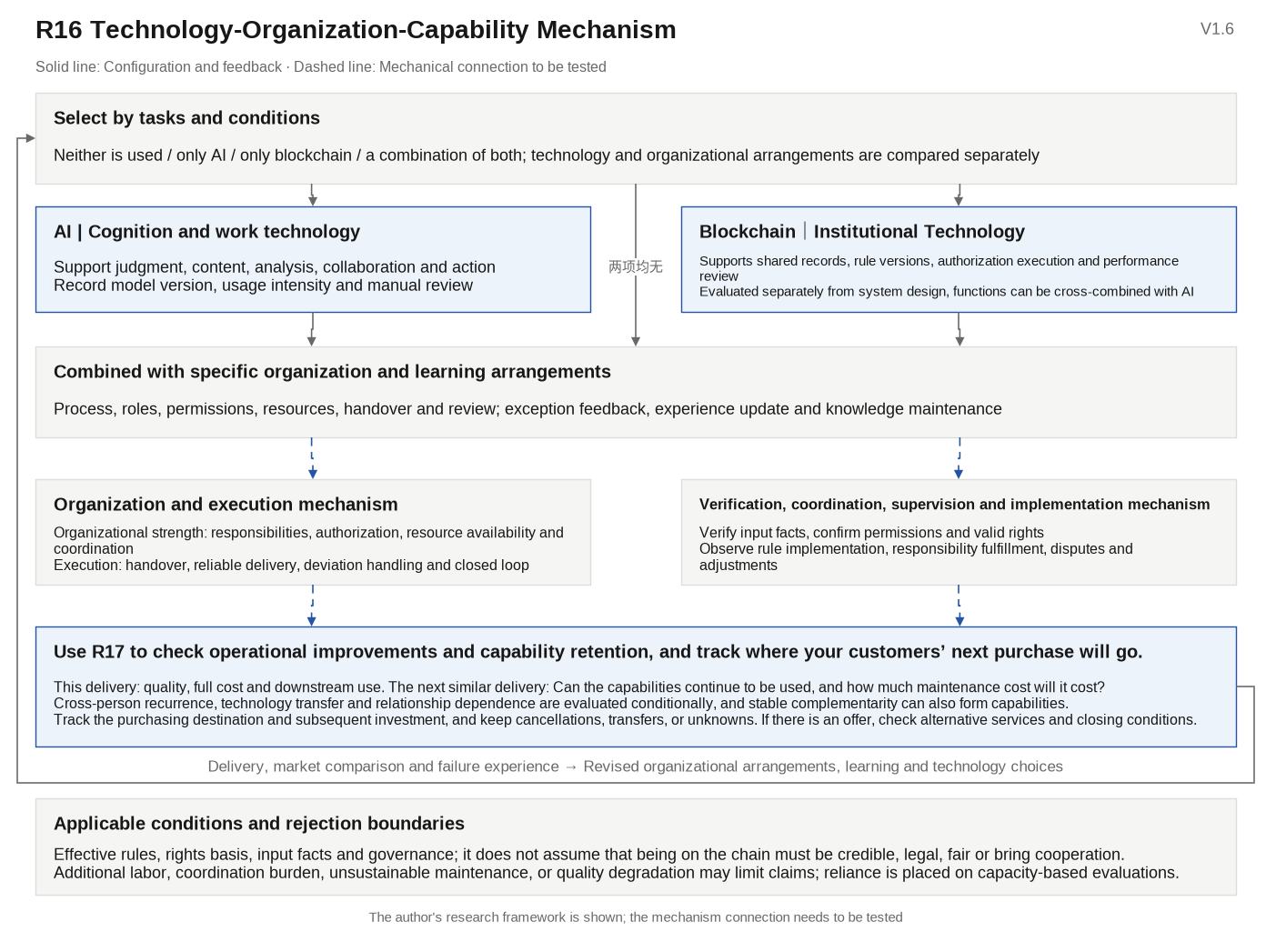
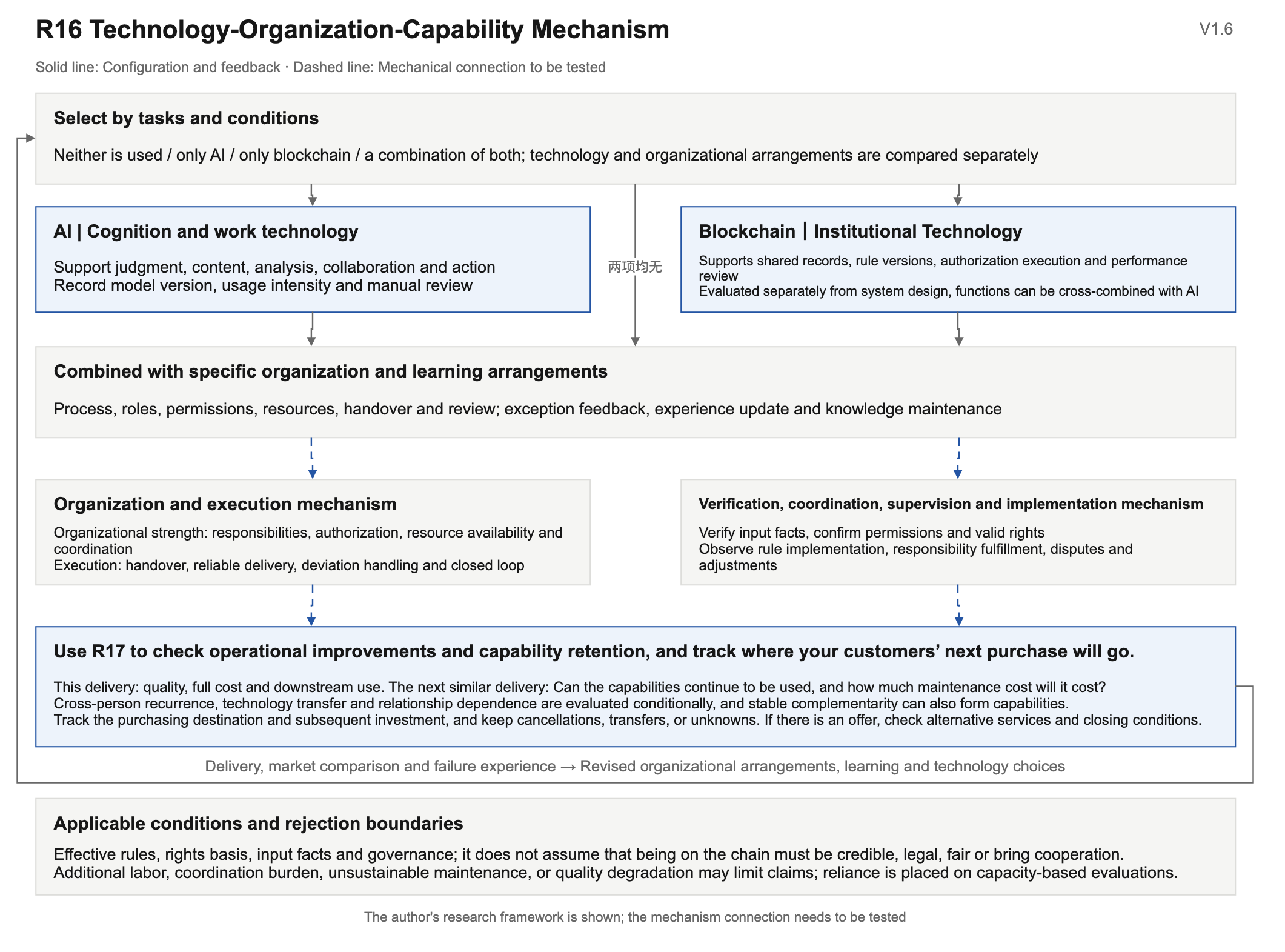
Two types of technology, the same business and capability issues
| Technology and Arrangement | Effect on specific work | Results that require interpretation |
|---|---|---|
| AI and human-machine collaboration | Change analysis, judgment, generation, execution and learning, reallocate tasks and manual review | Quality, full cost, downstream use, independent judgment and retention of capabilities |
| Blockchain as an institutional technology | Change shared verification, confirm permissions, rule versions, authorization execution and fulfillment review | Coordination and supervision of costs, clarity of rights and responsibilities, disputes, fulfillment and ongoing cooperation |
| Organization and system matching | Clarify job responsibilities, processes, resources, handovers, confirmations, objections and knowledge maintenance | Can the changes produced by technology be delivered reliably and become sustainable operational and cooperative capabilities? |
Technologies can be used none, individually or in combination. Explain which capabilities are required for specific problems and then establish appropriate comparisons, without requiring both AI and blockchain to be used for every task.
Already have a starting point and practical combination
Four-way SOP, enterprise AI management capability reconstruction system, SOP to Skill, action and capability accumulation; blockchain system technology, long-term capital account, contribution review and rule fulfillment design; knowledge organization, digital business platform, brand services, technology implementation and operation and maintenance. Paper III provides a mechanism for accepting feedback to change standards and resource arrangements.
AI versus work organization
| Existing work arrangements | Increase process and knowledge maintenance arrangements | |
|---|---|---|
| Not using AI | ① Existing process baseline | ② Process and organizational arrangements |
| Adopt AI | ③ AI integration into existing processes | ④ Combination of AI and organizational arrangements |
First, specify which job responsibilities, handover, acceptance or knowledge maintenance arrangements have changed. When conditions permit, use four sets of comparisons to identify the effects of AI, organizational adjustments, and their combination. If multiple teams share the same knowledge base, record when new practices are spread to other groups, and prioritize relatively independent workflows for comparison.
Comparison between blockchain and institutional arrangements
Select business relationships with multi-party confirmations, shared rules, authorizations, or delayed performance. When rules and incentives are comparable, compare blockchain with other recording and execution methods; when technical conditions are comparable, compare different confirmation, authority, review, dispute and performance rules. Whether AI participates will be recorded separately. When the combination effect needs to be studied, corresponding comparisons will be designed.
Focus on how the facts of contribution and performance enter into the decision, who has the right to confirm and change the rules, how errors and objections are corrected, whether resources and funds are sufficient to perform, and whether the actual participants change collaboration or investment, or choose to withdraw.
Observation and identification
First agree on the delivery scope, quality threshold and cost caliber, and then compare the waiting, rework, verification, disputes, redemption and actual downstream use of similar tasks. Document model version, usage intensity, personnel experience, additional labor, and contemporaneous changes. Choose random allocation, phased pilot or comparison group according to actual conditions.Nested viewing apertures Explain which conclusion these observations support.
Make a hypothetical comparison in terms of pricing. Both services use similar AI, are comparable in scope and quality, and both save man-hours. If a fixed-price project pays less outsourcing fees, the company may retain more revenue after deducting new expenses such as models, reviews, and maintenance. Projects billed on actual hours worked, client bill may be reduced by hours worked. To see what the company has received, it is also necessary to check where the vacated people have gone, whether they have received new orders, and how much the new orders have cost. The choice of contract itself may also be related to the difficulty of the task and the customer's bargaining power, which should be recorded when making comparisons.
The next time a similar delivery occurs, see whether the original approach can be reused, whether the same quality can be achieved after the handover, and how much maintenance is actually required. When the customer gets an alternative quotation or re-tenders, record the scope and conditions of the quotations from both parties, who was finally selected, and at what price the transaction was completed. When it is easy for competitors to follow suit and for customers to switch suppliers, the original price gap may quickly narrow. If a company can continue to provide packaged delivery that is difficult for its peers to replicate, customers may also accept the original price. Which situation is true depends on the real choice. Finally, correlate the actual reimbursement and project benefits with the next decision on personnel, budget, or maintenance investment, and ask which changes affected the decision.
Figure R17·Double acceptance of business improvement and capability retention

First, separately verify the current operating improvement and the capacity retention in the next similar delivery. Customer projects continue to track the next purchase destination and subsequent investment, and then check the quotation, alternatives and transaction results when invited.
Editable Draw.io · SVG Preview · PNG preview · full equivalent text
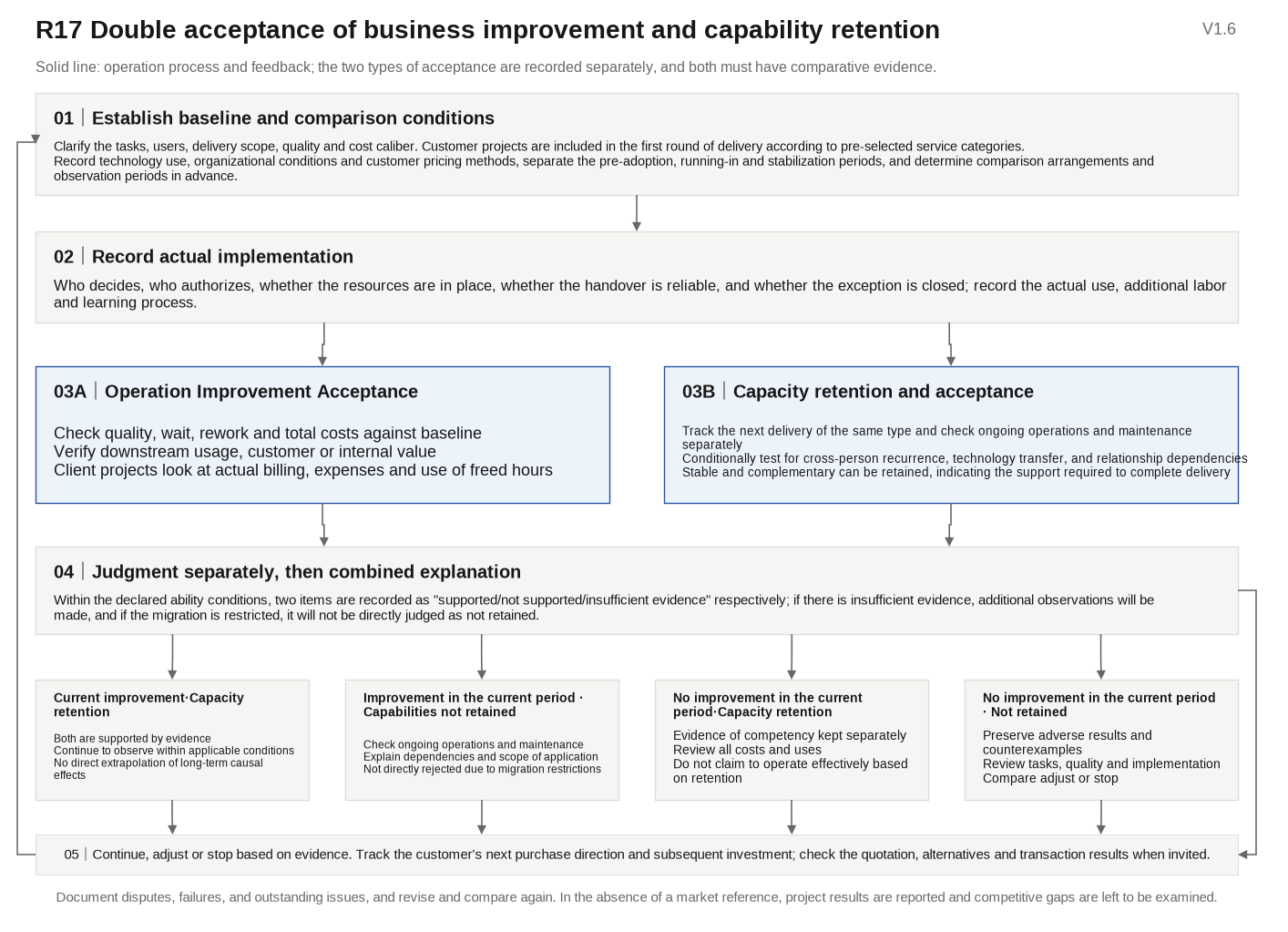
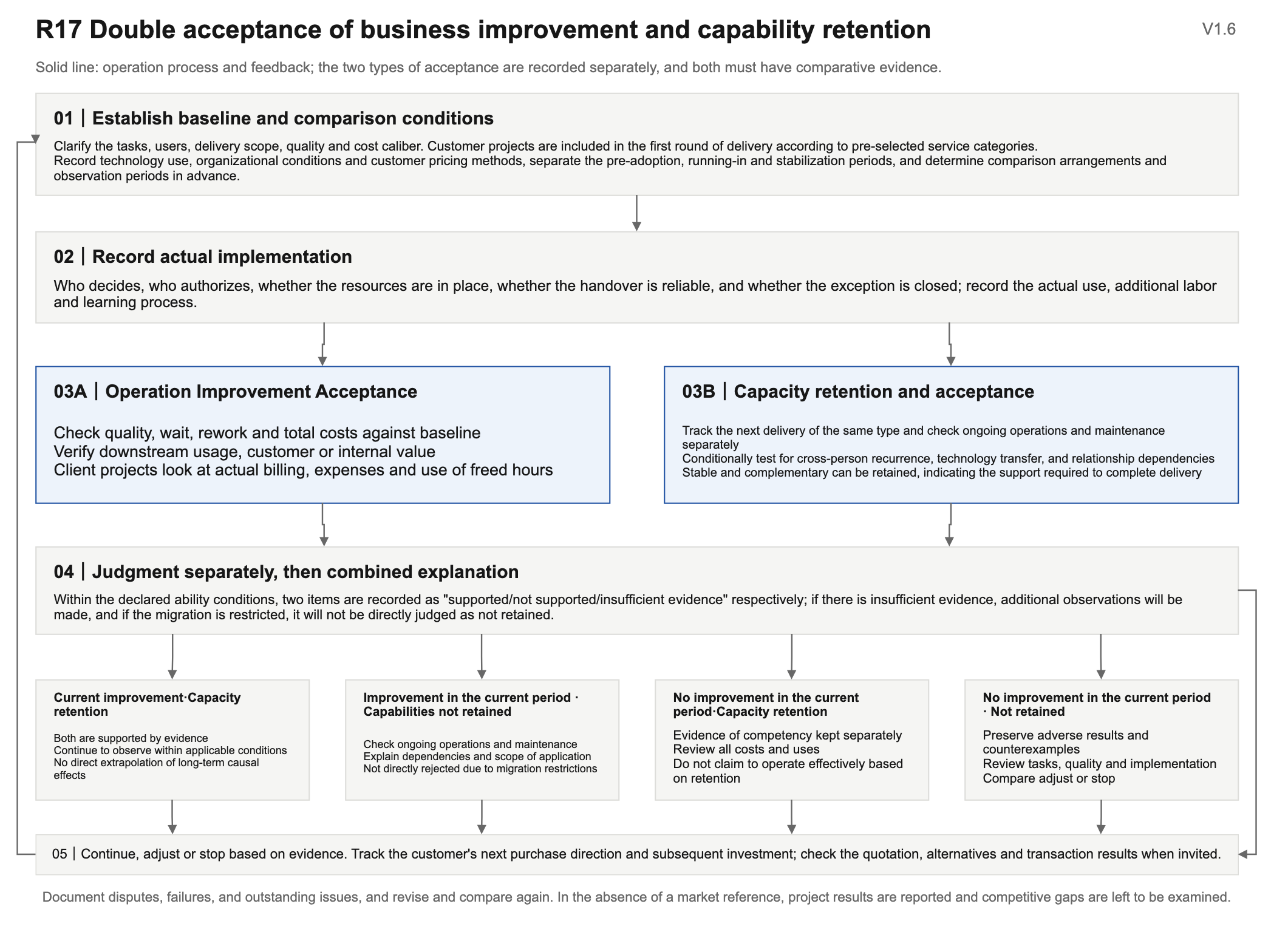
Double acceptance of business improvement and capability retention
Current acceptance will look at delivery quality, actual use, total costs and operating results; subsequent capabilities will be evaluated based on continued operation, maintenance sustainability, cross-person recurrence, technology migration and relationship dependence. First explain what conditions the ability depends on and which dimensions are ready to be tested, and then judge whether it is supported, not supported or insufficiently supported within this range. Do not use changing tools or breaking away from the relationship as a unified threshold. It may be that there has been improvement in the current period, but the ability to be continuously used has not been formed; it is also possible that the ability has remained under stable and complementary conditions, but the migration is limited; it is also possible that the ability has been formed, but the customer value has not yet been realized. The reasons for these results must be explained separately.
Vetoes and boundaries
If improvements come only from unaccounted for additional labor, unsustainable maintenance, task selection or quality degradation, limit the interpretation of efficiency and capacity accumulation accordingly. If only the effects of processes are found, organizational improvements will be reported separately; if only short-term tool effects are found, only short-term effects will be reported. Complementarity of stable tools or dependence on specific relationships will not be vetoed by themselves, and sustainability and transferability will be judged separately. When records are more complete but there are no changes in rights, responsibilities, performance and subsequent actions, the scope of interpretation of institutional technology should also be limited.
If the customer directly turns to another company for purchase, the result of the competition will be recorded if there is evidence, even if the company does not quote another price. If the destination is unknown, keep the item and write down which information is missing. To determine how big the gap is and how long it will last, it is also necessary to check the comparable range, quality, price and cost.
Stage outputs include task baselines and comparison plans, project full cost and pricing records, knowledge and rule versions, the next similar delivery, customer procurement destinations and actual quotation records, as well as decision records that explain the reasons for subsequent investment.
A direct test of organizational and execution capabilities
When comparing, it is also recorded who made the decision, who authorized it, whether resources are in place, whether the handover is reliable, whether the confirmation is well-founded, and whether exceptions and disputes are closed. Use organizational and execution changes as mechanisms to observe downstream actual usage, customer or internal value, maintenance, and capability retention.
The academic positioning is mainly CTO, ODC and STR; institutional rules and cross-subject collaboration connect OMT and SIM, and human judgment and team process intersect OB and MOC according to issues.
How do funding conditions affect the continuation, adjustment and cessation of capability investment?
This section mainly connects B, C, and D to answer the general question of how capital arrangements support or constrain enterprise adaptation, capability renewal, and development paths. Specifically study how capital market connections, financial instruments and transaction structures, capital allocation, control rights and stage feedback affect the selection, continuation, adjustment and discontinuation of capability investments. Long-term capital relationships and their return commitments can be used as a comparative approach to related topics, and can be studied separately from other funding and rights and responsibility arrangements.
Figure R18·Capacity investment and capital feedback

Track budget selections and subsequent changes from the same batch of alternatives. Compare the two-way connection between capital, capabilities and operating results, and check earnings, cash, financing and valuation separately.
Editable Draw.io · SVG Preview · PNG preview
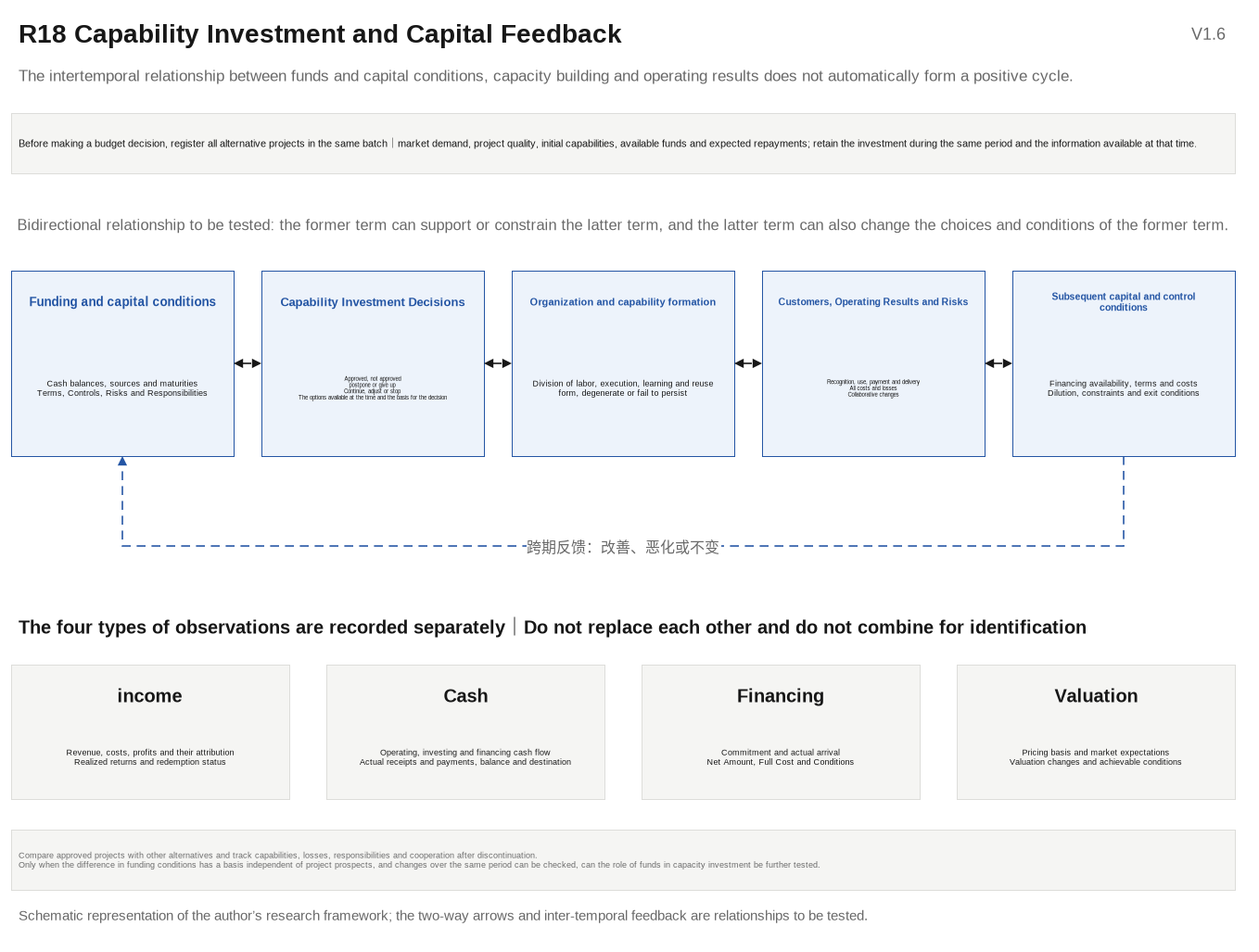
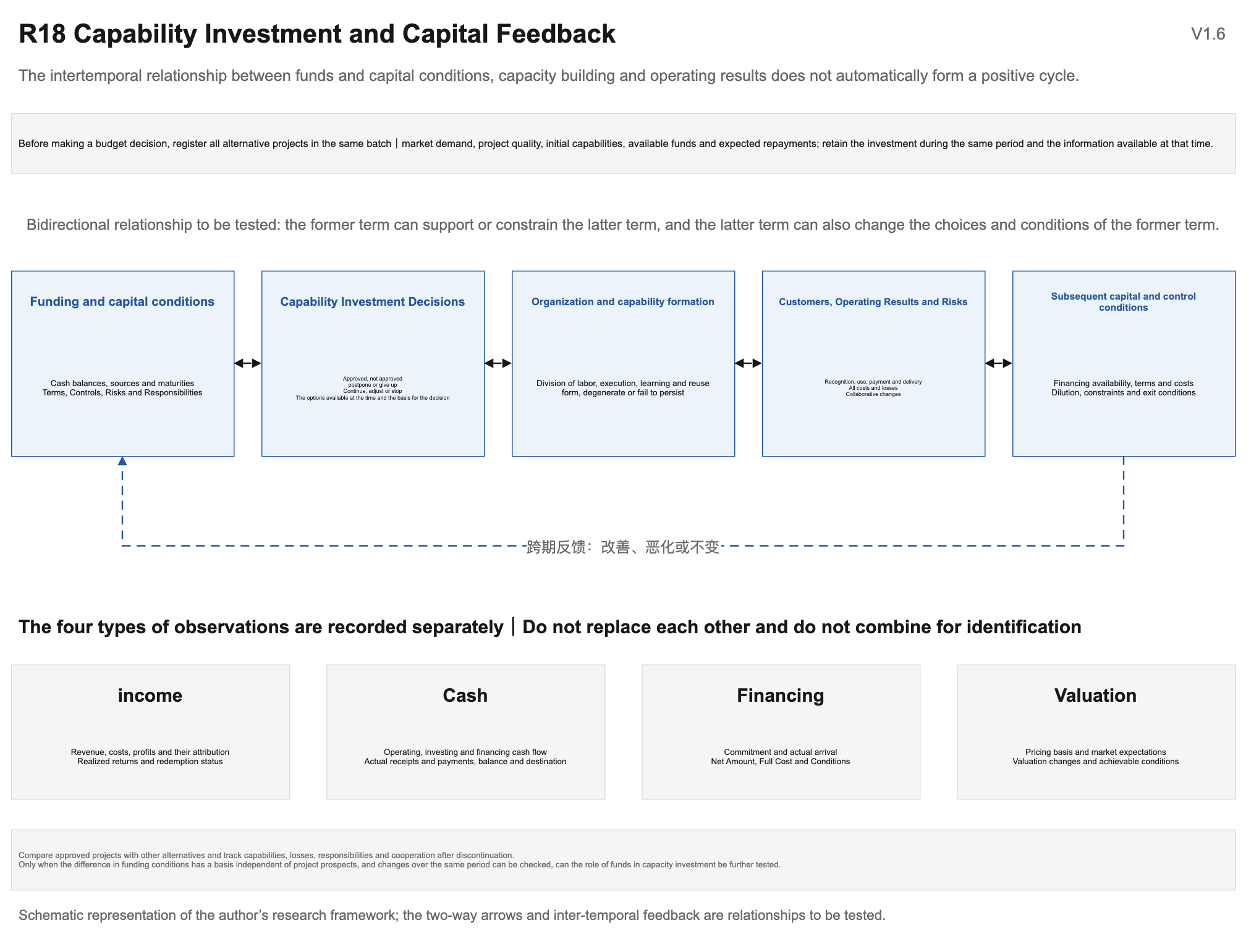
Equivalent text: Listed above are the same batch of alternative projects that need to be registered before decision-making, as well as their market demand, quality, initial capacity, available funds, expected repayments and contemporaneous investment. The five nodes in the middle are funding and capital conditions, capability investment decisions, organization and capability formation, customer operating results and risks, and follow-up capital and control conditions. Bidirectional connections and intertemporal feedback represent relationships to be tested. Investment options include approval, disapproval, extension, abandonment, and post-implementation continuation, adjustment and discontinuation. Observe income, cash, financing and valuation respectively below, distinguishing between commitments and receipts, valuation and achievable conditions. Compare approved projects with other alternatives, and track capabilities, losses, responsibilities, and cooperation after discontinuation. The role of funding can only be further tested when the difference in funding conditions has a basis independent of the project prospects and changes over the same period can be investigated.
Already have a starting point and practical combination
Four capitals and dual circulation, capital mechanism model, nine-dimensional comparison of capital paths, industrial operation and capital synergy; business and economic model design, capital strategy and listing path planning, financing consulting and investor relations services. Access to securities and asset systems according to project conditions.
| Recording session | core material |
|---|---|
| When entering the alternative | Before deciding on a budget, register all the items that are actually being discussed in this batch. Save the current business objectives, customer needs, project quality and basis, initial capabilities, available funds, budget, sources, deadlines, terms and expected repayments. |
| implementation period | Actual investment, receipts and expenditures, capacity building progress, customer or internal usage feedback, and cash balance. |
| decision node | Record approved, disapproved, delayed and voluntarily abandoned projects respectively, as well as their respective reasons. For those that have already been implemented, who will decide when to continue, add, reduce or stop based on the available options and the information at the time. |
| After decision | Track the subsequent status of each alternative project based on available materials, including whether additional funds can be raised, actual investment, operating repayments, capacity retention, losses and withdrawals, and related changes in cooperation. Data is missing in a single column. |
Comparison and mechanism of action
Start with your next real budget decision. There may be suitable projects for both knowledge content building and customer delivery. First put the same batch of alternative projects together and compare the quality, demand, expected payment and cooperation conditions that have been seen before making the decision. Then look at the funding period, cash constraints, control terms or installment investment, and how they are related to subsequent maintenance, handover, update and discontinuation. Managers would have given money to projects with clearer needs and more promise. Only by tracking the approved projects together with the projects that had a chance to be approved can we explain how this choice was made. Multiple decision inheritance for the same project Nested viewing apertures。
Vetoes and boundaries
If there is evidence that the difference in funding conditions comes from arrangements independent of project prospects, it is necessary to check the implementation time and changes in the same period to further examine the role of the funding itself. For example, if the budget is allocated in batches, it is necessary to first check that the batching rules have been determined before the project evaluation, and to check whether the first and last allocations are still determined by the merits of the project. If we could only restore who the team chose and why, the conclusion of this round would be written here. When the simulation tool has not yet entered into actual capital decisions, it is recorded as a method output. Deal activity, valuations and corporate capital available are reported separately.
Phase output: project decision-making ledger, investment and cash timeline, terms and rights comparison, decision-making event analysis and research report.
A direct test of active capital operations
According to specific conditions, "not adopting a certain path", external financing, listing path, post-listing applicable tools, STO and restructuring, etc. are put together as candidate arrangements for comparison. Observe what funds, assets or control rights the company actually obtains, and how these changes affect capacity investment, organizational adjustments, risks and subsequent operations. Company Zero’s long-term operating strategy is still based on Figure R24 The four-capital logic explains the relationship between continuous acquisition of high-quality resources, asset management and reinvestment.
Company Zero only records the actual entry decisions and events. Paths that have not yet occurred are retained as plans or scenario studies and are not listed as must-have items for advancement. Research docking STR; pure securities pricing, financial structure or legal system issues, and then connect adjacent disciplines.
How contribution, control and benefit arrangements affect the next round of investment
This section mainly connects B, C, and E, and the capital undertaking issue is related to D. It studies how contribution, control, income and risk arrangements affect corporate capability accumulation, value capture and continuous cooperation, and answers this part of the overall question. Stakeholder capital, long-term capital relations and account design are one of the theoretical, governance and practical paths. Specifically, it depends on how participants independently choose to accept and continue to hold equity related to the long-term value of the enterprise, contribution recognition, income and risk arrangements, actual performance, and how to link subsequent investment and cooperation behaviors; while retaining conventional performance and other arrangements for applicable comparison. Equity holdings, business collaboration and execution status are still observed separately.
Figure R19 · Long-term capital account: regular performance versus capital equity stratification

Accounts are layered to hold the basis for regular performance and capital equity. The study starts with the registration of those who are qualified and those who are actually invited, and tracks the independent acceptance, holding and redemption respectively. When the next cooperation occurs, we will see who gets the opportunity and who actually invests time or resources.
Editable Draw.io · SVG Preview · PNG preview · full equivalent text
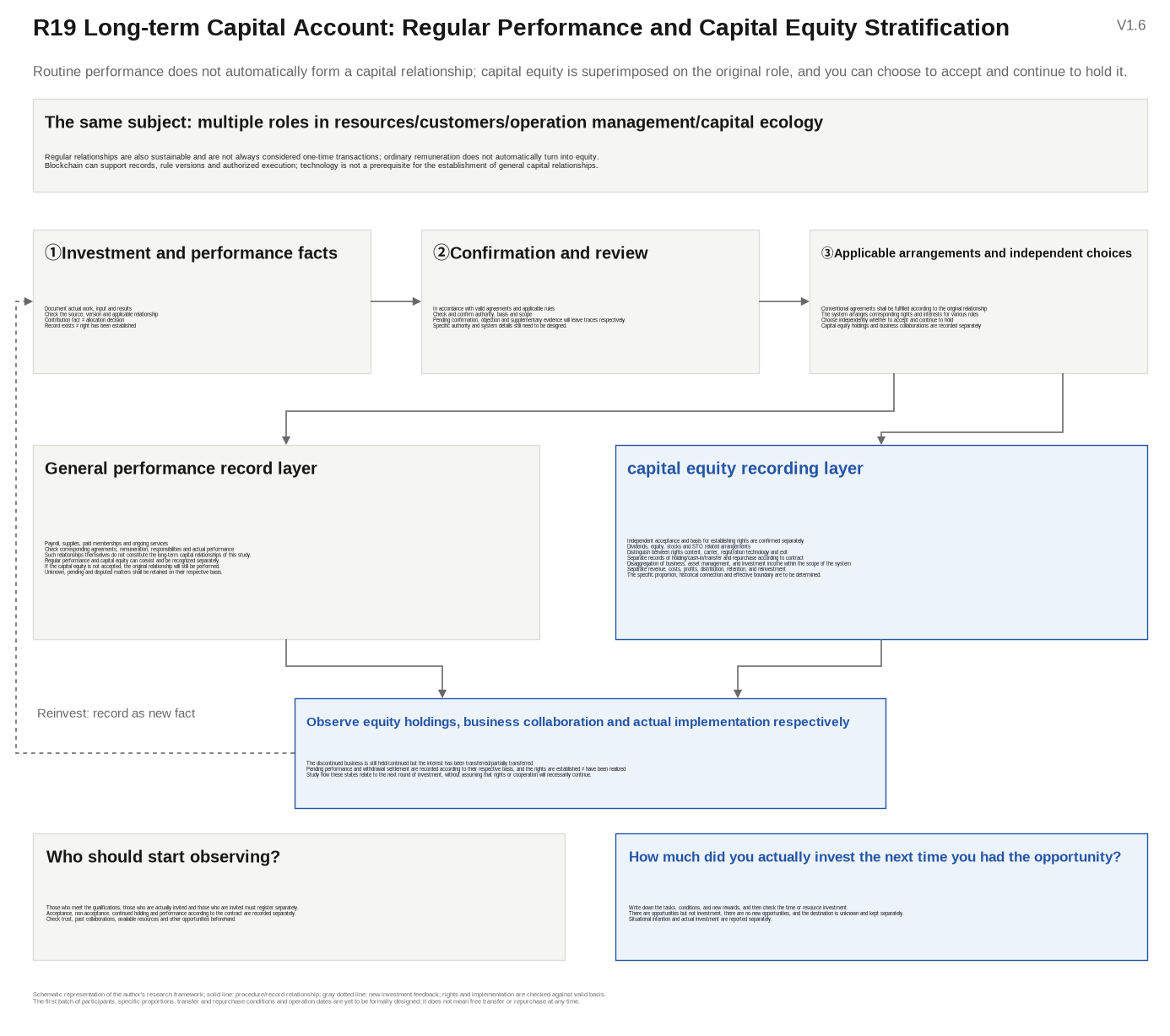
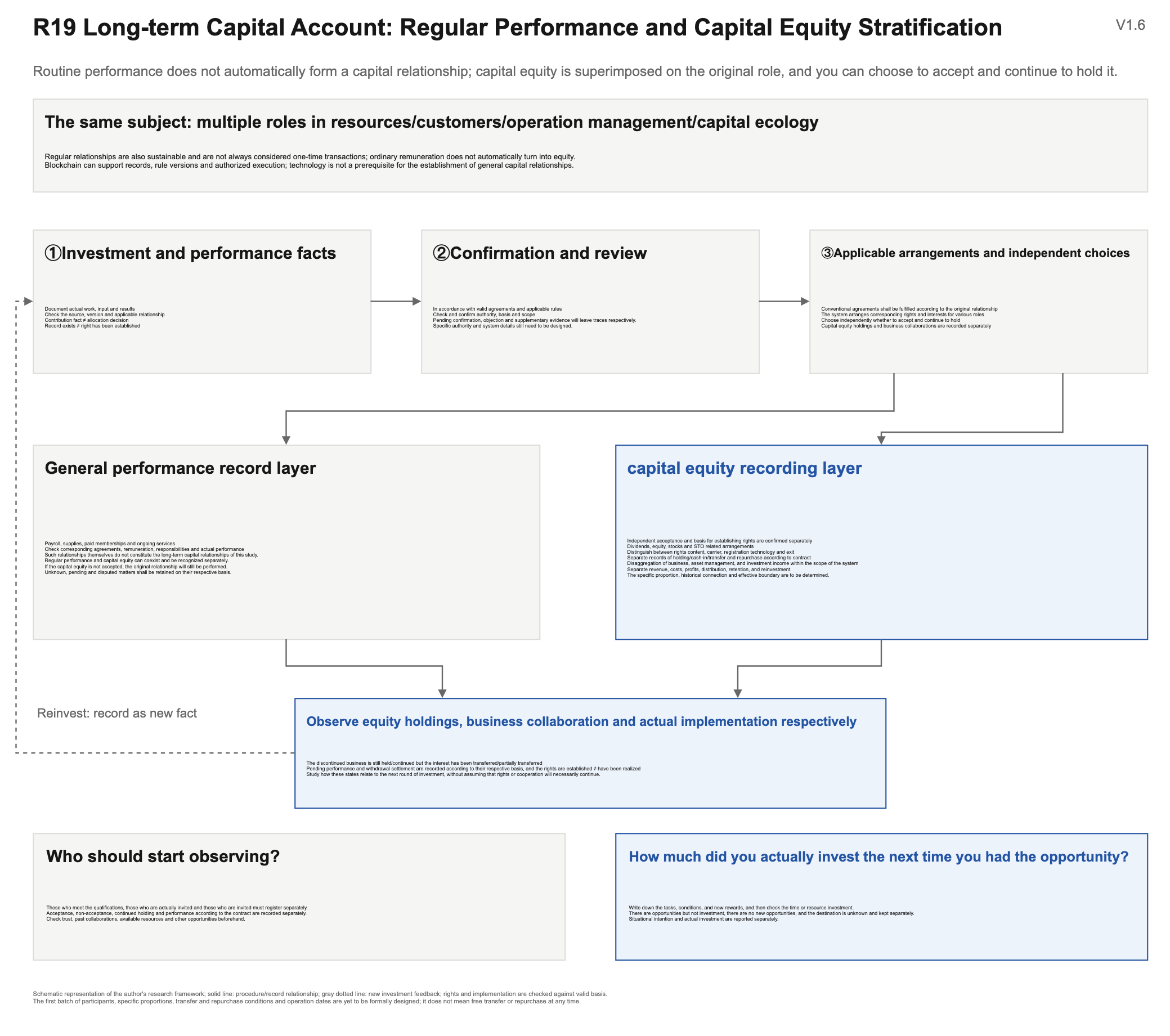
Regular performance and capital equity tiered recording
The long-term capital account associates two levels of records to avoid confusing ongoing business, contribution recognition and capital equity into the same status.
| record hierarchy | Corresponding content | Relationships and Confirming Boundaries |
|---|---|---|
| Routine performance | Wages, supplies, paid membership, ongoing services and their remuneration, responsibilities, acceptance and actual performance. | The relationship can last, but it does not constitute what this study calls a long-term capital relationship, and it is not necessarily a one-time transaction; ordinary compensation does not automatically become equity. |
| capital equity | The system arranges corresponding rights and interests for various roles, and can be connected with dividends, equity, stocks and STO-related arrangements. | Participants independently choose whether to accept and continue to hold it, which is superimposed on the original role; the rights content, carrier, registration technology, holding and redemption are checked separately and are not automatically established by account records or contribution confirmations. |
Separate observations on equity holding, business collaboration and execution
Stopping business collaboration but continuing to hold interests, continuing business but transferred interests, partial transfers and pending performance are all recorded separately, and it is not assumed that they are necessarily synchronized. Transfer, repurchase and withdrawal settlement will be handled in accordance with the subsequent formal system and corresponding valid basis, and there is no commitment to free transfer, unconditional repurchase or repurchase at any time. Applicable obligations and pending performance are not automatically deemed completed solely as a result of a cessation of business or a change in interest holding status.
The system after formal operation is oriented to the overall operating income and related rights and responsibilities within the scope of the system, covering business, asset management, investment and other income and accounting separately, not only making arrangements for new income. Revenue, costs, profits, distribution, retention and reinvestment are checked separately, and it is not presumed that all revenue has been distributed. The specific proportion, existing equity, historical business connection, effective boundary, first batch of participants and operation date are all subject to subsequent formal design; this section does not presume that the real equity has been activated based on work records.
Contribution has been confirmed, equity has been established, and returns have been cashed in, which can be at different points in time.
Already have a starting point and practical combination
Four ecological governance models, long-term capital relationships and equity redemption mechanisms, Paper I, II, IV, and blockchain system technology; corporate wallets, co-branded cards, governance design, contribution review, and community industry ecological operations.
| research session | Facts that need to be distinguished |
|---|---|
| Eligibility, Invitation and Selection | After the rules come into effect, record who is eligible according to the applicable conditions, who is actually invited, what conditions are received, and whether they accept it voluntarily. |
| Contributions and Evidence | Actual input, results, sources of evidence, independent review and objections. |
| rights and control | Who can confirm rights, decide allocations, review or modify rules. Record the basis for independent acceptance, establishment of rights and continued holding respectively. |
| Cash out and risk | Source of return, agreed conditions, actual performance, waiting and loss bearing. |
| Next opportunity and behavior | Whether there is indeed a task that can be participated in, what the conditions are, whether it is accepted, and how much dedicated time or resources are actually added. Also note knowledge sharing, contract renewal, disputes and exit. |
Compare and connect
During institutional preparation, the same collaboration scenario can be used to compare two events. First, after the end of the previous business, does the company have a reliable basis for fulfilling its commitment to existing rights and interests? Second, is the additional return on the next dedicated investment clear? Keep other conditions such as task cost and original role remuneration comparable, and ask participants respectively about their judgment of commitment and how much time or resources they are willing to devote. The choices in the scenario are first recorded as wishes.
When effective rules, rights and interests are fulfilled, and new cooperation opportunities actually arise, the next investment in the same relationship will be investigated. First record those who are qualified, including those who were not invited; then compare those who have received similar opportunities and face similar conditions, and retain the options of voluntary acceptance, non-acceptance and subsequent adjustments. The participants' original trust, resource balance, past cooperation experience and external opportunities will all simultaneously affect whether to accept the rights and interests and whether to invest again. These differences should be checked against the prior records; if still indistinguishable, only the behavioral differences between the groups are reported.
Some people had opportunities but did not invest, and some did not receive new assignments. The former records the choice, while the latter is listed separately as not being given an opportunity; if the destination or reason is unknown, keep it unknown. Finally, check the holding status, contract fulfillment, actual business collaboration and new investment on the same timeline.
Vetoes and boundaries
When the records are more complete, but there are no changes in distribution or subsequent behavior, check the permissions, redemption and incentive links separately. Increased transparency also preserves these adverse outcomes when there is a concentration of control or a decline in participation. Changes in willingness and changes in actual investment are reported separately.
Phase output: contribution and rights records, review and dispute events, revenue fulfillment and reinvestment timeline, experimental or case materials and research reports.
Customer value acceptance and participation contribution review
The same project or task retains the same project, achievement and version identification, but handles two evaluation processes separately. Customer value acceptance answers whether the delivery meets the goals and valid agreements, and whether actual use generates value; participation in contribution review answers who has undertaken what work, what actual inputs and results there are, and who has the right to confirm according to what rules. The two processes can be run in parallel, and the customer acceptance record can be used as one of the applicable evidences, but it cannot directly determine the contribution or allocation of all participants.
Figure R20 · Customer value acceptance and participation contribution review

The same project shares identification and evidence. The customer side records the delivery acceptance and actual use value respectively. The participant side confirms the contribution based on the input, results, evidence and authorized procedures; the two results are each associated with a long-term account, and unknowns and disputes are reserved.
Editable Draw.io · SVG Preview · PNG preview
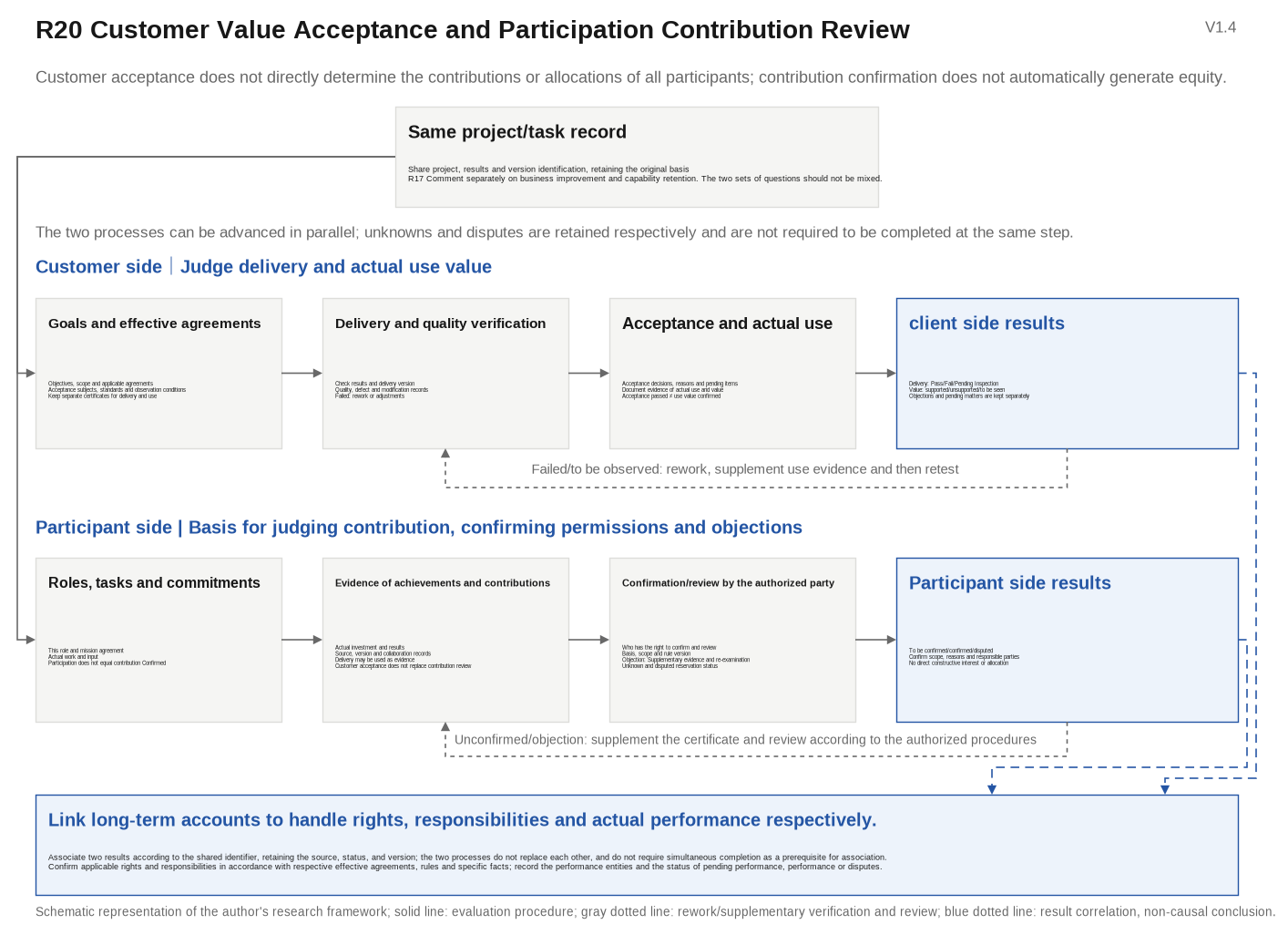
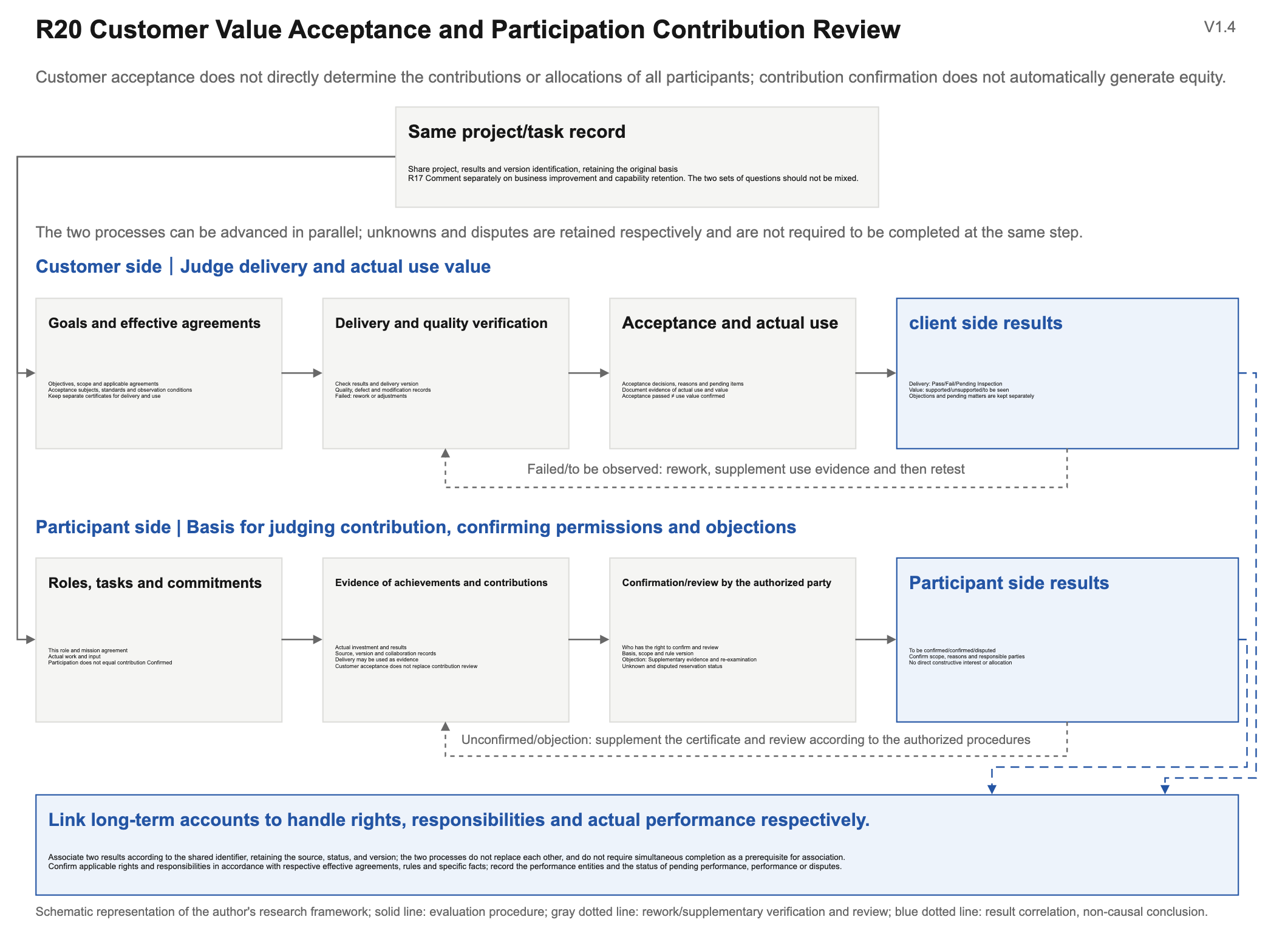
Equivalent text: The same project or task shares project, achievement and version identifiers and retains the original basis. The client first clarifies the goals, scope, valid agreements, acceptance subjects, standards and observation conditions, then checks the delivered version, quality, defects and modification records, and records the acceptance decision and actual use value respectively. The delivery status is passed, failed or awaiting inspection, and the value status is supported, unsupported or awaiting observation; passing the acceptance does not mean that the actual use value has been confirmed. If it fails or is awaiting observation, it will be reworked or re-inspected with additional evidence. Participants record roles and task agreements, actual inputs and results, evidence sources and collaboration versions, which are confirmed and reviewed by the authorized subject according to the applicable basis, scope of authority and version of the rules; in case of objection, evidence will be supplemented and re-examined according to the authorized procedures. Participants retain matters to be confirmed, confirmed, disputed and pending respectively. Customer acceptance can only be used as one of the applicable evidences and cannot replace contribution review or directly determine the contributions and distribution of all participants. The two processes can run in parallel, do not replace each other, and are not required to be completed at the same time; the respective results are associated with long-term accounts according to the shared identifier, retaining the source, status and version, and then confirm the applicable rights and responsibilities based on their respective effective agreements, rules and specific facts, and check the performance subject and the status of pending performance, performance or dispute. Contribution confirmation does not automatically generate equity. R17 Double acceptance of business improvement and capability retention answers another set of questions and is not to be mixed with this diagram.
| process | Check basis and procedure | Keep results separately |
|---|---|---|
| Customer value acceptance | Objectives and scope, valid agreements, acceptance subjects and standards; delivery version, quality and modification records; acceptance decisions and actual use evidence. Rework or adjust if it fails, and make additional observations if there is insufficient evidence. | Delivery passed, failed, or awaiting inspection; use value support, not supported, or awaiting observation; objections and pending matters are listed separately. Acceptance does not mean that the use value has been confirmed. |
| Participate in contribution review | Roles and task agreements, actual inputs and results, evidence sources and collaborative versions; the authorized subject shall confirm and review according to the confirmation authority, scope of application and rule version, and retain the procedures for objection, supplementary evidence and re-examination. | To be confirmed, confirmed or disputed; the scope of confirmation, reasons and responsible entities are recorded separately, and participation, completed delivery and contribution confirmed are not regarded as the same status. |
The two results are respectively associated with long-term accounts according to the common identifier, retaining their respective sources, statuses, basis and versions, and are not required to be completed at the same step. Subsequently, rights, responsibilities and actual performance will be handled based on respective effective agreements, applicable rules and specific facts, and the performance entities will be checked against the status of performance to be performed, performed or disputed; unknown matters will continue to be marked as unknown, records or contribution confirmation will not be automatically interpreted as the acquisition of equity, nor will it be assumed that different participants obtain the same income rights or voting rights. Objections and unfulfilled matters shall be handled according to applicable procedures, and another process that has been passed cannot be used to replace this judgment.
Two processes and Figure R19 Long-term capital account connection.Figure R17 A separate comparison of operational improvement and capability retention answers different questions; each set of judgments uses its own basis. For internal projects, internal users are responsible for the corresponding value acceptance, and the overall verification, final review by users, and actual use effects are recorded separately.
The principle of handling customer value acceptance and participation contribution review separately continues the existing operating concept. [31]
A direct test of the long-term capital account
In the actual relationships and effective arrangements of Company Zero, establish observation records of identity relationships, input contributions, rights and responsibilities, and implementation of governance. Study how accounts and rules affect authorization, review, redemption, trust, and subsequent behavior, while documenting disputes, additional costs, relationship termination, and no-change scenarios. Further distinguish between regular performance, acceptance and holding of capital equity, actual cashing out and applicable transfer repurchase, and track changes in the combination of these statuses, business collaboration, and subsequent investment. Whether the capital relationship is established and continued shall be demonstrated based on the corresponding facts and effective arrangements, and shall not be determined solely by the adoption of technology or the existence of accounts.
Mainly connects SIM, OMT and STR; digital work and platform mechanism cross CTO, fairness and trust behavior cross OB. Account design, technical implementation, rights establishment and performance effects are reported separately.
Current starting point confirmed by the author
The following is the situation confirmed by the author on November 25, 2026.
Traditional business has always been done, and knowledge content construction and customer business delivery are all real tasks. There is already a team, and some people are paying attention to related work and hope to participate. This provides two entrances for research to continue to observe: one is how knowledge content is formed, organized, used and revised, and the other is customer needs, actual delivery and subsequent use. This was the basis of the business confirmed on 25 November. V1.6's forensic arrangements prioritize a class of repeatably observable customer deliveries. Knowledge content construction continues to be used for research handover, maintenance and reuse.
The new co-construction system has not yet been officially launched, and related product functions are still being tested on a small scale. Subsequent opening will be promoted based on system preparation and actual testing; willingness to participate, formal participation, task execution, contribution confirmation, establishment of rights and interests, and actual performance will be recorded according to their respective basis. Having a team, followers or testing functions does not mean that the corresponding rights and allocations have taken effect.
Subsequently, requirements, division of labor, versions, handover, usage, costs and feedback materials can be accumulated from real work. Authors, human teams, and AI tools play different roles, and multiple sets of collaboration records of AI tools cannot be treated as multiple independent human research samples. Work status, specific incident records and comparative research evidence should be explained separately.
The first batch of account participants, specific rights and interests, allocation ratios, repurchase and transfer details, governance thresholds and operation dates will not be formulated this time. Relevant facts, agreements and results will be recorded and studied based on the corresponding basis after they are actually formed.
The connection between scientific research co-construction, operating assets and return reinvestment
This section develops the connection between knowledge and professional capabilities, operating assets and capital arrangements as a comparable research and practice path, mainly related to B, C, D and E. It provides specific issues for studying enterprise adaptation, value acquisition and continuous investment. It is not a system that must be adopted in all five directions, nor is it the only explanation.
Scientific research co-construction can link research problems, knowledge and professional capabilities, resource work can connect people, institutions and actual callable conditions, and business can organize appropriate capabilities into products, services and customer solutions. Actual delivery, use, maintenance and cooperation experience provide material for ongoing operations capabilities and asset base. These efforts can be carried out in parallel and iteratively, and there is not a capitalization stage that each investment must go through sequentially, nor does it have a separate set of operational dimensions.
Research not only looks at how many knowledge products are formed and how many businesses are completed, but also looks at which results and relationships can be continuously used, maintained and serviced under clear conditions, which investments still need support, and which ones should be adjusted or stopped. The specific scope and confirmation basis of operating assets must be checked in conjunction with actual matters; accumulation during work cannot automatically be regarded as established accounting assets, legal rights or securities interests.
How capital connections obtain funds or resources, how these conditions support the acquisition and operation of suitable assets, and how the use and operation of assets form business return, actual returns and reinvestment are the connections that this study will track. When acquiring assets, check demand adaptation, operating conditions, investment and responsibilities; when continuing operations, look at use, maintenance, return, risks and subsequent resource selection. Each link may be interrupted or deviated. It must be compared with the real process. The cycle cannot be deemed effective just by obtaining assets or completing financing. The four capitals here are still the principle logic of long-term asset management and operating strategies, and do not include financing, issuance or transaction commitments. Profit, cash, valuation and realized returns are observed separately, and financing income and business income are accounted for separately.
According to the author's proposed direction, the system after formal operation will be oriented towards the overall income and related rights and responsibilities within the scope of application of the system, including business, asset management, investment and other income, rather than just being arranged around new income. All types of income are accounted for separately, and the study tracks revenue, costs, profits, distribution, retention and reinvestment separately, and it is not presumed that all revenue is used for distribution. The specific proportion, existing equity, historical business connection and effective boundary will be determined by the subsequent system.
The corresponding equity arrangements are for different roles. Participants can choose whether to accept and continue to hold them, and their original business identities will be recorded separately. Equity holdings and actual collaboration may be out of sync, and long-term capital relationships cannot be presumed solely from continued supply, wages or paid membership. Whether the returns support continued investment, whether operating capabilities are sustained, and whether cooperation is continued all need to be compared based on the actual process; the connection between scientific research co-construction and operating capital is therefore a question to be studied, rather than a cycle of effects that has been achieved.
How to divide this round and what to continue with in the next round must be written into the arrangement.
Company Zero’s scientific research practices, operational structure, and evidence status
Company Zero: the overall practical carrier of scientific research results
The observation of Company Zero is limited to the actual organization, tasks, investment, operation and cooperation of WISERUNION itself. The theories, models, methods and system designs formed by the research are used to adjust business models, organizational methods and capital arrangements in technological changes, and then the actual processes, results, deviations, failures and adjustments are brought back to study. [25, 31]
Through these practices, we study how corporate capabilities are accumulated and updated, how value is created and obtained, how capital is allocated, and how cooperation is governed. Stakeholder capital theory, long-term capital relations and accounts, NST and ecological governance have been accumulated and used in related topics as theories, methods, governance arrangements or practical paths respectively, and compared with other applicable explanations and arrangements. Practical results can support, qualify or deny specific claims, and each research direction is still carried out according to its own problems.
Five-dimensional operation: academic, community, resources, business, capital
Company Zero organizes its actual operations along five interconnected dimensions. Five dimensions answer "how organizations operate"; five research directions A-E and fifteen main lines answer "what to study". The four major ecologies are used to organize participants and relationships, and the four resources are used to explain how resources, assets, capital, and funds are allocated and transformed. Each of these sets of classifications has its own uses and can relate to the same project from different perspectives.
Academic formation direction and theory → guide community, resources, business, capital and overall organizational practice → record actual processes, results and counterexamples → review and revise academic results → then enter practice.
The five dimensions can be parallel, intersecting and repeated, and do not constitute five fixed stages of development.
Figure R21 · Company Zero’s five-dimensional operation and scientific research practice closed loop

Company Zero operates in five dimensions: academic, community, resources, business, and capital. Academic achievements guide the overall practice of each dimension, and the real process, results and counterexamples are independently reviewed, revised and studied. The five dimensions can be cross-collaborated and do not correspond to the A-E research directions one-to-one, nor are they fixed in five stages; the capital dimension refers to R24 to explain asset management principles and long-term operation strategies, which does not constitute a specific implementation plan.
Editable Draw.io · SVG Preview · PNG preview
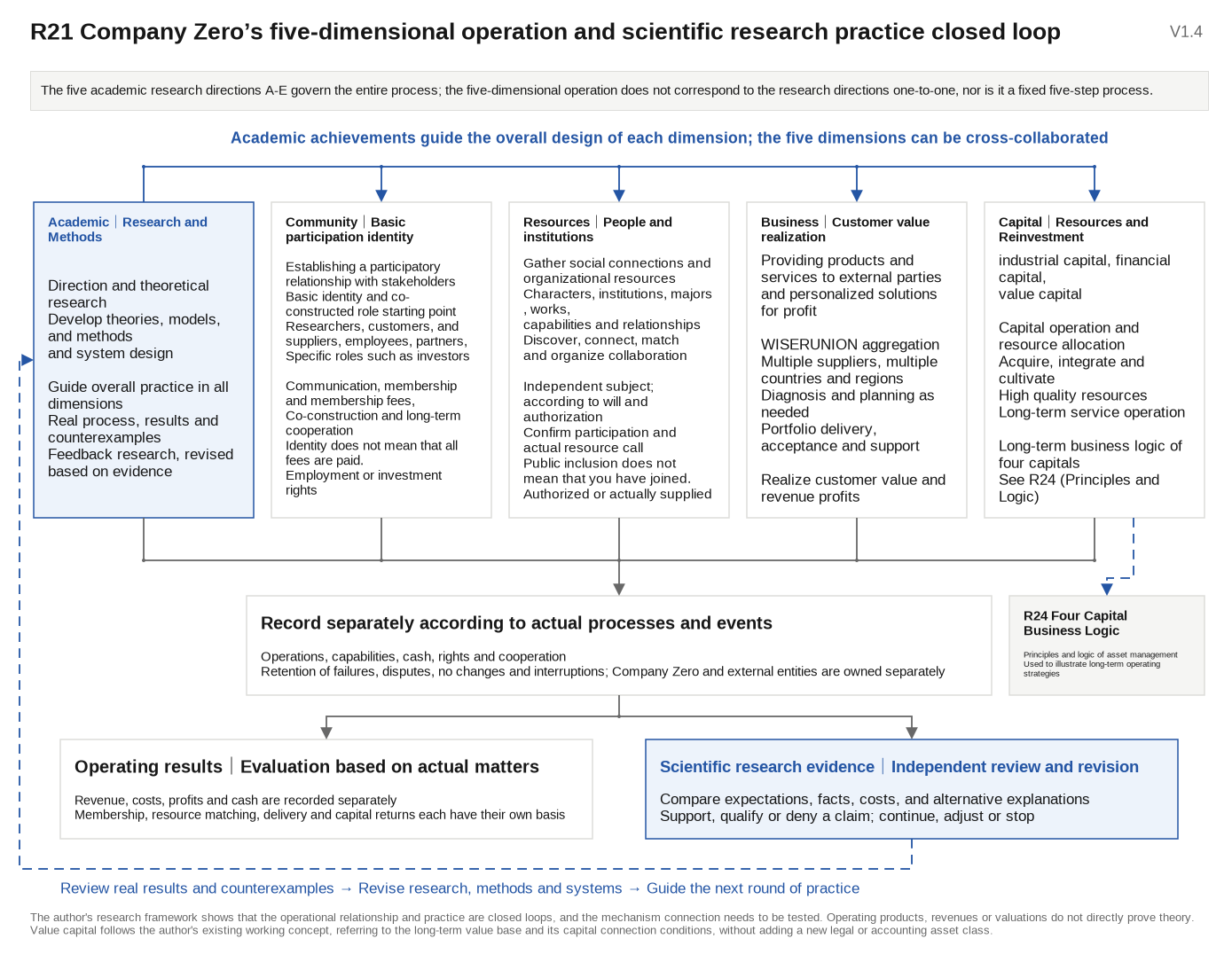
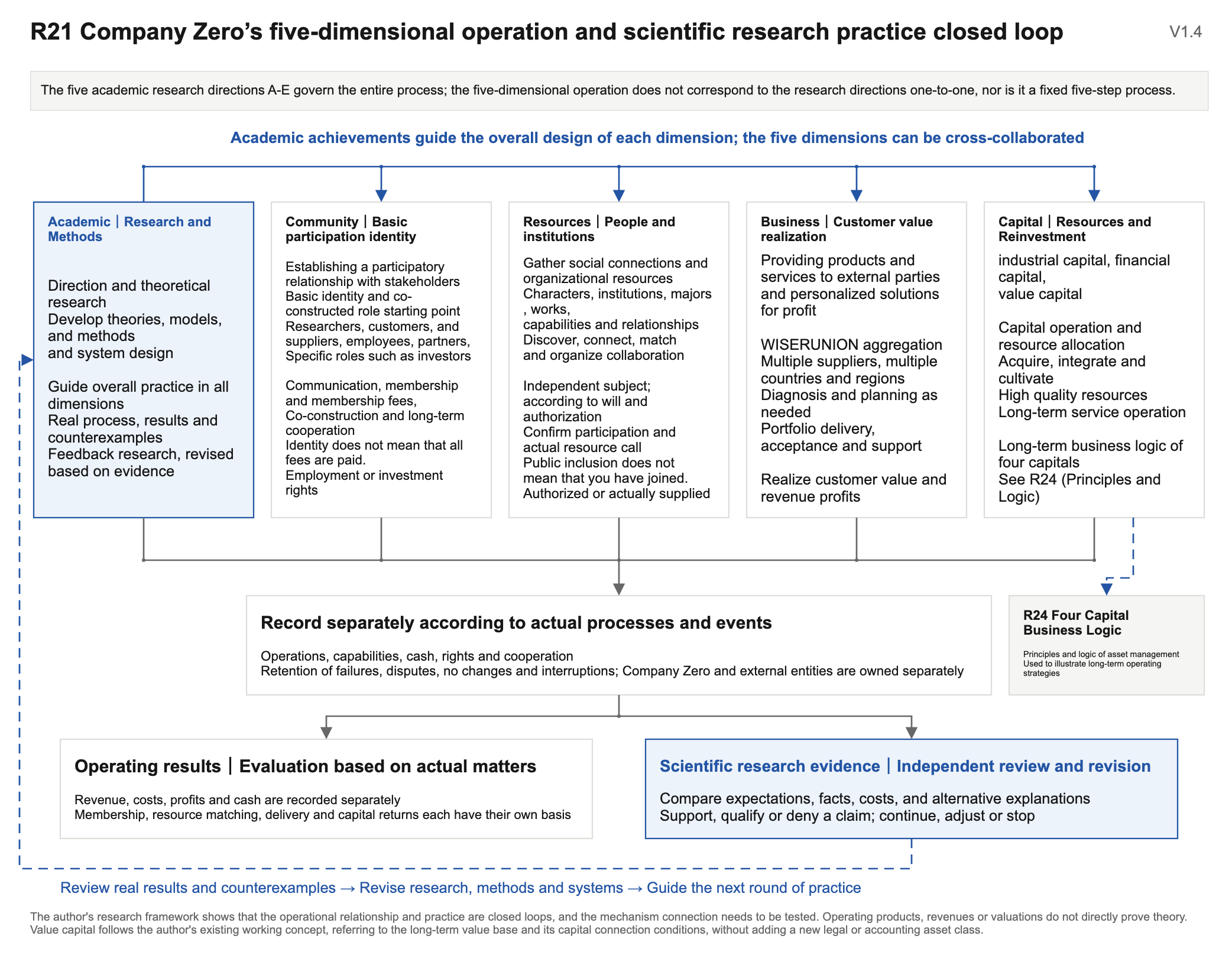
Equivalent text: The five academic research directions A-E govern the entire process; academic, community, resources, business, and capital are the five operational dimensions, which do not correspond to the research directions one-to-one, nor are they five fixed steps. Academically formulate theories, models, methods and system designs to guide overall practice in all dimensions, and accept feedback from real processes, results and counterexamples. The community is the starting point for stakeholders to establish their first basic identity and subsequent co-construction roles. It can superimpose the roles of researchers, customers, suppliers, employees, partners, investors, etc., and retains communication, membership and membership fees, co-construction and long-term cooperation; identity does not mean uniform payment, employment or investment rights. Resource Dimension gathers social connections and organizational resources to discover, connect, match and organize collaboration through the professions, works, abilities and relationships of characters and institutions; characters and institutions maintain independent subjectivity, confirm participation and actual resource utilization based on willingness and authorization, and public inclusion does not mean joining, authorization or actual supply. Businesses provide products, services and personalized solutions to the outside world to make profits. WISERUNION aggregates multiple suppliers and countries and regions, diagnoses and plans combination delivery according to needs, and realizes customer value and revenue profits. Capital covers industrial capital, financial capital, value capital and investment, financing, control, return and reinvestment. It acquires, integrates and cultivates high-quality resources through capital operation and resource allocation to serve long-term operations; R24 is only an explanation of the principles and logic of long-term four-capital asset management, not a specific tool, transaction or implementation plan; value capital is the author's existing working concept and does not add new legal or accounting asset categories. The five dimensions can be cross-collaborated. Actual operations, capabilities, cash, rights and cooperation results are recorded separately. Failures, disputes, no changes and interruptions are retained. Company Zero and external entities are owned separately. Operating results are evaluated separately by revenue, cost, profit, cash and members, resource matching, delivery and capital return; scientific research evidence independently compares expectations, facts, costs and alternative explanations to support, qualify or deny claims, continue, adjust or stop based on conditions, and revise research, methods and systems to guide the next round of practice. Revenues, valuations, or operating results do not directly prove a theory.
| Operational dimension | actual tasks | Key results and observations | Research undertaking |
|---|---|---|---|
| academic | Determine research directions and carry out research on theories, models, methods and system design; transform them into practice through education and application, and absorb feedback from use and operations | Specific questions, theoretical comparisons, contribution claims, designs and versions, evidence, counterexamples, and revisions | Coordinate A-E and fifteen main lines |
| community | As the first basic participation identity and the starting point for subsequent participation in co-building roles for all stakeholders; organizational communication, membership and member charging, co-construction and long-term relationships | Entry and participation, identity and role changes, member services, tasks, contributions, rights and responsibilities and continuation of cooperation | E’s identity, governance and cooperation are at its core, connecting B, C and D |
| Resources | Gather social connections and organizational resources; continue to discover, connect, match and organize collaboration through the professions, works, abilities and relationships of people and institutions | Information and sources, willingness to contact, actual participation, scope of authorization, callability, resource supply and quality of collaboration | A3, B1, B3, C, D1, E3 are accepted according to the main issues |
| business | Provide products, professional services and personalized solutions to the outside world to achieve profitability; aggregate, plan, combine, deliver and support through WISERUNION | Customer usage and payment, revenue, total cost, profit, cash, quality and capacity reuse | C is the core of value and income, connecting A, B, D, and E |
| capital | Organize research and operations related to industrial capital, financial capital, and value capital; continue to obtain high-quality resources with the help of capital operations and financial tools, and explain asset management and long-term development with the logic of the four capitals | The connection between capital and operations, resource base, return risk, capital return and continued investment | D1-D3 is the core, connecting B, C and E |
Community: basic identity and subsequent co-construction
In the participatory identity design of Company Zero, community is the common basic identity of various stakeholders and is also the starting point for further participation in co-construction. In actual work, researchers, customers, suppliers, employees, partners, investors, editors and other roles can be superimposed; the same subject can have multiple roles.
Basic community participation, paid membership, specific positions and tasks, transactions or investment relationships are recorded separately. The community will not reduce membership fees; the contractual identities and rights of existing customers, employees, suppliers and investors will continue to be confirmed on their own independent basis. See the relevant public entrance WISERUNION participates in co-construction。[70]
Resources: People, Institutions and Continuous Connections
Social connections and organizational resources pass People column and Hub for People and Institutional Resources Gather together, discover each other around expertise, works, abilities and evidence-based relationships, establish ongoing connections, and then organize demand, supply and collaboration according to actual wishes. [68, 69]
Public inclusion, establishing contact, agreeing to participate, authorizing cooperation, being able to actually call and complete the supply must be registered separately. The community provides a common identity and starting point for participation, and resource work further connects specific people and institutions to clarify how collaboration can be done; business organizes appropriate capabilities to complete delivery, and capital then supports the acquisition and cultivation of resources.
Transformation of scientific research, education and practical applications
Scientific research raises questions and forms theories, methods and rules; education then explains the appropriate results clearly so that people can understand, learn and use them. These contents can be used directly for learning and practice, or can be further developed into knowledge tools, products or services according to task needs. For the parts suitable for external supply, the use, maintenance and responsibility arrangements will be clearly defined to form actual supply.
Figure R22 · Transformation of scientific research, education and practical application

Research results are transformed into understandable and learnable content, and knowledge or tools, products and services are formed on demand. After actual use by Company Zero or customers, problems, experiences and evidence are brought back for research and content revision. Education is jointly undertaken by the existing five dimensions.
Editable Draw.io · SVG Preview · PNG preview
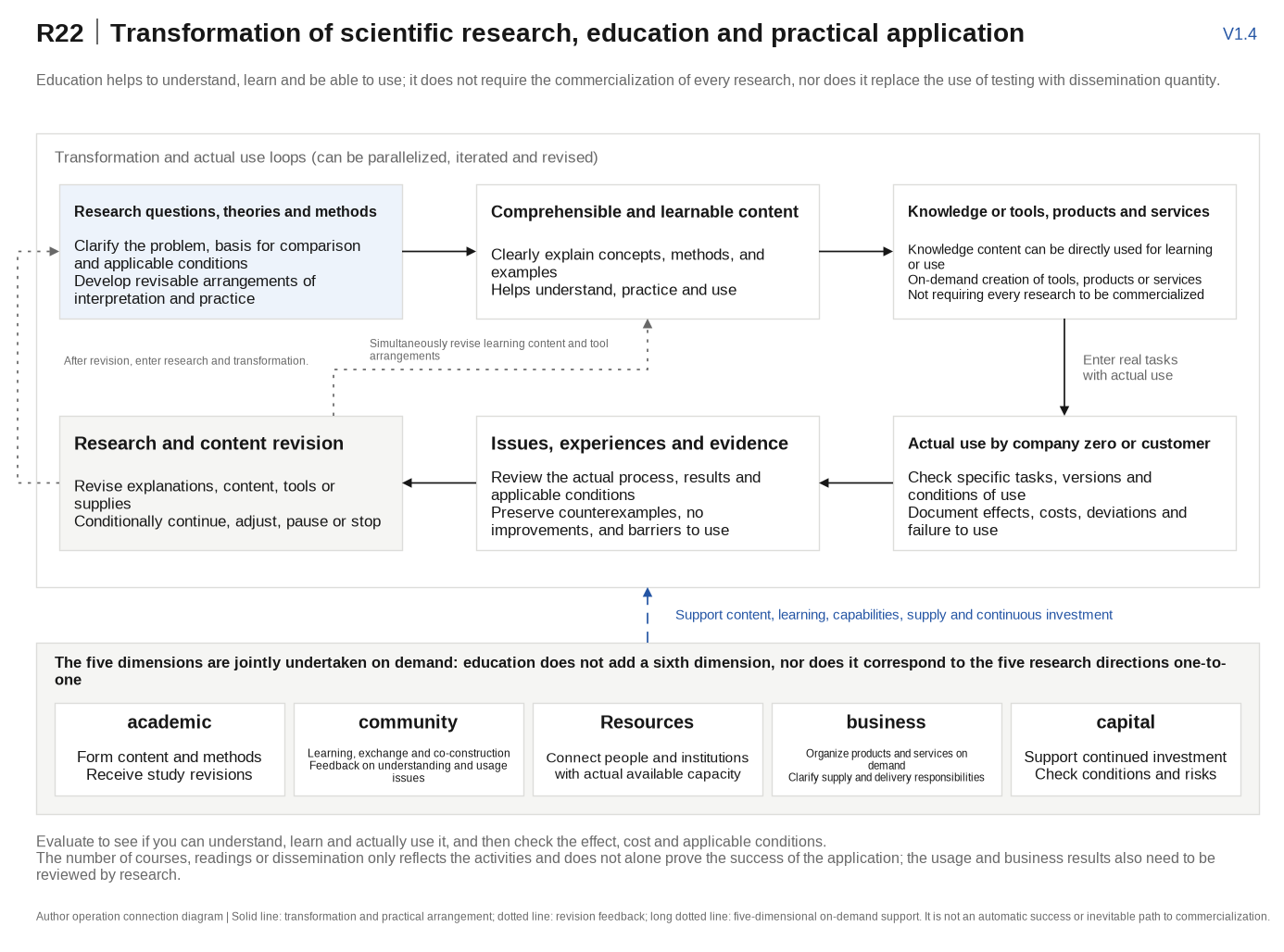
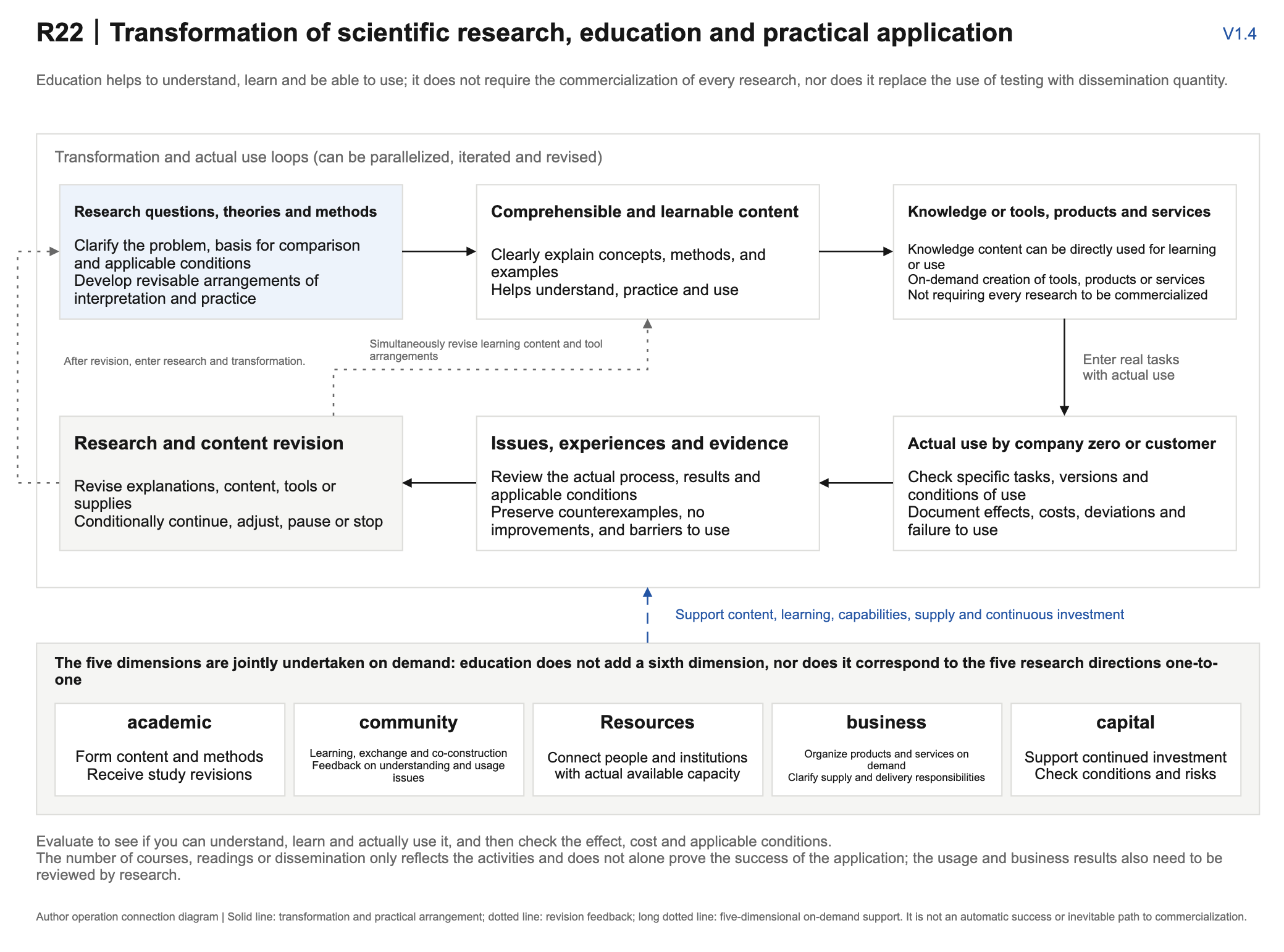
Equivalent text: Research questions, theories and methods clarify the basis for comparison and applicable conditions, and form content that is understandable, learnable and usable. The knowledge content can be directly used in learning and practice; based on specific needs, it can also be formed into knowledge tools, products or services, without requiring each research to be commercialized. Company Zero or customer actually uses it under clear tasks, versions and conditions, and records effects, costs, deviations and failure to use. Problems, experiences, evidence and counterexamples are reviewed and entered into research and content revision, and are continued, adjusted, suspended or stopped according to conditions; revision feedback research is also fed back on learning content and tool arrangements. Academic formation content and methods, community organization learning, exchange and co-construction, resources connecting people, institutions and actual capabilities, business on-demand organization of product and service supply and delivery, capital support for sustained investment with evidence; five dimensions are jointly undertaken on demand, not five stages of transformation, and education does not add a sixth dimension. The number of courses, readings or dissemination only reflects the activities and cannot alone prove the success of the application; the usage and operating results still need to be researched and reviewed.
Real-world use by Company Zero or customers, bringing specific issues, experiences, biases, and evidence back to the study. The review not only looks at whether the content is understood and whether it can be used in real tasks after learning, but also looks at the use effect, cost, limitations and reasons for failure to use, and then revise the research explanation, learning content, tools and supplies. The results of the curriculum, reading and communication activities are recorded, and the understanding, practical application and effect are observed respectively, and the research is fed back with corresponding evidence.
This transformation is jointly undertaken by the existing five dimensions on demand: academic formation theory, method and content, community organization learning, exchange and co-construction, resources connecting people, institutions and practical capabilities, commercial organization's supply and delivery of suitable products and services, and capital support for continuous investment with evidence. Education is jointly undertaken as a transformation work between the five dimensions, and the five dimensions can be parallel, intersecting and repeated.
This transformation continues Company Zero’s existing concept of “scientific research-application-practical feedback”. [31]
Cross-dimensional work connections across projects
The five groups of work in the old article continue to be used to connect specific projects, describing what is received, what is made, who is given to it, and how to adjust after receiving feedback. They are not new research directions, operational dimensions, or fixed departments, nor are they divided by site. The same project can involve multiple groups of work at the same time, and the actual roles and responsibilities are confirmed according to specific agreements.
| working connection | input | main output | Handover and feedback | Relevant five dimensions |
|---|---|---|---|---|
| Research and Education | Research questions, theoretical methods, practical issues and existing evidence | Research and learning content with sources, versions and applicable conditions; available methods or tools are developed as needed | Explain the purpose to learners, co-builders and usage projects; return barriers to understanding, usage results and counterexamples for research and revision | Academic formation and revision of content, community learning and co-construction; resources, business, and capital support application according to actual needs |
| Product Service Solutions | Customer objectives and conditions, demand diagnosis, available supply and research methods | Products, services and personalized solutions with clear providers and responsibilities | WISERUNION aggregates multi-vendor, multi-country and regional supply; planning, contracting, delivery and support responsibilities are clarified by project; feedback is used to return supply and research | Business organization supply, resource connection capabilities, community participation; academic and capital support on demand |
| Resource Hub and Participation in Co-construction | Personal and institutional information, majors and works, actual needs, willingness to participate and authorization | Verifiable records of connections, competency matches, participating roles and actual collaboration | Distinguish between inclusion, contact, willingness to participate, actual supply and completed delivery; feedback on relevant projects based on matching deviation, delivery quality and contribution | Resources and communities connect people, institutions and participating roles; business, academia, and capital collaborate by project |
| NST software and shared governance | Governance requirements, effective rules, role permissions, process records and usage issues | Methods, rules and software versions tested by actual use, as well as matters to be revised | The authorized body formulates and changes rules, and the software supports execution and recording within authorization; it first serves Company Zero for its own use, and then judges the parts that can be delivered independently based on actual inspection; contributions, rights and performance are confirmed separately | Academics, communities and resources jointly participate in the design and use; business and capital undertake according to actual supply, maintenance and investment needs |
| Investment research, investment, financing and post-investment | Operation and resource requirements, research materials, input conditions and existing results | Well-founded investment selection, clear subject responsibilities and continuous tracking records | The selection basis, conditions and responsibilities will be handed over to actual decision-making and execution; follow-up arrangements will be fed back with real results, risks and performance status, and the four capitals will maintain the principled logic of long-term asset management and operation strategies. | Mainly capital, connecting academic research, resource capabilities, business operations and community participation; specific relationships are confirmed separately |
How the five dimensions support each other
Academic achievements help diagnose problems, plan solutions and select systems through education, tools and practical applications; community organization participation, learning exchanges and co-construction; resource work connects contacts, institutions and practical capabilities; business realizes customer value and profits; capital organizes investment, rights, risks and subsequent allocation, and can also continue to obtain high-quality resources through applicable tools. New issues and actual results that arise in operations are then used for academic comparison, evidence review, and achievement revision.
WISERUNION unifies the products, services and solutions of different suppliers to connect demand and supply. Each website and tool can be used as a different entrance, and five-dimensional operations are not divided by website.
Three types of work calibers in the capital dimension
| The capital caliber adopted by the author | Job leads at company zero | Continuously checked connections |
|---|---|---|
| industrial capital | Organize investment, business collaboration, asset allocation and applicable industry integration around real industries, enterprises, projects and capabilities | How investment enters resources, business and capabilities, how collaboration occurs, and who bears the investment and obtains returns |
| financial capital | Connect capital supply, financing structure and financial markets, and compare IPO, post-listing applicable instruments, STO and other financing transaction paths according to entities and market conditions | How funding and terms change resource acquisition, costs, duration, controls, risks, liquidity and reinvestment conditions |
| value capital | Following the working title of "Stakeholder Capital", we analyze the long-term value foundation and its capital connection conditions, and clarify the connotation, indicators and boundaries in specific research. [03] | How resources, capabilities, assets and partnerships support sustained value, how capital is connected, and how benefits and rights are realized |
The working calibers of the three types of capital can overlap; the four types of capital are understood as a logical framework for long-term asset management, and the two sets of classifications are not added together. "Value capital" continues to be used according to the author's research concept, and no legal or accounting asset categories are added.
Mutual inspection of scientific research and operations
Scientific research results enter actual decision-making, organizational rules and delivery; the cognitive and work effects of AI and the institutional technical effects of blockchain are selected according to problems and tested separately. The specific arrangement retains the research basis, applicable conditions, implementation version and adjustment reasons, and actual operation can support, limit or deny the original interpretation.
Academic products, community participation, personal and institutional resources, business income and capital returns are evaluated separately and related to the same actual event. Membership fees, business income, capital investment, financing income, valuation and actual returns remain separate; growth, inclusion or system launch itself does not alone prove the theoretical mechanism.
Zhixing Personal Knowledge Station: Online knowledge organization practice
yutengfei.com has been launched as a personal knowledge station to organize research, works, skills, sources and versions. Website construction, translation and knowledge base work provide task division, handover, acceptance, revision and reuse of materials; their continuous efficiency and cross-person transfer are also tested according to the research design. [27]
Ten Billion Maple: Achievements in the Branding and Communication Stage
Public cases include strategy and brand expression, VIS, store SI concepts, digital official website and communication works. The relationship between strategy and delivery, version and maintenance can be observed; SI concepts and construction facts, communication delivery and operating effects are recorded separately. [26]
| Status | can be stated accordingly |
|---|---|
| Models and Research Design | Concepts, mechanisms, methods or topics to be tested are proposed. |
| Public materials and samples | A viewable document, tool, or method artifact is completed. |
| Actual implementation and acceptance | A certain agreed work has occurred and there is a record of execution, modification or acceptance. |
| Evidence of use and results | The results are actually used and changes are observed for a limited period. |
| Comparative and Sustainability Evidence | Support an explanation through explicit comparison, review, and follow-up observations. |
External cases and partner business are recorded on their own entities and are not included in Company Zero's advancement milestones or performance. Data collection, relationship introduction and planning disclosure each retain their factual boundaries.
Key observations under the new model
In the actual operation of the five dimensions of academia, community, resources, business, and capital, Company Zero observes direction and theoretical formation, identity and co-construction roles, connection of people and institutions with resources, organizational execution and capability retention, customer value, capital and long-term operations, and long-term account related relationships. Capital operation paths, account functions and institutional arrangements are distinguished by planning, design, pilot, execution and result status; business that has not occurred is not presumed to be completed based on the name of the plan.
Research results and practical evaluation
| Outcome level | Main products and reviews |
|---|---|
| Research results | Concepts and boundaries, comparative designs, mechanistic evidence, thesis and longitudinal cases; also report findings that do not support expected findings. |
| Method results | Four-way SOP, research card, evidence ledger, contribution review, capital comparison and acceptance criteria; record applicable conditions and revision basis. |
| Knowledge achievements | Manuscripts, think tanks, literature and terminology resources, skills and training materials; maintain source, edition and citability. |
| Products, services and solution results | Based on demand diagnosis and planning, combine products and services to form personalized solutions and agreed delivery; evaluate acceptance, use, maintenance and follow-up results respectively. |
| Company Zero operating results | The theoretical and practical revision of academic direction; the basic identity, membership and co-construction of the community; the connection and actual collaboration of resources, people and institutions; profit-making of commercial products, services and solutions; the three types of work of capital and its support for long-term operation, resource acquisition and continuous investment. |
| Practice feeds back the results of scientific research | Connect expectations, actual results, deviations, failures and condition changes in five-dimensional operations to specific research propositions to form revisions of theories, methods, systems and solutions. |
research statement
This study takes strategic management as its main academic base, and its upper-level proposition is:Firm adaptation and differentiation in technological change. The general title remains "Research on Enterprise Capabilities and Capital Governance in the Change of Intelligent Technology". The core questions are:
How do firms adapt their business models, organizational arrangements, and capital structures in response to technological change to build and renew capabilities and create and capture value? Why do firms adopting similar technologies end up with different long-term operating outcomes and development paths?
Five directions and fifteen main lines jointly organize the research on business models, organizational methods, capability accumulation, value creation and acquisition, capital arrangements and cooperative governance, and the names, codes and parallel levels are maintained. AI is a cognitive and work technology, and blockchain is an institutional technology; specific topics compare adoption, combination, traditional substitution and condition differences, and track different long-term operating results and development paths under similar technologies. Technology brings possibilities. When explaining adoption and results, we must also look at business needs, competition, organization and capital arrangements, leaving unchanged and failure.
The accumulation of stakeholder capital, long-term capital relations, long-term capital accounts, NST, ecological governance and the four capitals will enter into specific theoretical explanations, methods, governance arrangements and practical paths according to their actual nature. Important issues in preserving the path of relationships between stakeholders and long-term capital are:
How can stakeholders acquire and continue to hold interests related to the long-term value of the enterprise based on voluntary choices and institutional rules, forming long-term capital relationships? How does this relationship affect organizational form, capacity accumulation, income distribution and continuous cooperation, and how is it inherited, realized and continued through capital operations?
This path mainly connects E, D and compares its B, C, A consequences, not as a common premise for all directions. "Under what organizational and governance conditions can dispersed knowledge, professional capabilities, social relationships and funds be transformed into capabilities and operating assets that enterprises can sustainably use? How can the corresponding returns support participants' continued investment?" continues to be a supporting issue for the formation of organizational capabilities and operating assets. The two proposed main contributions and the four supporting candidates retain their existing status and evidence status, and their relative increments are demonstrated respectively. This does not exhaust all the research on the general outline, nor does it limit the use of the four supporting candidates to the stakeholder path.
Long term concerns are:How the organizational forms of enterprises and stakeholders may evolve under changes in smart technology and institutional arrangements. This is a research question, and the current observation objects are still enterprises and specific cooperative relationships.
The research starts from the existing ecological governance, four-way SOP, AI operating capabilities, capital mechanism and institutional technology. Company Zero implements the overall practice of the five-dimensional organization of academics, community, resources, business, and capital: direction and theoretical research guide operations, the community undertakes the basic identity and co-construction of stakeholders, the resources gather social connections and organizational resources, the business provides products, services, and personalized solutions to make profits, the capital organizes investment, returns, and the circulation of the four capitals, and continues to obtain high-quality resources through applicable capital operations and financial instruments. The actual results are then fed back to scientific research. WISERUNION unifiedly aggregates the products, services and solutions of current and subsequent suppliers, organizes matching and personalized combinations according to customer problems, countries and regions, and clarifies the responsibilities of the platform and suppliers respectively. Other cases are used for comparison and boundary identification. Progress will be based on conditions, evidence and phased results, and there will be no fixed deadline.
Outcome evaluation
To evaluate research contributions, we need to look at what explanations, designs, methods or findings have been added to existing studies, whether the comparison is credible, and whether the level and boundaries of the conclusions are clear; the two axes of originality verification and evidence support are recorded separately. To evaluate practical contributions, we need to see whether the results are actually used, whether capabilities can be continuously deployed and maintained under clear conditions, whether cash and risks are affordable, and whether cooperation can continue as agreed. Corresponding conclusions are provided separately for cross-person recurrence, migration and relational dependence. The two types of contributions will first be evaluated separately, and then the connections will be explained.
This outline is a research and practice plan. Current models, design drafts, public materials, online cases and candidate solutions all retain their respective statuses.
Operations test whether the value can be realized, and research asks whether the explanation can be established.
Attribution of original contributions
Theory, design, methods and empirical products are classified into corresponding contribution claims respectively, retaining the comparative basis and dual-axis status. The five directions and the fifteenth main line continue to organize and accumulate, and the catalog, number of models, technology adoption or business scale cannot be used to replace academic increment. For main contribution and supporting contribution, see Positioning and Inspection of Original Contributions。
The results of operational connections
Scientific research and education transformation retain research basis, learnable content and actual use feedback; NST retains rules, software, internal use, maintenance and independent delivery status for self-use and productization; value acceptance and contribution review retain evidence, conclusions and objections respectively; complete practical examples integrate delivery, revenue and expenditure, rights and interests and review as the same project.
The above products are put into the established research direction, five-dimensional operation and achievement evaluation system, and research, learning, application, delivery and actual effects are explained separately. Then continue to revise methods, software and research based on practical feedback.
Appendix Navigation
The following materials are retained in their entirety and are available for review by question:
| Check the need | entrance |
|---|---|
| Pictures, source files and complete text descriptions | Picture catalog · Update image equivalent text |
| Academic fields and existing research accumulation | AOM/SMS mapping · ecological model · Manuscripts and papers · Existing methods take over |
| Capital analysis and long-term operating principles | Joint analysis of language and four capitals |
| Platforms, products, services and solutions | aggregation platform · Products · service · supply relationship · capital program · Digital business plan |
| Practice advancement and process materials | Advance conditions · Research Index and Internal Examples |
The business catalog is used to check optional supplies and research undertakings, and specific supplies are confirmed by project. The process instance is read according to its own observation cut-off point, and subsequent newly added images will not be written back as the completed items of the historical instance.
Illustrated Reading and Editable Documents
The drawing numbers are R01-R29 according to the display order of the blocks. R01 presents a common explanatory model of technology, organization, capabilities, capital and cooperative governance, and R02 presents upper-level propositions, general issues and five main lines in five directions. The direction map, specific contribution map and practice map are developed at their respective levels, and the stakeholder correlation map explains the theoretical and practical paths.
Each image provides native editable Draw.io, SVG and PNG.Comparison of figure catalog and historical figure number You can check the original drawing number. R29 summarizes the evidence collection conditions for each of the three flagship topics.
| Drawing number | Name | Text |
|---|---|---|
| R01 | Shared explanatory model | View illustration |
| R02 | Five directions and fifteen research strands | View illustration |
| R03 | A. Intelligent technology adoption and organizational restructuring | View illustration |
| R04 | B. Accumulation and updating of corporate capabilities | View illustration |
| R05 | C. Customer value, market competition and revenue acquisition | View illustration |
| R06 | D. Investment, Financing and Capital Allocation | View illustration |
| R07 | E. Rights allocation, incentives and cooperative governance | View illustration |
| R08 | Blockchain as institutional technology: Common evaluation of rules and implementation | View illustration |
| R09 | Original contributions and evidence | View illustration |
| R10 | Contribution 1: The formation and sustainability mechanism of long-term capital relationships | View illustration |
| R11 | Contribution 2: Institutional design of long-term capital account | View illustration |
| R12 | Contribution 3: How organization and execution mechanisms affect capability retention | View illustration |
| R13 | Contribution 4: The two-way role of capital operation and capacity building | View illustration |
| R14 | Contribution 5: Dual acceptance method for business improvement and capability retention | View illustration |
| R15 | Contribution 6: Longitudinal evidence and failure boundaries | View illustration |
| R16 | Technology-Organization-Capability Mechanism | View illustration |
| R17 | Double acceptance of business improvement and capability retention | View illustration |
| R18 | Capability investment and capital feedback | View illustration |
| R19 | Long-term capital accounts: regular performance versus capital equity tiering | View illustration |
| R20 | Customer value acceptance and participation contribution review | View illustration |
| R21 | Company Zero’s five-dimensional operation and scientific research practice closed loop | View illustration |
| R22 | Transformation of scientific research, education and practical applications | View illustration |
| R23 | Capital operation functions and paths | View illustration |
| R24 | The four-capital logic of Company Zero’s long-term operating strategy | View illustration |
| R25 | WISERUNION Aggregation Supply | View illustration |
| R26 | Personalized solutions | View illustration |
| R27 | NST governance methods and software: self-use inspection and gradual productization | View illustration |
| R28 | Complete practical example: from requirements to review | View illustration |
| R29 | The order of evidence collection for the three flagship topics | View illustration |
Classification connections, research procedures, and mechanisms to be tested are explained according to each figure legend; complete catalogues, revenue growth, capital acquisition, or technology adoption do not alone prove the validity of the theory.
AOM classification and research correspondence
overall positioning
This study takes STR as the main academic base, focusing on intersecting with CTO, TIM, OMT, and SIM, and then connecting ODC, OB, MOC, HR, and OSCM according to specific issues and levels of analysis. These fields are not all listed as primary belongings, nor are they added to the first-level direction of this research.
The following English names are based on the AOM public domain description, and the Chinese names are the unified translations of this outline. See AOM Research Area Catalog。
| abbreviation | Official English name | Chinese name | Source |
|---|---|---|---|
| STR | Strategic Management | strategic management | Formal domain description |
| CTO | Communication, Digital Technology, and Organization | Communication, Digital Technologies and Organizations | Formal domain description |
| TIM | Technology and Innovation Management | Technology and Innovation Management | Formal domain description |
| OMT | Organization and Management Theory | Organization and Management Theory | Formal domain description |
| ODC | Organization Development and Change | Organizational Development and Change | Formal domain description |
| MOC | Managerial and Organizational Cognition | Managers and Organizational Cognition | Formal domain description |
| OB | Organizational Behavior | organizational behavior | Formal domain description |
| HR | Human Resources | human resources | Formal domain description |
| SIM | Social Issues in Management | Social Issues in Management | Formal domain description |
| OSCM | Operations and Supply Chain Management | Operations and Supply Chain Management | Formal domain description |
Field distribution in five directions
| The primary direction of this research | AOM domain for centralized docking | major crossing or border |
|---|---|---|
| A. Intelligent technology adoption and organizational restructuring | CTO、TIM、ODC | STR、OMT、OB、OSCM |
| B. Accumulation and updating of corporate capabilities | STR、MOC、OB | OMT、TIM、HR |
| C. Customer value, market competition and revenue acquisition | STR | OSCM、TIM、OMT、SIM |
| D. Investment, Financing and Capital Allocation | STR, positioning by strategic and organizational issues | TIM, OMT, SIM; corporate finance and capital markets are adjacent disciplines |
| E. Rights allocation, incentives and cooperative governance | OMT、SIM、STR | CTO、OB、HR、OSCM |
The main ownership and conditions of the fifteen main lines
The main attribution is the positioning judgment of this outline. Which field a specific paper is classified into depends on the core issues, theoretical mechanism and level of analysis; when it involves cross-fields, it must also explain what role it plays in the research.
| continuous main line | Recommended primary ownership | Cross-cutting or adjacent disciplines | vesting conditions |
|---|---|---|---|
| A1 Task and technology adaptation | CTO | TIM、OSCM | When digital technology enters organizational work, the CTO is the main lead; innovative adoption is linked to TIM, and operational quality and cost are linked to OSCM. |
| A2 Processes and Human-Machine Collaboration | CTO | ODC、OB、OSCM | Digital work and collaboration are dominated by CTO; organizational change is connected to ODC, work design and team is connected to OB, and delivery process is connected to OSCM. |
| A3 Technology dependence and organizational boundaries | STR | OMT、CTO | The impact of self-building, external collaboration and boundaries on strategy goes to STR; organizational dependence goes to OMT, and digital infrastructure goes to CTO. |
| B1 Knowledge Precipitation and Feedback Transformation | MOC/STR (by question) | OMT | Learning, attention, interpretation and memory go to MOC; Feedback into strategic agendas, budgeting and resourcing goes to STR; Institutions and routines go to OMT. |
| B2 Human-computer learning and skill changes | OB | HR、MOC | Human behavior, team and learning are connected to OB; skill development and staffing are connected to HR, and cognitive judgment mechanism is connected to MOC. |
| B3 Capability retention and transferability | STR | MOC、TIM、HR | Capability continuity and performance intersect STR; organizational memory, technology renewal, and personnel mobility intersect by issue. |
| C1 Demand Satisfaction and Commercial Fulfillment | STR (Strategic Issues) | OSCM、TIM | Business models and competitive results are connected to STR; delivery quality is connected to OSCM; technology commercialization is connected to TIM; pure consumer issues are connected to Marketing. |
| C2 Competition and Value Capture | STR | OMT、SIM | Competition, bargaining, and value capture are dominated by STR; market institutions and power are connected to OMT, and stakeholder responsibility and fairness are connected to SIM. |
| C3 Measurement of business value | STR | OSCM | Operational and competitive performance is mainly based on STR; operational quality and efficiency are connected to OSCM; when the method itself constitutes a contribution, it is connected to the method field. |
| D1 Dynamic Investment and Project Selection | STR | TIM | Dynamic resource allocation, selection and adjustment are mainly based on STR; technology and innovation investment are connected to TIM. |
| D2 financing matching and capital constraints | STR (partial correspondence) | Adjacent fields such as corporate finance, capital markets and financial law | Financing conditions affect strategy and capability investment when connected to STR; pure issuance pricing, securities structure and supervision cannot be fully attributed to AOM. |
| D3 Capital Control, Risk and Exit | STR | OMT、SIM | Governance, control and strategic consequences of exit continue with STR; institutions and control structures continue with OMT, and issues of responsibility and regulation continue with SIM. |
| E1 Knowledge, data and decision-making power | OMT | CTO、TIM、STR | The organizational system, authority and responsibilities are mainly based on OMT; digital governance, intellectual property and strategic resource control intersect according to issues. |
| E2 Contribution recognition and income arrangement | SIM | OB、HR | Multi-party contribution, fairness and responsibility are dominated by SIM; fairness, trust, and voluntary contribution are connected to OB, and employee compensation system is connected to HR. |
| E3 Cross-organizational commitment and system adjustment | STR | OSCM、OMT | Strategic Consequences of Cross-Organizational Commitment and Cooperation is connected to STR; Supplier Performance is connected to OSCM, and Rule Formulation and Adjustment is connected to OMT. |
focus boundary
- B1 is positioned according to core issues. The learning and memory of organizational knowledge, feedback entering the strategic agenda, and organizational rules taking over feedback are connected to MOC, STR and OMT respectively. Paper III prioritizes conversations with STRs when focusing on the translation of strategic actions.
- D2 retains partial correspondence. The strategic, organizational and governance consequences of IPOs, post-listing securities vehicles and STOs feed into the AOM; their offering pricing, security structuring and legal regimes themselves require adjacent disciplines.
- Long-term capital accounts are divided by research questions. Roles and Permissions goes to OMT, Digital Systems goes to CTO, Contributions and Responsibilities goes to SIM, and Strategic Consequences of Collaboration and Resource Allocation goes to STR.
- C1 Distinguish between strategy and marketing issues. Enterprise-level interpretations of customer value and business models can be accommodated in STR; pure consumer behavior and marketing measurements cannot all be subsumed in this area.
- Research tools do not equal disciplinary affiliation. Classification is not automatically determined using blockchain, metrics or empirical methods. Nor does the sustainability of a long-term collaboration alone constitute grounds for attribution of environmental research.
Complementary comparison with SMS
This edition mainly refers to AOM to determine academic classification, and then searches for relevant strategic research groups through SMS. The fifteen main lines remain unchanged. See SMS Research Group Directory。
| First level direction | SMS main correspondence | Applicable conditions |
|---|---|---|
| A | Knowledge and Innovation;Strategy Process;Corporate Strategy | Technology and knowledge application, strategy implementation, corporate boundaries and external cooperation |
| B | Knowledge and Innovation;Strategic Human Capital | Organizational learning and knowledge transfer, the impact of human skills and deployment on corporate performance |
| C | Competitive Strategy;Stakeholder Strategy | Product and factor markets, competition and value capture, and multi-party value |
| D | Strategy Process;Strategic Leadership & Governance;Corporate Strategy | Investment decisions, capital providers and governance; M&A, divestitures and business scope; pure finance components still require adjacent disciplines |
| E | Stakeholder Strategy;Cooperative Strategies;Strategic Leadership & Governance | Rights and values of multiple parties, cross-organizational commitment and cooperation, supervision and incentives |
Corporate strategy mainly studies the enterprise scope and business portfolio, and cannot include all financing activities; the research method community can provide method support, but it cannot determine the subject ownership of C3 based on this.
Ecological model and overall accumulation
The stakeholder ecological digital governance model and the four-ecological governance model are used to observe and design participant relationships, value activities, and rule arrangements. In applicable topics, they can be used to analyze how companies organize resources, carry out operations, and cooperate in the face of technological changes, but this framework is not required for all topics. [01–02]
Resource ecology
Talent, knowledge, technology, suppliers and other organizational resources
Customer Ecology
Demand, usage, transactions, feedback and ongoing customer relationships
Operation management ecology
Roles, tasks, processes, handovers, operational execution and improvement
capital ecology
Investment, capital, rights, risks, returns and reinvestment
six value systems
Core value, value production, value sales, value operation and management, value income, and value amplification. It is used to track what value the enterprise advocates, how to form and realize value, how to organize execution, and how to obtain returns and support subsequent development.
Four levels of competition
Products, platforms, finance, culture. As the observation dimensions of competitive positions and organizational relationships, products and services, collaboration networks, capital connections and shared cognition are respectively examined. The role of each dimension needs to be tested based on enterprise conditions.
Three types of closed loops and research undertaking
The closed loop of management looks at work and results; the closed loop of contribution looks at facts, confirmation and application of rights and interests; the closed loop of governance looks at how issues are decided, implemented and revised. The four-ecological model can help A-E applicable topics determine objects and relationships. It does not set up separate research directions, nor does it require each direction to start from the same ecology or account arrangement.
The model currently serves as a framework for observing and designing organizations. Once participation records, work products, or contributions have been confirmed, specific rights still depend on the operative agreement and its underlying facts.
Connections to capital operations and long-term capital relationships
Capital ecology looks not only at capital investment, but also at capital market connections, financial instruments and transaction structures, as well as adjustments to assets and control rights. When studying long-term capital relationships, you can use long-term capital accounts to record the input, contribution, applicable rights, responsibilities, and performance of resources, customers, and operations and management relationships, and then see how they are related to continued cooperation. For other topics, choose the observation and recording method according to your own problems. The model helps organizations observe and design, and does not presuppose that all participating relationships form equity or similar capital interests.
Manuscripts and original papers
These manuscripts and papers bring together the author’s existing theoretical explanations, methods, and approaches to practice. They address specific questions about how firms adapt and diverge amid technological change. The agenda also covers other research. Directions A–D pursue their own questions about technology, capabilities, markets, and capital, in addition to those addressed by the stakeholder research. Each item continues to be documented by type, argument, and strength of evidence.
"Stakeholder Capitalism"
Integrate co-creation, contribution recognition, capabilities and long-term cooperative relationships, and study the conditions under which joint contributions form resources, capabilities and relationships that can be used across time, and how corresponding equity and governance arrangements support cooperation. [03]
Blockchain: The Foundational Technology of Stakeholder Capital Theory
This research covers institutional technology, information and assets, contribution records, capital formation, allocation of rights, and the evolution of governance. How blockchain structures verification, coordination, authorization, oversight, and fulfillment cuts across technology and organizational fit in A, rules and capability retention in B, and questions of value, capital, and governance in C, D, and E. [04]
| Original paper | Main ownership and current status |
|---|---|
| From shareholder primacy to stakeholder company | E, association D. Public normative arguments and policy frameworks. |
| Paper I · How Stakeholders’ Fairness Perceptions Influence Voluntary Contribution | E2, associated with B2. Draft research design, no empirical results reported. |
| Paper II · Value Distribution When Stakeholder Power and Strategic Contribution Diverge | E2, associated with C2. Draft research design, no empirical results reported. |
| Paper III · From Stakeholder Feedback to Strategic Action | B1, related to A2, E1. Draft research design, no empirical results reported. |
| Paper IV: Research on the impact of intertemporal conflicts of interest on stakeholders’ willingness to continue cooperation | E3; associated with D2 when actually measuring financial conditions. Draft research design, no empirical results reported. |
The manuscript is responsible for theoretical integration, and the thesis is responsible for specific demonstration and testing. The final draft, publication and proposed research design are recorded separately; empirical conclusions are confirmed based on actual data and research reports.
For the original text and status of the paper, see [05–09] at the end of the article; for the manuscript, see [03–04].
Continuous inheritance of existing directions and methods
Co-creation → Contribution confirmation → Value distribution → Equity and governance → Continuous cooperation
This mechanism chain continues to be used for stakeholder and long-term cooperation research, mainly connecting E and D, and then comparing its impact on capabilities, values and organizations in B, C and A. It is a specific interpretation path in the general outline. Each direction still has its own research problems, and technology and organizational research are not limited to providing supporting facilities for this chain.
| Existing topics | Mainly undertake |
|---|---|
| Stakeholder Corporations and Capital Governance | The rights and governance of E; the capital conditions of D; and the connection with the capabilities and operating results of B and C. |
| Contribution recognition and value distribution | E2’s evidence and incentives; C2’s value capture; D’s investment and risk arrangement. |
| Fairness, trust and feedback transformation | Fairness and trust mainly enter E2; feedback transformation mainly enters B1, connecting A2 and E1. |
| Cross-organizational collaboration and credible commitment | E3 is the main one; when the funding period and constraints are actually included in the measurement, connect D2 and D3. |
| Blockchain as an institutional technology | E1, E3 and A3 are the main ones, and D3 is connected according to specific equity and capital issues. |
Division of method assets
The existing accumulation includes theoretical explanations, methods, governance arrangements and practical paths, which must be distinguished according to their actual nature and cannot all be called tools. Stakeholder capital theory and long-term capital relationships retain their theoretical explanations and mechanisms to be tested; whether specific methods and software are suitable will be judged based on the research questions and actual materials.
The ecological model delineates participants and dependencies; the four-way SOP connects performance, business, functions and actions; the application and piloting of AI system organizational cognition and work technology; the blockchain system technology connects shared verification, rule versions, authorization and fulfillment; capital tools compare investment and financing options; contribution and governance tools record facts, reviews, decisions and redemptions.
Determine the main ownership of each asset, and retain the version, scope of application, existing evidence, and issues to be tested. When the same model is used in multiple directions, it is accumulated and managed according to the same item.
The connection between research accumulation and academic issues
The four-way SOP and AI system are used to study organizational and executive changes; capital mechanisms, paths and tools are used to study active capital operations; stakeholder capital theory and long-term capital accounts are used to study inter-temporal relationships and governance. As an institutional technology, blockchain can be used for organizational collaboration, contribution confirmation, long-term accounts and rule fulfillment, and can also support capital paths such as securities tokenization. Specifically study how it changes verification, coordination, supervision and cooperation, and then determine the ownership according to the main issues.
A common analytical language for capital and finance
| concept | The scope of observation in this study |
|---|---|
| Resources | Talent, knowledge, technology, relationships and other elements that can be organized and mobilized. |
| assets | Resources and rights that have identifiable control or use boundaries and form a certain economic value. |
| capital | The investment of the organization around future returns, as well as the corresponding equity, risk and return relationships. |
| funds | The payment capacity that a specific entity can actually control and allocate. |
The concepts of the four capitals come from related readings and comprehensive research, and may overlap with each other. Assets or capital referred to in operating analysis should be checked separately from accounting confirmations and specific legal rights. [15]
Figure R23 · Capital operation functions and paths

Compare capital paths based on operational and capacity needs, and consider capital carriers and market entry, tools and transaction structures, capital acquisition and reallocation, and ongoing capital operations as combinable functions; changes in actual resources and rights and responsibilities will be entered into subsequent allocations after input, results, and review.
Editable Draw.io · SVG Preview · PNG preview
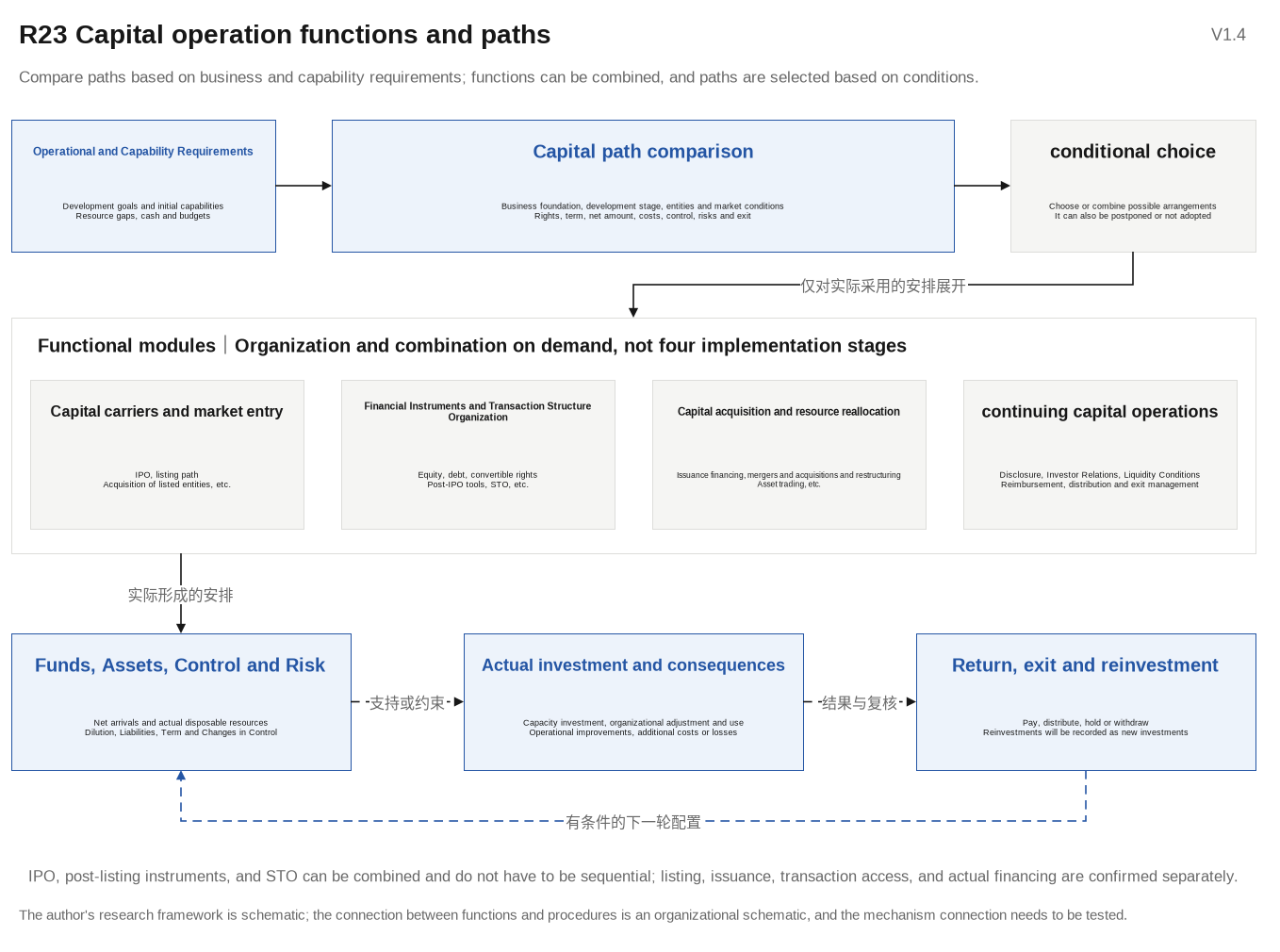
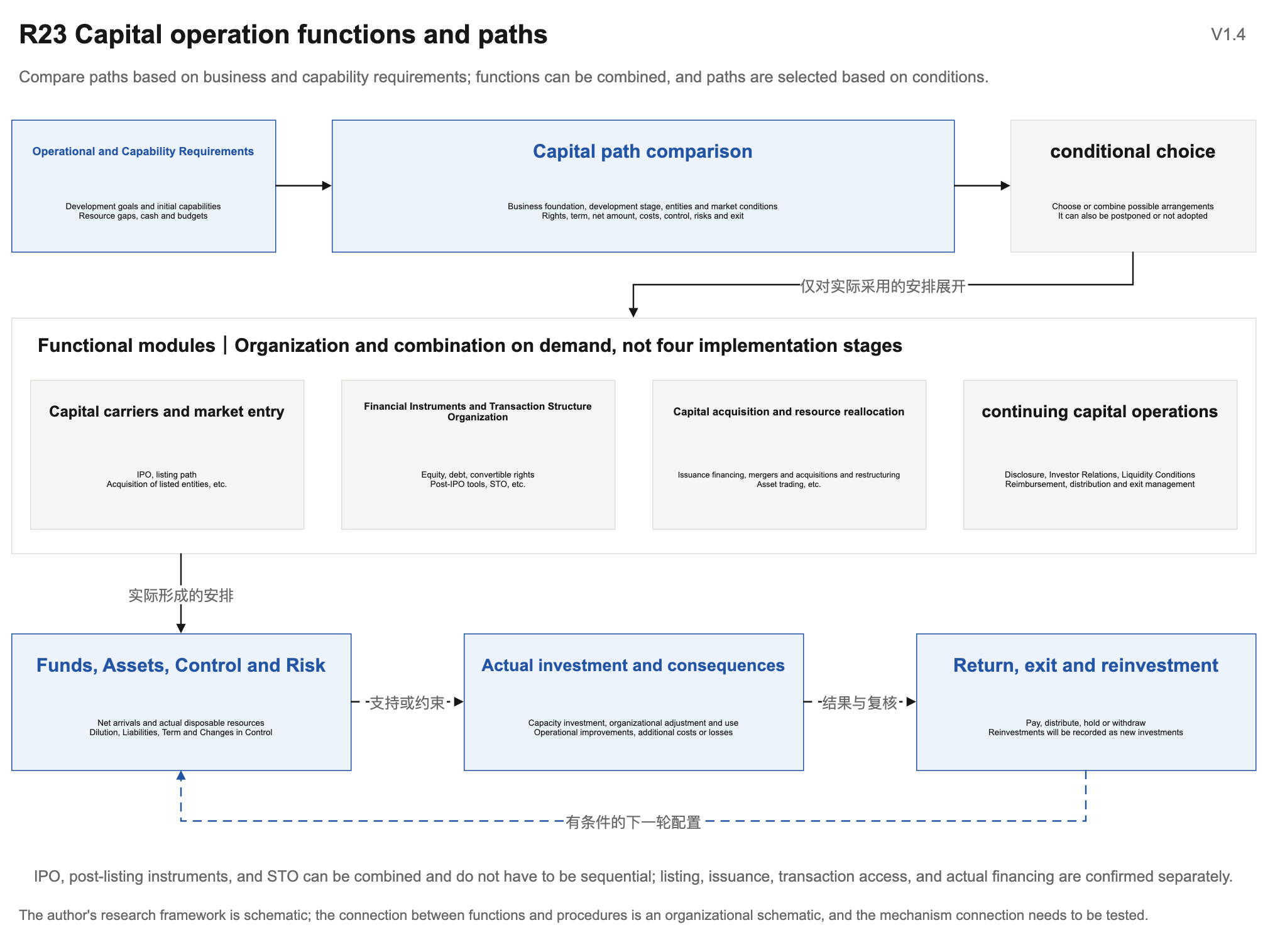
Equivalent text: Operation and capability requirements lead to a comparison of capital paths. Based on the operating basis, stage, entity, market, rights, term, net amount, cost, control, risk and exit conditions, feasible arrangements can be selected or combined, and may be postponed or not adopted. Only four types of parallel functions are carried out for the arrangements actually adopted: capital carriers and market entry, financial instruments and transaction structure organization, capital acquisition and resource reallocation, and continuing capital operations. IPO, post-listing tools and STO are optional means rather than mandatory stages. The actual formation of funds, assets, control and risk arrangements to support or constrain capacity investment and organizational adjustments may result in improvements, additional costs or losses; the results will enter repayment, allocation, holding or exit after review, and conditionally enter the next round of allocation. Re-investment is recorded as new investment; listing, issuance, transaction access and actual financing are confirmed separately.
The four-capital logic of Company Zero’s long-term operating strategy
Company Zero draws on the main line of analysis from Shi Yuqiang's "Four Capital Operations" and connects it with Wei Tengfei Reading diagram first picture, using the transformation and circulation between the four capitals to illustrate asset management and long-term operation strategies. [67]
Continuously acquire high-quality resources → organize and operate assets → connect and allocate factors with capital → form a return flow of funds → reinvest in resource acquisition, cultivation and management.
| Four assets | role in long-term operations |
|---|---|
| Resources | Provide a foundation for sustainable development and focus on the gathering, acquisition and cultivation of high-quality resources |
| assets | Organize appropriate resources into manageable value carriers and continuously create value through operations |
| capital | Organizational input, rights and factor allocation, using capital operations and financial connections to support development |
| funds | Support development, operation and turnover; continue to allocate to resource and asset management after reshoring |
Principles of long-term operation: Based on resources, create value through asset management, support expansion with capital organization, and continue development with capital return and reinvestment; and then continue to obtain high-quality resources through capital operations and financial instruments, so that the resource base, assets and capabilities can be updated in operations.
Funds are used throughout resource development, asset management and transactions. Operations, financing and appropriate exits can all bring funds, and exit reflow is only one of the sources. How capital and operations support each other and how the four capitals are transformed depends on actual conditions.
Company Zero uses this framework to explain the principles and long-term strategy of asset management, explaining "why we continue to obtain resources, why we operate assets, and how capital and funds support the next round of development." The source of the Four Capital Framework and the application statement of Company Zero are respectively indicated attribution. This section does not propose a new Four Capital Theory based on this.
The independent identities of people and institutions remain clear; resource gathering and asset management are connected through actual collaboration and effective use.
Figure R24 · The four-capital logic of Company Zero’s long-term operating strategy

The principles of long-term asset management of Company Zero are explained with the logic of four capitals: resource base supports the continuous acquisition and cultivation of high-quality resources through asset management, capital organization and capital return; capital operation and financial instruments serve as general support.
Editable Draw.io · SVG Preview · PNG preview
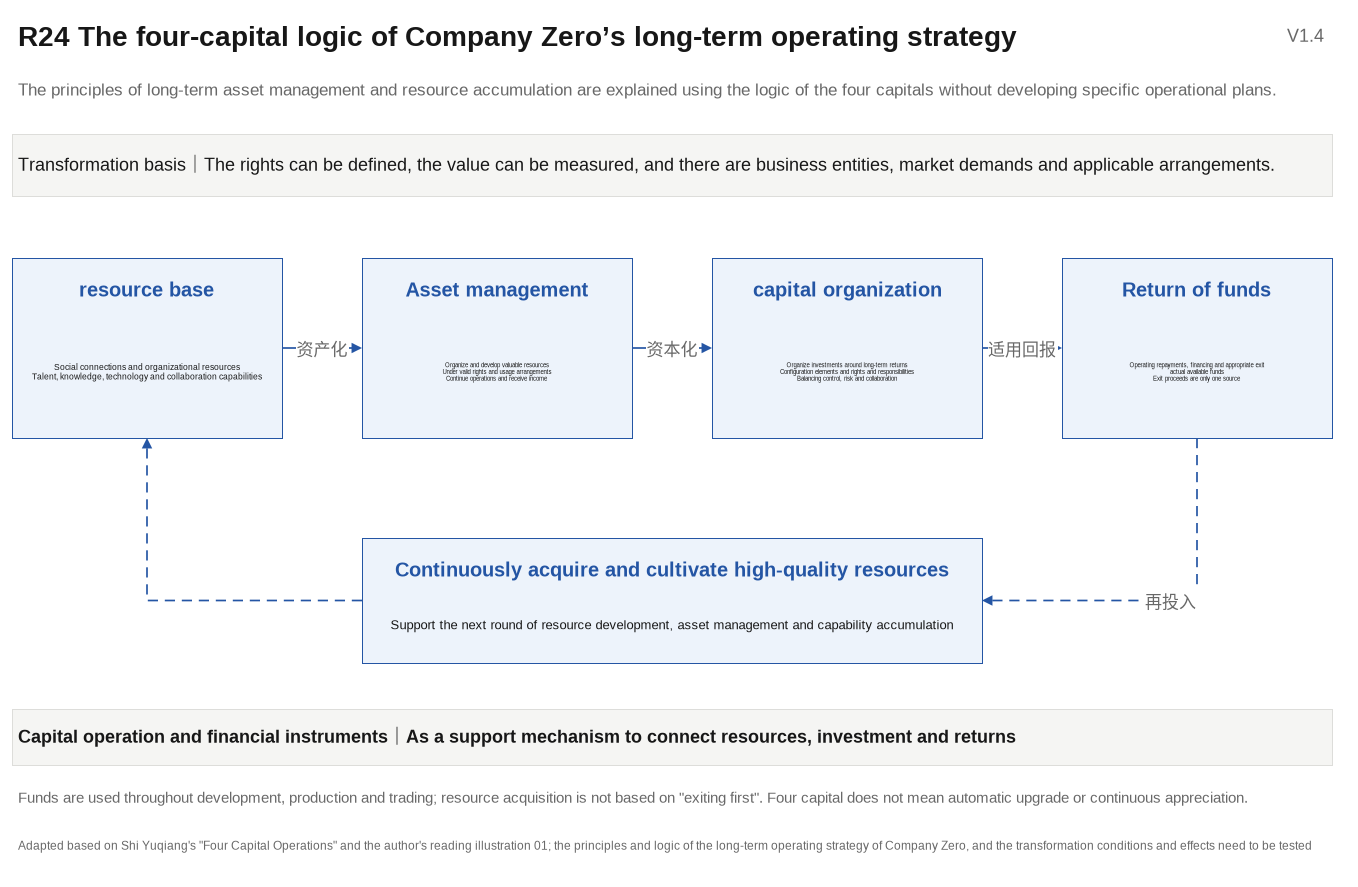
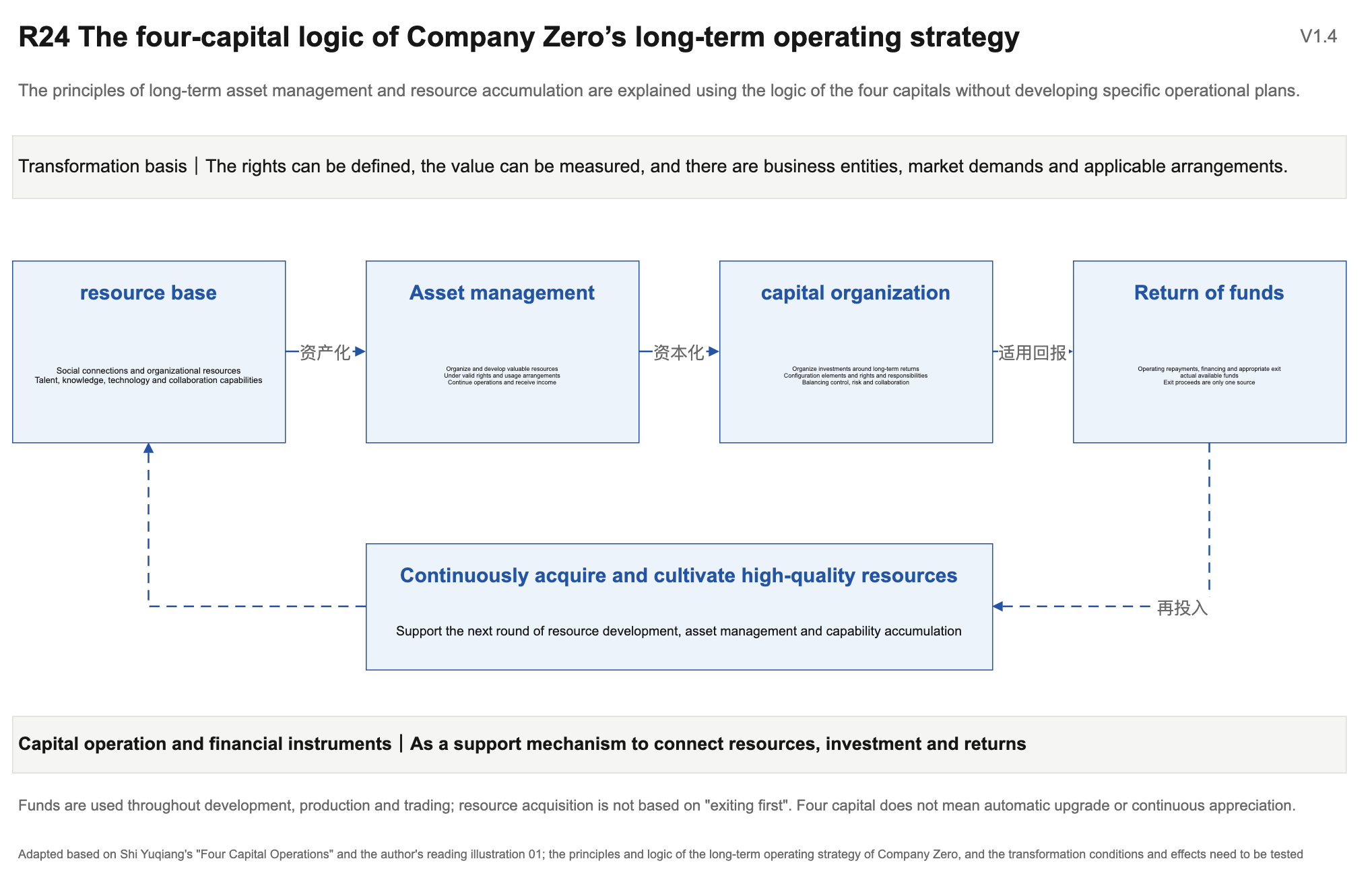
Equivalent text: This is a principle and logic diagram used to explain the long-term operating strategy of Company Zero, not a specific operation plan. The resource base includes social connections, organizational resources, talents, knowledge, technology and collaborative capabilities; it enters asset management through organizational development and effective rights and use arrangements, and then the capital organization allocates investments, elements and rights and responsibilities around long-term returns, taking into account control, risk and cooperation. Operating repayments, financing and appropriate exits can form actual available funds, and exit proceeds are only one source of funds. Available funds are reinvested to continue to acquire and cultivate high-quality resources, support the next round of resource development, asset management and capacity accumulation, and return to the resource base. Capital operations and financial instruments are general support mechanisms that connect resources, inputs and returns, and do not list specific tools or paths. Funds are used throughout development, production and trading, and resource acquisition is not predicated on exiting first. Transformation requires definable rights, measurable value, operating entities, market demands and applicable arrangements; the four capitals do not mean that each resource must be automatically upgraded, nor does it guarantee continuous value-added.
Double loop and four layers of review
Business cycle: Requirements and Resources → Work and Delivery → Usage and Transactions → Costs, Chargebacks and Improvements. Capital circulation: Investments and Rights → Capital Allocation → Returns and Risks → Reimbursement, Distribution, Exit and Reinvestment.
Review based on four levels of value, equity, capital and financial connections: whether the operating value is established, who holds the rights, how capital is organized, and how funds and transactions are accessed.
Nine-dimensional comparison
Compare development stages, investor roles, rights types, issuance arrangements, primary and secondary relationships, products or instruments, risks, returns and registration techniques. Fill in each dimension clearly, and then compare the available paths under the same business goal.
Funds and rights tracked separately
Accounts for cash, customer contracts, consumer rights, project assets, equity or investment units are established separately; operating, investment, and financing cash flows are checked separately. The capital increase goes to the enterprise, and the proceeds from the sale of old shares go to the seller; reinvestment after income distribution is recorded as a new investment.
The case amounts, proportions and deadlines in the model remain demonstrative in nature. Financing efficiency observes net amount, arrival, cost, dilution and conditions; cashing out efficiency observes time, achievable price, cost and exit conditions.
The boundaries between capital operations and long-term accounts
The capital market connects research entities, markets and investors; tools and transaction structures study rights, terms, pricing basis, risks and responsibilities; continuous capital operations research disclosure, governance, repayment and exit. Long-term capital accounts link participant relationships to confirmed arrangements and are reconciled separately with securities accounts, capital accounts and legal rights.
When organizing resources or operating capabilities into investment relationships, control, use, benefits, and responsibilities should be checked separately. Market valuation, asset status and actual disposable funds cannot be combined for calculation.
WISERUNION Aggregation and Personalization Solutions
WISERUNION is a unified aggregation platform for products, services and solutions. The supply that is now integrated, as well as the supply from more suppliers in the future, are all in wiserunion.com Unify display, search, comparison, matching and combination. The catalog is first organized by customer issues and supply content, and then linked to suppliers, countries and regions. These dimensions can intersect.
This section describes the finalized operational design for V1.3. How to integrate and migrate existing portals, and what steps are taken in functional construction are all recorded according to the actual situation. [20–25]
Figure R25 · WISERUNION aggregate supply

WISERUNION aggregates P/S/L in a unified directory, and presents supply solutions differentiated by version, country region, service scope and responsibility through many-to-many mapping of suppliers and items.
Editable Draw.io · SVG Preview · PNG preview
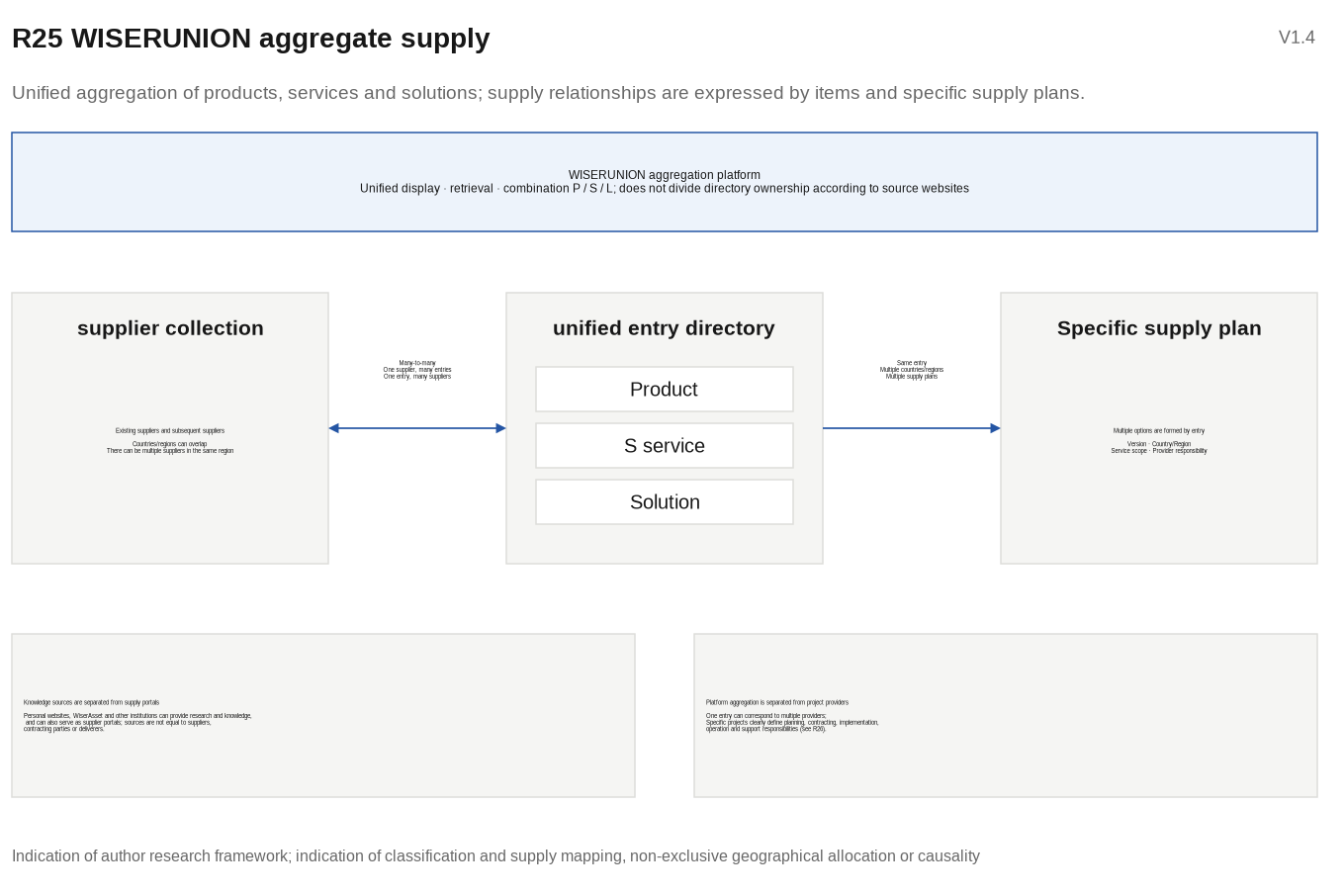
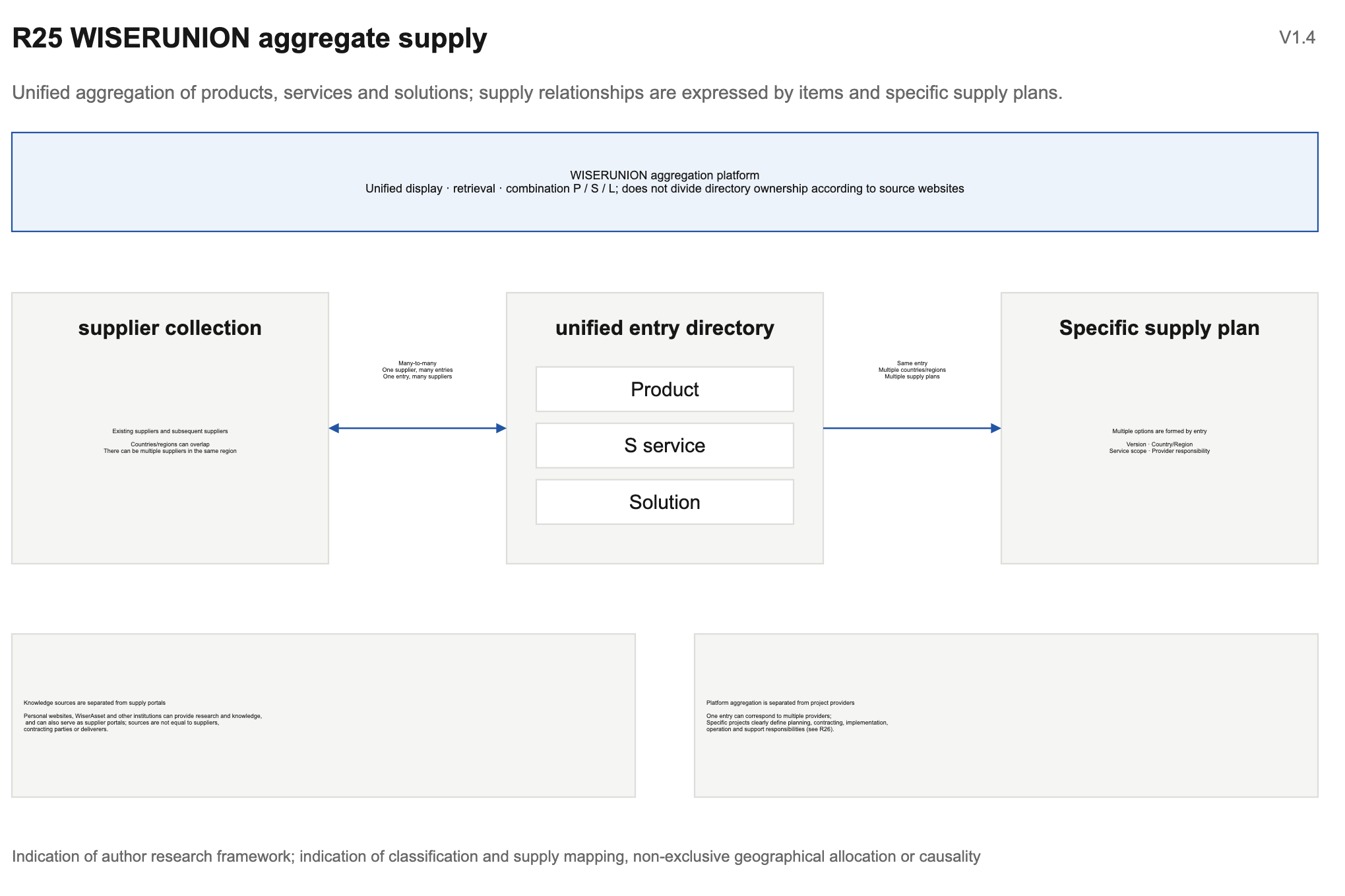
Equivalent text: WISERUNION uniformly displays, retrieves and combines products P, services S and solutions L without dividing the catalog according to sources from personal sites or platforms. The supplier collection contains existing and successor suppliers: there can be multiple entries for the same supplier, and there can be multiple suppliers for the same entry. Countries and regions can overlap, and there can be multiple suppliers in the same region; the same entry can form multiple supply plans differentiated by version, country region, scope and responsibility. Personal websites, WiserAsset and other institutions can be used as research knowledge sources and supplier portals, but the sources are not equal to suppliers, contractors or deliverers. The platform is responsible for aggregation; specific projects clearly define planning, contract signing, implementation, operation and support responsibilities.
Unified aggregation and multi-vendor provisioning
| level | Organize content | Relationships with other levels |
|---|---|---|
| unified directory | Content, purpose and optional capabilities of product P, service S, solution L | Do not divide the directory according to the original personal website or other websites; retain the source of knowledge, versions and results |
| supplier network | Current and subsequent product, service, and solution providers | The same item can be provided by multiple suppliers, and a single supplier can provide multiple items. |
| National and regional supply | The service scope, versions, delivery conditions and support of each supplier in specific countries or regions | There can be multiple suppliers in the same region, and the same supplier can also cover multiple regions; coverage and responsibilities are clarified based on the actual supply plan |
| Client and Project Arrangement | Select supplies and organize delivery based on specific customer goals, existing conditions and actual areas | Choose from complete supplier solutions or combine products and services across suppliers to create personalized arrangements |
The same product, service or solution can have multiple suppliers, or there can be supply solutions for different countries and regions. Even if the names are the same, the functions, versions, support and service scope may also be different. It depends on the actual content and then related and compared; only when the applicable conditions are met, they will be listed as replaceable options.
Products, Services and Solutions
| level | definition | Role in aggregation and delivery |
|---|---|---|
| P / product | Selectable and reusable knowledge products, tools, software, systems, applications, platforms and related accounts, rule execution or interface capabilities | It can be supplied independently, or applicable versions can be provided by different suppliers to enter a variety of solutions. |
| S/Service | Diagnosis, research, planning, design, coordination, implementation, training, operation and support undertaken by people and organizations | Can be supplied independently or combined with products, other services and complete solutions according to customer needs |
| L/Solution | After demand diagnosis and planning, a personalized arrangement is formed by combining multiple products and services as needed around specific customers or projects. | It can be adapted based on the supplier's complete solution, or can be planned across suppliers; clarify the problem, goal, combination logic, responsible person, implementation, delivery and acceptance |
Solution planning itself is a professional service, and the solutions made must correspond to specific customers. You can continue planning based on the supplier's reference plan or complete plan, and then clarify the selection, region, version, role, resources and delivery conditions.
Figure R26 · Personalized solutions

Starting from the customer's goals and conditions, after diagnosis, planning and supply selection, we combine P/S or adapt a complete third-party solution to form a customer-specific plan and clarify responsibilities; it is revised based on feedback from acceptance and actual use.
Editable Draw.io · SVG Preview · PNG preview
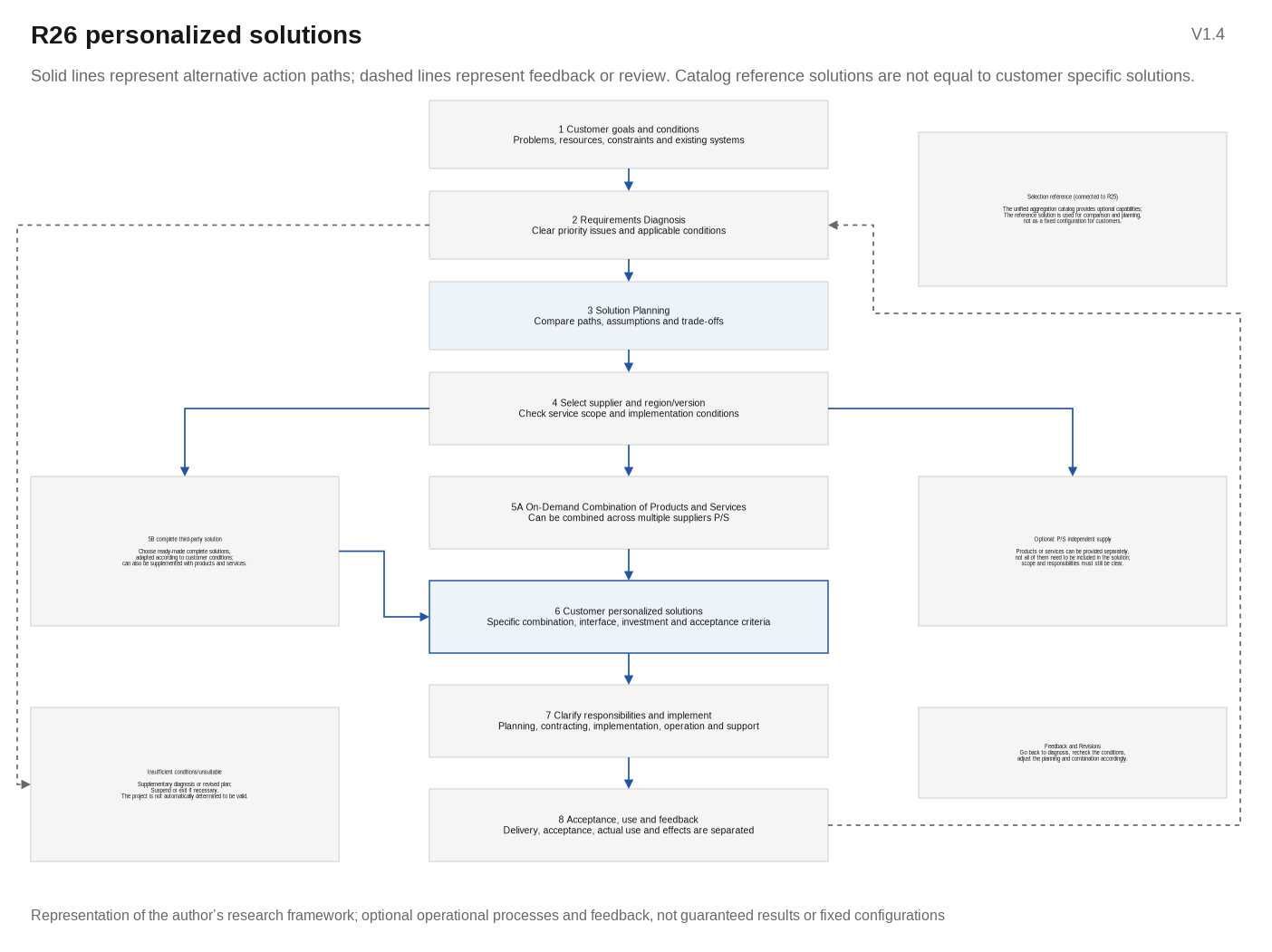
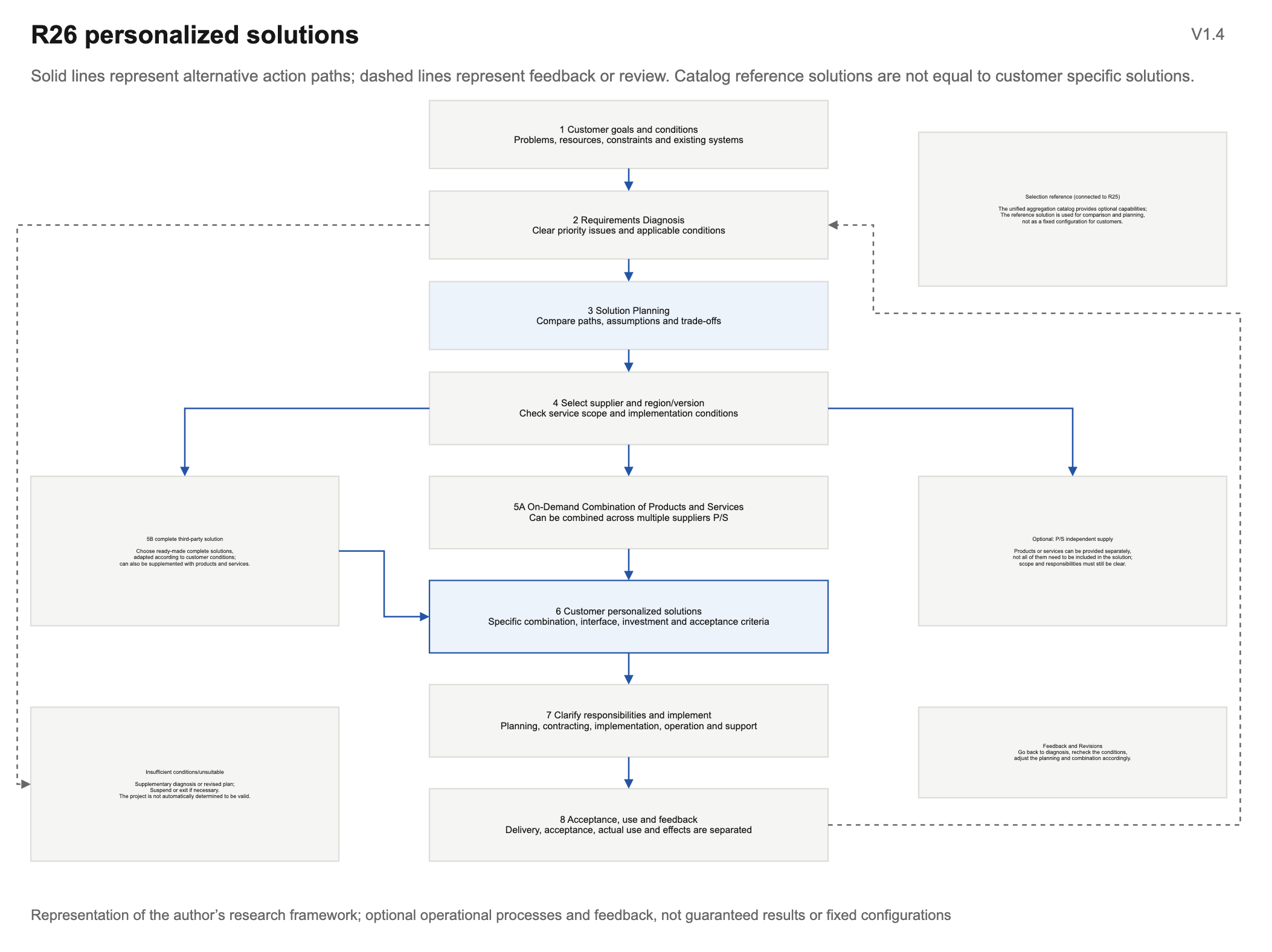
Equivalent text: Customer goals and resource constraints enter demand diagnosis, and then solution planning; after comparing alternative paths, key assumptions, and trade-offs, select suppliers, regions, and versions, and check scope conditions. You can combine products and services on demand across multiple suppliers, or you can choose a complete third-party solution and adapt and supplement P/S according to customers; both paths can form customer-specific solutions. The plan clearly defines the combination interface, investment and acceptance criteria, and is then implemented according to clear planning, contract signing, implementation, operation and support responsibilities. Distinguish between delivery, acceptance, actual use and effects, and feedback back to diagnosis and revision of planning. P/S can also be supplied independently, without forming an L, and the responsibilities are still clear. When the diagnosis finds that the conditions are insufficient or unsuitable, supplement the diagnosis or revise the plan, and suspend or withdraw if necessary. The unified catalog and catalog reference plan are only used for selection planning and are not a fixed configuration for customers.
From needs to individual solutions
Customer goals and conditions → Demand diagnosis → Solution planning → Select suppliers and applicable regions and versions → Combine multiple products and services as needed → Form personalized solutions → Clarify responsibilities and implement acceptance → Use, feedback and continuous improvement.
| link | Main work and products |
|---|---|
| Requirements diagnosis | Understand the client or project's problems, goals, country region, operating basis, resources and constraints, and clarify what to prioritize |
| solution planning | Use research, theories, models and methods to compare paths and clarify goals, key assumptions, applicable conditions and basis for choices. |
| Supply selection and mix | Select the corresponding product, service or complete solution, compare suppliers, versions, regional scope, interfaces, dependencies and support, and organize multi-party collaboration |
| Form personalized solutions | Organize the goals, portfolio structure, roles and responsibilities, input, implementation, delivery, acceptance and subsequent maintenance into a complete arrangement for the project |
| Implement, use and improve | Clear planning, contract signing, implementation, coordination, operation and support for all parties, and adjust the combination and working methods based on acceptance and actual use |
Knowledge sources, platforms and actual providers
Personal research platform weitengfei.com(yutengfei.com) continue to accumulate research, papers, books, methods and results; Wiser Asset and other platforms, institutions and professional entities can provide products, services, technologies or collaborative capabilities. Relevant supplies are unified into the WISERUNION aggregation system.
Where the knowledge and results come from, on which platform they are displayed, who supplies them, who contracts them, and who actually delivers them, must be recorded separately. Existing websites and platforms can continue to serve as entrances for research, software display, delivery or professional work; WISERUNION unifies the organization's supply catalog and matching relationships, and specific responsibilities are defined by project.
The role of the solution catalog
The existing ten types of solution directions first provide a reference for a unified catalog, listing applicable problems, possible paths and optional components. Solutions from other fields and suppliers can be added later. Solutions for specific customers must be determined through diagnosis and planning. The catalog cannot be directly regarded as a fixed configuration for all customers.
Separate evaluation of user value and participation contribution
Delivery and use value are evaluated by customers or internal users based on goals, agreements, and actual materials used; participation contributions are reviewed by the authorized subject based on role tasks, input results, and applicable rules. The two processes share project, achievement and version identifiers, retain conclusions and objections respectively, and then associate them with long-term accounts, specific rights and responsibilities and performance, see Figure R20。
How does practice return to research?
From aggregation, selection, combination, to delivery and subsequent use, supplier dependence, regional differentiation, customer value, capacity retention, capital arrangements and long-term cooperation can be specifically observed. What organizational role WISERUNION plays as a platform, and how each supplier supplies and implements it, must be identified separately.
Company Zero organizes practice in five dimensions: academics, community, resources, business, and capital. Academic formation direction and theory, the community undertakes the basic identity and co-construction of stakeholders, resources connect social connections and institutions, business realizes the profitability of products, services and personalized solutions, capital supports resource acquisition, investment, returns and the four capital cycles; the actual results of the five dimensions are continuously fed back to each research direction of A-E. The input, rights and performance of Company Zero, customers and suppliers are vested respectively.
Polymer product catalog and research undertaking
WISERUNION unified polymer product supply. Next, the existing seven categories of technical products are mapped to the research problems, and the P01-P07 numbers are retained to facilitate reference of solutions; suppliers and national and regional supply plans are also related. The specific version, configuration and usage scope are recorded according to the actual project. [22]
| Products | Main disclosed capabilities and research affiliations |
|---|---|
| P01 · WBS Brokerage Platform | Securities accounts, positions, orders and securities connection process. Mainly: D2, D3; associated with E1. |
| P02 · Omin Market trading platform | Digital securities access, transaction configuration, account wallet and market records. Primary: D3; associated E1. |
| P03 · AssetX Liquidity Technology System | Asset connection, participation incentives, contribution records and system interfaces. Mainly: D3, E2; associated with E3. |
| P04 · Enterprise customized STO and digital asset DApp system | Brand client, rights display, rule permissions and business interface. Mainly: A2, A3, E1; associated with D3. |
| P05 · Enterprise Stakeholder Wallet and Governance Platform | Role accounts, contribution records, rights display and authorized collaboration. Mainly: E1, E2, E3; associated with B1. |
| P06 · Corporate co-branded cards and card project management | Brand entrance, card and role rights, partner interface and records. Mainly: C1, E2, E3. |
| P07 · Digital business SaaS and cross-border e-commerce platform | Brand mall, product orders, customer points, channels and operating data. Mainly: C1, C3; related to A2, E3. |
Technical capabilities and research purposes
System access provides implementation conditions for process, permissions and collaboration changes. Actual users, task coverage, rule versions and interface dependencies enter A; knowledge and maintenance during use enter B; customer behavior enters C; capital conditions enter D; rights fulfillment enters E.
The product catalog describes the selection and delivery directions. Functional indication, access preparation, actual deployment and continuous operation are registered separately; whether AI enters a certain job is judged based on the task facts.
Use in personalized solutions
When planning, you can select the required capabilities from the product catalog. Specific selection, configuration, interfaces and combinations must be determined based on customer problems, existing conditions and actual delivery. The same product can be used for different personalized solutions.
NST management methods and software: first self-use inspection, and then gradually productization
NST follows the author's existing governance methods, rules and titles of software work. It is not equivalent to the entire research master plan, nor does it replace the five academic research directions A-E. Its specific functions, implementation methods and progress are subject to actual materials and version records.
Figure R27 · NST governance methods and software: self-use inspection and gradual productization

The author's own NST management methods and software are first actually used by Company Zero, and are tested according to use, maintenance, error correction and responsibility implementation. Parts that meet independent delivery conditions are gradually commercialized and supplied to WISERUNION; they are allowed to continue to be used, revised or temporarily not available to the public.
Editable Draw.io · SVG Preview · PNG preview
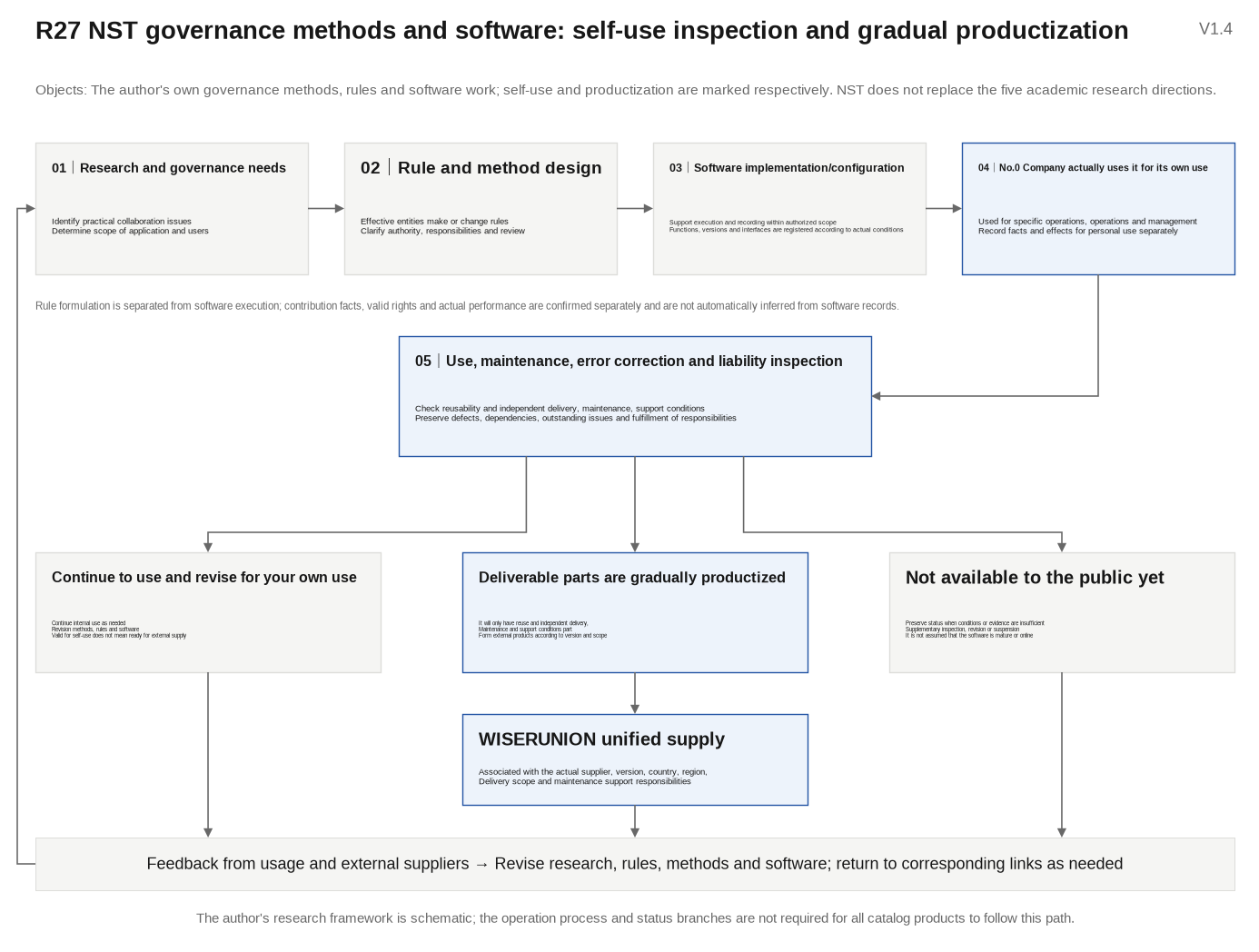
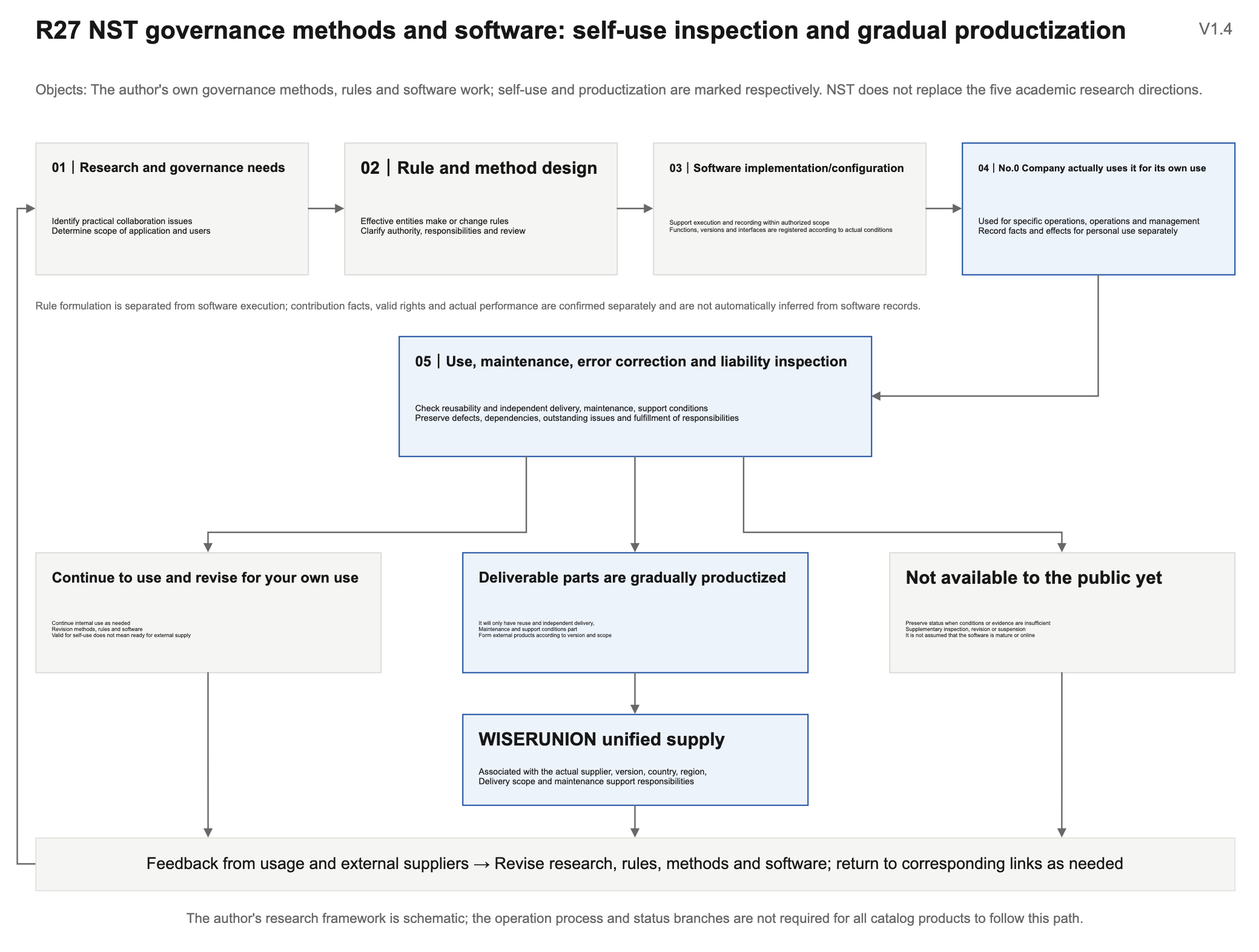
Equivalent text: Starting from research and governance needs, effective entities formulate or change rules and design methods. Software implementation or configuration supports execution and recording within authorization, and is first used for the specific operation, operation and management of Company Zero. After actual use, check maintenance, error correction, responsibility implementation, as well as reuse and independent delivery, maintenance, and support conditions. The status is recorded separately for self-use and productization. It can be continued for self-use and revised, or the qualified parts can be gradually formed into external products according to version and scope, or it can be temporarily not released to the public when the conditions and evidence are insufficient. The productization part is uniformly supplied through WISERUNION, and is related to the actual supplier, version, country region, delivery scope and maintenance support responsibilities. Problems and feedback in internal use and actual external supply will be revised to research, rules, methods and software, and return to the corresponding links as needed. The fact of contribution, valid rights, and actual performance are confirmed separately and are not automatically inferred from software records. This path is for the author's own management work, and does not require that all supplier products in the catalog are first used by Company Zero; NST is not equivalent to the research master plan, does not replace the five directions, nor is it recognized as mature software, online, or rights and interests have been formed based on the illustration.
For the author's own governance methods and software, he first designs rules and methods based on the real research and governance needs of Company Zero, and then implements or configures the software for specific operations, operations and management. Rules are formulated or changed by authorized entities based on effective arrangements; the software supports execution and recording within the scope of authorization. The fact of contribution, valid rights and actual performance are confirmed separately, and software records do not automatically form equity or other rights and interests.
After internal use, continue to check the use, maintenance, error correction and responsibility implementation, check which parts can be reused, and which parts have the conditions for independent delivery, maintenance and support. The status is recorded separately for personal use and productization: it can continue to be used and revised, or the qualified parts can be gradually formed into external products according to version and scope of application; if the conditions or evidence are insufficient, it is allowed to be temporarily not available to the public. Just because there is a method name, software implementation or internal usage record, it does not mean that the software is mature, has been launched or has the ability to be delivered to external parties.
Form the external supply part, enter the WISERUNION unified aggregation directory, and associate the actual suppliers, versions, country regions, delivery scope and maintenance support responsibilities. Feedback on problems, costs, experience and responsibilities in internal use and actual external supply will continue to revise methods, software and related research. This path is aimed at the author's own NST management work. It does not require all suppliers or all products in the catalog to be used by Company Zero, nor does it change the principle of multi-supplier, multi-country and region, and combination supply based on demand.
Figure R27 is used to illustrate the above operation process, conditional branches and feedback relationships. It does not mean that each link has been implemented or that each product must enter the next stage in sequence. Actual self-use, inspection, productization and external supply status are registered separately.
This self-use and gradual productization path inherits the existing operating concept of No. 0 Company, and the specific progress is registered based on actual materials. [31]
Knowledge and method products
Knowledge and method products such as book manuscripts, research tools, training materials, think tank resources and skills can also be entered into the unified product catalog based on actual supply status. Public knowledge, method introductions, available tools, and agreed-to-delivery products are identified separately, and source, version, usage scope, and maintenance records are retained. [03, 04, 28]
Product Items and Supply Plans
The catalog explains the uses and capabilities of the product, and the specific supply plan clearly states the supplier, version, country region, delivery scope, interface and support. The same item can have multiple supply plans, and new suppliers and new products can continue to be added. After the product is placed in the unified catalog, the specific source of knowledge or technology must still be found.
Unified service catalog and research undertaking
Existing strategies, capital, brands and WISERUNION professional services are integrated into the same service catalog and presented uniformly in WISERUNION. The following is grouped according to customer problems and professional work, and the existing names are retained to facilitate the search of the original content; when selecting, check similar names and overlapping scopes, and match suppliers according to specific work. [20, 23]
| service group | Existing integrated content | Main research undertaking |
|---|---|---|
| Strategy, Operations and Governance | Top-level strategic planning services; strategic diagnosis and business planning; business and economic model design; stakeholder governance design | Coordinate A-E; determine main ownership based on business objectives, organization and governance issues |
| Industrial Capital, Financing and Capital Strategy | Strategy and industrial capitalization; international financing and long-term value; financing and capital operation consulting; digital finance and global links | D1-D3, related rights and responsibilities of E |
| IPOs, M&A and Securitization | Listing and mergers and acquisitions; listing planning and acquisition of listing entities; STO structure design and issuance implementation | D1-D3; observe entities, assets, transactions, controls and operating inputs |
| Liquidity and Investor Relations | Liquidity construction and market value management support; investor relations and capital docking | D2, D3; Disclosure collaboration and responsibility connection E |
| Professional coordination and technical implementation | Compliance and coordination with professional institutions; technical consultation and customization implementation; exchange listing and currency docking | A2、A3、D3、E3 |
| Products, brands and markets | Product planning services; brand planning services; visual expression services; brand and marketing promotion | C1-C3; connection between delivery and knowledge retention A2, B1 |
| Knowledge, training and ecological operations | Zhixing personal knowledge station; new financial education and management training; community and industrial ecological operation; platform operation and maintenance and customer support | B1—B3、C1、E3 |
| International expansion and overseas operations | Enterprise overseas and overseas operation support | C1, C2, D1, connect cross-regional organization collaboration |
Service names help describe what work is done and cannot be used directly to calculate the number of non-overlapping results. Whether to merge or not depends on the service scope, products and responsibilities; the old name can be retained as a search alias or scope description, and the number of old directories cannot be added directly. Product and service planning retain their respective scopes of work; broad-based mergers, acquisitions, reorganizations and operational integration also receive separate instructions from listed entities.
The service catalog continues to be open, and subsequent suppliers can add new capabilities or provide supply solutions for existing services in different countries, languages, scopes and delivery conditions.
Planning, portfolio and responsibility
Customers can choose a single service or combine multiple services and products through solution planning. Who will provide it, how much it will be done, how it will be delivered and collaborated, how it will be accepted, and who will support it and assume follow-up responsibilities, all will be clear based on the actual project. The same service may be provided by different suppliers. Just because it is displayed on the platform, it does not mean that it must be delivered by the platform itself.
Method basis and research materials
Diagnosis and planning can use think tanks, manuscripts, tools, skills, contribution reviews, project evidence ledgers and brand materials. Records should be kept of initial questions, comparison options, products, written acceptance, modifications, actual use and follow-up support, and then evaluate what the plan has done, what has been implemented, and what effects have been achieved.
The connection between education and scientific research and application
Education must clearly explain appropriate research results so that people can understand, learn and use them. Manuscripts, guides, courses, training, and tool descriptions can be connected with actual tasks; community learning, professional resources, and business services can help you use them as needed, and then bring back to study what you don’t understand, how to actually apply it, and what the effect is. Education is jointly undertaken by the existing five dimensions, and the transformation relationship can be seen in Figure R22。
Suppliers, national regions and responsible organizations
The aggregation system must separately manage the content of the supply and who actually supplies it. The same product, service or solution can be associated with multiple suppliers and multiple countries and regions; the same supplier can also provide multiple types of supplies across multiple regions.
many-to-many supply relationship
| object | Record content | Connection method |
|---|---|---|
| directory entry | Stability identification, P/S/L type, customer issue, functional or scope of work, knowledge and version sources | Associate one or more supply options and compare similar, alternative or combined relationships by content |
| supplier | Actual entity, location, professional capabilities, supply role, contacts and scope of responsibility | Multiple items can be provided, or the same item or customer plan can be provided in collaboration with other suppliers; the location and serviceable area are recorded separately |
| Countries and regions | Serviceable regions, languages, applicable versions, delivery and support conditions | As a coverage dimension of the supply plan, it is not mandatory to form a one-site-one-business relationship. |
| Specific supply plan | Item, supplier, country, version, scope, delivery, support and corresponding conditions | Describe what is provided by whom and under what conditions; there can be multiple comparable supply options for the same item |
| Customer personalized solutions | Customer objectives, selected supplies and suppliers, rationale for combination, roles and responsibilities, implementation and acceptance | Complete solutions can be adopted and adapted, or products and services can be combined across suppliers or regions |
Aggregation and Delivery Responsibilities
WISERUNION organizes catalog presentation, needs matching, solution curation and collaboration. The specific work to be undertaken by the platform and which by the supplier shall be confirmed according to the project agreement. Planning, contracting, delivery and operational support can be the responsibility of the same entity, or the work can be divided.
The supplier’s source, supply capabilities, applicable regions and responsibilities must be true and verifiable. The reference catalog, availability, actual transaction, delivery acceptance and continued operation must be recorded separately. If the products have substantial differences in functions, rights or delivery, they should remain independent entries and can indicate substitution or combination relationships. They cannot be merged just because of similar names or functions. When the supply relationship changes, follow-up arrangements for the applicable versions and customer projects must also be retained.
value to research
Aggregation practices provide observation objects for A3's external dependencies and boundaries, B3's capability migration, C's customer value and comparative options, D's resources and capital conditions, and E's cross-organizational commitments and fulfillment.
When comparing different suppliers or regional arrangements, it is necessary to record customer conditions, reasons for selection, task differences, additional investment and service scope. Differences caused by the selection of suppliers or regions cannot be directly interpreted as the effect of a certain technology.
Solution reference direction: capital path and market connection
The following six types of solution directions are placed in the WISERUNION unified aggregation directory for personalized planning reference. Each direction can be associated with specific supplies from different suppliers and country regions. When facing specific customers, products and services are combined based on projects, industries, capital carriers and market conditions, and applicable conditions and delivery content are clarified. [21, 24]
L01 · Project STO
Evaluate project capitalization, securities structure and implementation preparation around existing technologies, business models or industrial resources.
Research undertaken: D1—D3, associated E. Observe how the development stage, fund use and rights structure affect subsequent investment in the project.
L02 · Industrial STO
Sort out the operation, assets and collaborative relationships of mature industries, and study the appropriate capital structure and collaborative promotion.
Research undertaken: D, associated E3. Compare the scope of industry integration, asset boundaries, multi-party investment, and risk arrangements.
L03 · Independent Capitalization STO
Compare capital platform acquisition and control arrangements, ongoing investments, and governance and operating conditions.
Research undertaken: D1, D3. Examine the cost, control and operational adaptation of self-owned platforms and external cooperation.
L04 · Listed company STO
Based on the existing listed entities and governance, evaluate securities connections, capital operations and investor communication.
Research undertaken: D2, D3. Trace the connection between capital arrangements, information and actual operating inputs.
L05 · Securities Liquidity Construction Plan
Combine WBS, Omin Market, AssetX and other technologies with liquidity and investor relations work.
Research undertaken: D2, D3. Observe the completion of access, market conditions, capital costs and actual financing of the enterprise respectively.
L06 · Exchange listing and three-month incubation plan
Organize technology docking, professional coordination, brand community and stage operations; three months is the incubation service period.
Research undertaken: D3, associated with E3. Distinguish between preparation, listing decision, operational execution and subsequent results.
Catalog Names and Research Advancement
This section retains the name of the existing business plan, and the service period written therein does not serve as the implementation period of this study. Capital paths must be compared based on actual conditions, and research advancement is not predicated on completing listing, issuance, listing or STO.
Solution reference direction: digital operation and cooperation
The following four types of solution directions are placed in the WISERUNION unified aggregation directory for business and collaboration planning reference. Specific products, services and complete solutions can come from different suppliers and country regions. Select and combine products and services based on the customer's role, rights, platform and operating conditions to form personalized solutions; research attribution is still determined based on the main issues. [21, 24]
L07 · Listed company stakeholder wallet and co-branded card solution
Combine enterprise wallet, role rights, card project interface, rule configuration and continuous operation.
Research undertaken: E1-E3, associated with C1. Compare how accounts and benefit arrangements change customer usage, engagement and engagement.
L08 · Stakeholder Digital Governance Solution
Combined governance design, incentive model, software configuration and ecological operation, organizational contributions, rights and decision-making authority.
Research undertaken: E, associate A2, B1. Examine whether independent review, rule enforcement and objection procedures affect allocations and reinvestments.
L09 · Digital business going global and capitalization solutions
Combine digital business platforms, brand channels, overseas operations and professional coordination to study capital paths based on conditions.
Research undertaken: C, associates A, B, D. First observe demand, contract performance, payment and operations, and then analyze financial support and capacity accumulation.
L10 · Web3 ecological platform construction and operation plan
As the baseline for candidate solutions and project establishment, it organizes model, DApp, contract, backend, verification and operation handover.
Research undertaken: A, E, connect B, C, D by project. Compare technology choices, rights rules and ongoing operations in specific scenarios.
The combination in planning
The following only illustrates the optional components, and specific items can add, replace or adjust products and services.
P05 Enterprise wallet + governance design and other services → Personalized digital governance solutions. P07 Digital business platform + brand, overseas operations and other services → Personalized digital business overseas solutions. Securities and asset systems + capital advisory, IR and other services → Capital or market solutions adapted to customer conditions.
The ten categories of solution directions serve as an existing reference for WISERUNION's unified aggregation catalog, which can be expanded later on by suppliers and suppliers. Specific customer delivery is personalized based on diagnosis and planning. System functions, professional access, effective rights, actual funds and operating results are checked separately.
Conditions for promoting practice in Company Zero
Company Zero is the overall practical carrier of scientific research results and the main subject of longitudinal research. Research and actual operations promote each other. Through the five dimensions of academia, community, resources, business and capital, we conduct research on organizational direction, participation identity, people and institutional resources, profit-making business and capital allocation, and then bring back the real process and results for research. Which step to achieve depends on conditions, evidence and results, and there is no fixed deadline. The following links can be paralleled, repeated, reduced in scope or stopped according to the actual situation.
| Promotion link | Research and practical tasks of Company Zero | Basis for entering or continuing |
|---|---|---|
| Transform scientific research results into practical arrangements | Clearly identify which research results will be adopted, which business decisions, organizational rules, products, services or capital arrangements will be converted into; record applicable conditions, expected mechanisms and adjustment basis | The results match the actual problems, and the implementation objects, responsible persons, resources and observation scope are clear |
| Research subjects and preparation for measurement | Choose your own real tasks, business chains or cooperative relationships, and clarify objects, permissions, data, result users and comparison arrangements. | The objects and scope are clear, inputs and results can be traced, and necessary recording and review conditions are in place. |
| Five-dimensional operations and practical feedback | Track inputs, uses, results and revisions, and relate research questions across academic products, communities and co-construction, connections between people and institutions, commercial delivery and capital matters | There are actual work and verifiable records, which can distinguish operating results, subject ownership and research explanations. |
| Comparison of organization and execution mechanisms | Compare AI, process, authorization, handover and knowledge maintenance arrangements, and observe changes in organizational and execution capabilities | Baseline and comparable tasks are available to differentiate between technology, organizational arrangements, and additional labor |
| Capability retention and capital operation observation | Check performance after replacements, tools, and maintenance; track real budgets, capital paths, financing conditions, and investment decisions | Ability to obtain usage and subsequent performance; record changes in funds, assets, controls and risks as actual decisions occur |
| An examination of long-term capital accounts and cooperative governance | In actual relationships and effective agreements, track identity, investment, contribution review, rights and responsibilities, performance and subsequent investment | The rules and authorities are clear, the confirmation basis can be reviewed, and the design, establishment of rights and interests and actual realization can be distinguished |
| Review, integration and new issues | Review different tasks, processes, or relationships, compare adverse results, and update models, methods, and research scope | Evidence that supports qualified conclusions while leaving open alternative explanations, invalidating conditions, and open questions |
Technology and organizational arrangements, customers and operating results, capital and capability investment, long-term capital accounts and cooperative governance can all form their own comparable research paths. The links in the table are grouped according to specific issues, and the promotion of accounts or system design cannot be used to replace the comparison and inspection of other topics.
Only the actual matters of Company Zero will be included in the promotion index. External cases are used for comparison and boundary identification, and the input and performance of partners and customers are recorded separately. IPO, securities issuance, STO, mergers and acquisitions, etc. are all conditional paths and are not set as must-have events for advancement.
Connect work with complete practical examples
Choose an internal or customer project with an appropriate scope and clear deliverables, and organize requirements, roles, versions, delivery and usage, value acceptance, contribution review, revenue and expenditure, applicable rights and review into a common index to help understand how Company Zero actually operates.
Below, the delivered round of V1.3 graphics and text construction is listed as an example of internal materials, with the existing facts and pending status clearly stated. Subsequent projects will be accumulated according to the same structure. See Complete practice example. Just because the fields can be connected does not mean that all business matters have been completed. The two are explained separately; advancement is still based on conditions and evidence.
Company Zero Research Index and Review
common observation unit
| unit | Continuous recording |
|---|---|
| Tasks and processes | Task conditions, executors and tools, responsibilities and authorities, resources, handover, results, acceptance, downstream use, maintenance and reuse |
| Commercial projects and client relations | Demand diagnosis, product or service selection, solution planning and combination, supplier and country and region selection, responsibility agreement, user value acceptance, actual use, customer payment, cost profit, cash, repurchase and capability reuse |
| Community identity and co-construction of relationships | Basic participation status, free or paid categories, subsequent co-construction roles, membership fees and services, task authorization, contribution, fulfillment, retention and exit |
| Collaboration of people, institutions and resources | Sources of information, expertise and relationships, willingness to contact and participate, authorization, available capabilities, demand matching, actual supply and collaboration results |
| Investment and Capital Events | Goals, candidate paths, subject and market conditions, budget, terms, actual changes in funds or resources, decision basis and consequences |
| Stakeholder Relations and Accounts | Multiple roles, input results and evidence, confirmation and review of participation contributions, rights and responsibilities to be confirmed or established, performance, objections, continuation and exit; associated with value acceptance through common project identification |
| Practical version of scientific research results | Research basis, candidate explanations, applicable conditions, adoption decision, implementation version, deviations, actual results, counterexamples and feedback revisions |
| Organization and Rules Version | Applicable subjects and scope, decision maker, effective basis, reason for change, authorization, responsibility and impact on actual work |
Complete practical example: indexing and internal construction examples
The complete practice example first selects an internal or customer project with appropriate scope, and connects requirements, roles, working versions, delivery and use, customer value acceptance, participation contribution review, revenue and expenditure, applicable rights and review. Each item is associated with a common project and achievement identifier and can be recorded in parallel.
The completeness mentioned here means that matters, status and basis can be mutually consulted. Already occurred, not yet occurred, data not provided and yet to be confirmed should be marked separately. Internal projects are subject to value acceptance by internal users and organized according to actual materials. It is not assumed that there have been transactions with external customers.
Figure R28 · Complete practice example: from requirements to review

Use the same project and achievement identification to connect requirements, division of labor, work version and delivery; customer value acceptance, participation contribution review, revenue and expenditure and applicable rights and interests are recorded separately, and then reviewed and revised research and rules. Each track can be run in parallel, and pending items retain their status.
Editable Draw.io · SVG Preview · PNG preview
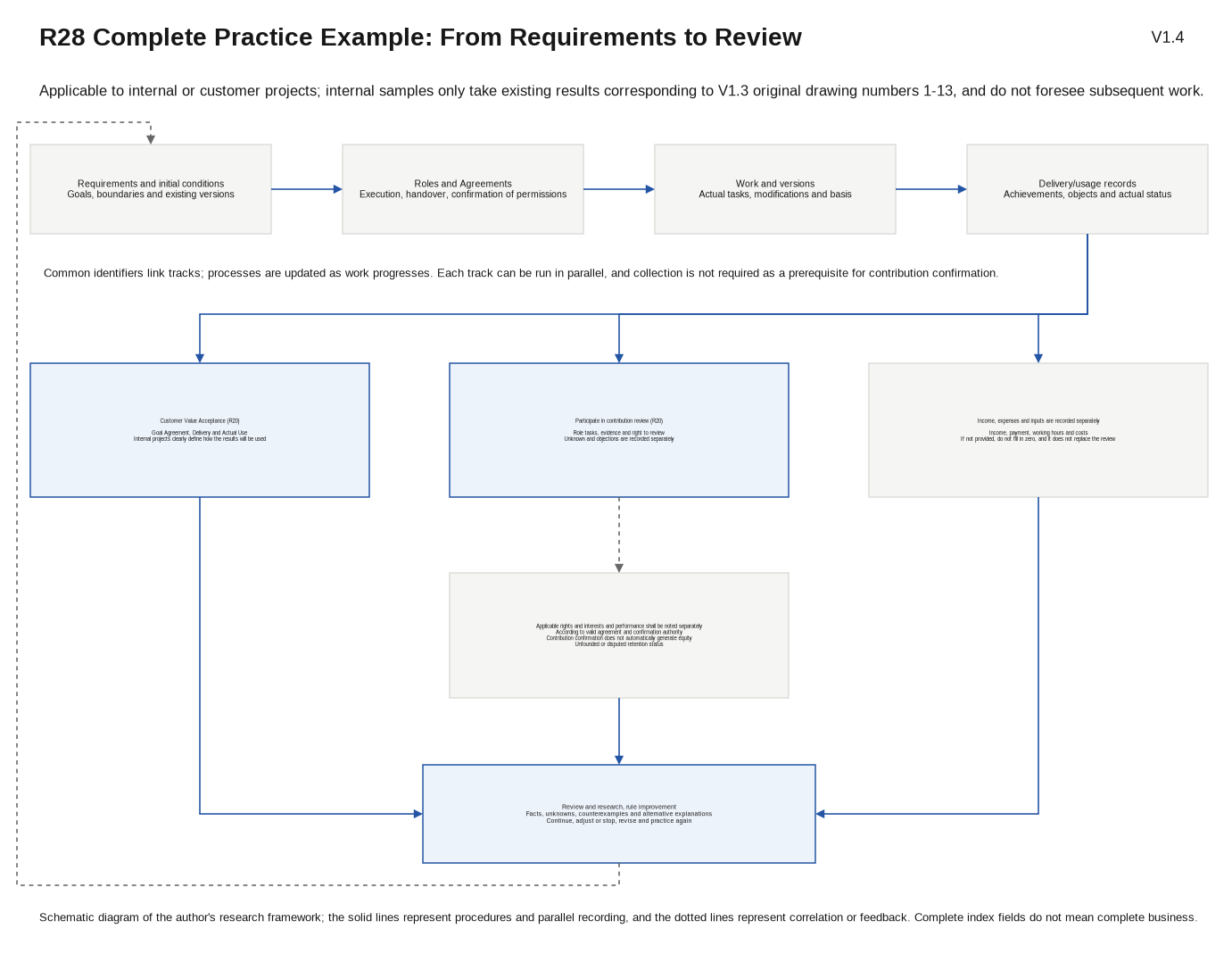
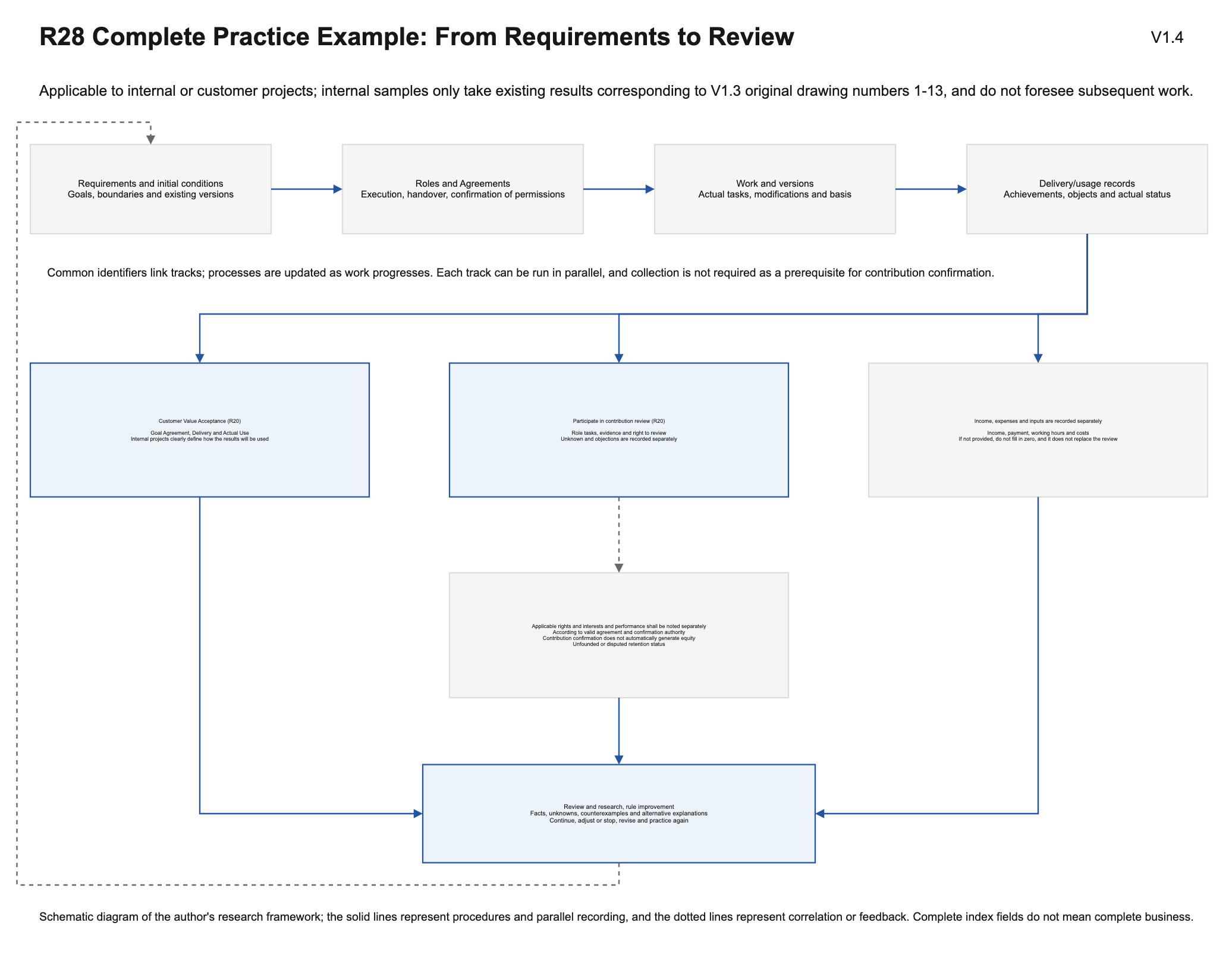
Equivalent text: Establish a common identity for an internal or client project of appropriate scope, documenting initial requirements, roles and participation agreements, confirmed permissions, actual work and versions, deliverables and usage status. Process materials are updated with tasks, and each track can be run in parallel. Contributions cannot be confirmed until payment is received. Customer value acceptance is based on target agreement, delivery and actual use. Internal projects clearly identify the users of results. Participation contribution review is based on role tasks, actual evidence and confirmation by authorized entities. Unknown and objections are retained, and R20 two processes are adopted. Income and expenses, working hours and costs are recorded separately, and zeros are not allowed if not provided. Applicable rights and interests and performance are handled separately based on valid agreements and confirmation authority. Contribution confirmation does not automatically generate equity. The results of each track are reviewed, and expectations, facts, costs, counterexamples, and alternative explanations are compared, and decisions are made to continue, adjust, or stop, and are fed back to research, rules, and the next round of requirements. The real internal examples only include the V1.3 manuscript and original drawing numbers 1-13 at that time, and the new work of original drawing numbers 14-17 will not be included in advance; the correspondence between historical numbers and this version is shown in the drawing number comparison table. A complete index does not mean that all operations are completed.
Reusable sample index
| Index | What needs to be connected |
|---|---|
| Projects, Requirements and Boundaries | Who asked what question, goals and initial conditions, project scope, changes in requirements, observation cutoff points |
| Roles and participation agreements | Who proposes requirements, implements, coordinates, uses, accepts and reviews; authorization, responsibility and handover |
| Work, releases and delivery | Actual work and modification, input and version, products, delivery objects, preservation and follow-up support |
| User value acceptance | Goals and agreements, delivery quality, acceptance opinions, actual use and subsequent value |
| Participate in contribution review | Role tasks, actual input and results, evidence, rights to confirm and review, objections and status |
| Income, Expenditure and Investment | Actual receipts and payments, working hours, tools and other costs, vouchers and accounting standards; amounts not provided are retained. |
| Applicable rights, responsibilities and performance | Effective agreements, types of rights and responsibilities, establishment conditions, actual performance, disputes and long-term account associations |
| Review, revision and follow-up | Expectations and actualities, problems and counterexamples, methodological rules and research revisions, pending matters and follow-up undertakings |
Customer value acceptance and contribution review and adoption Figure R20 There are two processes; revenue and expenditure and equity are recorded according to their respective basis. The delivery fact, actual use, contribution confirmation and equity fulfillment are retained in separate states, and are later associated through the same project.
Internal construction example: V1.3 revision of five-dimensional operations and four-capital strategy diagram
This example takes this round of operational connections to supplement the previously delivered round of V1.3 revisions as real material for internal research and knowledge building. This round contains the manuscript and thirteen accompanying pictures with original drawing numbers 1-13 of V1.3; see the correspondence between the original numbers and this version.Figure number comparison table. The new operational connections added in this round are recorded separately to avoid counting follow-up work in advance as completed results.
| matters | Existing materials and facts | Status and follow-up |
|---|---|---|
| Project requirements | The author requires that the three-side operation be changed to the five dimensions of academic, community, resources, business, and capital in V1.3, and the expression of the four capitals be tightened into the principle logic of asset management and long-term operation strategy | Maintain the version number; the five research directions, fifteen main lines and original contribution positioning will continue |
| Roles and collaboration | The author proposes goals and feedback and is responsible for review, organizes the division of labor, integration and acceptance, and completes graphics and text in groups | Tasks and handovers can be verified; complete input and formal contribution confirmation results are pending. |
| Jobs and versions | Revise the relevant text; V1.3 original picture 11 updates the five-dimensional operation, original picture 13 newly draws the long-term strategic logic of the four capitals, and the remaining eleven pictures follow the accepted version | In this round, the original V1.3 images 11 and 13 were actually exported and viewed, and the image, text and file verification records were retained. |
| Delivery and internal use | V1.3 manuscript, thirteen Draw.io source images, SVG, PNG, picture list, acceptance record and complete package have been saved; the manuscript continues to be used for author discussion and subsequent revisions | Document delivery and internal use can be confirmed; external customer use and commercial effect data are not provided |
| Value acceptance by internal users | Coordinate and complete the real Draw.io export, image-by-image viewing, text, image and local link verification, and revise the five-dimensional and four-dimensional requirements proposed by the author | Delivery and content verification have been completed; the author’s final review and continued use effects are recorded separately |
| Participate in contribution review | Division of labor, version, graphic products and acceptance materials can be used as review input and related through the same project | Contribution confirmation authority, complete investment and formal evaluation results are pending; objection and review entrances are reserved. |
| Income and Expenditure and Applicable Rights | Current materials do not provide revenue, payment, complete work hours, cost amounts, and specific remuneration or equity allocation agreements. | Write "Information not provided/to be confirmed"; do not replace unknown with zero, specific rights, responsibilities and implementation will be handled based on actual basis |
| Review and improvement | The author's feedback led to the adjustment from three dimensions to five dimensions, the tightening of the strategic boundaries of the four capitals, and the coordinator rechecked the graphics and text. | The process material of "feedback-revision-verification" has been formed; follow-up will continue to record usage feedback, input and confirmation status |
This example shows the work process and pending status that can be checked. Delivery and visual verification, author review, actual use effects and theoretical evidence are evaluated separately; subsequent real projects can accumulate more complete management, contribution and performance materials along the same index.
Figure R29 · The order of evidence collection for the three flagship topics

Flagship One gives priority to obtaining certificates from the first round of delivery from customers and continues to track the entire batch of projects. Flagship 2 collects evidence based on real budget decisions, and Flagship 3 studies intentions and behaviors based on system preparation and formal implementation respectively. All three can be done in parallel.
Editable Draw.io · SVG Preview · PNG preview
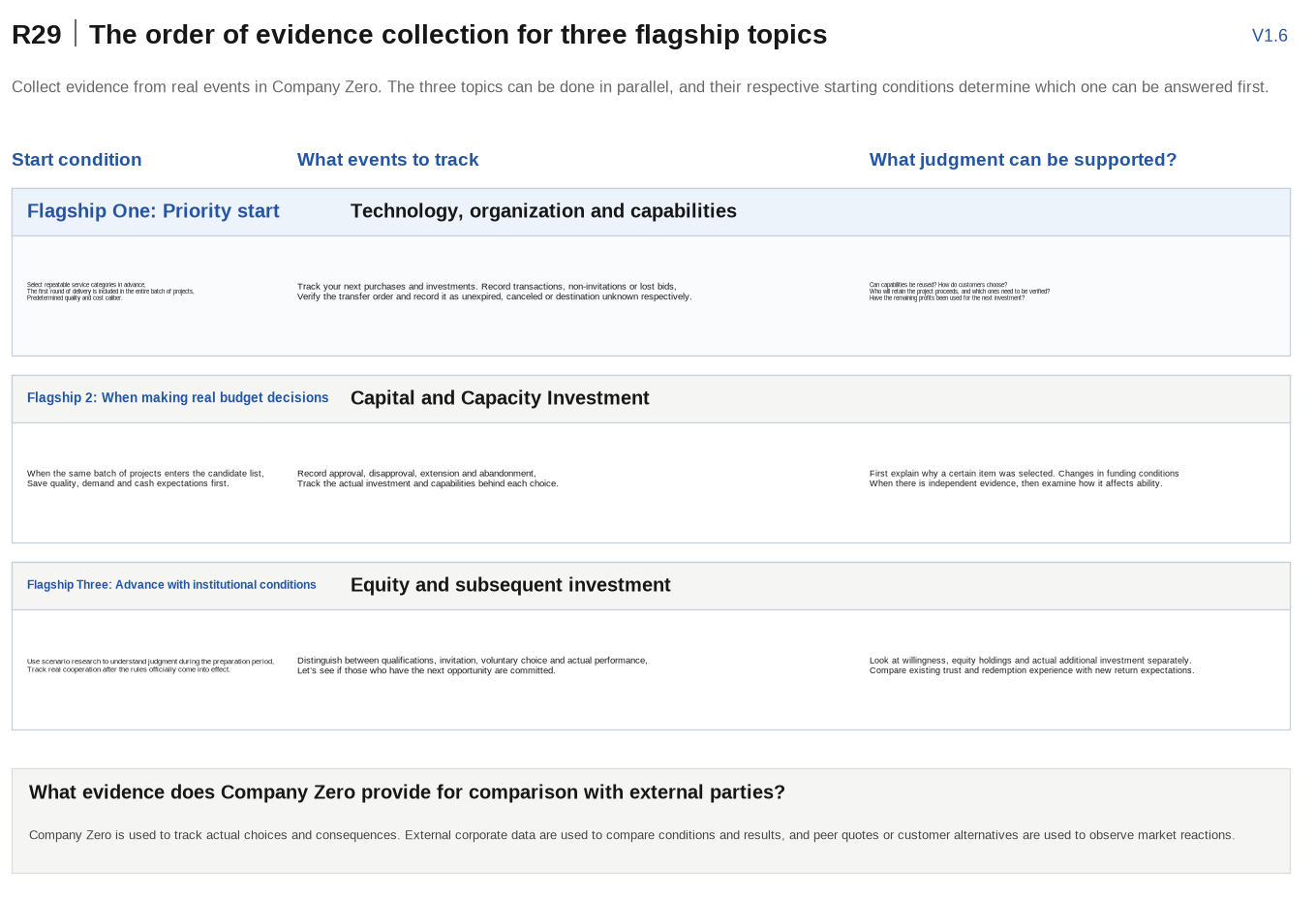
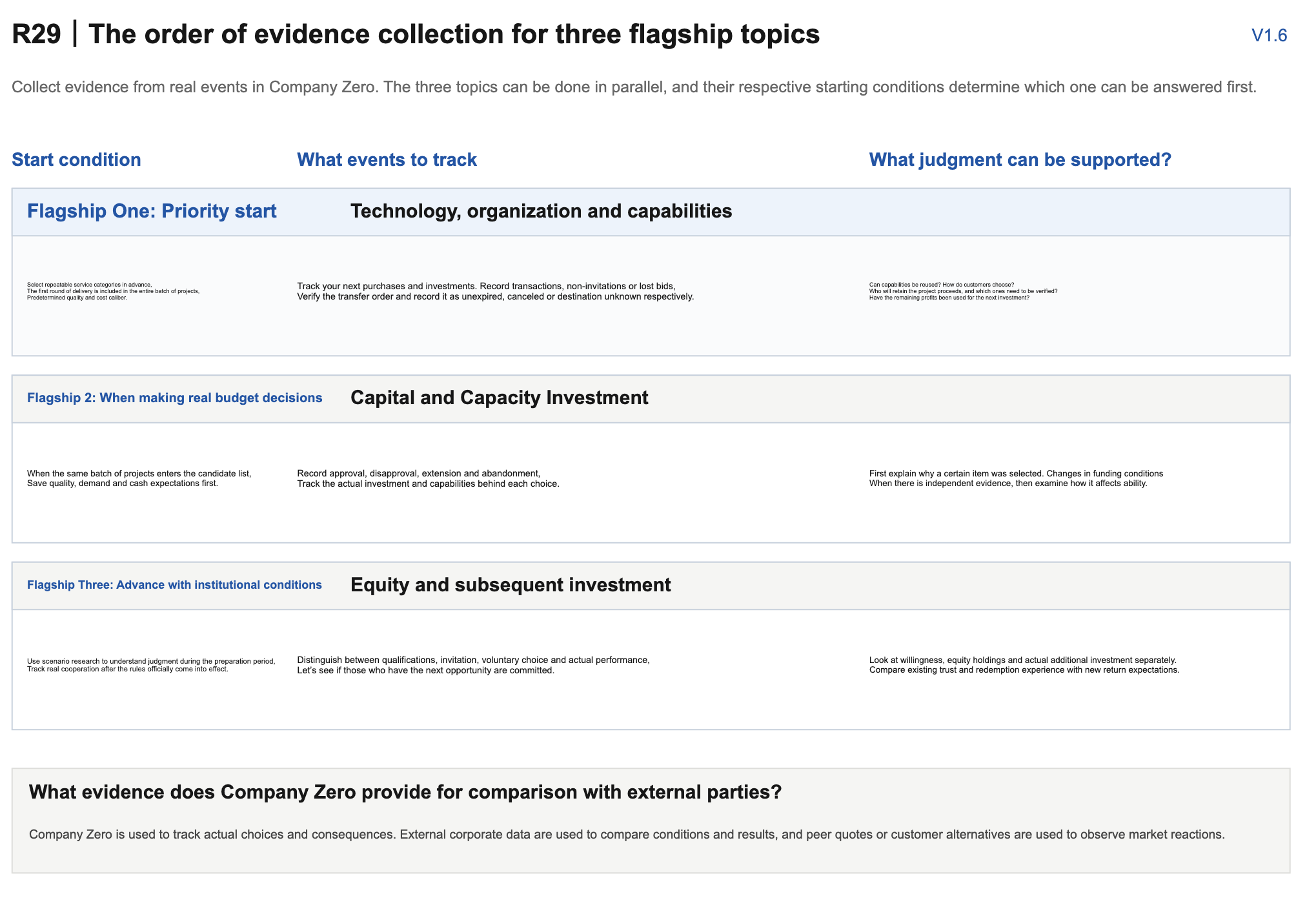
Equivalent text: Flagship selects repeatable service categories and quality and cost standards in advance, and incorporates them into the entire batch of projects from the first round of delivery. Track the next purchase selection and investment, and record the transaction, purchase not invited, failed bid, not yet expired, canceled demand and unknown destination. Confirm whether to transfer the order when there is evidence, and keep the project even if there is no re-quote. Compare whether capabilities can be reused, how customers choose, who gets the project benefits, what net benefits need to be verified, and whether to invest again next time. Flagship 2 registers the same batch of alternative projects and the quality, demand and cash expectations at that time before the real budget decision is made, and records approval, disapproval, postponement, abandonment and subsequent changes. When there is independent basis for the difference in funding conditions, the role of funding will be examined again. Flagship Three uses scenario research to observe and judge during the preparation period, and after the rules take effect, it tracks qualifications, invitations, voluntary selection, fulfillment and actual investment in the next opportunity. All three can be done in parallel. Company Zero provides actual options and consequences, external corporate data is used to compare conditions and results, and peer quotes or customer alternatives are used to observe market reactions.
Return to the evidence collection arrangements for the three flagship topics
Event-triggered review
After scientific research results are transformed into actual arrangements, important task handovers, customer acceptance, changes in community identity or co-construction roles, changes in membership services and resource collaboration, rule changes, capital decisions, rights fulfillment, dispute resolution, cooperation continuation or withdrawal, etc., check expectations, facts, costs, alternative explanations and basis for adjustments. Reviews are initiated based on events and evidence, and there is no fixed frequency or deadline.
Continue, adjust or stop
Whether to continue, adjust or stop depends on whether the target is clear, whether the necessary data can be obtained, whether the comparison is valid, whether the results of use can be tracked, and whether the costs and risks can be tolerated. When conditions are insufficient, make additional measurements, narrow the scope, adjust the design, or stop the corresponding project.
Independent Review and Adverse Outcome
Distinguish between designer intent and actual operation. Key judgments are retained for reviewable materials, and objections are allowed for contribution evaluation; quality decline, additional investment, concentration of control, performance failure, suspension of cooperation, and no improvement are recorded. Repeated observations of a single organization are interpreted at their level of study.
The input, rights and results of Company Zero, customers, partners and software providers are vested separately, and external matters will not be incorporated into Company Zero's performance.
Connection and attribution of five-dimensional results
Establish correlations between academic, community, resource, business and capital records for the same project, transaction, subject or achievement, and check research products, identities and roles, people and institutions, actual resource supply, business income, membership fees, capital investment and corresponding rights and responsibilities respectively to avoid repeated measurement of the same matter. Resource quality is checked based on adaptation, reliability, actual utilization and operational capability results. Financing proceeds are reconciled with business income, account records with actual cash, and valuations with realized returns.
The review should also answer: did the operation create and realize value; which research explanation was supported, revised or denied by this practice. Actual adjustments are then used for the next version of scientific research results and the next round of implementation.
Source Index · Research and Methods
The following is the entrance to the public results and methods corresponding to the outline. Links are clickable; website content and file versions may be continuously updated. Data verification date: November 25, 2026.
-
[01] Stakeholder ecological digital governance model https://yutengfei.com/zh/journal/stakeholder-ecosystem-governance/
-
[02] Four Ecological Governance Model: Contribution, Rights and Collaboration Closed Loop https://yutengfei.com/zh/journal/four-ecology-governance-model/
-
[03] Stakeholder Capitalism https://yutengfei.com/zh/books/stakeholder-capital/ · Chinese text
-
[04] Blockchain - the underlying technology of stakeholder capital https://yutengfei.com/zh/books/blockchain/ · Chinese text
-
[05] From shareholder primacy to stakeholder company https://yutengfei.com/zh/papers/from-shareholder-primacy-to-stakeholder-corporation/
-
[06] Paper I: Fairness Perception and Voluntary Contribution https://yutengfei.com/zh/papers/stakeholder-fairness-voluntary-contribution/
-
[07] Paper II: Power, strategic contribution and value distribution https://yutengfei.com/zh/papers/stakeholder-power-strategic-contribution/
-
[08] Paper III: Transforming feedback into strategic actions https://yutengfei.com/zh/papers/stakeholder-feedback-strategic-action/
-
[09] Paper IV: Intertemporal Conflict and Continuous Cooperation https://yutengfei.com/zh/papers/intertemporal-conflict-cooperation/
-
[10] Enterprise AI business capability reconstruction system https://yutengfei.com/zh/journal/enterprise-ai-capability-reconstruction/
-
[11] Four-way SOP https://yutengfei.com/zh/journal/four-way-sop/
-
[12] From SOP to Skill https://yutengfei.com/zh/journal/sop-to-ai-skill/
-
[13] Actions, results and precipitation https://yutengfei.com/zh/journal/action-results-organizational-capability/
-
[14] How does the capital model form a closed loop? https://yutengfei.com/zh/journal/capital-mechanism-model/
-
[15] Capital logic and path of stakeholder capital theory https://yutengfei.com/zh/blog/stakeholder-capital-logic-and-paths/
-
[16] Analyze a project using four resources and double cycles https://yutengfei.com/zh/journal/four-assets-dual-cycle-project-analysis/
Source Index · Business & Practice
-
[17] Capital path nine-dimensional comparison table https://yutengfei.com/zh/journal/capital-path-nine-dimension-comparison/
-
[18] How do industrial operations and capital arrangements support each other? https://yutengfei.com/zh/journal/industry-operations-capital-alignment/
-
[19] From contribution recognition to equity realization https://yutengfei.com/zh/journal/from-contribution-to-rights-fulfillment/
-
[20] Personal Services: Strategy, Capital and Brand https://yutengfei.com/zh/services/
-
[21] Personal website solution https://yutengfei.com/zh/solutions/
-
[22] WISERUNION seven categories of technical products https://wiserunion.com/products/
-
[23] WISERUNION seventeen services https://wiserunion.com/services/
-
[24] WISERUNION ten types of solutions https://wiserunion.com/solutions/
-
[25] WISERUNION positioning, division of labor and status of company zero https://wiserunion.com/about/
-
[26] Ten Billion Maple Group: Brand and communication stage results https://wiserunion.com/cases/baiyifeng/
-
[27] Zhixing Personal Knowledge Station Case https://wiserunion.com/cases/weitengfei/
-
[28] AI Skills and Methods Catalog https://yutengfei.com/zh/skills/
-
[29] Contribution record and review form https://yutengfei.com/zh/journal/contribution-record-review/
-
[30] The formation mechanism of long-term capital relationships among stakeholders https://yutengfei.com/zh/journal/stakeholder-long-term-capital-mechanism/
-
[31] How will Company Zero operate next? https://yutengfei.com/zh/blog/company-zero-operating-model/
The research organization, candidate topics, comparative arrangements and practical promotion of Company Zero in the main text belong to the planning statement of this outline. The source page is used to check existing models, materials, catalogs and public status.
Source Index·Academic Positioning and Model Supplement
The following is public access to the Society's formal domain definitions, supplementary positioning, and institutional concepts. The source verification record date is November 25, 2026; the date is used for version and data records, and no research promotion deadline is set.
-
[32] AOM Research Area Directory
https://www.aom.org/divisions-and-interest-groups/ -
[33] Strategic Management(STR)
https://www.aom.org/divisions-and-interest-groups/strategic-management/ -
[34] Communication, Digital Technology, and Organization(CTO)
https://www.aom.org/divisions-and-interest-groups/communication-digital-technology-and-organization/ -
[35] Technology and Innovation Management(TIM)
https://www.aom.org/divisions-and-interest-groups/technology-and-innovation-management/ -
[36] Organization and Management Theory(OMT)
https://www.aom.org/divisions-and-interest-groups/organization-and-management-theory/ -
[37] Organization Development and Change(ODC)
https://www.aom.org/divisions-and-interest-groups/organization-development-and-change/ -
[38] Managerial and Organizational Cognition(MOC)
https://www.aom.org/divisions-and-interest-groups/managerial-and-organizational-cognition/ -
[39] Organizational Behavior(OB)
https://www.aom.org/divisions-and-interest-groups/organizational-behavior/ -
[40] Human Resources(HR)
https://www.aom.org/divisions-and-interest-groups/human-resources/ -
[41] Social Issues in Management(SIM)
https://www.aom.org/divisions-and-interest-groups/social-issues-and-management/ -
[42] Operations and Supply Chain Management(OSCM)
https://www.aom.org/divisions-and-interest-groups/operations-and-supply-chain-management/ -
[43] Directory of SMS Research Groups
https://www.strategicmanagement.net/connect-participate/interest-groups-communities/ -
[44] SMS Knowledge and Innovation
https://www.strategicmanagement.net/group/knowledge-and-innovation-interest-group/ -
[45] SMS Strategy Process
https://www.strategicmanagement.net/group/strategy-process-interest-group/ -
[46] SMS Corporate Strategy
https://www.strategicmanagement.net/group/corporate-strategy-interest-group/ -
[47] SMS Competitive Strategy
https://www.strategicmanagement.net/group/competitive-strategy-interest-group/ -
[48] SMS Stakeholder Strategy
https://www.strategicmanagement.net/group/stakeholder-strategy-interest-group/ -
[49] SMS Strategic Leadership & Governance
https://www.strategicmanagement.net/group/strategic-leadership-governance/ -
[50] SMS Cooperative Strategies
https://www.strategicmanagement.net/group/cooperative-strategies-interest-group/ -
[51] SMS Strategic Human Capital
https://www.strategicmanagement.net/group/strategic-human-capital-interest-group/ -
[52] AOM journal system
https://www.aom.org/publications/journals/ -
[53] SMS journal system
https://www.strategicmanagement.net/publications-resources/sms-journals/ -
[54] UT Dallas School of Business Research Ranking Journal List
https://jsom.utdallas.edu/the-utd-top-100-business-school-research-rankings/?page=list-of-journals -
[55] SEC: Public Companies, Securities Offerings and Continuing Obligations
https://www.sec.gov/resources-small-businesses/capital-raising-building-blocks/public-companies -
[56] Hong Kong Securities and Futures Commission: Securities Tokenization Related Activities
https://apps.sfc.hk/edistributionWeb/api/circular/list-content?lang=EN&refNo=23EC52 -
[57] WISERUNION: Long-term capital account design
https://wiserunion.com/community/
The domain definition cites public information; the attribution, mechanism relationship, specific topics and promotion conditions of this research belong to the research organization and planning of this outline, and are not the society's certification of this research or the completed empirical conclusion.
Source index · Original contributions and comparative literature
The following is the research literature used for contribution judgment and first comparison. Years are recorded in journal volume and issue years; online publication times may vary. The bibliographic information has been checked against accessible public descriptions, and detailed novelty comparisons still require special justification.
-
[58] Whetten, D. A.(1989). What Constitutes a Theoretical Contribution? Academy of Management Review, 14(4), 490–495.
https://doi.org/10.5465/amr.1989.4308371 -
[59] Corley, K. G., & Gioia, D. A.(2011). Building Theory about Theory Building: What Constitutes a Theoretical Contribution? Academy of Management Review, 36(1), 12–32.
https://doi.org/10.5465/amr.2009.0486 -
[60] Gregor, S., & Hevner, A. R.(2013). Positioning and Presenting Design Science Research for Maximum Impact. MIS Quarterly, 37(2), 337–355.
https://aisel.aisnet.org/misq/vol37/iss2/3/ -
[61] Bridoux, F., & Stoelhorst, J. W.(2022). Stakeholder Governance: Solving the Collective Action Problems in Joint Value Creation. Academy of Management Review, 47(2), 214–236.
https://doi.org/10.5465/amr.2019.0441 -
[62] Gibbons, R., & Henderson, R.(2012). Relational Contracts and Organizational Capabilities. Organization Science, 23(5), 1350–1364.
https://doi.org/10.1287/orsc.1110.0715 -
[63] Lumineau, F., Wang, W., & Schilke, O.(2021). Blockchain Governance—A New Way of Organizing Collaborations? Organization Science, 32(2), 500–521.
https://doi.org/10.1287/orsc.2020.1379 -
[64] Brynjolfsson, E., Rock, D., & Syverson, C.(2021). The Productivity J-Curve: How Intangibles Complement General Purpose Technologies. American Economic Journal: Macroeconomics, 13(1), 333–372.
https://doi.org/10.1257/mac.20180386 -
[65] Myers, S. C.(1977). Determinants of Corporate Borrowing. Journal of Financial Economics, 5(2), 147–175.
https://doi.org/10.1016/0304-405X(77)90015-0
These documents are used to determine the existing explanations, contribution scope and comparative tasks. It cannot be presumed that a complete review has been completed or research gaps have been identified based on their quantity.
- [66] Davidson, S., De Filippi, P., & Potts, J.(2018). Blockchains and the economic institutions of capitalism. Journal of Institutional Economics, 14(4), 639–658.
Cambridge University Press: Papers & Abstracts · DOI
This article provides the existing theoretical basis for blockchain as an institutional technology, and does not claim that this study was the first to propose the concept based on its positioning.
-
[67] Wei Tengfei: Read "Four Capital Operations" | How to connect resources, assets, capital and funds. Based on Shi Yuqiang's "Four Capital Operations"; this round uses the first picture of the reading illustration.
Article and original image source -
[68] WISERUNION Resource Hub: People, Institutions and Collaborative Resources.
Entrance to expertise, relationships, discovery, and collaboration for people and organizations -
[69] WISERUNION Characters: Professional, organizational relationships and resource coordinates.
People column -
[70] WISERUNION Participation in co-construction: communities, co-construction roles and long-term capital accounts.
Participate in co-construction
There are already sources for the recycling of the four capitals, and this outline will launch the specific application of Company Zero; the five-dimensional operation and the application of the four capitals will not be recognized as new theoretical contributions just because they are included in the diagram.
closest comparison source [71]—[74]
The following is a limited supplementary comparison entry. Only use the main source of the publisher or the author's institution to check bibliographic information and public abstracts; do not check the abstracts to write a full-text systematic review, and do not make global novelty judgments based on this.
-
[71] Rajan, Raghuram G., and Luigi Zingales (1998). Power in a Theory of the Firm. The Quarterly Journal of Economics, 113(2), 387–432. Publisher's main source;DOI。
Verification scope: author, year, volume, issue, page number, DOI and publisher abstract. The abstract discusses the regulation of access rights to key resources, dedicated investment, power and incentives. Used as a reminder: There is a theoretical basis for the importance of resource availability, permissions, or dedicated investment. This research still needs to demonstrate the specific new mechanisms for acquiring, holding and business selection of multi-role rights and interests, and it is not the first research to rewrite the literature arguments.
-
[72] Blair, Margaret M., and Lynn A. Stout (1999). A Team Production Theory of Corporate Law. Virginia Law Review, 85(2), 247–328. The author's institution preserves the main source and full-text entrance;Journal volume and issue table of contents check;DOI。
Verification scope: Institutional author records, year, journal and public abstract, journal catalog verification page number. The abstract discusses the issues of multi-person dedicated input, non-dividable output and reward distribution. Existing explanations for comparing contribution and benefit arrangements.
-
[73] Hart, Oliver, and John Moore (1990). Property Rights and the Nature of the Firm. Journal of Political Economy, 98(6), 1119–1158. Publisher's main source;Author's academic homepage;DOI。
Scope of verification: bibliographic information, DOI, publisher abstract and author inclusion. Abstract Links asset control and ownership structures to the incentives of different actors. It is not a blank field for clarifying property rights and investment incentives, and various types of income rights, account registrations or business collaborations cannot be equated with asset ownership.
-
[74] Dyer, Jeffrey H., and Harbir Singh (1998). The Relational View: Cooperative Strategy and Sources of Interorganizational Competitive Advantage. Academy of Management Review, 23(4), 660–679. Publisher's main source;Journal volume and issue directory;DOI。
Verification scope: author, year, volume, issue, page number, DOI and publisher abstract. The abstract discusses relationship-specific assets, knowledge sharing practices, complementary resources, and effective governance, supporting relationship embeddedness as an established benchmark for comparison. This puts forward the comparative task of this study: capability persistence within relationship conditions and cross-relationship transfer should be evaluated separately; this evaluation suggestion belongs to the scope of this research, and we do not pretend that the paper has verified this research framework.
Verification date: 2026-11-25. The main source can support the above limited comparison, but does not support conclusions such as "existing theories do not have these functions", "comprehensive confirmation of novelty has been completed" or "this research mechanism has been empirically proven".
Comparative Literature on Competition and Attribution of Benefits
- [75] Teece, D. J. (1986). Profiting from technological innovation: Implications for integration, collaboration, licensing and public policy. Research Policy, 15(6), 285–305. publisher
- [76] Coff, R. W. (1999). When Competitive Advantage Doesn’t Lead to Performance: The Resource-Based View and Stakeholder Bargaining Power. Organization Science, 10(2), 119–133. publisher
Complete equivalent text accompanying the picture
The following is arranged according to the plate number, and the complete text expression is retained. The equivalent text for other figures remains with the corresponding chapters.
R02 · Five directions and fifteen main lines architecture
The subtitle in the figure clearly states the upper-level proposition "Enterprise Adaptation and Differentiation in Technological Changes" and explains that the five directions are parallel and are not the five stages of enterprise development. The general title is "Research on Enterprise Capabilities and Capital Governance in the Change of Intelligent Technology". The core question is: In the face of technological changes, how do companies adjust their business models, organizational methods and capital arrangements to form and update capabilities, create and obtain value? Why do companies using similar technologies have different long-term operating results and development paths? The five parallel directions are: A. Intelligent technology adoption and organizational restructuring, including A1 task and technology adaptation, A2 process and human-machine collaboration, A3 technology dependence and organizational boundaries; B. Enterprise capability accumulation and updating, including B1 knowledge precipitation and feedback transformation, B2 human-machine learning and skill changes, B3 capability retention and transferability; C. customer value, market competition and revenue acquisition, including C1 demand satisfaction and business realization, C2 competition and value acquisition, C3 Measurement of operating value; D investment, financing and capital allocation, including D1 dynamic investment and project selection, D2 financing matching and capital constraints, D3 capital control, risk and exit; E rights allocation, incentives and cooperative governance, including E1 knowledge, data and decision-making rights, E2 contribution recognition and income arrangement, E3 cross-organizational commitment and system adjustment. The five directions are not five stages of development; specific research topics will continue to be refined under the fifteen main lines, and theories, plans, methods and evidence will be formed and tested. The main question determines the research attribution, and the cross-correlation illustrates the mechanism or boundary. The left column below the figure first compares how companies facing similar technology supply choose and adopt, and then compares businesses with similar actual use conditions to see how organization and capital arrangements affect capabilities, returns, and the next round of investment. The right column asked participants under what conditions voluntary holding of equity related to the long-term value of the enterprise would change knowledge sharing, dedicated investment, and continued cooperation. The left column represents the research concerns of the entire program, and the right column illustrates a research path that the author has accumulated deep experience in.
R04·B. Accumulation and updating of corporate capabilities
Direction B studies how dispersed knowledge, professional capabilities and cooperative resources can be used through work and organizational arrangements to form the ability of enterprises to sustainably mobilize. Real tasks, execution feedback, organizational arrangements and follow-up cooperation constitute the observation situation; AI cognition and work technology, and blockchain system technology can be used alone or in combination to identify their roles respectively. B1 Knowledge precipitation and feedback transformation distinguish between explanation memory, inheritance of rules and practices, feedback entering the strategic agenda and resource allocation, checking permissions, versions, change execution and actual use. Increased archiving cannot replace changes in action. B2 Human-computer learning and skill changes respectively observe human independent judgment and skills, organizational knowledge distribution and responsibilities, compare review, takeover, training and sharing arrangements, and retain learning and judgment degradation. B3 Capability retention and transferability are evaluated separately according to continuous operation, maintenance sustainability, cross-person recurrence, technology migration and relationship dependence, recording the required support, repeated performance, maintenance investment, switching costs and relationship conditions; when migration is required and there are comparative conditions, the performance after replacing the technology will be tested again. Stable human-machine complementarity or relationship-specific capabilities can exist, and it does not require all capabilities to be separated from the original tools or relationships to be established; continuous operation but limited migration can be established at the same time. The three main lines support each other rather than being fixed stages. Accumulation, maintenance, degradation or insufficient evidence of ability are judged according to applicable dimensions. The number of knowledge files, codes, accounts and manuals is not directly equal to ability. Compare tasks, baselines, existing capabilities, additional labor and subsequent performance; connect R17's operational improvement and capability retention, and do not confuse the two types of evaluations with R20. The research direction and the five operational dimensions are at different classification levels, and the specific mechanism still needs to be tested.
R07 · E. Rights allocation, incentives and cooperative governance
Direction E studies the general rights, incentives and cooperation arrangements of enterprises in response to technological changes. E1 Knowledge, data and decision-making rights study the use of knowledge data, basis for decision-making, confirm the scope of application of authorization and responsibility, and distinguish rights content, carriers and registration technologies. E2 Contribution confirmation and income arrangement check the input results, contribution basis, remuneration incentives, income distribution, rights establishment and actual performance, and compare their connection with subsequent investment. E3 Cross-organizational commitments and institutional adjustments examine the continuation, adjustment or suspension of contracts, relationship arrangements, commitments, performance and cooperation, retaining disputes, revisions and pending performance. The three main threads are parallel and related issues, not three stages; the mechanism needs to be tested to compare the consequences of different arrangements on organization, capabilities, benefits and cooperation. Long-term capital relations and accounts are one of the theoretical explanations, governance arrangements and practical paths. They are not the common premise for all topics, nor are they reduced to tools. Regular wages, supplies, memberships, and services themselves do not constitute long-term capital relationships for this study, and ordinary compensation does not automatically convert into equity. This path is open to various roles. Participants can choose whether to accept and continue to hold the role, superimposing the original role; retaining the discontinued business, continuing the business but the rights have been transferred, partial transfer and pending performance. Within the scope of the capital path system, the overall income from business, asset management, investment, etc. is calculated separately. Not only new income, but also revenue, cost, profit, distribution, retention and reinvestment are checked separately, and all revenue distribution is not presumed; the specific proportion, existing equity, historical business connection, effective boundary and transfer repurchase conditions still need to be formally designed. AI and blockchain can support work and system implementation. Specific topics compare their role with traditional alternative arrangements and are not a prerequisite for the establishment of general capital relationships. The diagram does not set governance thresholds or operational dates, nor does it indicate that rights or collaborations have been established.
R10 · Contribution 1: The formation and sustainability mechanism of long-term capital relationships
Contribution 1 maintains the proposed main theoretical contribution status, belongs to the author's proposed contribution combination in the general outline, and does not exhaust all research on enterprise adaptation and differentiation in technological changes. The research question of this approach is: How do stakeholders acquire and continue to hold rights and interests related to the long-term value of the enterprise based on voluntary choices and institutional rules, and form long-term capital relationships? How does this relationship affect organizational form, capacity accumulation, income distribution and continuous cooperation, and how is it inherited, realized and continued through capital operations? Established research on stakeholder governance and relational contracting constitutes a fair comparison benchmark. The figure respectively observes joint investment, contribution facts, confirmation basis, rights acquisition, actual performance and subsequent choices; the dotted line only represents the candidate mechanism to be demonstrated and tested, and the process can be repeated, blocked or interrupted. The system arranges corresponding rights and interests related to the long-term value and capital strategy of the enterprise for various roles. Participants can choose independently whether to accept and continue to hold the rights and interests. The rights and interests are superimposed on the original roles; regular wages, long-term supply, paid membership and continuous service relationships themselves do not constitute what this research calls long-term capital relationships. The enterprise side observes the sustainable calling capabilities and operating assets, and the continuous operation, maintenance, recurrence, migration and relationship dependence are evaluated separately according to conditions; the participants side observes the equity, liability risks, actual cashing out and holding options. Comparing the different trajectories of continuous holding but discontinuing business, continuing business but transferred interests, partial transfers, remaining interests and pending performance are recorded separately, and the business is not presumed to continue based on holding, nor is it presumed to be held based on business continuation. After formal operation, the system will cover the overall income within the scope of the system, including business, asset operation and investment income, and will be accounted separately; revenue, costs, profits, distribution, retention and reinvestment will be separated, and the proportion, existing equity, historical business connection and effective boundaries will be determined. The transfer and repurchase conditions are determined by the subsequent system, and there is no preset free transfer or repurchase at any time. The lower part juxtaposes the two forecasts to observe the actual dedicated investment in the same subsequent cooperation opportunity. When new return arrangements are similar, seeing existing rights and interests fulfilled as promised may make new commitments more credible and encourage additional investment. When the old rights and interests are equally reliable, if continuing to hold and continuing to receive orders can be separated, and the additional returns on new investments are unclear, participants may retain their rights and invest time or resources elsewhere. Both roles can exist at the same time, and original trust, remuneration and other opportunities must be checked. The establishment of rights and interests does not mean actual performance, and the retention of capabilities does not mean the continuation of the relationship. Dedicated investment, interdependence, or deferred cashing are used as argument conditions; the contribution claim is narrowed when the existing explanation is sufficient. The original candidate status and originality verification and evidence support are maintained, and no actual launch or effectiveness assertion is added.
R11 · Contribution 2: Institutional design of long-term capital account
Contribution 2 maintains the main system design contribution status to be established, using customer relationship and membership records, contribution ledgers, contracts and remuneration sharing, holder records, DAO and shared database as the comparison benchmark, and making fair comparisons based on actual rules, permissions, uses and maintenance costs. The four institutional modules in the figure continuously relate the multiple roles of the same subject, heterogeneous inputs, contribution evidence, confirmation and allocation of authority in effective arrangements, rule versions, rights and responsibilities and actual implementation. Stratification of original roles and capital rights: The regular performance relationship itself does not automatically become a long-term capital relationship. The system arranges corresponding rights and interests for various roles, and participants can choose whether to accept and continue to hold them. To be confirmed, conditional, established, to be performed, performed and disputed are recorded according to their respective bases and do not constitute an automatic upgrade ladder. Equity holdings and business collaborations are observed separately. The equity can be held and the business stopped, or the business can continue but the equity has been transferred. Partial transfer, remaining equity and pending performance are retained separately. After formal operation, the system covers overall operating income and related rights and responsibilities, not just new income; new value can be retained as an analytical measurement concept. Business, asset management, investment and other income within the scope of the system are accounted separately; revenue, cost, profit, distribution, retention and reinvestment are recognized separately, and all revenue is not presumed to be distributed; the specific proportion, existing equity, historical business connection and effective boundary are to be determined by the subsequent system. Rights and interests can be connected with dividends, equity, stocks and STO-related arrangements. Rights content, carrier, registration technology and withdrawal are confirmed separately. Transfer and repurchase conditions are to be determined. There is no automatic conversion, free transfer or repurchase at any time. Check original commitments after financing, restructuring and control changes, and connect accounts, securities, funds and legal relationships respectively. Fixed rules compare blockchain to other systems of record, fixed technologies compare different confirmations, permissions and fulfillment arrangements, observe and review error correction, fulfillment costs, clarity of rights and responsibilities and follow-up cooperation, and record maintenance, disputes and governance burdens. The original candidate status is maintained, and the design novelty and effect are checked separately.
R12 · Contribution 3: How organization and execution mechanisms affect capability retention
The comparison benchmark is research on technology and organization complementarity, organizational learning, job design and resource capabilities, and does not regard the impact of technology on the organization itself as a new discovery. The cognitive and work functions of AI and the institutional and technical functions of blockchain are separately identified, and are allowed to be used alone, in combination, or neither; technology is a research situation, organizational condition, or means of implementation, and the functions and conditions are evaluated separately, and it is not a prerequisite for the establishment of general capital relationships. The proposed contribution points in the blue box are the intermediate processes such as positioning decision-making authority, resource arrival, cross-role handover, abnormal feedback and experience update. The continuation and retention of improvement are explained according to technical and relationship conditions. Organizational power, execution power and inter-temporal enterprise capabilities are defined and observed respectively. The continuous operation of capabilities, maintenance sustainability, cross-person recurrence, technology transfer and relationship dependence are evaluated separately, and changing tools or breaking away from relationships is not used as a unified necessary threshold for the establishment or retention of all capabilities. Stable human-machine complementarity and relationship-specific capabilities can exist, and applicable conditions and maintenance burdens must be recorded. Through comparison of technical and organizational arrangements, actual operation and process record verification capabilities, replacement of people and tools is used as a test of specific recurrence or migration conditions; compared with alternative explanations such as task selection, additional labor, existing capabilities, and unsustainable dependence. If it is only established in the original tool or original relationship, limit the scope of migration and application without directly denying the ability under the original conditions; when the actual operation is interrupted, the maintenance is unsustainable, or the conditional ability cannot be realized, the claim shall be limited based on the corresponding evidence. The framework, design, SOP, skills and local process materials are available, and the organizational execution effect, capability maintenance and specific theoretical increment need to be studied separately. As one of the four support candidates in this study, originality verification and evidence support are recorded separately; the dotted line represents the mechanism to be tested, and the solid line represents the research procedure of observation and testing.
R14 · Contribution 5: Dual acceptance method for business improvement and capability retention
Compare existing process management, organizational practices, performance evaluation, knowledge management, process tracking and capability measurement, locate increments according to actual distinctions and uses, and do not assume that existing methods lack these functions. The planned contribution points of the blue box are to distinguish between record connection and acceptance: through four-way SOP, job responsibilities and manuals, execution completion and result handover, actual use and operating results, subsequent reuse and maintenance records, associate tasks, versions, users and time, and record tools, human-machine division of labor and relationship conditions. Respectively check and accept current delivery or operational improvements, as well as the ability to continue to use them under clear conditions in the future. The latter evaluates continuous operation, maintenance sustainability, cross-person recurrence, technology transfer and relationship dependence separately, and does not replace the results of one dimension with all ability judgments. It does not use changing tools, breaking away from relationships, or breaking away from human-machine complementary arrangements as necessary thresholds for unification. Stable human-machine complementarity and relationship-specific capabilities can be established based on conditions, and actual operating performance, maintenance burden, and applicable scope of reuse and migration must be recorded. This forms a re-verifiable observation caliber to evaluate the reliable use of maintenance, reuse and migration. Check the consistency and executability of operations by different users, discover any missing results based only on work hours or quantities, and report maintenance and relationship conditions, record burdens, and failure scenarios. Double acceptance names or record sheets do not alone prove novelty, four-group or 2×2 comparisons are established methods. The relative increment of the originality axis still requires special comparison; the evidence axis already has methods and some delivery materials, and its reliability, implementability and use need to be evaluated. As one of the four support candidates in this study, the solid line only represents the connection between recording and acceptance and does not claim that the effect has been proven.
R16 · Technology-Organization-Capability Mechanism
Select neither technology, only AI, only blockchain, or a combination by task. AI supports cognition and work, and blockchain supports shared records, rule versions, authorization execution and performance review. Comparisons between adoption and non-adoption consider processes, permissions, resources, handovers, reviews, exception feedback and knowledge maintenance. We separately test organizational and execution capabilities, as well as verification, coordination, supervision and implementation mechanisms, and use R17 to check current-period operational improvement and inter-temporal capability retention. The first delivery is based on quality, total cost and downstream usage, and the next similar delivery is based on ongoing calls and maintenance costs. Cross-person recurrence, technology transfer and relationship dependence are evaluated conditionally, and stable complementarity can also form capabilities. Customer projects continue to record the purchase destination and subsequent investment. In case of cancellation, transfer of orders, or unknown destination, they are retained separately. When quotations are available, check the customer's optional alternative services and closing conditions. Delivery, market comparison and failure experience feedback organizational arrangements, learning and technology selection. The role of institutional technology depends on effective rules, rights basis, input facts and governance. Additional labor, coordination burden, unsustainable maintenance, or quality degradation can limit conclusions.
R17 · Double acceptance of business improvement and capability retention
First determine the tasks, users, work scope, quality and cost caliber, and customer projects will be included in the first round of delivery according to the pre-selected service categories. Document technical and organizational conditions, pricing methods, and comparison arrangements and observation periods. Check authorization, resources, handovers, exceptions, actual usage and additional labor during implementation. Operational improvement acceptance looks at quality, waiting, rework, all costs, and actual internal or customer use. Customer projects increase actual billing, expenditures, and the use of freed-up hours. Capability retention acceptance will be followed up with the next delivery of the same type, and continuous operation and maintenance, as well as applicable cross-person recurrence, technology migration and relationship dependencies will be checked respectively. Document the supporting conditions under stable complementarity. Two items were judged to be supported, not supported, or insufficient evidence respectively. When there is sufficient evidence, there are four outcomes: both current-period improvement and ability retention, only current-period improvement, only ability retention, and neither. Make additional observations when uncertain, record adverse results and disputes, continue, adjust or stop and retest based on evidence. Customer projects track the next purchase destination and subsequent investment. When invited, check the quotation, alternatives and transaction results again, and limit the conclusion to the project if there is a lack of market reference.
R19 · Long-term capital account: regular performance and capital equity tiering
The same entity can assume multiple roles in resources, customers, operations management and capital ecology. Record the facts, check the confirmation basis and authority, and then distinguish between regular performance and capital equity according to applicable arrangements. Regular wages, supplies, paid memberships, and ongoing services may exist over time, but do not themselves constitute long-term capital relationships for this study, nor are they necessarily described as one-time transactions. The system arranges corresponding capital rights and interests for various roles, and participants can choose whether to accept and continue to hold them, and the original roles can be superimposed; capital rights and interests that are not accepted will still be performed according to the original relationship, and the basis for independent acceptance and the establishment of rights must also be confirmed separately. Dividends, equity, stocks and STO-related arrangements must distinguish between rights content, carrier, registration technology and exit. Ordinary remuneration is not automatically converted into equity. Contribution confirmation does not mean the establishment of rights, and establishment of rights does not mean that rights have been realized. The formal operating system is oriented to the overall operating income and related rights and responsibilities within the scope of the system, including business, asset management, investment and other income, and is accounted separately, not just new income; revenue, cost, profit, distribution, retention and reinvestment are separated. Holding, cashing out, applicable transfer repurchase, business collaboration, pending performance and disputes are recorded separately, and combinations such as still holding the discontinued business, continuing business but the rights and interests have been transferred, and partial transfer are retained. New inputs are recorded as new facts. The lower left side starts with those who are qualified, distinguishes who is actually invited, invitation conditions, acceptance and non-acceptance, holding and fulfillment, and observes voluntary choices in combination with prior trust, past cooperation, resources and external opportunities. On the right side, check the tasks, conditions, new returns and actual investment of the next cooperation opportunity, record the opportunities that have not been invested, no new opportunities and the destination is unknown, and report the situational willingness and real investment separately. The continuation of the relationship needs to be tested. Blockchain can support records, rule versions and authorized execution, but it is not a prerequisite for the establishment of general capital relationships. The specific proportion, existing and historical business connection, effective boundary, first batch of participants, transfer and repurchase conditions and operation date are subject to formal operation design, and there is no commitment to free transfer or repurchase at any time.
Research and practice

蔚腾飞
ANDREW DAVID W.Y. · Personal research and practice

Create together, grow together
WISERUNION