Firm Capabilities and Capital Governance in an Era of Intelligent Technology
When firms can access similar technologies, how do they build distinctive capabilities, capture value in competition, and create room for the next round of investment?
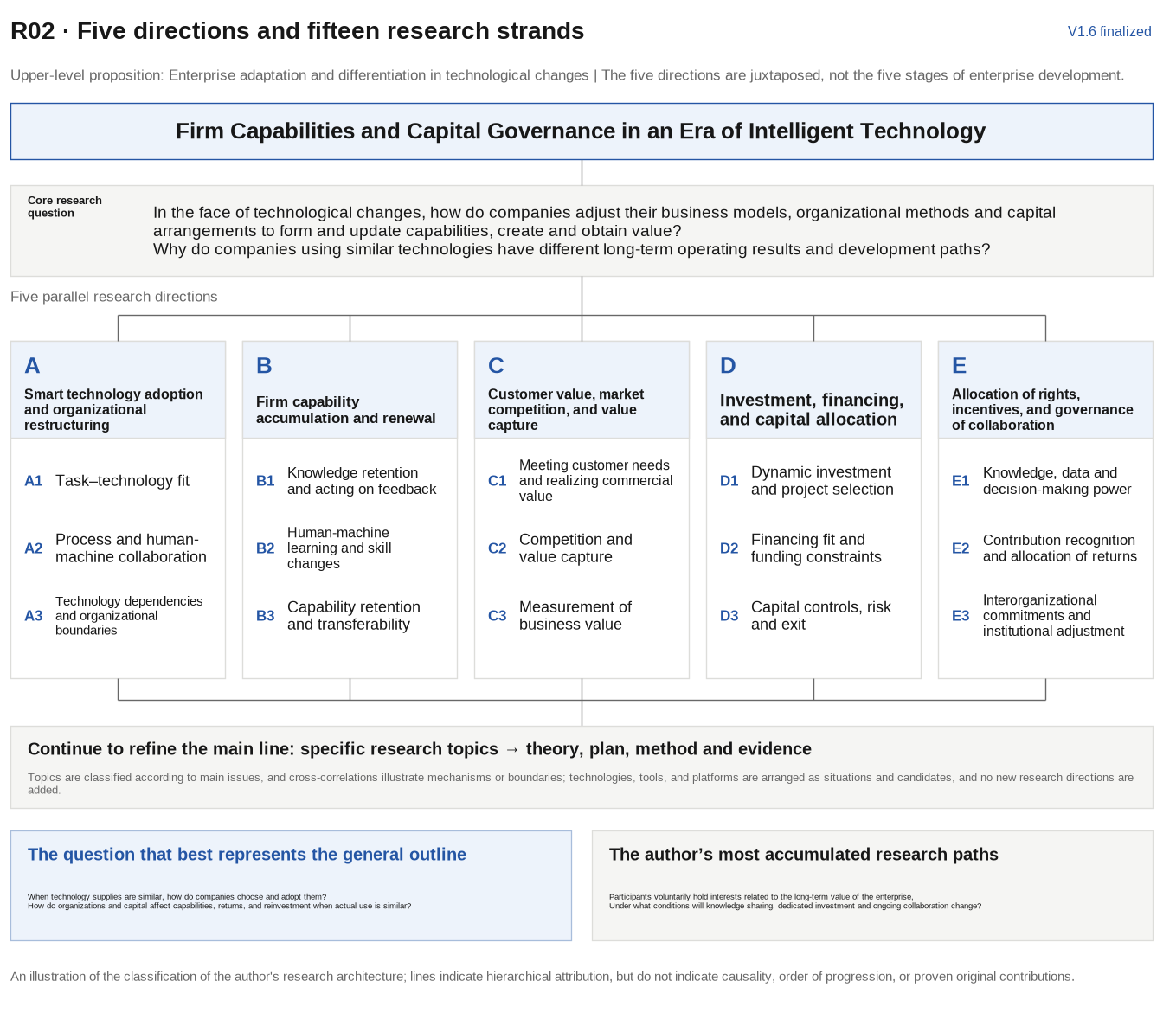
Enterprise adaptation and differentiation in technological changes are the upper-level proposition of this general outline. Five directions observe the same company from different angles. You can start with the problem at hand.
View the final architecture diagram R02 · Five directions and fifteen research strandsFigure R02 · Five directions and fifteen research strands The five directions are juxtaposed. The bottom of the figure compares the adoption choices when technology supply is similar, the role of organization and capital when actual use is similar, and the research path of long-term capital relations.Enlarge diagram · View original SVG
A
Intelligent technology adoption and organizational redesign
If the same task is handed over to AI, rule programs or manual labor, how much will it cost and what quality will be achieved?
Existing work and evidence collection
Already have a jobThe enterprise AI management capability reconstruction system and four-way SOP have broken down business tasks into specific actions.
How to obtain evidenceIt is planned to check the actual use of tools, manual review and takeover, errors and total costs in tasks of similar difficulty and risk.
Delivery is faster. How much is due to the use of AI, and how much is due to changes in division of labor, handover and authorization?
Existing work and evidence collection
Already have a jobThe job responsibilities, processes and human-machine collaboration model have provided a division of work from order receiving, execution to review.
How to obtain evidenceWaiting, rework, handover quality and downstream actual usage are to be recorded against different combinations of technologies and processes.
Should a capability be built by oneself, purchased for use, or handed over to a partner? What will it cost to change service providers in the future?
Existing work and evidence collection
Already have a jobCustomized systems, multi-system interfaces and external collaboration provide comparable work scenarios.
How to obtain evidenceIn the event of an actual switch or exit, it is planned to track who owns the data and knowledge, how long the business was interrupted, and how much the migration cost.
Colleagues or clients raise their opinions. Who makes the decision before the budget, standards or working methods are actually changed?
Existing work and evidence collection
Already have a jobPaper III has put forward feedback into the research design of strategic actions, and the construction of knowledge content has also left a traceable version.
How to obtain evidenceIt is planned to follow one opinion through reception, discussion, resource arrangement and actual use, while retaining feedback that cannot be implemented.
Employees are using AI to do things faster and faster. When faced with an unfamiliar task, can they still make independent judgments?
Existing work and evidence collection
Already have a jobThe SOP-to-Skill approach differentiates between actions that AI can assist and those that require human review.
How to obtain evidenceIt is planned to combine independent completion of tasks with human-machine collaboration to compare judgment accuracy, takeover performance and learning on new tasks.
This time it was done, how much better could it have been done with another person or another tool? How much maintenance is required?
Existing work and evidence collection
Already have a jobThe handover manual and capability accumulation method have been formed, and knowledge content maintenance and customer delivery can be used to observe subsequent reuse.
How to obtain evidenceIt is planned to first check whether it can continue to operate under the original conditions, and then observe the performance after changing people, changing tools, and changing cooperative relationships based on actual opportunities.
The response is faster and the delivery is more practical. Will the customer be willing to pay? Who should you choose for your next purchase?
Existing work and evidence collection
Already have a jobCustomer delivery has been carried out, and the starting point of customer use can be seen from requirements, contracts and delivery records.
How to obtain evidenceIt is planned to track the use, payment, return and renewal of the same type of services; distinguish between no purchase, no invitation, failed bid and unknown destination.
AI saves half a day of work. Will this benefit be retained in the company, passed on to customers, or absorbed by platform fees?
Existing work and evidence collection
Already have a jobPaper II starts with value distribution from power and strategic contribution. The C2 study card puts the problem down to two rounds of actual transactions for the same service.
How to obtain evidenceIt is planned to check comparable quotations, transaction prices, charges and costs, and then estimate the net benefits of each party respectively. When there are only bills, only verified payments are reported.
Are labor hours saved and delivery, profits and reimbursement improved?
Existing work and evidence collection
Already have a jobFour-way SOP and business results diagnosis have linked daily work to business and performance.
How to obtain evidenceIt is planned to calculate investment, maintenance costs, income, profits and cash one by one, and record operating repayments and financing receipts separately.
Training, changing processes, and buying models all cost money. Which one should you invest in first? What do you see that prompts you to invest more?
Existing work and evidence collection
Already have a jobIndustrial operation and capital arrangement, four capitals and dual circulation provide analytical methods for discussing project portfolio and long-term asset management.
How to obtain evidenceIt is planned to start with a real budget decision, keep the optional projects, budgets and reasons together at that time, and then compare the projects that were approved, postponed or abandoned.
For capacity investments that are equally worth making, what will happen to the time it takes for the money to arrive, the financing term, and the cost?
Existing work and evidence collection
Already have a jobThe capital path nine-dimensional comparison table can be used to compare paths such as market entry, IPO, post-listing financing instruments and STO under applicable conditions.
How to obtain evidenceIt is planned to match committed financing with net receipts, maturity dates, fund uses and project repayments, and compare which investments are affected when money is tight.
After receiving the funds, who can decide to continue, who bears the losses, and who has the conditions to exit?
Existing work and evidence collection
Already have a jobThe public materials on listing, mergers and acquisitions and ongoing operations sort out the control, supervision and responsibilities before and after capital entry.
How to obtain evidenceVerify effective terms and actual decisions along proposed financing, restructuring or exit events, and record changes in control, loss commitments and whether to reinvest.
Who can use this knowledge, who has the authority to confirm it, and who is responsible for errors in judgment?
Existing work and evidence collection
Already have a jobThe stakeholder ecological governance model, job responsibility authorization and long-term capital account design provide institutional assumptions about roles and rights and responsibilities.
How to obtain evidenceIt is planned to compare authorizations, revisions, objections and corrections under contracts, conventional records and blockchain shared records, and verify off-chain facts according to effective rules.
Now that the contribution has a basis for review, will the actual distribution change? Are participants still willing to invest their own experience?
Existing work and evidence collection
Already have a jobPaper I, Paper II, and the Contribution Recording and Review Form provide behavioral questions, assignment questions, and recording methods, respectively.
How to obtain evidenceIt is planned to distinguish actual contributions, confirmation of authority, establishment of rights and actual performance, and track the choices of participants the next time there is a cooperation opportunity.
Suppliers have to invest first and receive rewards later. What kind of commitment is worth continuing to cooperate with?
Existing work and evidence collection
Already have a jobPaper IV has proposed a research design on intertemporal conflicts of interest and willingness to cooperate, and the long-term capital relationship model provides another comparative path.
How to obtain evidenceIt is planned to check whether the commitment is supported by funds or orders, how to deal with disputes if they occur, and track equity holding, performance, renewal and exit respectively.
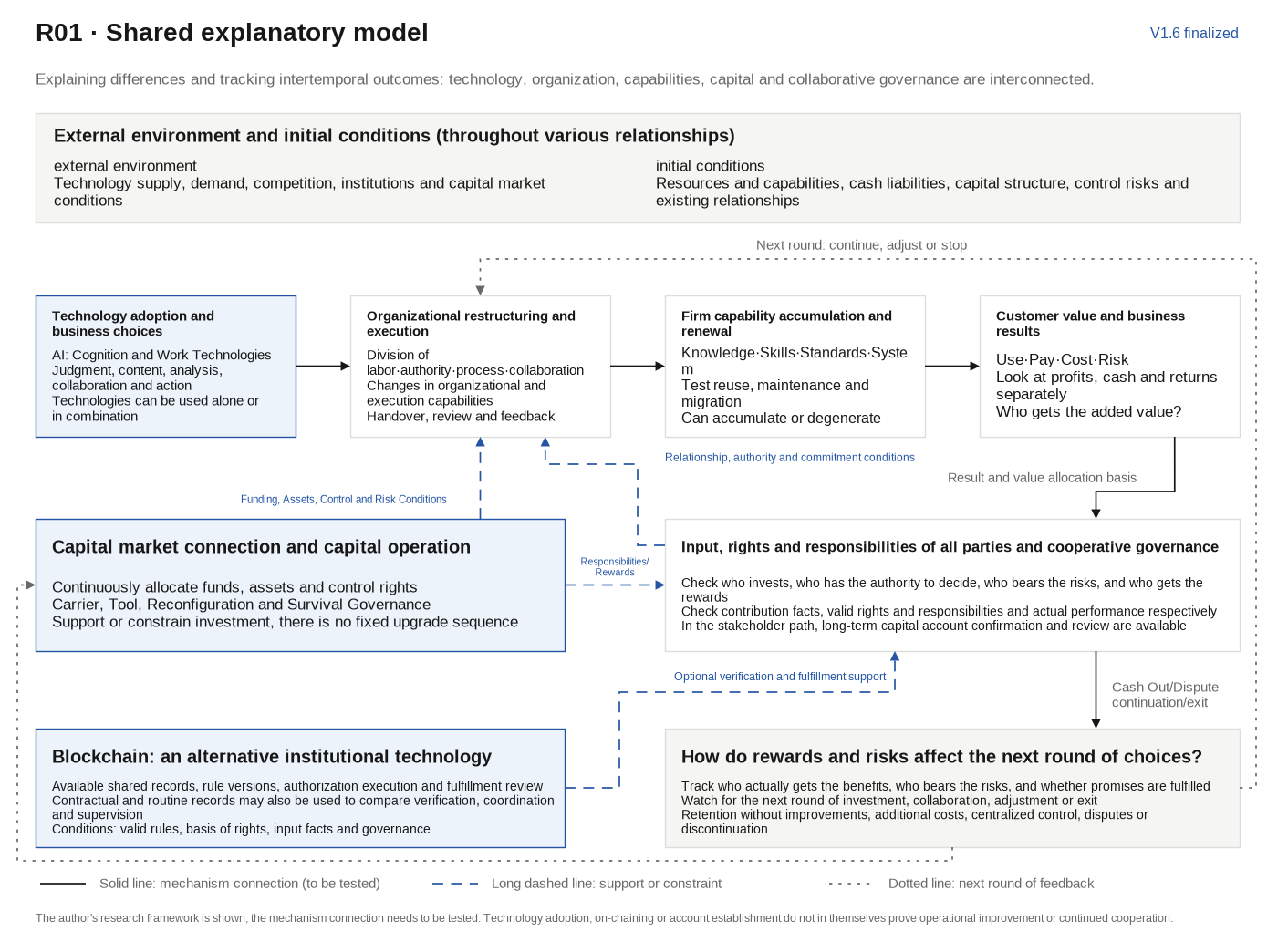
How do firms adapt their business models, organizational arrangements, and capital structures in response to technological change to build and renew capabilities and create and capture value? Why do firms adopting similar technologies end up with different long-term operating outcomes and development paths?
Before a company adopts technology, budget, existing capabilities, and decision-making authority already influence its choices. After the work methods change, it also depends on whether the knowledge can be retained, whether customers recognize and actually pay for it, and who will ultimately bear the benefits and risks. These results in turn influence the next round of investment, collaboration or exit.
Figure R01 · Shared explanatory model Capital allocation, input from all parties, and rights and responsibilities run through changes in technology, organization, and capabilities, affecting customer value and the next round of choices. Connected lines indicate relationships to be tested.Enlarge diagram · View original SVG
As a cognitive and work technology, AI can change how tasks are performed, reviewed, and handed over. As an institutional technology, blockchain can be used to share records, verify rights and track performance among multiple parties. Both techniques are put back into the specific task and compared with other practices available to the business at the time.
Proposed original contributions
I start from an old question in strategic management. Why do companies take different paths? The entry of AI into practical work has given this issue new opportunities for observation. Stakeholder capital, long-term capital relations and long-term capital accounts are a research path in which I have accumulated a lot of experience in rights, capital and cooperation. Around this path, I propose two proposed contributions and list four supporting studies.
Proposed main contribution · Theoretical explanation
The formation and persistence mechanism of long-term capital relationships
Participants voluntarily accept and hold interests related to the long-term value of the enterprise in accordance with effective rules. After the existing rights and interests are realized, what will make him continue to invest in the next cooperation, and what will make him only retain the rights and interests?
Institutional design of long-term capital accounts for stakeholders
How to connect the basis of contribution, confirm authority, establishment, fulfillment and objection of rights and interests in the account? When multiple parties jointly verify, which step can the blockchain and conventional records handle?
The mechanism by which technology, organization and execution influence ability retention
From the completion of a task to the next time the team can still complete it, what roles do authorization, handover, review and feedback play respectively?
Support candidates · Capital operation
The two-way effect of active capital operation and capacity building
How do financing conditions and control change investment in capabilities? How will actual operations and agreed performance affect the next capital arrangement?
Support Candidates · Observation Methods
Dual acceptance method for business improvement and capability retention
How to separately check and accept current delivery and inter-period capabilities, and record the tools, relationships and costs relied on to maintain this capability?
Support Candidates · Experience and Boundaries
Longitudinal evidence and failure boundaries
By connecting the same tasks or collaborations across time periods, where can additional costs, disputes, interruptions, or lack of improvement be seen, so that the original interpretation can be revised?
How to start evidence collection for three flagship topics
Starting from a delivery, a budget decision and a real cooperation opportunity, track the inter-temporal results of operations, funding and equity arrangements respectively.
Flagship study 1 · Delivery scenarios are available and cross-round comparisons are planned to be launched.
How technology and organizational arrangements can lead to sustainable business improvements
From the customer deliveries already in progress, a type of repeatable service is selected in advance and included in the entire batch of eligible projects from the first round. Follow up with the next similar delivery and procurement, check capability reuse, customer selection, transaction and total costs respectively, and then track subsequent investment.
Flagship study 2 · Start with actual budget decisions
How do funding conditions affect the continuation, adjustment and cessation of capability investment?
Wait for a real budget decision to come up and note down the alternatives, available funds, and judgment at the time. Compare the actual investment and capacity changes of approved, delayed, abandoned and unapproved projects, and check the original judgment of the project prospects.
Flagship study 3 · Distinguish between situational judgment and actual behavior after the system takes effect
How contribution, control and benefit arrangements affect the next round of investment
During system preparation, use scenario comparison research and judgment first. After the rules come into effect, invitations, selections and fulfillment will be recorded starting with those who qualify. The next time there is a real opportunity for cooperation, differentiate between continuing investment, retaining rights but ending services, and continuing cooperation after transferring rights.
How Company Zero brings practice back to research
Company Zero puts research into actual operations and then uses problems in operations to revise the practical targets of research. Examples from external companies, customers and partners are used to compare differences and check which explanations can be applied to other contexts.
academic · community · Resources · business · capital Actual operations are divided into five dimensions. When researching, trace how a decision, investment, and results are connected from a specific project.
Already carried out
As of November 25, 2026, knowledge content construction and customer commercial delivery have been carried out. Existing teams and followers who want to co-build can continue to collect evidence from versions, division of labor, delivery and actual use.
small-scale testing
The new co-construction system is still being prepared and relevant functions are being tested on a small scale. Willingness to participate, formal roles, establishment and actual performance of rights and interests are recorded according to the facts that occurred.
Next step to observe
Prioritize tracking a category of repeatable customer deliveries. After a real budget decision or effective co-construction rules appear, funding and equity studies will be conducted separately.
This page is being finalized. When citing a main thread, you can click on the main thread title and retain the number at the end of the link. C2 · Competition and value capture.