Why do companies take different paths through the same wave of technological change?
Across five research areas and fifteen lines of inquiry, I look at how firms turn technology into capabilities, how they earn returns, and how capital and collaboration shape their next choices. Company 0 is where I plan to start testing these ideas in practice.
Reading & sharing

I study how AI can be used to run and manage a business. I also study capital transactions, and I went back to an old manuscript and rewrote Stakeholder Capital Theory. Each of these made sense when I talked about it on its own. Inside a company, though, those decisions often come up together. The moment you consider bringing AI into your core business, a few questions follow. Who has the authority to change the existing workflow? Can we afford to keep and train the people we need while we wait for customers to pay? What will the people who bring years of experience and help get the work done receive in return?
I recently finished my research agenda, Firm Capabilities and Capital Governance amid Shifts in Intelligent Technology. I often say, “Technology drives business. Advances in science and technology guide change.” The agenda takes that thought a step further. When companies face similar technological opportunities, why do they take different paths? One might start taking on work it could never handle before. Another might do the same work faster and pass the savings on to customers in lower prices. Over time, the two could differ in the capabilities they have retained, the funds they can put to use, and the people who still want to work with them. I want to understand how those differences build up. That is what draws me to how firms adapt and diverge during technological change.
I look at this in two steps. First, when firms have access to similar technology, why do some adopt it early, others wait, and others stick with the way they work now? Then I compare operations that use it in similar ways to see how organizational choices, customer decisions, and capital arrangements shape later results. Over the longer run, I also want to know how the firm itself might change as people and AI work with the same knowledge and people outside the company contribute to building it over time.
How the five research areas and fifteen lines of inquiry fit together
1. Adoption of intelligent technology and organizational redesign. I start with the fit between the task and the technology. Where does AI help, and which decisions still call for someone with experience? Then I look at workflows and human–AI collaboration. A draft can be ready in minutes, yet the work can still stall if the person reviewing it has no authority to decide. I also look at technology dependencies and the boundaries of the firm. Building in-house, connecting to a platform, and working with a specialist all have consequences for where critical knowledge sits and how much it costs to switch later.
2. Building and renewing firm capabilities. When a task goes well, I want to see what happens the next time. Does a problem a customer pointed out make it into the next version of the standard? That is how I look at retaining knowledge and acting on feedback. When employees work with AI, what do they learn to judge for themselves and which skills start to fade? That is the question of human–AI learning and changing skills. If we change the person, the tool, or the partner, how much of the work can we still do? That is capability retention and transferability. Understanding which parts still depend on whom helps a company decide whom to train and which partnerships to maintain.
3. Customer value, market competition, and value capture. A company may feel it has improved. I want to see how well the service works for customers and what they are willing to pay. That is the line of inquiry on meeting demand and turning it into business. Once competitors can offer the same service, customers have more choices. Do the gains from the improvement go to the customer, the firm, the supplier, or the platform? That is competition and value capture. I also want to measure what the improvement is worth in the business. Saving half a day may cut an outsourcing bill, or it may just free up an afternoon. I track revenue, actual expenses, and cash collected to see who gained and how.
4. Investment, financing, and capital allocation. Funding already shapes a firm's choices before it selects a technology. Should it spend the money on tools or training, keep it for another line of business, and later put in more or stop? That is dynamic investment and project selection. When a capability takes time to build, what term and cost of funding can support it? That is financing fit and funding constraints. Who can decide whether a project continues, who bears the losses, and how can investors exit? That is capital control, risk, and exit. These questions also guide my study of public listings, mergers and acquisitions, and other capital transactions. What choices open up once the capital comes in, and what responsibilities come with it?
5. Allocation of rights, incentives, and governance of collaboration. A company draws on many people's capabilities. Who can use the knowledge and data, and who decides how they are used? How do we establish what each party contributed and make good on the returns we agreed to? When organizations work together and demand changes or an earlier commitment can no longer be met, who comes to the table and how do the rules change? These questions cover knowledge, data, and decision rights, recognition of contributions and arrangements for returns, and commitments across organizations and adjustments to the rules. They shape a practical choice in the next round. Will partners still bring their most valuable experience and commit people and money?
I can follow these five areas from a task or from an investment. How long funding can wait and who has decision authority shape which technologies a firm is willing to try. Once the work changes, keeping what people have learned depends on how they and the organization learn. When the firm builds a capability, how much it gains still depends on customers and competitors. What the business earns and which promises it keeps this time change the choices it faces next time. Connecting the fifteen lines of inquiry helps me follow one decision far enough to see the business outcome and identify the choices that may explain it.
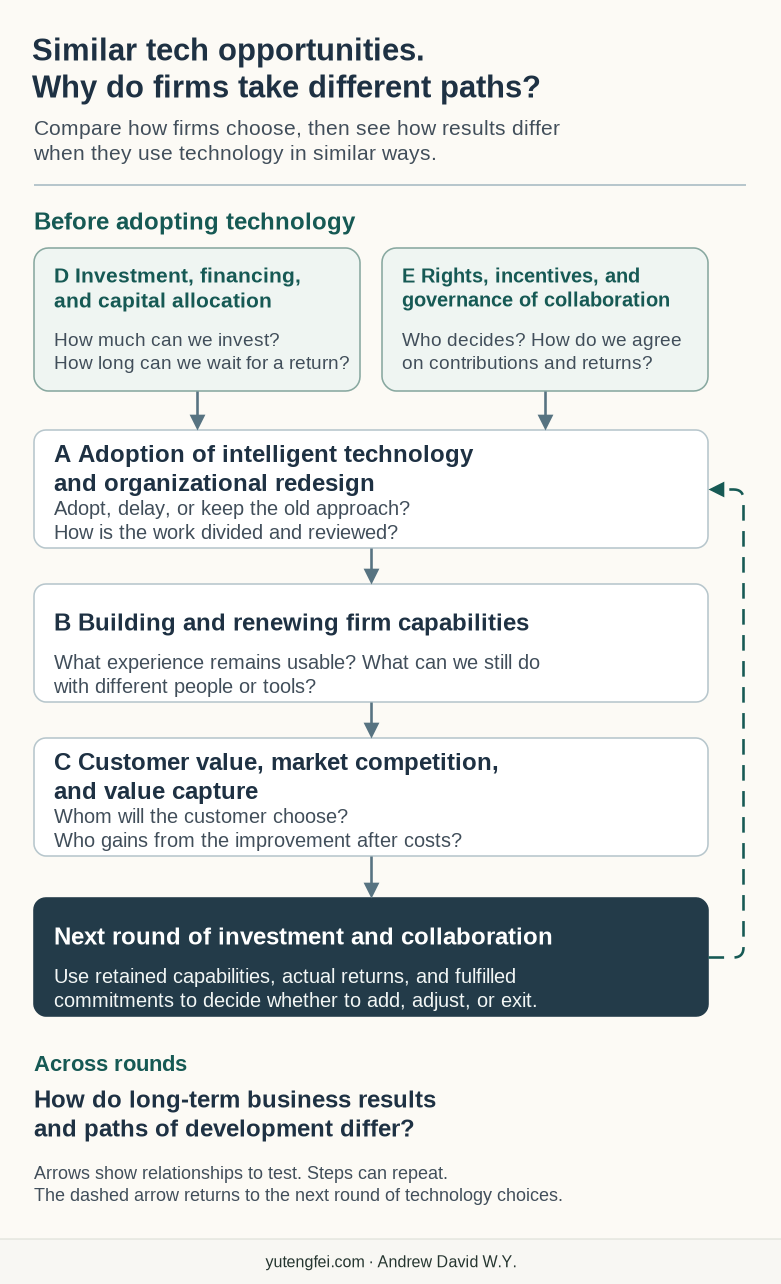
How I plan to do this research at Company 0
Company 0 is where I put research into operating practice and use the results to revise it. We already produce knowledge content and do client work. WISERUNION brings together providers from different countries and regions. We start with a client's specific problem and combine the products and specialist services that make sense for that client. Someone on a project knows the customer, someone knows the technology, and someone has to maintain what we deliver. That gives me a place to observe how people actually get things done together.
I want to start with a repeatable service and keep a full record of the projects from the first round. Suppose AI lets us complete the same work half a day sooner. I'd check who actually saved money and whether the next person to take over made use of the customer's earlier feedback. At the next purchase, I want to know whom the customer chose. Even if we were never invited back to quote, a verified switch to another provider is a competitive outcome worth recording. If we can't establish where the work went, I'll record it as unknown. Then I can see whether we used what we learned with another customer and whether the original investment is worth continuing.
Stakeholder Capital Theory is one line of work I have developed in more depth. I want to explore an arrangement in which participants receive the agreed compensation and, under the rules, can choose whether to accept and continue holding rights linked to the firm's long-term value. I study blockchain as a technology for implementing institutional rules. I'm looking at how it might support long-term capital accounts that let parties check who confirmed a contribution, which version of the rules applied, and how much of the promised return was delivered. The rules for the new joint work are still being prepared, and the related features are in small-scale testing. Once the arrangement is in use, I can start to see how keeping a promise changes someone's next decision.
I hope more people will bring real problems from their own industries into this work. Company 0 gives me a way to trace where a decision came from and what happened afterward. By looking at it alongside other businesses, especially those that started with similar conditions and took a different path, I can see which lessons carry over and which of my judgments I need to revisit.