Transactions matter in business. Selling a product, delivering a service and checking costs and cash receipts provide a basis for continuing operations.
I think there is another useful question alongside those results: what will be better in the next round of work because this transaction took place?
Do we understand the customer's needs better? Are suppliers and the team working together more smoothly? Can we reduce a problem next time? If someone else takes over, can they use the experience left behind?
These questions concern what an enterprise can build through doing business.
After completing similar orders, some enterprises still have to explain everything again, coordinate from scratch and handle the same mistakes. Others record the problem, change their approach and give subsequent work a better starting point.
That is what I want to discuss: how one transaction can become a basis for the next round of operations.
1. Examine current results, then what remains
First understand the current transaction.
Check transaction value, revenue that can be recognized, costs, profit and actual cash receipts separately. Continue tracking returns, exchanges, after-sales work and outstanding responsibilities.
An enterprise needs these results to assess current operations. Revenue, profit and cash collection mean different things. One figure does not settle the others.
Then examine another level of result: did this transaction help the enterprise understand demand, organize delivery or solve problems better?
That result usually takes longer to appear. A clearer specification, a corrected delivery process or more reliable supplier coordination needs to be used in later work before its value can be assessed.
I would group these possible gains into relationships, coordination and capability.
Relationships concern whether both parties can cooperate with greater confidence. Coordination concerns whether different roles can get the work done more smoothly. Capability concerns whether the team can continue using effective methods.
Records and data run through all three. They help explain problems, check judgments and assess improvements. More records alone do not show that the enterprise has become stronger if they never enter the work.
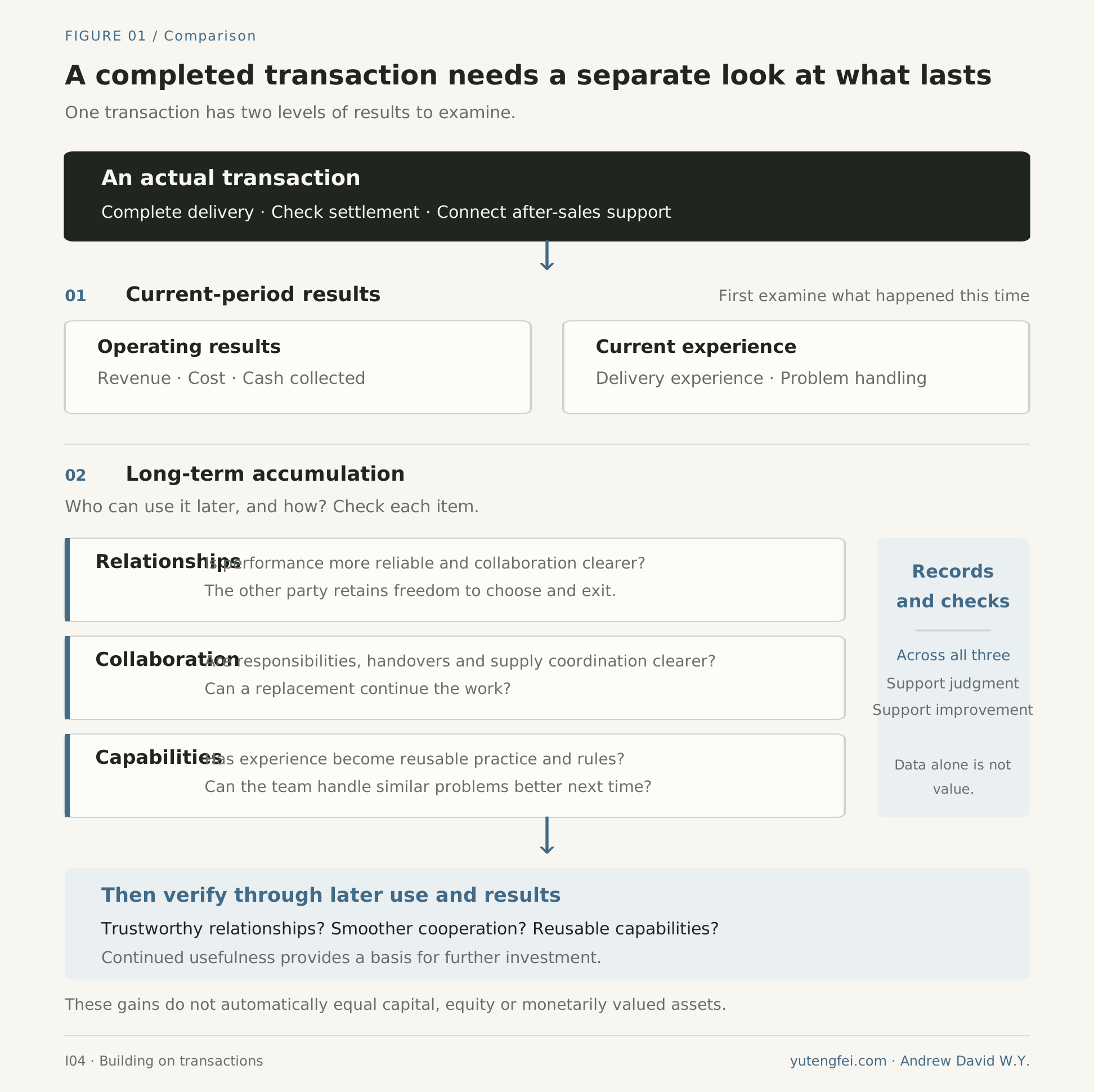
Figure 1 examines current results separately from subsequent gains. Those gains need use and testing; a completed transaction alone does not establish them.
2. Relationships depend on willingness to cooperate again
Repeat purchases are an obvious place to look at customer relationships.
A returning customer is worth understanding, but ask why they returned. They may value the product and service. They may also be waiting for discounts, have few immediate alternatives or face high switching costs.
Those situations imply different relationship quality.
I am more interested in whether the other party would choose to work with us again when alternatives exist; whether they will tell us what is really happening when problems arise; and whether we keep our promises or explain promptly when we cannot.
A normal delivery can improve understanding. A problem handled carefully may also clarify each party's responsibilities and way of working. Trust still needs continuing behavior to test it. One positive review is not enough.
This applies to suppliers, channels and service partners too.
Clear forecasts from a buyer, honest explanations of capacity and constraints from a supplier, and a timely response to delivery deviations help both sides judge how to cooperate next time.
If a relationship continues only because one party keeps conceding or carrying the other's problems, its sustainability still needs examination.
A relationship needs reasons for both sides to choose it, with room for the other party to choose differently or leave.
3. Better coordination should reduce repeated negotiation
Some orders are completed only through considerable coordination effort.
Sales promises a date without procurement confirmation. A warehouse uses an old specification. Customer service lacks current information. Once a problem appears, people scramble to find someone to coordinate.
Checking only final delivery can miss these costs.
After a transaction, review the interfaces: who confirms the customer's requirements, checks supply conditions, receives change notifications and handles exceptions?
If the same issue repeatedly depends on personal connections to resolve it, the team has little guidance for next time. Explain the coordination that worked, then test it on the next batch of orders. That creates an opportunity to reduce repeated confirmation and rework.
Do not assess convenience for the enterprise alone. A process that eases internal work while making customers resubmit information or imposing unreasonable last-minute changes on suppliers may not improve overall coordination.
Look for specific changes: information passed fewer times, clearer responsibilities, less rework or earlier detection of exceptions.
These can be checked again in subsequent work.
4. Capability needs experience to move beyond one person
There is a gap between one person doing a task well and a team being able to do it consistently.
An experienced colleague may anticipate problems and know whom to contact. If those judgments remain only in that person's head, a replacement has to start exploring again.
Capture the useful parts: which situations need another question, which steps require confirmation, which promises must be checked first and who should decide on particular exceptions.
Then let someone else use the method. A complete-looking document may still be hard to understand or fail to solve the problem in practice. If so, adjust it.
Capability needs to appear in work. Does the method still help with a different colleague or a comparable batch of orders? Are recurring problems reducing? Can a newcomer understand what to do more easily?
Records help, but their purpose should be defined first.
To improve specification confirmation, an enterprise may retain necessary requirements, confirmation steps and error types within its authority to collect and use information. It need not keep everything that might conceivably be useful later. Who may see it, permitted uses and retention periods should also be clear.
Records can support reusable capability when someone analyzes them, makes a judgment, changes the method and tests it in use.
Data supplies evidence here. What needs testing is whether the work improves.
5. Examine one order in detail
The following parts-supply example is fictional and illustrates the analysis only.
After delivery, a business discovers that the actual installation specification does not match the ordered model. Customer service makes repeated calls, the warehouse finds replacement stock, the supplier helps check the details and an exchange is completed.
For this order, the after-sales problem has been handled. Exchange costs, payment status and outstanding responsibilities still need checking.
For subsequent operations, ask why the specification was not clarified earlier. Was the explanation unclear? Did the customer not know what information to provide? Were sales, the warehouse and the supplier using different versions of model information?
Different causes require different responses. An exchange alone does not establish that someone was careless.
Suppose review finds that the confirmation page lacks a parameter affecting compatibility. A small change could add that parameter at order confirmation, explain how to provide it and assign someone to check unresolved orders before dispatch.
Test it on orders with comparable product categories and fulfillment conditions.
| What to examine | Possible action | What to observe afterwards |
|---|---|---|
| Does the customer understand what needs confirmation? | Explain the parameter in ordinary language and reduce repeated questions. | Is confirmation easier, or has it created extra difficulty? |
| Do the team and supplier use the same definitions? | Identify model versions, change notifications and responsibility for confirmation. | Is information consistent, with less rework and repeated communication? |
| Can another person use the method? | Ask another colleague to try the steps and record exceptions. | Which parts still depend on personal experience, and which steps need revision? |
| Is the effort worthwhile? | Record checking time, exchange costs and after-sales costs. | Are problems reducing, and are overall costs and the service experience improving? |
There is no guaranteed result in advance.
Extra confirmation may slow the process. The explanation may still be unclear. The actual cause may lie elsewhere. If results do not improve, revisit the judgment, adjust the approach and, where necessary, stop the trial.
Even if mismatches decline, examine changes in order mix, volume, promotions and supply. Substantially different comparison conditions do not justify attributing the whole change to this intervention.
What is worth retaining is a clearer understanding of the problem, an explained way of coordinating and steps tested in use. Resolving the exchange is a starting point; more work follows.
6. Someone must turn feedback into a judgment and action
After transactions, enterprises receive customer feedback, after-sales records, supply changes, delivery deviations and colleagues' experience every day.
First select what is relevant to the current problem, what has evidence and what needs confirmation. Choose a worthwhile problem, then identify who is responsible, which step to change and when to check it.
The process can follow this sequence:
Complete fulfillment → organize necessary records and feedback → select a problem → adjust the approach → use it next time → compare results → retain, revise or stop.
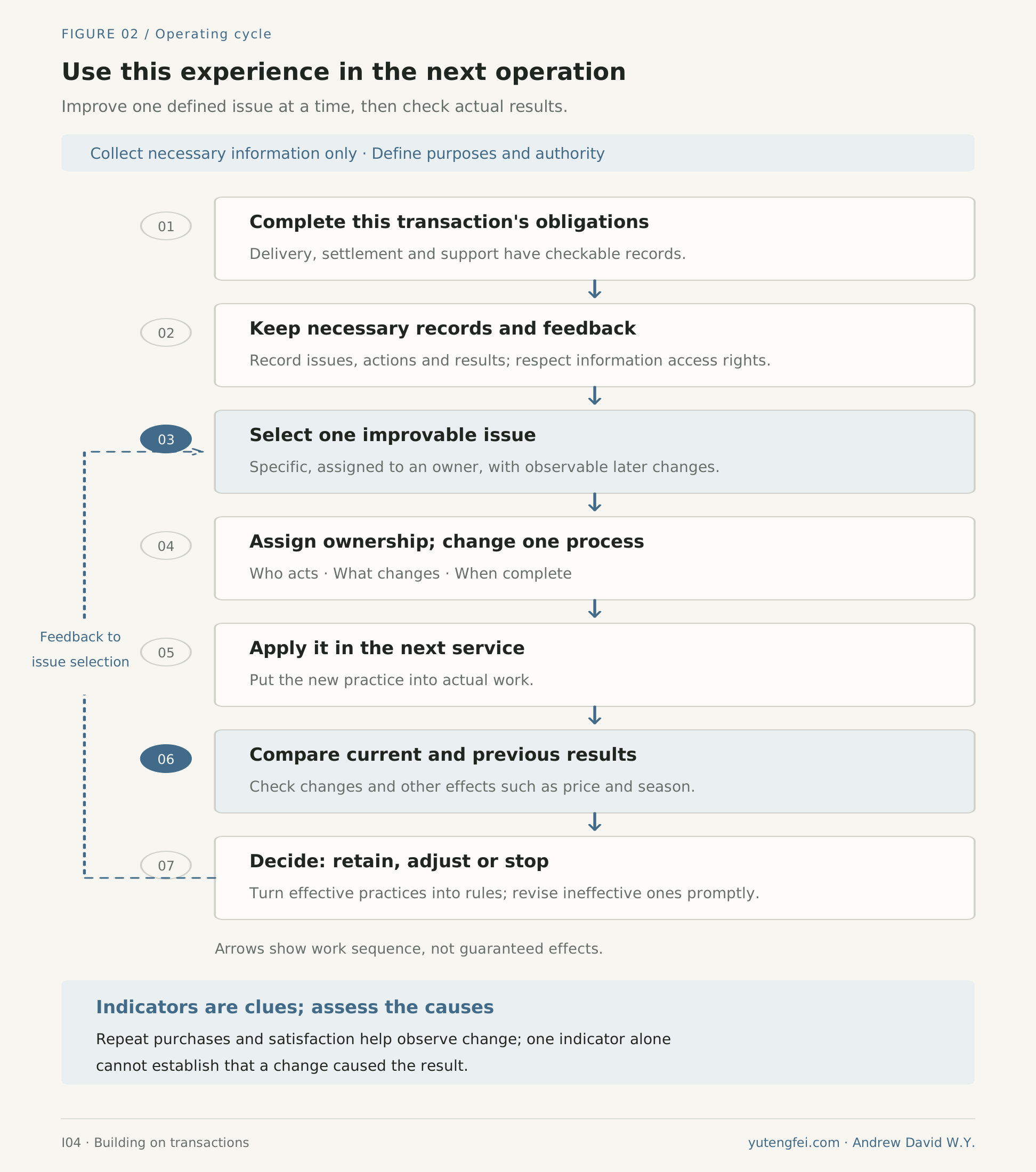
The connections in Figure 2 represent actions and checks that must actually happen. Feedback does not automatically produce improvement. Results may require an earlier judgment to be revised.
I think two actions are especially easy to omit.
One is assigning the improvement to a specific person. Everyone may know the problem, yet no one is responsible for using the revised method next time. The record then stays in a table.
The other is returning to check. Treating a launched process as finished can conceal new problems. Reducing repeated confirmation might, for example, create a burdensome form for customers. That deserves reassessment.
During review, ask the same questions: what improved, what evidence supports that, who found it easier, who carried extra cost and what alternative explanations remain?
Specific answers make the experience easier to use.
7. Long-term development still needs affordable commitments today
Organizing information, training people, improving systems and maintaining relationships require resources.
Saying that these activities have long-term value is not enough. Compare priorities. Which problems repeatedly cause loss? Which improvements affect more work? Which can first be tried in a limited setting?
Demanding extensive records for every transaction may make recording cost more than it yields. Some one-off needs offer little scope for reuse. They can be completed normally without building a complex system simply to demonstrate that something was retained.
A practical starting point is a recurring activity with one significant problem. See whether it can produce an improvement the team can use.
Relationships also have limits. Respect for long-term cooperation does not require unlimited service promises. Partners have their own operations and costs. Clear commitments, responsibilities and available support give cooperation a basis for further discussion.
These gains may support operating quality, but they need testing against cost, actual demand and sustained use. They do not by themselves establish equity rights, asset value or capital-market value.
8. Return to one transaction and ask five questions
To examine whether the enterprise keeps building through its operations, I suggest asking:
- Have revenue, costs, collections and outstanding responsibilities been checked separately?
- Are the real needs of customers and partners clearer than before?
- Have the problems found changed coordination and methods for the next task?
- Can a different person use the experience retained?
- After use, have the effect and cost been checked?
There is no rush to give everything an impressive name. Start with something that was done before, actually used afterwards and then checked.
If this can keep happening, the enterprise has an opportunity to build more reliable relationships, clearer coordination and more reusable capabilities alongside transactions.
Today's work can help tomorrow's work. When problems arise, the team can find causes together and adjust its approach. Those concrete changes deserve attention alongside current results.