When discussing a listing, people often ask which market, how long it will take and how much it will cost.
Those questions matter. I think another comes first: why does this enterprise need access to public capital markets?
Where will the money go? Is the business ready? Who will sustain governance and disclosure? How will existing shareholders' interests change? Without answers, even a timetable may not show where the enterprise actually stands.
I prefer to examine listing and capital transactions through four stages: strategic planning, route selection, coordinated execution and continuing operations.
At each stage, clarify the question, obtain the relevant materials and decide whether to proceed, gather evidence, adjust or defer the capital initiative. A listing may be an important milestone; operating responsibilities continue afterwards.
This article is a learning map. Selected U.S. rules illustrate distinctions, while different issuers, transactions and venues require separate assessment. The four stages and exercises are a working method developed for this edition, not a statutory procedure for every market.
1. Put the purpose of listing into the business context
If the purpose is financing, ask who needs the funds, for what, when and on which acceptable terms.
If the purpose is acquisition, examine targets, integration capability, consideration and governance. Shares may be considered as transaction consideration, but the counterparty's acceptance and the validity of issuance and transaction arrangements require separate confirmation.
If the aim is public credibility, consider whether the enterprise will continuously publish information, accept the relevant scrutiny and bear finance, governance and professional-service costs.
Listing every possible benefit does not establish a strategy.
Write a one-page purpose statement: the present operating problem, which part the capital initiative is intended to address and what still depends on products, customers, talent and daily management.
Include “not proceeding now” in the comparison. Strengthening operating and financial foundations first, or meeting funding needs in stages, can also be a reasoned choice.
Retain objectives, constraints and unresolved questions at this stage rather than immediately assigning a route.
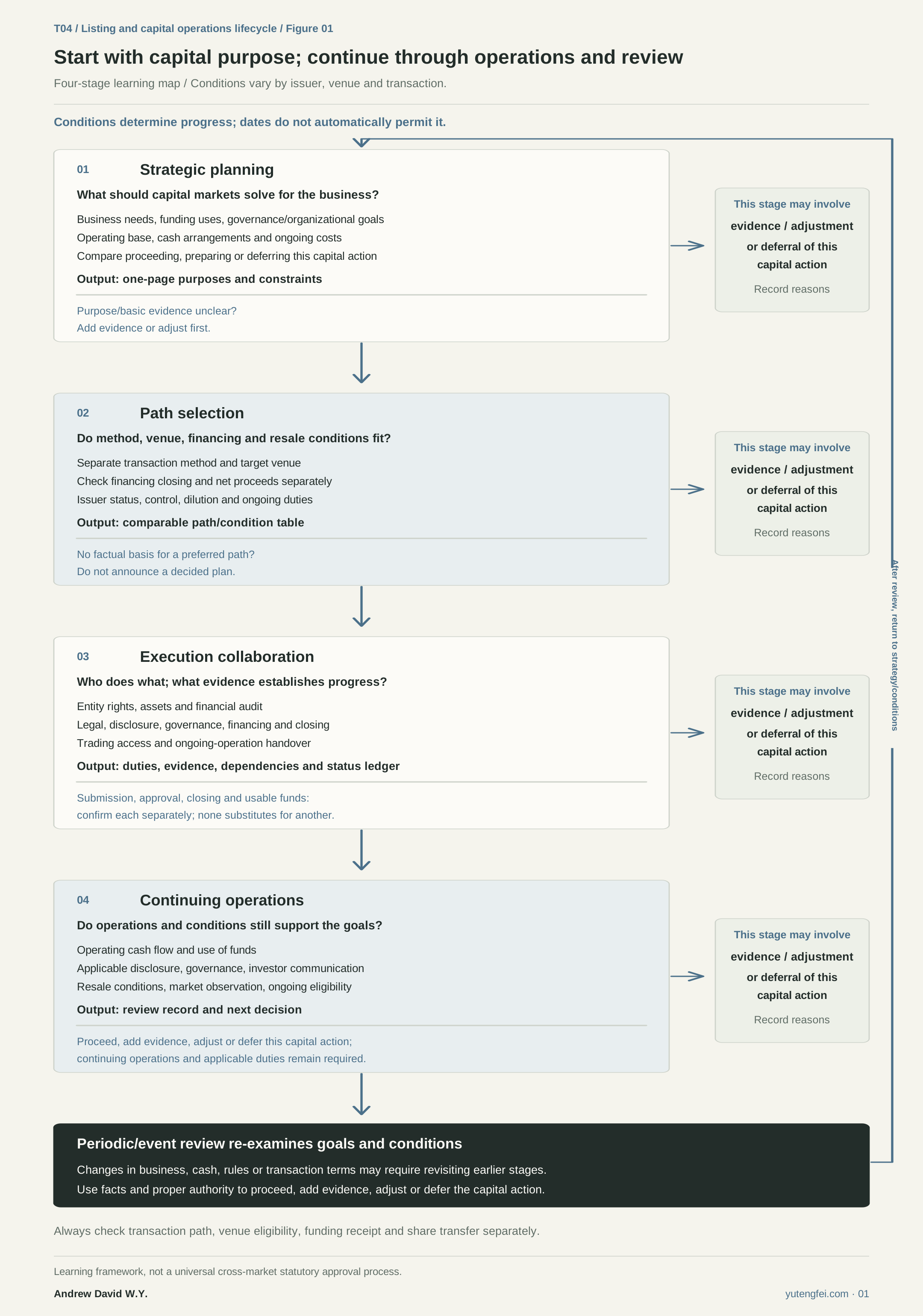
Figure 1: Progress depends on conditions, with review able to return to objectives and route selection. Seeking evidence, adjusting and deferring relevant capital actions all require recorded reasons.
2. Compare routes without putting different questions in one box
IPO, SPAC, reverse takeover (RTO), direct listing, OTCQB and Nasdaq are often discussed together, although they answer different questions.
An IPO involves a public offering. A de-SPAC combination and an RTO involve particular transaction structures. Direct listing concerns entry to exchange trading. OTCQB and Nasdaq involve different markets and qualification requirements. A complete arrangement must also explain financing closing and share ownership and transfer.
The SEC provides an overview of several routes. Direct listing should not be described as necessarily raising no funds: NYSE provides an option to raise new capital where conditions are met. Check the venue's specific rules separately. See the SEC overview and NYSE direct-listing explanation.
I would separate these questions:
| Comparison | Questions |
|---|---|
| Issuer and business | Which entity enters public markets, what business and assets does it control, and which securities do shareholders obtain? |
| Transaction and issuance | What restructuring or issuance method is used, and which registration, exemption and confirmation procedures apply? |
| Target venue | Which qualification is sought, and which initial and continuing conditions apply? |
| Financing and funds | Who invests, who receives funds, when does closing occur, and what remains usable after fees and restrictions? |
| Governance and continuing costs | Who handles reporting, audit, governance and communication, and can the company sustain them? |
| Shareholders and trading conditions | What dilution occurs, can shares be transferred, and is there actual market demand? |
Use the same business scope, funding need, cost definitions and assessment date. Comparing entry fees on one side with several years of maintenance on the other distorts the result.
OTC quotation is not exchange listing, and quotation procedures are not regulatory endorsement of a security's quality. An applicable reverse-merger company later seeking initial Nasdaq listing must examine additional conditions and exceptions; there is no automatic upgrade. See FINRA's explanation and Nasdaq Rule 5110(c).
3. Confirm qualification, funds received, transferability and liquidity separately
A letter of intent, a filing or a stock symbol may establish progress at one milestone. It does not prove later milestones.
Public offerings, public reporting and exchange or OTC qualifications each have conditions. In a U.S. registered offering, filing and effectiveness are different statuses; sales and financing closing require confirmation under the relevant arrangements. See the SEC going-public explanation.
Continue checking the funding: whether subscriptions are effective, conditions are met, funds were actually received, fees were deducted and use or withdrawal restrictions apply.
Market trades in shares do not automatically bring financing proceeds into the company's account. Market capitalization is not available company cash.
For shareholders, obtaining shares and being permitted to transfer them are different questions. Permission to transfer and finding a buyer at a particular price are different again.
Rule 144 is one possible resale safe harbour. A holding period is not its only condition, and shell or former-shell history requires further examination. “Listed” or “held long enough” does not mean all shares trade freely. See the SEC guide to restricted and control securities and related guidance.
A timetable becomes useful when these distinctions remain visible. Record each status and supporting evidence rather than substituting earlier progress for a later result.
4. Coordinate execution in parallel and check dependencies
Listings and capital transactions involve many people. Finishing one document does not establish that other conditions are ready.
I would examine several workstreams.
| Workstream | Records it should produce |
|---|---|
| Entities, assets and rights | Entity relationships, control and ownership evidence, and rights and obligations before and after the transaction |
| Finance, audit and operations | Checkable financial and operating records, audit scope, discrepancies and their treatment |
| Law, disclosure and governance | Applicable requirements, documents, authority, disclosure arrangements and internal responsibilities |
| Financing and closing | Terms, prerequisites, fees, actual receipts and use restrictions |
| Market access and handover | Applicable qualifications, procedural feedback, trading preparations and owners of continuing work |
This is a learning framework. Actual responsibilities, sequencing and professional scope require project-specific arrangements.
For each milestone, identify the owner, dependencies, acceptance evidence and current status.
“Underway” may work in conversation, but a register needs more: submitted to whom, what, when, with what feedback, and subject to which conditions next?
Arrange handover of post-listing finance, governance, disclosure and investor communication during execution. Do not assume someone will naturally take it over later.
5. Connect three groups of continuing work
The first is operations and cash.
Examine revenue, profit, collections, customers and project progress separately. Continue checking agreed fund use, actual acquisition integration and whether operating improvement reaches cash.
The second is disclosure and governance.
Establish issuer and reporting status before scheduling obligations. U.S. domestic reporting forms 10-K, 10-Q and 8-K should not simply be assigned to every foreign company. Foreign private issuers using the relevant forms generally deal with 20-F and information furnished under 6-K, with possible additional market requirements. See the SEC reporting explanation, Form 20-F and Form 6-K.
The third is investor communication.
Explain business, risks and public progress, record market questions and return them to operations and disclosure. Communication cannot replace required disclosure.
Keep regulatory distinctions clear. Regulation FD generally excludes foreign private issuers, but that does not remove anti-fraud or applicable market disclosure requirements. See the SEC rule explanation.
Establish arrangements confirmed under the relevant responsibilities: who assembles facts, reviews, decides or carries out disclosure, and communicates within what scope? Update related versions when facts change so accounts stay consistent.
6. Observe the market before deciding what needs changing
Price, turnover, spreads, trading depth and actually tradable shares can be observed. They are not outcomes the enterprise can promise to control.
For low activity, first check data definitions and the observation period, then information availability, resale conditions, shareholder structure, market conditions and operations. Causes need evidence; do not begin by assuming insufficient promotion.
I would not multiply fundamentals by liquidity to calculate company value, or connect earnings growth, higher valuation, successful financing and acquisitions into an inevitable upward cycle.
Financing may fail to close, terms may change, new shares may dilute existing holders and acquired businesses may integrate poorly. Review needs room for those possibilities.
Each review should reach a reasoned decision: continue, obtain evidence, change timing, compare alternatives again or defer this capital action. Operations and applicable continuing obligations do not stop; they may run alongside further evidence gathering or adjustment. New financing or an acquisition needs its own checks of conditions and authorization even where a strategy was approved earlier.
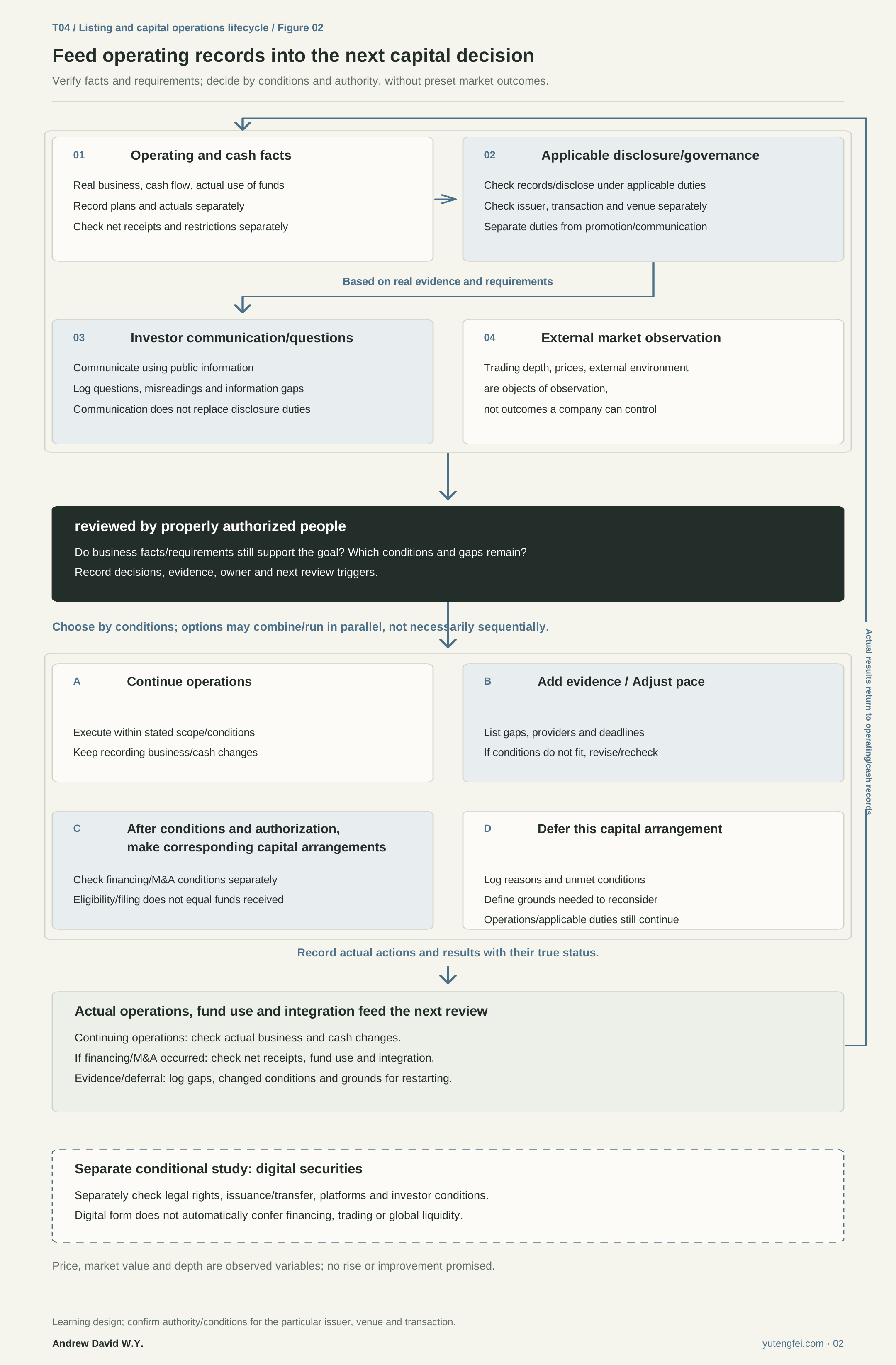
Figure 2: Operations, disclosure, investor questions and market observations enter review together. Actual capital-transaction outcomes return to operating records through feedback that can be revised.
7. Treat digital securities as a tool choice requiring separate assessment
When considering connections between shares and tokens, distinguish what is issued, who may hold it, the rights, registration, transferability, and trading and settlement arrangements.
Digital form does not resolve these conditions. Issuer-sponsored digital securities, third-party representations of rights and other exposures cannot be treated as identical shareholder rights without examining their structure. See the SEC staff statement on tokenized securities.
Rules may develop. On 17 September 2026, the SEC granted temporary, conditional relief for specified arrangements involving tokenized NMS stocks. Its scope and conditions do not establish that every stock can automatically connect to global on-chain trading, or guarantee prices, round-the-clock trading or liquidity. See SEC Order 34-106402.
Place digital securities in a separate research area: identify the actual use, then establish rights, applicable registration or exemption, participants, trading and continuing maintenance conditions.
The tool may be unnecessary. A full-cycle framework should accommodate different combinations.
8. Turn the map into your own worksheet through four exercises
First, write the purpose. Explain the specific business and funding problem, why public-capital routes are being considered now, and when not to proceed.
Second, compare routes. Use consistent definitions to separate transaction method, venue, financing, continuing obligations and resale conditions. Leave unknowns unknown.
Third, check execution. Start with “submitted” or “signed” and ask which stage it proves and what remains missing.
Fourth, rehearse review. For operating, funding or market changes, specify evidence needed, reviewers, the next discussion and facts that trigger adjustment.
Organizing complexity means laying out relationships and conditions. Simplifying means identifying this enterprise's objective and current problem. Making action easier means giving each person a next step. Drawing means checking responsibilities, conditions and feedback together.
The exercise does not require everyone to select the same route. Clear reasons, evidence and conditions for changing a decision provide a basis for further discussion.
Learning materials and references
- Learning map and instructions
- Four-stage unit exercises
- Capital-route and progression-conditions worksheet
- Reference review and common misunderstandings
- Official references and applicability boundaries: checked 19 October 2026
- Download the blank capital-route conditions diagram as SVG
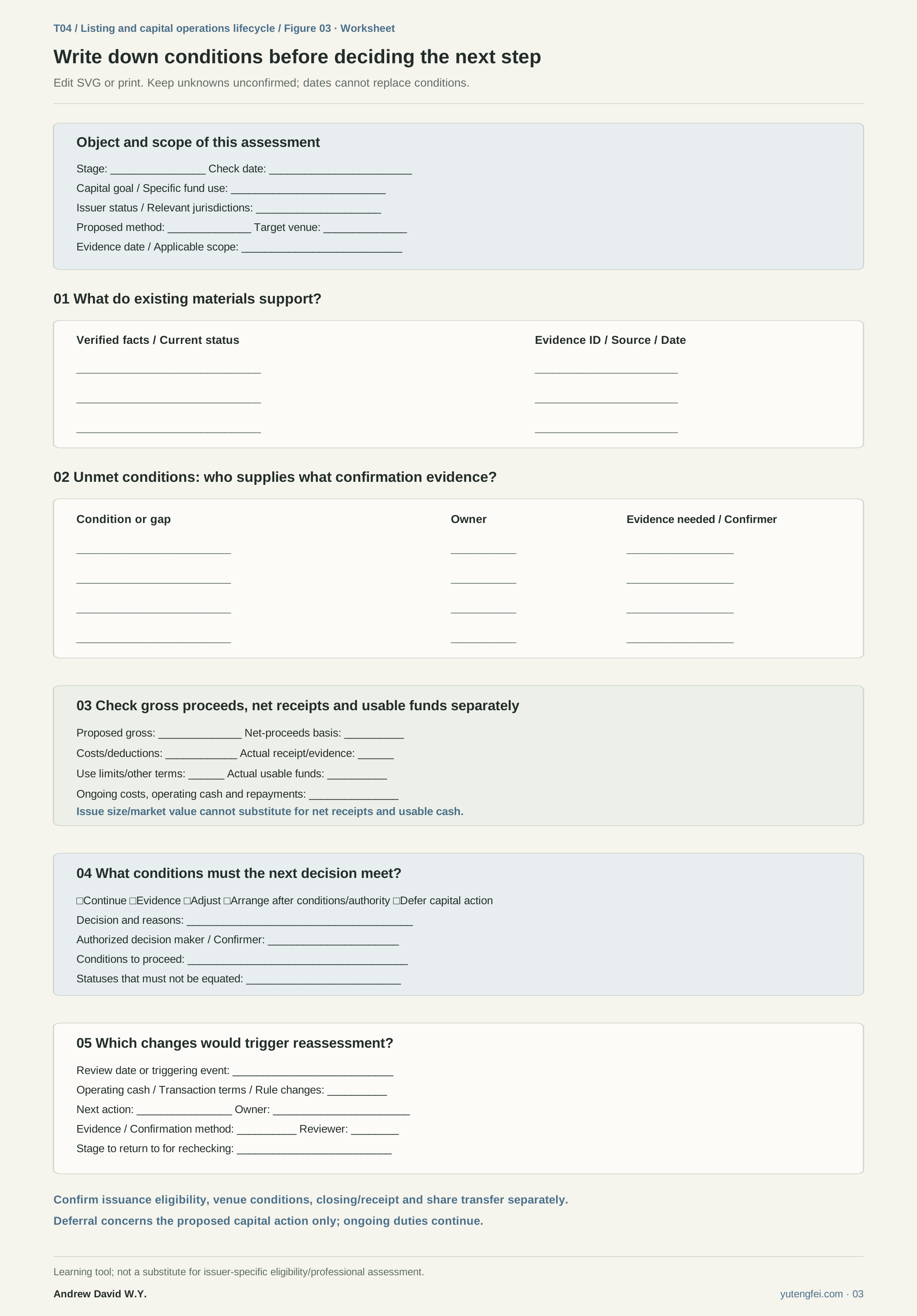
The official references identify sources, dates and the scope used here. They support the distinctions stated in this article, not a completed qualification assessment for a particular enterprise or an exhaustive cross-border review.