After a job is finished, business development says it won the customer. Delivery says the earlier promises would have meant little without fulfilment. A supplier says it connected the resources when a problem arose. The person improving the process points out that the method left behind may keep helping after this batch.
Each account may contain part of the truth.
Once people discuss whose contribution was larger, however, attention can shift from the work to themselves. Everyone presents their own effort and evidence. They may not even be discussing the same thing: this delivery, or long-term cooperation afterwards.
I think contribution assessment is worth rehearsing. Give people the same materials, let them change viewpoints and compare their judgments to see where the disagreement lies.
Explain the reasons before discussing the relative weight.
1. Put the object of assessment in the same place
This exercise uses a wholly fictional task: four working roles cooperate to deliver 40 reusable transport boxes and record methods that may be used again.
Business development clarified requirements; delivery operations coordinated progress and acceptance; a supply partner arranged an alternative after a standard component was delayed; a process-improvement participant prepared a checklist.
At first acceptance, 36 boxes passed and four needed adjustment. All 40 passed final acceptance after correction. The checklist had trial-use records at closeout, and the customer expressed willingness to discuss another batch.
Which contributions would you discuss first?
Before judging, fix the scope. This assessment covers cooperation from clarification of this batch's requirements to final acceptance, and reusable capability created within that period. Willingness to discuss another batch can be recorded; revenue from a batch that has not occurred cannot be counted in advance.
The four role cards are four working viewpoints, not a complete list of stakeholders. Customer assessments, other people's records and later use may require more information.
All four roles can see the shared facts. Role cards change the focus of observation without secretly giving one person decisive information.
Open the shared event and four role cards
2. Use six dimensions to separate different judgments
Use role, contribution, time, responsibility, risk and strategic value. They offer questions, not fixed weights or a validated scoring algorithm.
Role examines position and task. What should business development complete, and what must delivery undertake? Rank and visibility do not prove contribution size.
Contribution examines actual work and effects. Requirements discussions, resource coordination, exceptions and a checklist can all be recorded. Final delivery of 40 boxes is a shared result. Explain how each party supported it rather than turning it into several unrelated new achievements.
Time separates input from duration of effect. Extra hours are input records; the useful life of a method is another matter. Twelve hours are not inherently more valuable than six. A long-term effect that cannot yet be observed is not necessarily absent.
Responsibility separates agreement, performance and remedy. Responsibility for coordinating acceptance and responsibility for causing rework require separate checks. Extensive remedial work does not prove that the person caused the problem. Nor should rescue work conceal an earlier duty left unfulfilled.
Risk returns to conditions at the time. What could have happened, who actually carried the exposure and what compensation existed? No eventual loss does not mean no earlier risk. Settled expenses should not continue to be described as uncompensated.
Strategic value relates to this stage's objectives. What constrained delivery, what did the work resolve, and what alternatives existed? “It could not happen without me” needs evidence.
Keep unclear dimensions unclear. Missing information means further evidence is needed, not zero contribution or zero risk.
Open the six-dimension foundation sheet and exercise plan
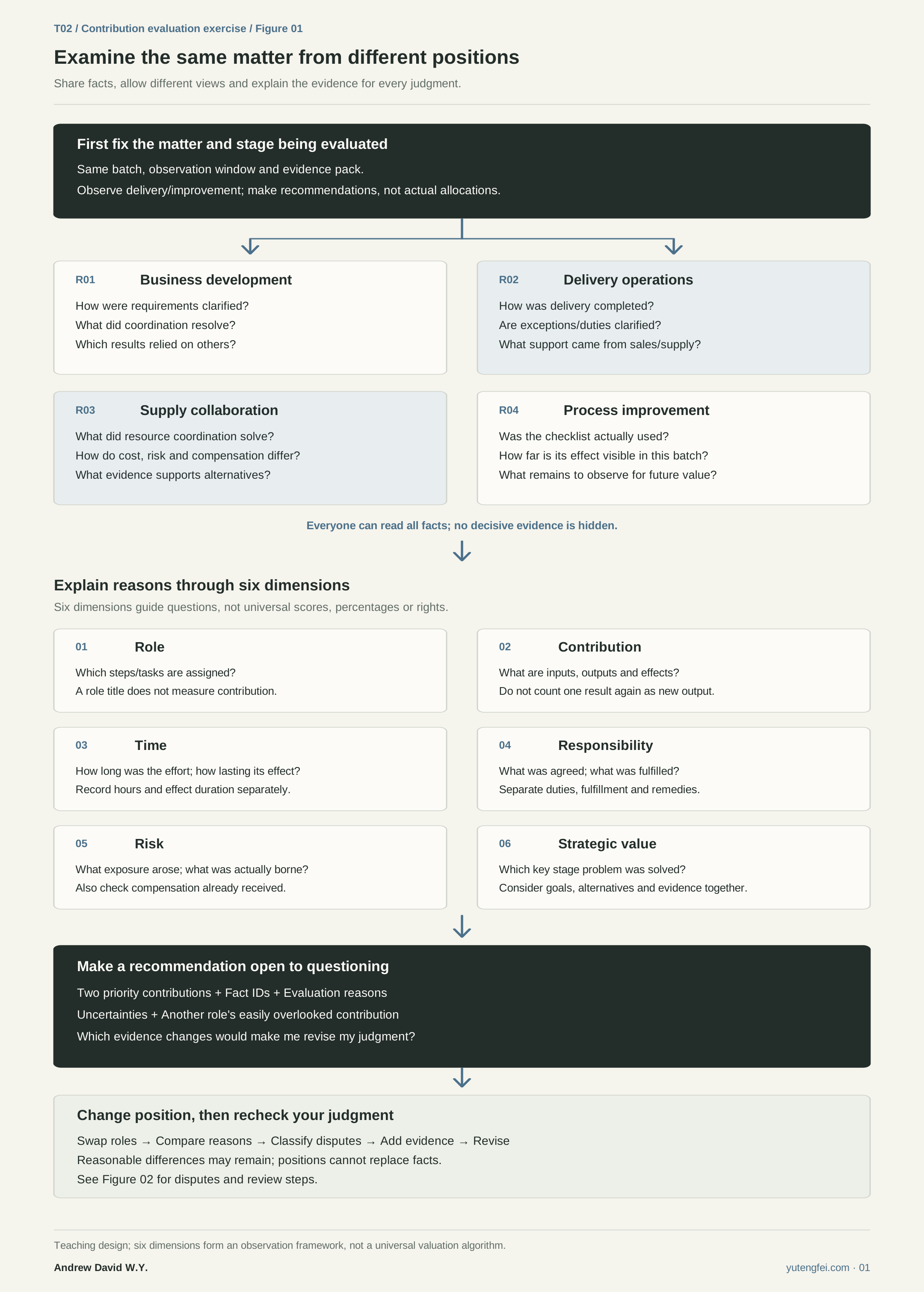
Figure 1: Examine shared facts through different working viewpoints and six dimensions, then compare evidence, reasons and reservations.
3. Judge independently before hearing the others
A group of four can assign one card to each person. Larger groups can assign teams to roles. Alone, choose two roles and complete each view before comparing them.
Do not discuss in the first round. Record two contributions worth discussing first, fact IDs, the relevant dimensions and missing evidence.
“Discuss first” sets the order of discussion. It does not determine that the role deserves more.
For example, a customer's willingness to discuss another batch supports identifying an opportunity for continued communication. It does not establish additional revenue already earned.
Add one sentence: From this position, which contribution by someone else am I most likely to overlook?
Business development can examine how delivery fulfilled front-end promises. Delivery can check whether clarification reduced misunderstanding. The supplier can examine how the alternative was approved. Process improvement can ask which frontline experience entered the checklist. Checking these relationships helps discussion move beyond who worked hardest.
Be careful with records. There is evidence of two rounds of customer discussion, but not yet evidence of how much rework they prevented. The latter may be proposed for validation, not recorded as an achieved effect.
Open the contribution assessment and review worksheet
4. Change positions and test your reasons
Exchange role cards after the first round.
The aim is not to argue that the new role should rank first. Explain one contribution you originally overlooked, then check whether you treated your own task as the entire project.
The facts cannot change when the role changes.
The materials record 12 hours of process improvement and six hours of delivery adjustment. Both involved effort. Complete hours, difficulty and costs were not recorded consistently for all parties, so these figures cannot rank all four contributions.
One recorded checklist use does not establish that the checklist lacks value. We can confirm a document and one trial use; time savings and continuing usefulness remain to be observed.
State established facts as established, and assumptions as matters to validate. Clear reasons help others continue the inquiry.
5. Separate disagreements to identify the next action
Place the four worksheets together before voting. Identify the kind of disagreement.
| Disagreement | Possible statement | Next action |
|---|---|---|
| Facts | “All four adjustments were the supplier's fault.” | Check causes and responsibility records; retain a pending status if evidence is insufficient |
| Definitions or scope | “I am assessing customer opportunity; you are counting this batch's revenue.” | Align the object, time window and terms, then reconsider |
| Stage priorities | “I value fulfilling this batch; you value the method left behind.” | Explain the evidence and stage-related reasons; reasonable disagreement may remain |
| Authority | “Let us decide everyone's payment now.” | Establish who may decide what; this exercise produces assessment recommendations only |
Different questions need different responses. Add missing facts, align definitions, discuss objectives or check authority as appropriate.
Forceful speaking and the number of supporters present cannot replace this work.
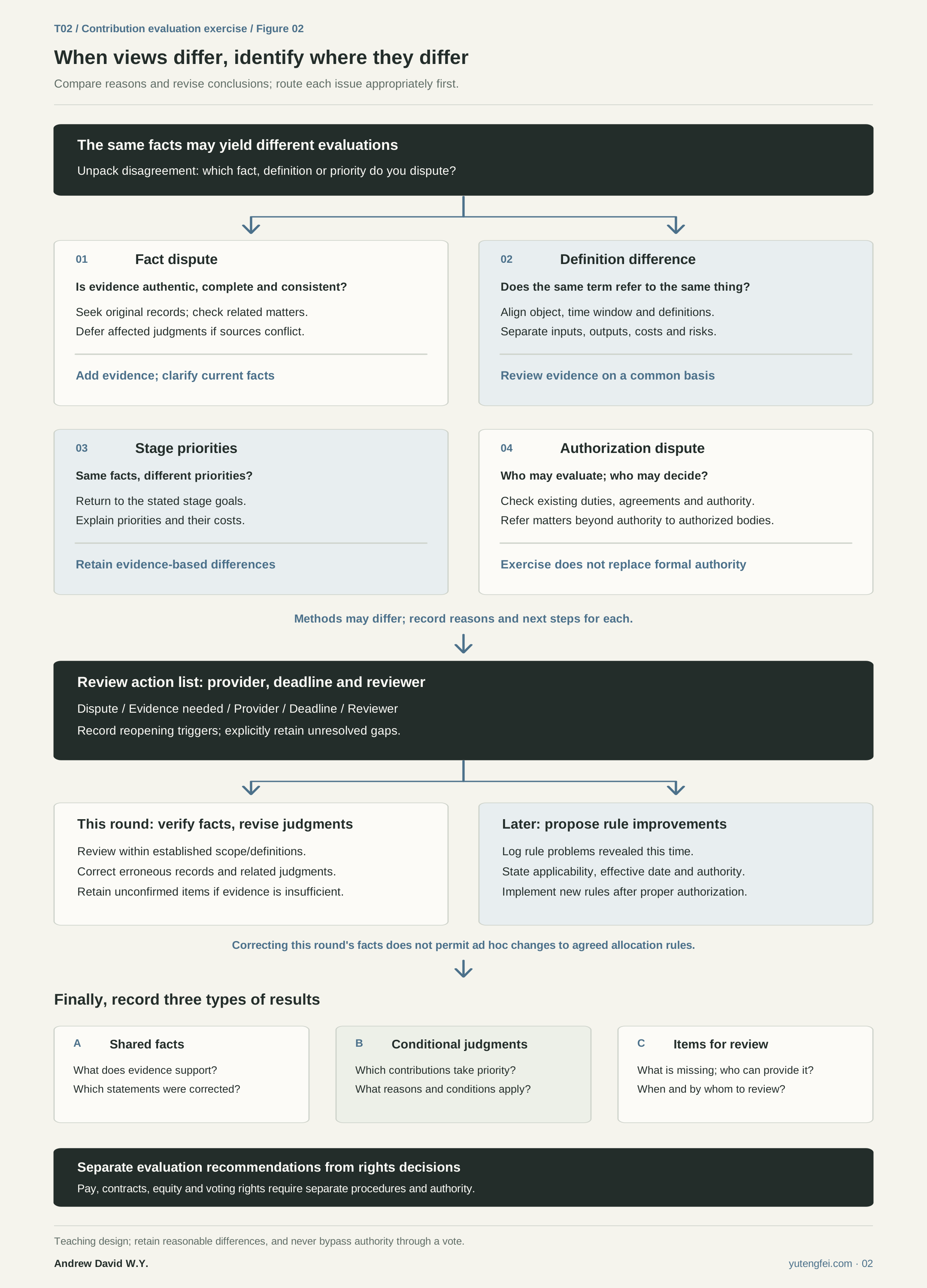
Figure 2: Identify the disagreement before seeking evidence, aligning definitions, discussing priorities or checking authority. Record corrections in this round separately from future rule changes.
6. Reconsider after further evidence
After the first discussion, open the supplementary packet. Its three records add information on adjustment causes, approval and costs of the alternative, and checklist use.
Return to the original worksheet and ask:
- What fact is new, and which judgment needs correction?
- Which contribution has stronger support, and how far does it extend?
- What remains unanswered, and who should provide what?
- If the discussion priority stays the same, do the reasons still hold?
Explain why you changed a judgment. If you did not change it, explain why the new evidence does not alter the priority.
Sometimes evidence merely allows greater precision. One initial trial use becomes three uses within the same batch and limited feedback. The scale of efficiency gains and future value remain open. That is still a useful correction.
Do not force unanimous agreement simply to make the discussion feel complete.
After the first two rounds, open the supplementary evidence packet
7. Leave three things on the table
First, shared confirmed facts: what happened, where the evidence is and how far it supports a conclusion.
Second, conditional assessments: which contribution matters, why, at which stage and within what scope. People may disagree while discussing the same facts.
Third, matters for review: missing records, who will obtain them, when to return, who reviews and what new fact would reopen the discussion. People and dates proposed in the exercise do not confer authority in a real organization.
Correct a misread fact in this round. If future assessment rules need changing, record a separate proposal with scope, effective date and confirmation procedure. Do not change rules to obtain a preferred result and pretend they were always there.
There is no standard allocation percentage in this exercise. A discussion does not directly change remuneration, contracts, equity or voting rights.
What matters is whether we found the facts, saw other people's work, corrected ourselves when evidence changed and can continue handling the remaining disagreements.
Lay out the complexity, separate the judgments, make the next action clear and express the relationships in a diagram. That is how the approach of organizing complexity, simplifying, making action easier and drawing the relationships becomes practical here.
Exercise materials and blank diagram
Use the first four materials in order before consulting the fifth, the facilitation guide. Supplementary evidence and reference discussion are separate so you can judge independently first.
- Six-dimension foundation sheet and suggested 80-minute plan
- Shared event and four role cards F01–F07
- Contribution assessment and review worksheet
- Second-stage evidence B01–B03
- Reference assessment and facilitation notes: no single answer
- Download the fillable blank exercise diagram as SVG
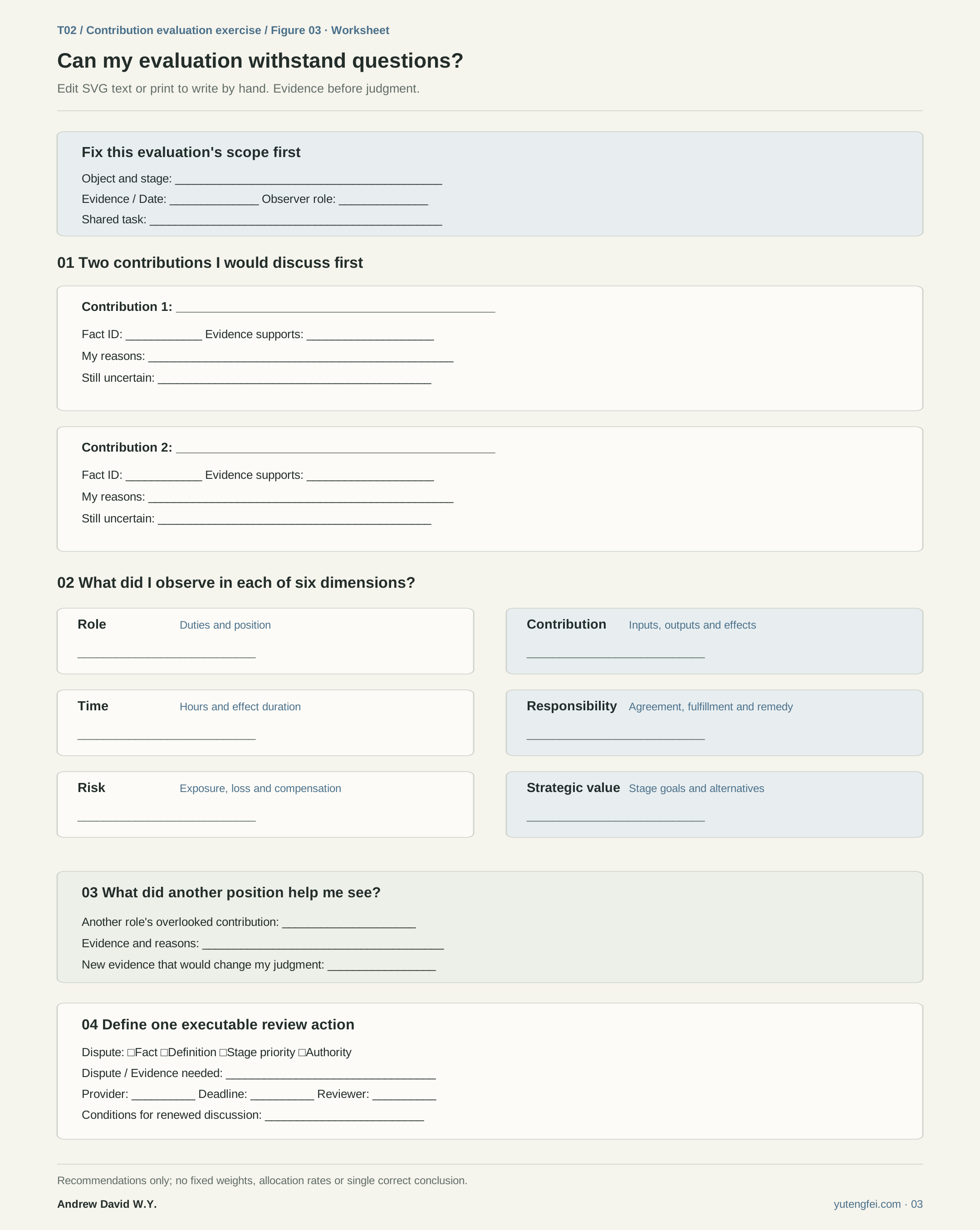
The setting, roles, records and figures are fictional teaching materials created for this exercise. The six dimensions support observation and discussion. The exercise procedure and diagrams were designed for this edition, and their practical usefulness still requires testing.