Use this resourceMethods
- Purpose
- Limits, returns, rewards and withdrawal rules describe how a funding model is arranged. Further questions remain: who receives the money, what assets are allocated, where value comes from, who takes the other side of trades, and whether proceeds are actually received. Two diagrams connect rule parameters with operations, responsibilities and the verifiable path to actual receipt.
- Conditions for use
- Check that the subject, objective and constraints fit the task. Confirm any conditions that the article does not specify.
- Methods
- Steps, inputs and completion criteria
- Evidence and validation limits
- This article presents a method for observing and checking funding models. Its diagrams organize questions and evidence; they do not establish that any particular project has implemented the arrangements or been validated. No separate external-validation result is recorded for this article. Publication does not establish effectiveness; check the evidence, assumptions and limits in the text.
- Version
- V1.0 · Revised 2026-11-07
- Original diagrams and files
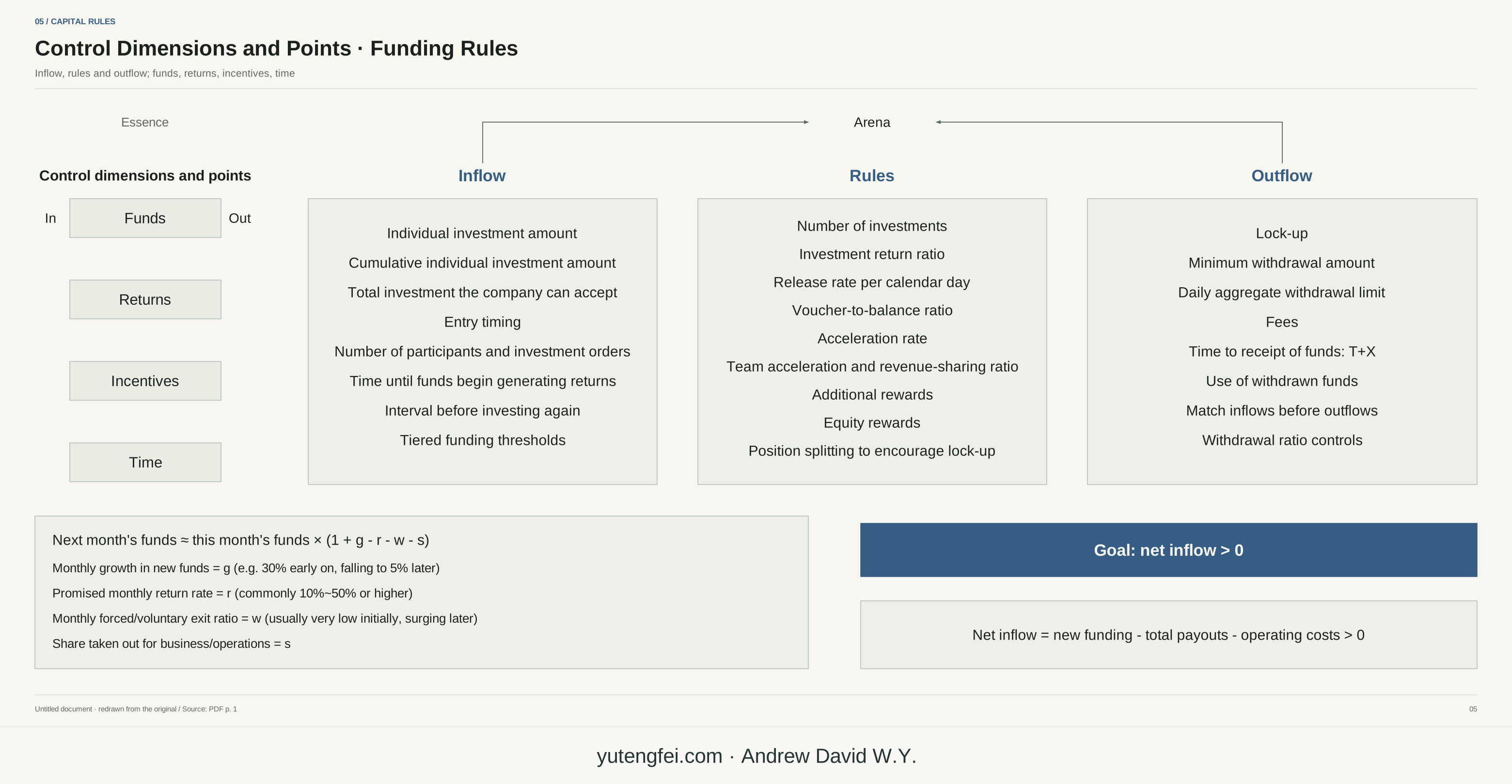
- Figure 1: funding rules and control dimensions, retaining four dimensions and 25 fields across inflow, rules and outflow. The original formula and illustrative figures are unverified and are not used as a calculation basis in this article.
- Download the editable diagram
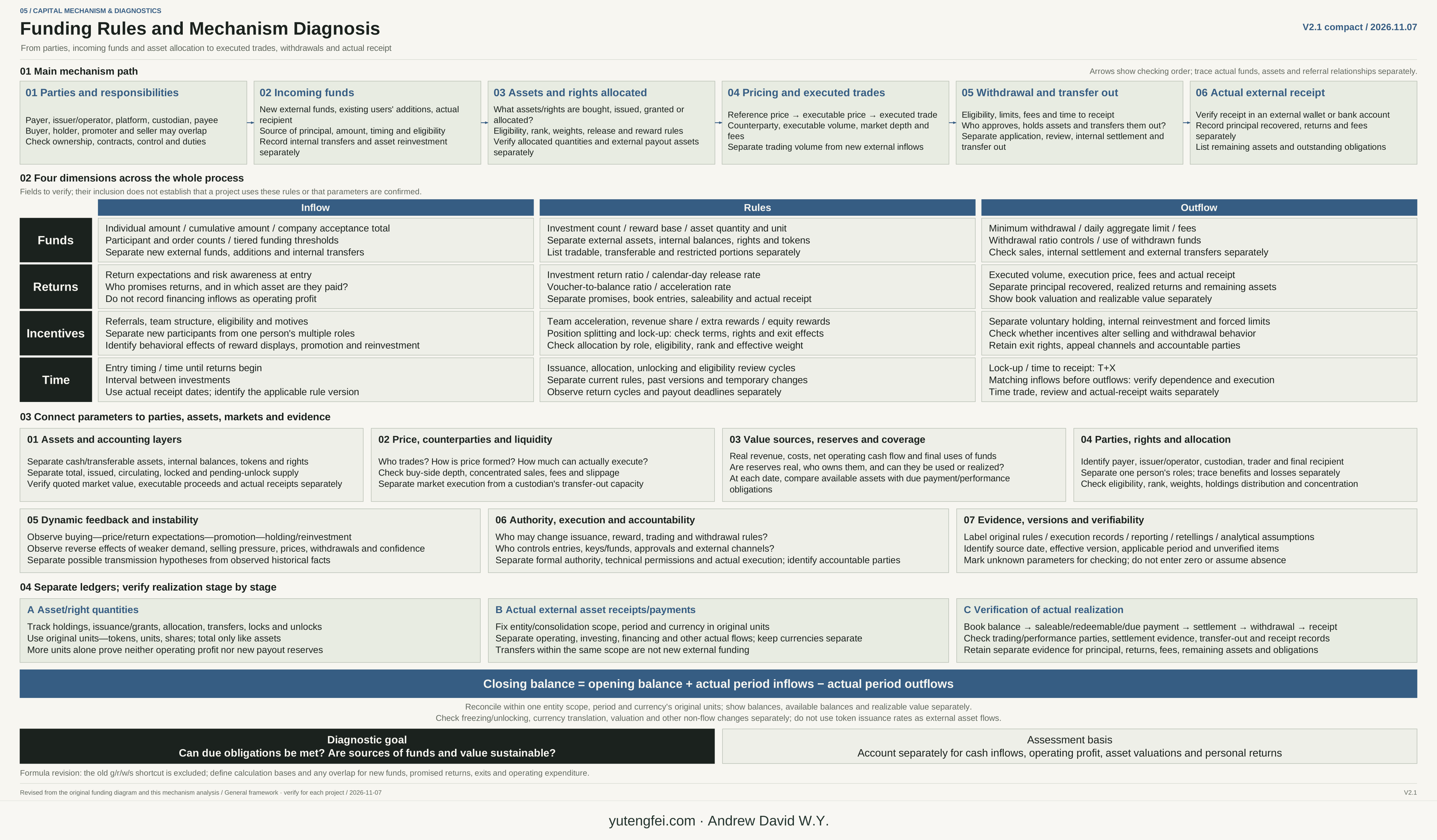
- Figure 2: Funding Rules and Mechanism Diagnosis, compact V2.1. The diagram connects parties and responsibilities, incoming funds, allocation of assets and rights, executed trades, withdrawals and transfers out, and actual external receipt with rule checks, two types of ledger and realization records. Arrows show the order of checking.
- Download the editable diagram
- Related reading
- External links in the article
This is a readable, citable knowledge resource, not an installed Skill. When using it with AI, retain its sources and limits and review the output.
CC BY-NC-ND 4.0 · Applies to original text unless otherwise stated; excludes third-party materials. Downloading or machine reading does not extend the existing license or separately authorize derivatives, commercial use or model training.
When presented with a funding model, people usually ask three questions first: how much do I put in, what do I get back, and when?
The materials may also describe release rates, referral rewards, reinvestment conditions and withdrawal restrictions. Each rule can be explained on its own. Together, however, they may still leave basic questions unanswered: who receives the money, what has increased in the account, where returns come from, and who takes the other side when someone exits.
I find it useful to work in two stages. First, list the rules in full. Then follow participation, allocation, trading and receipt, connecting each number to what actually happens between the parties. The first stage helps prevent omissions. The second helps establish what makes the arrangement work.
The two diagrams below form a working framework I have put together for these questions. They organize investigation and verification; they do not prejudge any particular project.
1. Four dimensions: put the rules on one diagram
Funds concern contributions and receipts and payments. Returns concern what participants receive and where it comes from. Incentives concern how rules affect behavior. Time concerns when eligibility, allocation and realization take effect.
The three columns—inflow, rules and outflow—provide an initial checklist. Figure 1 lists 25 fields to investigate.
| Column | Fields retained from the original diagram for verification |
|---|---|
| Inflow: 8 fields | Individual investment amount; cumulative individual investment amount; total investment the company can accept; entry timing; number of participants and investment orders; time until funds begin generating returns; interval before investing again; tiered funding thresholds |
| Rules: 9 fields | Number of investments; investment return ratio; release rate per calendar day; voucher-to-balance ratio; acceleration rate; team acceleration and revenue-sharing ratio; additional rewards; equity rewards; position splitting that encourages lock-up |
| Outflow: 8 fields | Lock-up; minimum withdrawal amount; daily aggregate withdrawal limit; fees; time to receipt of funds, T+X; use of withdrawn funds; matching inflows before outflows; withdrawal ratio controls |
These are fields to verify. If a particular arrangement does not apply, record it as not applicable. If information is insufficient, mark it as unverified. Listing “equity rewards” does not establish that participants have acquired equity. Nor does the phrase “matching inflows before outflows” establish how money actually moves.
Figure 1 provides fields to investigate. Its old formula is not a basis for calculation in this method. The formula “next month’s funds ≈ this month’s funds × (1+g-r-w-s)” does not specify a consistent calculation base for new inflows, return payments, exits and operating expenditure, or whether those items overlap. Phrases such as “30% early on, 5% later,” “commonly 10%–50% or higher,” and “very low initially, surging later” are unverified illustrations or generalizations in the original diagram. They have no statistical evidence behind them and are neither industry data nor suggested parameters. “Net inflow > 0” describes only the difference between receipts and payments over a period; it does not establish operating value or the capacity to keep meeting obligations. The sections below instead reconcile actual receipts and payments for the same entity, period and currency.

View the vector diagram at full size · Download high-resolution PNG · Download the editable diagram
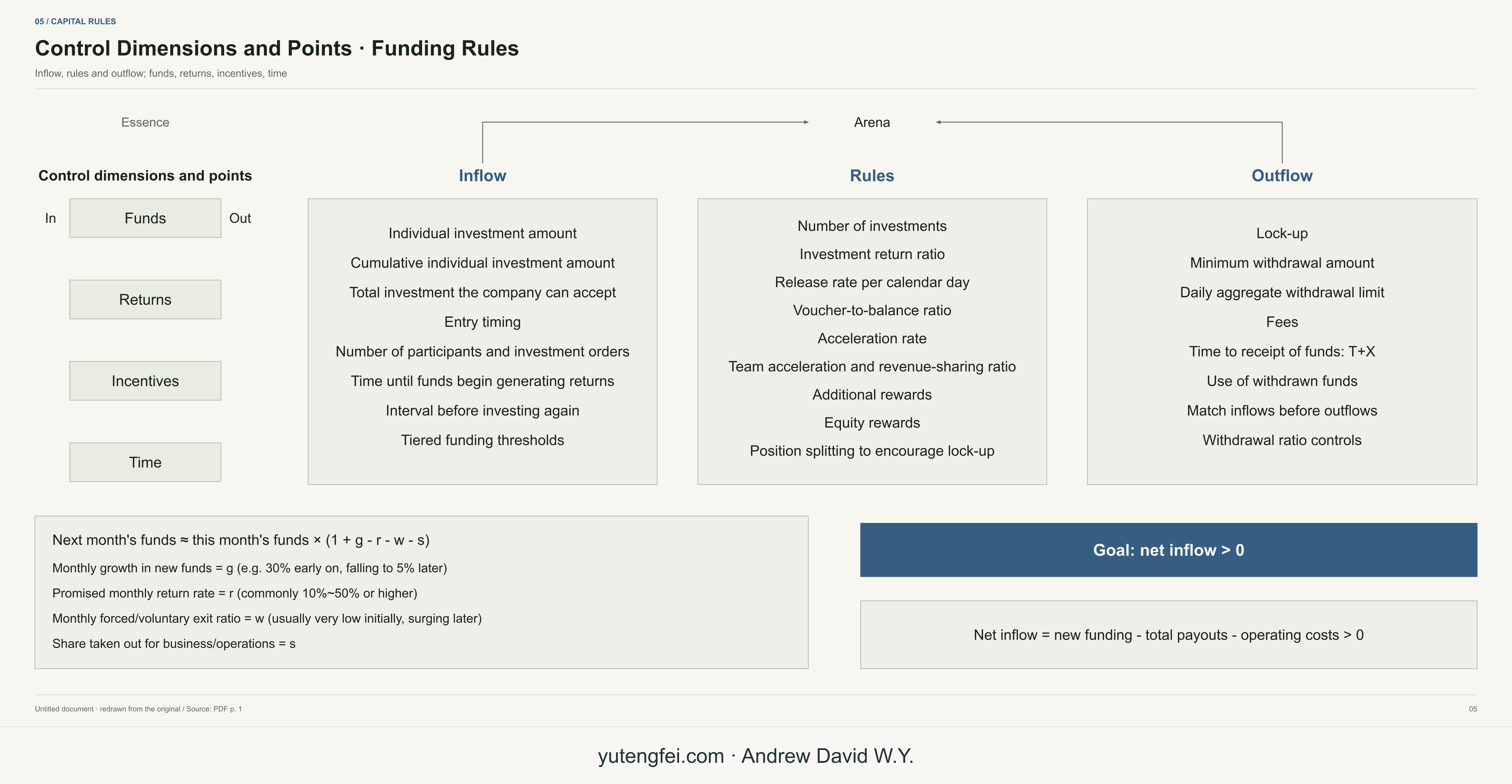
Figure 1: funding rules and control dimensions, preserving the original diagram. Its references to control dimensions and control points still require verification of who has which powers and what actually constrains them. Listing rules does not establish that the corresponding control exists.
2. Follow six stages to connect rules with actual events
Figure 2 follows six stages: parties and responsibilities; incoming funds; allocation of assets and rights; pricing and executed trades; withdrawals and transfers out; and actual receipt outside the platform.
Start with the parties. Who are the payer, issuer or operator, platform, custodian, counterparty and final recipient? Do brand names and interface names correspond to the contracting entities? If one person is a buyer, holder, promoter and seller, record those roles separately.
Then examine incoming funds. Record new external contributions, additional contributions from existing participants, internal transfers and reinvestment of existing assets separately. Find evidence of which entity and account actually receive the money, its purpose, the rights acquired and the obligations assumed.
Next, verify allocation, trade execution and transfers out. What asset is created by issuance or rewards, and what eligibility determines allocation? If it must be sold, who is willing to buy? If it is redeemed or paid at maturity, who owes performance? Finally, has the asset reached an account outside the platform that the participant can control and use?

View the vector diagram at full size · Download high-resolution PNG · Download the editable diagram
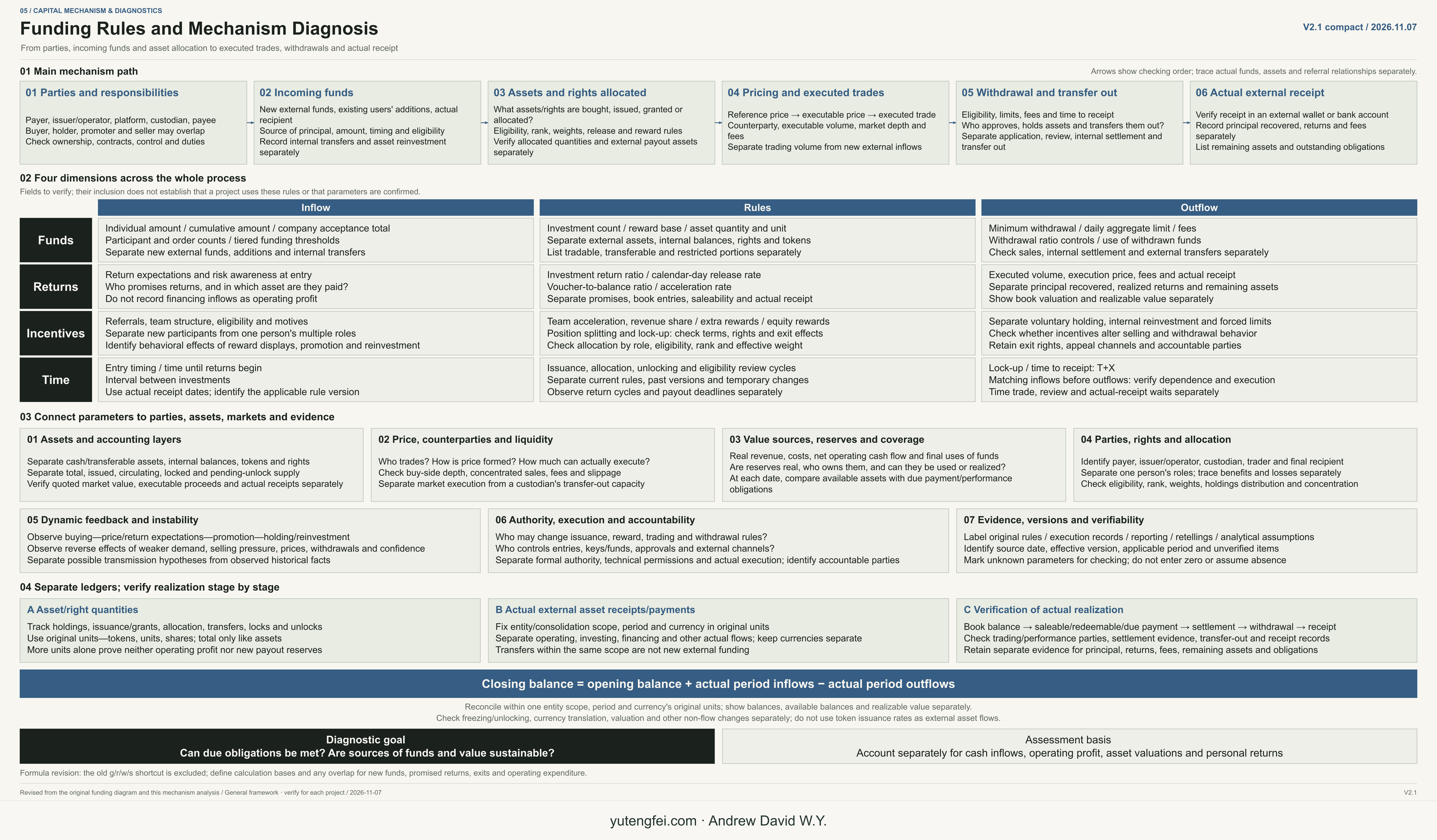
Figure 2: Funding Rules and Mechanism Diagnosis, compact V2.1. The six-stage arrows show the order of checking. Actual flows of funds, assets and referral relationships must be traced separately. Real activity may move backward, wait, repeat or involve no market sale. A straight line on the diagram does not establish that a transaction has occurred.
3. When an account grows, identify what has increased
Cash, transferable assets, internal balances, token quantities and units of rights require separate treatment.
On receiving a reward, first identify its unit. How many tokens or units were added? Under what rule were they acquired, what can they be used for, and are there transfer, lock-up or performance conditions? Once the quantity is established, verify the rights attached to it and the conditions for realizing proceeds.
Internal figures must also be connected to external assets. A displayed balance shows that the system has made an entry. Whether corresponding assets are held, who controls them and whether they can be transferred out require further evidence. Even if the displayed asset name matches an external asset, verify actual receipt.
Prices need similar distinctions. A reference or listed price, the price someone is actually willing to pay, and the price achievable for a given quantity support different conclusions. Multiplying a quote by the entire holding gives a book figure; it cannot simply be treated as the proceeds available from exiting the whole position.
Keep principal, realized returns and remaining assets separate as well. Showing one successful receipt does not establish that the participant has recovered the full amount contributed, or that others can exit on the same terms.
4. Examine both trading capacity and the ability to transfer assets out
Some arrangements provide an exit through market sales; others through contractual redemption or payment at maturity. Establish which route applies, then examine its conditions.
A market sale needs a counterparty. Check actual buying interest, executable volume, the capacity to absorb concentrated selling, fees and price changes. Permission to submit a sell order shows only that an instruction has been accepted. Execution must still be verified.
After execution, check whether the asset can leave the platform. Who holds it, approves release and carries out the transfer? Who owns the reserves, and are they subject to pledges, use restrictions or other conditions? Smooth order matching and a custodian’s ability to pay require separate checks.
Exit rights also need concrete terms. Which holdings are voluntary, which restrictions were agreed in advance, and which conditions were added later? Who handles objections, who may change the rules, and what happens to rights already confirmed? Participants need to understand their rights to judge what continued participation entails.
These questions distinguish “visible,” “application permitted,” “trade executable,” “withdrawable” and “actually received.” Conclusions should stop at the stage the evidence supports.
5. When funds increase, keep asking about value and responsibility
Financing can support products, supply, teams and market development. It also creates corresponding rights and responsibilities. Receipt of financing and the generation of operating profit must be recorded separately.
To examine returns, trace how revenue is generated, what the business costs, what remains after performance, and when cash comes in and goes out. If a participant gains from selling an asset, also identify who paid and what was exchanged. An individual’s trading proceeds cannot simply be recorded as the platform’s operating profit.
Positive net inflow therefore leaves further questions. What payment or service obligations accompany the new funds? Which obligations can existing available assets cover? If new inflows slow, can business revenue and existing resources support future performance?
This is also where stakeholder relationships matter. Some provide funds, some operating capabilities, some demand, and others custody, delivery or service. Allocations need a basis, commitments need a source of support, and someone must bear risks and losses. Looking only at who receives rewards can overlook the operating foundations on which cooperation depends.
6. Include change, authority and evidence
A static parameter table cannot, by itself, explain outcomes over time.
Purchases may affect prices. Prices and displayed returns may affect promotion and expectations, which in turn influence holding, reinvestment and selling. Assets added through continuing allocations may also become quantities that need buyers in the future.
Conversely, weaker buying interest, concentrated selling, price changes and demand to exit may affect one another. These are feedback relationships to investigate. Records must establish which steps occurred and how much they mattered; the relationships cannot simply be imposed as a particular project’s historical chain of causation.
Also establish control authority. Who can change issuance, rewards, trading and withdrawal rules? Who controls accounting entries, private keys or funds, approvals and external channels? Written authority must be checked against who actually exercises it. Where powers are unknown, leave them unverified rather than assuming that one person can decide everything.
Each parameter also needs a source, version, applicable period and current status. Distinguish original rules, execution records, reporting or secondhand accounts, and analytical assumptions. Retain conflicts between materials. If reserve information has not been obtained, record it as unverified; neither enter zero nor conclude that reserves are sufficient.
7. Keep two ledgers, then verify one actual receipt
I suggest keeping at least two types of record.
One records quantities of assets and rights: existing holdings, issuance or grants, allocation, transfers, locking and unlocking. Use their original units—tokens, units, shares and so on—and do not add different assets together.
The other records actual external asset receipts and payments. Define the same entity or consolidation scope, period and currency in its original units, then reconcile:
Closing balance = opening balance + actual inflows during the period − actual outflows during the period.
Transfers between accounts within the same scope are not counted again as new external funding. Check changes that do not involve receipts or payments—such as freezing and unlocking, currency translation and valuation changes—separately. The equation reconciles actual receipts and payments; available balances, book valuations and realizable value must still be shown separately.
Then select one contribution and trace it from the basis for payment through asset registration, allocation evidence, the trading or performance counterparty, settlement documents, transfer-out records and receipt records. Retain the party, amount or quantity, unit, time, version and supporting evidence at each stage.
The resulting assessment should state what has been verified, where gaps remain, what supports obligations as they fall due, and who will supply which missing information next.
Understanding a funding model requires rules, operations, rights and actual receipts and payments to explain one another. Complete parameters provide a starting point. When value has a source, responsibilities can be fulfilled and realization has supporting evidence, there is a basis for deciding whether and how cooperation can proceed. This method still needs use and revision in real business; a diagram cannot replace factual verification.
Method sources and reference
This article starts from the original funding diagram’s 25 fields and develops checks connecting parties, assets, markets, rights and responsibilities, feedback and evidence. The two diagrams are the author’s working framework, not evidence that empirical validation has been completed.
The IFRS Foundation’s official overview of IAS 7, Statement of Cash Flows classifies cash flows during a period into operating, investing and financing activities. It also explains that investing and financing transactions involving no cash or cash equivalents are excluded from the statement of cash flows and disclosed separately. This article cites it only to support classifying receipts and payments and separately recording non-cash matters. The two diagrams and their diagnostic method are not part of that standard.