Use this resourceMethods
- Purpose
- Use a research article’s publication to trace an outcome through four levels of work, separate deliverable acceptance from readiness to proceed, and check four kinds of evidence.
- Conditions for use
- Check that the subject, objective and constraints fit the task. Confirm any conditions that the article does not specify.
- Methods
- Steps, inputs and completion criteria
- Evidence and validation limits
- The publication process is illustrative. Apply the method using your own work records and acceptance criteria. No separate external-validation result is recorded for this article. Publication does not establish effectiveness; check the evidence, assumptions and limits in the text.
- Version
- V1.0 · Revised 2026-11-16
- Original diagrams and files
- https://yutengfei.com/diagrams/viewer-en.html?back=%2Fen%2Fjournal%2Ffour-scales-handoff-diagnosis%2F%23fig-four-scales-handoff&title=Figure+1.+Break+the+outcome+down+into+actions+and+trace+the+evidence+back+up.+Record+draft+acceptance+and+readiness+to+publish+separately.&src=%2Fjournal%2Ffour-scales-handoff-diagnosis%2Fmaterials%2Fen%2Ffigure-01-v1.svg
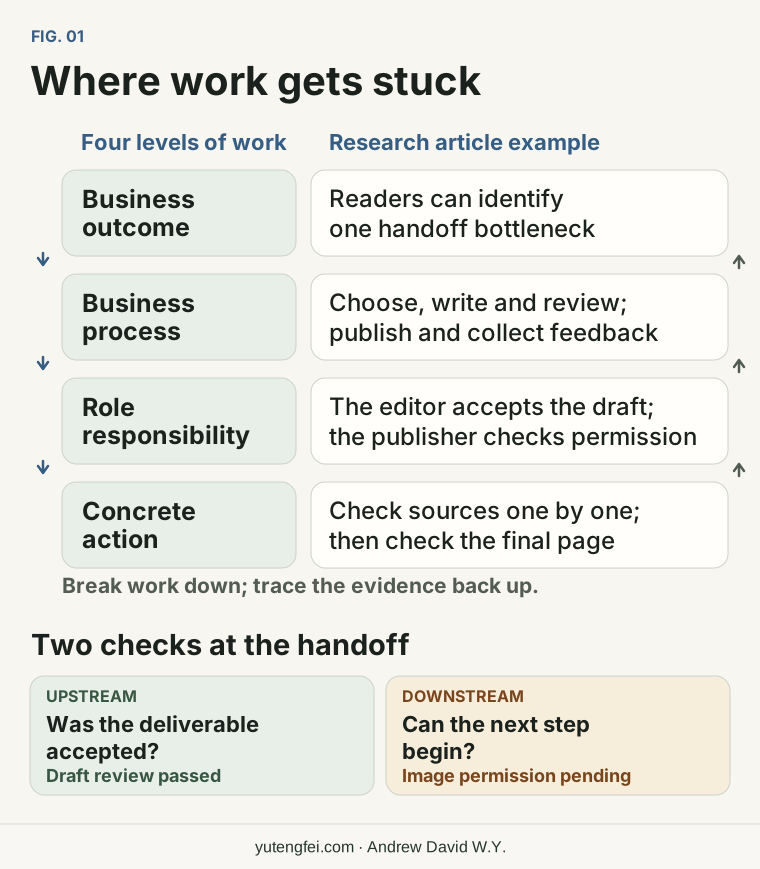
- A research article example traces a business outcome down through the business process, role responsibilities and concrete actions, then checks evidence back up. The editor has accepted the draft, but the next step still awaits image permission.
- Related reading

This is a readable, citable knowledge resource, not an installed Skill. When using it with AI, retain its sources and limits and review the output.
CC BY-NC-ND 4.0 · Applies to original text unless otherwise stated; excludes third-party materials. Downloading or machine reading does not extend the existing license or separately authorize derivatives, commercial use or model training.
Start with the outcome and work down through the four levels
Business outcomes, business processes, role responsibilities, and concrete actions are four levels of the same piece of work.
Take publishing a research article. I would start with two questions. Who will read it, and what should they be able to do afterward? Say it is for someone reviewing how their team works. After reading it, they should be able to point to one handoff where their own work gets stuck. Once that outcome is clear, we can decide what the article needs to cover and how to tell whether it helps.
At the process level, we need to connect topic selection, writing, editorial review, publication, and feedback. At the role level, we need to know who decides whether the draft is ready to hand over, who confirms permission to publish the figures, and who checks the live page. Then we can get to the individual actions, such as opening each reference, checking figure numbers, and reviewing the page on a phone.
I usually work back up through the levels once. If all the reference links open, we know the link check is done. If the editor has a draft that meets the requirements, we have an outcome from the editorial review. To know whether a reader used it to identify an actual bottleneck, we need separate evidence. Working back up helps us see what we can already conclude and which conclusions still depend on other conditions.
Four-Way SOP: How performance, processes, functions and actions connect


The deliverable passed review. Can the next step begin?
Suppose the text and figures passed editorial review, but permission to publish one figure is still pending. The editor can record that the draft passed its quality review. The publication lead still needs to mark publication as waiting for permission. More edits to the text will leave this handoff stuck. Find the person who can confirm permission, or use a figure that is already cleared and have the publication lead verify it.
I would put two lines in the handoff record. The first says what the previous stage delivered and whether it meets the agreed standard. The second lists the conditions for the next stage, who confirms them, and what is missing. The person taking over can then see where the issue is and who to go to.
What must be handed over before the next step can start?
People and AI use the same standard for the same work
When checking references, for example, AI can first list the citations, their sources, and any questions. An editor could also do the check by hand. In either case, the same requirements apply. The link must open, the relevant passage must be identifiable, and the source must support the specific statement in the article. List doubtful items separately for the editor to check. Leave decisions about permission and publication to the people authorized to make them.
Write down the inputs, the expected deliverable, and who will review it before assigning the work. When a different person or tool takes over later, whoever picks up the work can still understand what was originally required.
Role, Process and Human–AI Collaboration Model
After publication, check four kinds of evidence
For this research article, I would check four things separately.
- Was the work done? The check record corresponds to the actual draft submitted this time.
- Did the deliverable meet the standard? The text, links, and figures passed the agreed checks.
- Was it used in the next stage? The publisher used the approved draft to put the article online, and readers can open it from the intended entry point.
- Was the goal achieved? Gather feedback during the agreed observation period and see whether the intended readers could use the article to identify an actual bottleneck. If all we have is traffic data, record it and wait for further evidence of how the article was used.
Start with one recurring piece of work. Agree on the outcome, who is responsible, and what to observe. Record where it gets stuck and what allows it to move forward. Next time, run through it again under the same conditions. Keep what helps, change what causes problems, and use more evidence from similar work to decide whether to apply it elsewhere.
The publication process here is illustrative. When applying the method, use your own work records and acceptance criteria.
Rebuilding Enterprise AI Capabilities: Evidence and Performance