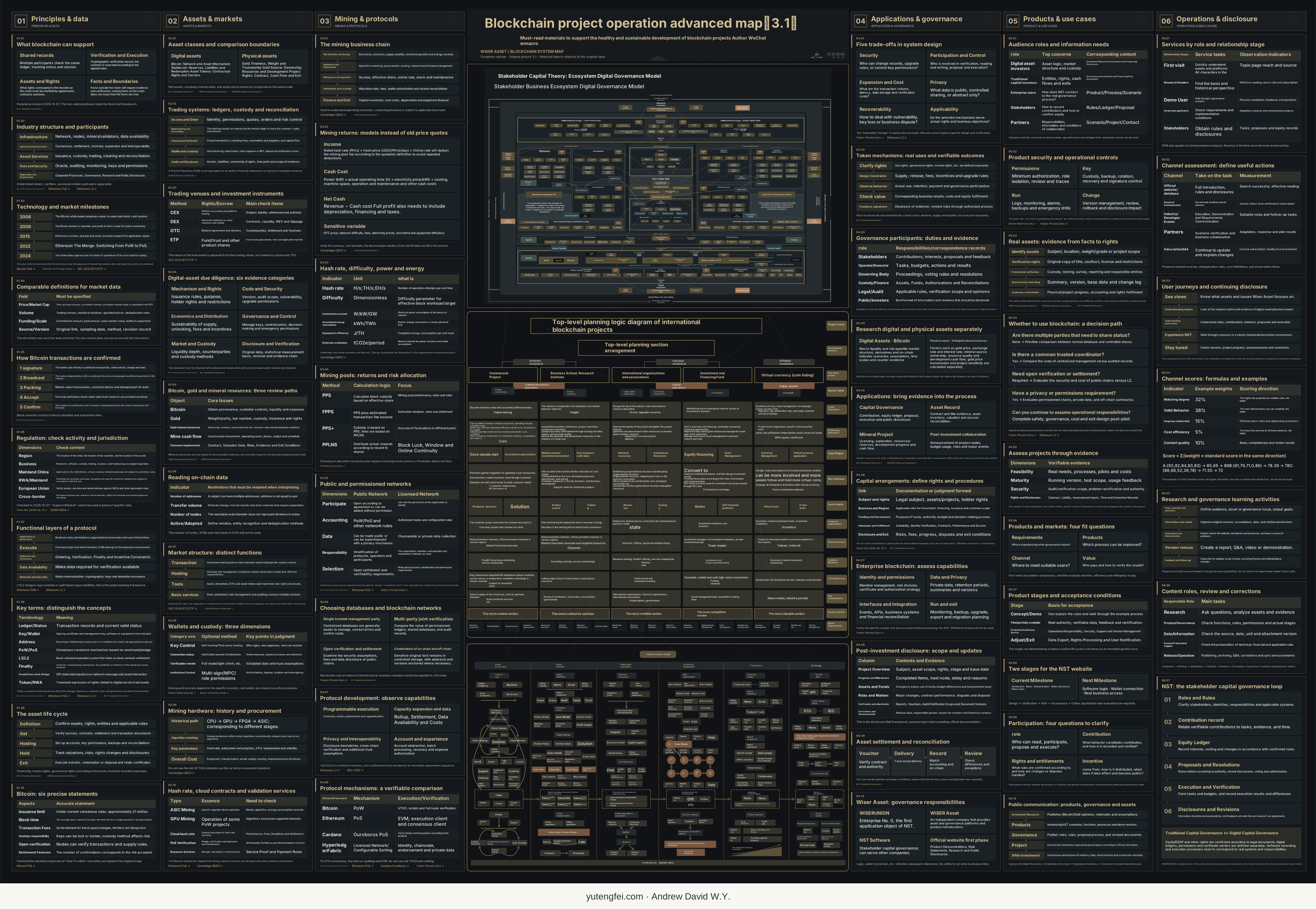
1. Start with relationships, then examine technology and tools
This map brings blockchain technology, assets and markets, project applications, stakeholder governance and public disclosure into one framework. Use it to ask clear questions, find evidence, identify responsibility and turn judgments into processes that others can review.
Begin with the governance model at the top of the central column and its four relationships: resources, customers, operations and capital. Then use the six surrounding modules to develop technical and business understanding. Return to roles, contributions, entitlements, proposals, execution and disclosure to test whether the knowledge supports a real governance task.
By the end, you should be able to explain what an on-chain record represents, compare the evidence needed for different assets, identify participants’ responsibilities and design a disclosure and correction process for an asset or project.
| Learning route | Focus | What to produce |
|---|---|---|
| Introductory route | Principles and data → assets and markets → applications and governance | Map the asset, entity, rights and evidence |
| Technical route | Principles and data → mining and protocols → products and use cases | Explain the technical choice, operating assumptions and acceptance conditions |
| Governance route | Central model → applications and governance → operations and disclosure | List roles, matter-level authority and versioned disclosures |
2. Module one: principles and data
Blockchain supports shared records, verification and execution under defined rules. A shared ledger helps parties check a common state; it cannot independently establish the truth of off-chain facts. For each record, identify its contents, input evidence, confirming party and applicable rules.
A Bitcoin transaction passes through signing, broadcasting, inclusion in a block, validation and confirmation. Average block time and the issuance limit describe protocol properties; they do not guarantee the settlement time of a particular transaction or the safety of custody. Market comparisons also need consistent dates, currencies, supply definitions and valuation methods.
Exercise: choose an asset record and identify its source, observation date, unit, verification method and remaining off-chain uncertainties.
3. Module two: assets and markets
Study digital assets and physical assets separately before comparing their rights and risks. For Bitcoin, examine the network, liquidity, custody and settlement. For gold, verify fineness, weight, ownership, custody and delivery. A gold mineral resource project also requires evidence about resources and reserves, project rights, development conditions, costs and cash-flow assumptions.
Platform balances, control of wallet signatures and contractual rights remain distinct even when each has a digital record. Proof of reserves describes verification within a stated scope; it cannot by itself replace analysis of assets, liabilities, rights and a full financial audit. Gold prices affect project economics, but a rising price does not automatically create project profit.
| Asset | Main evidence | Do not conflate |
|---|---|---|
| Bitcoin | Protocol, transaction, custody and risk records | Address count ≠ investor count |
| Gold | Fineness, weight, rights, custody and delivery records | Price trend ≠ realized gain or loss |
| Gold mineral resources | Professional resource reports, rights documents, engineering and financial assumptions | Mineral resources ≠ extractable reserves; gold price ≠ project profit |
Exercise: list three essential evidence items each for Bitcoin, gold and gold mineral resources, and identify who should verify them.
4. Module three: mining and protocols
Start the economics of mining and validation services with actual contracts, equipment, power supply and protocol mechanisms. Hash rate, difficulty, electrical power, energy use, block subsidies and transaction fees have different units. Account for electricity, operations, downtime and other agreed costs. Historical equipment quotes do not establish current procurement prices.
When comparing public networks, permissioned networks and databases, first ask whether independent parties need a shared state. Then assess privacy, performance, fees, upgrade authority and dispute handling. Mining-pool payout methods distribute volatility and risk differently; each consensus mechanism also has its own operating assumptions.
Exercise: build a mining sensitivity table covering price, difficulty, electricity tariffs and uptime. Explain how each affects net cash flow.
5. Module four: applications and governance
Governance begins with responsible entities, roles, matters and the basis of rights. Identity records show who participates; contribution evidence shows what was delivered; an entitlement ledger records which rights are recognized under which rules. Discussion, proposal, decision, execution and oversight permissions are assigned separately. A contribution record does not automatically grant them.
Wiserunion is Company No. 0 and NST’s first enterprise application. Wiser Asset is an independent company serving as an asset and governance platform and software service provider. Corporate governance, asset allocation, financing and project matters must each identify their responsible entity and rules. One entity’s arrangements do not automatically become decisions for every other entity.
NST is based on Stakeholder Capital Theory and supports the recording and coordination of governance processes. Traditional capital governance and on-chain digital capital governance can share a framework for confirmation and review, while legal rights, contracts, tool permissions and execution arrangements are established separately.
Exercise: choose a governance proposal and identify who initiates, reviews, decides, executes, verifies and discloses it, together with the basis of each person’s authority.
6. Module five: products and use cases
Product design starts with users and tasks before selecting technology. Investment researchers need verifiable sources and methods, enterprise users need applicable rules and permissions, and stakeholders need the status of contributions and matters. Whether blockchain suits a use case depends on collaboration, privacy, dispute handling and actual costs.
The current NST website stage focuses on product information, rules, public disclosure and demonstrable processes. The usability of individual functions depends on what has actually been released. Software sign-in, wallet connections and live business entry points belong to later milestones. Distinguish demonstrations, proposed capabilities and available functions.
Exercise: define a use case through roles, tasks, evidence, permissions, output records and acceptance conditions. Then decide whether it needs an on-chain component.
7. Module six: operations and disclosure
Operations explains changes in research, products and governance to the relevant participants. Channel assessment first defines useful actions, cost measurement and an observation period. Example scores illustrate a method; they are not actual business results. Relationship analysis does not convert spending into governance authority.
Post-investment disclosure identifies a project’s status, reporting date, use of funds, completed and outstanding matters, significant risks and changes. Retain sources, versions and responsible persons. A correction explains what changed, why and which earlier judgments it affects. Disclosure and feedback then inform the next governance cycle.
Exercise: draft a project update identifying changes, evidence, the responsible entity, outstanding tasks, risks and the conditions for the next update.
8. Integrated exercise: evidence and governance for a gold mineral resource project
Use a hypothetical gold mineral resource research project for practice. Resource partners submit rights and resource documentation; specialists check the technical evidence; the operations team proposes tasks and a budget; capital participants distinguish funding commitments, received funds and the scope of risk. The exercise does not establish that a real project has completed due diligence or received investment.
Set out the process: define the asset and entity → gather evidence → obtain professional review → confirm roles and matter-level authority → create task and entitlement records → execute, reconcile and disclose. Identify inputs, responsible persons, outputs, versions and exception handling at every step.
Introduce three changes: a fall in gold prices, revised resource-test results and a budget overrun. Identify which assumptions need revision, who proposes and decides on adjustments, what should be disclosed and how historical versions are retained.
| Review point | Questions to answer |
|---|---|
| Facts and records | Which facts are verified? Which are assumptions? What evidence supports the on-chain record? |
| Rights and authority | Who holds each right? Who may decide? Which contract or rule provides the basis? |
| Execution and feedback | Which funds have arrived? Which tasks are complete? How are differences reviewed and disclosed? |
9. Versions, historical frameworks and use of the material
The 55 surrounding knowledge panels were revised on 7 October 2026. The top central diagram now uses the supplied current Stakeholder Capital Theory: Ecosystem Digital Governance Model. The central project-planning and token-economic diagrams retain their original frameworks for historical study. The original framework credit to wmacro is retained.
In the historical content, distinguish market-operating terminology, proposed mechanisms and activities actually performed. Labels referring to market capitalization management, trading, issuance or authorization do not establish that an entity holds the relevant authorization or offers those services. The learning task is to verify lawful rights, actual use, responsibility and public evidence.
Six translations follow the same Chinese edition and retain table data, relationships and source links. Longer labels are fitted to each language. The map retains Wiser Asset’s restrained black-and-gold visual style. The definitions in actual protocols, contracts, regulations and original reports govern specialist terminology.
10. Primary sources and further reading
Use these primary sources to check the relevant technical, rights and disclosure concepts. Legal and regulatory materials have jurisdiction and version boundaries. For a particular activity, examine the entity, asset, customer location and business type. Source links in the map open the corresponding original documents.
- Bitcoin FAQ
- Bitcoin Developer Guide
- Bitcoin Wallet Security
- Bitcoin Validation Modes
- Ethereum PoS
- Ethereum Protocol History
- Ethereum EVM
- Ethereum Layer 2
- ERC-4337
- Cardano Ouroboros
- Hyperledger Fabric Private Data
- Cambridge CBECI
- F2Pool Payout Schemes
- BIS: Tokenisation
- PCAOB: Proof of Reserves
- LBMA: Clearing and Custody
- CRIRSCO: Reporting Standards
- China: Notice No. 42 (2026)
- ESMA MiCA
- SEC: Spot Bitcoin ETPs (2024)