At a meeting, everyone may agree on the direction and want the work to proceed.
Afterward, progress reports differ: someone is waiting for a plan, someone has already started, and someone thinks another team owns it. A few days later, the same matter returns to the meeting.
The gap may lie between discussion and action.
“This direction works” still leaves questions: what was decided, who advances it, what comes first, whom it depends on, and what counts as completion?
I think a meeting should leave at least two clear records: actions ready to execute, and matters not yet decided.
Put executable work on an action sheet. For undecided matters, record who must supply what, who confirms it and when it returns for handling. That gives discussion a path forward.
1. Separate decisions from matters still under discussion
“No problem” may mean agreement with the goal, support for an approach, or only willingness to help with one part.
Recording all of these as “unanimously approved, execute immediately” can hide unresolved questions in the minutes.
Sort the results into two groups.
Confirmed matters ready for execution. State the decision, applicable scope and necessary conditions. Verify decision authority and whether the required collaborating parties have accepted their responsibilities.
Matters awaiting a decision. Identify missing information, further comparisons or authorized confirmation, and record who handles them and when they report back.
Undecided matters may still have specific preparatory actions: gathering evidence, a small verification exercise or preparing alternatives. Confirm their scope too. Permission to gather information does not approve the eventual plan.
Also record reasons and reconsideration conditions for matters explicitly deferred, so that they are not later mistaken for overlooked tasks.
Discussion and an executable arrangement require a distinct confirmation step between them.
2. Define six elements for each action
An action sheet need not be complex. Different readers should understand the same next step from the same row.
At least six elements should be explicit:
| Element | Question | Make it specific |
|---|---|---|
| Goal | What problem should this solve? | State the concrete improvement sought |
| Deliverable | What must this step produce? | Document, draft, data, physical item or verifiable work result |
| Responsibilities | Who advances it and who supports it? | Separate lead and collaborators; confirm acceptance |
| Time | When is delivery or feedback needed? | Separate target dates, confirmed dates and unresolved timing |
| Dependencies | What is needed before starting or finishing? | Materials, authority, resources, prior outputs and their providers |
| Acceptance | Who checks it and against what? | Criteria, checker and method of recording the result |
For “improve the plan”, ask which sections, whether a first draft or approval-ready version is expected, who reviews it and what they check.
For “strengthen coordination”, specify information to exchange, the version to use and who resolves discrepancies.
These questions connect action verbs to actual outputs.
Give each task a clear lead and record supporting duties separately. Cross-team arrangements require authority and acceptance checks. A name in a table does not mean its owner has accepted the work.
Likewise, mark unconfirmed timing as pending and assign an action to confirm it. Do not invent an undiscussed date on someone else's behalf to complete the table.
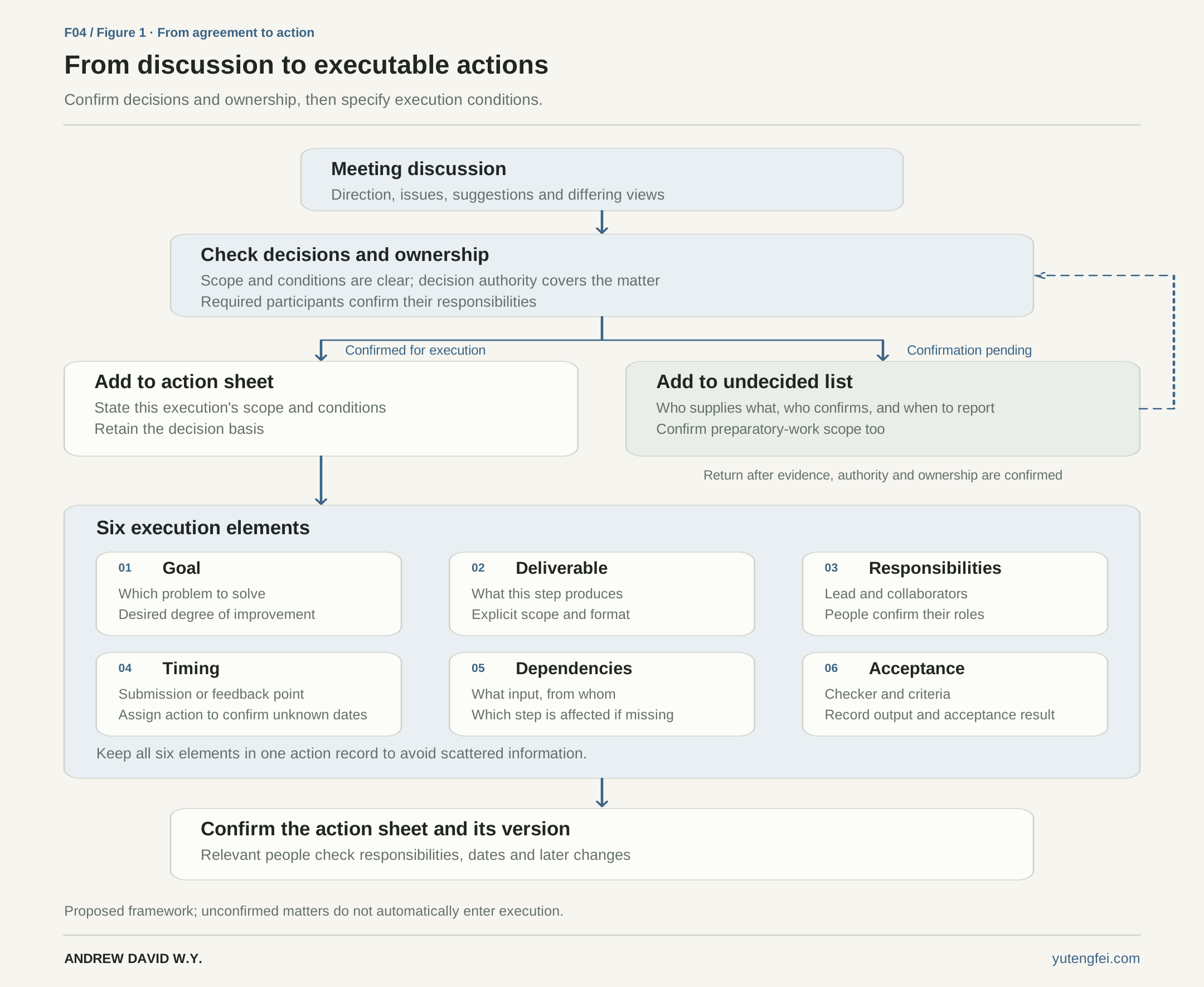
Figure 1 separates executable actions from undecided matters. After evidence, authority and acceptance are checked, undecided matters return to confirmation.
3. Record dependencies to identify what is blocked
If a task is not moving, first check its prerequisites.
Content production may await business materials; analysis may await statistical definitions; publication may await review. Without recorded dependencies, the deadline arrives and everyone sees only “unfinished”.
For each important dependency, state what is needed, who provides it, when it is needed, and which step is affected if it is missing.
A blocked-task update can then explain:
What is complete, which input is missing, which deliverable is affected, and what confirmation is needed from whom.
Some tasks can run in parallel; others need an earlier task to pass. Drawing the relationships helps identify the next workable step and coordination needs.
The lead should report blocks promptly, and providers should respond. Refer issues beyond both parties' authority to the appropriate coordinator or decision-maker.
This gives progress follow-up a concrete focus: the gap and next step. Do not summarize every delay as “poor execution”.
4. Submission needs an acceptance result
“Sent” records submission. It does not establish which version was received, what was checked or whether agreed criteria were met.
Simple statuses may be “not started”, “in progress”, “blocked”, “submitted” and “accepted”. Retain separate confirmation records for cancellation or adjustment.
Each change needs evidence. For “submitted”, attach the output and version. For “accepted”, record the checker, criteria and conclusion.
Failed acceptance feedback must identify unmet criteria, the required correction and who rechecks it. “Optimize it a bit” still leaves the person doing the work without a clear next action.
If acceptance introduces new requirements, confirm the added scope, effort, dependencies and timing effects. Revision may continue, but everyone affected must know how the original arrangement changes.
Acceptance of a deliverable is also distinct from achieving its goal. An analysis report may meet delivery criteria while its effect on business decisions still requires use and observation. The action sheet records delivery; the review then examines whether it helped solve the original problem.
5. Work through a small example
This scenario was written for explanation and represents no real company, meeting or team.
Suppose a team wants to update an external introduction. Its old information is scattered, and readers should understand the service scope more easily.
“Improve introduction materials; content team to follow up” leaves questions: what can change, whose data apply, whether visuals must be rebuilt and who gives final confirmation.
An initial arrangement could be:
- Goal: help readers understand current service scope and main deliverables.
- This step's output: a structural draft, before full visual production.
- Lead and collaborators: content owner coordinates; business owner checks scope and facts; relevant people must confirm the division of work.
- Dependencies: provide the current service list and evidence permitted for external use first.
- Timing: confirm submission after dependencies are checked; promptly report deadline effects if they are delayed.
- Acceptance: business owner checks for accurate scope, checkable facts and no unconfirmed commitments.
A proposed new service remains undecided. The appropriate owner supplies its conditions for separate confirmation. The draft proceeds with existing services, without presenting a suggestion as an existing capability.
If two descriptions conflict with the current list, identify their locations, evidence and required changes. Once corrections pass, record the accepted version and continue production under the confirmed arrangement.
This completes the deliverable. After actual use, observe whether readers understand more easily and which questions recur, then feed that evidence into the next revision.
6. Review what must change next time
Work backward from the action sheet: what problem was intended, what was delivered, where did results diverge, what information and conditions existed then, and what arrangements need change?
Repeatedly late materials may signal unclear providers, scope or feedback points. Rework at acceptance may signal criteria never defined in advance. Waiting repeatedly for one person may signal unsuitable authority or decision arrangements.
Keep causes unverified until checked; do not rush to judgments about people.
Leave concrete changes for the next cycle: add a check, change dependency order, define a decision route or narrow a deliverable.
Return the new arrangement to the action sheet for confirmation by those concerned. This connects review to the next execution cycle.
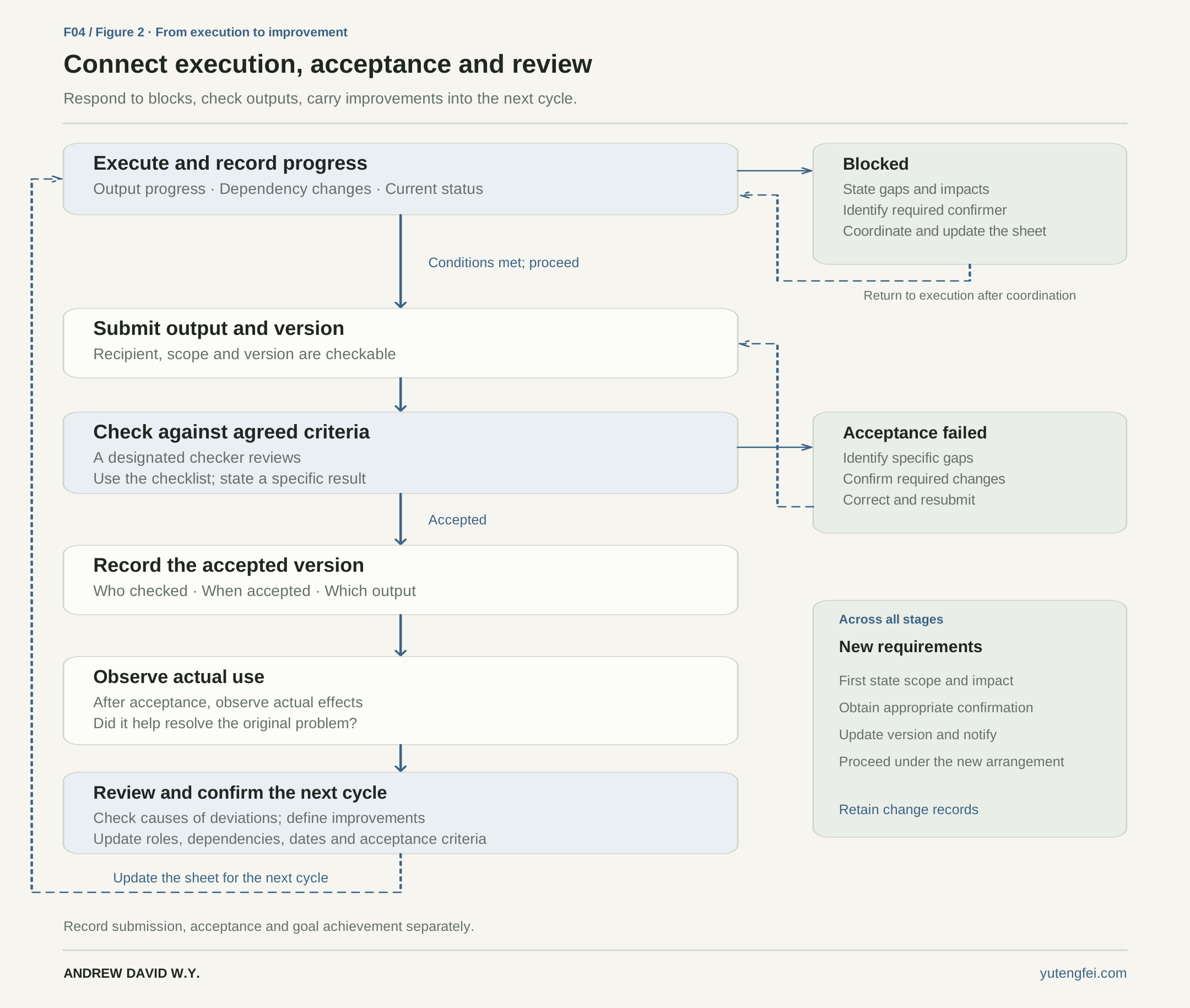
Figure 2 separates submission from acceptance and accepted delivery from actual effect. Blocks, failures and new requirements receive separate treatment; changes are confirmed and recorded.
7. A usable action sheet
Complex projects may need more tables. For ordinary collaboration, this one is enough to start. Enter confirmed arrangements, retain unknowns as pending and assign actions to resolve them.
| Field | Entry |
|---|---|
| Action ID, basis and version | Discussion/decision reference, current version and update date |
| Goal | Problem to solve and how improvement will be observed |
| This step's deliverable | Name, scope, format or verifiable result |
| Lead and collaborators | Individual duties and acceptance of ownership |
| Timing | Submission, feedback or confirmation points; actions for unresolved dates |
| Dependencies | Input, provider, required time and effect if unavailable |
| Acceptance | Checker, criteria, output evidence and conclusion |
| Current status | Not started, in progress, blocked, submitted, accepted; cancellation basis separately |
| Blocks and changes | Issue, impact, required decision and who confirmed adjustment |
| Next action and review | Action, owner, feedback point and improvement to retain |
Add a separate “awaiting decision” section: issue, missing information, provider, decision/confirmation role, return-to-discussion point and preparatory work already permitted.
Keep outputs, decisions and changes in mutually traceable locations. A replacement owner should understand current status from the records without asking everyone again.
Closing
A meeting's value continues through subsequent action. Shared direction needs explicit arrangements, arrangements need outputs, outputs need checks, and actual use tests their value.
Clarify what was decided, what is missing and who acts next. Afterward, record what worked and what needs changing.
That is how work moves forward, step by step.