Once a company has written down its culture, the next question is how that culture enters its operations.
A customer wants delivery, but quality checks are unfinished. What happens? An order would bring revenue, but the team is unlikely to keep the promise. Should it be accepted? An employee raises a problem early and disrupts the immediate schedule. How does the manager respond?
These situations can arise every day. When a choice is needed, do the words in the culture statement help people reach a judgment?
I would start with this test: can the enterprise use the principles it accepts to make a choice that can be explained, assigned to someone and checked?
A value needs corresponding judgments, actions and operating arrangements. Asking employees to agree is not enough. Management decisions, resource allocation and responses to problems also show what the enterprise actually values.
1. Distinguish mission, vision and values
Mission, vision and values are often discussed together, but they answer different questions.
Mission explains why the enterprise exists, whose problem it addresses and what that problem is.
It helps assess whether a business activity or service still addresses the intended problem. A new opportunity needs more than a revenue estimate. The people served and practical value also need to be clear.
Vision describes the enterprise the organization hopes to build.
It influences capability development and long-term investment. Reliable service requires sustained work on people, processes, delivery and quality. A future direction needs preparation today.
Values explain what the organization stands by when choices conflict.
When revenue conflicts with a promise, speed with quality or immediate results with a long-term relationship, values should help identify the requirements to protect and compare the options.
Three questions can help check these statements.
| Element | Main question | Use in operations |
|---|---|---|
| Mission | Whose problem do we address? | Assess the practical value of a business or service. |
| Vision | What enduring capabilities do we want? | Decide what to invest in and build in stages. |
| Values | How do we choose when priorities conflict? | Define principles, boundaries and reasons for decisions. |
Mission gives direction, vision informs continuing development and values guide specific choices. Clear distinctions help connect them to behavior and organizational arrangements.
2. Turn culture words into behaviors people can discuss
People may all accept “integrity,” “customer focus” and “long-term thinking” while understanding them differently in the same situation.
For example, customer focus might mean accepting every request, achieving a useful outcome, responding promptly or offering a particular price.
Without an explanation, employees rely on their own interpretations. If managers then judge them differently after seeing the result, people can struggle to know what is expected.
I would develop a cultural statement through three questions: which operating problem does it address, what behavior should be visible and what arrangements support that behavior?
| Illustrative principle | Operating question | Observable behavior | Supporting arrangements |
|---|---|---|---|
| Be truthful and keep promises | Should we commit before capability is confirmed? | Explain what is finished and unfinished; confirm conditions before committing. | Business-information checks, authority to make commitments and change notifications. |
| Value customer outcomes | How do we know a product or service is useful? | Check needs, use outcomes and subsequent problems. | Needs records, delivery standards and after-sales feedback. |
| Value cooperation | How do departments share responsibility? | Explain dependencies early, hand over complete information and report obstacles promptly. | Shared objectives, clear roles and a route for cross-department coordination. |
| Build lasting capability | How do immediate tasks fit capability development? | Retain necessary training, maintenance and improvement work. | Time, budget, people and stage reviews. |
These examples support discussion and need adjustment for the business. They are not a universal assessment scheme.
The more abstract the statement, the more it needs ordinary operating situations. Explaining behavior and conditions is more useful than repeatedly asking people to interpret a word.
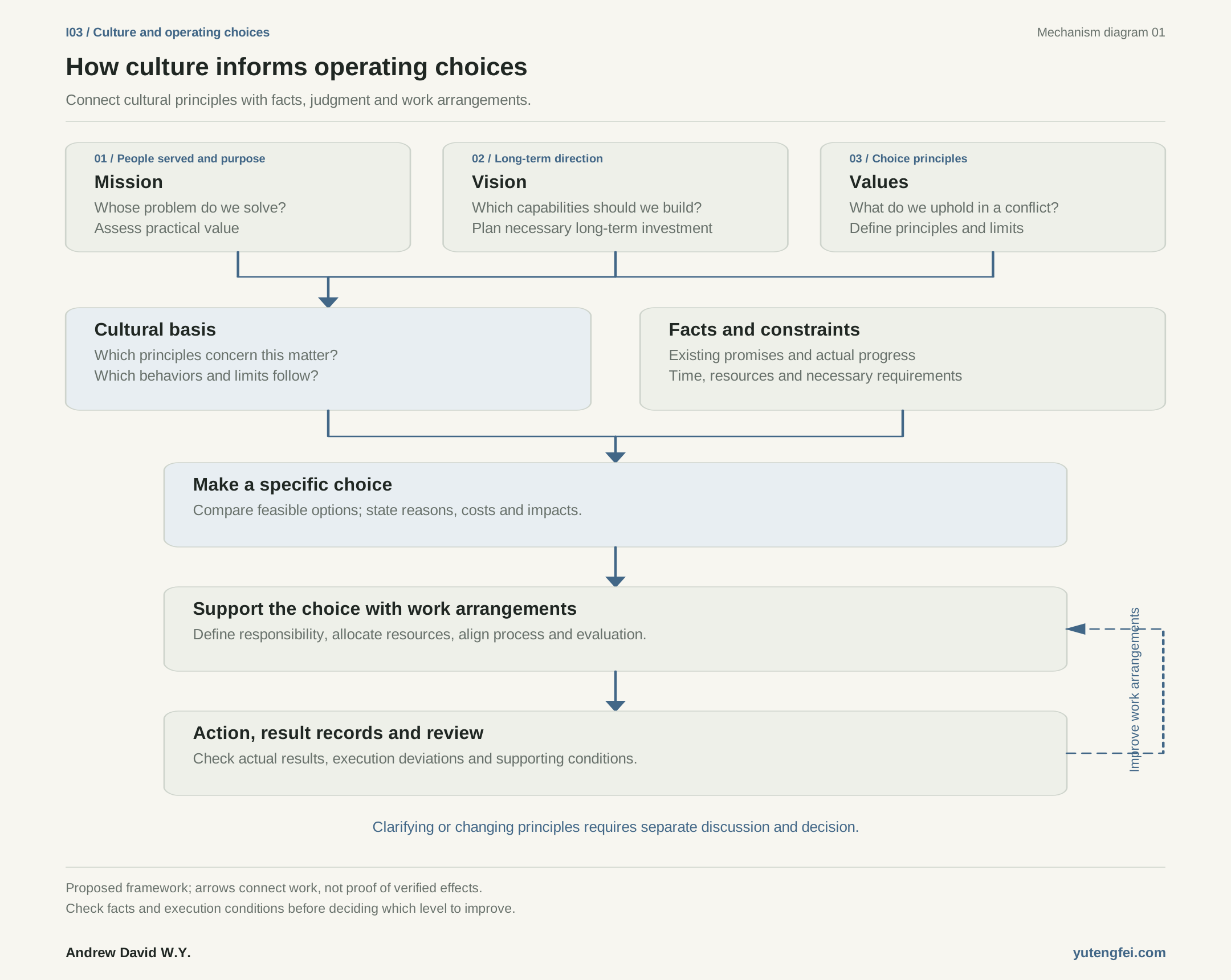
Figure 1 connects cultural principles, operating facts, decision criteria and implementation conditions. The arrows show proposed working relationships; they do not establish that the culture statement has already improved performance.
3. Establish the facts when priorities conflict
Acting on culture can involve costs.
An honest progress update may delay an order. Necessary quality checks may require more work. Training new people takes time that could otherwise be spent on immediate delivery.
Discuss which requirements must be protected, which conditions can be negotiated, who is affected by each option and whether the enterprise can carry the consequences.
I suggest three levels of examination.
First, check the facts. What has been promised? How much is complete? Which conditions are missing? Do people, time and resources match the task? Without clear facts, discussion can become a series of departmental positions.
Then examine principles and boundaries. Which cultural principle applies, what does it require here and which obligations or essential standards are already established? Culture should support those requirements. It cannot justify bypassing existing agreements or responsibilities.
Then compare feasible options. How does each affect customers, the team, partners and continuing operations? What does it cost, whose authorization is needed and how will deviations be handled?
There may be no option that immediately satisfies everyone. The decision-maker should still explain the choice and how its consequences will be handled.
Sometimes no acceptable option exists under current conditions. Resources may need adding, scope and timing may need renegotiation, or an authorized person may need to decide on a pause. Unresolved conditions cannot simply be passed to an employee with an instruction to “find a way to demonstrate our values.”
4. Work through a delivery situation
The following scenario is fictional and does not describe a real enterprise or project.
A service company has promised a fully checked formal report by an agreed date. As delivery approaches, the team discovers gaps in key data. Some conclusions are not yet supported.
If the enterprise values honesty, reliability and long-term cooperation, how should it respond?
First establish the missing data, affected conclusions, conditions for completing the work and the customer's intended use. Explain completed and unfinished work separately.
Then consider options: add suitable verification resources, negotiate a revised date for full delivery or discuss whether an interim document with a clearly defined purpose and scope would help.
The customer needs to confirm whether an interim document meets the immediate need. It must not be presented as the promised formal report or leave users thinking that conclusions have been fully verified.
If the intended use requires complete, accurate formal conclusions, an interim option may be unsuitable. The team must continue discussing conditions or refer the matter to someone with the relevant authority.
Assign the next steps: who communicates with the customer, checks what can be delivered, confirms the revised arrangement and obtains further information? When will progress be reviewed?
Management also needs to examine its own arrangements. Why was the promise made? Was verification time underestimated? Did the business commit before confirming capability? Does someone who raises a problem early receive appropriate support? If assessment recognizes only the original delivery date while the responsible person cannot change the resources, will the team raise a similar issue next time?
Addressing these questions brings culture into operations. It affects external explanations, internal decisions and how the next commitment and delivery are organized.
5. Connect the choice to responsibility, resources and assessment
A team asked to value quality needs time and people for checks. Cross-department cooperation needs a way to resolve disagreements and a clear handover process. Early reporting needs a route for receiving, handling and responding to issues.
Someone may know what should be done yet lack time, authority or resources. Those conditions need attention. Treating every unfinished task as a failure to share the organization's values can hide the actual problem.
I would connect four things:
- Clear responsibility: who handles the matter, coordinates and has authority to choose.
- Suitable resources: the people, time, tools and budget needed for the decision.
- Consistent assessment: results considered alongside critical processes, actual constraints and responsibilities.
- Usable feedback: people can raise issues, receive responses and see the next steps.
Check especially whether everyday assessment rewards the opposite behavior.
An organization may demand honesty externally while rewarding only impressive figures internally. It may praise cooperation while departmental assessments ignore shared tasks. It may speak of long-term capability while allocating every resource by short-term output. Make those conflicts explicit and adjust assessment and resource arrangements.
How management handles such situations is a substantial part of whether the culture is credible.
6. Find the missing connections in a review
After a choice, examine what happened.
Did the customer understand and accept the arrangement? Did delivery meet the relevant standard? Did the team carry unforeseen costs? Were other partners affected?
An unsatisfactory result does not immediately prove that a cultural principle lacks value. Check whether the facts were assessed accurately, the option was feasible, implementation conditions were in place and the work followed the agreement.
I suggest reviewing in two directions.
Improve working arrangements. Add verification steps, clarify who may make commitments, improve handovers, provide training or revise unsuitable assessment measures.
Clarify cultural language. If people repeatedly disagree about a term, discuss real working situations. Explain the behavior it supports, how it applies to common conflicts and where its scope ends.
Use everyday outcomes first to improve judgments and working arrangements. Changes to mission, vision or important values need the appropriate discussion and decision, with reasons and an effective date. Do not replace the explanation each time pressure arises simply to justify the result.
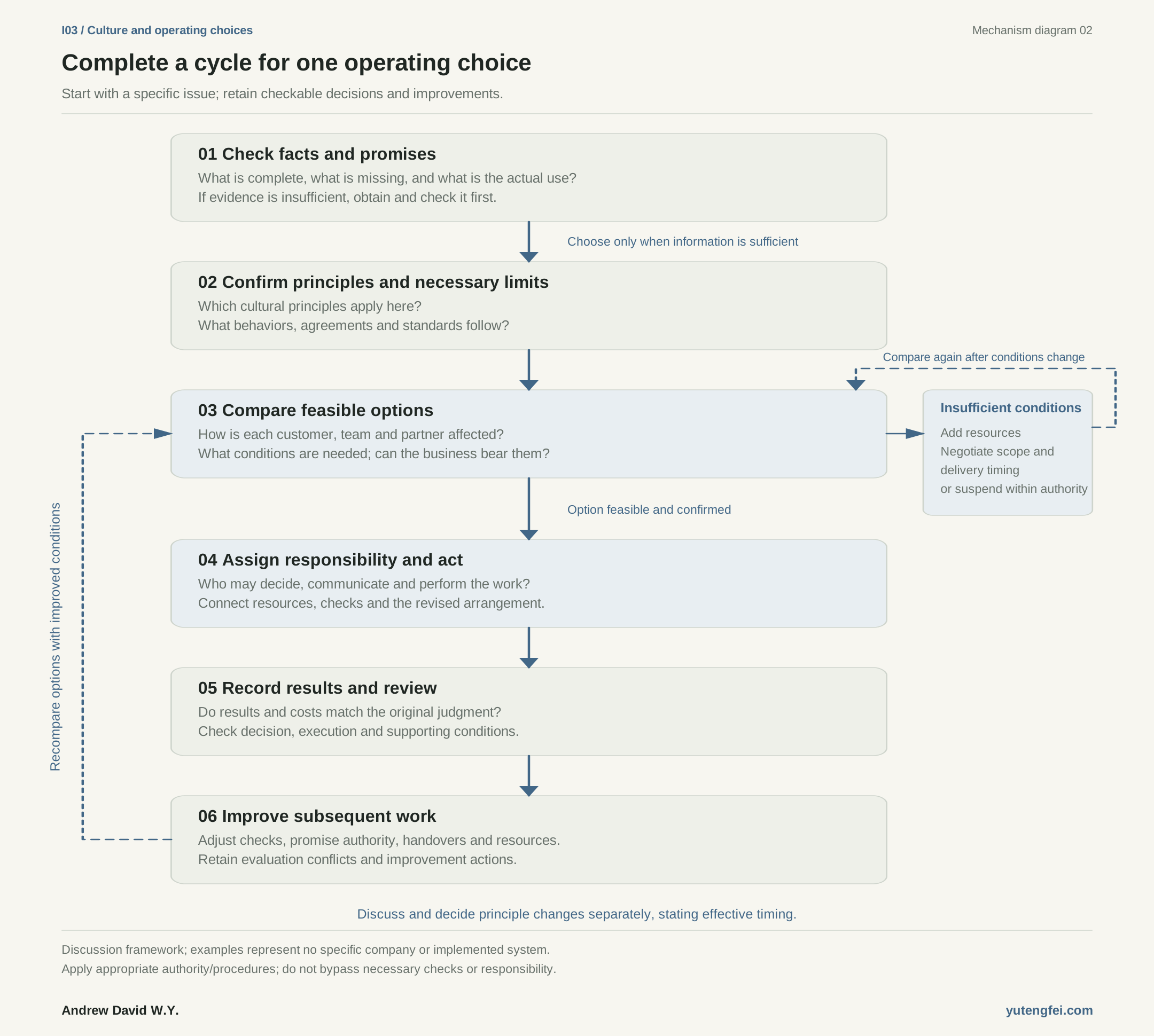
Figure 2 concerns one operating matter. Missing facts call for more information; inadequate conditions call for resources or renegotiation. Results help examine the decision and implementation and improve subsequent work.
7. Use a table to check whether culture has entered the work
A complex culture-management system is not the necessary starting point. Choose a recurring operating choice and work through it.
| What to check | A direct question | Record to retain |
|---|---|---|
| People served | Whose need should this choice address? | Needs and the actual use situation. |
| Cultural basis | Which principle applies, and what does it mean here? | The principle and expected behaviors. |
| Actual conditions | What is complete, missing or unconfirmed? | Facts, constraints and open questions. |
| Feasible options | What choices exist, who is affected and what do they cost? | Options and reasons for comparison. |
| Authority and responsibility | Who decides, implements and coordinates? | The decision and assigned responsibilities. |
| Supporting conditions | Do time, people, resources and assessment fit? | Resource arrangements and review points. |
| Subsequent review | What happened, and what should change next time? | Results, deviations and improvement actions. |
The table supports checking. Filling it in should help move an actual choice and subsequent action forward. A written record that changes no arrangement leaves the problem where it was.
Begin with an ordinary operating choice
Culture needs to reach specific problems.
When an enterprise can explain a choice, provide the responsibilities and resources it requires and examine the actual result, culture has something visible and testable behind it.
Start with an ordinary delivery, a commitment or cross-department work. Connect these relationships and keep doing so. People can then develop a more consistent understanding of what the enterprise values.