When people discuss contributions, they often bring different things to the table. One person talks about sales, another about time spent, another about responsibilities carried, and another about an opportunity that was difficult to secure.
Each may have a point. The difficulty is that they are presenting different kinds of evidence.
Before evaluating a contribution, I would first ask: what was the task, what role did this person take, what results followed, and what responsibility did they actually carry? Which parts have been verified, and which remain interpretations?
I find it useful to examine six dimensions together: role, contribution, time, responsibility, risk and strategic value.
They do not share a common unit, and I would not give them a universal set of weights. Putting them in one diagram helps us unpack a judgment and see what still needs an explanation.
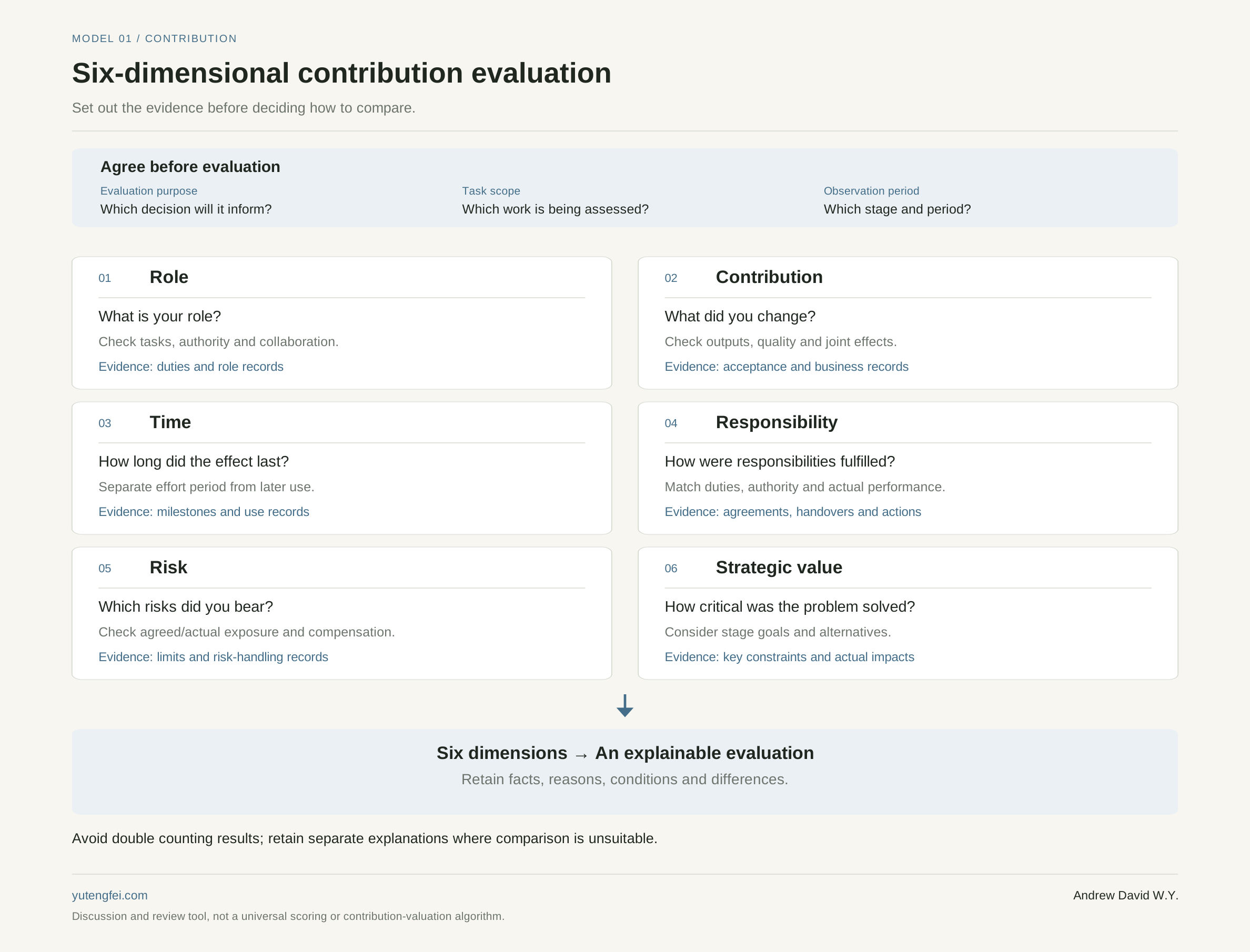
Figure 1: Establish the task, period and purpose first. The connections show relationships to examine; they do not mean that the six dimensions can simply be added together.
1. Start with the role: what was this person expected to do?
In a business, different roles contribute in different ways.
A channel partner may clarify what customers actually need. A delivery team fulfils the commitment. A supplier maintains quality, quantity and timing. A manager coordinates resources, resolves conflicts and remains accountable for decisions.
Looking only at sales can overlook the work that made delivery possible. Looking only at time spent can overlook efficiency.
So I would first set out the person's responsibilities, authority and working relationships. If someone performs several roles, record them separately. A senior title does not by itself demonstrate a larger contribution, and a role outside sales does not mean that no value was created.
The role gives us a viewpoint. What the person actually did provides the basis for judgment.
2. What should we examine in each dimension?
Role: position, task and working relationships
What was the person responsible for? Which decisions could they make? Where did their work connect with other people's work?
Different tasks should not be ranked against the same measure without explaining why that measure is appropriate. The evidence may include agreements, role descriptions, project assignments and changes made during the period.
If someone took on additional work, it helps to confirm that assignment when it happens, rather than reconstructing it from memory at the end.
Contribution: what was delivered or improved?
What did the person deliver? Which problem did they solve? What happened to quality, and whose work became easier because of their help?
A result needs context. Sales may be accompanied by costs, quality issues, returns, after-sales obligations and payment collection. These effects belong in the assessment too.
Where a result was created jointly, identify the shared result and the participants' respective work. We should not count the entire result once for every person involved.
Acceptance records, quality records, business changes and confirmations from collaborators may support an assessment. The conclusion should stay within what those records can establish.
Time: distinguish effort, duration and continuing usefulness
Time can mean several things: the time invested, how long an effect lasts, and whether a result continues to be used later.
A plan developed in two weeks may remain useful for a long time. Daily maintenance can be hard to notice precisely because it keeps things running normally.
Length of service is not the same as contribution. I would look at records of the work, delivery and subsequent use, rather than turning the assessment into a comparison of who worked the most overtime.
Responsibility: what was agreed, and what was actually carried?
Who was responsible for quality, customer commitments or resource decisions? Who was expected to coordinate when problems arose?
A nominal responsibility and a responsibility actually performed may differ. Quiet handovers and coordination also need to be visible.
If someone missed a required check and later helped resolve the resulting problem, record the whole sequence. Counting only the rescue would leave out part of the responsibility.
The assessment should connect duties, authority, actual performance and handovers.
Risk: what exposure was undertaken, on what basis?
Someone may have committed funds in advance, reserved capacity, assigned dedicated staff or accepted uncertainty about performance.
We need to specify the possible adverse outcomes, the authority for taking that exposure, how losses were allocated and what the parties agreed beforehand.
Reasonable, authorized exposure differs from an unauthorized gamble. A higher level of risk does not automatically mean a greater contribution.
Look at both the exposure and how it was handled. Also check whether compensation for that exposure has already been provided, so that the same item is not counted twice.
Strategic value: what did the work make possible at this stage?
Not every useful contribution appears immediately in sales. A quality improvement may open a new use for a product. An adaptation may connect previously separate parts of the business. A stable supply arrangement may remove a constraint.
The explanation should refer to the objectives at that stage: which choice or constraint did the work affect, what alternatives existed, and what effect has actually been observed?
Calling something “strategic” does not prove its value. An introduction, a contact or an expression of interest is not completed cooperation. Future possibilities and effects already achieved should be recorded separately.
What matters most may also change as the project moves into a different stage.
3. Form an explanation before making a comparison
Once the six dimensions are listed, it is tempting to assign weights and add up scores. I think there is work to do before that.
Separate facts, judgments, prior agreements and matters still open for discussion. A delivery date is a fact that can be checked. The importance of that delivery is a judgment that needs reasons.
The same work may appear under both contribution and strategic value. That does not justify counting the same value twice.
First explain what happened, which evidence supports it, why it matters and where the limits of the assessment lie. Then decide the scope and rules for any comparison.
If scoring is useful, define its purpose, scales, comparable items and treatment of missing information. Weights should fit the purpose, tasks and stage, and remain open to review.
This framework is not a universal valuation formula.
4. A fictional example: delivering the first batch of a new product
Consider a wholly fictional first-batch delivery. The channel team identifies suitable customer needs, a technician adapts the product to its intended use, a supplier reserves capacity and delivers, and operations connects orders, handovers and exception handling.
Their work is related, but the evidence to examine differs.
| Role | Questions to examine | Possible evidence | A further question |
|---|---|---|---|
| Channel | Were the needs accurate and suitable? What commitments were made? | Confirmed requirements, communication records and order terms | What other factors helped produce the result? |
| Technical | What problem was solved? Were the test requirements met? | Test records, revisions and acceptance records | What support did other people provide? |
| Supplier | Was capacity reserved? Were delivery and quality commitments met? | Agreements, delivery records and quality records | Have the related risk and cost already been compensated? |
| Operations | Which interfaces and exceptions were handled? | Responsibilities, handovers and resolved-issue records | Did the work produce methods that can be reused? |
The table does not place everyone on a single numerical scale or determine rewards in advance.
A one-off adaptation and a reusable method have different durations of usefulness. An ordinary supply arrangement and dedicated capacity reserved for this project involve different commitments.
Where information is missing, mark it as pending. A precise-looking score does not make an unknown fact known.
5. Connect records, judgment and review
An assessment also needs a process. Who selected the indicators, who recorded the facts, who made the judgment, and how can the people concerned check it? Are conflicts of interest visible?
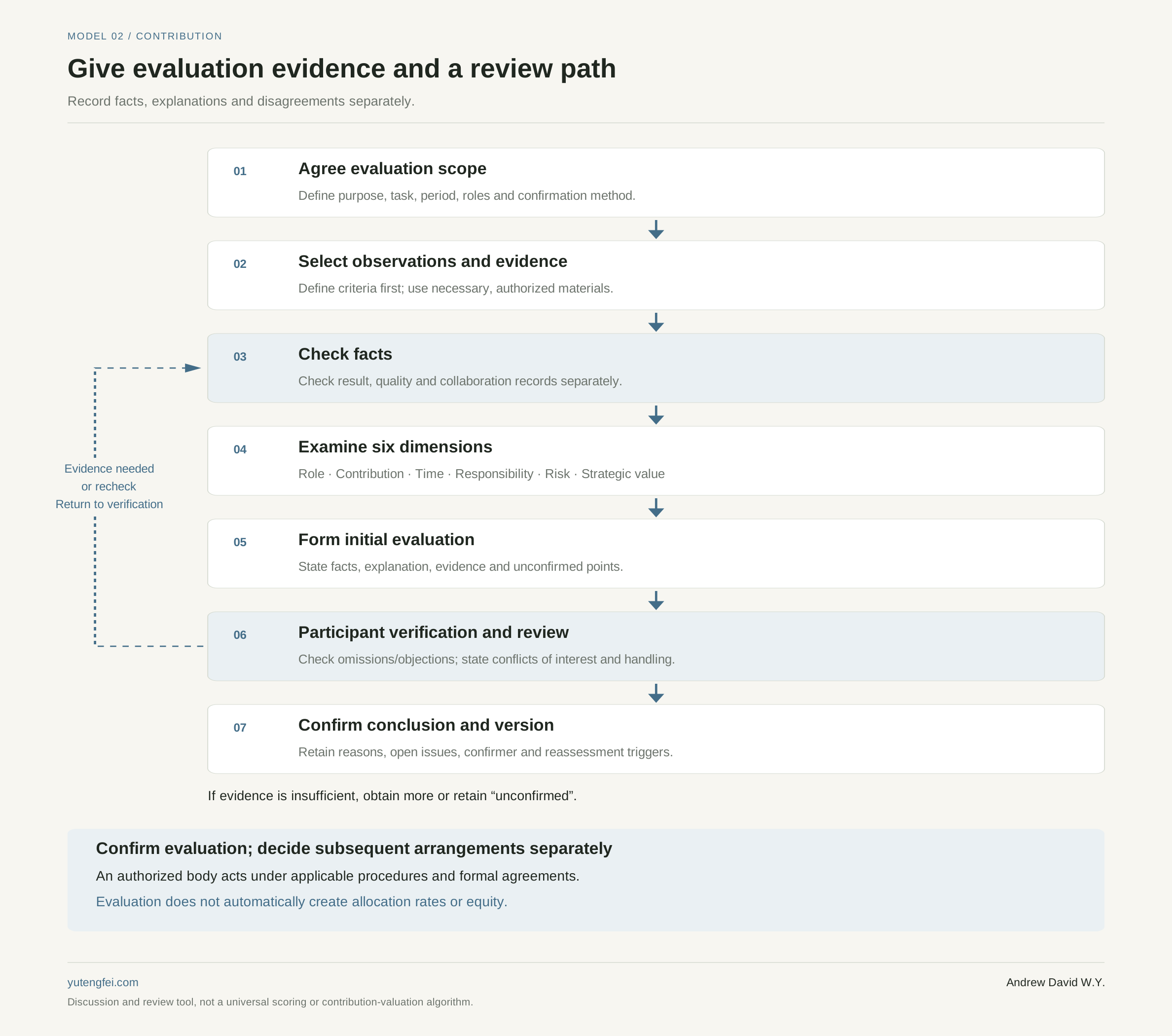
Figure 2: Define the purpose first, then connect facts, explanations and objections. Where evidence is insufficient, seek further information or retain a pending status. Keep the contribution assessment separate from decisions about rights.
Start by defining the purpose, task, period and participants. Reviewing completed work and discussing long-term cooperation are different purposes and may require different information.
Collect only necessary information through authorized channels. Give people the access they need; review does not require publishing everyone's information to everyone else.
Keep facts and judgments distinct. “Three acceptance checks were completed this week” differs from “this work is critical to the next stage.” The second statement needs an explanation.
Let participants check for omissions. Distinguish objections about facts, standards and relative importance. Depending on the issue, recheck the evidence, add information, record the reasons and apply the review procedure agreed beforehand.
Disclose conflicts of interest and use recusal or independent review where appropriate. Make final decision-making authority clear in advance. A process does not have to wait for unanimous agreement before it can conclude.
Retain the version, evidence, reasons and unresolved matters. A significant change should trigger a new assessment. New standards should not be quietly applied retrospectively to rewrite earlier agreements.
6. A blank table for a first discussion
Before filling in the dimensions, establish these items:
- Purpose of the assessment: pending confirmation.
- Task and period: pending confirmation.
- Participants and roles: pending confirmation.
- Standards and confirmation procedure: pending confirmation.
| Dimension | What to examine | Facts and evidence IDs | Initial judgment and reasons | Unconfirmed matters or objections |
|---|---|---|---|---|
| Role | Tasks, responsibilities, authority and working relationships | To be completed | To be completed | To be completed |
| Contribution | Deliverables, problems solved and effects observed | To be completed | To be completed | To be completed |
| Time | Time invested, duration of effects and subsequent use | To be completed | To be completed | To be completed |
| Responsibility | Agreed duties, actual performance and handovers | To be completed | To be completed | To be completed |
| Risk | Authorized exposure, handling and compensation already received | To be completed | To be completed | To be completed |
| Strategic value | Stage objectives, constraints, alternatives and effects observed | To be completed | To be completed | To be completed |
After completing it, ask a few more questions. Have we treated a title as a contribution, or hours as results? Have we treated an intention as something already implemented? Have we counted the same work twice? Have we overlooked work because it is difficult to quantify?
Confirm what can be confirmed and state what is missing. Retain explanations where items cannot fairly be compared. Where a number would not help, use a reasoned written judgment.
7. Decide how the assessment will be used
An assessment may inform role improvements, training, recognition, incentives or long-term cooperation. These are different decisions, and the intended use should be clear.
The assessment does not automatically determine a payout percentage or an equity allocation.
Existing remuneration and basic rights remain governed by their existing arrangements. New changes need the appropriate authorization and formal procedure.
What matters to me is whether we can explain who did what, which evidence supports it, what may have been overlooked and how disagreements can be reviewed. Once those questions become concrete, the discussion becomes more useful, and valuable continuing contributions have a better chance of being recognized.