When a piece of business is completed, someone may have brought in the customer, someone fulfilled the order and someone handled after-sales problems. The records should show what each person did. If the enterprise then plans an incentive, more questions follow: how is the work assessed, how is the amount calculated, who confirms it, where does the money come from, and was the correct payment actually made?
Connecting these questions gives the incentive a basis.
I think we can start with a single business event. Following it through helps reveal whether the mechanism connects. Attractive totals for transaction volume, contribution rankings and rewards may still explain very little about any individual payment.
This article organizes that processing chain into a working model: actual business activity, data verification, contribution assessment, calculation and budget checks, authorized confirmation, settlement and payment, and exception review. It gives business, operations, finance and systems teams a way to examine the same event together. Whether it suits a particular business must still be tested against its actual rules and operating results.
1. Keep business activity, assessment and payment distinct
An order shows that a business system has received a transaction record. Whether performance is complete, a refund has occurred or the event was registered twice still needs checking.
A person's involvement shows that they undertook some work. Whether it qualifies for an incentive, and how it differs from other people's contributions, depends on the applicable rules and evidence.
A calculated incentive amount still requires checks on conditions, confirmation by an authorized person and the payment arrangement it enters. A calculation, a confirmed payable and money actually received are separate statuses.
Keeping them separate tells everyone which stage they are discussing.
For example, operations may say “the reward is out” when the system has generated an estimate. A participant may understand that payment is now available, while finance has not received any approval. Combining these meanings in one phrase makes disagreement likely.
The rules should therefore define statuses explicitly: pending verification, pending assessment, pending confirmation, confirmed and awaiting payment, payment in progress, paid, or under exception review. The conditions triggering each status should also be traceable.
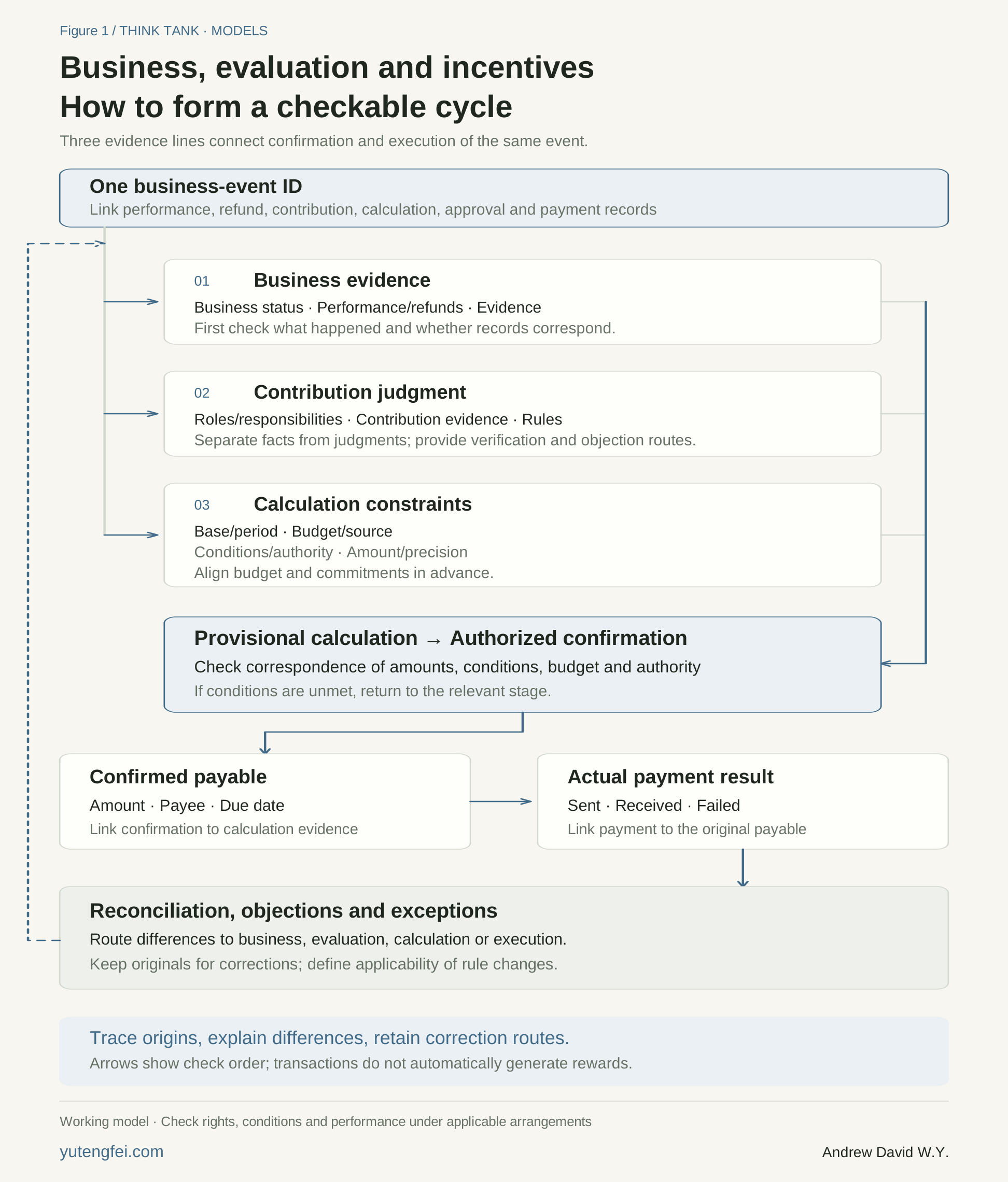
Figure 1 connects the business evidence, contribution judgment, calculation constraints and execution records. Lines show the sequence of checks and processing; they do not mean that a transaction automatically generates a reward.
2. Connect the records around the same business event
Before checking records, establish that everyone is discussing the same event.
I suggest assigning each business event a traceable ID. Related performance, refunds, contribution records, calculation sheets, approvals and payment records should all lead back to it. Orders, service tickets and project tasks may have different IDs, but their relationships must be clear.
Retain the information that directly affects judgment: who participated, what they undertook, how far it was completed, where the evidence is, which period it belongs to and which rule version applied at the time.
Rules and business activity change. If the system displays only the latest rules, checking an old transaction later may produce a different result.
A calculation record should therefore identify the applicable rule version, input data and calculation process. Later corrections and reviews can be added while keeping the original calculation and its reasons traceable.
The same event may be reported through several channels. Deduplication needs to distinguish the business fact from its reporting records. A person may also perform several different tasks. Assess those tasks under the rules rather than deleting real contributions in the name of deduplication.
Limit the records to what the review requires. Use information needed for performance, assessment and settlement under the relevant permissions. Unrelated personal information does not need to enter this chain.
3. Explain how a contribution judgment was reached
Contribution assessment starts by identifying the work being assessed.
Bringing in customers, completing delivery, improving service and undertaking risk have different effects. Ranking everyone by sales alone can overlook much of the work. Conversely, separate impressive-looking indicators for every role will be difficult to trust without a shared basis for review.
Start with four questions: who contributed, what did they contribute, what results can be observed, and how long did the contribution last? Then add quality, responsibility and other necessary conditions for the role.
For a channel partner, distinguish a registered lead, effective cooperation and completed delivery. For a service employee, examine the work performed, their responsibility and the recorded result. Where several people worked together, distinguish a shared contribution from duplicate counting.
The assessment should appear together with its supporting reasons. Where data can be checked, state the definitions and period. Where human judgment is needed, record the reasons. Where evidence is insufficient, mark what is missing instead of concealing the gap behind a precise-looking score.
Participants should also have a way to check the record and raise objections. Define in advance whom to approach and how a review works when work is omitted, recorded incorrectly or understood differently.
This discussion concerns how contribution assessment supports incentive decisions. Wages, contract payments and agreed basic rights should be fulfilled under their respective arrangements. All payables should not be put back through a contribution score to decide whether they are owed.
4. Clarify the budget, funding source and calculation basis before making commitments
Assessment asks who contributed what. Calculating an incentive also asks what base, rate or fixed amount applies, which budget bears it and who may approve it.
Transaction value, service revenue, gross profit and a budget pool are different bases. “Allocate 10%” is not a complete calculation rule. State 10% of which figure, what is included or deducted, and the period in which it is recognized.
Funding needs the same care. Planned income, an established receivable and funds actually available for use are different things. The budgeted amount and the amount currently payable in cash may differ.
Clarify these matters when designing rules and budgets, before external commitments are made. Rights and obligations already confirmed under an agreement also need a performance arrangement. If a budget or cash shortfall arises, record the difference, responsibility and proposed resolution. “Insufficient budget” should not be used later to change a confirmed amount unilaterally.
A wholly fictional numerical example makes the calculation easier to follow.
| Item to check | Arrangement in this teaching example |
|---|---|
| Calculation base | Verified service revenue of RMB 1,200; deductions are determined under this example's rules |
| Incentive budget for this event | 10% of the base, or RMB 120 |
| Eligible roles and allocation | A, B and C have passed the condition checks and receive 50%, 30% and 20% of the pool respectively |
| Calculated amounts | RMB 60 for A, RMB 36 for B and RMB 24 for C, totalling RMB 120 |
| Next status | Submit for authorized confirmation and settle as agreed; check the payment result separately after payment |
These percentages illustrate the process; they are not recommendations for a business. Actual arrangements also need a funding source, a specific obligated party, conditions, deadlines and monetary precision.
The example allows at least three checks: which base was used, whether the three amounts exceed this event's budget, and whether the calculations follow the applicable rules. Whether participants are entitled to those amounts still depends on the applicable rules, agreements and confirmation procedure.
5. Record authorized confirmation and actual payment separately
The person calculating an amount explains the calculation. The person authorized to confirm it checks whether the applicable conditions are met. Submission, review, confirmation and payment authority should correspond to actual duties and permissions.
An enterprise does not necessarily need many approval levels. It does need clarity about who is responsible at each step and on what basis the step is completed. Where one person performs several tasks, use a review or oversight arrangement appropriate to the circumstances.
After confirmation, connect the calculation sheet to the payable record. At payment, connect the payable to the outgoing transfer and the result—receipt, failure or another status. Differences in amount, recipient, period or status should be discoverable.
A submitted payment request may still be processing, fail or be returned by the bank or payment provider. Reconcile against the actual outcome. Link any later payment to the original payable so that a retry does not create a new reward.
For a participant, the useful information is straightforward: which business event the incentive relates to, which rule version applies, how much was calculated, how much was confirmed, how much was paid and what remains unresolved. Set access by role so people have enough information to check their own matters.
6. Retain the original records when refunds or disputes arise
Business activity changes. Refunds, cancellations, duplicate entries and disputes over contribution attribution may affect later processing. The mechanism should provide for them from the outset.
Continue the fictional example. Suppose a RMB 240 refund affecting the calculation base occurs before the incentive is confirmed. Under the example's previously agreed rules, the base falls from RMB 1,200 to RMB 960, and the incentive budget from RMB 120 to RMB 96. With other conditions unchanged, the candidate amounts become RMB 48 for A, RMB 28.80 for B and RMB 19.20 for C.
Link the refund to the original business event. Retain the original candidate record, create an updated candidate record and resubmit it for confirmation. The difference between the versions should be explainable.
If the refund occurs after confirmation, or after payment, check the applicable agreements and adjustment conditions. Whether an adjustment is permitted, whose amount it affects, how notice is given and who approves it all require attention. Where an adjustment is appropriate, record the original confirmation, original payment and subsequent adjustment separately.
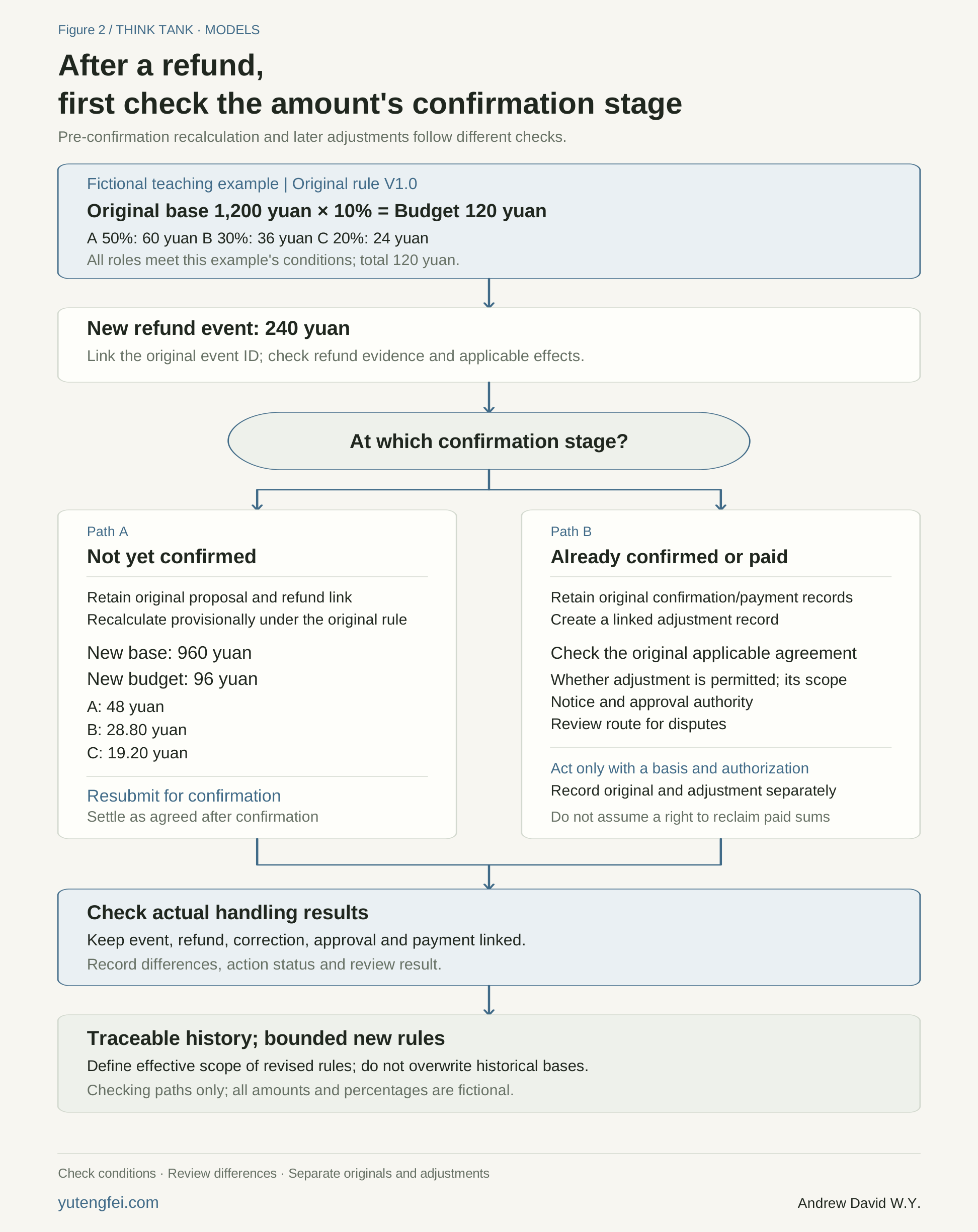
Figure 2 uses fictional teaching amounts. Recalculation before confirmation and handling after confirmation follow different review paths. The diagram does not presume that an enterprise may recover an incentive already confirmed or paid.
What matters to me is whether the mechanism can still explain what happened when an exception arises. Overwriting the original figure may leave a tidy display while erasing the history of the event.
7. Where should the improvements go after a review?
Review should go beyond determining how much to pay as a correction. Identify the layer where the problem arose.
| Problem found | Where to investigate | Record to retain |
|---|---|---|
| The same event was reported twice, or a refund was not linked | Business facts and relationships between records | Deduplication or correction records with the supporting links |
| Several people claimed the same contribution in full | Roles, contribution boundaries and evidence | Review findings and records checked with participants |
| Percentages were correct but the total was wrong | Base, period, allocation scope and monetary precision | A reproducible calculation and explanation of differences |
| A confirmed amount remains unpaid | Funding, performance deadlines and responsible authority | Actual status, responsibility for resolution and arrangements to fulfil the agreement |
| Ambiguous rules repeatedly cause similar disputes | Definitions, scope and explanation of the rules | A properly confirmed new version and its scope of application |
| Indicators encourage superficial results while harming delivery or service | Indicator design and the actual business purpose | Proposed changes, trial scope and observed results |
Different problems require different paths. Correcting a calculation error and changing a rule's version or scope are separate actions.
For a rule revision, specify when it takes effect and which business activity it covers. Earlier transactions still require review against their originally applicable arrangements and valid changes. Do not quietly move all historical records onto the new version.
Then examine operating results: have discrepancies decreased, do the same disputes recur, are performance and service affected, and is the review effort worthwhile? Larger reward amounts or higher rankings alone do not establish that the mechanism has improved.
8. Follow the whole chain for one type of business first
Begin with one type of business whose boundaries are clear.
Choose the rules and reporting period. Bring together business events, refunds and cancellations; connect the contribution evidence; calculate candidate incentives; check budgets; seek confirmation; and record payments. Then trace normal, failed and disputed cases back through the chain.
A table with linked records can be enough to start. Decisions about systems and integration can follow once the working definitions are clear. A system should explain the origin of each result and retain the necessary review and correction routes.
Five questions can guide the trace:
- What actual business activity does this incentive relate to, and what changed afterwards?
- Why are these people receiving it, and what supports the contribution judgment?
- Which base and rules determine the amount, and who bears the budget?
- Who confirmed the amount, and was payment actually completed?
- Can a discrepancy or objection be reviewed through the original records and the outcome fed back?
When these questions can be answered, participants have a basis for checking their amounts, and the people doing the work know where to take a problem. The enterprise can then decide which records to simplify, which checks to strengthen and which rules need further adjustment.
This is how I understand the business, assessment and incentive loop: every act of participation, judgment and payment has a path that can be questioned, explained and corrected. The enterprise can keep checking whether actual contributions, clear commitments and execution remain connected.