Why does a business struggle to make progress even after setting clear goals? Why does execution keep drifting from written policies? Why does performance still depend on the owner’s personal oversight after capable people have been hired?
When these problems arise, it is tempting to jump to conclusions: employees cannot execute, managers lack ability, or the organization is poorly structured. People are replaced, departments reshuffled, and performance targets tightened. After all that activity, the problem may remain.
Perhaps we have examined one part without understanding how the business works as a whole.
The 7S model offers seven dimensions for observing an organization: Strategy, Structure, Systems, Style, Staff, Skills, and Shared Values. Its value lies in bringing scattered management problems onto one map, so we can examine whether these elements support or constrain one another.
For business owners, it is a map for examining their own organization. For consultants, it is a framework for investigation and reflection. Owners use it to understand their business; consultants use it to ask questions, gather evidence, and develop judgments together with the owner.
1. Understanding 7S: Performance Depends on How the Elements Work Together
McKinsey introduced the 7S framework in the late 1970s. It became widely known through works such as Peters and Waterman’s In Search of Excellence. The framework argues that organizational effectiveness cannot be explained by structure alone: several interconnected factors must be considered. Source: McKinsey’s introduction to the 7S framework
All seven English names begin with S, hence “7S.”
| Element | Focus | Core question |
|---|---|---|
| Strategy | Strategic choices | Whom do we serve, what value do we offer, how do we compete, and what do we choose not to do? |
| Structure | Organizational arrangements | How is work divided, who owns the results, who can decide, and how do departments coordinate? |
| Systems | Operating mechanisms | Which processes, rules, information flows, and feedback mechanisms keep daily work running? |
| Style | Management behavior | How do owners and managers actually make decisions, delegate, and handle problems? |
| Staff | People and roles | What people do our goals require, and how do we deploy, develop, and retain them? |
| Skills | Organizational capabilities | Which critical tasks can the organization perform reliably, and which capabilities are missing? |
| Shared Values | Shared principles | What principles do people collectively uphold when interests conflict and choices become difficult? |
Strategy, Structure, and Systems are commonly called the “hard elements”; Style, Staff, Skills, and Shared Values are the “soft elements.” The former are easier to capture in plans, organizational charts, and formal policies. The latter appear more often in behavior and organizational habits. This distinction is useful, but it does not mean that soft elements matter less or cannot be observed and changed.
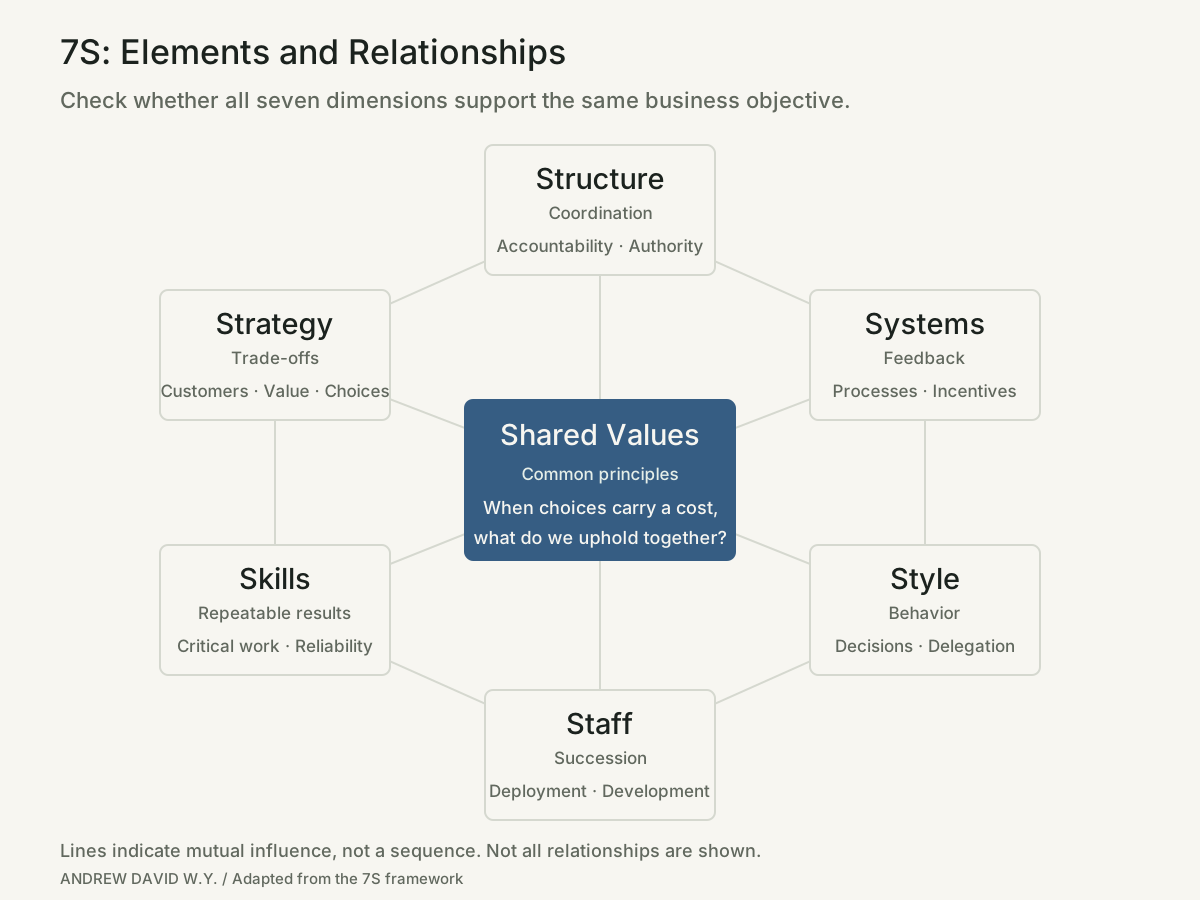
Three distinctions deserve particular attention.
Systems are more than policy documents or software. Budgets, performance management, approvals, meetings, business processes, and data feedback all form part of the organization’s operating systems. Buying software does not establish an effective operating mechanism.
Style is different from management policy. Policy says what should happen; style reveals what managers actually do. A written requirement to delegate may conflict with an owner’s habit of bypassing managers and issuing direct instructions.
Skills are different from training. Training is one way to build capability. The real question is whether the business can perform critical tasks reliably, and whether individual experience has become results that a team can reproduce. These distinctions draw on McKinsey’s definitions of the 7S elements. The questions, example, and working steps below are application designs for business self-assessment and consulting practice. Source: McKinsey’s definitions of the 7S elements
2. What to Examine in Each Dimension
Using 7S does not require scoring the business first. A more useful approach is to begin with a specific business objective, identify facts and gaps in each dimension, and then examine the relationships.
1. Strategy: What Has the Business Chosen to Do?
“Grow by 30% this year” is a target, not a complete strategy. Strategy explains which customers the business chooses to serve, which problems it solves, how it creates an advantage, and what it gives up in making those choices.
Owners can ask: Where will our growth come from? Which customers and orders deserve sustained investment? Which activities should cease to be priorities even if they generate revenue? Would the heads of sales, delivery, and finance describe those choices consistently?
Consulting research should go beyond strategy presentations. Compare the owner’s account with the customer mix, product margins, order composition, budget allocations, and actual project choices. Where a business commits its money, time, and key people often reveals the strategy it is actually pursuing.
Watch for a stated commitment to long-term customers while resources continually chase low-priced, one-off orders; or a new business direction without corresponding changes to budgets and key roles.
2. Structure: How Are Responsibility, Authority, and Coordination Arranged?
Structure covers more than reporting lines. It includes how work is divided and integrated, who is accountable for outcomes, who can mobilize resources, and who coordinates issues across departments.
Owners can ask: When something goes wrong, can we identify the person accountable for the final outcome? Does that person have the necessary decision authority? Which matters, large or small, must wait for my approval?
A consultant should trace a real order or project through sales, design, procurement, delivery, and collection of payment. Record the owner of each stage, handover conditions, decision authority, and waiting time. The organizational chart describes formal arrangements; the actual work path reveals how the business operates.
Watch for job titles without clear accountability; project managers held responsible for delivery without authority to coordinate resources; or departments completing their own tasks while nobody owns the customer’s unresolved problem.
3. Systems: How Do Good Intentions Become Daily Actions?
Systems make it possible to carry out critical work without starting from scratch each time or relying entirely on reminders from the owner. They include processes, rules, incentives, information, and feedback mechanisms.
Owners can ask: Are our objectives reflected in budgets, workflows, and performance assessments? If employees follow the current rules, will the results be those we want? Can exceptions be detected promptly and acted upon?
Consultants should compare policies with actual records: how performance is calculated, how bonuses are paid, how orders are approved, whether information is accurate, and whether reviews change subsequent actions. Complete documentation is only a starting point. What matters is whether the system operates and produces its intended effects.
Watch for rewarding sales solely on contract value while asking for better-quality orders; assessing only departmental results while demanding cooperation; or repeatedly discussing problems without assigning an owner or completion date.
4. Style: What Are Managers Teaching Through Their Behavior?
Management style appears in everyday choices: whether managers hear the facts before assigning blame, how disagreements are resolved, how mistakes are handled, and whether people can genuinely decide after authority has been delegated.
Owners can ask: Do the behaviors I reward match those I say I encourage? Are employees solving problems proactively or guessing my preferences? When I intervene personally, does the team become more capable or more dependent?
Consultants can observe operating meetings, problem reviews, and approvals, and interview people at different levels about how the same event was handled. An owner’s description of being “open” or “democratic” is insufficient evidence. Nor should a forceful or gentle manner automatically be judged good or bad.
Watch for asking employees to report risks and then reprimanding the person who raises them; or asking managers to take responsibility while frequently overturning decisions they were authorized to make. Repeated management behavior becomes a powerful guide to the rules employees believe apply.
5. Staff: Are the Right People Responsible for Critical Work?
Staff concerns the composition and development of the workforce: which roles are needed, who is suited to them, whether key positions have successors, and whether recruitment, development, and retention support the business direction.
Owners can ask: Which types of people are most needed for the next stage? Is the problem insufficient headcount, poor deployment, or unsuitable people in key roles? Could the departure of one key person stop an entire business chain?
Consultants should review role requirements, staffing, vacancies in key positions, turnover, and development plans against business volumes and workloads. Interviews should include both key personnel and frontline employees’ experience.
Watch for a new strategy requiring solution-oriented people while recruitment still uses old criteria; every complex problem landing on one expert; or promises to develop a successor without opportunities to take on real work.
6. Skills: Can the Business Consistently Do the Critical Work Well?
Staff answers “Who will do it?” Skills answers “Can it be accomplished?” An outstanding individual does not necessarily mean the organization possesses the corresponding capability.
Owners can ask: Which tasks do we perform reliably? Which become difficult when a different person takes over? Is our advantage a repeatable organizational capability or the expertise of a few individuals? Where will the capabilities required by the new strategy come from?
Consultants should examine actual outcomes: project delivery, quality consistency, sales conversion, R&D cycles, and resolution of customer problems. Then ask whether methods, tools, accumulated knowledge, and training mechanisms support those outcomes. Gaps may also be filled through hiring, partnerships, or external resources; not every gap should become a training assignment.
Watch for extensive training with no change in results; one expert producing solutions while others wait; or a move into customized services without capabilities in needs diagnosis, cost estimation, and project management.
7. Shared Values: What Does the Business Uphold When Interests Conflict?
Shared Values shape what the organization considers worth pursuing and what it considers unacceptable. They influence strategic choices, resource allocation, and actual trade-offs under pressure.
Owners can ask: How do we choose when short-term revenue conflicts with customers’ interests? How do we respond when strong performance comes with misconduct? Are these principles my personal beliefs, or standards the team understands and is willing to uphold?
Consultants should start with real events: a customer complaint, a promotion, a decision to accept or reject an order, or a quality incident. Compare declared principles with actual decisions. Positioning describes the business’s role in the market; vision describes what it wants to become. Both can relate to values, but they are not interchangeable.
Watch for “customer first” on the wall while salespeople are told to conceal customer losses; or declared respect for expertise while resources are consistently allocated through personal relationships.
The values that truly shape an organization reveal themselves in choices that carry a cost.
3. Connect the Dimensions to Understand the Problem
Writing separate explanations under seven headings can turn 7S into seven disconnected documents. Its real usefulness lies in identifying misalignment.
A strategy may require fast customer response while structure subjects every quotation to layers of approval. Policies may demand managerial initiative while the owner’s style pulls every critical decision back to the top. A business may want to replicate its best employees’ results while capability development remains confined to personal experience.
One dimension can look sound on its own and still fit poorly with the others.
An Example: Moving from Products to Solutions
The following is a fictional equipment-business example for teaching purposes, not an actual client case.
The business previously sold standard equipment and now wants to provide complete solutions. The owner notices that, despite repeatedly explaining the new direction, salespeople still compete on price, projects become busier, and delivery complaints increase.
A superficial reading might blame poor selling skills or weak project managers. Looking through 7S reveals a different picture.
| Dimension | What the new direction requires | Current practice | Relationship to examine |
|---|---|---|---|
| Strategy | Bounded solutions for a defined customer group | “Transformation” without agreement on customers, scope, or orders to decline | Do the other six elements share the same strategic basis? |
| Structure | Coordination across requirements, solution design, and delivery | Separate sales, technical, and service management; project leads cannot coordinate resources | Does structure support the strategy and workflow? |
| Systems | Assessment of needs, costs, and delivery risks before contracting | Rewards still depend only on contract value; promises precede assessment | Do incentives and approvals support the new direction? |
| Style | Delegation within boundaries and early reporting of risks | The owner agrees directly with customers, then asks the team to find a way | Does management behavior undermine the process? |
| Staff | Necessary solution, project, and customer-success roles | A workforce still dominated by product sales and repair staff | Do roles cover the critical work? |
| Skills | Needs diagnosis, solution design, estimation, and project management | Dependence on a few experts without reusable methods | Can the people and capabilities support the promises? |
| Shared Values | Accountability for deliverable promises and customer outcomes | Promotions and praise still prioritize “how much was signed” | Do actual choices support long-term value? |
One possible relationship needs testing: Contract-value incentives encourage salespeople to expand their promises. Solution assessment is not a required step, and project leads lack coordination authority. Delivery therefore takes on work that has not been adequately assessed.
This is a diagnostic hypothesis, not a cause established by the table. Test it against order records, promised commitments, reviews, delivery outcomes, and interviews. Also examine alternative explanations, such as supply issues, technical problems, or changes in customer requirements.
If the evidence supports the hypothesis, begin with a pilot involving one customer type and one project team. Define the service scope, introduce pre-contract review, give project leads appropriate coordination authority, and connect sales incentives to order quality and delivery outcomes. Managers must follow the new review rules, while the team develops solution and project-management capabilities.
Improvements should advance together around the same business objective. A single training session or a revised organizational chart is usually insufficient for such interconnected problems.
4. For Owners: Choose One Problem and Hold an Evidence-Based Discussion
Owners do not need to begin with a large diagnosis of the entire company. Start with a recurring business problem: delayed delivery, customer attrition, slow progress in a new business, or an inability to step back from daily coordination.
Describe a specific outcome: which business activity is affected, for how long, which measures are affected, and by when improvement is needed. Instead of “weak execution,” state an observable pattern—for example, “During the last quarter, this type of project was frequently delivered later than the contract required.”
Ask the relevant managers to answer three questions independently:
- What are our actual practices in the seven dimensions around this objective?
- Which two or three practices conflict with one another, and what facts support each observation?
- If we change only one area first, which supporting conditions must change alongside it?
Record individual views before checking them together. Different answers from employees and the owner do not necessarily mean someone misunderstands the business. They may reveal a gap between formal arrangements and actual operations.
Select one to three priorities. For each, specify an owner, supporting changes, completion date, and verification measures. Seven dimensions do not mean seven simultaneous reform programs.
5. For Consulting Apprentices: From Framework to Investigation to Judgment
When examining an owner’s business, first understand the problem they want to solve, then use 7S to organize the investigation. Arriving with a worksheet does not justify assuming that the business has seven types of problems.
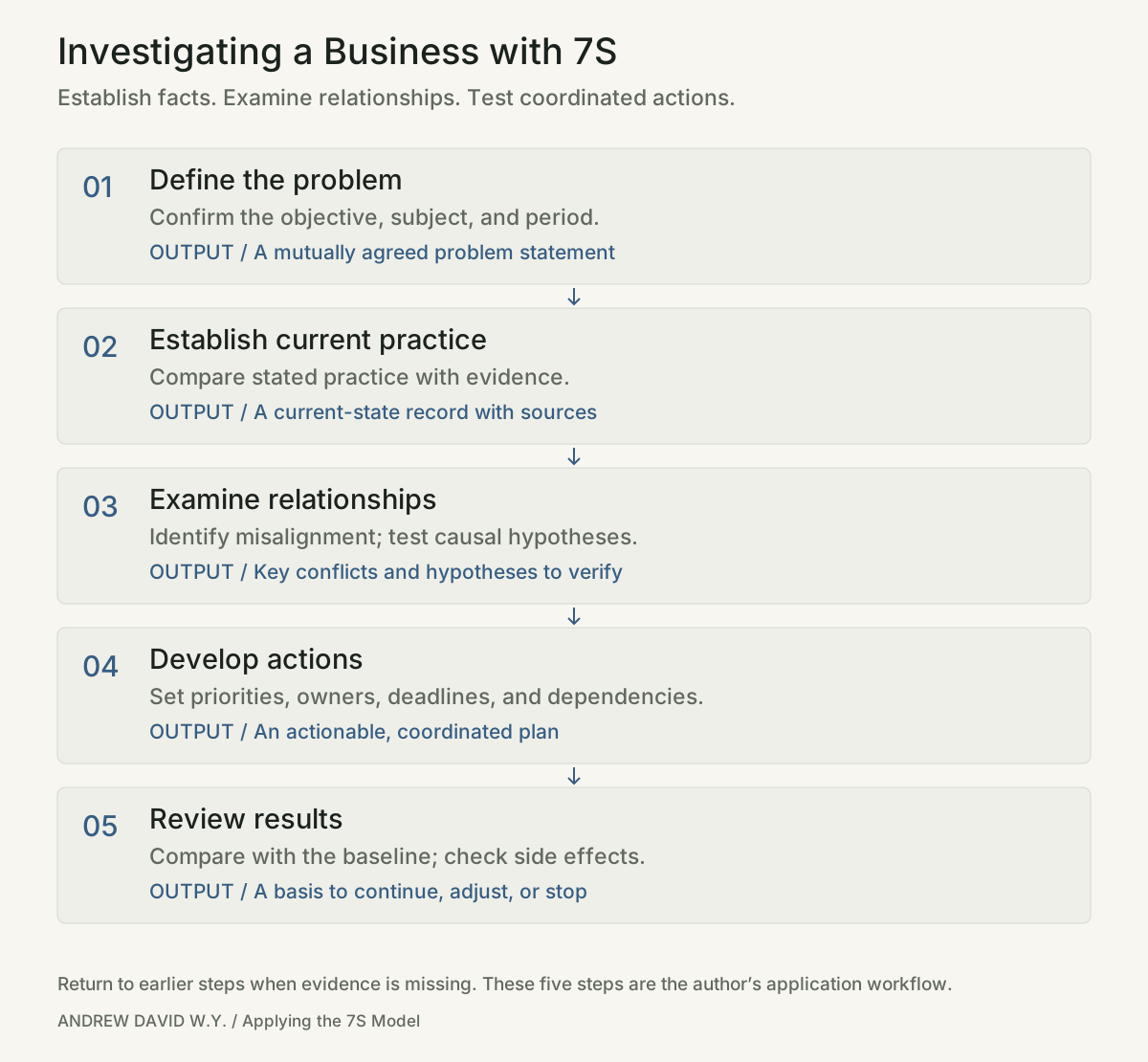
Step 1: Define the Problem and Its Boundaries
Confirm the business objective, the subject of the diagnosis, and the period under review. Distinguish the observed problem from the owner’s explanation of its cause. If the owner says “employees do not take responsibility,” ask what specifically happened rather than immediately treating that statement as a conclusion.
Output: a problem statement accepted by both parties.
Step 2: Establish Actual Practice in the Seven Dimensions
In every dimension, distinguish what the business claims to do from what it actually does. Interview the owner, relevant managers, and people doing the work. Examine policies, data, and work records, and trace processes through real projects.
Where information is missing, record “to be verified.” Do not invent a story to complete the table. Conflicting interview accounts are themselves a finding that requires further investigation.
Output: a current-state record with traceable evidence.
Step 3: Examine Relationships and Develop Testable Hypotheses
First check whether the seven elements support the same objective, then examine conflicts between them. A relationship diagram or pairwise matrix may help, but there is no need to explain every possible pairing.
Prioritize relationships that could explain the current problem: objectives and resources, responsibility and authority, incentives and behavior, promises and capabilities, and values and actual choices.
Output: key misalignments and causal hypotheses to test.
Step 4: Translate Judgment into Coordinated Actions
Choose a small number of priorities based on impact, strength of evidence, feasibility, and dependencies. Each action must specify who is responsible, what changes first, which other changes are required, and how effectiveness will be assessed.
“Improve management,” “strengthen training,” or “enhance culture” is insufficient. An actionable proposal is closer to: “Introduce solution and delivery review before contracts are signed in the pilot projects, clarify approval authority, and adjust sales bonuses to include order-quality conditions.”
Output: an action plan with owners, deadlines, and supporting changes.
Step 5: Review Results and Check for New Conflicts
Establish a baseline before the pilot, then examine outcomes and side effects. Has the additional review reduced rework while also slowing routine approvals? Has delegation reduced waiting while revealing capability gaps?
The review may support the original hypothesis or show that the explanation needs revision. The model helps us keep checking; it does not confer authority on our first judgment.
Output: a basis for continuing, adjusting, or stopping the action.
A Minimal Investigation Worksheet
| Element | Stated practice | Actual facts and sources | Effect on the objective / conflicts with other elements | Questions to verify |
|---|---|---|---|---|
| Strategy | ||||
| Structure | ||||
| Systems | ||||
| Style | ||||
| Staff | ||||
| Skills | ||||
| Shared Values |
Keep facts, judgments, and recommendations separate. “The current bonus policy rewards contract value only” is a verifiable fact. “This may encourage salespeople to overlook delivery difficulty” is a causal hypothesis. “Introduce order-quality conditions in the pilot” is a recommendation. These three statements are not equivalent.
6. Use 7S with an Understanding of Its Limits
7S is best suited to examining internal organizational alignment. On its own, it cannot establish market demand, competitive advantage, or whether a business model is profitable. Nor can it replace cash-flow or financial analysis. A highly aligned organization may still be pursuing the wrong direction together.
Begin with the business problem and external facts, then use 7S to examine whether the organization can support the corresponding choices. There is no need to seek “perfect harmony” across all seven dimensions. Businesses keep changing; practical improvement means reducing critical conflicts within real constraints and continually checking results.
For owners, the most useful question is: In pursuing our current objective, which arrangements reinforce one another, and which cancel one another out?
For consulting apprentices, the essential practice is: Identify elements in the facts, relationships between the elements, and then judgments and actions that can be tested.
Following the thinking path of “map the complexity, simplify it, make it workable, and express it visually,” 7S can help us first map how a business operates, then identify the relationships that influence outcomes, and finally turn those relationships into diagrams and actions that people can discuss, check, and improve together.
Memorizing seven names will not solve a business’s problems. The real value is a shared language for owners and consultants: turning vague impressions into observable facts, and scattered judgments into an understanding of how the whole organization operates.