How Can Co-Creation Lead to Shared Prosperity? — Reading the APEC Shenzhen Outlook
Reading the APEC Shenzhen Outlook, I bring the question of shared prosperity back to enterprise cooperation: conduct value acceptance and contribution review separately, record contribution confirmation, fulfil rights on the agreed terms, and test shared growth through income, capabilities, experience and continued participation.
Reading & sharing
Reading the 2026 APEC Leaders’ Shenzhen Outlook, I returned to a question I have been studying lately: once different people have created value together, how can their inputs be recognized, their cooperation continue, and the participants grow through the process?
When a business becomes more efficient, creates more products and services, and earns new revenue, what arrangements can connect these results to the people who helped create them in a lasting way?
That is the question I want to bring back to business practice after reading this document.
The Shenzhen Outlook addresses regional economic cooperation in the Asia-Pacific. It connects technological progress with broad benefits, calls for “sharing the benefits of digital transformation with all our peoples,” and pays attention to workers’ skills and rights. It also supports access to the finance, assets, training and technology that micro, small and medium-sized enterprises need to develop. Its closing section emphasizes the importance of business communities and other stakeholders as partners in cooperation.[1]
These statements give me a starting point for further research. The document upholds voluntary, non-binding and consensus-based principles of cooperation. What follows on contribution confirmation, rights arrangements and lasting capital relationships is my own thinking at the enterprise level, drawing on Stakeholder Capital Theory.[2]
My first thought is that people need practical conditions that enable them to take part in co-creation.
Someone who wants to join a piece of work also needs to know what they can do, how to get involved, to whom they will deliver, and how their completed work will be assessed. When a business adopts new technology, the people using it need opportunities to learn, understand the work requirements and adapt to changes in the process.
These conditions affect who gets the opportunity to participate and who can continue participating.
I therefore understand shared growth to include income and returns, as well as stronger capabilities, accumulated experience, dependable expectations of cooperation and opportunities to keep creating value. Employees, customers, suppliers and providers of funds do not all have the same concerns. Taking those differences into account in the rules makes it possible to design participation arrangements that fit different roles.
The Shenzhen Outlook’s discussion of smaller enterprises also leads me back to the question of how to organize resources.
A business usually needs funds, technology, people, management, customers and markets at the same time. Once funds are invested, how do they become a sustained ability to deliver? Once technology enters the business, who organizes its use, and how do customers validate the results? These relationships need to be arranged together.
In the four-ecosystem framework I am studying, the resource ecosystem provides people, technology and capabilities for cooperation. The operations and management ecosystem organizes the business, controls costs and delivers. The customer ecosystem tests value through demand, purchases and use. The capital ecosystem connects suitable funding with arrangements for risk-bearing and returns.
These four ecosystems need clear working connections and responsibilities. In actual operations, we need to explain how an input at one stage enables another, and how the resulting benefits can flow back to the participants.
These are the connections that Stakeholder Capital Theory seeks to study further.
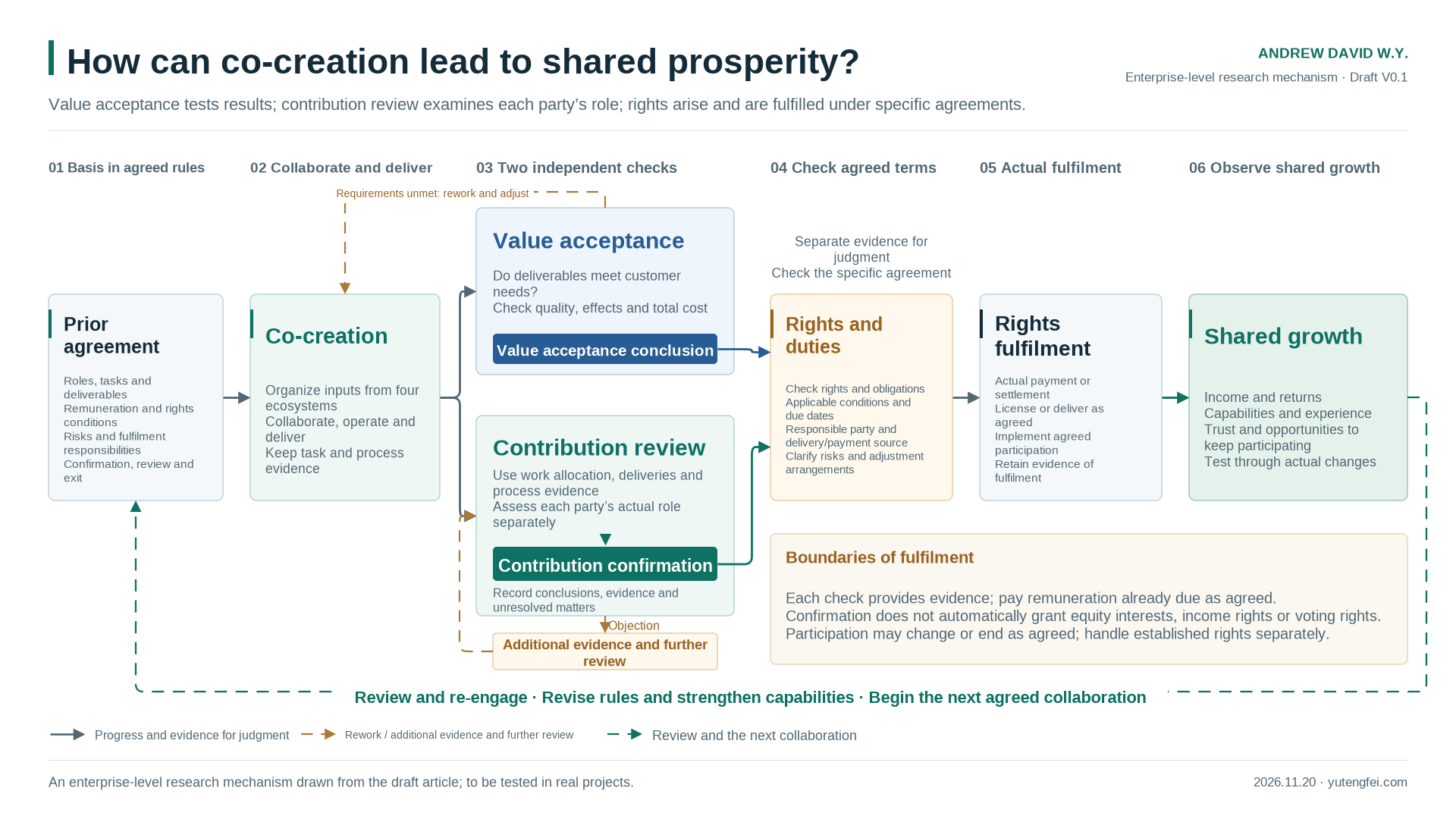
Inputs from several parties produce shared results. Operations and customers test those results, and explicit agreements connect them with the relevant remuneration, rights, responsibilities and lasting relationships. Several parts of this process need to be put on a firm footing separately:
Reach agreements before participation and keep evidence during collaboration. For the deliverables, conduct value acceptance and contribution review separately. Contribution confirmation records the conclusions, supporting evidence and unresolved matters arising from the contribution review. The two checks each provide a basis for checking specific rights and obligations, which are then fulfilled as agreed.
After fulfilment, we also need to observe what has actually changed for the participants and bring those lessons into the next round of cooperation. When each step can be traced to particular people, matters and records, lasting relationships gradually gain a foundation.

View original SVG · Download editable Draw.io source
I will use a hypothetical enterprise AI project to examine how these relationships might develop.
Suppose a smaller business wants to organize its internal knowledge and use AI to improve customer service. The business provides operational materials; employees who know the business organize their experience; outside collaborators design the knowledge structure and workflows; software and tool providers supply technical support; and the management team organizes implementation. Customer feedback helps test the results.
If the time taken to handle problems falls after the project, I would assess that result against the customer needs agreed in advance, checking delivery quality, actual effects and total cost. Tool fees, training, human review and subsequent maintenance all need to be included. I would also ask whether the experience has been retained, whether employees can keep using the system, and whether someone remains responsible when customers encounter complex problems.
This value acceptance asks whether the results are effective within the agreed scope. Where requirements have not been met, responsibility for rework and adjustment needs to be clear, followed by a check of the improvements.
A separate contribution review can examine the same collaboration. It needs to consider the division of work, actual deliveries and process records to judge what each party did. Customer acceptance of the overall result provides evidence about the result; judging individual contributions also requires evidence about the matters each party undertook and the inputs they actually made.
The two checks can proceed in parallel or develop as evidence becomes available. Each needs clear criteria and responsibility for confirmation. Some contributions can be identified quite clearly, while some results come from collaboration and are difficult to divide precisely into individual shares. That makes prior agreements, process records and review procedures more important.
Contribution confirmation records the judgments produced by the contribution review. It states who confirms them, on what evidence and which matters still need to be checked. When there is an objection, people should be able to provide additional evidence and obtain a further review, with any changes to the conclusions recorded. Confirmation on that basis is easier for those involved to understand and can support the subsequent checking of rights under the agreement.
I want to remain specific when discussing rights arrangements.
Service fees, wages, intellectual property licenses, contractual revenue shares, equity and participation in governance each have different conditions for their establishment and different ways of being fulfilled. Checking rights and obligations means referring to the particular agreement: has the right arisen, what conditions apply, when does it fall due, who must fulfil it, what is the source for delivery or payment, and how will the arrangement change if conditions change?
The two checks provide their respective evidence, while each right is dealt with according to its own conditions and timing. Remuneration that has already become payable and fallen due should be paid as agreed. A dispute within the contribution review should also be confined to the relevant matters and handled separately. The diagram’s two paths should not be read as requiring every payment to wait until both checks have been completed.
Recording and confirming a contribution does not automatically create equity, income rights or voting rights. Existing rights are checked against agreements that have already been established. If the parties wish to develop a further long-term relationship, they need corresponding arrangements. Continuing revenue shares need a calculation basis that can be checked; participation in governance needs defined matters and authority; and equity requires the relevant entity conditions and procedures.
Fulfilment of rights needs to take the form of actual payment or settlement, licensing or delivery as agreed, and implementation of the agreed participation arrangements, with corresponding evidence retained. Confirmation records and records of fulfilment establish different facts. Together, they help participants check how far promises have actually been delivered.
The lasting capital relationships I study take shape through these specific arrangements: participants can understand how their inputs will be treated, the business can be clear about its obligations, and operating results can flow back to the relevant participants when the agreed conditions are met.
The capacity to fulfil those obligations also needs to be tested.
What value has the business created? Will customers continue to pay? Have funds actually returned to operations? Can cash support payment obligations that have already arisen? These questions directly affect lasting relationships. Judgments about future growth should also retain assumptions that have not yet been tested and explain how the arrangements will adapt if conditions change.
Keeping records and governing cooperation also have costs. The time spent assessing, reviewing and coordinating, and whether the added procedures actually help people work together, need to be observed in the same practical project.
Shared growth also needs to be tested through actual changes. It is worth following the income and returns participants receive, whether they accumulate capabilities and experience, whether cooperation builds trust, and whether they have opportunities to participate again. A completed payment is a fact of fulfilment. Whether these wider changes emerge and endure still needs to be observed through operations.
After reviewing the experience, parties who want to keep working together can revise the rules for the next round, strengthen their capabilities and return to co-creation. Participation arrangements should also allow adjustment or exit on the agreed terms, while rights that have already arisen are dealt with separately. Changes to the next round’s arrangements need to be understood by the relevant participants and set out in a new agreement.
In building WISERUNION Company Zero, I want to start by taking one project with a sufficiently small scope and a deliverable we can genuinely complete through the whole process.[3]
First define the customer’s problem, the participating roles, work requirements and rights arrangements. Then record delivery, value acceptance, contribution review and confirmation, receipts and expenditure, and fulfilment of the agreement separately. Keep a record of any matters in dispute and how additional evidence and further review are handled. How knowledge and methods can be retained, and what execution and records the NST software can support, will also be tested through this process.
These remain directions for research and practice that I am working on. When a project makes progress, we need to examine which mechanisms helped. When problems arise, we also need to distinguish the effects of the market, resources, execution and institutional arrangements. Keep what proves useful and revise what does not fit.
There is still a long way to go from reading a document to doing the detailed work of a business.
The Shenzhen Outlook connects regional cooperation, technological development and benefits for people. My further question is what organizational capabilities and institutional arrangements are needed to turn those directions into changes that participants can actually experience in businesses and projects.
Can co-creation help people develop new capabilities? Can the results pass value acceptance? Can each party’s actual role be clearly confirmed through contribution review? Can established agreements continue to be fulfilled through operations? These are questions I want to keep examining through Stakeholder Capital Theory and the practical work of Company Zero.
My next step is to leave a concrete example that others can check. I want to record how the work was completed, how value was created, how each party participated and how the results flowed back to the participants, then continue in light of what actually happened.
[1] 2026 APEC Leaders’ Shenzhen Outlook, full Chinese text, November 19, 2026. This article focuses on innovation, economic growth and stakeholder participation, corresponding to paragraphs 12–15, 19 and 22 of the official English text.
[2] The Capital Logic and Pathways of Stakeholder Capital Theory, November 14, 2026. This article continues the framework used there to discuss the four ecosystems, contributions and rights, operational fulfilment and lasting capital relationships.
[3] Thinking through how Company 0 should operate, October 27, 2026.