Source and version
Integrating Insights From the Resource-Based View of the Firm Into the New Stakeholder Theory
Anita M. McGahan
Journal of Management 2021, 47(7): 1734-1756; https://doi.org/10.1177/0149206320987282
Source reading copy / 2021
Access and review
Original English reading edition and six independently prepared translations, freely available for study and research. AI context review does not constitute native-speaker, expert or line-by-line human approval. These are not official translations. Check the English source when citing.
The original and adaptations on this page follow the license below, excluding separately credited third-party material. CC BY-NC 4.0 · Original
PDF page 1
Check the English source page
https://doi.org/10.1177/0149206320987282 Journal of Management Vol. 47 No. 7, September 2021 1734–1756 DOI: 10.1177/0149206320987282 © The Author(s) 2021 Article reuse guidelines: sagepub.com/journals-permissions Integrating Insights From the Resource-Based View of the Firm Into the New Stakeholder Theory Anita M. McGahan University of Toronto A powerful new stakeholder theory (NST) of strategic management is emerging. The theory, which is yet incomplete, offers novel and precise tools for understanding stakeholder involvement in organizations. This article identifies open questions in the NST in five areas (organizational formation, resource development, claims on value, governance, and performance) and suggests ways in which insights from the resource-based view of the firm advance answers to these questions. The conclusion emphasizes that because stakeholders bind resources to organizations, neither the resource-based view nor the new stakeholder view is complete without the other. Keywords: resource-based view; stakeholder theory; strategic human capital; corporate governance An emerging new stakeholder theory (NST) of strategic management is evolving from early arguments about the ethical legitimacy of stakeholder claims on organizations (Donaldson & Preston, 1995; Freeman, 1984) to address precise questions about stakeholder involvement in value creation (Jourdan, Kivleniece, & McGahan, 2019; Klein, Mahoney, McGahan, & Pitelis, 2019; Tantalo & Priem, 2014), enfranchisement (Klein et al., 2019; McGahan, 2020), uniqueness (Kaul, 2013), rights (Dorobantu & Odziemkowska, 2017), claims (Barney, 2018, 2020; Blair & Stout, 1999; Stout, 2012), governance (Klein et al., 2019; Mahoney, 2012), trade-offs (Kaplan, 2019, 2020; Porter & Kramer, 2004), Acknowledgments: Thanks to Aseem Kaul, David Ketchen, Peter Klein, Joe Mahoney, Kate Odziemkowska, Leandro Pongeluppe, and Thomaz Teodorovicz for comments and suggestions. All errors are my own. Corresponding author: Anita M. McGahan, University of Toronto, 105 St George Street, Toronto, ON M5S3E6, Canada. E-mail: Anita.McGahan@Rotman.Utoronto.Ca 987282JOMXXX10.1177/0149206320987282Journal of ManagementMcGahan / research-article2021
PDF page 2
Check the English source page
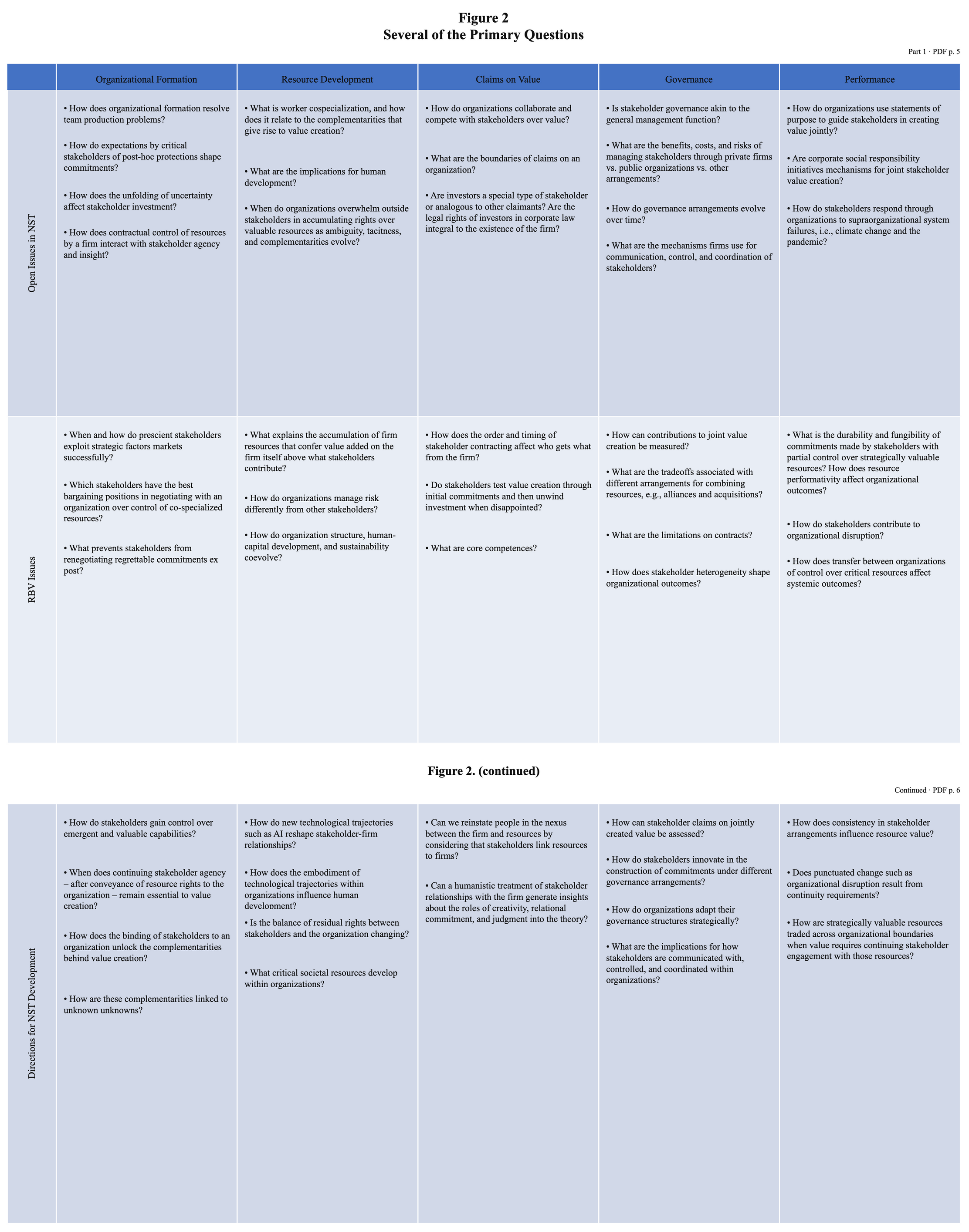
cospecialization (Coff, 2010), retention (Buttner & Lowe, 2017), and human development (Morris, Alvarez, Barney, & Molloy, 2017). The NST relies primarily on economic and legal arguments that stakeholders will sustain their connection to an organization only if they expect and ultimately receive appropriate returns on their contributions. Much of the theory seeks to deal precisely with what this means. Accumulating insights point to the opportunity for a new theory of organization that integrates stakeholder considerations formally with established ideas in the field of management (Amis, Barney, Mahoney, & Wang, 2020; Barney & Harrison, 2020; Barney, Wright, & Ketchen, 2001; Mahoney, 2012; Zingales, 2000). Demand for theorizing about stakeholder claims also reflects practical developments, such as the 2019 Business Roundtable endorsement (Gelles & Yaffe-Bellany, 2019). The purpose of this article is to encourage development of the NST through integration of ideas from the resource-based view of the firm (Amit & Schoemaker, 1993; Barney, 1986a, 1986b, 1991, 2001; Rumelt, 1984; Wernerfelt, 1984). To accomplish this, I describe several critical questions arising from the NST in five important areas: organizational formation, resource development, claims on value, governance, and performance. On each topic, I then turn to the resource-based view of the firm—with emphasis on early theoretical work—for insights on how answers to these questions might be obtained. Figure 1 lists the papers cited in each area. Each of the five sections concludes with directions for further development of our ideas about stakeholders and the resources that the organization controls. Figure 2 is a summary table of the main points. The conclusion points to directions for the evolution of the NST. Organizational Formation A foundational idea on which the NST relies is that organizations form to enable teams of stakeholders to create more value jointly than the stakeholders can create independently (Alchian & Demsetz, 1972; Coase, 1937). NST scholars build on this idea—often with reference to the resource-based view—to examine its implications for a theory of organizational formation. Asher, Mahoney, and Mahoney (2005) investigate how the property rights of participating stakeholders create an implicit bargaining problem (Coase, 1937) that must be resolved for a firm to form. Hoskisson, Gambeta, Green, and Li (2018) describe how expectations by critical stakeholders of post hoc protections over firm-specific investments shape the incentives of those stakeholders to engage with the firm in the first place. Foss and Klein (2018) clarify how “unknown unknowns” (i.e., Knightian uncertainty) is integral to organizational formation because it is the unknowable that creates the potential for high joint return.
Klein, Mahoney, McGahan, and Pitelis (2012) suggest that success in organizing a firm to deploy complementary, cospecialized assets controlled by stakeholders requires enough potential upside to make participation a better choice for stakeholders than outside opportunities. This view of how and why organizations are formed is therefore highly aligned with the resource-based view. Yet there is at least one facet of organization formation as conceptualized under the NST that has not been fully developed or integrated with the resource-based view, and that is the idea from legal scholarship that resources cannot be combined in a firm without some form of contractual commitment by a controlling entity (Blair & Stout, 1999; Stout, 2012). It is the contractual control—implicit or explicit, clear or unclear, emergent or well defined— of specific valuable resources, including human resources, by early stakeholders in an
PDF page 3
Check the English source page
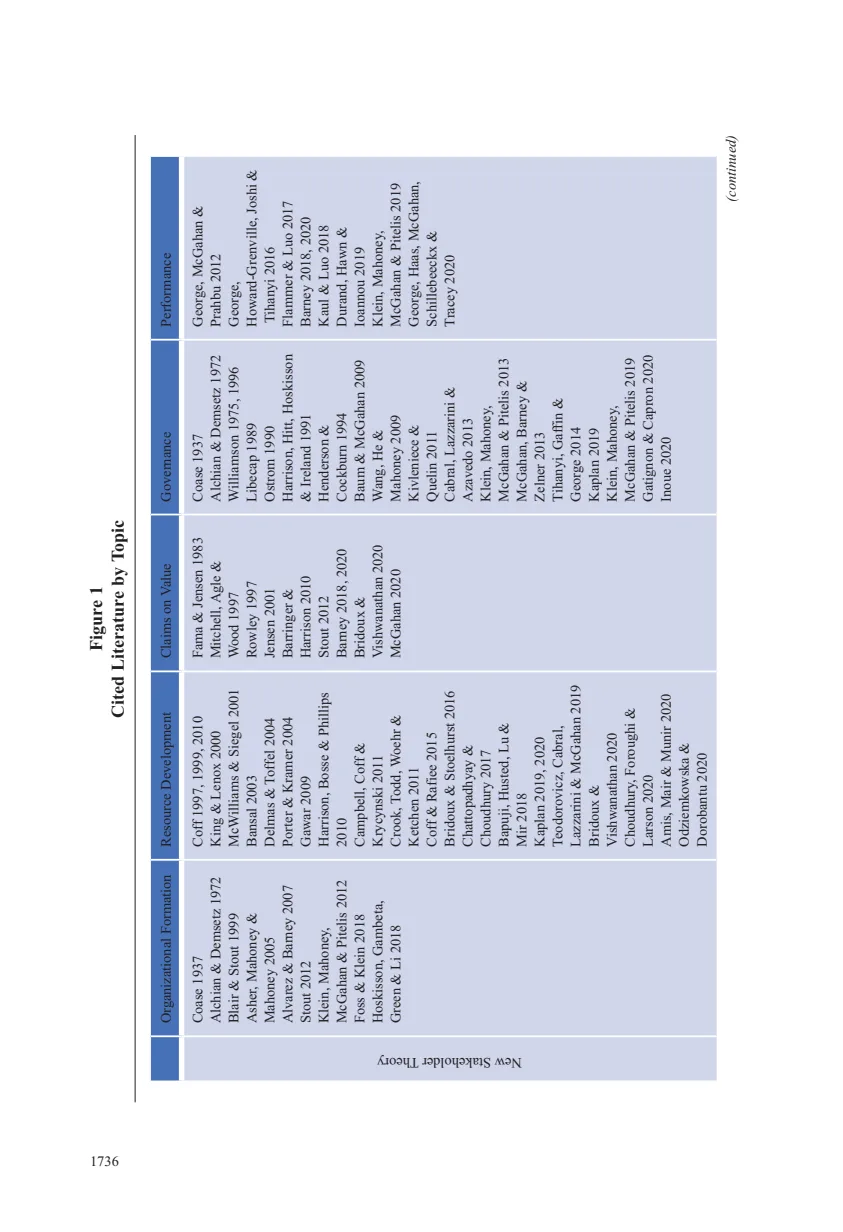
1736Figure 1 Cited Literature by Topic Organizational Formation Resource Development Claims on Value Governance Performance New Stakeholder Theory Coase 1937 Alchian & Demsetz 1972 Blair & Stout 1999 Asher, Mahoney & Mahoney 2005 Alvarez & Barney 2007 Stout 2012 Klein, Mahoney, McGahan & Pitelis 2012 Foss & Klein 2018 Hoskisson, Gambeta, Green & Li 2018 Coff 1997, 1999, 2010 King & Lenox 2000 McWilliams & Siegel 2001 Bansal 2003 Delmas & Toffel 2004 Porter & Kramer 2004 Gawar 2009 Harrison, Bosse & Phillips 2010 Campbell, Coff & Krycynski 2011 Crook, Todd, Woehr & Ketchen 2011 Coff & Rafiee 2015 Bridoux & Stoelhurst 2016 Chattopadhyay & Choudhury 2017 Bapuji, Husted, Lu & Mir 2018 Kaplan 2019, 2020 Teodorovicz, Cabral, Lazzarini & McGahan 2019 Bridoux & Vishwanathan 2020 Choudhury, Foroughi & Larson 2020 Amis, Mair & Munir 2020 Odziemkowska & Dorobantu 2020 Fama & Jensen 1983 Mitchell, Agle & Wood 1997 Rowley 1997 Jensen 2001 Barringer & Harrison 2010 Stout 2012 Barney 2018, 2020 Bridoux & Vishwanathan 2020 McGahan 2020 Coase 1937 Alchian & Demsetz 1972 Williamson 1975, 1996 Libecap 1989 Ostrom 1990 Harrison, Hitt, Hoskisson & Ireland 1991 Henderson & Cockburn 1994 Baum & McGahan 2009 Wang, He & Mahoney 2009 Kivleniece & Quelin 2011 Cabral, Lazzarini & Azavedo 2013 Klein, Mahoney, McGahan & Pitelis 2013 McGahan, Barney & Zelner 2013 Tihanyi, Gaffin & George 2014 Kaplan 2019 Klein, Mahoney, McGahan & Pitelis 2019 Gatignon & Capron 2020 Inoue 2020 George, McGahan & Prahbu 2012 George, Howard-Grenville, Joshi & Tihanyi 2016 Flammer & Luo 2017 Barney 2018, 2020 Kaul & Luo 2018 Durand, Hawn & Ioannou 2019 Klein, Mahoney, McGahan & Pitelis 2019 George, Haas, McGahan, Schillebeeckx & Tracey 2020 (continued)

The reconstruction preserves visible source structure. Plotted geometry does not recover underlying raw data.
PDF page 4
Check the English source page
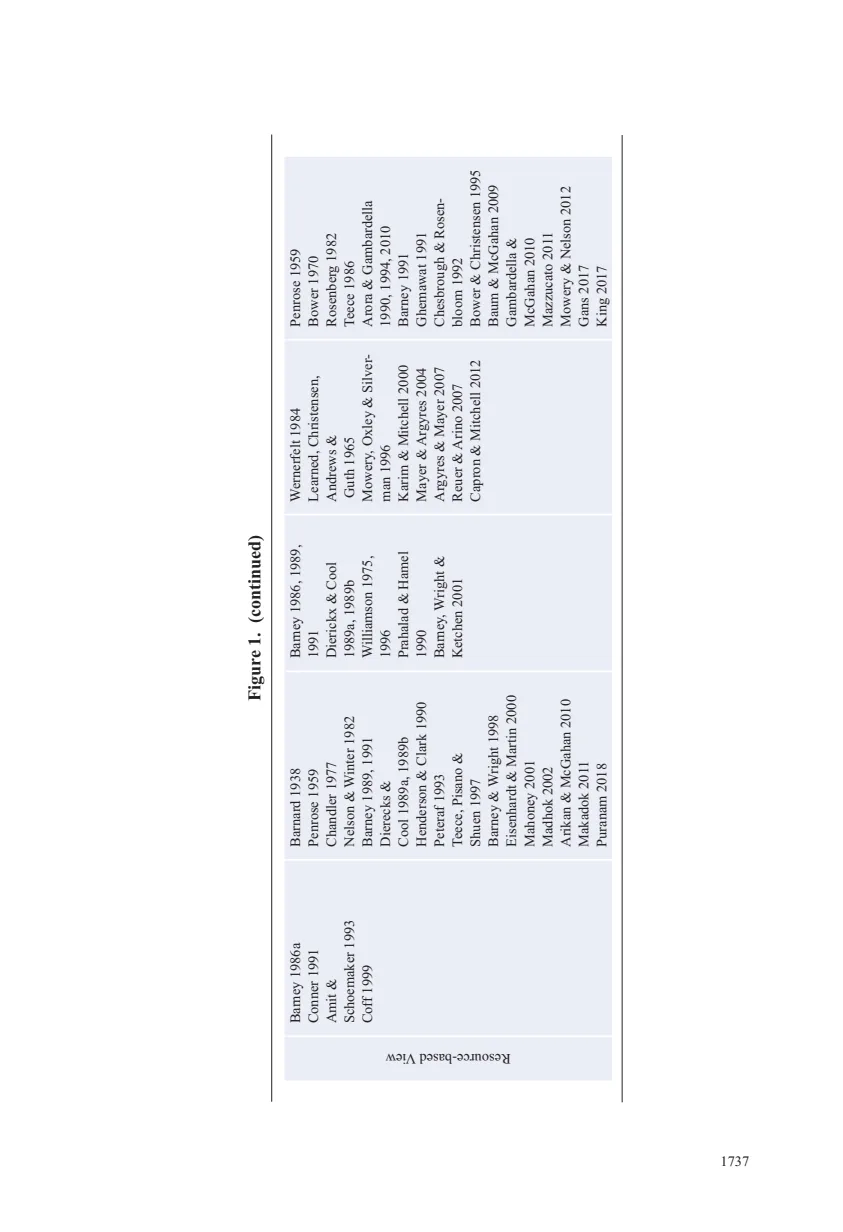
Resource-based View Barney 1986a Conner 1991 Amit & Schoemaker 1993 Coff 1999 Barnard 1938 Penrose 1959 Chandler 1977 Nelson & Winter 1982 Barney 1989, 1991 Dierecks & Cool 1989a, 1989b Henderson & Clark 1990 Peteraf 1993 Teece, Pisano & Shuen 1997 Barney & Wright 1998 Eisenhardt & Martin 2000 Mahoney 2001 Madhok 2002 Arikan & McGahan 2010 Makadok 2011 Puranam 2018 Barney 1986, 1989, 1991 Dierickx & Cool 1989a, 1989b Williamson 1975, 1996 Prahalad & Hamel 1990 Barney, Wright & Ketchen 2001 Wernerfelt 1984 Learned, Christensen, Andrews & Guth 1965 Mowery, Oxley & Silverman 1996 Karim & Mitchell 2000 Mayer & Argyres 2004 Argyres & Mayer 2007 Reuer & Arino 2007 Capron & Mitchell 2012 Penrose 1959 Bower 1970 Rosenberg 1982 Teece 1986 Arora & Gambardella 1990, 1994, 2010 Barney 1991 Ghemawat 1991 Chesbrough & Rosenbloom 1992 Bower & Christensen 1995 Baum & McGahan 2009 Gambardella & McGahan 2010 Mazzucato 2011 Mowery & Nelson 2012 Gans 2017 King 2017
Figure 1. (continued)
PDF page 5
Check the English source page
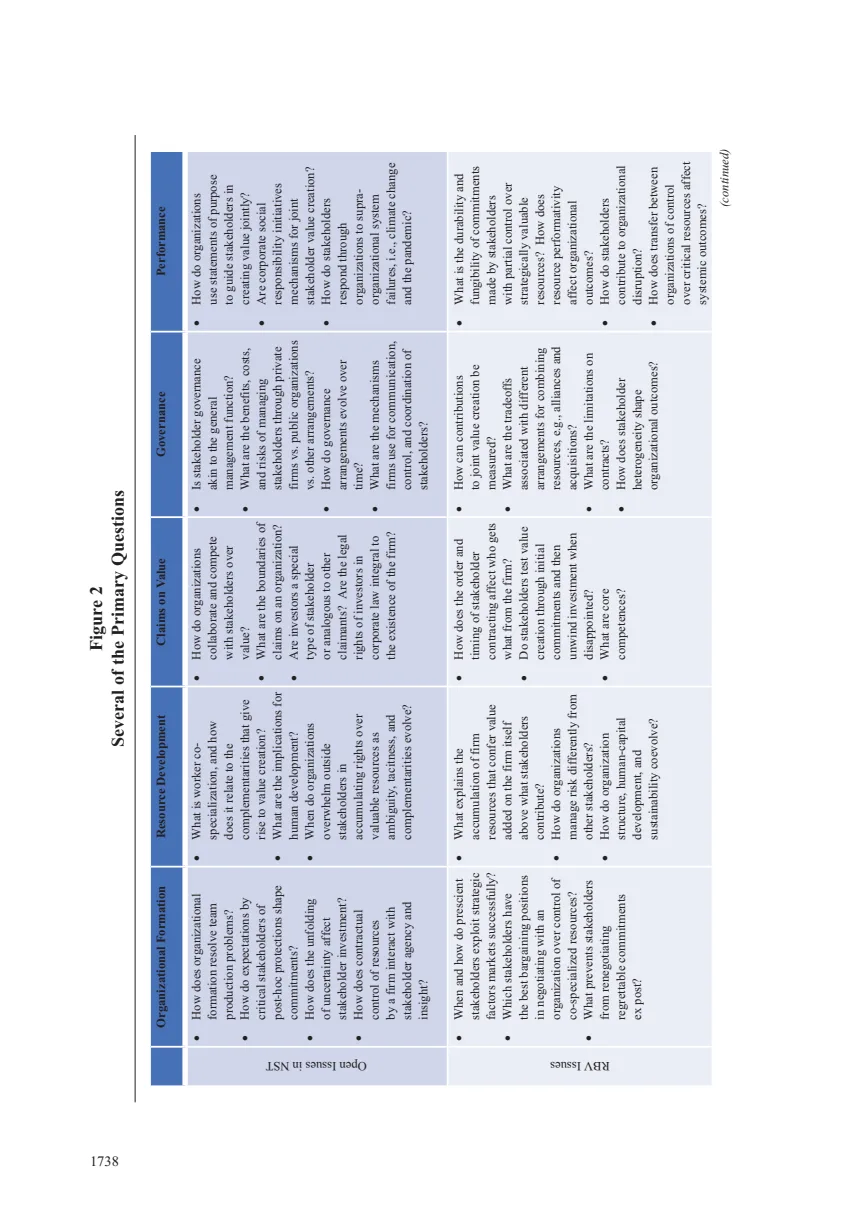
1738Figure 2 Several of the Primary Questions Organizational Formation Resource Development Claims on Value Governance Performance Open Issues in NST • How does organizational formation resolve team production problems? • How do expectations by critical stakeholders of post-hoc protections shape commitments? • How does the unfolding of uncertainty affect stakeholder investment? • How does contractual control of resources by a firm interact with stakeholder agency and insight? • What is worker cospecialization, and how does it relate to the complementarities that give rise to value creation? • What are the implications for human development? • When do organizations overwhelm outside stakeholders in accumulating rights over valuable resources as ambiguity, tacitness, and complementarities evolve? • How do organizations collaborate and compete with stakeholders over value? • What are the boundaries of claims on an organization? • Are investors a special type of stakeholder or analogous to other claimants? Are the legal rights of investors in corporate law integral to the existence of the firm? • Is stakeholder governance akin to the general management function? • What are the benefits, costs, and risks of managing stakeholders through private firms vs. public organizations vs. other arrangements? • How do governance arrangements evolve over time? • What are the mechanisms firms use for communication, control, and coordination of stakeholders? • How do organizations use statements of purpose to guide stakeholders in creating value jointly? • Are corporate social responsibility initiatives mechanisms for joint stakeholder value creation? • How do stakeholders respond through organizations to supraorganizational system failures, i.e., climate change and the pandemic? RBV Issues • When and how do prescient stakeholders exploit strategic factors markets successfully? • Which stakeholders have the best bargaining positions in negotiating with an organization over control of co-specialized resources? • What prevents stakeholders from renegotiating regrettable commitments ex post? • What explains the accumulation of firm resources that confer value added on the firm itself above what stakeholders contribute? • How do organizations manage risk differently from other stakeholders? • How do organization structure, human-capital development, and sustainability coevolve? • How does the order and timing of stakeholder contracting affect who gets what from the firm? • Do stakeholders test value creation through initial commitments and then unwind investment when disappointed? • What are core competences? • How can contributions to joint value creation be measured? • What are the tradeoffs associated with different arrangements for combining resources, e.g., alliances and acquisitions?
• What are the limitations on contracts? • How does stakeholder heterogeneity shape organizational outcomes? • What is the durability and fungibility of commitments made by stakeholders with partial control over strategically valuable resources? How does resource performativity affect organizational outcomes? • How do stakeholders contribute to organizational disruption? • How does transfer between organizations of control over critical resources affect systemic outcomes? (continued)
The reconstruction preserves visible source structure. Plotted geometry does not recover underlying raw data.
PDF page 6
Check the English source page
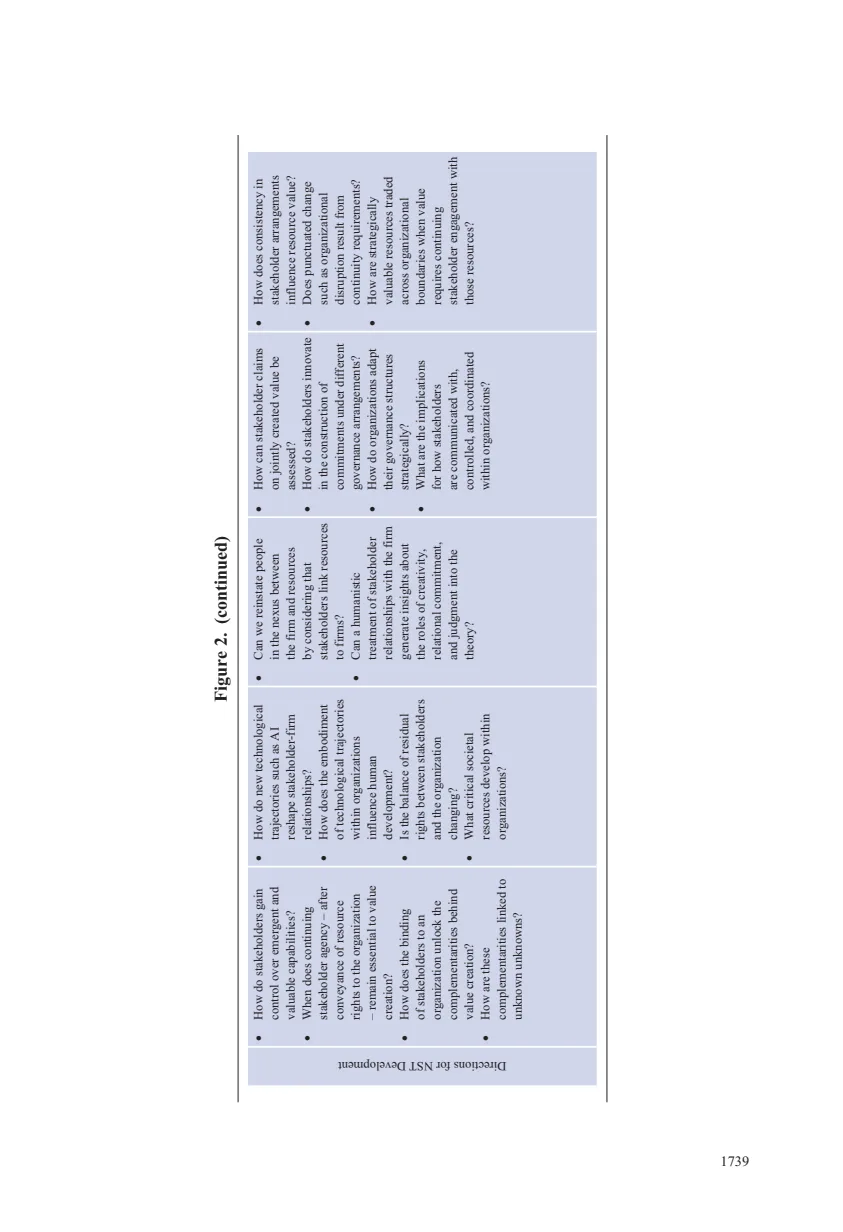
Directions for NST Development • How do stakeholders gain control over emergent and valuable capabilities? • When does continuing stakeholder agency – after conveyance of resource rights to the organization – remain essential to value creation? • How does the binding of stakeholders to an organization unlock the complementarities behind value creation? • How are these complementarities linked to unknown unknowns? • How do new technological trajectories such as AI reshape stakeholder-firm relationships? • How does the embodiment of technological trajectories within organizations influence human development? • Is the balance of residual rights between stakeholders and the organization changing? • What critical societal resources develop within organizations? • Can we reinstate people in the nexus between the firm and resources by considering that stakeholders link resources to firms? • Can a humanistic treatment of stakeholder relationships with the firm generate insights about the roles of creativity, relational commitment, and judgment into the theory? • How can stakeholder claims on jointly created value be assessed? • How do stakeholders innovate in the construction of commitments under different governance arrangements? • How do organizations adapt their governance structures strategically? • What are the implications for how stakeholders are communicated with, controlled, and coordinated within organizations? • How does consistency in stakeholder arrangements influence resource value? • Does punctuated change such as organizational disruption result from continuity requirements? • How are strategically valuable resources traded across organizational boundaries when value requires continuing stakeholder engagement with those resources?
Figure 2. (continued)
PDF page 7
Check the English source page
1740 Journal of Management / September 2021
organization that the NST emphasizes. As a result, entrepreneurship under the NST can be conceptualized as the early accumulation of property rights over resources and capabilities by insightful, risk-taking, or lucky actors who subsequently exercise those rights to deploy the controlled resources and capabilities creatively. Whether acting as individuals or on behalf of established organizations, the role of human actors in contractual control suggests that, in at least an important set of cases, value-creating opportunities may follow the people rather than the resources. Some of these people may be walking out of ossifying old organizations that have been fined-tuned in ways that are out of alignment with their current priorities (putting the NST in contact with the disruption and global challenges literatures—more on that later). This means that entrepreneurial opportunity may be linked both to the past and to “unknown unknowns” about the future (Alvarez & Barney, 2007). The psychological and social processes that lead critical stakeholders to envision how resources can be recombined fruitfully away from old uses into new organizations take center stage. Just as Conner (1991) explored the relationship between the resource-based view and its antecedents in industrial organization, we face an opportunity to explore the relationship between the NST and the resource-based view. So how can the resource-based view advance the NST’s conceptualization of organizational formation? Barney (1986b) points us to strategic factor markets and the importance to organizational profitability of engaging stakeholders before information about the organizational opportunity leaks into the public domain and increases stakeholder prices. This point generalizes for the NST to questions about the order in which stakeholders are engaged and the ways in which information about joint value is revealed. At its foundation, the argument in Barney (1986b) emphasizes asymmetric understanding and/or good fortune in initial contracting, which raises questions about renegotiation and regret that have yet to be fully investigated in the NST. Amit and Schoemaker (1993) define strategically important resources and link them to organizational rent, which takes NST scholars on a path toward unpacking the team production function that gives rise to the opportunity for combining stakeholder resources through an organization. Coff (1999) shows how the details of early contracts between the firm and initial stakeholders have long-standing implications for organizational performance, which indicates that NST scholars would benefit from understanding heterogeneity in bargaining capabilities upon organizational formation.
By investigating the core constructs of the resource-based view upon its inception, NST scholars are prompted to study how specific stakeholders gain control over emergent and valuable capabilities and to address why valuable capabilities and resources cannot be combined through markets. We must consider why and how markets fail to normalize the value of stakeholder resources as firms are formed and, perhaps most importantly, how the binding together of stakeholders through contractual ties to an organization unlocks the complementarities behind value creation. The connection between these stakeholder complementarities and the resolution of “unknown unknowns”—that is, Knightian uncertainties—must also be interrogated for the NST to develop fully. Resource Development Within the Organization The NST views resource development within the organization primarily from two perspectives. The first emphasizes human capital, and the second emphasizes interactions between the organization and external constituents, including communities, government,
PDF page 8
Check the English source page
supply-chain partners, investors, and customers. I refer to the first as human-capital development and the second as sustainability. Contributions in the NST on human-capital development focus on the evolution, structure, and consequences of worker capabilities over time. The most salient stream of research in this category deals with worker investment in skills and capabilities that are cospecialized to the organization. Coff (1997, 1999) describes the bargaining power that arises when workers develop firm-specific capital that serves as the source of the organization’s competitive advantage and the dilemmas that this creates for the organization. Campbell, Coff, and Kryscynski (2012) critically analyze the degrees to which workers are tied to the organization through cospecialization of skills and capabilities. Causal ambiguity in the team production function creates paradoxes and dilemmas both for the worker and for the organization (Coff & Krycynski, 2011; Coff & Raffiee, 2015). Management expertise and the nature of the work shape both the opportunities for human-capital development and the organizational paradoxes that arise from them (Chattopadhyay & Choudhury, 2017; Crook, Todd, Combs, Woehr, & Ketchen, 2011). A second stream of research, in the human capital category, emphasizes the degree to which workers are tied to organizations through mechanisms other than cospecialization, such as loyalty, reputation, reciprocity, and the absence of outside alternatives (Coff, 2010; Harrison, Bosse, & Phillips, 2010; Teodorovicz, Cabral, Lazzarini, & McGahan, 2019). A third stream investigates the perpetuation and amplification of inequalities among stakeholders as organizations develop and the consequences of asymmetries for both workers and organizations (Amis, Mair, & Munir, 2020; Bapuji, Husted, Lu, & Mir, 2018; Bridoux & Stoelhorst, 2016; Bridoux & Vishwanathan, 2020). Overall, a core theme within the NST is that the experiences of workers and other human stakeholders in interactions with organizations carry profound implications for both human development and the organization’s capacity to create value. Contributions in the NST on sustainability are fundamentally driven by the insight that the evolution of organizations favors the accumulation of resources and capabilities that strengthen the organization’s ability to create and capture value, often by taking control of resources and capabilities for which structured stakeholder representation is weak (Odziemkowska & Dorobantu, 2020). Bansal (2003), Delmas and Toffel (2004), and King and Lenox (2000) analyze the implications of this process for the environment. McWilliams and Siegel (2001) describe the supply and demand for corporate social responsibility (CSR) programs and suggest that an “ideal” level of CSR arises for organizations. Kaplan (2019, 2020) and Porter and Kramer (2004) describe the advantages and limitations of a “shared value” perspective in which organizations invest in low-voice stakeholder relationships. The core theme of the sustainability literature within the NST is that the causal ambiguity, tacitness, and complementarities that develop within organizations may powerfully overwhelm the capacity of external stakeholders to develop coherent positions in negotiating to protect external resources and capabilities of value to the firm.
How can the resource-based view advance the NST’s conceptualization of resource development within established organizations? There are three major areas of opportunity. The first arises from early insights in the resource-based view developed in Dierickx and Cool (1989a) that were the subject of a comment from Barney (1989) and a reply (Dierickx & Cool, 1989b). Dierickx and Cool (1989a) argued that Barney (1986b) was incomplete in that the combination of strategically important resources within a firm was
PDF page 9
Check the English source page
1742 Journal of Management / September 2021
insufficient for creating sustainable competitive advantage. What was required for advantage was the development within the firm of asset stocks that could not be acquired on markets (Dierickx & Cool, 1989a). The debate quickly resolved through the comment (Barney, 1989) and reply (Dierickx & Cool, 1989b) on the point that strategically acquired resources and internally developed assets are complementary rather than competing explanations for the achievement of sustainable competitive advantage. This argument is important for the NST because it suggests that the value created by a wellformed organization depends on the translation of the luck and/or foresight that gave rise to the accumulation of strategically important contractual relationships into a causally ambiguous, hard-to-imitate, impossible-to-trade approach for combining those resources to create something more than the sum of the parts. Barnard (1938) describes this approach as executive function, Barney (1986a) describes it as “culture,” Nelson and Winter (1982) considers this as routines and tacit knowledge embedded in organizational capabilities, and Barney (1991) more fully develops a framework for understanding the specific characteristics of the organization’s strategically valuable resources that emerge from this translation of insight into practice. The NST would benefit by considering the insights in these arguments about the complementarities between the acquisition by an organization of access to strategically important resources and the development within an organization of an approach—a strategy—for combining them (Arikan & McGahan, 2010). By doing this, human-capital development scholars will contend with the relationships between the diversity of employee capabilities (including their degrees of cospecialization with the organization), the character of opportunities for human actualization through continued interaction within an organization, and the nature of the organization’s unique competitive strength. The NST will confront questions regarding the relative strength of stakeholders—as compared with that of the organization—in representing their interests when the assets they hold have hard-to-quantify value outside of deployment by the organization. We will also have to deal with the strength and character of the contracts through which stakeholders tie resources to organizations. This is especially important because the dynamic capabilities of organizations (Eisenhardt & Martin, 2000; Teece, Pisano, & Shuen, 1997) to deepen and improve the effectiveness, efficiency, and relevance of internally developed resources and capabilities may intensify the organization’s ability to appropriate value both from human stakeholders and from underfunded representatives of the environment or of vulnerable communities. The implications for stakeholders of the dynamic process by which organizations turn from a moment of founding in which stakeholders are simultaneously represented (Madhok, 2002) to an ongoing operation in which resources and capabilities develop differentially have yet to be investigated.
The second major area of opportunity for the NST is in considering how organizations— especially firms operating under a legal limitation on liability—manage risk differently from other stakeholders. Chandler (1977), a resource-oriented thinker, explains that limitations on liability were essential historically to the formation and development of private railroads in the United States because they enabled the accumulation of investment capital and, simultaneously, coordination protocols that made large-scale deployment of resources possible. In general, the resource-based view rests squarely on theories of rent appropriation (Barney, 1991; Mahoney, 2001; Makadok, 2011; Penrose, 1959; Peteraf, 1993) that incorporate
PDF page 10
Check the English source page
various assumptions and contingencies regarding the bearing and accumulation of different types of uncertainty by organizations. The NST would benefit from considering the bearing of these different types of uncertainty by stakeholders unprotected by limitations on liability and by employees and other human stakeholders for which risk commensurate to the firm is disproportionately great (Barney & Wright, 1998). Asymmetries between stakeholders in ability to bear risk is of central importance to an organization’s strategy for obtaining access to valuable resources. Similarly, the resource-based view categorization of the choices made within organizations to appropriate value (Barney, 1991; Mahoney, 2001; Makadok, 2011; Penrose, 1959; Peteraf, 1993) can be integrated with both the human-capital development and sustainability streams of the NST in a unifying theoretical framework that enriches our understanding of how organizations mitigate and manage risk asymmetrically and differently from other parties to joint value creation. The third opportunity for the NST is to consider relationships between organization structure, human-capital development, and sustainability. Of course, many contributions at this intersection arise from research on organization behavior and organization theory. My focus here is on the contributions by scholars of the resource-based view to our understanding of organization structure and the implications for the NST. Henderson and Clark (1990) argue that the technological trajectories carry implications for organization architecture. If we conceive of technological trajectories as enlivened by the embedded, impossible-to-trade, difficult-to-imitate, valuable resources within the firm—in other words, the strategically valuable resources as defined by Barney (1991)—then Henderson and Clark (1990) point us toward the insight that an organization’s architecture is defined by the ways in which stakeholders interact within the organization to create and deploy strategically valuable resources. What holds stakeholders to a line in this effort is conceptualized in this research as a technological trajectory. We know as well that organization structure shapes internal communication and coordination between stakeholders that each control strategic resources (Puranam, 2018). Thus, a tension that is not fully understood exists between the constraints on the firm in enacting value along a technological trajectory, the creativity of human stakeholders in creating and deploying strategic resources, and the ways in which the evolution of organization structure drives firms to exploit external resources unsustainably. The NST faces an opportunity to consider these interrelationships. Consider that emerging technologies around advanced analytics, artificial intelligence, and machine learning are giving rise to new types of relationships between organizations and human stakeholders, such as extended contract work, regularized temporary work, and work from anywhere (Choudhury, Foroughi, & Larson, 2020). While studies on the resources and capabilities of platform-based organizations have developed (Gawar, 2009), substantial opportunity exists for further research on the interactions between the emergence of strategically valuable resources and their implications for both human-capital development and sustainability.
The opportunity is especially compelling given that, for example, platform-based companies accumulate data on the behavior of external stakeholders in which those stakeholders have unadjudicated interests. As strategically valuable resources accumulate within those organizations around the data, the resources themselves—often only weakly controlled by relevant external stakeholders—take on significance. By revisiting critical ideas from the resource-based view, scholars in the NST can deepen understanding of the evolution of critical societal resources that accumulate within organizations.
PDF page 11
Check the English source page
1744 Journal of Management / September 2021
Claims on Value The NST focuses centrally on stakeholder appropriation of the value that stakeholders create in concert with organizations. Many questions have been raised about how this value is created jointly, the legitimacy of stakeholder claims, and mechanisms for disbursing jointly created value. Barringer and Harrison (2000) describe the arrangements between an organization and outside stakeholders as “walking a tightrope” in which organizations both collaborate and compete with partners over value. Rowley (1997) describes how stakeholder influence can radiate into an organization through networks of interrelationships, which raises questions about the boundary of claims on the organization. McGahan (2020) addresses the boundaries on claims directly in an article titled “Where does an organization’s responsibility end?” Much more research is needed on issues such as how to identify boundaries on stakeholder enfranchisement, how to assess claims and parse value creation, and how to understand the legitimacy of stakeholder exercise of property rights after jointly created value is revealed. One of the most significant questions in the NST regarding stakeholder claims deals with the primacy of shareholders and other investors on the value created by organizations. Barney (2018) relies on a stakeholder argument to argue that shareholder primacy is inconsistent with the resource-based view. The reasoning is that stakeholders would not contribute or continue to contribute valuable resources to an organization without the potential to claim at least some of the value created through the joint deployment. If shareholders were the sole residual claimants, then the upside for other stakeholders would be blunted and the organization’s performance damaged (Barney, 2018). This would lead to the breakdown of the organization’s relationships with nonshareholder stakeholders who would pursue outside opportunities rather than participate only to enrich shareholders (Barney, 2018, 2020). This seminal paper on the NST evokes arguments arising at the inception of the resource-based view primarily by financial economists arguing that the separation of ownership and control creates the foundational management problem in organizations (Fama & Jensen, 1983; Jensen, 2001). The argument in Barney (2018, 2020) raises broad questions that arise about the order in which stakeholders engage, contractual negotiations, the distribution of and capacity to bear risk, and stakeholder understanding at the time of engagement of the rights and obligations created by working with or within an organization (Stout, 2012). Asymmetries in prescience—in abilities to forecast the implications of various arrangements—loom large. The large literature on venture capital and venture investment also points to the significant benefits conferred on early investor-stakeholders that arise from limitations on liability, the preponderance of outside options, the lack of specificity of investment capital, and the depth of legal and contractual remedies available to investors. Given these advantages, a critical question arising in the wake of Barney (2018, 2020), given the preponderance of publicly traded companies, is how investor claims on value are mitigated by stakeholders.
The resource-based view has much to offer in unlocking answers to this question and, more generally, to puzzles about claims on value by various stakeholders. Barney (1986b) and the debate between Dierickx and Cool (1989a, 1989b) and Barney (1989) suggest that the order and timing of acquisition of strategically valuable resources and of the development of internally generated assets specifically shape how value is jointly created, including the relevance of specific stakeholders in joint production. Classical research in
PDF page 12
Check the English source page
the resource-based view’s close cousin, the transaction-cost economics literature, points to the hazards of opportunism in the construction of resource bundles (Williamson, 1975). Variation across stakeholders in inclination to intensify and deepen commitments as the firm evolves may shape claims on value, such as when certain employees act keenly in the organization’s interest in the hopes of earning rewards through which the organization signals to all employees the rewards to consummate commitment (Williamson, 1996). In other words, the resource-based view suggests that employees may overcommit initially to test an organization’s willingness to share value. Alternatively, others may act opportunistically (Williamson, 1975). It is straightforward to envision that a stakeholder also might initially overcommit to accrue understanding of the organization and its approach to value creation with the intention of basing subsequent decisions to stay or quit on the outcome. The organization’s evolutionary path may be affected as emergent, unique organizational resources develop within an organization through combination with stakeholders that may or may not renew their engagement. Indeed, the threat of departure is often what gives early funders so much influence over the organization’s trajectory. It may be significantly easier for a funder to pull funds than for an employee to pull labor. Similarly, it may be difficult for a local government to enforce environmental regulations in an organization that accounts for high levels of local employment. Asymmetries in the exposure of different stakeholders in the commitment of resources and in the enforcement of rights must be better understood. Overall, the NST would benefit from consideration of mechanisms for allocating value fairly to engaged stakeholders given their varying levels of commitment, specificity, knowledge, capacity for contracting, strategic intent, and value at risk. Prahalad and Hamel (1990) made an important contribution to the resource-based view by identifying that some resources developed within organizations are “core competences.” All else equal, these competences, which may emerge over time through the contributions of many stakeholders, are ultimately uniquely tied to and identifying of an organization (Barney, 1991). Questions arise for the NST about the contribution, claims, and incentives of stakeholders given stakeholder inability to wrest core competences from the organization ex post. How do organizations manage to retain stakeholders and to elicit their consummate commitment if the cospecialization of the stakeholder and the organization involves the construction of organizational competences that confer substantial ex post power on the organization (Bridoux & Vishwanathan, 2020; Mitchell, Agle, & Wood, 1997)? Research from the resource-based view suggests that the ongoing coherence of an organization depends on the abilities of stakeholders to capture enough value through their continued engagement with the firm than from other alternatives (Barney, Wright, & Ketchen, 2001). Adaptation and renegotiation under these conditions are critical but insufficiently understood.
Where will the integration of the NST and the resource-based view take us in understanding the evolution within firms of strategically important resources and capabilities? By considering that stakeholders link resources to firms, scholars conducting research on these topics confront an opportunity to reinstate people in the nexus between the firm and its resources. As the relationships between organizations and resources are considered less programmatically and more humanistically, scholars will develop insights on the roles of creativity, relational commitment, and judgment more readily into our theory.
PDF page 13
Check the English source page
1746 Journal of Management / September 2021
Governance Governance of an organization is decision making about how resources are acquired, created, and deployed over time. For decades, these activities within an organization have defined the discipline of general management itself (Learned, Christensen, Andrews, & Guth, 1965). Stakeholder conceptualizations of the general-management function take a page from Alchian and Demsetz (1972) and Williamson (1975, 1996) in prioritizing the remediation of stakeholder concerns and challenges in the construction of governance systems (McGahan, Barney, & Zelner, 2013). The NST raises questions about this function in several streams: comparative governance, governance adaptation, and mechanisms of governance. The stream of NST on comparative governance views envisions that various forms of organization, such as private, public, and nonprofit, are substitutable tools for accomplishing general management functions (Cabral, Mahoney, McGahan, & Potoski 2019; Mahoney, McGahan, & Pitelis, 2009), McGahan, Barney, & Zelner, 2013). For example, Inoue (2020) investigates how public and private water utilities in Brazil operate differently to find that alternation between forms of governance may deliver extra value. Kivleniece and Quelin (2011) explore the challenges of private-sector management over resources that are traditionally and alternatively managed publicly. Baum and McGahan (2009) examine how private mercenaries work together with governments by engaging in activities of value to governments but that governments cannot perform directly. Cabral, Lazzarini, and de Azavedo (2013) show how private prisons are managed differently than public prisons on both cost and quality criteria. Klein, Mahoney, McGahan, and Pitelis (2013) describe how entrepreneurship can occur in public organizations to create public “bads” as well as public goods. In a broad sense, the comparative governance literature investigates the benefits, costs, and risks of different ways to manage the stakeholders that come together to create value in an organization. The NST on governance adaptation views governance arrangements as a negotiated settlement among stakeholders (Coase, 1937) and then asks how change in governance arrangements occurs as conditions and opportunities create gaps between standing arrangements and those needed for the future. In a fundamental sense, governance arrangements are designed for stability—that is, to protect stakeholders that contributed under uncertainty to organizational outcomes that, ex post, may not favor their continued involvement (Libecap, 1989). Studies in the NST ask, But what should happen when the general management of an organization becomes so suboptimal in light of new conditions that change is imperative (Klein et al., 2019)? How can change take place when the purpose of the change may be to disenfranchise some previously privileged stakeholders and to empower others (this is a question akin to asking why King John signed the Magna Carta in 1215)? In answering this question, NST scholars take inspiration and guidance from Ostrom (1990), who outlines a series of principles for successful transition of governance over common resources, such as those controlled by stakeholders in an organization (Gatignon & Capron, 2020).
All in all, the emerging literature on adaptive governance currently emphasizes the costs imposed on organizations as changes in general-management principles are contemplated and implemented.
The third stream in the NST deals with mechanisms of governance—that is, with the tools through which organizations influence and shape the acquisition, creation, and deployment
PDF page 14
Check the English source page
of resources by stakeholders. A critical insight in this domain is the central role of stakeholders in mediating access by the organization to resources after the enfranchisement of stakeholders in governance (Tihanyi, Graffin, & George, 2014). Contractual ties between a stakeholder and an organization are not a guarantee of maximal value creation through the combination of resources. Variation exists across organizations in their capabilities for executing on stakeholder management (Wang, He, & Mahoney, 2009). Organizations may construct a wide range of systems for communication, control, and coordination among enfranchised stakeholders to drive value creation (Kaplan, 2019). Insights from the resource-based view carry significant potential to inform the NST on governance in four major ways. First, a series of studies in resource-based traditions offer insights on how stakeholder contributions to joint value contribution can be assessed and even measured. Mahoney (2001) and Makadok (2011) each offer frameworks for understanding how resources generate rents for firms. By interleafing these frameworks with considerations of the interests of the stakeholders with control rights over these resources, scholars in the NST can advance theory on stakeholder contributions to joint value creation. Henderson and Cockburn (1994) describe approaches for measuring competence that may be generalized for assessing stakeholder contributions. Harrison, Hitt, Hoskisson, and Ireland (1991) model an assessment of synergies using an approach that can inform NST scholars seeking to understanding variation across stakeholders in contributions to governance. Each of these studies (as well as many others on the measurement of resources) can inform NST research on comparative and adaptive governance that requires nuanced measurement of the varying contributions of stakeholders to joint value creation within an organization. Second, the resource-based literature contains an extraordinary group of studies on alliances, acquisitions, divestitures, licensing agreements, outsourcing, long-term contracts, and recombinations (Capron & Mitchell, 2012; Karim & Mitchell, 2000; Mowery, Oxley, & Silverman, 1996; Reuer & Arino 2007, to name just a few). These studies are highly aligned with the comparative governance steam of the NST, which emphasizes the benefits, costs, and risks of alternative arrangements for combining resources. In general, the resource-based literature deals with systematic trade-offs arising from synergistic resource configurations across firm boundaries, while the NST emphasizes paradoxes and challenges in reconciling stakeholder interests. Given the insight from the NST that stakeholders are gatekeepers in the acquisition, creation, and deployment of resources within organizations, much would be gained by the integration of insights from these literatures. Consider, for example, the implications of variation in organization capabilities for reconciling disparate stakeholder concerns in the process of seeking to realize the synergies that can arise from interorganizational collaboration.
Third, scholars in the resource-based view have studied contracts extensively (Argyres & Mayer, 2007; Mayer & Argyres, 2004, for example). In general, studies in this line have compared the specific characteristics of contracts within and across organizations. By integrating concepts, constructs, and theoretically robust insights from this literature with consideration of variation in stakeholder interests, scholars in the NST can illuminate mechanisms of governance over stakeholders. Contract scholars in resource-based traditions have examined the implications for organizational performance of variation in contractual terms and in resource bundles but have not yet fully considered variation in stakeholder needs, positions, vulnerabilities, and options. Thus, there is also the potential to cultivate understanding of comparative and adaptive governance through integration.
PDF page 15
Check the English source page
1748 Journal of Management / September 2021
Fourth, we are reminded by Wernerfelt (1984) that resources are half of the dual challenge that organizations face, which is to create value by adding value to acquired resources through insightful and effective offerings to buyers. In general, the NST, and particularly the governance streams within the NST, tends to treat stakeholders—such as employees, suppliers, and buyers—symmetrically, leaving open an opportunity for further research that reconsiders relationships between various groups of stakeholders. For example, Klein et al. (2019) conceptualizes the implications for governance adaptation of exogenous shocks to an organization without discerning the differential impact on shocks on buyers, suppliers, and employees. Furthermore, governance research in the NST generally has not fully examined how shocks to one stakeholder group, such as buyers, might yield a different approach to adaptation than shocks to suppliers. Overall, the governance stream in the NST would benefit from greater treatment of heterogeneity in the positions and interrelationships between stakeholders to organizations. Where will integration of established insights under the resource-based view into the governance streams of the NST lead us? By looking more closely at the resource-based literature, we can better measure stakeholder contributions to value creation and therefore improve our understanding of stakeholder claims on jointly created value. By considering the tradeoffs illuminated in the literature on alliances and acquisitions (and other forms of interorganizational arrangements), the governance literature will find insights on how stakeholders innovate in the construction of commitments to deploy resources through various governance arrangements. Closer examination of the contracting literature will lead us to better understand variation in the ties that link stakeholders together in organizations. And greater nuance in our treatment of interactions between stakeholders within the firm will allow us to make much greater progress in our understanding of governance adaptation. Performance One of the most powerful features of the NST is that it considers the appropriation of value by organizations as endogenously determined by both the value created through stakeholder engagement and the arrangements negotiated by the organization to disburse value to stakeholders after it is realized. To put this point simply, an organization’s profitability is the amount left over after value is created and after stakeholders are paid. No single stakeholder group, including investors, can expect others to engage in the enterprise if it seeks to appropriate all the upside (Barney, 2018, 2020). This insight also suggests a logic for the Business Roundtable declaration on stakeholder claims (Gelles & Yaffe-Bellany, 2019). Under the NST, sensitive interrelationships arise between (a) stakeholder commitments to value creation under uncertainty, (b) stakeholder expectations about forthcoming payouts and stakeholder experiences of the organization, (c) the organization’s contribution of strategically valuable resources to the resource mix, and (d) the quality of organizational governance.
Central to the NST is the idea that organizations can be sustained only if they create enough value through team production to compensate stakeholders sufficiently to retain their participation in the enterprise (Klein et al., 2019). As a result, scholars in the NST focus specifically on the value-creation imperative of organizations as central to stakeholder interests. Two major streams within the NST deal are important. The first relates to organizational purpose and aspiration, and the second, which I shall refer to as the “grand-challenges stream,” considers compelling ecosystem-level opportunities to create value.
PDF page 16
Check the English source page
The NST on organizational purpose and aspiration examines how statements of mission and purpose guide stakeholders in understanding the organization’s plan for value creation (George, Haas, McGahan, Schillebeeckx, & Tracey, 2020). Flammer and Luo (2017) examine how expressions of CSR goals and objectives may induce deeper employee commitment to the firm. Durand, Hawn, and Ioannou (2019) demonstrate that an organization’s level of commitment to normative pressure shapes its relationships with stakeholders. Kaul and Luo (2018) show that the potential for commitment to CSR may make for-profit firms more effective than nonprofit organizations in aligning stakeholders and achieving social impact. These and other articles generally adopt the view that internal stakeholders, such as employees, value social impact intrinsically and that alignment of the organization with the nonpecuniary goals of stakeholders can improve overall value creation and, consequently, organizational performance. The grand-challenges stream in the NST, by contrast, conceptualizes value-creation opportunities as emerging essentially from system failures at a scale beyond the scope of any single organization (George, Howard-Grenville, Joshi, & Tihanyi, 2016; George, McGahan, & Prabhu, 2012). Climate change, health inequities, privacy loss, social isolation, exclusion, and erosions of trust are examples. The NST in this stream considers how organizations must respond both individually and en masse to find solutions to these pressing global problems. In this work, the challenge is in bridging broad challenges with specific achievements that can guide organizational action. In an important sense, the literature seeks to examine how organizations reduce “unknown unknowns” to actionable and compelling agendas for stakeholder action. The resource-based view has not brought the same attention to questions of value creation. Historically, the resource-based view took as its starting point examination of forprofit firms for which the canonical strategic problem was the pursuit of profitability. Indeed, the purpose of the field of strategy during the 1980s and most of the 1990s was represented in most corners as the study of heterogeneity in firm financial performance. Thus, the opportunities for developing the NST through integration of ideas from the resource-based view do not relate directly to conceptualizations of performance per se but, rather, relate to emergent constructs and relationships that carry the potential to inform an agenda on understanding multiple, complex goals. I see these as falling into three broad categories. The first arises from investigations of the durability and fungibility of commitments made by stakeholders of strategically valuable resources (Penrose, 1959). Ghemawat (1991) argued that the source of competitive advantage for organizations was in making commitments to courses of action that would withstand the buffeting of future, temporary setbacks. Implicit in this argument was the view that sustaining stakeholder alignment with the organization’s strategy would sometimes be out of sync with short-term pressures on the organization’s performance. Ghemawat (1991) encouraged organizations to bind themselves to the mast to weather the storm—that is, to commit themselves to the long-term goal even in ways that would withstand foreseeable future pressures to abandon course.
The mechanisms for this commitment involved investing in durable, hard-to-trade, unique assets—a resource-based argument (Barney, 1991). For scholars in the NST, these ideas can be integrated into the trajectories of research on both purpose and global challenges because they suggest that organizations with ambitious agendas can unwind ambiguity and uncertainty indirectly by building durable capabilities that are sure to be relevant without knowing precisely how. It is
PDF page 17
Check the English source page
1750 Journal of Management / September 2021
the potential performativity of resources that gives organizations an edge in value creation (Baum & McGahan, 2009; Penrose, 1959). The second is the disruption literature, which has its genesis in the pioneering resource-based perspective of Joseph Bower (1970), a scholar of diversification who collaborated with Clayton Christensen to coauthor an early work on disruptive innovation (Bower & Christensen, 1995). Notwithstanding significant critiques of ideas in this line (Gans, 2017; King, 2017), the disruption literature reflects long-standing and robust questions arising from Bower’s early work about the ability of large established organizations to diversify into activities that might supplant those in established divisions. This idea—that organizational renewal may be impeded by internal conflicts of interest—is deeply relevant to NST explorations of long-term goals and their implications for investments under structural uncertainty about the organization’s evolutionary path. Because the NST considers organizations as committing to specific stakeholders in the acquisition, creation, and deployment of resources, it must consider that those stakeholders may impede—in the sense described by the disruption literature—innovation at a structural level. In other words, stakeholders that initially contribute to value creation by the firm may subsequently get in the way of value creation. The NST would also benefit by considering that many of the problems that compel the global-challenges approach were created by ossifying systems in which many established organizations are embedded. As stakeholders flee those old organizations in efforts to innovate (again in line with the predictions of the disruption scholars), the new organizations to which they adhere may inherit resources and capabilities that paradoxically impede progress. The bottom line is that the stakeholders who join organizations in pursuit of purpose and grand challenges may bring liabilities as well as assets to new organizations. Third, the resource-based view has a deep tradition of scholarship on the relationships between scientific achievements and their instantiation in commercially relevant assets (Chesbrough & Rosenbloom, 2002; Mowery & Nelson, 2012; Rosenberg, 1982). Mazzucato (2011) shows how significant scientific achievements often originate in investments by states. The transfer of science from the state to private organizations, including especially corporations, requires deliberation and negotiation shaped by understandings of the potential of the science to generate valuable services and products (Mowery & Nelson, 2012; Rosenberg, 1982). Further development of technologies in the private sector involves a cascade of decisions over time regarding commercial potential (Chesbrough & Rosenbloom, 2002; Gambardella & McGahan, 2010; Teece, 1986). Ultimately, the technological trajectory that shapes organizational capabilities and gives life to innovation within the organization (Henderson & Clark, 1990) may involve a complex series of stakeholders, enfranchised in different ways over time, who interact with the organization and its antecedents in consequential ways. Stakeholders with foundational scientific insights must work with or get out of the way of commercializing inventors, who in turn must work with or get out of the way of production engineers, and so on.
The stakeholders that are relevant to an organization’s performance over the long run interact in myriad ways that give rise simultaneously both to the possibility of value creation and to the resources required to realize the value (Teece, 1986). The organizations that drive intermediary scientific accomplishments often must cede control to other organizations for progress to occur (Arora & Gambardella, 1990, 1994, 2010). The NST’s conceptualizations of purpose and an orientation to grand challenges would be greatly informed by deeper consideration of these insights.
PDF page 18
Check the English source page
The NST on organizational purpose and grand challenges is only just emerging. Important questions have rarely been raised in the NST about the issues covered in this section: intertemporal consistency in organizational commitment (Ghemawat, 1991), resource performativity (Baum & McGahan, 2009; Penrose, 1959), disruption (Bower & Christensen, 1995), endogeneity of technological development (Rosenberg, 1982; Mowery & Nelson, 2012), and organizational exchange of strategically vital resources (Arora & Gambardella, 1990, 1994, 2010; Teece, 1986). This last idea—that strategically valuable resources can be traded across organizational boundaries—is particularly notable as it suggests that much more work is needed to understand whether and how resources become rare, costly to imitate, and organized to create value (Barney, 1991). The NST on purpose and global challenges must engage these issues to make progress. Conclusion: Directions for a New Stakeholder Theory The NST is on the precipice of breakthroughs in five major areas that together would lead to a new stakeholder theory. On organizational formation, the resource-based view compels us to understand how and why particular stakeholders get control over strategically valuable resources, including human capital. We need to know much more about why and how markets fail to integrate information about resource value and why, alternatively, organizations can resolve this failure internally as they pursue “unknown unknowns.” How do organizations transform this structural uncertainty into valuable, rare, inimitable, and non-substitutable (VRIN) resources (Barney, 1991) as they exercise control over the resources acquired in strategic factor markets (Barney, 1986b)? The answers to these questions will instantiate the NST in the fields of entrepreneurship and strategy. On resource deployment, the NST faces an important opportunity to understand evolution in the ties that bind resources through stakeholders to organizations, especially in technologically sophisticated business models, such as online platforms. Shifts over time in the nature and degree of internal complementarities change the bargaining positions of the stakeholder that tie those resources to organizations. What are the implications of this? We do not yet know. We also have not sufficiently studied how organizations take control of critical resources over which stakeholder rights are diffuse—such as the environment. When rights are diffuse and weakly structured, then organizations may take control through the development of complementarities over which rights are difficult to establish. Much more research is needed in this critical area. Claims on the value created by organizations are complicated by issues such as the strength of stakeholder control, asymmetries in the bargaining power of stakeholders and firms, structural uncertainties that are asymmetrically tolerable by various stakeholders, differences across stakeholder groups in inherent rights, and the very complementarities that make stakeholders valuable partners in the first place. The resource-based view offers many insights on these issues.
The core of the opportunity for integration of scholarship across these domains rests on the idea that it is people representing both themselves and organizations who commit resources to joint value creation, and it is the creativity, humanity, morality, and vulnerabilities of people that give rise to stakeholder control over valuable resources.
It is these qualities of personhood that also must be considered in the design of systems for allocating value across stakeholders.
PDF page 19
Check the English source page
1752 Journal of Management / September 2021
Governance (also known as “general management”) requires resolving the co-commitment problems that led to the internalization of value-creating opportunities within the organization. To add value to an assembly of stakeholders, an organization must develop unique resources for both continuity and coherence contemporaneously with deploying resources. The resource-based view’s contributions on alliances and acquisitions (and related arrangements), contracting, and resource recombination carry insights about resource divisibility, problem solving, and control rights that can inform NST investigations into these issues. Organizational performance is conceptualized in the NST as value creation defined in part by purpose and grand challenges. To date, these constructs and their relationships to the both the organization and the availability of stakeholder-controlled resources have not been fully theorized. The endogeneity of the organization to the availability of resources and the willingness of stakeholders to make consummate commitments may both be determined contemporaneously with the opportunity for value creation for the organization. The ways in which an organization is embedded in an ecosystem defined by technological trajectories, scientific development, resource creation, resource exchange, commercialization, and stakeholder legitimacy are critical to the progress in the NST. At its heart, the NST considers how individuals—acting either on their own behalf or on behalf of outside organizations—interact with the focal organization. In contrast, the resource-based view considers the durable resources that are combined within organizations to create value. The analysis in this article argues that neither theoretical lens is independently sufficient and that insights from both the NST and resource-based view are necessary for understanding organizational effectiveness and performance. Through the integration of insights from the resource-based view, the NST can fulfill its promise to illuminate how stakeholders draw on rare, inimitable, and hard-to-trade resources to create socially valuable outcomes through organizations. ORCID iD Anita M. McGahan https://orcid.org/0000-0002-5584-8207
References
Alchian, A. A., & Demsetz, H. 1972. Production, information costs, and economic organization. American Economic Review, 62: 777-295. Alvarez, S. A., & Barney, J. B. 2007. Discovery and creation: Alternative theories of entrepreneurial action. Strategic Entrepreneurship Journal, 1: 11-26. Amis, J., Mair, J., & Munir, K. A. 2020. The organizational reproduction of inequality. Academy of Management Annals, 14: 195-230. Amis, J., Barney, J. B., Mahoney, J. T., & Wang, H. 2020. Why we need a theory of stakeholder governance—and why this is a hard problem. Academy of Management Review, 45: 499-503. Amit, R., & Schoemaker, P. J. H. 1993. Strategic assets and organizational rent. Strategic Management Journal, 14: 33-46. Argyres, N. S., & Mayer, K. J. 2007. Contract design as a firm capability: An integration of learning and transaction-cost perspectives. Academy of Management Review, 32: 1060-1077. Arikan, A., & McGahan, A. M. 2010. The development of capabilities in new firms. Strategic Management Journal, 31: 1-18. Arora, A., & Gambardella, A. 1990. Complementarity and external linkages: The strategies of the large firms in biotechnology. Journal of Industrial Economics, 38: 361-378.
PDF page 20
Check the English source page
Arora, A., & Gambardella, A. 1994. Evaluating technological information and utilizing it: Scientific knowledge, technological capability, and external linkages in biotechnology. Journal of Economic Behavior and Organization, 24: 91-114. Arora, A., & Gambardella, A. 2010. Ideas for rent: An overview of markets for technology. Industrial and Corporate Change, 19: 775-803. Asher, C. C., Mahoney, J. M., & Mahoney, J. T. 2005. Towards a property rights foundation for a stakeholder theory of the firm. Journal of Management and Governance, 9: 5-32. Bapuji, H., Husted, B. W., Lu, J., & Mir, R. 2018. Value creation, appropriation, and distribution: How firms contribute to societal economic inequality. Business and Society, 57: 983-1009. Bansal, P. 2003. From issues to actions: The importance of individual concerns and organizational values in responding to natural environmental issues. Organization Science, 14: 510-527. Barnard, C. I. 1938. The functions of the executive. Cambridge, MA: Harvard University Press. Barney, J. B. 1986a. Organizational culture: Can it be a source of sustained competitive advantage? Academy of Management Review, 11: 656-665. Barney, J. B. 1986b. Strategic factor markets: Expectations, luck, and the theory of business strategy. Management Science, 32: 1512-1514. Barney, J. B. 1989. Asset stock accumulation and sustainability of competitive advantage: Comment. Management Science, 35: 1512-1513. Barney, J. B. 1991. Firm resources and sustained competitive advantage. Journal of Management, 17: 99-120. Barney, J. B. 2001. Is the resource-based “view” a useful perspective for strategic management research? Yes. Academy of Management, 26: 41-56. Barney, J. B. 2018. Why resource-based theory’s model of profit appropriation must incorporate a stakeholder perspective. Strategic Management Journal, 39: 3305-3325. Barney, J. B. 2020. Measuring performance in a way that is consistent with strategic management theory. Academy of Management Discoveries, 6: 5-7. Barney, J. B., & Harrison, J. S. 2020. Stakeholder theory at the crossroads. Business and Society, 59: 203-212. Barney, J. B., & Wright, P. M. 1998. On becoming a strategic partner: The role of human resources in gaining competitive advantage. Human Resource Management, 37: 31-46. Barney, J. B., Wright, M., & Ketchen, D. J., Jr. 2001. The resource-based view of the firm: Ten years after 1991. Journal of Management, 27: 625-641. Barringer, B. R., & Harrison, J. S. 2000. Walking a tightrope: Creating value through interorganizational relationships. Journal of Management, 26: 367-403. Baum, J. A. C., & McGahan, A. M. 2009. Outsourcing war: The evolution of the private military industry after the Cold War. http://doi.org/10.2139/ssrn.1496498 Blair, M., & Stout, L. 1999. A team production theory of corporate law. Virginia Law Review, 85: 248-320.
Bower, J. L. 1970. Managing the resource allocation process: A study of corporate planning and investment. Boston: Harvard Business School, Division of Research. Bower, J. L., & Christensen, C. M. 1995. Disruptive technologies: Catching the wave. Harvard Business Review, 73: 43-53. Bridoux, F., & Stoelhorst, J. 2016. Stakeholder relationships and social welfare: A behavioral theory of contributions to joint value creation. Academy of Management Review, 41: 229-251. Bridoux, F. M., & Vishwanathan, P. 2020. When do powerful stakeholders give managers the latitude to balance all stakeholders’ interests? Business and Society, 59: 232-262. Buttner, E. H., & Lowe, K. B. 2017. Addressing internal stakeholders’ concerns: The interactive effect of perceived pay equity and diversity climate on turnover intentions. Journal of Business Ethics, 143: 621-633. Cabral, S., Lazzarini, S. G., & de Azavedo, P. F. 2013. Private entrepreneurs in public services: A longitudinal examination of outsourcing and statization of prisons. Strategic Entrepreneurship Journal, 7: 6-25. Cabral, S., Mahoney, J. T., McGahan, A. M., & Potoski, M. 2019. Value creation and value appropriation in public and non-profit organizations. Strategic Management Journal, 40: 465-475. Campbell, B. A., Coff, R., & Kryscynski, D. 2012. Rethinking sustained competitive advantage from human capital. Academy of Management Review, 37: 376-395. Capron, L., & Mitchell, W. 2012. Build, borrow, or buy: Solving the growth dilemma. Boston: Harvard Business Review Press. Chandler, A. 1977. The visible hand. Cambridge, MA: Harvard University Press. Chattopadhyay, S., & Choudhury, P. 2017. Sink or swim: The role of workplace context in shaping career advancement and human-capital development. Organization Science, 28: 211-227.
PDF page 21
Check the English source page
1754 Journal of Management / September 2021
Chesbrough, H. W., & Rosenbloom, R. S. 2002. The role of the business model in capturing value from innovation: Evidence from Xerox Corporation’s technology spin-off companies. Industrial and Corporate Change, 11: 529-555. Choudhury, P., Foroughi, C., & Larson, B. 2020. Work-from-anywhere: The productivity effects of geographic flexibility. Strategic Management Journal. Advance online publication. https://doi.org/10.1002/smj.3251 Coase, R. H. 1937. The theory and nature of the firm. Economica, 4: 386-405. Coff, R. W. 1997. Human assets and management dilemmas: Coping with hazards on the road to resource-based theory. Academy of Management Review, 22: 374-402. Coff, R. W. 1999. When competitive advantage doesn’t lead to performance: The resource-based view and stakeholder bargaining power. Organization Science, 10: 119-133. Coff, R. W. 2010. The coevolution of rent appropriation and capability development. Strategic Management Journal, 31: 711-733. Coff, R. W., & Kryscynski, D. 2011. Drilling for micro-foundations of human capital-based competitive advantages. Journal of Management, 37: 1429-1443. Coff, R. W., & Raffiee, J. 2015. Toward a theory of perceived firm-specific human capital. Academy of Management Perspectives, 29: 326-341. Conner, K. R. 1991. Historical comparison of resource-based theory and five schools of thought within industrial organizational economics: Do we have a new theory of the firm? Journal of Management, 17: 121-154. Crook, T. R., Todd, S. Y., Combs, J. G., Woehr, D. J., & Ketchen, D. J. 2011. Does human capital matter? A metaanalysis of the relationship between human capital and firm performance. Journal of Applied Psychology, 96: 443-456. Delmas, M., & Toffel, M. 2004. Stakeholders and environmental management practices: An institutional framework. Business Strategy and the Environment, 13: 209-222. Dierickx, I., & Cool, K. 1989a. Asset stock accumulation and sustainability of competitive advantage. Management Science, 35: 1504-1511. Dierickx, I., & Cool, K. 1989b. Asset stock accumulation and sustainability of competitive advantage: Reply. Management Science, 35: 1514. Donaldson, T., & Preston, L. E. 1995. The stakeholder theory of the corporation: Concepts, evidence, and implications. Academy of Management Review, 20: 65-91. Dorobantu, S., & Odziemkowska, K. 2017. Valuing stakeholder governance: Property rights, community mobilization, and firm value. Strategic Management Journal, 38: 2682-2703. Durand, R., Hawn, O., & Ioannou, I. 2019. Willing and able: A general model of organizational responses to normative pressures. Academy of Management Review, 44: 299-320. Eisenhardt, K. M., & Martin, J. A. 2000. Dynamic capabilities: What are they? Strategic Management Journal, 21: 1105-1121.
Fama, E. F., & Jensen, M. C. 1983. Separation of ownership and control. Journal of Law and Economics, 26: 301-325. Flammer, C., & Luo, J. 2017. Corporate social responsibility as an employee governance tool: Evidence from a quasi-experiment. Strategic Management Journal, 38: 163-183. Foss, N., & Klein, P. G. 2018. Entrepreneurial opportunities: Who needs them? Academy of Management Perspectives, 34: 366-377. Freeman, R. E. 1984. Strategic management: A stakeholder approach. London: Pitman. Gambardella, A., & McGahan, A. M. 2010. Business-model innovation: General purpose technologies and their implications for industry structure. Long-Run Planning, 43: 262-271. Gans, J. 2017. The disruption dilemma. Cambridge, MA: MIT Press. Gatignon, A., & Capron, L. 2020. The firm as an architect of polycentric governance: Building open institutional infrastructure in emerging markets. Strategic Management Journal. Advance online publication. https://doi. org/10.1002/smj.3124 Gawar, A. (Ed.). 2009. Platforms, markets and innovation. Cheltenham, UK: Edward Elgar. Gelles, D., & Yaffe-Bellany, D. 2019. Shareholder value is no longer everything, CEOs say. New York Times, August 19. https://www.nytimes.com/2019/08/19/business/business-roundtable-ceos-corporations.html George, G., Haas, M., McGahan, A. M., Schillebeeckx, S., & Tracey, P. 2020. Purpose in the for-profit firm: A review and framework for management research. Working paper. George, G., Howard-Grenville, J., Joshi, A., & Tihanyi, L. 2016. Understanding and tackling grand challenges through management research. Academy of Management Journal, 59: 1880-1895.
PDF page 22
Check the English source page
George, G., McGahan, A. M., & Prabhu, J. 2012. Innovation for inclusive growth: Towards a theoretical framework and a research agenda. Journal of Management Studies, 49: 661-683. Ghemawat, P. 1991. Commitment: The dynamic of strategy. New York: Free Press. Harrison, J. S., Bosse, D. A., & Phillips, R. A. 2010. Managing for stakeholders, stakeholder utility functions, and competitive advantage. Strategic Management Journal, 31: 58-74. Harrison, J. S., Hitt, M., Hoskisson, R. E., & Ireland, R. D. 1991. Synergies and post-acquisition performance: Differences versus similarities in resource allocations. Journal of Management, 17: 173-190. Henderson, R. M., & Clark, K. B. 1990. Architectural innovation: The reconfiguration of existing product technologies and the failure of established firms. Administrative Science Quarterly, 35: 9-30. Henderson, R. M., & Cockburn, I. M. 1994. Measuring competence? Exploring firm effects in pharmaceutical research. Strategic Management Journal, 15: 63-84. Hoskisson, R. E., Gambeta, E., Green, C. D., & Li, T. X. 2018. Is my firm-specific investment protected? Overcoming the stakeholder investment dilemma in the resource-based view. Academy of Management Review, 43: 284-306. Inoue, C. 2020. Election cycles and organizations: How politics shapes the performance of state-owned enterprises over time. Administrative Science Quarterly, 65: 677-709. Jensen, M. C. 2001. Value maximization, stakeholder theory, and the corporate objective function. Journal of Applied Corporate Finance, 14: 8-21. Jourdan, J., Kivleniece, I., & McGahan, A. M. 2019. Towards a stakeholder-centric value co-creation and appropriation perspective. Working paper. Kaplan, S. L. 2019. The 360 corporation: From stakeholder trade-offs to transformation. Stanford, CA: Stanford University Press. Kaplan, S. L. 2020. Beyond the business case for social responsibility. Academy of Management Discoveries, 6: 1-4. Karim, S., & Mitchell, W. 2000. Path-dependent and path-breaking change: Reconfiguring business resources following acquisitions in the U.S. medical sector, 1978-1995. Strategic Management Journal, 21: 1061-1081. Kaul, A. 2013. Entrepreneurial action, unique assets, and appropriation risk: Firms as a means of appropriating profit from capability creation. Organization Science, 24: 1765-1781. Kaul, A., & Luo, J. 2018. An economic case for CSR: The comparative efficiency of for-profit firms in meeting consumer demand for social goods. Strategic Management Journal, 39: 1650-1677. King, A. A. 2017. The theory of disruptive innovation: Science or allegory? Entrepreneurship and Innovation Exchange, October 26. https://eiexchange.com/content/299-the-theory-of-disruptive-innovation-science-or-a King, A. A., & Lenox, M. J. 2000. Industry self-regulation without sanctions: The chemical industry's responsible care program. Academy of Management Journal, 43: 698-716.
Kivleniece, I., & Quelin, B. 2011. Creating and capturing value in public-private ties: A private actor’s perspective. Academy of Management Review, 37: 272-299. Klein, P. G., Mahoney, J. T., McGahan, A. M., & Pitelis, C. N. 2012. Who is in charge? A property rights perspective on stakeholder governance. Strategic Organization, 10: 304-315. Klein, P. G., Mahoney, J. T., McGahan, A. M., & Pitelis, C. N. 2013. Capabilities and strategic entrepreneurship in public organizations. Strategic Entrepreneurship Journal, 7: 70-91. Klein, P. G., Mahoney, J. T., McGahan, A. M., & Pitelis, C. N. 2019. Organizational governance adaptation: Who is in, who is out, and who gets what. Academy of Management Review, 44: 6-27. Learned, E. P., Christensen, C. R., Andrews, K., & Guth, W. 1965. Business policy: Text and cases. Homewood, IL: R. D. Irwin. Libecap, G. D. 1989. Contracting for property rights. New York: Cambridge University Press. Madhok, A. 2002. Reassessing the fundamentals and beyond: Ronald Coase, the transaction cost and resource-based theories of the firm and the institutional structure of production. Strategic Management Journal, 23: 535-550. Mahoney, J. T. 2001. A resource-based theory of sustainable rents. Journal of Management, 6: 651-660. Mahoney, J. T. 2012. Towards a stakeholder theory of strategic management. In J. E. R. Costa & J. M. R. Marti (Eds.), Towards a new theory of the firm: Humanizing the firm and the management profession: 153-182. Bilbao: BBVA. Mahoney, J. T., McGahan, A. M., & Pitelis, C. 2009. The interdependence of private and public interests. Organization Science, 20: 1034-1052. Makadok, R. 2011. The four theories of profit and their joint effects. Journal of Management, 37: 1316-1334. Mayer, K. J., & Argyres, N. S. 2004. Learning to contract: Evidence from the personal computer industry. Organization Science, 15: 375-497.
PDF page 23
Check the English source page
1756 Journal of Management / September 2021
Mazzucato, M. 2011. The entrepreneurial state. London: Demos. McGahan, A. M. 2020. Where does an organization’s responsibility end? Identifying the boundaries on stakeholder claims. Academy of Management Discoveries, 6: 8-11. McGahan, A. M., Barney, J. B., & Zelner, B. 2013. Private entrepreneurship in the public interest. Strategic Entrepreneurship Journal, 7: 1-5. McWilliams, A., & Siegel, D. 2001. Corporate social responsibility: A theory of the firm perspective. Academy of Management Review, 26: 117-127. Mitchell, R. K., Agle, B. R., & Wood, D. J. 1997. Toward a theory of stakeholder identification and salience: Defining the principle of who and what really counts. Academy of Management Review, 22: 853-886. Morris, S. S., Alvarez, S. A., Barney, J. B., & Molloy, J. C. 2017. Firm-specific human capital investments as a signal of general value: Revisiting assumptions about human capital and how it is managed. Strategic Management Journal, 38: 912-919. Mowery, D. C., & Nelson, R. R. (Eds.). 2012. Sources of industrial leadership. Cambridge, UK: Cambridge University Press. Mowery, D. C., Oxley, J. E., & Silverman, B. S. 1996. Strategic alliances and interfirm knowledge transfer. Strategic Management Journal, 17(S2): 77-91. Nelson, R. R., & Winter, S. G. 1982. An evolutionary theory of economic change. Cambridge, MA: Belknap Press. Odziemkowska, K., & Dorobantu, S. 2020. Contracting beyond the market. Organization Science. Advance online publication. https://doi.org/10.2139/ssrn.3591227 Ostrom, E. 1990. Governing the commons: The evolution of institutional forms of collective action. Cambridge, UK: Cambridge University Press. Penrose, E. T. 1959. The theory of the growth of the firm. New York: Wiley. Peteraf, M. 1993. The cornerstones of competitive advantage: A resource-based view. Strategic Management Journal, 14: 179-192. Porter, M. E., & Kramer, M. R. 2004. Creating shared value: How to reinvent capitalism—and unleash a wave of innovation and growth. Harvard Business Review, 89: 62-77. Prahalad, C. L., & Hamel, G. 1990. The core competence of the corporation. Harvard Business Review, 69: 275-292. Puranam, P. 2018. The microstructure of organizations. Oxford, UK: Oxford University Press. Reuer, J. J., & Arino, A. 2007. Strategic alliance contracts: Dimensions and determinants of contractual complexity. Strategic Management Journal, 28: 313-330. Rosenberg, N. 1982. Inside the black box: Technology and economics. New York: Cambridge University Press. Rowley, T. J. 1997. Moving beyond dyadic ties: A network theory of stakeholder influences. Academy of Management Review, 22: 887-910. Rumelt, R. 1984. Towards a strategy theory of the firm. In R. Lamb (Ed.), Competitive strategic management: 556-570. Englewood Cliffs, NJ: Prentice Hall.
Stout, L. A. 2012. The shareholder value myth: How putting shareholders first harms investors. San Francisco: Berrett-Koehler. Tantalo, C., & Priem, R. L. 2014. Value creation through stakeholder synergy. Strategic Management Journal, 37: 314-329. Teece, D. J. 1986. Profiting from technological innovation: Implications for integration, collaboration, licensing and public policy. Research Policy, 15: 285-305. Teece, D. J., Pisano, G., & Shuen, A. 1997. Dynamic capabilities and strategic management. Strategic Management Journal, 18: 509-533. Teodorovicz, T., Cabral, S., Lazzarini, S., & McGahan, A. M. 2019. How a firm strengthens relationships with contract workers by investing in their general human capital. Working paper. Tihanyi, L., Graffin, S., & George, G. 2014. Rethinking governance in management research. Academy of Management Journal, 57: 1535-1543. Wang, H. C., He, J., & Mahoney, J. T. 2009. Firm-specific knowledge resources and competitive advantage: The roles of economic- and relationship-based employee governance mechanisms. Strategic Management Journal, 30: 1265-1285. Wernerfelt, B. J. 1984. A resource-based view of the firm. Strategic Management Journal, 5: 171-180. Williamson, O. E. 1996. The mechanisms of governance. Oxford, UK: Oxford University Press. Williamson, O. E. 1975. Markets and hierarchies: Analysis and antitrust implications. New York: Free Press. Zingales, L. 2000. In search of new foundations. Journal of Finance, 55: 1623-1653.