Source and version
Employee Voice and Silence: Taking Stock a Decade Later
Elizabeth Wolfe Morrison
Annual Review of Organizational Psychology and Organizational Behavior 2023, 10(1): 79-107; https://doi.org/10.1146/annurev-orgpsych-120920-054654
Source reading copy / 2023
Access and review
Original English reading edition and six independently prepared translations, freely available for study and research. AI context review does not constitute native-speaker, expert or line-by-line human approval. These are not official translations. Check the English source when citing.
The original and adaptations on this page follow the license below, excluding separately credited third-party material. CC BY 4.0 · Original
PDF page 1
Check the English source page
Annual Review of Organizational Psychology and Organizational Behavior Employee Voice and Silence: Taking Stock a Decade Later Elizabeth Wolfe Morrison Stern School of Business, New York University, New York, NY, USA; email: emorriso@stern.nyu.edu Annu. Rev. Organ. Psychol. Organ. Behav. 2023. 10:79–107 First published as a Review in Advance on October 6, 2022 The Annual Review of Organizational Psychology and Organizational Behavior is online at orgpsych.annualreviews.org https://doi.org/10.1146/annurev-orgpsych-120920- 054654 licensed under a Creative Commons Attribution 4.0 International License, which permits unrestricted use, distribution, and reproduction in any medium, provided the original author and source are credited. See credit lines of images or other third-party material in this article for license information.
Keywords
employee voice, employee silence, upward communication, proactive behavior, information sharing
Abstract
Over the past decade, hundreds of studies have been published on employee voice and silence. In this review, I summarize that body of work, with an emphasis on the progress that has been made in our understanding of when and why employees choose to speak up or remain silent, as well as the individual and organizational implications of these choices. I identify underexplored issues, limitations in how voice has been conceptualized and studied, and promising avenues for future research. Although there has been notable progress in our knowledge of voice and silence, numerous key questions remain, and there are opportunities for the literature on voice to adopt a broader view of that construct. One of the objectives of this review is to motivate and guide research that will address those questions and explore that broader view.
PDF page 2
Check the English source page
INTRODUCTION
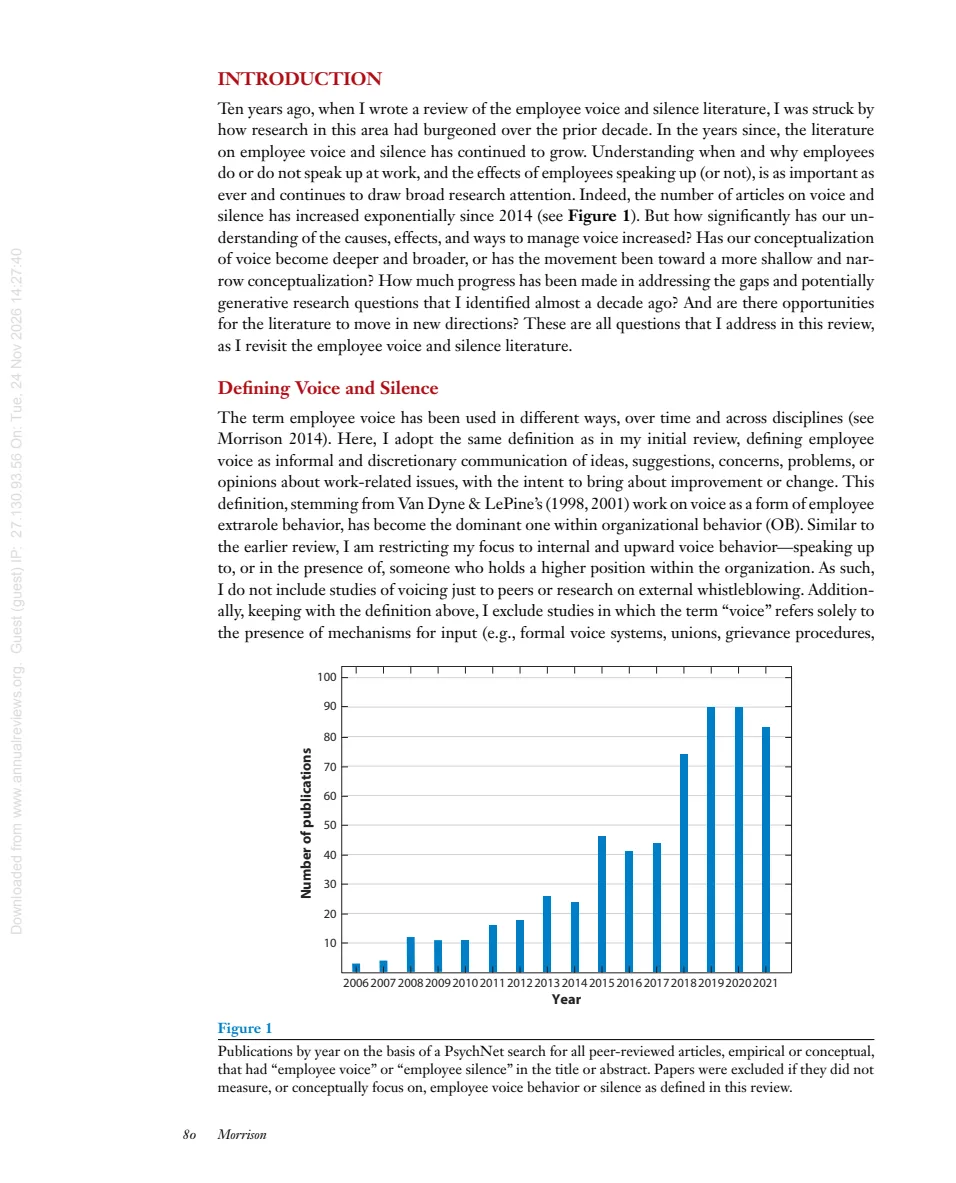
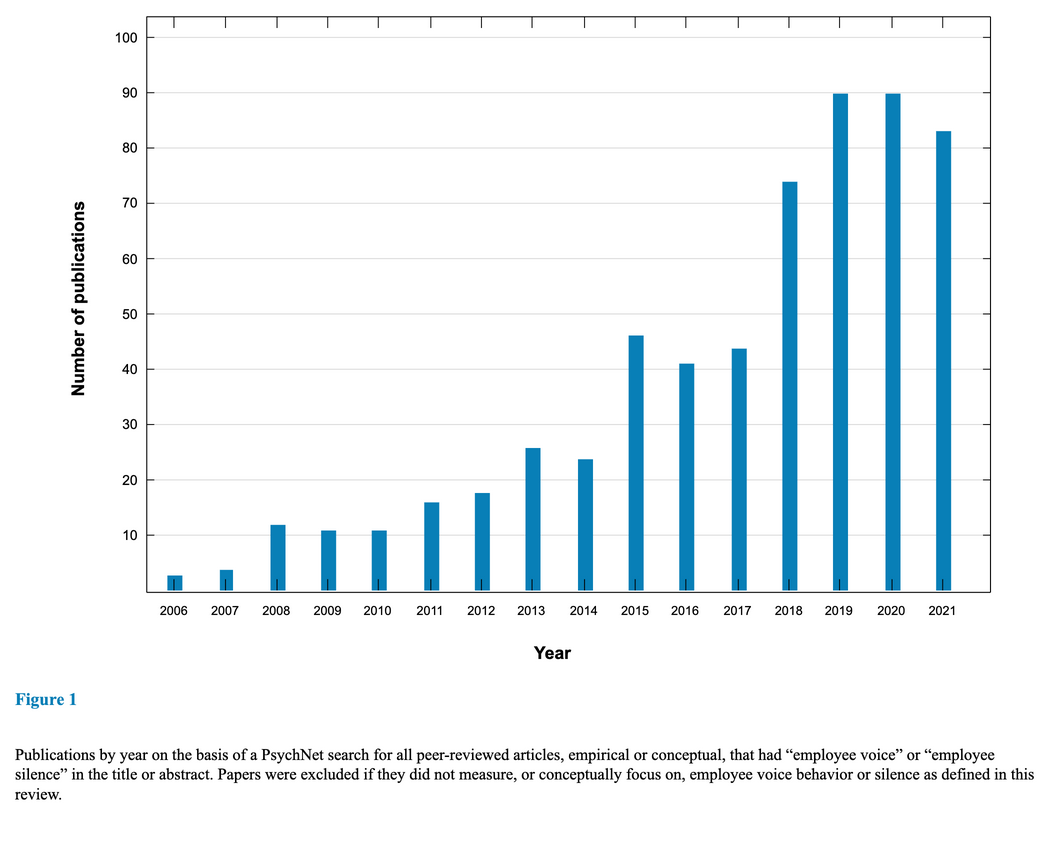
Ten years ago, when I wrote a review of the employee voice and silence literature, I was struck by how research in this area had burgeoned over the prior decade. In the years since, the literature on employee voice and silence has continued to grow. Understanding when and why employees do or do not speak up at work, and the effects of employees speaking up (or not), is as important as ever and continues to draw broad research attention. Indeed, the number of articles on voice and silence has increased exponentially since 2014 (see Figure 1). But how significantly has our understanding of the causes, effects, and ways to manage voice increased? Has our conceptualization of voice become deeper and broader, or has the movement been toward a more shallow and narrow conceptualization? How much progress has been made in addressing the gaps and potentially generative research questions that I identified almost a decade ago? And are there opportunities for the literature to move in new directions? These are all questions that I address in this review, as I revisit the employee voice and silence literature. Defining Voice and Silence The term employee voice has been used in different ways, over time and across disciplines (see Morrison 2014). Here, I adopt the same definition as in my initial review, defining employee voice as informal and discretionary communication of ideas, suggestions, concerns, problems, or opinions about work-related issues, with the intent to bring about improvement or change. This definition, stemming from Van Dyne & LePine’s (1998, 2001) work on voice as a form of employee extrarole behavior, has become the dominant one within organizational behavior (OB). Similar to the earlier review, I am restricting my focus to internal and upward voice behavior—speaking up to, or in the presence of, someone who holds a higher position within the organization. As such, I do not include studies of voicing just to peers or research on external whistleblowing. Additionally, keeping with the definition above, I exclude studies in which the term “voice” refers solely to the presence of mechanisms for input (e.g., formal voice systems, unions, grievance procedures, Number of publications 100 90 80 70 60 50 40 30 20 10 Year 2006200720082009201020112012201320142015201620172018201920202021
Figure 1
Publications by year on the basis of a PsychNet search for all peer-reviewed articles, empirical or conceptual, that had “employee voice” or “employee silence” in the title or abstract. Papers were excluded if they did not measure, or conceptually focus on, employee voice behavior or silence as defined in this review.
80 Morrison
The reconstruction preserves visible source structure. Plotted geometry does not recover underlying raw data.
PDF page 3
Check the English source page
participative decision making) or, in other words, studies that do not focus on or measure voice behavior. There are a few points worth noting about this conceptualization of voice. One, informal means that the behavior is occurring either face-to-face or through direct communication channels such as an email to a boss, not through formal channels such as suggestion systems or grievance procedures. Two, discretionary means that it is voluntary and/or unsolicited. Three, it is about change—improvement, reassessment of a decision or procedure, or addressing a problem or concern. The intended beneficiary of the change could be the organization, or it could be fellow employees, customers, or other external stakeholders (e.g., raising concerns about safety issues or suggestions for more environmentally friendly practices). Silence, in contrast to voice, is when employees withhold ideas, information about problems, or opinions on work-related issues. It includes situations where employees do not speak up about errors, unfair treatment, or behaviors that violate personal, moral, or legal standards (Knoll & van Dick 2013). In 2014, there were just a few papers on employee silence, mostly conceptual. In fact, the earlier review identified only two papers that had studied silence empirically (Milliken et al. 2003, Tangirala & Ramanujam 2008a). That has changed rather significantly in recent years, with studies explicitly measuring silence and providing insight into when and why employees withhold input and the effects of this withholding. Studies have also begun to provide a better sense of how silence and voice relate to and differ from one another, although more work remains to be done on this front. Objectives and Structure of this Review In conducting this review, my goal was to strike a balance between comprehensiveness and selectivity with respect to quality and relevance. I began by conducting a search, using several online databases (PsychInfo, PsychNet, ABI-INFORM), for all peer-reviewed articles published between 2014 and 2021 with voice, silence, speaking up, whistleblowing, issue selling, or dissent in the title, followed by a search for any additional papers citing Morrison (2014). I then excluded articles that were not about voice or silence by employees, papers that did not examine voice or silence as conceptualized for the purpose of this review, and studies that were entirely exploratory and/or descriptive. I also restricted my focus to journals on the 2021 Financial Times Journal List or with a five-year impact factor of at least 2.5. Lastly, I added papers that were accepted for publication in 2021 but not yet in print. This resulted in a set of 158 papers that formed the basis for this review.
My focus is primarily on empirical work. However, conceptual papers informed my review, and I thus cite them as appropriate. I begin with an overview of the evolution in how voice and silence have been conceptualized and studied. I then review and integrate research that has advanced our understanding of the predictors, outcomes, and characteristics of voice. Next, I review and integrate recent research on the predictors and outcomes of silence. This is followed by a discussion of future research needs and opportunities: some of the directions in which I believe the research on voice and silence needs to go. I conclude with a discussion of the practical implications of what we have come to understand about employee voice and silence.
HOW VOICE AND SILENCE HAVE BEEN CONCEPTUALIZED
AND STUDIED
Over the past decade, there has been convergence among OB scholars around the conceptualization of voice and silence presented above. This convergence, however, has not come without challenge or critique. I discuss some of these challenges and critiques below. This is followed by
PDF page 4
Check the English source page
a discussion of some recent trends in how voice and silence have been measured and empirically studied. What Is and Isn’t Employee Voice Behavior Although researchers have come to regard voice as challenging yet constructive in intent and focused on change, and silence as the failure to voice, there have been exceptions to this conceptualization. In particular, Maynes & Podsakoff (2014) offered a significantly broader view of voice, defining it as “voluntary and open communication...that is focused on influencing the context of the work environment” (p. 88). Maynes & Podsakoff proposed a framework with four distinct forms of voice, including “destructive voice” (e.g., badmouthing the organization, making insulting comments, offering criticism that is unfounded) and “defensive voice” (e.g., “stubbornly arguing against changes even when the changes would be for the best”). Although this framework speaks in important ways to the different forms of employee communication, it abandons the central features of the generally accepted conceptualization of employee voice: that it is challenging or change oriented and prosocial or constructive in intent. As such, I would argue that it muddies the voice construct. More broadly, I would argue that it is important to maintain what have come to be the core defining features of employee voice (discretionary behavior, prosocial/constructive, change oriented) in order to delineate it from other forms of workplace communication. In other words, I believe that the conceptual convergence noted above has been a good thing in terms of enabling progress in the literature on employee voice. At the same time, there is a need to think more broadly about what it means for voice to be prosocial or constructive, as I discuss in the following section. There is also a need to think more broadly about the types of issues that employees do or do not speak up about—issues that fall within the definition of voice but have not received sufficient attention. I revisit this point in the discussion of future research. Critiques from Industrial and Employment Relations Scholars In addition to being challenged from within OB, the dominant conceptualization of voice has come under harsh fire from industrial relations (IR) and employment relations (ER) scholars (e.g., Barry & Wilkinson 2016, Kaufman 2015, Nechanska et al. 2020). Within the fields of IR and ER, the term voice refers not to something that employees do but, rather, to mechanisms or opportunities for employees to have a say and influence decisions that affect them. These include direct channels, such as meetings between managers and workers, as well as formal mechanisms and institutions, such as unions, arbitration, works councils, and grievance procedures, that allow for the voicing of collective input and concerns. Voice is viewed as the means by which employees can express and protect their interests, which are assumed to be distinct from, and often in opposition to, those of the firm.
IR and ER researchers have criticized the OB voice literature for diverging from the historical roots of the voice concept, for only considering voice that reflects the interests of management, and for ignoring indirect and collective vehicles for voice and employee representation (e.g., unions) (Barry & Wilkinson 2016, Kaufman 2015, Mowbray et al. 2015, Nechanska et al. 2020). For example, Kaufman (2015) claims that models and studies of voice in OB are “truncated entities inhabiting a narrow psychological, individualistic, managerialistic and scholastic silo having little contact with forces and ideas in the larger outside world, research in other voice-related fields, or the practice of employee voice in real-life organizations” (p. 36). Barry & Wilkinson (2016) argue that “the OB conception of voice is narrow because OB researchers view employee behavior from a unitarist lens in which ‘what is good for the firm must be good for the worker’” (p. 263).
82 Morrison
PDF page 5
Check the English source page
I would venture to say that most OB scholars would view these as exaggerated and unfair characterizations, reflecting deep epistemological differences between the two fields.1 There is in fact nothing in the OB definition of voice that precludes voice aimed at bringing about constructive change for workers (versus management), or voice as an expression of criticism or dissent, and one could argue that the IR and ER literature on voice has been siloed as well. That said, it does seem appropriate to critique the empirical research on voice within OB for insufficient attention to situations where employees are voicing to advance interests at odds with the interests of management, and for largely ignoring the impact of formal and collective voice mechanisms on informal voice behavior (Wilkinson et al. 2020). I return to these issues when I discuss future research needs in the Building Bridges Across Disciplines section. Methodological Developments Although there has been general consistency and convergence in how voice is conceptualized within OB, there has been a noteworthy shift in how it is measured. In particular, there has been less reliance on the Van Dyne & LePine (1998) scale, and growing usage of the instrument developed by Liang et al. (2012), with almost as many studies using the latter as the former. The Liang et al. measure assesses two forms of voice: promotive, which is suggestion-focused, and prohibitive, which is problem-focused. Although most studies still do not distinguish between these, there has been a notable shift in that direction. This is a positive development, as there is evidence that promotive and prohibitive voice exhibit different relationships with various predictors and outcomes. There has also been a growing number of studies measuring silence. The most commonly used measures include those developed by Tangirala & Ramanujam (2008a), Detert & Edmondson (2011), Knoll & van Dick (2013), and Van Dyne et al. (2003). The latter two have separate subscales corresponding to different underlying motives: resignation (acquiescent silence), fear (quiescent or defensive silence), and not wanting to embarrass others (prosocial silence). An issue of concern, however, is that these motives are not necessarily mutually exclusive, meaning that silence may not always fall neatly into one of these categories. There might be more value in measuring the extent to which an employee exhibits silence, separate from the motives underlying that behavior. There are also issues with trying to measure silence based on supervisor reports (e.g., the original Van Dyne et al. 2003 scale), as silence by its very nature is not observable. Another methodological development has been an increasing number of papers combining survey studies with experiments, the latter allowing a clearer identification of causality. In addition, a handful of studies have utilized experience sampling, where data are collected once or twice a day over an extended period of time, enabling researchers to capture within-person effects over time (Liu et al. 2017b, Madrid et al. 2015, Schilpzand et al. 2018, Starzyk et al. 2018). Nonetheless, causality remains an issue in the voice and silence literature overall, as the predominant empirical approach has been cross-sectional surveys.
Furthermore, because very few studies have examined voice at the episodic level, we have limited understanding of what impacts the decision, in the moment, of whether or not to speak up.
When it comes to samples and context, voice and silence have been studied across a wide range of industries, including healthcare, hospitality, retail, and manufacturing. Samples have come from around the globe, with the largest number from China (34% of the studies reviewed), followed by the United States (21% of the studies reviewed). Yet despite this global reach, only a few studies 1For a more detailed discussion of the differences between how the different fields conceptualize and study voice, and how they might be better integrated, see Wilkinson et al. (2020).
PDF page 6
Check the English source page
have examined cultural differences, and even then, they have typically compared just two specific cultural contexts (e.g., Balabanova et al. 2019, Lam et al. 2019), rather than offering a broad or systematic examination of cultural dimensions in relation to voice and silence. A noteworthy exception is a study by Ng et al. (2019), who collected data from dyads in a large global organization, measuring the distance between supervisors’ and subordinates’ national cultural values. They found that for employees with low cultural intelligence, voice was inversely related to cultural distance, suggesting the need to consider not just the effects of cultural dimensions on voice but also cultural differences and employees’ competencies in managing those differences. Another noteworthy exception to simple two-country comparisons is a recent large-scale study of motives for silence (Knoll et al. 2021a). Knoll et al. developed hypotheses about the association between four types of silence and three specific cultural dimensions: power distance, assertiveness, and collectivism. They tested those hypotheses across 33 countries. Findings show positive associations between power distance and acquiescent and prosocial silence, and a negative association (not hypothesized) between institutional collectivism and acquiescent silence. There was no relationship between power distance and quiescent (fear-based) silence, nor between assertiveness or in-group collectivism and silence. Although the data showed considerable between-country variance in silence motives, the results did not support many of the stereotypical assumptions about culture and silence.
NEW FINDINGS AND INSIGHTS ON VOICE: PROGRESS SINCE 2014
In the sections below, I review and integrate research findings on voice and how our understanding of voice has expanded. As studies have used a broad range of theoretical frameworks, and have examined a long list of antecedents, mediators, moderators, and outcomes, integration is difficult. The literature is not just large, but increasingly fragmented, an issue to which I will return. I first review the research on antecedents to voice. This is followed by a discussion of outcomes. I conclude with a discussion of research on the content and process of voice. Predictors of Voice Research on factors that predict voice behavior has been quite robust. In reviewing that body of work, I begin with studies that have highlighted the importance of employees having something to share (i.e., ideas for improvement, awareness of a problem) and being motivated to share it. Assuming this is the case, variations in the frequency of voice behavior can be explained by broad sets of individual characteristics, job-related attitudes and emotions, leadership styles and behaviors, and relational and contextual factors. I review each of these sets of predictors here. Latent voice opportunity. A necessary precondition for voice or silence is that the employee is aware of a problem or has ideas or information to potentially share, such that there is a latent opportunity to voice (or not) (Morrison 2014). However, the employee must also be motivated to share that information. Consistent with this premise, Tucker & Turner (2015) reported that employees who had ideas about how to improve occupational safety, combined with high affective commitment, reported the most safety-related voice; Shepherd et al. (2019) found that the more information a project team member had about an underperforming project’s flaws, the more willing they were to voice concerns about that project to their supervisor, an effect that was stronger for employees who were prosocially motivated and perceived their supervisor to be open-minded. Conversely, Hussain et al. (2019) found that employees are less likely to voice if they believe that the information they have is shared by others, as this belief reduces their feeling of responsibility for speaking up. This effect was particularly likely when peers had a high-quality relationship with
84 Morrison
PDF page 7
Check the English source page
the supervisor. Taken together, these studies suggest that having relevant and potentially unique information and being willing to share it are necessary conditions for voicing. Individual characteristics. Earlier research had identified numerous personal dispositions that explain variation in employee voice behavior, such as personal initiative, extraversion, proactive personality, and conscientiousness (Chamberlin et al. 2017, Morrison 2014). Extending that list, Aryee et al. (2017) reported that high core self-evaluations relate to greater personal control and approach motivation, both of which predict voice behavior. Supporting earlier findings on the importance of proactive personality, Starzyk & Sonnentag (2019) showed that personal initiative can increase felt responsibility for change (although transformational leadership substitutes for this effect), and that felt responsibility for change in turn relates to more voice (as long as there is high psychological safety). Status has been shown to be an important predictor of voice as well. In a study of multiteam systems, Bienefeld & Grote (2014) found that self-perceived status, by enhancing psychological safety, related positively to voice both within and across teams. In addition, Jiang et al. (2018) found that migrant workers, whose low status might impede them from voicing, were more likely to do so when they had high cultural intelligence, an effect that was partially mediated by leadermember exchange (LMX). These findings, like the ones for individual dispositions, are consistent with the idea that employees are more likely to voice when they perceive that doing so will be safe and effective. Studies have also uncovered gender differences in voice. Yan et al. (2022) found that women tend to have lower voice self-efficacy than men, which can reduce their voice behavior, but this effect was mitigated when they had the opportunity to observe female leaders speaking up. Eibl et al. (2020) found that women reported less self-efficacy than men, and thus less voice, but only when they did not experience a high level of supportive leadership. Sherf et al. (2017) showed that men are less likely to speak up about gender parity issues, because they experience lower psychological standing with respect to that issue. Taken together, these studies suggest that gender differences in voice are nuanced, and that there is a need to consider the specific contexts and types of issues where such differences might exist. Attitudes and emotions. Attitudes about one’s job and organization, highlighted in Morrison (2014), also continue to feature prominently in the voice literature. Similar to the U-shaped relationship between personal control and voice that Tangirala & Ramanujam (2008b) reported, Lin et al. (2020) found a U-shaped relationship between job satisfaction and voice, strengthened by prosocial voice beliefs and attenuated by self-protective voice beliefs. This finding may help explain the weak positive association between satisfaction and voice reported previously (Chamberlin et al. 2017). Studies have also confirmed earlier findings that voice is more frequent when employees feel a strong sense of responsibility for change or obligation to the organization, with Ng & Feldman (2015a) finding this effect to be particularly strong for men (versus women) who have a high preference for job stability.
Employees have also been found to exhibit constructive voice when they perceive that their organization has kept (versus reneged on) promises (Ng et al. 2014), and when they perceive a high level of organizational support (Loi et al. 2014).
There is evidence as well that perceived job and organizational fit affects voice behavior. Erdogan et al. (2020) found that employees who feel overqualified for their job (a type of person-job misfit) are less likely to engage in voice, unless they perceive that their personorganization fit is high. Along similar lines, employee-organization goal alignment was shown to predict prosocial voice, by enhancing efficacy (King et al. 2020), and perceived career growth progress was shown to predict voice, by increasing affective commitment (Wang et al. 2014). Furthermore, studies point to a positive relationship between perceived embeddedness in the
PDF page 8
Check the English source page
organization and voice behavior (Ng & Lucianetti 2018, Tan et al. 2019). Taken together, these findings suggest that employees are more likely to voice if they feel that they belong and are connected within the organization. As was the case in 2014, the relationship between emotions and voice remains an understudied issue. In fact, I found only two studies linking discrete emotions to voice. Lebel (2016) found that fear stemming from sources external to the organization was positively related to voice as long as employees perceived that their supervisor was open to input, suggesting that fear is not just an inhibitor of voice. Wang et al. (2022) found that the moral emotion of guilt, stemming from unethical pro-organizational behavior, can motivate both promotive and prohibitive voice. A recent conceptual paper (Heaphy et al. 2021) argued that when employees experience prosocial emotions such as empathic concern, empathic anger, or guilt in response to another person’s suffering, they are more likely to voice. The authors argued that other-oriented emotions make it more likely that employees will see an opportunity for voice, feel sufficiently motivated to do so, and assess the potential benefits of speaking up as greater than the possible costs. These would be interesting ideas to test empirically. There have also been a few studies on the impact of emotional exhaustion and distress on voice. Consistent with conservation of resources (COR) theory, Qin et al. (2014) found a negative relationship between emotional exhaustion and both promotive and prohibitive voice when individual and contextual resources were lacking (i.e., high job insecurity and low interactional justice), and a U-shaped relationship when these resources were high. Wee & Fehr (2021), similarly drawing from COR theory, found that emotional suffering during the COVID-19 pandemic led to less voice behavior, with this effect mitigated by team compassion. Leaders’ style, behavior, and personality. The importance of the employee’s supervisor continues to be a strong theme in the voice literature. Similar to earlier works, studies have reported positive relationships between voice and a range of different leadership styles, including ethical and moral leadership (Bai et al. 2019, Chan 2014, Huang & Paterson 2017, Lee et al. 2017, Zhang et al. 2015, Zhu et al. 2015), empowering leadership (Schilpzand et al. 2018), transformational leadership (Duan et al. 2017), servant leadership (Arain et al. 2019, Lapointe & Vandenberghe 2018, Sun et al. 2019), benevolent leadership (Zhang et al. 2015), ambidextrous leadership (Li et al. 2021), and authentic leadership (Liang 2017, Liu et al. 2015), as well as a negative relationship with authoritarian leadership (Chan 2014, Li & Sun 2015, Zhang et al. 2015, Zheng et al.
2019). With such a long list, it is unclear how to best advise organizational leaders. If they want to encourage employee voice, must they try to demonstrate all of these different leadership styles, or do they just need to exhibit one form or another of positive leadership? It is also difficult to gain a clear picture of the leadership-voice relationship given the long and fragmented list of mediators and moderators that have been identified. Mediators include organization-based self-esteem, affective commitment, gratitude, LMX, identification, role modeling, efficacy, expectations, and meaningfulness. Moderators include, among other factors, job autonomy, felt obligation, leader-member value congruence, team climate, implicit theories, power distance, identification, and regulatory focus. These many different mediating and conditioning factors make it difficult to offer clear answers to questions about why or when particular forms of leadership matter. As for specific leader behaviors, voice has been shown to be more frequent when supervisors display helping behavior, as this creates greater employee self-efficacy (Hu et al. 2018), and when they display responsiveness to input, especially for employees with high self-efficacy ( Janssen & Gao 2015). In addition, Weiss et al. (2018) found voice to be more likely when leaders used inclusive language. On the basis of survey data collected two times a day over a two-week period,
86 Morrison
PDF page 9
Check the English source page
Schilpzand et al. (2018) found that empowering leadership behaviors related to more employee voice behavior the next day due to higher employee proactive goal setting. In an in-depth study of surgical teams, Farh & Chen (2018) examined the effects of three forms of leader behavior: directing, coaching, and supporting. Directing and coaching promoted voice in both the preparation and action phases of team performance. Supportive behavior did not have an effect in either phase. However, other studies suggest that supportive behaviors do matter. For example, Lebel & Patil (2018) found voice to be less frequent when leaders engage in discouraging (i.e., unsupportive) behavior, as this lowers employees’ efficacy for being proactive and their felt responsibility for change, and Frazier & Bowler (2015) found supervisor undermining behavior to reduce voice by impacting perceptions of voice climate. Voice is affected not just by leaders’ style and behavior but also by their dispositional characteristics. Positive associations have been shown between voice and leader humility (Lin et al. 2019), integrity (Peng & Wei 2019), learning goal orientation (Zhu & Akhtar 2019), and personal control (via voice solicitation; Sherf et al. 2019). Negative associations have been found between voice and leader narcissism (Helfrich & Dietl 2019, Huang et al. 2020). Yet here, too, the effects may hold only under certain conditions, such as low power distance for leader humility (Lin et al. 2019), ethical values for leader integrity (Peng & Wei 2019), and felt obligation for learning goal orientation (Zhu & Akhtar 2019), or might be stronger or weaker under different conditions. For example, the negative effect of leader narcissism was weaker when the leader had positive implicit beliefs about voice (Helfrich & Dietl 2019) and stronger when the supervisor had a poor relationship with his/her leader (Huang et al. 2020). The effect of leader personality may depend on the personality of the employee as well. Xu et al. (2019) found that supervisor-subordinate congruence in proactive personality (especially when both were high) related to higher levels of psychological safety and, thus, greater voice. Similarly, Guzman & Fu (2022) found that voice, via trust, was greater when the supervisor and subordinate both held low power distance values. Lastly, leaders’ affective state can impact an employee’s decision of whether to voice. Liu et al. (2017b) found that promotive voice toward a particular target was positively related to that target’s mood, an effect that was partially mediated by psychological safety. Liu et al. (2017a) demonstrated similar effects using experience sampling. In the context of daily interactions, leader positive affect related to employee positive affect, which led to greater psychological safety and thus more voice behavior. Leaders’ negative affect also positively related to employee voice, but the mechanisms for this effect were unclear. In sum, it seems clear that the style, behavior, personality, and mood of the supervisor play an important role in motivating and empowering employees to voice, although other conditions may also need to exist for these effects to manifest.
Relational and contextual factors. The 2014 review revealed a paucity of studies on relational or contextual antecedents to voice beyond the effects of leadership style. That has changed rather significantly. Several studies, for example, have examined the effects of relationships with and cues from coworkers. Ng et al. (2021a) reported that employees who believe they are respected by their coworkers experience stronger control beliefs and positive mood, and are thus more motivated to voice, and Xie et al. (2015) found that when employees receive support from their colleagues they have a stronger sense of obligation for constructive change, which leads to more promotive voice. Similarly, Curcuruto et al. (2020) found that support from both supervisors and coworkers predicted voicing about safety issues. Subhakaran & Dyaram (2018) showed that employees are more likely to experience psychological safety, and thus more likely to voice, both when their managers exhibit behavior that supports voice and when their coworkers engage in voice. Supporting a voice contagion effect, Ng et al. (2021b) found that witnessing a coworker engage in voice increases an
PDF page 10
Check the English source page
employee’s propensity to do so as well, by affecting the perceived efficacy and instrumentality of voice behavior. The most well-established relational predictor of voice is LMX. However, whereas prior reviews and meta-analyses indicated a strong positive effect of LMX on voice (Carnevale et al. 2017, Chamberlin et al. 2017, Morrison 2014), a recent study suggests a more complex effect. Carnevale et al. (2020) showed an inverted U-shaped relationship between LMX and voice, mediated by felt obligation for constructive change and moderated by coworker voice and leader solicitation of voice. Davidson et al.’s (2017) study of how voice is influenced by supervisor-subordinate guanxi (informal connection bound by mutual commitment, loyalty, and obligation) similarly suggests the need for a more nuanced and contextualized view of how voice relates to the quality of the supervisor-subordinate relationship. Further insight into the effects of relationships on voice comes from a study examining the connection between voice and network position. Venkataramani et al. (2016) found that employees are more likely to voice when they hold a central position in their team’s workflow network. This effect was even stronger when the team leader was in a central position in the team’s friendship network. Alongside the progress in our understanding of how relationships with coworkers and supervisors affect voice, there has been progress in our understanding of the impact of organizational structures and practices. Specifically, studies have shown that voice is greater in the context of employee-oriented human resource management (HRM) practices (Hu & Jiang 2018), managerial practices intended to enhance employees’ skills, motivation or involvement (Chamberlin et al. 2018), participative decision making (Silla et al. 2020), and idiosyncratic deals (employment arrangements tailored to the personal needs and preferences of employees; Ng & Feldman 2015b). A common explanatory mechanism for these effects is trust. A recent study also suggests a positive relationship between perceived corporate social responsibility (CSR) and both promotive and prohibitive voice, as CSR creates a more other-focused (versus self-focused) climate (Wang et al. 2020). Lastly, several studies have examined the relationship between contextual stressors and voice. The effects of challenging stressors (e.g., complexity, workload, time pressure) have been inconsistent, with some studies reporting no effect (Zhang et al. 2014) and others showing a positive relationship via reduced ego depletion (Xia et al. 2020). Results have been more consistent for hindrance stressors (e.g., conflict, politics, red tape, job insecurity). Xia et al. (2020) found a negative effect through ego depletion, and Zhang et al. (2014) found a negative effect through justice perceptions. Consistent with the idea that depletion reduces voice (Lin & Johnson 2015), Schmitt et al. (2017) showed that voice was more likely when employees had higher sleep quality the night before, an effect mediated by daily vitality and strengthened by high self-efficacy.
Differential predictors of promotive and prohibitive voice. Most of the empirical research on voice does not distinguish between promotive and prohibitive forms of this behavior (Chamberlin et al. 2017). However, this has been changing, with increasing use of the promotive and prohibitive voice scales developed by Liang et al. (2012). Some studies have shown similar results for the two types of voice, whereas others have shown differences. For example, Lin & Johnson (2015) found that promotion focus relates positively to promotive voice, whereas prevention focus relates positively to prohibitive voice, with both effects operating through ego depletion. Kakkar et al. (2016) found that approach orientation had a positive relationship with promotive voice and a negative relationship with prohibitive voice, whereas the opposite was true for avoidance orientation. Furthermore, need for affiliation was shown to be a stronger predictor of promotive voice (Kong et al. 2017), and contextual communication orientation (sensitivity to social rules of deference and
88 Morrison
PDF page 11
Check the English source page
conflict avoidance) was shown to be a stronger (negative) predictor of prohibitive voice (Ward et al. 2016). Studies suggest that cultural values may play out differently for the two forms of voice as well. Wei et al. (2015) found that power distance inhibits promotive voice, by reducing perceived efficacy, while the cultural value of superficial harmony inhibits prohibitive voice, by increasing perceived risk. Hsiung & Tsai (2017) likewise found the effects of power distance to vary for the two types of voice, with these effects moderated by activated negative mood and group voice climate. There has not been much research on how contextual factors differentially relate to promotive versus prohibitive voice. However, Arain et al. (2019) found that felt responsibility for change mediated the effect of servant leadership only for prohibitive voice, and Li et al. (2018) found that while perceived organizational politics reduced both forms of voice through uncertainty, job autonomy attenuated the effect for promotive voice whereas job security attenuated the effect for prohibitive. Hopefully with more research distinguishing between promotive and prohibitive voice, we will gain a fuller understanding of the similarities and differences in predictors, as well as mediating and moderating variables. Outcomes of Voice Although there continues to be more focus on predictors of voice than outcomes, there has been notable progress in our understanding of the latter. This work has examined both immediate responses to voice as well as downstream consequences for the employee. Although very little research has examined the effects of voice behavior on supervisors or colleagues, there have been several studies on how team-level voice affects innovation and unit performance. Supervisors’ responses. Earlier research showed that supervisors may react positively or negatively to voice. Recent research sheds additional light on these different reactions. For instance, Nelson & Proell (2018) suggest that reactions may change over time. While team leaders reacted with irritation at the time voice occurred, they subsequently rewarded speaking up in performance evaluations, especially when team members spoke up about issues that aligned with the team’s goals. Studies have also shown that leader dispositions affect their reactions to voice. For example, a set of experiments by Sijbom et al. (2015a,b) showed that supervisors with a mastery goal orientation, as opposed to a performance goal orientation, were more likely to adopt creative ideas voiced by employees. In addition, supervisors with high (versus low) power motive may be less supportive of power-threatening ideas when they are from employees who also have a high power motive (Urbach & Fay 2018). LMX, however, appears to mitigate the negative effect of perceived power threat on support for voiced ideas (Urbach & Fay 2020). Managers may also be more likely to reject voiced input when they are feeling depleted, as this causes them to spend less cognitive effort in processing the message (Li et al. 2019).
Characteristics of the voicer appear to matter as well (e.g., Duan et al. 2021). Howell et al. (2015) found that supervisors were more likely to recognize and give credit for voice from employees with high ascribed status (cued by demographic variables such as majority ethnicity) or achieved status (cued by centrality in informal social structures). That study suggests that even when lower status employees speak up more, they cannot compensate for the negative effect of demographics on voice recognition. It also found that recognition of employee voice impacted performance evaluations a year later. Employee gender also appears to affect supervisors’ responses to voice, but not in a simple manner. In a study of active duty military teams, Farh et al. (2020) showed that input from a token female member in a mostly-male team was more likely to be enacted than input from a comparison male in an all-male team. Furthermore, the likelihood of a token female’s voice being
PDF page 12
Check the English source page
enacted was higher when the team leader held favorable beliefs about women’s capabilities in the military. Another study showed that managers with high social comparison orientation respond more favorably to voice from opposite-gender voicers, whereas those with low social comparison orientation respond more favorably to voice from same-gender subordinates (Guarana et al. 2017). A third study suggests that gender effects depend on the type of voice. McClean et al. (2021) found that women who engage in agentic voice, which is counter-stereotypical for them, are seen as more competent than women who engage in communal voice, which in turn increases the likelihood of the voiced ideas being endorsed. Other studies have examined the implications of how employees voice. Isaakyan et al. (2020) demonstrated that managers experience greater image threat, and thus endorse voice less, when it is public rather than private, especially when LMX quality is low. Schreurs et al. (2020) found that when the message is framed in a manner compatible with the psychological distance between the employee and the supervisor, the supervisor will find the message easier to process and, consequently, will be more likely to endorse it. Lam et al. (2019) found that responses to how employees voice vary across cultures. Whereas US managers were more likely to endorse suggestions when the voicer was credible, managers in China were more likely to do so when the voicer was polite. Underscoring the importance of supervisors’ responses to voice, King et al. (2019) found that when supervisors fail to provide an explanation for not implementing an employee suggestion, employees see voice as less safe, and are thus less likely to engage in subsequent voice. However, when supervisors offer a sensitive explanation for not endorsing a suggestion, future voice behavior is more likely. This study is important in showing not only that supervisor reactions matter for subsequent voice, but also that a “positive” reaction does not necessarily mean that the input is implemented. Even if the idea is not adopted, the employee can feel heard and valued, and feel that the supervisor was receptive to his or her input. Performance evaluations. Earlier studies, mostly in the lab, suggested that voicing has implications for performance evaluation, but that there are many contingency factors affecting this relationship. Extending that idea, Huang et al. (2018) suggest that the frequency and type of voice need to be considered. They found that employees received higher ratings of promotability when they engaged in moderate levels of prohibitive voice, with the downturn at high frequencies of voice more likely when LMX was low. Promotive voice, on the other hand, did not relate to ratings of promotability. Chamberlin et al.’s (2017) meta-analysis reported that prohibitive voice has a weaker relationship with job performance ratings than promotive voice, and that the effect of prohibitive voice was actually negative when controlling for task performance. Further research on moderators of the relationship between voice and performance evaluations seems warranted. It would also be valuable to examine whether evaluations differ depending on the attributions made for the voice behavior. For example, Park et al.
(2022) found that when managers solicit voice, they are less likely to view voicers as proactive, and thus less likely to reward the behavior.
Other employee-level effects. Voice relates not just to performance evaluations but also to coworkers’ perceptions of the employee. For example, Weiss & Morrison (2019) found that voice led to higher assessments of an employee’s status, an effect that was explained by higher ratings of agency and communion. Extending this finding, McClean et al. (2018) found that by enhancing perceived status, promotive voice (but not prohibitive) predicts leader emergence, especially for men. Other employee-level outcomes of voice include energy level and affective state. Röllmann et al. (2021) reported a positive effect of voice on vigor, and also a positive effect on fatigue when job insecurity is high. Lin & Johnson (2015) found that promotive voice decreased depletion, whereas prohibitive voice increased it. Starzyk et al.’s (2018) daily diary study showed that
90 Morrison
PDF page 13
Check the English source page
problem-focused voice was associated with a decrease in negative affect. Suggestion-focused voice was unrelated to changes in affect.Welsh et al.’s (2021) recent study found that promotive voice increases feelings of pride, whereas prohibitive voice increases feelings of anxiety, both of which have downstream effects on interpersonal avoidance and citizenship behavior. These findings suggest that voice may affect not just the voicer but also (indirectly) his or her coworkers. Studies have also shown that voice can be a mechanism transmitting the effects of leadership style on a range of employee-level outcomes. For example, voice has been shown to mediate the relationships between ethical leadership and task performance (Mo & Shi 2018), creativity (Chen & Hou 2016), and retention (Lam et al. 2016), and the relationship between leader delegation and perceived inclusion (Rubbab & Naqvi 2020). Voice also mediates the relationship between high-performance managerial practices and job performance (Chamberlin et al. 2018). There is evidence as well that voice may help buffer the negative effects of abusive supervision (Sun et al. 2022). For example, Frieder et al. (2015) showed that voice, when combined with the perceived ability to manage one’s resources, attenuated the relationship between abuse and job dissatisfaction, emotional exhaustion, and turnover intentions. Effects on supervisors and coworkers. In the 2014 review, I noted a need for research on how voice affects people other than the voicer (Morrison 2014). Two recent studies speak to this issue. Sessions et al. (2020) demonstrated that group promotive voice (the average level of voice from members of the work group) was appraised positively by supervisors, thereby reducing their emotional exhaustion. Group prohibitive voice, on the other hand, was appraised negatively, thereby increasing supervisors’ emotional exhaustion, particularly for those with a low sense of power. Chen & Trevino (2022) found that promotive voice about ethical issues enhances coworkers’ moral elevation, which elicits their verbal support for the voice behavior. Prohibitive ethical voice, on the other hand, led to mixed coworker emotions. It sometimes elicited feelings of threat, reducing coworker support, and sometimes enhanced moral elevation, increasing their support. Team-level effects. At the team level, additional evidence has accrued that voice positively impacts innovation, with studies identifying various mechanisms and moderators. For example, Guzman & Espejo (2019) suggest that willingness to discuss ideas is a mediating mechanism for the relationship between team voice and innovation, with this effect being strongest when available resources are high. Liang et al. (2019) point to team knowledge utilization and team reflexivity as important mediators. These effects varied for promotive versus prohibitive voice and across different stages of team innovation, highlighting the importance of disentangling the two types of voice and the importance of considering temporal dynamics. Li et al. (2017) demonstrated a relationship between promotive voice and team productivity gains, mediated by team innovation, and a positive relationship between prohibitive team voice and gains in team safety performance, mediated by team monitoring.
Lastly, Li & Tangirala (2022) found that prohibitive voice reduced performance losses in the disruption phase of discontinuous change (by enabling error management), whereas promotive voice enhanced performance gains in the recovery phase (by enabling process innovation).
The Content and Process of Voice In the 2014 review, I made a case for moving beyond examining predictors and outcomes of voice frequency, to examining the different ways in which employees voice, how the perceived nature of the message comes into play, and how the voice process unfolds over time. There has been some modest progress here, although there is room for additional work. In an examination of when and why employees utilize different voice tactics, Xu et al. (2020) discovered that employees tend to use
PDF page 14
Check the English source page
more formal tactics, and to voice publicly (e.g., at team meetings), only when the issue is important and when managers are perceived as being open to input and in a positive mood. In other words, employees decide not just whether to voice, but how to do so, based on a consideration of both the message and the context. Mayer et al.’s (2019) study on issue selling suggests that these tactical choices may impact the success of voice behavior. They found that when it comes to selling social issues, moral language is more effective than economic language, particularly when the issue is framed as aligning with the organization’s values or mission. Brykman & Raver (2021) argued for the importance of examining the perceived quality of employees’ voiced messages, which they conceptualized in terms of four dimensions: rationale, feasibility, organizational-focus, and novelty. They demonstrated that when voice quality was higher, supervisors and peers evaluated the voicer more positively, above and beyond the effects of voice frequency. High-quality voicers were evaluated even more positively by their peers at high (versus low) voice frequency, whereas low-quality voicers were evaluated even more negatively at high (versus low) voice frequency. In another recent study, employees who were seen as offering low-quality ideas were more likely to be seen as incompetent, and as a result, more likely to be ostracized by their peers (Ng et al. 2022). Burris et al. (2017) conducted a similarly in-depth and multimethod investigation of message content and its implications for how managers respond. They empirically identified three dimensions of voice content—the importance of initiating change, the resources required to enact the change, and the interdependencies involved in implementing it—and demonstrated that each of these dimensions influence the extent to which managers view the voice message as valuable. They further demonstrated that employees who identified highly with their work unit (versus their profession) were more likely to voice ideas that were feasible to implement, which in turn led to higher managerial assessment of the message’s value. Lastly, there are some recent studies that provide valuable insight into how the voice process unfolds over time. Li & Tangirala (2022) focused on how voice emerges and develops in new supervisor–employee dyads. They found that employees higher in proactive personality speak up more in early stages of interactions compared to those lower in proactive personality. Yet the subsequent trajectory that voice takes depends on whether their proactive personality matches their supervisors’. Congruence in proactive personality related to a positive trend in voice and enabled voice growth to pick up momentum, whereas incongruence related to a negative trend and deceleration over time. Two other papers explored not only the voice process over time but also how individuals outside of the voicer-target dyad can facilitate that process. Satterstrom et al.
(2020) conducted a longitudinal ethnographic study of a multidisciplinary team. From the data, they developed a process model of how other team members can help to keep seemingly rejected ideas alive to reach implementation. They highlight how voice can be a collective and dynamic process, rather than a one-time dyadic event, and develop theory on how employees can help each other in getting their voiced ideas heard and put into practice. Bain et al. (2021) introduced the construct of voice amplification, whereby an employee publicly endorses a coworker’s input. The authors found that this behavior enhances the status of both the voicer and the amplifier, and also leads to higher ratings of idea quality. Taken together, these two studies suggest that peers can play an important role in helping voiced ideas reach fruition.
RESEARCH ON EMPLOYEE SILENCE
An important development in the employee voice and silence literature has been the growing number of studies of silence. Yet debate continues about whether silence and voice should be conceptualized as opposite ends of the same continuum or as distinct behaviors, and thus whether we can extrapolate from studies on predictors of voice to draw conclusions about predictors of silence.
92 Morrison
PDF page 15
Check the English source page
Whereas studies of voice have used measurement instruments that do not enable one to conclude that a low level of voice means that an employee is actually withholding ideas and concerns (versus not having ideas or concerns to share), the employee silence literature clearly positions it as a failure to voice, either about a particular issue or more broadly, suggesting that, conceptually, the two constructs are at opposite ends of the same continuum. Supporting this perspective, studies have shown voice and silence to operate through similar mediating judgements (Morrison 2014), and in many studies (perhaps even most), the word “voice” could be substituted with “silence,” and the logic and expected results would be the same (albeit in the opposite direction). For example, it has been argued and shown that leader openness creates higher psychological safety, which increases the likelihood of voice (Detert & Burris 2007). This same logic implies that leader openness, by creating greater psychological safety, will reduce the likelihood of silence (Morrison et al. 2015). However, Sherf et al.’s (2021) recent paper challenges the view that silence and voice have the same relationship with variables such as psychological safety. They argue not only that voice and silence are distinct, but that they reflect different underlying regulatory systems: Voice reflects the behavioral activation system (BAS), and silence reflects the behavioral inhibition system (BIS). Because these systems are independent, differences in the extent to which they are triggered will lead to differing frequencies of voice and silence, respectively. Sherf et al. conducted a meta-analysis and a six-month panel study. Their results not only support the idea of voice and silence being independent (at least as they are traditionally measured in the literature) but also show that perceived impact (by activating the BAS) has a stronger effect on voice, whereas psychological safety (by activating the BIS) has a stronger effect on silence. Predictors of Silence In contrast to Sherf et al.’s (2021) study, which measured both voice and silence, most of the research on silence has examined it in isolation. In this section, I review that research and the picture that is emerging on factors that predict employee silence. Leader behavior. The most frequently investigated antecedents of silence have been leadershiprelated. Consistent with studies showing that positive forms of leadership support voice, negative forms of leadership have been found to foster silence. Studies have demonstrated an association between abusive supervision and silence, mediated by such states as emotional exhaustion (Xu et al. 2015) and psychological distress (Park et al. 2018), and stronger in the context of factors that might lead employees to expect more favorable treatment, such as gender similarity (Park et al.
2018) and high LMX (Xu et al. 2015). The relationship between abusive supervision and silence was shown to be particularly strong for employees with high power distance orientation and in contexts perceived to be political (Lam & Xu 2019). Manager narcissism (Hamstra et al. 2021) and knowledge hiding (Arain et al. 2020) have also been shown to increase employee silence, by leading to less trust and higher disengagement. As well, studies have demonstrated that employees are less likely to be silent in the presence of positive forms of leadership, consistent with studies that have measured voice in relation to leadership. For example, Guenter et al. (2017) found that, for employees with low proactivity, authentic leadership leads to less silence (i.e., more voice). Work context. I identified only a handful of studies on how silence is affected by aspects of the work context beyond leader behavior, which is interesting given that the foundational conceptual papers on silence focused largely on contextual forces (Morrison & Milliken 2000, Pinder & Harlos 2001). One study that focused on context examined the effects of contextual cues about one’s status and worth (Mignonac et al. 2018). It showed that when employees get mixed messages—specifically, when organizational prestige is high but organizational support is
PDF page 16
Check the English source page
low—they experience ambivalent identification, which manifests in higher silence. In another study, Knoll et al. (2021b) found that collective-level beliefs about voice (i.e., shared implicit theories) explain variance in silence above and beyond the effects of individual-level perceptions of organizational climate and manager openness. And based on a qualitative study of female clergy and actors in the United Kingdom, Dean & Greene (2017) argued that remaining silent about poor quality conditions may stem from occupational ideologies that equate loyalty with not speaking up. I came across only one study on the relationship between formal structures and silence. Knoll & Redman (2016) found that employees who reported greater use of employee-sponsored voice mechanisms, such as message forums, suggestion boxes, and meetings, reported more informal promotive voice but also a greater tendency to remain silent about issues that they feel might disturb group harmony. These results suggest that mechanisms designed to facilitate voice might cause employees to be selective in what they express, sharing helpful ideas but withholding input that might be seen as disruptive. Individual-level predictors. Overall, there has not been nearly as much research on individuallevel antecedents of silence as on individual-level antecedents of voice. However, there is evidence that emotions predict silence. Kirrane et al.’s (2017) vignette study demonstrated less silence in the presence of anger (a high-activated negative emotion). Madrid et al.’s (2015) daily diary study found this as well. It also showed a positive association between low-activated negative emotion (e.g., depression, disappointment, dejection) and silence, at least when cognitive rumination was high. Another individual-level factor associated with silence is low perceived power. Morrison et al. (2015) demonstrated that individuals are more likely to remain silent when they feel lacking in power, although this effect was attenuated when the voice target was perceived as open to input. Other studies on the effects of individual-level predictors have focused on specific populations. For example, An & Bramble (2018) examined individual-level factors that predict whether migrant workers in China remain silent when their rights are violated. Premised on the idea that a primary driver of silence is a weak bargaining position, they found that characteristics creating socio-demographic disadvantage, such as being female, lower education, having dependents, recent unemployment, and lack of a strong social network, predicted silence in their sample. A study of police officers found that they were more likely to remain silent regarding a fellow officer’s misconduct when they experienced low self-control, high cynicism, and high job dissatisfaction (Donner et al. 2018).
Outcomes of Silence Much has been written about why employee silence is bad, and yet there continues to be a paucity of empirical research on its individual or organizational effects. The research that does exist, however, suggests negative emotional effects. For example, Kirrane et al.’s (2017) vignette study showed that anger was a reaction to reading about acquiescent silence (silence that reflects resignation), whereas anger and fear were reactions to defensive silence (silence stemming from fear), but there is a need to examine whether these effects also occur in the case of personally experienced silence. Sherf et al. (2021) showed that frequent silence generates burnout. On the basis of a four-wave longitudinal study, Knoll et al. (2019) showed reciprocal effects between silence and burnout: Both acquiescent and quiescent silence related to increased levels of subsequent burnout, which in turn related to increased silence. Another longitudinal study demonstrated reciprocal effects between abusive supervision, fear, and silence (Kiewitz et al. 2016). Abusive supervision increased fear, which led to more defensive silence, which in turn led to more abusive supervision, with these effects intensified by low levels of assertiveness and high climate-of-fear perceptions.
94 Morrison
PDF page 17
Check the English source page
Studies examining silence as a mediator provide additional evidence of its dysfunctional individual-level effects. Guo et al. (2018) found that fear and defensive silence serially mediate the negative relationship between authoritarian leadership and creativity. Wang & Hsieh’s (2014) results suggest that acquiescent silence helps to explain the negative relationship between psychological contract breach and job satisfaction. In addition, Jahanzeb & Fatima (2018) positioned defensive silence as an explanatory variable connecting workplace ostracism to emotional exhaustion and deviance.
PROGRESS, GAPS, AND WHERE TO GO FROM HERE
It is fair to say that the past ten years of research on voice and silence has broadened our understanding of individual and contextual factors that predict these behaviors, as well as our understanding of how these antecedents operate (i.e., mediators) and the conditions under which they are most likely to do so (i.e., moderators). The research has also expanded our knowledge of receptivity to voice, and how voice affects not just the voicer but also his or her supervisor and team. There have been advancements as well, although more limited, in our understanding of the effects of different voice tactics and the implications of variation in voice quality. And yet, as with many fast-growing areas of research, there has been more focus on knowledge accumulation than on integration and synthesis. Furthermore, progress in addressing the gaps and the potentially generative research questions that I identified almost a decade ago has been mixed. I also believe that, in some core respects, the ways in which researchers think about voice has become narrower, and there are some opportunities for the literature on employee voice and silence to move in new directions. In this final section, I address these issues. Revisiting the Research Questions Highlighted in the 2014 Review I concluded the 2014 review by spotlighting five research questions that I believed had the most potential for expanding our understanding of voice and silence and for providing guidance to managers and organizational leaders (see Table 1 for a recap of those questions, a summary of the progress that has been made, and questions that still need to be addressed). The first question was about the effects of silence on the individual employee. As discussed, there has been some modest progress on this issue, with studies suggesting that silence may create feelings of anger and/or fear, increase burnout, emotional exhaustion, and deviance, and lead to lower creativity and job satisfaction. Nonetheless, research on the outcomes of silence has been sparse, and more attention to this issue is needed—including how silence affects the workgroup and how, at the collective level, it impacts organizational performance. The second question was about factors that moderate the effects of voice on unit-level effectiveness. Although research linking voice to team innovation and performance has focused more on mediators than moderators, there has been notable progress in our understanding of the conditions that increase the likelihood of voice having positive performance effects. For example, studies have shown stronger effects when performance pressure is high, when resources are abundant, during the idea generation (versus idea implementation) stage of team performance, and for promotive (versus prohibitive) voice. Research has also advanced our understanding of factors that increase the likelihood of voiced input being recognized, endorsed, and adopted. These include characteristics of the employee (status, gender, credibility), characteristics of the supervisor (mastery goal orientation, power motive, lack of ego depletion), the relationship between the employee and the supervisor (LMX), and how the message is conveyed (publicly versus privately, framing).
The third question that I believed held particular promise was how relationships with coworkers affect voice and silence. There has been good progress here as well. As discussed, studies have
PDF page 18
Check the English source page
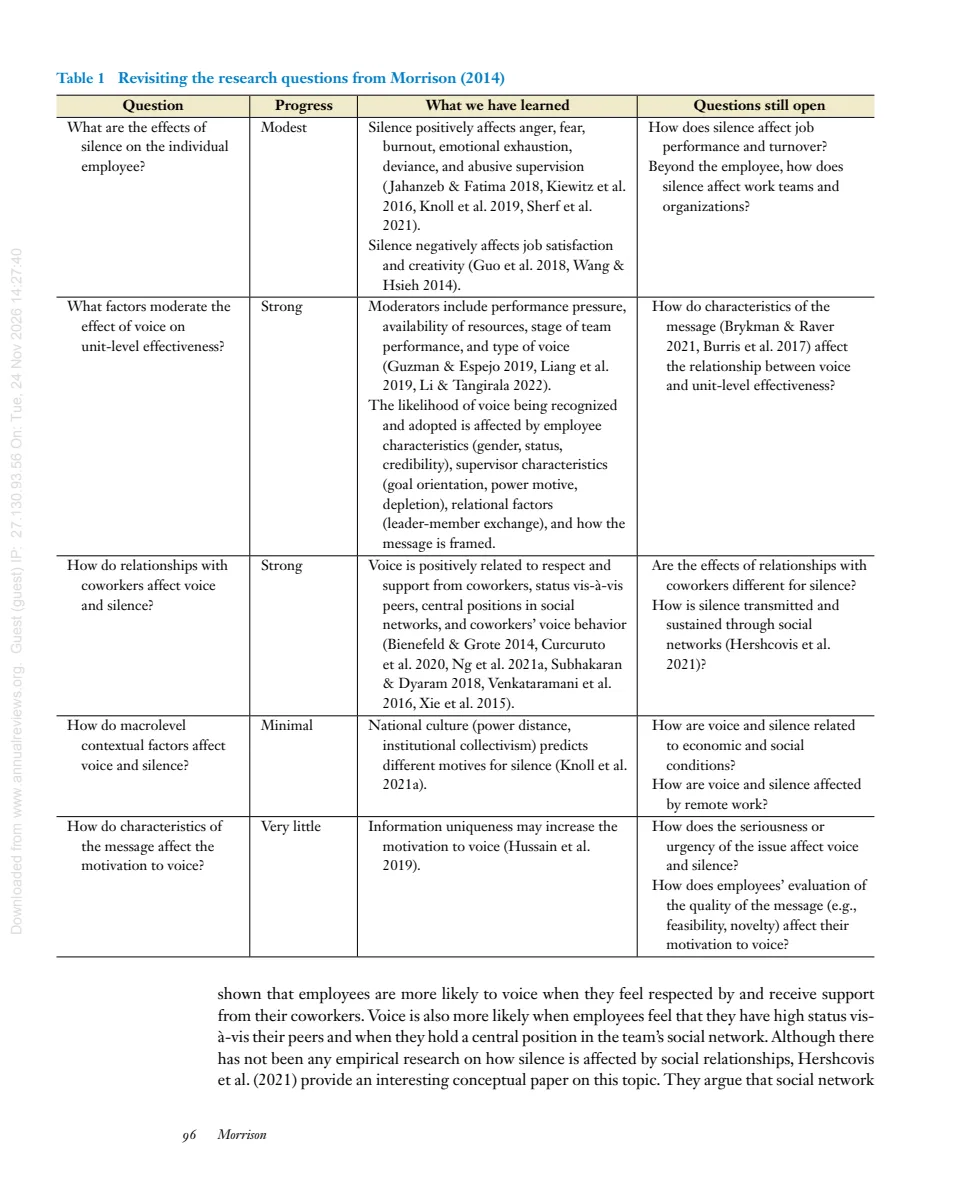
Table 1 Revisiting the research questions from Morrison (2014)
Question Progress What we have learned Questions still open What are the effects of silence on the individual employee? Modest Silence positively affects anger, fear, burnout, emotional exhaustion, deviance, and abusive supervision ( Jahanzeb & Fatima 2018, Kiewitz et al. 2016, Knoll et al. 2019, Sherf et al. 2021). Silence negatively affects job satisfaction and creativity (Guo et al. 2018, Wang & Hsieh 2014). How does silence affect job performance and turnover? Beyond the employee, how does silence affect work teams and organizations? What factors moderate the effect of voice on unit-level effectiveness? Strong Moderators include performance pressure, availability of resources, stage of team performance, and type of voice (Guzman & Espejo 2019, Liang et al. 2019, Li & Tangirala 2022). The likelihood of voice being recognized and adopted is affected by employee characteristics (gender, status, credibility), supervisor characteristics (goal orientation, power motive, depletion), relational factors (leader-member exchange), and how the message is framed. How do characteristics of the message (Brykman & Raver 2021, Burris et al. 2017) affect the relationship between voice and unit-level effectiveness? How do relationships with coworkers affect voice and silence? Strong Voice is positively related to respect and support from coworkers, status vis-à-vis peers, central positions in social networks, and coworkers’ voice behavior (Bienefeld & Grote 2014, Curcuruto et al. 2020, Ng et al. 2021a, Subhakaran & Dyaram 2018, Venkataramani et al. 2016, Xie et al. 2015). Are the effects of relationships with coworkers different for silence? How is silence transmitted and sustained through social networks (Hershcovis et al. 2021)? How do macrolevel contextual factors affect voice and silence? Minimal National culture (power distance, institutional collectivism) predicts different motives for silence (Knoll et al. 2021a). How are voice and silence related to economic and social conditions? How are voice and silence affected by remote work? How do characteristics of the message affect the motivation to voice? Very little Information uniqueness may increase the motivation to voice (Hussain et al. 2019). How does the seriousness or urgency of the issue affect voice and silence? How does employees’ evaluation of the quality of the message (e.g., feasibility, novelty) affect their motivation to voice? shown that employees are more likely to voice when they feel respected by and receive support from their coworkers. Voice is also more likely when employees feel that they have high status visà-vis their peers and when they hold a central position in the team’s social network. Although there has not been any empirical research on how silence is affected by social relationships, Hershcovis et al. (2021) provide an interesting conceptual paper on this topic. They argue that social network
96 Morrison
PDF page 19
Check the English source page
composition, together with belief systems, can create network silence about sexual harassment. Echoing Morrison & Milliken (2000), this paper highlights how silence can be transmitted and sustained through social network dynamics. Empirical research on such network effects could be informative. The fourth question, how macrolevel contextual factors affect voice and silence, remains largely neglected, which is unfortunate. Beyond the handful of studies suggesting effects of national culture (e.g., Knoll et al. 2021a), the only paper I found was a qualitative study by Prouska & Psychogios (2018), which explored, in the context of the Greek economic crisis, how silence develops over time in response to economic conditions. The findings suggest that in addition to the effects of fear or futility, employees may remain silent because they see everyone else remaining silent, highlighting the power of social cues, particularly in a context of high uncertainty. The lack of attention to the question of how employee behavior is shaped by factors external to the organization, such as economic or social conditions, is not unique to the voice literature, but nonetheless, is a gap worth addressing. One particularly relevant research question is how voice has been affected by the recent shift to remote and hybrid work, which is likely to continue for many employees. Lastly, I argued in the 2014 review that our understanding of voice could be deepened by considering characteristics of the message beyond just the promotive-prohibitive distinction, such as the seriousness or urgency of the issue. Recent research on different dimensions of voice quality (Brykman & Raver 2021, Burris et al. 2017) offers an important step in this direction. However, I would encourage research on how characteristics of the message affect not just reactions to voice but also the motivation to do so. Promising New Avenues In addition to the issues noted above, and the opportunities for future research identified throughout this review, there are some research avenues that I believe have significant potential to deepen our understanding of voice and silence. In this section, I discuss two nascent topics that I see as holding particular promise. This is followed by a discussion of what I regard to be broader needs within the voice and silence literature (see Table 2 for an overview). One emergent topic has to do with temporal dynamics. In 2014, I made a case for research on how voice and silence, and their drivers and outcomes, vary over time. Recent years have seen a handful of promising empirical studies (Farh & Chen 2018, Li & Tangirala 2022, Satterstrom et al. 2020). These studies show that there are important temporal dynamics that need to be considered and highlight the value of additional research that studies voice and silence longitudinally. My hope is that we will see further work along these lines. I would also encourage voice researchers to draw from the issue selling literature (e.g., Dutton et al. 2001), which highlights that meaningful employee-initiated change often takes multiple attempts to draw attention to the issue. In fact, I would argue that issue selling is an important type of employee voice behavior, and that there would be great value in more tightly integrating these two bodies of research with the goal of broadening how we think about change-directed communication from employees.
There is also budding interest in ethical voice, or speaking up about ethical issues such as mistreatment, harassment, and fraud (Chen & Trevino 2022, Huang & Paterson 2017). Ethical misconduct often persists in organizations because employees, despite being aware and concerned, remain silent rather than speak up (Pinder & Harlos 2001). As illustrated by the #MeToo movement, victims of sexual harassment or assault often suffer in silence. When scandals break (e.g., Enron, Wells Fargo, sexual abuse in the Catholic Church), it often comes to light that many people knew about the misbehavior but said nothing (or tried to speak and were ignored). It has been reported in the whistle-blowing literature that only approximately half of the people who observe
PDF page 20
Check the English source page
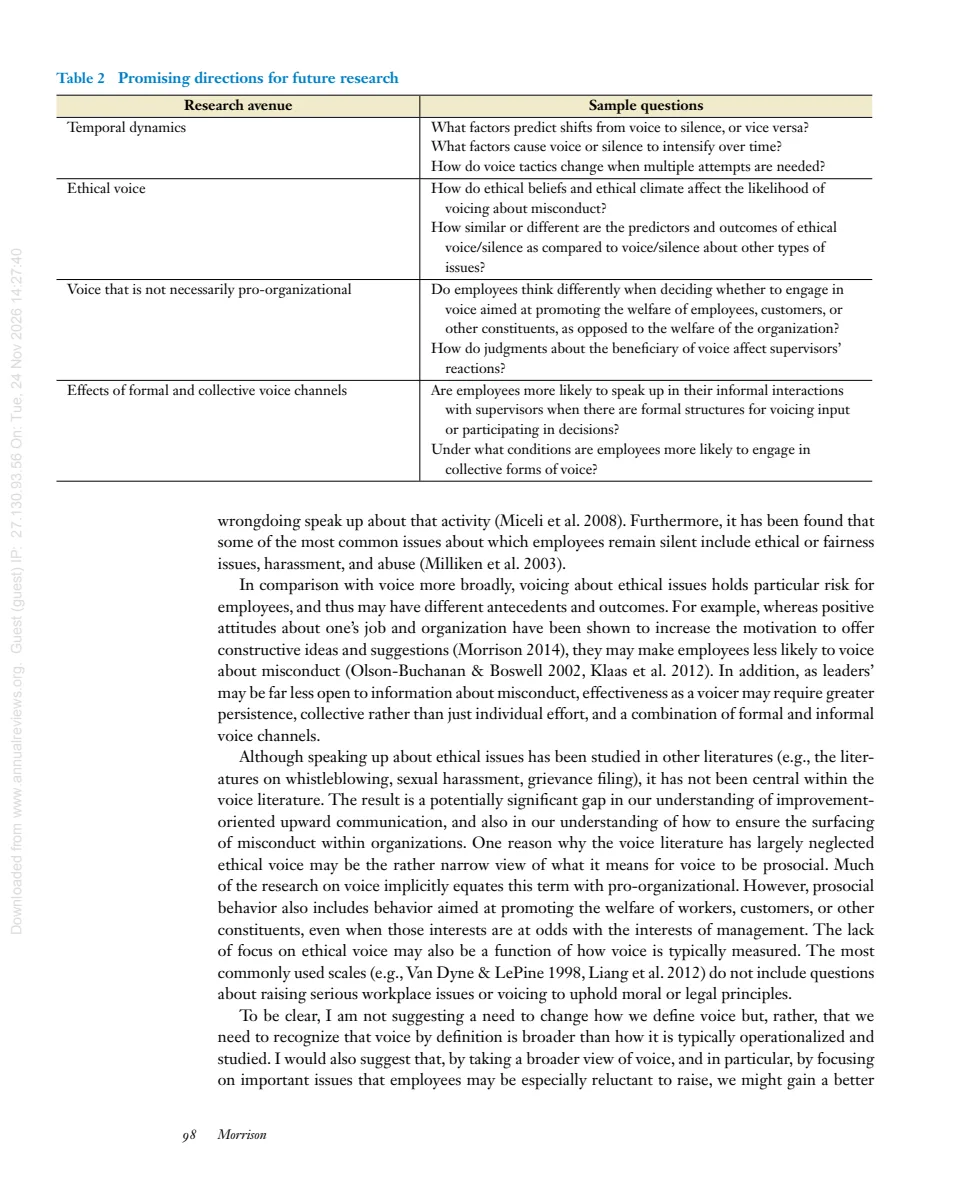
Table 2 Promising directions for future research
Research avenue Sample questions Temporal dynamics What factors predict shifts from voice to silence, or vice versa? What factors cause voice or silence to intensify over time? How do voice tactics change when multiple attempts are needed? Ethical voice How do ethical beliefs and ethical climate affect the likelihood of voicing about misconduct? How similar or different are the predictors and outcomes of ethical voice/silence as compared to voice/silence about other types of issues? Voice that is not necessarily pro-organizational Do employees think differently when deciding whether to engage in voice aimed at promoting the welfare of employees, customers, or other constituents, as opposed to the welfare of the organization? How do judgments about the beneficiary of voice affect supervisors’ reactions? Effects of formal and collective voice channels Are employees more likely to speak up in their informal interactions with supervisors when there are formal structures for voicing input or participating in decisions? Under what conditions are employees more likely to engage in collective forms of voice? wrongdoing speak up about that activity (Miceli et al. 2008). Furthermore, it has been found that some of the most common issues about which employees remain silent include ethical or fairness issues, harassment, and abuse (Milliken et al. 2003). In comparison with voice more broadly, voicing about ethical issues holds particular risk for employees, and thus may have different antecedents and outcomes. For example, whereas positive attitudes about one’s job and organization have been shown to increase the motivation to offer constructive ideas and suggestions (Morrison 2014), they may make employees less likely to voice about misconduct (Olson-Buchanan & Boswell 2002, Klaas et al. 2012). In addition, as leaders’ may be far less open to information about misconduct, effectiveness as a voicer may require greater persistence, collective rather than just individual effort, and a combination of formal and informal voice channels. Although speaking up about ethical issues has been studied in other literatures (e.g., the literatures on whistleblowing, sexual harassment, grievance filing), it has not been central within the voice literature. The result is a potentially significant gap in our understanding of improvementoriented upward communication, and also in our understanding of how to ensure the surfacing of misconduct within organizations. One reason why the voice literature has largely neglected ethical voice may be the rather narrow view of what it means for voice to be prosocial. Much of the research on voice implicitly equates this term with pro-organizational. However, prosocial behavior also includes behavior aimed at promoting the welfare of workers, customers, or other constituents, even when those interests are at odds with the interests of management. The lack of focus on ethical voice may also be a function of how voice is typically measured. The most commonly used scales (e.g., Van Dyne & LePine 1998, Liang et al. 2012) do not include questions about raising serious workplace issues or voicing to uphold moral or legal principles.
To be clear, I am not suggesting a need to change how we define voice but, rather, that we need to recognize that voice by definition is broader than how it is typically operationalized and studied. I would also suggest that, by taking a broader view of voice, and in particular, by focusing on important issues that employees may be especially reluctant to raise, we might gain a better
98 Morrison
PDF page 21
Check the English source page
understanding of the voice phenomenon. For example, there might be opportunities to draw more fully from the research on whistleblowing, which has identified antecedents that have not been focal within the voice literature, such as issue severity and ethical beliefs. Building Bridges Across Disciplines As discussed, there has been a gap between OB and ER when it comes to studying voice, with the two fields operating from different assumptions and definitions. Yet I believe there could be value in breaking down the walls between these two disciplines and working toward a broader and more interdisciplinary perspective on employee voice (Wilkinson et al. 2020). This would mean moving away from focusing so heavily on pro-organizational voice, as noted above. It would also mean considering how informal voice behavior, and the cognitions that drive it, is affected by the presence or absence of formal voice channels. Third, it would mean recognizing that voice is sometimes a collective-level behavior and, in fact, may sometimes need to be collective in order to be effective. Despite two reviews aimed at integrating the OB and ER/HRM voice literatures—one focused on the conceptualization of voice (Mowbray et al. 2015) and the other focused on outcomes (Bashshur & Oc 2015)—I identified only two empirical studies connecting these two literature streams. Both of those studies highlight the importance of considering formal voice channels, as well as collective mechanisms, when studying informal voice behavior, as these are interrelated (Knoll & Redman 2016, Mowbray 2018). And yet, the impact of formal and collective voice mechanisms has been almost entirely ignored in the OB voice literature. Practical Advice for Organizations Given the breadth of research on employee voice, we should be able to offer concrete advice to organizational leaders about how to ensure that employees speak up when they have ideas, concerns, or information. And yet, with such a long list of individual and contextual factors that affect the likelihood of voice and/or silence, it is not easy to cull out the most impactful drivers. Furthermore, many of the effects that have been found are dependent on other conditions holding true. Nonetheless, there are some conclusions that can be offered with respect to creating work contexts more conducive to employee voice. For example, in spite of the fragmented list of leadership styles and moderating conditions that have been identified, it seems that we can confidently say that leadership matters. Which leadership label best applies likely matters less than whether the employee feels that their supervisor is supportive, sets a positive example, and creates a safe context for speaking up. If this is the case, there is an opportunity to train leaders in active listening and other behaviors that signal that they are open to input and that it is safe to speak up. Particularly promising in this regard is research on how specific leader behaviors affect the likelihood of voice or silence, such as the use of inclusive language (Weiss et al. 2018), helping behavior (Hu et al.
2018), and coaching (Farh & Chen 2018). These are behaviors that can be trained. We can also conclude that positive attitudes about the organization and one’s work, such as control, responsibility, and commitment, matter for employee voice and silence. Organizations that follow best practices for creating a high engagement workforce, such as granting autonomy, creating mechanisms for meaningful participation, and ensuring that work is meaningful, should have environments that foster more voice and less silence. Particularly encouraging are the handful of studies that have gone beyond demonstrating a relationship between voice and perceived workplace climate, to showing effects for specific employee-oriented HRM practices (Chamberlin et al. 2018, Hu & Jiang 2018, Ng & Feldman 2015b, Silla et al. 2020).
PDF page 22
Check the English source page
CONCLUSION
To conclude, clear progress has been made in our understanding of why employees do or do not speak up at work, how supervisors respond to that behavior, and the effects that voice and silence have on employees, their coworkers, and their teams. Research has highlighted the importance of distinguishing between promotive and prohibitive voice and the need for further understanding of whether silence has different predictors than voice. There have also been noteworthy methodological advances. At the same time, there are remaining gaps in the literature and opportunities to move in new directions. Not only do we need to more fully understand how voice and silence develop and change over time, but we also need to expand the focus of voice research to include speaking (or not) when it comes to ethical issues, as well as prosocial voice that is not proorganizational. Furthermore, there is a need to consider how informal employee voice behavior is affected by formal opportunities and channels for voicing, both individually and collectively. My hope is that this review will motivate and help guide research that will explore these promising avenues.
DISCLOSURE STATEMENT
The author is not aware of any affiliations, memberships, funding, or financial holdings that might be perceived as affecting the objectivity of this review.
LITERATURE CITED
An F, Bramble T. 2018. Silence as a survival strategy: Will the silent be worse off? A study of Chinese migrant workers in Guangdong. Int. J. Hum. Resour. Manag. 29:915–40 Arain G, Hameed I, Crawshaw JR. 2019. Servant leadership and follower voice: the roles of follower felt responsibility for constructive change and avoidance-approach motivation. Eur. J. Work Organ. Psychol. 28:555–65 Arain G, Hameed I, Umrani WA, Khan AK, Sheikh AZ. 2020. Consequences of supervisor knowledge hiding in organizations: a multilevel mediation analysis. Appl. Psychol. 70:1242–66 Aryee S, Walumbwa FO, Mondejar R, Chu CWL. 2017. Core self-evaluations and employee voice behavior: test of a dual-motivational pathway. J. Manag. 43:946–66 Bai Y, Lin L, Liu JT. 2019. Leveraging the employee voice: a multi-level social learning perspective of ethical leadership. Int. J. Hum. Resour. Manag. 30:1869–1901 Bain K, Kreps T, Meikle N, Tenney E. 2021. Amplifying voice in organizations. Acad. Manag. J. 64:1288–1302 Balabanova E, Ehrnrooth M, Koveshnikov A, Efendiev A. 2019. Employee exit and constructive voice as behavioral responses to psychological contract breach in Finland and Russia: a within- and between-culture examination. Int. J. Hum. Resour. Manag. 33:360–91 Barry M, Wilkinson A. 2016. Pro-social or pro-management? A critique of the conception of employee voice as a prosocial behaviour within organizational behavior. Brit. J. Ind. Relat. 54:261–84 Bashshur MR, Oc B. 2015. When voice matters: a multilevel review of the impact of voice in organizations. J. Manag. 41:1530–54 Bienefeld N, Grote G. 2014. Speaking up in ad hoc multiteam systems: individual-level effects of psychological safety, status, and leadership within and across teams. Eur. J. Work Organ. Psychol. 23:930–45 Brykman K, Raver J. 2021. To speak up effectively or often? The effects of voice quality and voice frequency on peers’ and managers’ evaluations. J. Organ. Behav. 42:505–26 Burris ER, Rockmann KW, Kimmons YS. 2017. The value of voice to managers: employee identification and the content of voice. Acad. Manag. J. 60:2099–2125 Carnevale JB, Huang L, Crede M, Harms P, Uhl-Bien M. 2017. Leading to stimulate employees’ ideas: a quantitative review of leader-member exchange, employee voice, creativity, and innovative behavior.Appl. Psychol. 66:517–52
100 Morrison
PDF page 23
Check the English source page
Carnevale JB, Huang L, Uhl-Bien M, Harris S. 2020. Feeling obligated yet hesitant to speak up: investigating the curvilinear relationship between LMX and employee promotive voice. J. Occup. Organ. Psychol. 93:505–29 Chamberlin M, Newton DW, Lepine JA. 2017. A meta-analysis of voice and its promotive and prohibitive forms: identification of key associations, distinctions, and future research directions. Pers. Psychol. 70:11– 71 Chamberlin M, Newton DW, LePine JA. 2018. A meta-analysis of empowerment and voice as transmitters of high-performance managerial practices to job performance. J. Organ. Behav. 39:1296–1313 Chan S. 2014. Paternalistic leadership and employee voice: Does information sharing matter? Hum. Relat. 67:667–93 Chen A, Trevino LK. 2022. Promotive and prohibitive ethical voice: coworker emotions and support for the voice. J. Appl. Psychol. 107:1973–94 Chen AS-Y, Hou Y-S. 2016. The effects of ethical leadership, voice behavior and climates for innovation on creativity: a moderated mediation examination. Leadersh. Q. 27:1–13 Curcuruto M, Strauss K, Axtell C, Griffin M. 2020. Voicing for safety in the workplace: a proactive goalregulation perspective. Safety Sci. 131:104902 Davidson T, Van Dyne L, Lin B. 2017. Too attached to speak up? It depends: how supervisor-subordinate guanxi and perceived job control influence upward constructive voice. Organ. Behav. Hum. Decis. Process. 143:39–53 Dean D, Greene A. 2017. How do we understand worker silence despite poor conditions—as the actress said to the woman bishop. Hum. Relat. 70:1237–57 Detert JR, Burris ER. 2007. Leadership behavior and employee voice: Is the door really open? Acad. Manag. J. 50:869–84 Detert JR, Edmondson AC. 2011. Implicit voice theories: taken-for-granted rules of self-censorship at work. Acad. Manag. J. 54:461–88 Donner CM, Maskaly J, Thompson KN. 2018. Self-control and the police code of silence: examining the unwillingness to report fellow officers’ misbehavior among a multi-agency sample of police recruits. J. Crim. Just. 56:11–19 Duan J, Li C, Xu Y, Wu C. 2017. Transformational leadership and employee voice behavior: a Pygmalion mechanism. J. Organ. Behav. 38:650–70 Duan J, Zhou AJ, Yu L. 2021. A dual-process model of voice endorsement. Int. J. Hum. Resour.Manag. 33:3765– 87 Dutton JE, Ashford SJ, O’Neill RM, Lawrence KA. 2001. Moves that matter: issue selling and organizational change. Acad. Manag. J. 44:716–36 Eibl B, Lang FR, Niessen C. 2020. Employee voice at work: the role of employees’ gender, self-efficacy beliefs, and leadership. Eur. J. Work Organ. Psychol. 29:570–85 Erdogan B, Karaeminogullari A, Bauer TN, Ellis AM. 2020. Perceived overqualification at work: implications for extra-role behaviors and advice network centrality. J. Manag. 46:583–606 Farh CIC, Chen G. 2018. Leadership and member voice in action teams: test of a dynamic phase model.
J. Appl. Psychol. 103:97–110 Farh CIC, Oh JK, Hollenbeck JR, Yu A, Lee SM, King DD. 2020. Token female voice enactment in traditionally male-dominated teams: facilitating conditions and consequences for performance. Acad. Manag. J. 63:832–56 Frazier M, Bowler WM. 2015. Voice climate, supervisor undermining, and work outcomes: a group-level examination. J. Manag. 41:841–63 Frieder RE, Hochwarter WA, DeOrtentiis PS. 2015. Attenuating the negative effects of abusive supervision: the role of proactive voice behavior and resource management ability. Leadersh. Q. 26:821–37 Guarana CL, Li J, Hernandez M. 2017. Examining the effects of manager-subordinate gender match on managerial response to voice. J. Exp. Soc. Psychol. 72:147–60 Guenter H, Schreurs B, van Emmerik IH, Sun S. 2017. What does it take to break the silence in teams: Authentic leadership and/or proactive followership? Appl. Psychol. 66:49–77
PDF page 24
Check the English source page
Guo L, Decoster S, Babalola MT, De Schutter L, Garba OA, Riisla K. 2018. Authoritarian leadership and employee creativity: the moderating role of psychological capital and the mediating role of fear and defensive silence. J. Bus. Res. 92:219–30 Guzman FA, Espejo A. 2019. Introducing changes at work: how voice behavior relates to management innovation. J. Organ. Behav. 40:73–90 Guzman FA, Fu X. 2022. Leader-subordinate congruence in power distance values and voice behavior: a person-supervisor fit approach. Appl. Psychol. 71:271–95 Hamstra MR, Schreurs B, Jawahar IM, Laurijssen LM, Hanermund P. 2021.Manager narcissism and employee silence: a socio-analytic theory perspective. J. Occup. Organ. Psychol. 94:29–54 Heaphy E, Lilius J, Feldman E. 2021. Moved to speak up: how prosocial emotions influence the employee voice process. Hum. Relat. 7:1113–39 Helfrich H, Dietl E. 2019. Is employee narcissism always toxic? The role of narcissistic admiration, rivalry and leaders’ implicit followership theories for employee voice. Eur. J. Work Organ. Psychol. 28:259–71 Hershcovis MS, Vranjes I, Berdahl JL, Cortina LM. 2021. See no evil, hear no evil, speak no evil: theorizing network silence around sexual harassment. J. Appl. Psychol. 100:1834–47 Howell TM,Harrison DA, Burris ER, Detert JR. 2015.Who gets credit for input? Demographic and structural status cues in voice recognition. J. Appl. Psychol. 100:1765–84 Hsiung H, Tsai W. 2017. The joint moderating effects of activated negative moods and group voice climate on the relationship between power distance orientation and employee voice behavior. Appl. Psychol. 66:487– 514 Hu X, Griffin M, Yeo G, Kanse L, Hodkiewicz M, Parkes K. 2018. A new look at compliance with work procedures: an engagement perspective. Safety Sci. 105:46–54 Hu X, Jiang Z. 2018. Employee-oriented HRM and voice behavior: a moderated mediation model of moral identity and trust in management. Int. J. Hum. Resour. Manag. 29:746–71 Huang L, Krasikova D, Harms PD. 2020. Avoiding or embracing social relationships? A conservation of resources perspective of leader narcissism, leader-member exchange differentiation, and follower voice. J. Organ. Behav. 41:77–92 Huang L, Paterson TA. 2017. Group ethical voice: influence of ethical leadership and impact on ethical performance. J. Manag. 43:1157–84 Huang X, Xu E, Huang L, Wu L. 2018. Nonlinear consequences of promotive and prohibitive voice for managers’ responses: the roles of voice frequency and LMX. J. Appl. Psychol. 103:1101–20 Hussain I, Shu R, Tangirala S, Ekkirala S. 2019. The voice bystander effect: how information redundancy inhibits employee voice. Acad. Manag. J. 62:828–49 Isaakyan S, Sherf E, Tangirala S, Guenter H. 2020. Keeping it between us: managerial endorsement of public versus private voice. J. Appl. Psychol. 106:1049–66 Jahanzeb S, Fatima T. 2018. How work ostracism influences interpersonal deviance: the mediating role of defensive silence. J. Bus. Psychol. 33:779–91 Janssen O, Gao L. 2015. Supervisory responsiveness and employee self-perceived status and voice behavior.
J. Manag. 41:1854–72 Jiang Z, Le H, Gollan PJ. 2018. Cultural intelligence and voice behavior among migrant workers: the mediating role of leader-member exchange. Int. J. Hum. Resour. Manag. 29:1082–112 Kakkar H, Tangirala S, Srivastava NK, Kamdar D. 2016. The dispositional antecedents of promotive and prohibitive voice. J. Appl. Psychol. 101:1342–51 Kaufman BE. 2015. Theorising determinants of employee voice: an integrative model across disciplines and levels of analysis. Hum. Resourc. Manag. J. 25:19–40 Kiewitz C, Restubog SLD, Shoss MK, Garcia PRJM, Tang RL. 2016. Suffering in silence: investigating the role of fear in the relationship between abusive supervision and defensive silence. J. Appl. Psychol. 101:731–42 King C, So KF, DiPietro RB, Grace D. 2020. Enhancing employee voice to advance the hospitality organization’s marketing capabilities: a multilevel perspective. Int. J. Hosp. Manag. 91:102657 King DD, Ryan A, Van Dyne L. 2019. Voice resilience: fostering future voice after non-endorsement of suggestions. J. Occup. Organ. Psychol. 92:535–65 Kirrane M, O’Shea D, Buckley F, Grazi A, Prout J. 2017. Investigating the role of discrete emotions in silence versus speaking up. J. Occup. Organ. Psychol. 90:354–78
102 Morrison
PDF page 25
Check the English source page
Klaas BS, Olson-Buchanan JB, Ward AK. 2012. The determinants of alternative forms of workplace voice: an integrative perspective. J. Manag. 38:314–45 Knoll M,Götz M, Adriasola E, Al-Atwi AA, Arenas A, et al. 2021a. International differences in employee silence motives: scale validation, prevalence, and relationships with culture characteristics across 33 countries. J. Organ. Behav. 42:619–48 Knoll M, Hall R, Weigelt O. 2019. A longitudinal study of the relationships between four differentially motivated forms of employee silence and burnout. J. Occup. Health Psychol. 24:572–89 Knoll M, Neves P, Schyns B, Meyer B. 2021b. A multi-level approach to direct and indirect relationships between organizational voice climate, team manager openness, implicit voice theories, and silence. Appl. Psychol. 70:606–42 Knoll M, Redman T. 2016. Does the presence of voice imply the absence of silence? The necessity to consider employees’ affective attachment and job engagement. Hum. Resour. Manag. 55:829–44 Knoll M, van Dick R. 2013. Do I hear the whistle...? A first attempt to measure four forms of employee silence and their correlates. J. Bus. Ethics 113:349–62 Kong F, Huang Y, Liu P, Zhao X. 2017. Why voice behavior? An integrative model of the need for affiliation, the quality of leader-member exchange, and group cohesion in predicting voice behavior. Group Organ. Manag. 42:792–818 Lam CF, Lee C, Sui Y. 2019. Say it as it is: consequences of voice directness, voice politeness, and voicer credibility on voice endorsement. J. Appl. Psychol. 104:642–58 Lam LW, Loi R, Chan KW, Liu Y. 2016. Voice more and stay longer: how ethical leaders influence employee voice and exit intentions. Bus. Ethics Q. 26:277–300 Lam LW, Xu AJ. 2019. Power imbalance and employee silence: the role of abusive leadership, power distance orientation, and perceived organisational politics. Appl. Psychol. 68:513–46 Lapointe A, Vandenberghe C. 2018. Examination of the relationships between servant leadership, organizational commitment, and voice and antisocial behaviors. J. Bus. Ethics 148:99–115 Lebel D. 2016. Overcoming the fear factor: how perceptions of supervisor openness lead employees to speak up when fearing external threat. Organ. Behav. Hum. Decis. Process. 135:10–21 Lebel D, Patil SV. 2018. Proactivity despite discouraging supervisors: the powerful role of prosocial motivation. J. Appl. Psychol. 103:724–37 Lee D, Choi Y, Youn S, Chun J. 2017. Ethical leadership and employee moral voice: the mediating role of moral efficacy and the moderating role of leader-follower value congruence. J. Bus. Ethics 141:47–57 Li AN, Liao H, Tangirala S, Firth BM. 2017. The content of the message matters: the differential effects of promotive and prohibitive team voice on team productivity and safety performance gains. J. Appl. Psychol.
102:1259–70 Li AN, Tangirala S. 2022. How employees’ voice helps teams remain resilient in the face of exogenous change. J. Appl. Psychol. 107:668–92 Li C, Jian L, Farh J. 2018. Speaking up when water is murky: an uncertainty-based model linking perceived organizational politics to employee voice. J. Manag. 46:443–69 Li J, Barnes CM, Yam KC, Guarana CL, Wang L. 2019. Do not like it when you need it the most: examining the effect of manager ego depletion on managerial voice endorsement. J. Organ. Behav. 40:869–82 Li S, Jia R, Hu W, Luo J, Sun R. 2021. When and how does ambidextrous leadership influences voice? The roles of leader-subordinate gender similarity and employee emotional expression. Int. J. Hum. Resour. Manag. https://doi.org/10.1080/09585192.2021.1991433. In press Li Y, Sun J. 2015. Traditional Chinese leadership and employee voice behavior: a cross-level examination. Leadersh. Q. 26:172–89 Liang J, Farh CI, Farh JL. 2012. Psychological antecedents of promotive and prohibitive voice: a two-wave examination. Acad. Manag. J. 55:71–92 Liang J, Shu R, Farh CI. 2019. Differential implications of team member promotive and prohibitive voice on innovation performance in research and development project teams: a dialectic perspective. J. Organ. Behav. 40:91–104 Liang S. 2017. Linking leader authentic personality to employee voice behaviour: a multilevel mediation model of authentic leadership development. Eur. J. Work Organ. Psychol. 26:434–43
PDF page 26
Check the English source page
Lin S, Johnson RE. 2015. A suggestion to improve a day keeps your depletion away: examining promotive and prohibitive voice behaviors within a regulatory focus and ego depletion framework. J. Appl. Psychol. 100:1381–97 Lin X, Chen ZX, Tse HH,Wei W,Ma C. 2019.Why and when employees like to speak up more under humble leaders? The roles of personal sense of power and power distance. J. Bus. Ethics 158:937–50 Lin X, Lam LW, Zhang LL. 2020. The curvilinear relationship between job satisfaction and employee voice: speaking up for the organization and the self. Asia Pac. J. Manag. 37:587–607 Liu S, Liao J, Wei H. 2015. Authentic leadership and whistleblowing: mediating roles of psychological safety and personal identification. J. Bus. Ethics 131:107–19 Liu W, Song Z, Li X, Liao Z. 2017a.Why and when leaders’ affective states influence employee upward voice. Acad. Manag. J. 60:236–63 Liu W, Tangirala S, Lam W, Chen Z, Jia R, Huang X. 2017b. How and when peers’ positive mood influences employee voice. J. Appl. Psychol. 100:976–89 Loi R, Ao O, Xu A. 2014. Perceived organizational support and coworker support as antecedents of foreign workers’ voice and psychological stress. Int. J. Hosp. Manag. 36:23–30 Madrid HP, Patterson MG, Leiva PI. 2015. Negative core affect and employee silence: how differences in activation, cognitive rumination, and problem-solving demands matter. J. Appl. Psychol. 100:1887–98 Mayer DM, Ong M, Sonenshein S, Ashford SJ. 2019. The money or the morals? When moral language is more effective for selling social issues. J. Appl. Psychol. 104:1058–76 Maynes TD, Podsakoff PM. 2014. Speaking more broadly: an examination of the nature, antecedents, and consequences of an expanded set of employee voice behaviors. J. Appl. Psychol. 99:87–112 McClean EJ, Kim S, Martinez T. 2021. Which ideas for change are endorsed? How agentic and communal voice affects endorsement differently for men and women. Acad. Manag. J. 65:634–55 McClean EJ, Martin SR, Emich KJ, Woodruff T. 2018. The social consequences of voice: an examination of voice type and gender on status and subsequent leader emergence. Acad. Manag. J. 61:1869–91 Miceli MP, Near JP, Dworkin TM. 2008. Whistle-Blowing in Organizations. New York: Routledge Mignonac K, Herrbach O, Archimi CS, Manville C. 2018. Navigating ambivalence: perceived organizational prestige-support discrepancy and its relation to employee cynicism and silence. J.Manag. Stud. 55:837–72 Milliken FJ, Morrison EW, Hewlin P. 2003. An exploratory study of employee silence: issues that employees don’t communicate upward and why. J. Manag. Stud. 40:1453–76 Mo S, Shi J. 2018. The voice link: a moderated mediation model of how ethical leadership affects individual task performance. J. Bus. Ethics 152:91–101 Morrison EW. 2014. Employee voice and silence. Annu. Rev. Organ. Psychol. 1:173–97 Morrison EW, Milliken FJ. 2000. Organizational silence: a barrier to change and development in a pluralistic world. Acad. Manag. Rev. 25:706–25 Morrison EW, See KE, Pan C. 2015. An approach-inhibition model of employee silence: the joint effects of personal sense of power and target openness. Pers. Psychol. 68:547–80 Mowbray PK. 2018. Giving voice to managers: forging the desire line through the creation of informal employee voice channels and productive resistance. Int. J. Hum. Resour. Manag. 29:941–69 Mowbray PK, Wilkinson A, Tse HM. 2015.
An integrative review of employee voice: identifying a common conceptualization and research agenda. Int. J. Manag. Rev. 17:382–400 Nechanska E, Hughes E, Dundon T. 2020. Towards an integration of employee voice and silence. Hum. Resour.
Manag. Rev. 30:100674 Nelson MW, Proell CA. 2018. Is silence golden? Audit team leader reactions to subordinates who speak up “in the moment” and at performance appraisal. Account. Rev. 93:281–300 Ng K, Van Dyne L, Ang S. 2019. Speaking out and speaking up in multicultural settings: a two-study examination of cultural intelligence and voice behavior. Organ. Behav. Hum. Decis. Process. 151:150–59 Ng TW, Feldman DC. 2015a. Felt obligations to reciprocate to an employer, preferences for mobility across employers, and gender: three-way interaction effects on subsequent voice behavior. J. Vocat. Behav. 90:36– 45 Ng TW, Feldman DC. 2015b. Idiosyncratic deals and voice behavior. J. Manag. 41:893–928 Ng TW, Feldman DC, Butts MM. 2014. Psychological contract breaches and employee voice behaviour: the moderating effects of changes in social relationships. Eur. J. Work Organ. Psychol. 23:1251–69
104 Morrison
PDF page 27
Check the English source page
Ng TW, Hsu DY, Parker SK. 2021a. Received respect and constructive voice: the roles of proactive motivation and perspective taking. J. Manag. 47:399–429 Ng TW, Lucianetti L. 2018. Are embedded employees active or passive? The roles of learning goal orientation and preferences for wide task boundaries and job mobility in the embeddedness–voice link. Hum. Resour. Manag. 57:1251–69 Ng TW, Lucianetti L, Hsu DY, Yim FHK, Sorensen KL. 2021b. You speak, I speak: the social-cognitive mechanisms of voice contagion. J. Manag. Stud. 58:1569–1608 Ng TW, Wang M, Hsu DY. 2022. Voice quality and ostracism. J. Manag. 48:281–318 Olson-Buchanan JB, Boswell WR. 2002. The role of employee loyalty and formality in voicing discontent. J. Appl. Psychol. 87:1167–74 Park H, Tangirala S, Hussain I, Ekkirala S. 2022. How and when managers reward employees’ voice: the role of proactivity attributions. J. Appl. Psychol. https://doi.org/10.1037/apl0001008. In press Park JH, Carter MZ, DeFrank RS, Deng Q. 2018. Abusive supervision, psychological distress, and silence: the effects of gender dissimilarity between supervisors and subordinates. J. Bus. Ethics 153:775–92 Peng H, Wei F. 2019. How and when does leader behavioral integrity influence employee voice? The roles of team independence climate and corporate ethical values. J. Bus. Ethics 166:505–21 Pinder CC, Harlos KP. 2001. Employee silence: quiescence and acquiescence as responses to perceived injustice. Res. in Pers. and Hum. Resour. Manag. 20:331–69 Prouska R, Psychogios A. 2018. Do not say a word! Conceptualizing employee silence in a long-term crisis context. Int. J. Hum. Resour. Manag. 29:885–914 Qin X, DiRenzo MS, Xu M, Duan Y. 2014. When do emotionally exhausted employees speak up? Exploring the potential curvilinear relationship between emotional exhaustion and voice. J. Organ. Behav. 35:1018– 41 Röllmann LF, Weiss M, Zacher H. 2021. Does voice benefit or harm occupational well-being? The role of job insecurity. Brit. J. Manag. 32:708–24 Rubbab U, Naqvi SM. 2020. Employee voice behavior as a critical factor for organizational sustainability in the telecommunications industry. PLOS ONE 15:e0238451 Satterstrom P, Kerrissey M, DiBenigno J. 2020. The voice cultivation process: how team members can help upward voice live on to implementation. Adm. Sci. Q. 66:380–425 Schilpzand P, Houston L, Cho J. 2018. Not too tired to be proactive: Daily empowering leadership spurs next-morning proactivity as moderated by nightly sleep quality. Acad. Manag. J. 61:2367–87 Schmitt A, Belschak FD, Den Hartog DN. 2017. Feeling vital after a good night’s sleep: the interplay of energetic resources and self-efficacy for daily proactivity. J. Occup. Health Psychol. 22:443–54 Schreurs B, Hamstra MR, Davidson T. 2020. What’s in a word? Using construal-level theory to predict voice endorsement. Eur. J. Work Organ. Psychol. 29:93–105 Sessions H, Nahrgang JD, Newton DW, Chamberlin M. 2020. I’m tired of listening: the effects of supervisor appraisals of group voice on supervisor emotional exhaustion and performance. J. Appl. Psychol. 105:619– 36 Shepherd DA, Patzelt H, Berry CM. 2019. Why didn’t you tell me? Voicing concerns over objective information about a project’s flaws. J. Manag. 45:1087–1113 Sherf EN, Parke MP, Isaakyan S. 2021. Distinguishing voice and silence at work: unique relationships with perceived impact, psychological safety and burnout. Acad. Manag. J.
64:114–48 Sherf EN, Tangirala S, Venkataramani V. 2019. Why managers do not seek voice from employees: the importance of managers’ personal control and long-term orientation. Organ. Sci. 30:447–66 Sherf EN, Tangirala S, Weber KC. 2017. It is not my place! Psychological standing and men’s voice and participation in gender-parity initiatives. Organ. Sci. 28:193–210 Sijbom RB, Janssen O, Van Yperen NW. 2015a. How to get radical creative ideas into a leader’s mind? Leader’s achievement goals and subordinates’ voice of creative ideas. Eur. J. Work Organ. Psychol. 24:279–96 Sijbom RB, Janssen O, Van Yperen NW. 2015b. Leaders’ receptivity to subordinates’ creative input: the role of achievement goals and composition of creative input. Eur. J. Work Organ. Psychol. 24:462–78 Silla I, Gracia FJ, Peiro JM. 2020. Upward voice: participative decision making, trust in leadership and safety climate matter. Sustainability 12(9):3672
PDF page 28
Check the English source page
Starzyk A, Sonnentag S. 2019. When do low-initiative employees feel responsible for change and speak up to managers? J. Vocat. Behav. 115:103342 Starzyk A, Sonnentag S, Albrecht A. 2018. The affective relevance of suggestion-focused and problem-focused voice: a diary study on voice in meetings. J. Occup. Organ. Psychol. 91:340–61 Subhakaran SE, Dyaram L. 2018. Interpersonal antecedents to employee upward voice: mediating role of psychological safety. Int. J. Product. Perform. Manag. 67:1510–25 Sun J, Liden RC, Ouyang L. 2019. Are servant leaders appreciated? An investigation of how relational attributions influence employee feelings of gratitude and prosocial behaviors. J. Organ. Behav. 40:528–40 Sun S, Burke M, Chen H, Tan Y, Zhang J, Hou L. 2022. Mitigating the psychologically detrimental effects of supervisor undermining: joint effects of voice and political skill. Hum. Relat. 75:87–112 Tan AJ, Loi R, Lam LW, Zhang LL. 2019. Do embedded employees voice more? Pers. Rev. 48:824–38 Tangirala S, Ramanujam R. 2008a. Employee silence on critical work issues: the cross-level effects of procedural justice climate. Pers. Psychol. 61:37–68 Tangirala S, Ramanujam R. 2008b. Exploring nonlinearity in employee voice: the effects of personal control and organizational identification. Acad. Manag. J. 51:1189–203 Tucker S, Turner N. 2015. Sometimes it hurts when supervisors don’t listen: the antecedents and consequences of safety voice among young workers. J. Occup. Health Psychol. 20:72–81 Urbach T, Fay D. 2018. When proactivity produces a power struggle: how supervisors’ power motivation affects their support for employees’ promotive voice. Eur. J. Work Organ. Psychol. 27:280–95 Urbach T, Fay D. 2020. Leader member exchange in leaders’ support for voice: Good relationships matter in situations of power threat. Appl. Psychol. 70:674–708 Van Dyne LV, Ang S, Botero IC. 2003. Conceptualizing employee silence and employee voice as multidimensional constructs. J. Manag. Stud. 40:1359–92 Van Dyne LV, LePine JA. 1998. Helping and voice extra-role behavior: evidence of construct and predictive validity. Acad. Manag. J. 41:108–19 Van Dyne LV, LePine JA. 2001. Voice and cooperative behavior as contrasting forms of contextual performance: evidence of differential relationships with big five personality characteristics and cognitive ability. J. Appl. Psychol. 86:326–36 Venkataramani V, Zhou L, Wang M, Lia H, Shi J. 2016. Social networks and employee voice: the influence of team members’ and team leaders’ social network positions on employee voice. Organ. Behav. Hum. Decis. Process. 132:37–48 Wang J, Zhang Z, Jia M. 2020. Echoes of corporate social responsibility: How and when does CSR influence employees’ promotive and prohibitive voices? J. Bus. Ethics 167:253–69 Wang Q, Weng Q, McElroy JC, Ashkanasy NM, Lievens F. 2014. Organizational career growth and subsequent voice behavior: the role of affective commitment and gender. J. Vocat. Behav. 84:431–41 Wang Y, Hsieh H. 2014. Employees’ reactions to psychological contract breach: a moderated mediation analysis. J. Vocat. Behav. 85:57–66 Wang Y, Xiao S, Ren R. 2022. A moral cleansing process: how and when does unethical pro-organizational behavior increase prohibitive and promotive voice. J. Bus. Ethics 176:175–93 Ward A, Ravlin EC, Klaas BS, Ployhart RE, Buchan NR. 2016.
When do high-context communicators speak up? Exploring contextual communication orientation and employee voice. J. Appl. Psychol. 101:1498–1511 Wee EX, Fehr R. 2021. Compassion during difficult times: team compassion behavior, suffering, supervisory dependence, and employee voice during COVID-19. J. Appl. Psychol. 106:1805–20 Wei X, Zhang Z, Chen X. 2015. I will speak up if my voice is socially desirable: a moderated mediating process of promotive versus prohibitive voice. J. Appl. Psychol. 100:1641–52 Weiss M, Kolbe M, Grote G, Spahn DR, Grande B. 2018. We can do it! Inclusive leader language promotes voice behavior in multi-professional teams. Leadersh. Q. 29:389–402 Weiss M, Morrison EW. 2019. Speaking up and moving up: how voice can enhance employees’ social status.
J. Organ. Behav. 40:5–19 Welsh DT, Outlaw R, Newton DW, Baer MD. 2021. The social aftershocks of voice: an investigation of employees’ affective and interpersonal reactions after speaking up. Acad. Manag. J. https://doi.org/10. 5465/amj.2019.1187. In press
106 Morrison
PDF page 29
Check the English source page
Wilkinson A, Barry M, Morrison E. 2020. Toward an integration of research on employee voice. Hum. Resour. Manag. Rev. 30:100677 Xia X, Schyns B, Zhang L. 2020. Why and when job stressors impact voice behaviour: an ego depletion perspective. J. Bus. Res. 109:200–9 Xie X, Ling C, Mo S, Luan K. 2015. Linking colleague support to employees’ promotive voice: a moderated mediation model. PLOS ONE 10:e0132123 Xu A, Loi R, Lam LW. 2015. The bad boss takes it all: how abusive supervision and leader-member exchange interact to influence employee silence. Leadersh. Q. 26:763–74 Xu E, Huang X, Ouyang K, Liu W, Hu S. 2020. Tactics of speaking up: the roles of issue importance, perceived managerial openness, and managers’ positive mood. Hum. Resour. Manag. 59:255–69 Xu M, Qin X, Dust SB, DiRenzo MS. 2019. Supervisor-subordinate proactive personality congruence and psychological safety: a signaling theory approach to employee voice behavior. Leadersh. Q. 30:440–53 Yan TT, Tangirala S, Vadera AK, Srinivas E. 2022. How employees learn to speak up from their leaders: gender congruity effects in the development of voice self-efficacy. J. Appl. Psychol. 107:650–67 Zhang Y, Huai M, Xie Y. 2015. Paternalistic leadership and employee voice in China: a dual process model. Leadersh. Q. 26:25–36 Zhang Y, LePine J, Buckman B, Wei F. 2014. It’s not fair ... or is it? The role of justice and leadership in explaining work stressor-job performance relationships. Acad. Manag. J. 57:675–97 Zheng Y, Graham L, Farh J, Huang X. 2019. The impact of authoritarian leadership on ethical voice: a moderated mediation model of felt uncertainty and leader benevolence. J. Bus. Ethics 170:133–46 ZhuW,He H, Trevino LK, Chao MM,WangW. 2015. Ethical leadership and follower voice and performance: the role of follower identifications and entity morality beliefs. Leadersh. Q. 26:702–18 Zhu Y, Akhtar S. 2019. Leader trait learning goal orientation and employee voice behavior: the mediating role of managerial openness and the moderating role of felt obligation. Int. J. Hum. Resour. Manag. 30:2876–