What Is STO? Understanding Tokenized Securities, Starting with Shares
A beginner’s guide to STO: the rights you acquire, six stages of an offering, and common misconceptions about value, compliance and liquidity.
Suppose a company needs money to expand production. It can borrow from a bank or, where permitted, issue shares or bonds for investors to buy.
What changes if the security is represented, recorded and transferred through tokens on a blockchain rather than only through conventional records?
That is a useful starting point for understanding STO. Looking first at the relationship between a company and its investors is usually easier than starting with wallets and code.
1. Unpacking three words
STO stands for Security Token Offering.
- Security refers to rights governed by legal arrangements: shareholder rights attached to shares, for example, or a claim to repayment and interest attached to a bond. The precise rights depend on the offering documents and applicable law.
- Token is a digital representation of those rights: a digital instrument that a system can identify, record and process.
- Offering is the issuer’s provision of an opportunity for eligible investors to subscribe for securities under applicable rules.
An STO can be understood as an offering that represents securities rights through tokens and follows applicable securities offering rules.
Two concepts need to be distinguished. Securities tokenization is a way of representing and managing securities; an STO is an offering activity. Moving an existing security onto token-based records does not necessarily constitute another STO.
Calling a product an STO does not establish compliance. Compliance must be reflected in the offering jurisdiction, investor eligibility, disclosures, participating institutions and continuing obligations.
2. An example: what do you actually buy?
Suppose a company lawfully issues bonds with a face value of 1,000 monetary units each, with a specified term and interest. This amount is only a teaching example.
Conventionally, holdings may be maintained by registrars, custodians and other institutions. With tokenization, holdings or associated rights may be represented by on-chain tokens connected to legal documents, registration systems and service providers.
Both arrangements must answer the same question: Why does the company owe you money, how will it repay you, and against whom can you assert your rights if it defaults?
Holding a bond does not make you a shareholder. Receiving a token does not itself give you ownership of the company’s factory.
Equity tokens, debt tokens and tokenized fund interests represent different rights. Some products are issued by a third party that holds securities and creates tokens linked to them. The legal relationship with that third party, custody arrangements and counterparty risks also matter. “Linked to shares” alone does not mean that you directly own shares in the original company. SEC Commissioner’s statement on tokenized securities
3. From company funding to investor holdings
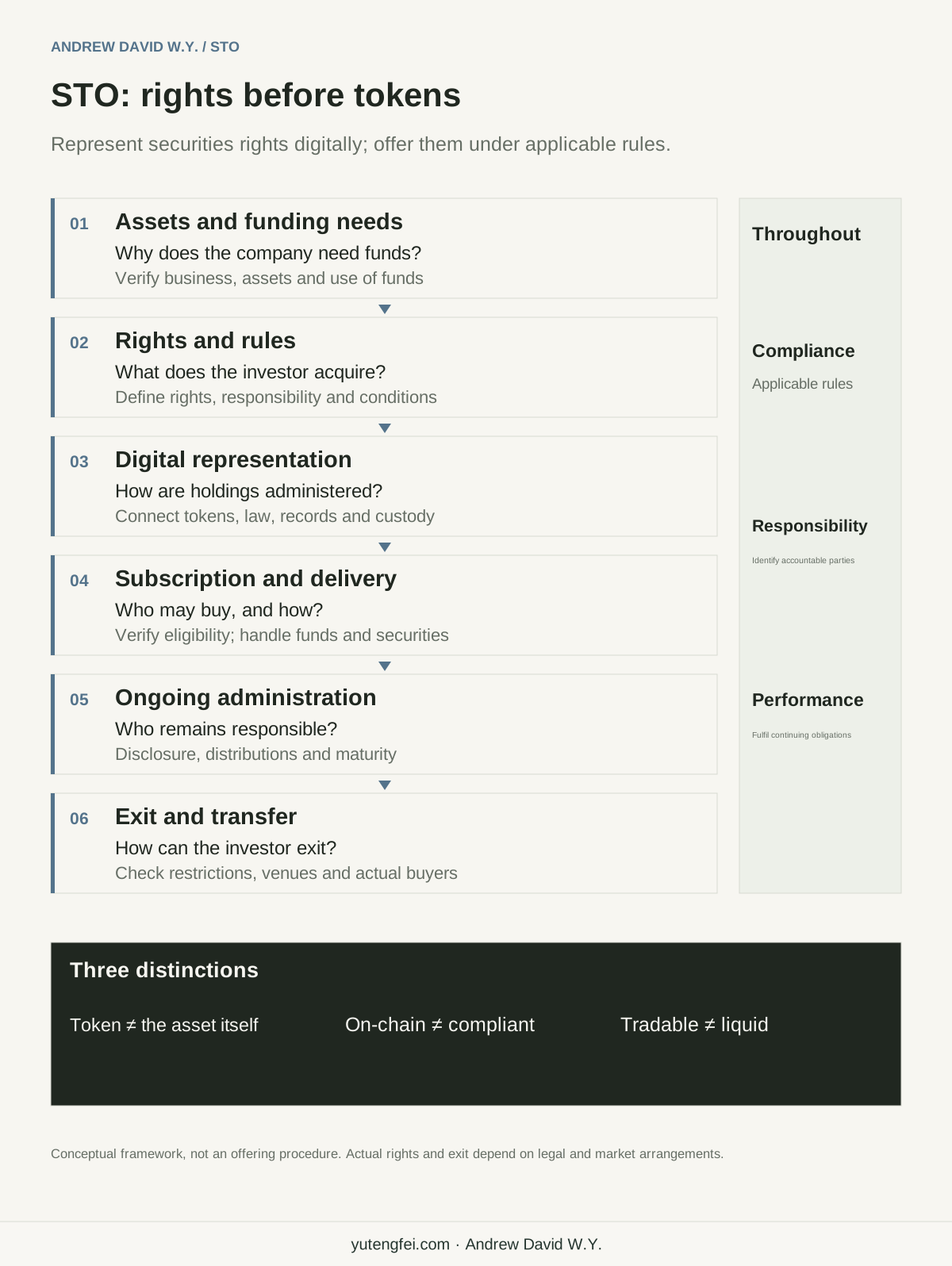
First, examine assets and funding needs. What does the company do, why does it need funds, and how does it generate revenue? A token cannot replace operating capability.
Second, define rights and rules. Is the instrument a share, bond or fund interest? Who may buy it? What must be disclosed? Which offering, transfer and investor-protection rules apply? Legal advisers and relevant professionals need to participate.
Third, implement digital representation. Connect the rights structure to tokens, registration, custody and technology. Uploading a contract is not enough to establish the rights.
Fourth, subscribe and deliver. Verify investor identity and eligibility, then handle funds, securities and registration records under the offering arrangements. The payment method depends on the actual structure; cryptocurrency is not mandatory.
Fifth, administer the instrument continuously. The company continues disclosures; relevant institutions manage dividends, interest, voting, redemption or maturity. Code can execute preset processes, but responsible parties must still perform real obligations.
Sixth, transfer or exit. Whether a security can be transferred, to whom, through which venue and after what lock-up period depends on rules and market conditions. Some instruments must be held to maturity; others may lack an active secondary market.
These six stages are a conceptual framework, not an identical procedure for every project.
4. How does STO relate to shares, ICOs and RWA?
| Term | What it mainly describes | Important distinction |
|---|---|---|
| Shares | Securities that generally carry shareholder rights | STO is not limited to shares |
| STO | An offering of security tokens | Having a token does not establish permission to issue or trade |
| ICO | Usually an initial coin or token offering | The name does not determine legal classification; some ICOs may involve securities |
| RWA | Commonly refers to real-world assets and their on-chain representation | Broader than securities; an RWA project need not involve a securities offering |
Traditional shares and equity security tokens may both involve shareholder rights, but registration, custody, transfer and enforcement arrangements may differ. Examine the rights structure before the product’s name.
5. Why use this approach?
My interest is whether more consistent digital records can connect funding, registration, settlement and ongoing administration more effectively.
For example, subscription conditions and transfer restrictions can be incorporated into systems; eligible transactions may be processed more automatically; institutions may have less duplicated reconciliation work. MAS highlights the efficiency potential of programmable transactions and asset servicing, while noting that liquidity, infrastructure, standards and settlement arrangements must support scaling together. MAS: pathways to scaling tokenization
Potential and realization are different.
A blockchain’s continuous operation does not mean that securities may trade around the clock. Cross-border technology does not permit sales to investors in every country. Divisible issuance units do not guarantee buyers.
Technology supplies tools. Law, institutions, business performance and markets determine their usefulness.
6. Four common misunderstandings
“Putting an asset on-chain makes it more valuable.” Value still depends on business performance, cash flow, the quality of rights and market judgment. A different recordkeeping method does not turn a poor asset into a good one.
“Physical backing means I cannot lose money.” Assets may be overpriced, indebted or difficult to realize. Companies and associated institutions may default.
“If I can buy it, I can sell it.” A trading interface does not guarantee buyers. Transfer restrictions, market depth and price affect exit.
“A smart contract solves everything.” Code cannot independently confirm the authenticity of real assets or replace courts, registrars, custodians or corporate performance. Systems can also have vulnerabilities and operational risks.
7. Six questions to ask before considering an STO
- What rights do I acquire, and which legal documents support them?
- Who issues the security, and who handles registration, custody and performance?
- Am I eligible, and which rules govern this offering?
- Can the underlying assets, use of funds and valuation basis be verified?
- Where do returns come from, and how much could I lose in the worst case?
- How can I exit, to whom can I transfer, and who handles disputes?
If these questions cannot be answered clearly, an attractive token name is not enough for an informed judgment.
8. My view: credible rights before useful tokens
For me, STO merits study because it may connect securities rights, corporate funding and digital infrastructure more effectively.
The sequence matters. Examine business and assets first, then rights, responsibility and rules, and finally whether technology improves offering, administration and transfer.
Tokens can carry capital relationships digitally. Trustworthy capital relationships still require real business activity, clear rights and continuing performance.
This article explains concepts; it is not a product recommendation or investment solicitation. Jurisdictions and product structures differ. A specific offering requires professional assessment under the rules applicable at the time.
Sources checked: 3 October 2026. The diagram is the author’s conceptual framework.