Jeju Blockchain Island: Turning a Vision into Practical Work
A practical look at Jeju Blockchain Island through technology, business coordination, and project incubation: starting with specific services, defining responsibilities, and testing value through small pilots.
Jeju is discussing plans to become a blockchain hub city. The operating proposal publicly reported on October 22 is still a draft. Arrangements for a special zone need further work, along with discussions with the central government. For those following this direction, this is a good time to study the questions thoroughly and set out the conditions for cooperation, so that later testing has a clear basis. The report at the time.
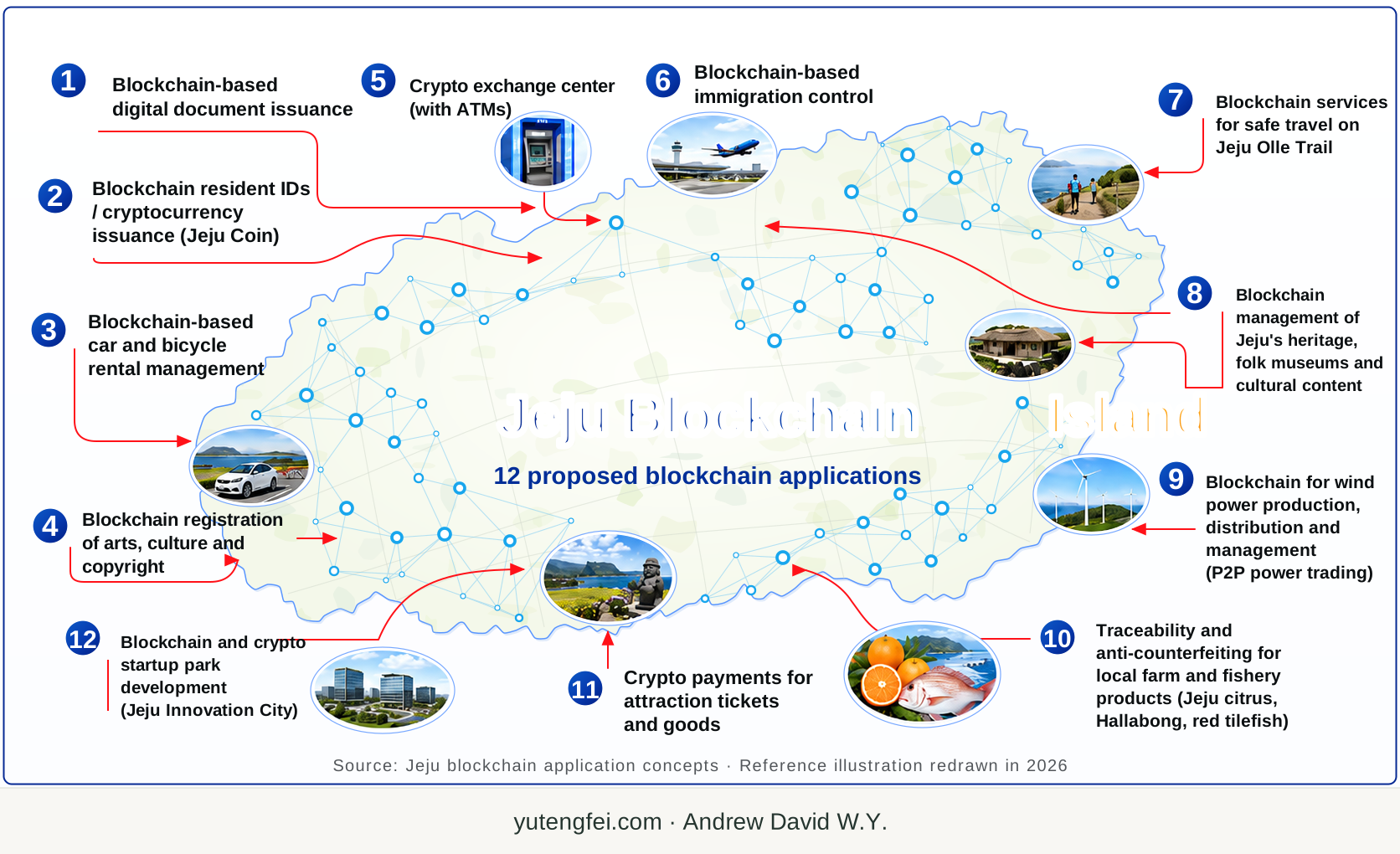
I approach this first through the practical work of technology, business coordination, and project incubation. A plan needs to explain who a service is for, what problem it solves, who bears the costs, and who is responsible for day-to-day operations. Clarifying these relationships gives the technical proposal something concrete to build on.
Jeju's tourism, hotel, and convention services offer specific settings for this thinking. From booking and travel to accommodation and shopping, visitors deal with several service providers. How information is checked, how entitlements are confirmed, and how different businesses coordinate are all worth examining separately. The more specific the setting, the easier it is to judge which step blockchain might actually improve.
I would start with a setting of manageable scale, such as a ticketing service or a record of customer entitlements at a single business. First, establish who enters the information, who checks it, what visitors and businesses each need to see, and how refunds and disputes are handled. Map the existing process before deciding whether several parties need to maintain and verify shared records.
Technology choices also need to justify their costs. We need to account for any extra steps users must take, the additional maintenance work for businesses, and whether there is a fallback process when the system fails. If we simply move the old procedures into a new system without improving the service experience, participants will have little reason to keep cooperating over time.
For each candidate scenario, I would first draw up two tables. One would record the business process, current problems, data sources, and acceptance criteria. The other would identify the participants, responsibilities, contributions, benefit-sharing arrangements, and ways to resolve problems. Technical teams, businesses, and operations staff could then discuss the same clearly defined task, while identifying which conditions are already in place and which still need work.
Evaluating a pilot should be as straightforward as possible. How long does verification take? Is reconciliation easier? Can exceptions be dealt with promptly? Do businesses and visitors want to keep using the service? These can all serve as indicators. First collect a set of comparable records, then decide whether to expand. The scale should follow the results of testing.
Proposals involving identity information, payments and settlement, or token mechanisms also need to be checked against the applicable rules and required authorizations, item by item. While the special-zone proposal remains under discussion, specific services should be designed within what is actually permitted. A plan can leave room to explore, while implementation needs to make clear who has authority, who is responsible, and how information will be used.
The same applies to project incubation. The value of a service platform ultimately depends on whether it helps teams find real needs, connect with business resources, clarify working relationships, and keep resolving the practical problems of implementation. Someone needs to take responsibility for this work, and the records need to be clear enough for others to take over and review.
For Jeju Blockchain Island, I would first focus on these basics: choose one scenario carefully, define the responsibilities, and complete a test with measurable results. A vision can bring people together. Trust in the cooperation that follows has to be built through one concrete task after another.